Stairlift Removal and Disposal: Options and Considerations
By Housey · Last reviewed 18th of May 2026
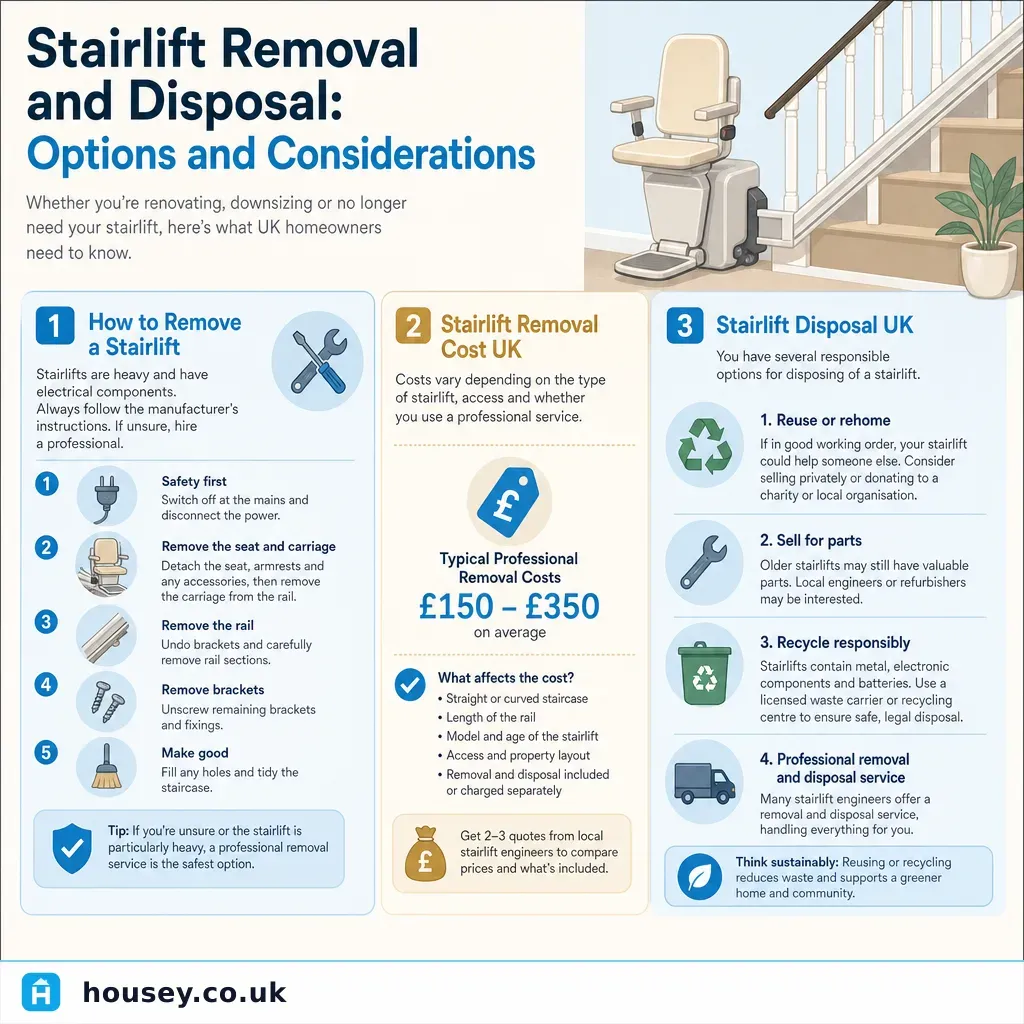
Stairlift Removal and Disposal: Options and Considerations
Stairlifts are often installed under a Disabled Facilities Grant (DFG) or through a community care equipment assessment, and the question of what to do when one is no longer needed — following a change in mobility, a house move, or a bereavement — is one many households face. Removal is usually straightforward from an engineering standpoint, but the options for the unit itself, from manufacturer collection to charity donation to WEEE recycling, vary considerably in cost, effort, and environmental outcome.
Key points
- A stairlift rail is typically bolted to the stair treads (not the wall) using four to eight bolts, meaning removal usually leaves only small bolt holes requiring filling — the staircase itself is rarely significantly altered.
- Most stairlift manufacturers and authorised dealers offer a collection service; straight-stair units under ten years old are often collected free of charge if suitable for refurbishment and resale.
- WEEE (Waste Electrical and Electronic Equipment) Regulations 2013 apply to stairlifts — they cannot be placed in general household waste and must go to an authorised WEEE recycler or a household waste recycling centre that accepts electricals.
- Curved-stair stairlifts have bespoke, site-specific rails and are very rarely suitable for resale — expect a disposal fee rather than a free collection for these units.
- If the unit was funded by a Disabled Facilities Grant, your local authority may have conditions on disposal — always check before arranging independent removal or sale.
Your removal and disposal options
The right option depends on the unit's age, condition, and rail type (straight vs curved), as well as your timeline and budget.
Option 1: Manufacturer or dealer collection
Most major stairlift brands — including Acorn, Stannah, Brooks, and Handicare — have national dealer networks and will often collect straight-stair models at low or no cost if the unit is within a usable age range (typically under ten years). Curved-stair units have bespoke rails and are almost always site-specific; dealers will rarely collect for resale, so expect a collection or disposal fee.
Option 2: Charity donation
Organisations including the British Red Cross Equipment Loan Service, local disability charities, and some NHS community equipment stores accept working stairlifts in good condition. Contact organisations in advance to confirm they are accepting donations and to clarify any condition requirements before arranging transport.
Option 3: Private sale
Working straight-stair units can achieve £200–£800 on platforms such as eBay or Facebook Marketplace, depending on age and condition. Indicative prices, last reviewed 2026-05-18; verify current market values independently. Straight-stair models from major manufacturers attract the most interest; curved-stair units are very difficult to sell privately due to their site-specific rail geometry.
Option 4: Independent removal and WEEE recycling
A local handyperson or small contractor can remove the unit and transport it to a licensed WEEE recycling point. Most local authority household waste recycling centres (HWRCs) accept stairlifts as WEEE — check your council's accepted materials list before transporting, as not all sites accommodate large items at all times.
Option 5: DFG return pathway
If the stairlift was originally provided through a Disabled Facilities Grant via your local authority, there may be conditions attached to its disposal, particularly if the grant was awarded within the previous five to ten years. Check with your local authority's housing or adaptations team before arranging independent removal or private sale.
Comparison of removal and disposal routes
Route | Best for | Typical cost to homeowner | Unit reused? |
|---|---|---|---|
Manufacturer or dealer collection | Straight-rail unit under 10 years, good condition | Free–£150 | Yes (refurbished for resale) |
Charity donation | Working unit, straight or curved | Free or modest transport cost | Yes |
Private sale | Working straight-rail unit | Listing fees only | Yes |
Independent contractor and WEEE recycling | Any unit; non-working; urgent timeline | £100–£300 | Possibly (parts only) |
Local authority DFG return | DFG-funded unit within grant conditions | Usually free | Varies |
Indicative UK costs, last reviewed 2026-05-18.
What to check before removal
Homeowner checklist:
What to ask before instructing a removal service
- Is removal and disposal included in a single price, or are they quoted separately?
- What experience does the operative have with stairlift removal, and will they work safely on stairs?
- Will the rail bolts be extracted and the holes filled as part of the service, or is making good charged separately?
- How will the unit be disposed of — WEEE-compliant recycling, refurbishment, or resale?
- If the unit is in good condition, can the contractor facilitate donation rather than disposal?
- Is VAT included in the removal charge?
When to get professional help
Stairlift removal is generally low risk and does not require a specialist engineer for a standard domestic unit. Seek qualified help when:
- The stairlift is connected to a dedicated electrical circuit rather than a standard socket — any modification to circuits should be carried out by a competent electrician registered under a Part P self-certification scheme such as NICEIC, NAPIT, or Elecsa.
- The staircase is in a listed building and you are concerned that bolt holes in original treads may require listed building consent before works proceed.
- The unit is a heavy-duty or commercial-grade lift that requires specialist handling equipment for safe extraction.
How Housey can help
If the stairlift removal is part of a wider home adaptation or clearance project — removing other accessibility equipment, reconfiguring a hallway, or preparing a property for sale or let — demolition contractors on Housey can advise on coordinating strip-out works and responsible disposal across multiple items.
Frequently asked questions
Can I remove a stairlift myself?
Removal of a standard domestic stairlift is within the capability of a competent DIYer with basic tools. The rail is bolted to stair treads and the unit connects to a standard power socket. If you are unsure about the electrical arrangement, or if the unit is unusually heavy, a qualified removal service is typically safer and not significantly more expensive.
What happens to stairlifts when they are removed?
Straight-stair units in good condition are frequently refurbished and resold — there is a well-established secondary market in the UK. Bespoke curved-rail units are harder to reuse because of their site-specific geometry. Units that cannot be refurbished should go to a WEEE-compliant recycler and must not be placed in general household waste.
Does a stairlift add or reduce the value of a house?
This depends on the buyer. For buyers who need mobility aids, a working stairlift is a practical benefit. For the general market, it may be perceived as requiring removal. Estate agents generally advise removing stairlifts before marketing a property broadly, as the visual impression of the staircase matters to most buyers.
How long does stairlift removal take?
A standard straight-stair unit typically takes one to two hours to remove, including making good the bolt holes in the stair treads. Curved-stair units with bespoke rail geometry are more complex and may take three to four hours depending on rail length, the number of bends, and site access conditions.
Sources and further reading
- Disabled Facilities Grant — GOV.UK
- Waste electrical and electronic equipment (WEEE) — GOV.UK
- Equipment loan service — British Red Cross
- Community equipment services — NHS
Useful next reads
 Improvement & Build
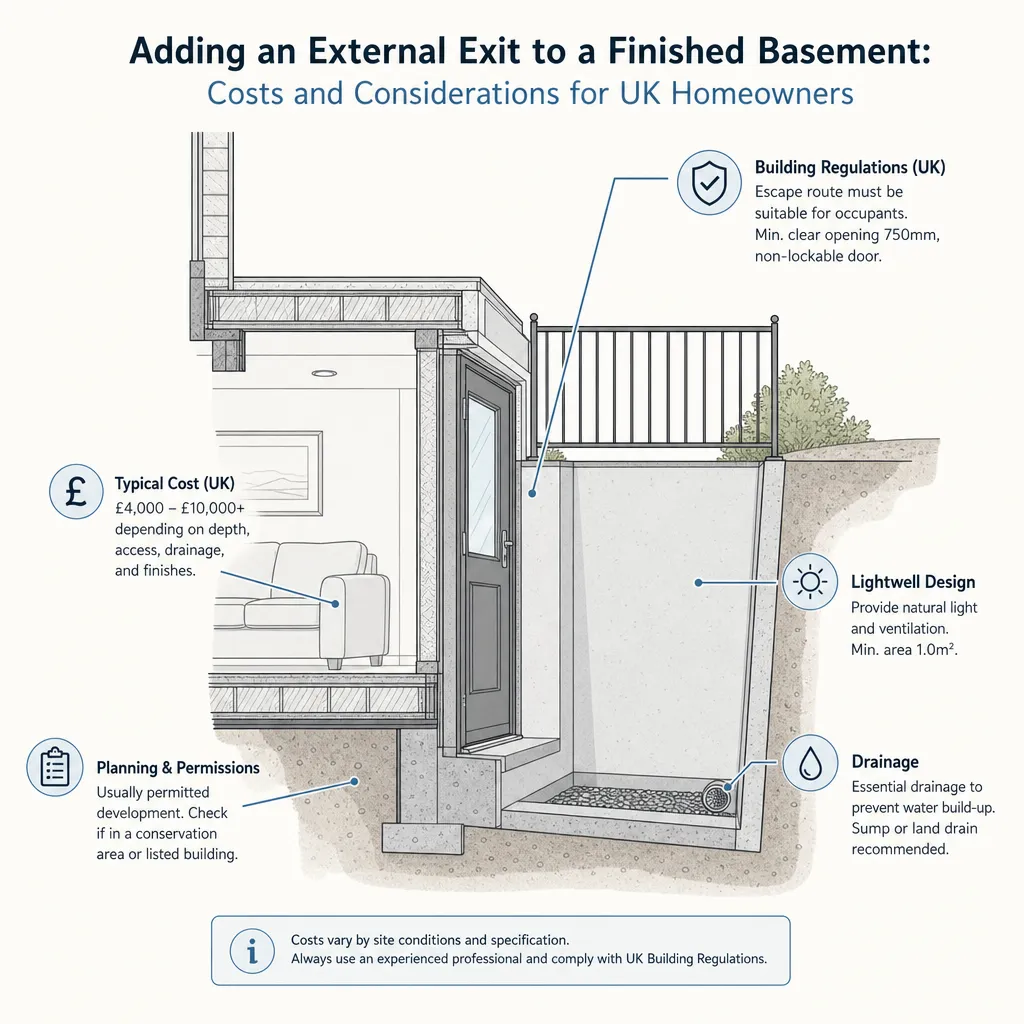
Adding an External Exit to a Finished Basement: Costs and Considerations
Adding an external exit to a finished UK basement always requires building regulations approval and a structural engineer's assessment before any wall is cut.
 Improvement & Build
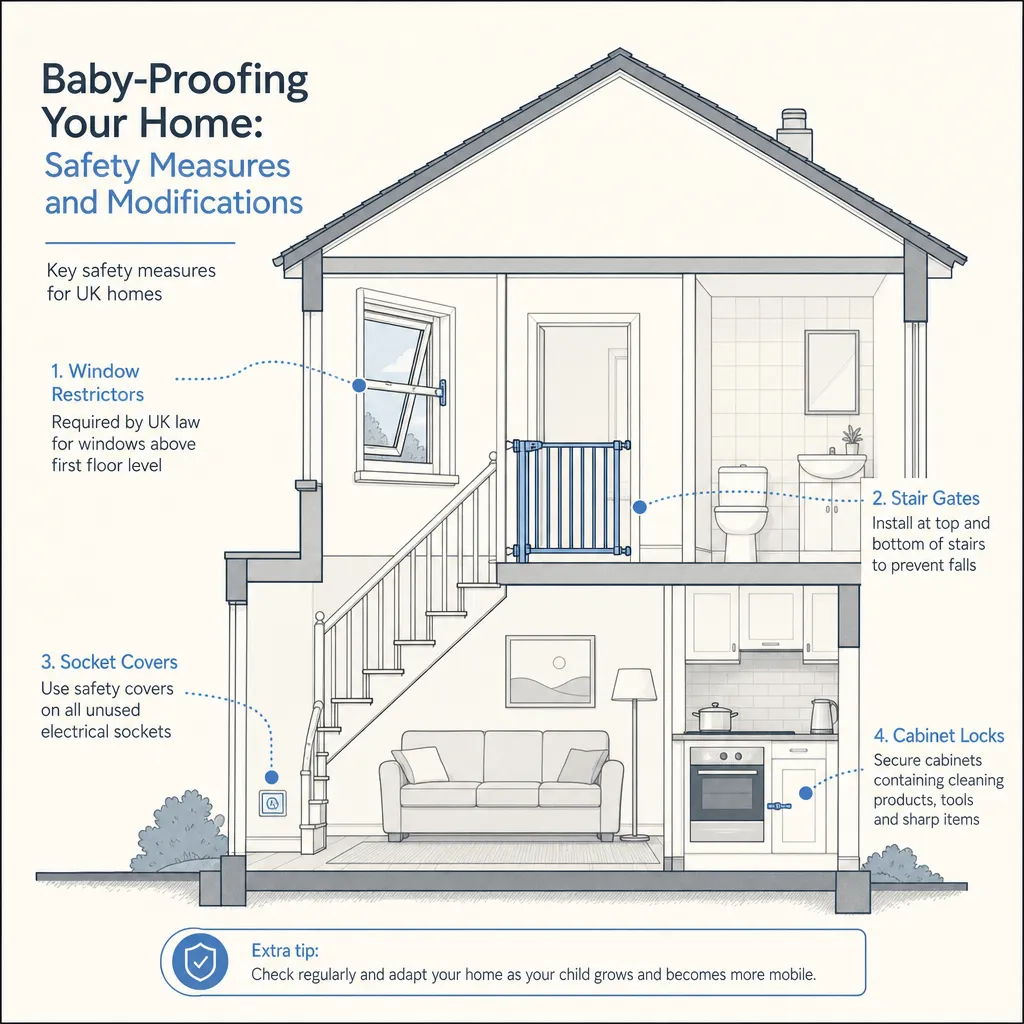
Baby-Proofing Your Home: Safety Measures and Modifications
Baby-proofing a UK home typically involves fitting stair gates conforming to BS EN 1930, window restrictors on upper floors, shuttered socket covers, cupboard locks, and securing heavy furniture to walls.
 Improvement & Build
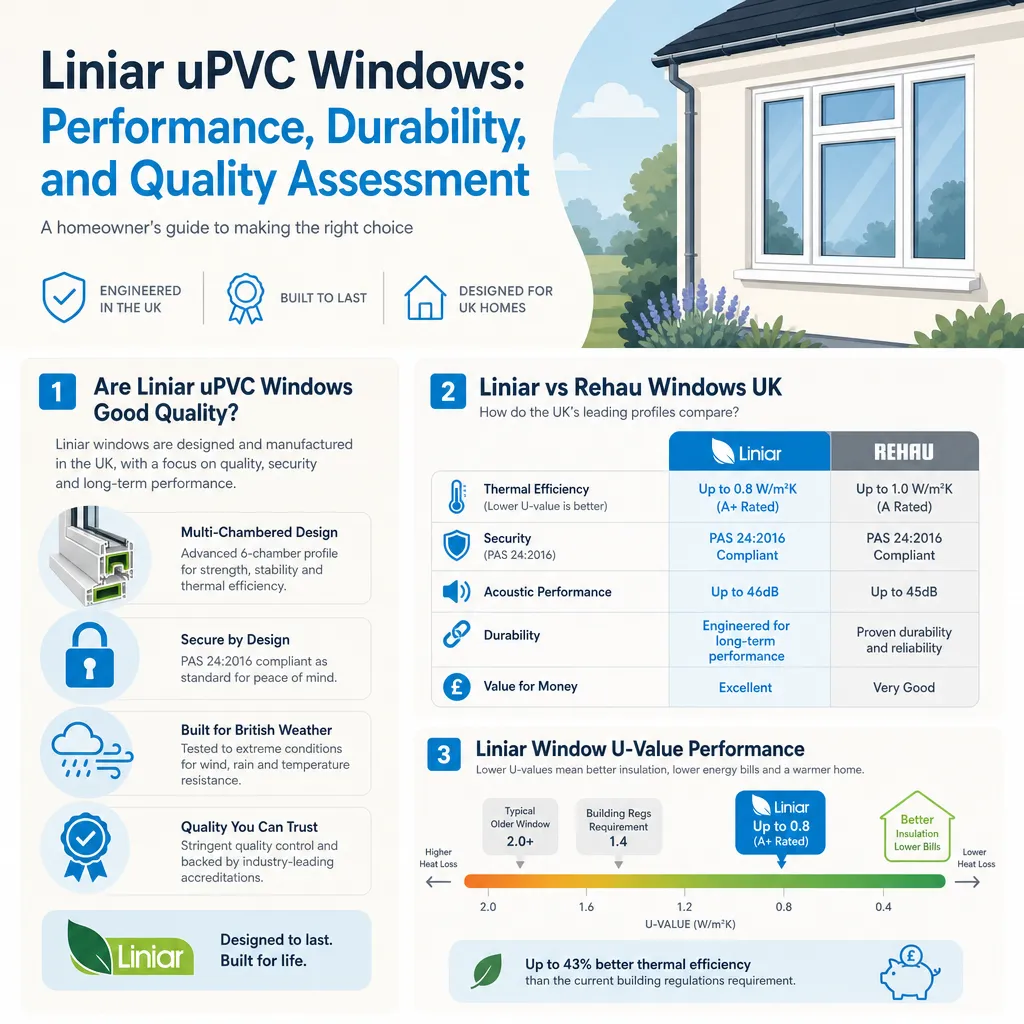
Liniar uPVC Windows: Performance, Durability, and Quality Assessment
Liniar uPVC window profiles are manufactured in the UK using multi-chambered, foamed frames.
 Improvement & Build
Garden Tap Installation with Hot and Cold Water: Plumbing Options
Adding a cold garden tap is a common DIY project, but routing hot water outdoors requires a plumber to connect to your domestic hot water system and comply with the Water Supply (Water Fittings) Regulations 1999.
 Improvement & Build
Sealing and Maintaining Historic Leaded Glass Windows: Preservation and Performance
Leaded glass windows are maintained using traditional linseed oil cement — not silicone or modern sealants, which prevent natural movement in the lead came.