Stamped Concrete Driveway Installation: Cost and Design Options
By Housey · Last reviewed 31st of May 2026
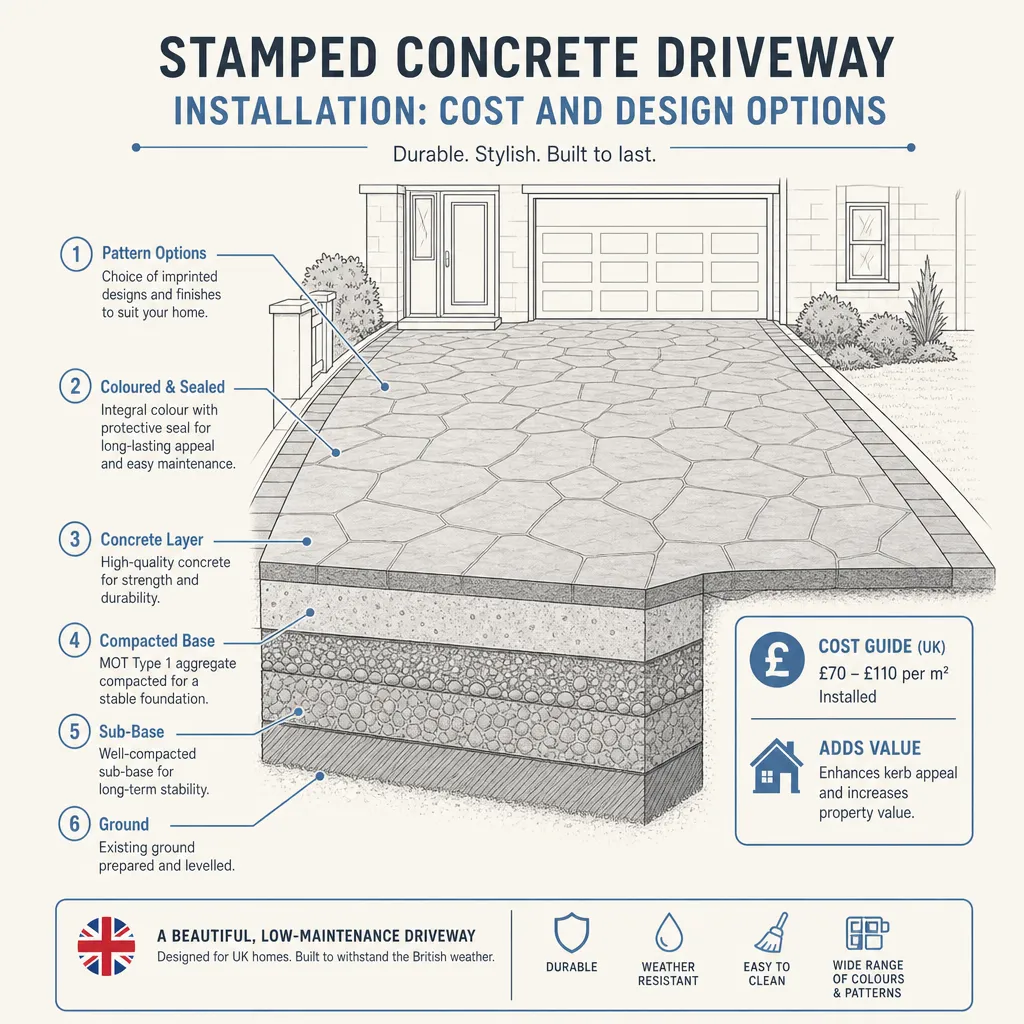
Stamped Concrete Driveway Installation: Cost and Design Options
Pattern imprinted concrete — the UK trade name for the product often advertised online as "stamped concrete" — has grown steadily in popularity as a residential driveway surface. It combines the structural durability of concrete with a decorative finish that can closely resemble natural stone, brick, or slate at a lower cost per square metre than individual natural materials. The decision to install one typically arises when an existing crumbling tarmac or concrete surface needs replacement, during a house extension project, or when homeowners want to improve kerb appeal before a sale. Getting the sub-base specification and drainage right from the outset determines whether the surface lasts 25 years or develops problems within five.
Key points
- Pattern imprinted concrete (PIC) is the correct UK trade term; "stamped concrete" is the American-derived marketing name for the same product.
- Installing an impermeable surface on a front garden greater than 5 m² in England requires planning permission unless surface water run-off is managed by draining to a permeable area such as a lawn, border, or soakaway — under the Town and Country Planning (General Permitted Development) (England) Order 2015.
- A properly laid domestic driveway requires a minimum 100–150 mm compacted sub-base (Type 1 crushed aggregate) and a concrete slab of at least 100 mm depth for vehicular use.
- Resealing every 3–5 years is the principal maintenance requirement, protecting colour vibrancy, surface integrity, and slip resistance against UK freeze-thaw cycles.
- Most driveway failures — cracking, surface delamination, colour loss — trace back to an inadequate sub-base, insufficient concrete depth, or absent sealing; not to the product itself when correctly specified.
What is pattern imprinted concrete and how is it installed?
Pattern imprinted concrete is poured as a standard concrete slab, then coloured using a dry-shake hardener broadcast across the fresh surface, textured with polyurethane or aluminium stamps pressed into the partially cured concrete, and finally sealed with a penetrating or surface-applied sealant. A release agent applied before stamping prevents the stamps sticking and creates a second colour tone that enhances the impression of individual stones or bricks.
The installation stages for a residential driveway are:
- Excavation: existing surface and subsoil removed to 250–350 mm depth.
- Sub-base: 100–150 mm of Type 1 crushed aggregate compacted in layers.
- Edge restraints: concrete kerbing or haunching laid to define the driveway boundary and contain the slab.
- Concrete pour: C30 or C35 concrete at 100 mm depth minimum for domestic vehicular use; reinforcement mesh used for larger or heavier-load areas; expansion joints incorporated at regular intervals.
- Colour and texture application: dry-shake hardener and release agent applied; stamps pressed in while concrete is partially cured.
- Curing and sealing: surface allowed to cure — typically 24–48 hours before light foot traffic, 7 days before vehicle use — then sealed.
The quality of sub-base compaction and concrete depth matters far more to long-term performance than the pattern or colour chosen.
How much does a pattern imprinted concrete driveway cost in the UK?
Indicative UK costs, last reviewed 2026-05-31. Quotes vary by region, site access, groundworks required, and contractor.
Item | Indicative cost range |
|---|---|
Pattern imprinted concrete — supply and lay | £75–£120 per m² |
Example: 40 m² driveway (supply and lay only) | £3,000–£4,800 |
Removal of existing tarmac or concrete | £15–£30 per m² |
Additional sub-base for poor ground conditions | £10–£20 per m² extra |
Channel or linear drain installation | £150–£400 per linear metre |
Resealing (every 3–5 years) | £400–£800 for a 40 m² driveway |
Costs tend toward the higher end where access is restricted, multiple colours or intricate border designs are specified, the site slopes, or where tree roots require additional excavation.
Comparing driveway surface options
Surface | Installed cost (approx.) | Lifespan | Maintenance | Front garden planning in England | Best for |
|---|---|---|---|---|---|
Imprinted concrete | £75–£120/m² | 20–30 years | Reseal every 3–5 years | Usually required (impermeable) | Decorative finish, wide pattern range |
Block paving | £60–£120/m² | 20–30 years | Re-sanding, weed control | Usually required (impermeable) | Traditional look, individual block repair |
Resin bound | £60–£100/m² | 10–25 years | Low — sweep and occasional wash | Not required (permeable) | Contemporary look, no planning issues |
Tarmac (macadam) | £30–£60/m² | 15–25 years | Occasional patching | Usually required (impermeable) | Budget, functional, fast to install |
Gravel | £10–£30/m² | Variable | Raking and regular topping up | Not required (permeable) | Low cost, self-draining |
Indicative UK costs, last reviewed 2026-05-31.
Planning permission: what you need to know
Under the Town and Country Planning (General Permitted Development) (England) Order 2015, paving a front garden — the area between the dwelling and the highway boundary — with an impermeable material requires planning permission if the paved area exceeds 5 m², unless surface water run-off is directed to a permeable area such as a lawn, border, or soakaway.
Pattern imprinted concrete is impermeable. A standard household front driveway almost always exceeds 5 m², so planning permission will usually be required. A householder planning application in England costs £258 (as of 2026 — confirm current fees at GOV.UK before applying).
Permeable alternatives — resin bound aggregate, permeable block paving, and gravel — do not require planning permission under these rules, which is one reason they are increasingly popular for front driveways.
Rules differ in Wales, Scotland, and Northern Ireland. Properties in conservation areas may face additional restrictions. Always check with your local planning authority before starting work.
Decision guide: which driveway surface is right for you?
- Choose imprinted concrete if you want a decorative surface with a wide choice of patterns and colours, are prepared to manage the planning permission process, and want minimal day-to-day upkeep between scheduled resealing intervals.
- Choose resin bound if avoiding planning permission is a priority, or if you prefer a smooth, contemporary finish that naturally manages surface water.
- Choose block paving if you want a traditional or period appearance, value the ability to lift and relay individual blocks for future utility access, or want a product with wide local contractor availability.
- Choose tarmac if budget is the primary driver and decorative finish is secondary.
- Consult your local planning authority if your property is in a conservation area, is subject to an Article 4 Direction, or if a planning condition attached to a housing development restricts driveway materials.
What to ask before accepting a quote
Before committing to a contractor, obtain at least two written quotes and ask each one:
- What sub-base depth and concrete thickness will you lay, and will you put this in writing as part of the contract?
- What concrete strength class (mix) will be used — C30 or C35 minimum for vehicular driveways?
- What pattern, colour, and edging options are included in this price?
- Does the price include removal and disposal of the existing surface?
- Does the quote include a channel or linear drain, and where will surface water be directed?
- What sealer product will be applied, and is the initial application included?
- How long before vehicles can use the surface after completion?
- What is your process if cracking or surface delamination occurs within the first two years?
- Is the price inclusive of VAT at 20%?
- Are you a member of any trade association, and can you provide references or photographs of completed driveways in the local area?
Worked example: replacing a cracked tarmac driveway in Nottingham
A homeowner in Nottingham replaces a deteriorating tarmac driveway (48 m²) with pattern imprinted concrete in an ashlar slate pattern. The existing tarmac sits on an inadequate 75 mm sub-base that cannot support the new slab.
Item | Calculation | Cost (ex-VAT) |
|---|---|---|
Tarmac removal and disposal | 48 m² × £20 | £960 |
Sub-base upgrade to 150 mm | 48 m² × £15 | £720 |
Imprinted concrete supply and lay | 48 m² × £90 | £4,320 |
Channel drain at pavement edge (4 m) | 4 m × £200 | £800 |
Contractor subtotal |
| £6,800 |
VAT at 20% |
| £1,360 |
Planning application fee (no VAT) |
| £258 |
Estimated total |
| ~£8,418 |
Costs are illustrative, based on indicative UK figures last reviewed 2026-05-31. Actual quotes will vary. Always obtain written specifications.
The homeowner applies for householder planning permission via the Planning Portal before work begins, and confirms in the application that surface water will be directed to a rear soakaway to satisfy run-off management requirements.
When to get professional help
Driveway installation involves heavy plant, drainage connections, and potential planning compliance obligations. Seek professional input if:
- You are unsure whether your sub-soil conditions — clay, made ground, or high water table — are suitable for a standard sub-base and slab specification.
- The driveway is on a significant slope and you are unsure how to manage surface water without it reaching the highway.
- Your property is in a conservation area or subject to planning conditions, and you are uncertain what materials are permissible.
- A contractor's quote does not specify sub-base depth, concrete thickness, or sealer product in writing — treat this as a red flag.
How Housey can help
Housey connects homeowners with vetted local driveway installers who can provide written specifications, explain planning requirements, and supply detailed comparable quotes. Always ask for the sub-base specification and sealer product in writing before accepting any quote.
Frequently asked questions
Do I need planning permission for an imprinted concrete driveway in England?
Usually yes, if the driveway is at the front of your property, exceeds 5 m² in area, and the surface is impermeable without managed run-off directed to a lawn, border, or soakaway. A householder planning application costs £258 in England as of 2026 — check current fees at GOV.UK. Rules differ in Wales, Scotland, and Northern Ireland.
How long does an imprinted concrete driveway last?
A correctly installed imprinted concrete driveway on an adequate sub-base typically lasts 20–30 years. The surface coating fades and the sealant degrades over time. Resealing every three to five years is the principal maintenance requirement and significantly extends both the appearance and the structural integrity of the surface.
Can imprinted concrete crack?
Yes — like all concrete it can crack, particularly where the sub-base is inadequate, the slab is too thin for the traffic loads, or expansion joints are omitted. A reputable contractor will specify slab design in writing and incorporate thermal movement joints at appropriate intervals. Always ask for the sub-base depth and concrete thickness in any written quote.
What patterns and colours are available for UK imprinted concrete driveways?
UK contractors typically offer patterns including cobblestone, ashlar slate, herringbone brick, fan cobble, and random flagstone in a wide range of colours. Two-tone finishes using a base colour and release agent are standard. Ask to view completed local examples before finalising your choice, as photographs can differ from results in natural light.
How soon can I drive on a new imprinted concrete driveway?
Most contractors advise waiting at least seven days before driving on a newly completed imprinted concrete surface, and up to 28 days for full curing. Your contractor should confirm the cure period in writing and provide guidance on initial care, including timing for the first reseal.
Sources and further reading
- Paving your front garden — planning permission rules for front driveways in England, GOV.UK
- Apply for planning permission — householder application process and current fees, GOV.UK
- Planning Portal — England and Wales planning guidance including conservation areas
- Concrete for housing — technical guidance on concrete specification for residential applications, The Concrete Centre
Useful next reads
 Improvement & Build
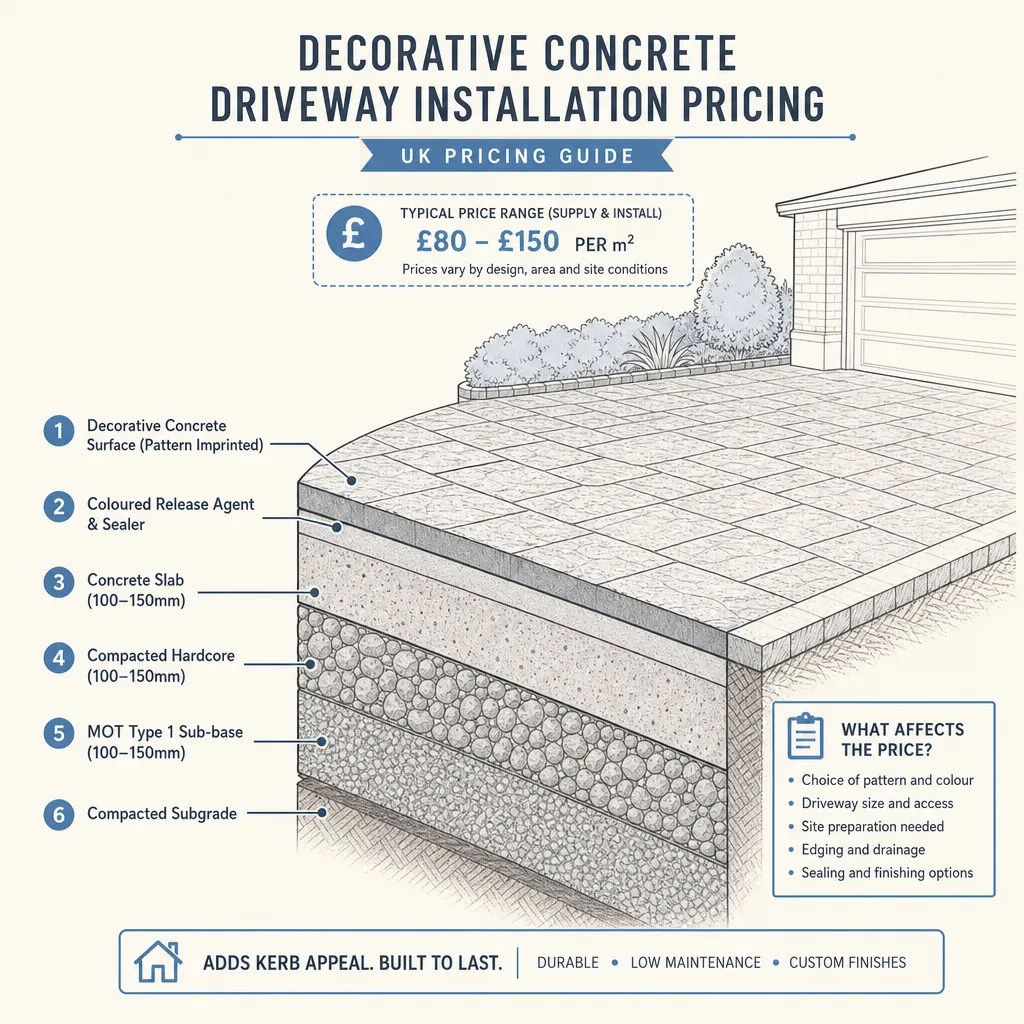
Decorative Concrete Driveway Installation Pricing
Pattern-imprinted concrete (PIC) is the most popular decorative driveway surface in the UK, offering cobble, slate, and tile effects at lower cost than natural stone.
 Improvement & Build
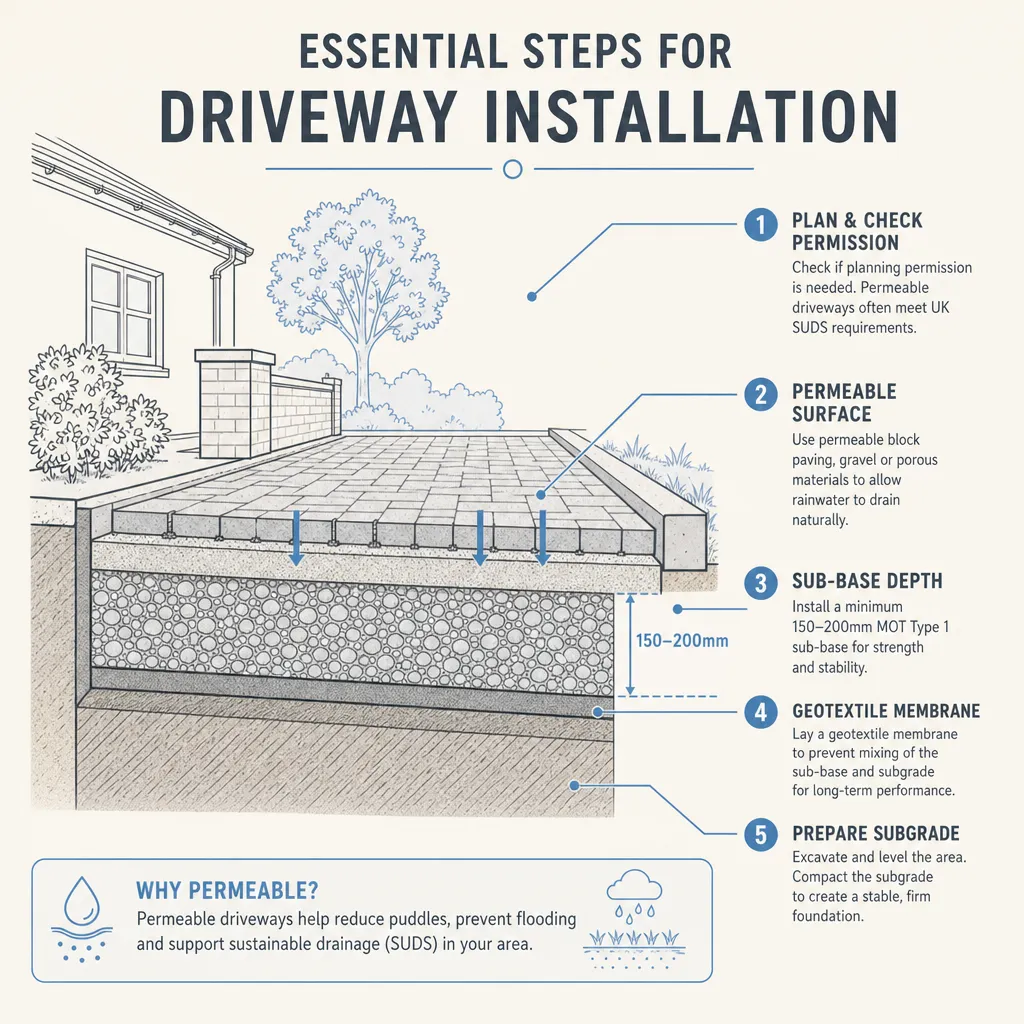
Essential Steps for Driveway Installation
Installing a driveway in England requires planning permission only when using an impermeable surface (standard tarmac, concrete, or block paving) on a front garden area over 5 m².
 Improvement & Build
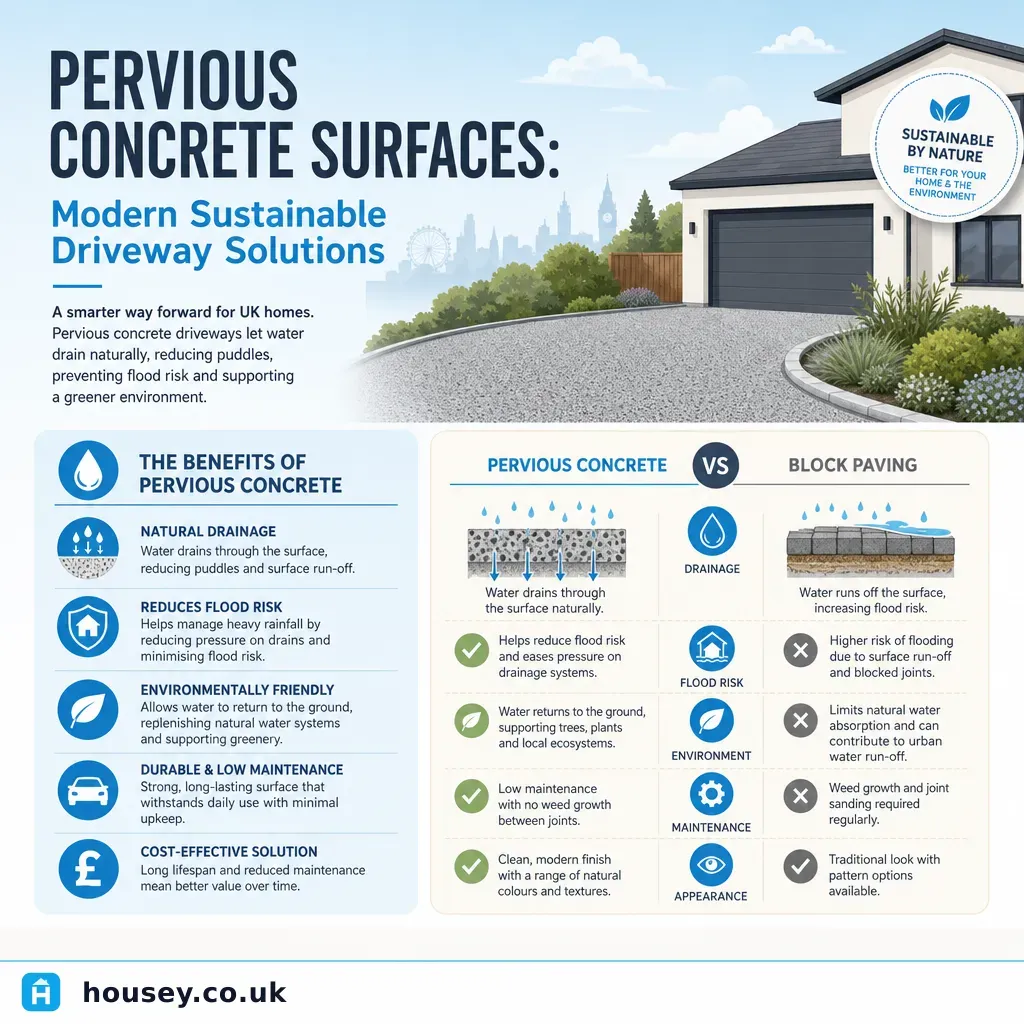
Pervious Concrete Surfaces: Modern Sustainable Driveway Solutions
Pervious concrete (also called porous or no-fines concrete) is a specialist concrete mix with large voids that allow rainwater to pass through the surface and into the sub-base below.
 Improvement & Build
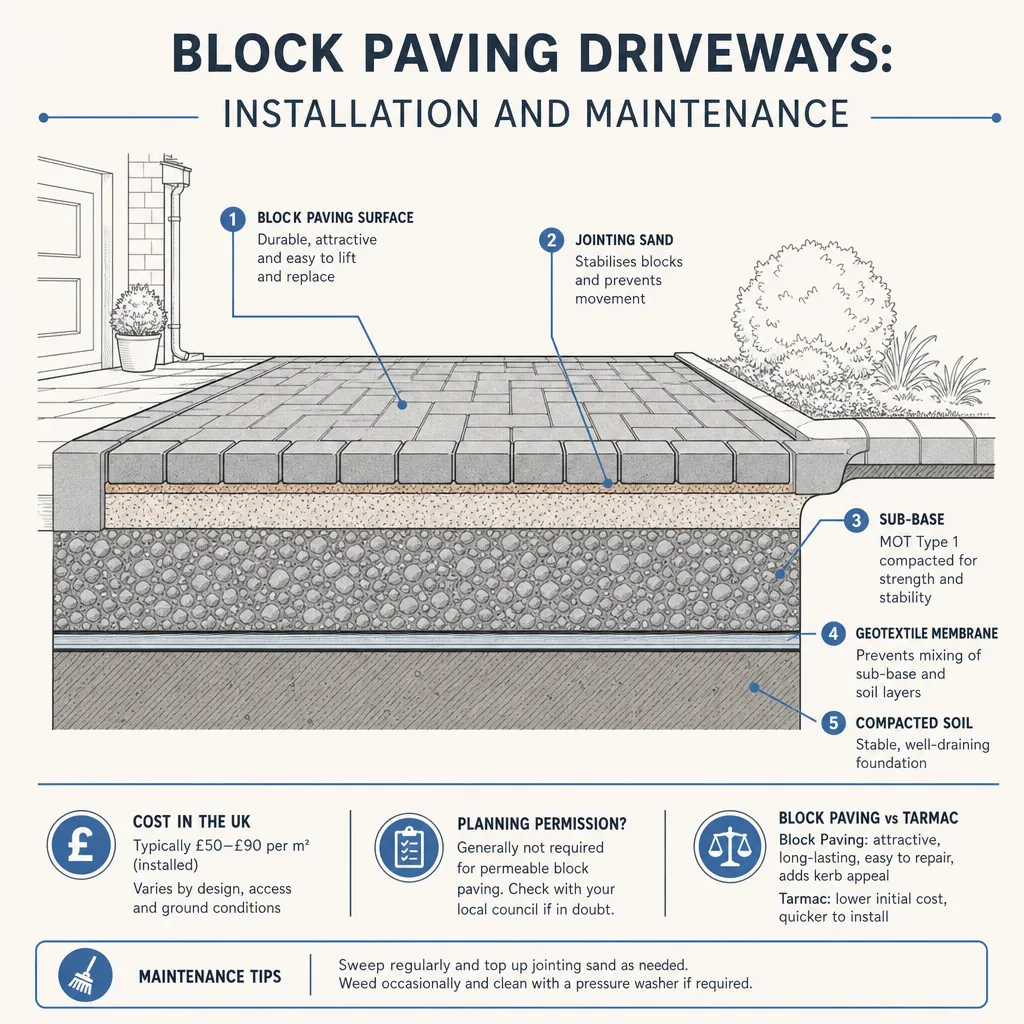
Block Paving Driveways: Installation and Maintenance
Block paving driveways typically cost £50–£120 per m² installed and last 20–30 years with good maintenance.
 Improvement & Build
Spring Garden Transformations: Design Ideas to Enhance Your UK Property
Spring is the best time to transform a UK garden, with mild temperatures and longer days ideal for planting and landscaping.