Standby Power Systems for Homes: Generator Options
By Housey · Last reviewed 9th of May 2026
Standby Power Systems for Homes: Generator Options
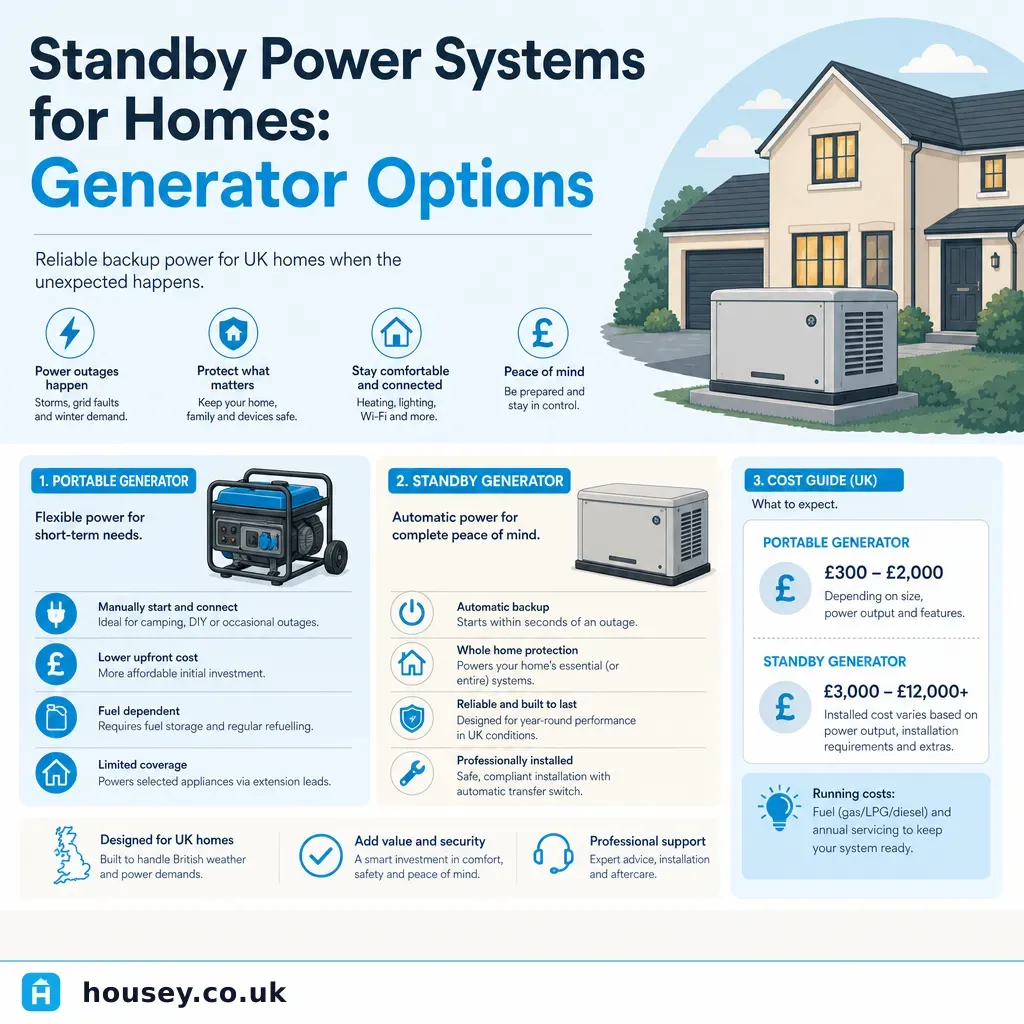
Power cuts are relatively rare across most of the UK, but when they occur — particularly during winter storms or in rural areas served by overhead lines — the disruption can affect heating, refrigeration, medical equipment, home offices, and security systems. Understanding your backup power options before an outage, rather than during one, lets you choose and install the right system methodically rather than in a panic.
Key points
- The UK experiences around 47 minutes of average customer interruption per year (Energy Networks Association), though rural properties on overhead networks can face far longer individual outages.
- Standby generators connected to household wiring via a transfer switch must comply with Building Regulations; if gas-fuelled, installation is a legal requirement for a Gas Safe registered engineer under the Gas Safety (Installation and Use) Regulations 1998.
- Portable generators must never be run indoors or in enclosed spaces — carbon monoxide (CO) poisoning is the primary cause of generator-related fatalities in the UK (HSE).
- Battery energy storage systems (BESS) above 3 kWh may require notification to your local distribution network operator (DNO) under Engineering Recommendation G98/G99.
- MCS-certified installers must be used for battery storage systems where the installation is to be eligible for the Smart Export Guarantee (SEG) or related incentives.
Types of standby power system
The main options for UK homes fall into four broad categories. Each has different fuel requirements, runtime, installation complexity, and cost profile.
System type | Fuel | Typical runtime | Automatic switchover | Approx. cost | Best for |
|---|---|---|---|---|---|
Portable petrol/diesel generator | Petrol or diesel | Hours (tank-dependent) | No — manual | £500–£2,500 (unit only) | Occasional outages, rural properties, temporary use |
Standby generator (gas/LPG) | Mains gas or LPG | Days (continuous supply) | Yes (with ATS) | £3,000–£10,000+ installed | Frequent outages, whole-house protection, off-grid |
Battery energy storage system (BESS) | Charged from grid or solar | 1–12+ hours (capacity-dependent) | Yes (with hybrid inverter) | £4,000–£15,000+ installed | Solar-paired homes, short outages, noise-sensitive locations |
Uninterruptible power supply (UPS) | Pre-charged battery | Minutes to a few hours | Yes (instant) | £200–£2,000 | Single appliances, computers, medical devices |
Indicative UK costs, last reviewed 2026-05-09. Costs vary significantly by system capacity, property type, and installer. Always obtain multiple quotes.
Which option suits your home?
Use the decision tree below to narrow down your choice before consulting an installer.
- Choose a portable generator if outages are rare (fewer than once a year), you only need to run essential appliances, you have secure outdoor storage, and you are comfortable with manual start-up.
- Choose a standby gas or LPG generator if outages are more frequent or prolonged (rural properties, overhead-line networks), you want automatic switchover, you have a mains gas supply or space for an LPG tank, and budget allows for full installation.
- Choose a battery energy storage system (BESS) if you already have solar panels (or plan to install them), noise is a concern in an urban or semi-urban setting, you want clean power with no fuel storage, and outages are typically short.
- Combine solar + BESS if energy bills and grid independence are priorities alongside backup capability — this also maximises SEG export income.
- Ask a qualified electrician or energy storage installer if your household relies on medical equipment (oxygen concentrators, dialysis machines) or runs a home office with server infrastructure — load calculations and transfer times matter significantly in these cases.
- Check with your local planning authority if you plan to install an external generator enclosure or LPG tank, as permitted development rights may not apply in conservation areas or for listed buildings.
Fuel types and supply considerations
Petrol and diesel: Readily available but degrade over time in storage. Fuel stabiliser extends shelf life. Diesel is more efficient for longer runtimes. Neither should be stored in large quantities inside a dwelling.
Mains gas: Convenient for connected properties, but gas pressure can fluctuate during major incidents. Installation must be carried out by a Gas Safe registered engineer. The generator must be sited in a well-ventilated external location.
LPG (liquefied petroleum gas): Suitable for off-grid properties. Requires a dedicated tank (above or below ground) subject to minimum separation distances from buildings. LPG installation and tank siting should follow UKLPG Code of Practice 1. Tank planning may require permitted development checks.
Battery (grid or solar charged): No on-site combustible fuel. Requires a compatible hybrid inverter. Large installations may require DNO notification under Engineering Recommendation G98 or G99. Well suited to properties with an existing solar PV array.
Installation, regulations, and safety
Automatic transfer switch (ATS): Any generator or battery system with automatic switchover must use an ATS or similar isolating device to prevent back-feeding electricity onto the grid — a serious safety hazard for network engineers. This work must be carried out by a qualified electrician registered with a competent person scheme (NICEIC or NAPIT).
Building Regulations: A permanently installed standby generator or battery system may trigger a Building Regulations application, particularly where structural work is involved in housing the equipment or where electrical work requires notification under Approved Document Part P.
Gas-fuelled generators: Installation by a Gas Safe registered engineer is a legal requirement under the Gas Safety (Installation and Use) Regulations 1998. Always verify the engineer's registration number at gassaferegister.co.uk before instructing them.
Carbon monoxide safety: Portable generators produce CO, which is odourless and lethal. Always run generators outdoors, at least 6 metres from any window, door, or vent. Fit a CO alarm on every level of your home. Never run a generator inside a garage, shed, or conservatory — even with doors open.
Battery systems: Lithium-ion batteries require correct installation to minimise fire risk. Use installers registered with MCS or TrustMark for battery storage work.
What to ask before accepting a quote
- What load (kW) will this system cover, and have you calculated this against my actual appliances?
- What fuel type do you recommend for my property, and why?
- Is the switchover automatic, and what is the transfer time?
- What qualifications and scheme registrations do you hold (Gas Safe, NICEIC, MCS)?
- Will this installation require a Building Regulations notification, and will you handle that?
- What maintenance does the system require, and what is the service interval?
- Is VAT included, and are there any grant or SEG-related incentives I should be aware of?
When to get professional help
Standby power is a practical choice, but installation involves qualified electrical, gas, and potentially structural work. Always engage a professional if:
- You are installing any form of automatic transfer switch or permanently wired generator.
- The system involves a gas or LPG fuel supply.
- Your home relies on medical or life-critical electrical equipment.
- You want to integrate backup power with an existing solar PV or battery system.
- The installation involves groundworks for an LPG tank or generator base.
How Housey can help
If you are considering a home battery storage system as your primary or complementary backup power solution, Housey can connect you with qualified battery storage installers who can assess your property, calculate load requirements, and provide itemised quotes.
Frequently asked questions
Do I need planning permission for a home standby generator in the UK?
Portable generators do not normally require planning permission. Permanently installed units may do so if they involve a new outbuilding, a large external enclosure, or works in a conservation area or on a listed building. LPG tanks have specific siting rules under permitted development. Check with your local planning authority before proceeding.
Can I connect a generator to my house wiring myself?
No. Connecting a generator directly to household wiring without an automatic transfer switch creates a risk of back-feeding the grid, which can injure or kill network engineers working on nearby lines. All permanent wiring connections must be carried out by a qualified electrician registered with a competent person scheme such as NICEIC or NAPIT.
How much does it cost to run a standby generator?
Running costs depend on fuel type, load, and runtime. A 5 kW petrol generator at 50% load consumes roughly 1.5–2 litres per hour — approximately £2–£3 at early-2026 UK pump prices. Gas generators are typically more cost-effective for extended runs. Battery systems have near-zero running costs if solar-charged.
What size generator do I need for a typical UK home?
A 6–10 kW generator typically covers essential loads in a 3–4 bedroom UK home — lighting, fridge-freezer, central heating pump, TV, and some sockets. Homes with electric showers, hobs, or EV chargers need significantly higher capacity. A qualified installer should carry out a load calculation before specifying any system.
Are battery storage systems eligible for any UK grants?
As of 2026, battery storage systems installed alongside a solar PV array may be eligible for 0% VAT under HMRC rules. The ECO4 scheme does not currently cover battery storage. Check the Energy Saving Trust and GOV.UK for the most current incentive information, as schemes are updated periodically.
Sources and further reading
- Gas Safety (Installation and Use) Regulations 1998 — legislation.gov.uk
- HSE: Carbon monoxide — portable petrol generators (GEIS1) — Health and Safety Executive
- Energy Saving Trust: Battery storage — Energy Saving Trust
- MCS: Microgeneration Certification Scheme — MCS
- UKLPG: Codes of Practice for LPG storage at domestic premises — UKLPG
- Energy Networks Association: Reliability and performance — Energy Networks Association
Useful next reads
 Energy & Retrofit
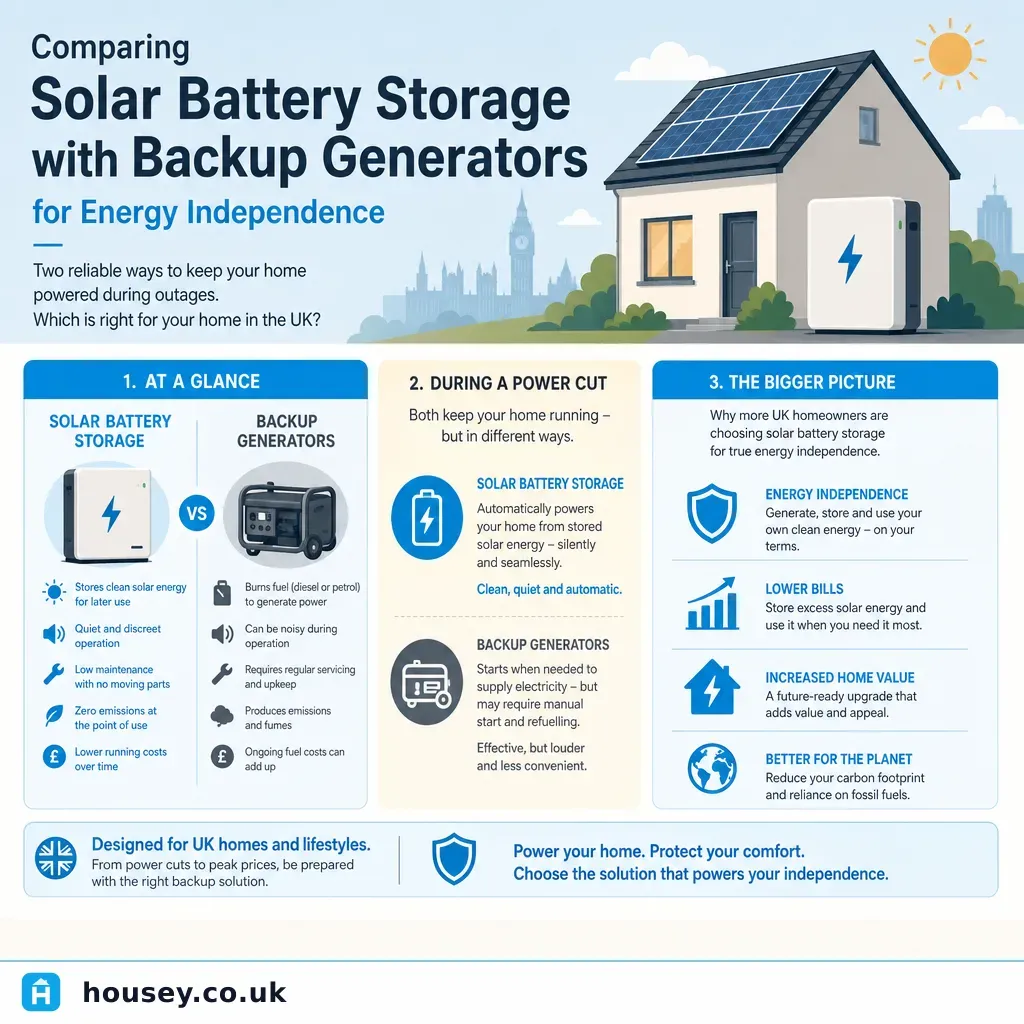
Comparing Solar Battery Storage with Backup Generators for Energy Independence
Solar battery storage and backup generators both offer energy resilience but work very differently.
 Energy & Retrofit
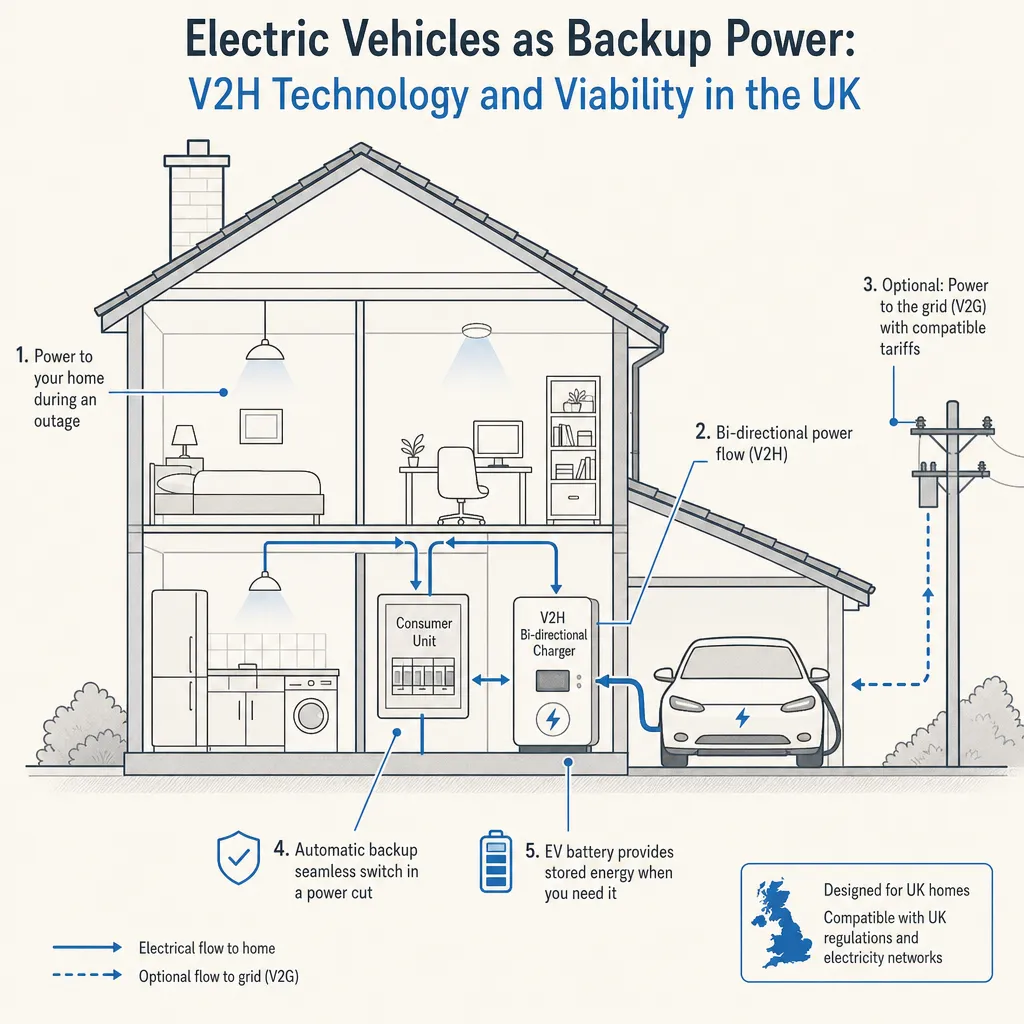
Electric Vehicles as Backup Power: V2H Technology and Viability in the UK
Vehicle-to-Home (V2H) technology uses your electric vehicle's battery to supply electricity to your home, either as backup power during grid outages or to shift cheap overnight charging into daytime use.
 Energy & Retrofit
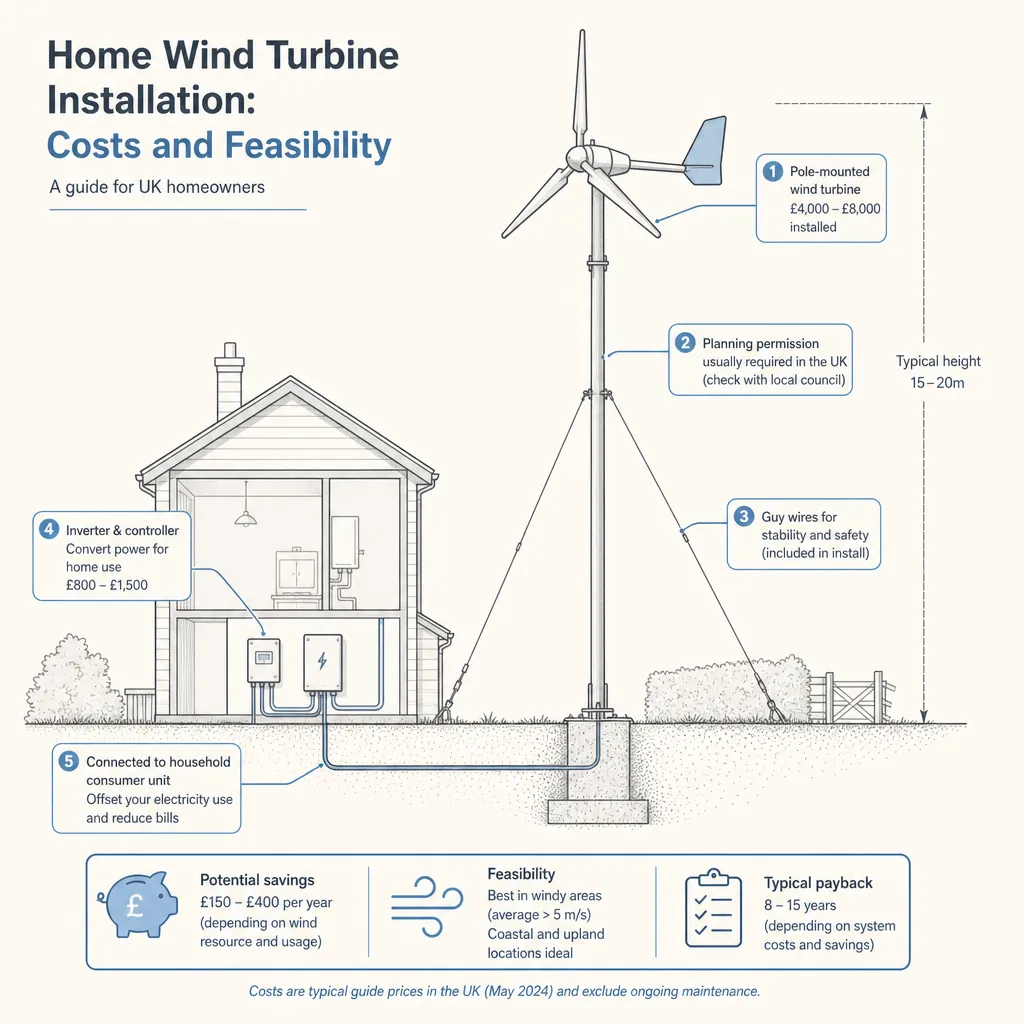
Home Wind Turbine Installation: Costs and Feasibility
A domestic wind turbine is only cost-effective if your site averages 5–6 metres per second or more in wind speed.
 Energy & Retrofit
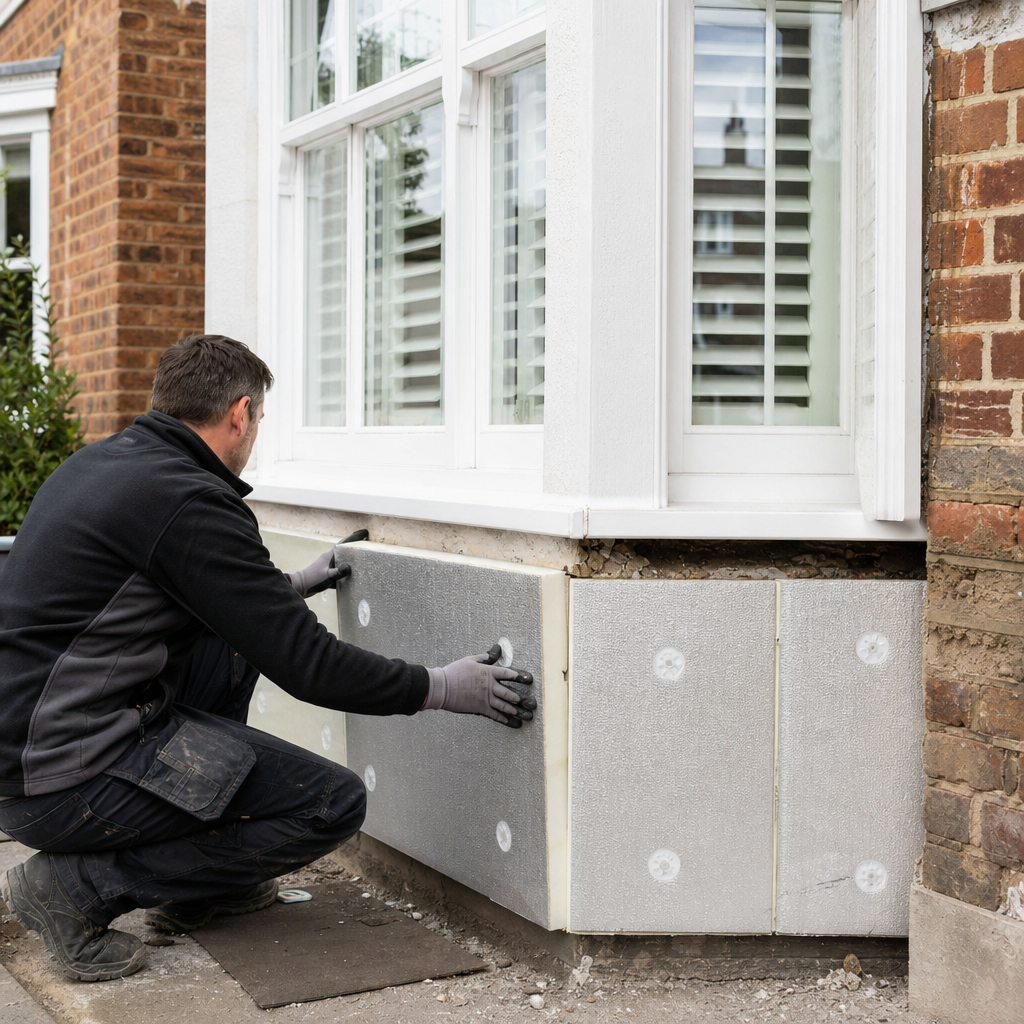
Insulating Solid Masonry Walls Under Bay Windows: Technical Guidance
Insulating solid masonry walls under bay windows requires specialist detailing at angled wall faces, window reveals, and the bay floor and ceiling junctions.
 Energy & Retrofit
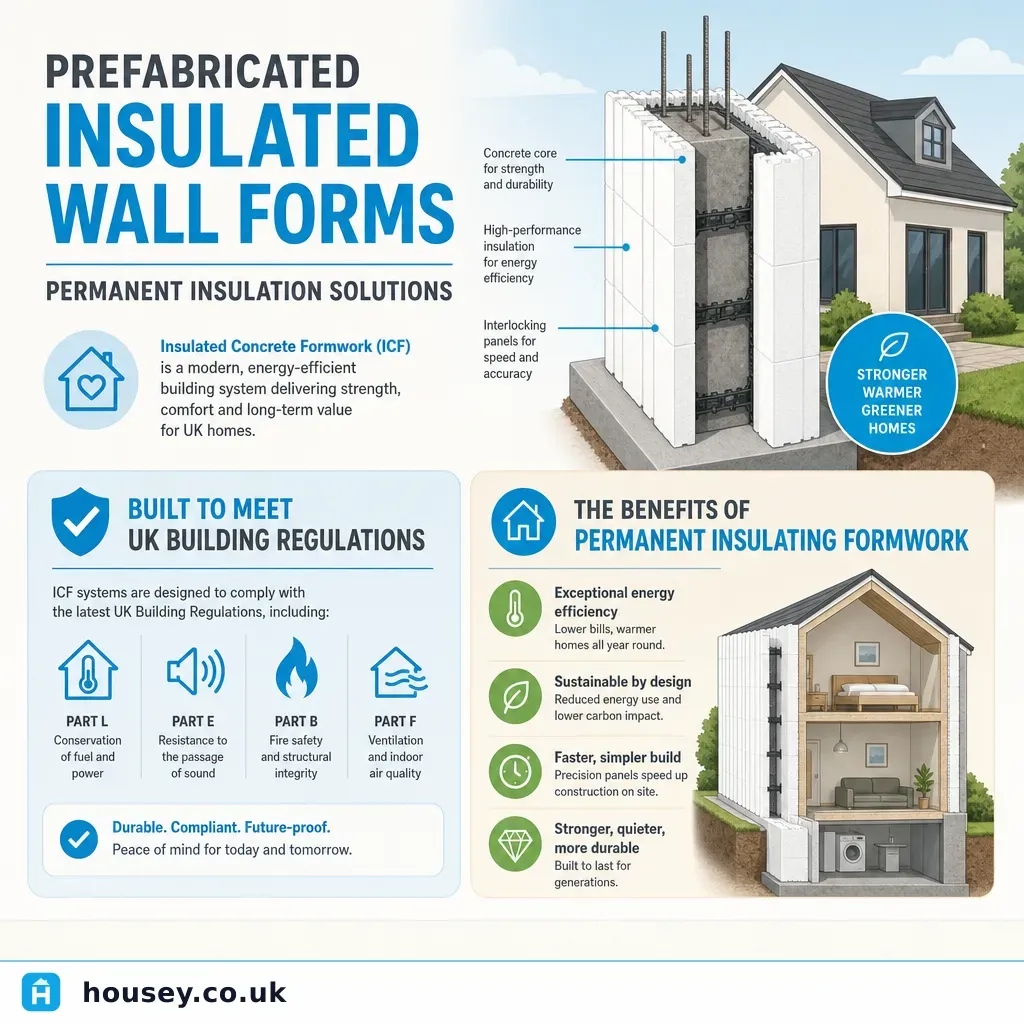
Prefabricated Insulated Wall Forms: Permanent Insulation Solutions
Prefabricated insulated wall forms — including ICF and SIPs systems — deliver high thermal performance by combining permanent insulation with structural concrete or timber in a single wall assembly.