Standing Seam versus Corrugated Metal Roofing: Material Performance and Cost
By Housey · Last reviewed 1st of June 2026
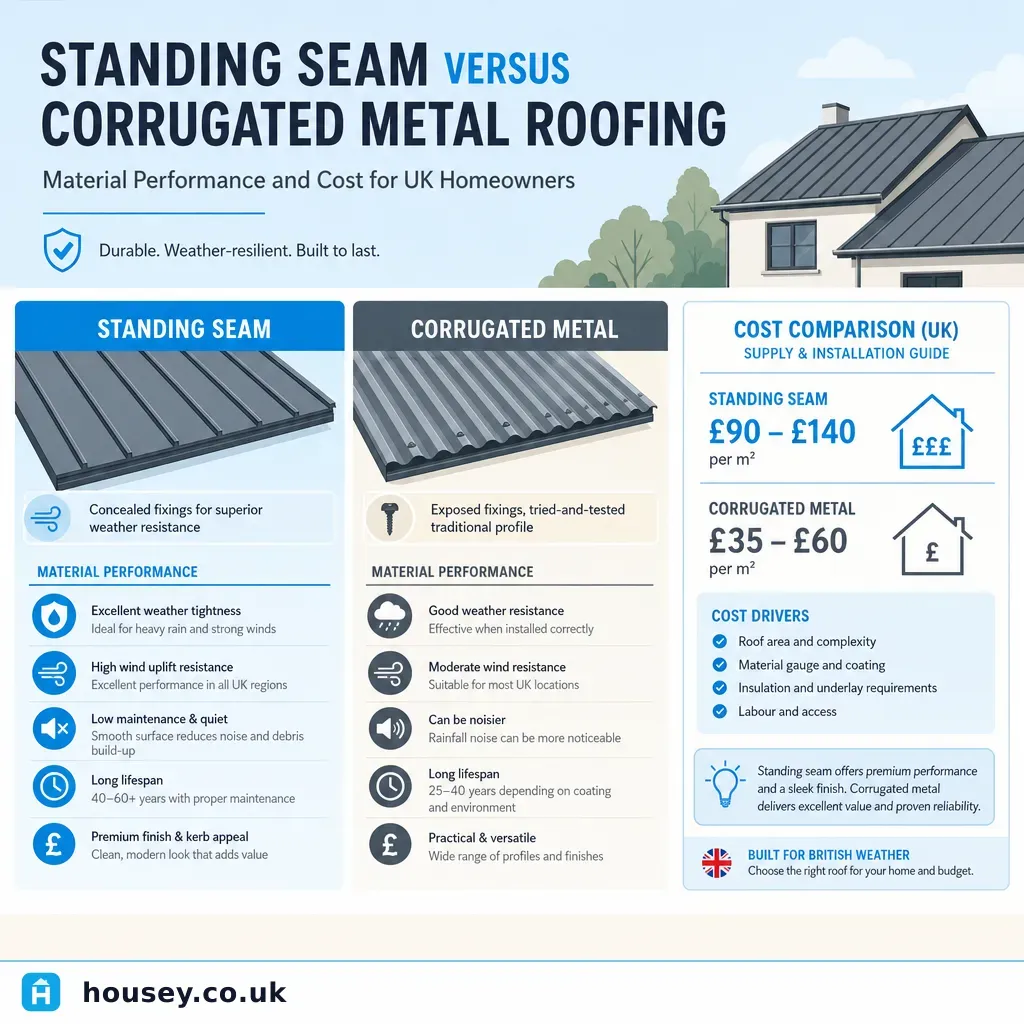
Standing Seam versus Corrugated Metal Roofing: Material Performance and Cost
Choosing between a standing seam and a corrugated (profiled) metal roof comes up regularly in UK projects — from agricultural outbuildings and commercial lean-tos to garden rooms, single-storey extensions, and full residential re-roofs. The two systems serve fundamentally different purposes, and selecting the wrong one for a given pitch or planning context can mean drainage failures, planning objections, or a roof that needs replacing decades earlier than anticipated.
Key points
- Corrugated and trapezoidal profiled metal sheets require a minimum pitch of typically 5°–10° depending on profile and manufacturer; standing seam systems can be installed at pitches as low as 1.5°–3° with proprietary clips and sealant.
- Polyester-coated (PE) steel profiled sheeting typically carries a 10–15 year colour guarantee; PVDF-coated profiles carry guarantees of 30 years or more — confirm the coating specification in any quote before accepting it.
- Approved Document L (2021, England) requires any new or replacement roof to achieve a U-value of ≤0.25 W/m²K; both profiled and standing seam systems can comply, but the insulation strategy is system-specific.
- In conservation areas and on listed buildings, corrugated metal sheeting may be refused on visual grounds; Listed Building Consent is always required for listed properties regardless of material.
- Indicative UK installed costs (last reviewed 2026-06-01): corrugated profiled steel £20–£50/m²; standing seam steel £80–£130/m² — the gap reflects material, fixing complexity, and warranted design life.
What is corrugated metal roofing?
Corrugated metal roofing in the UK refers to profiled metal sheeting — usually galvanised or coated steel or aluminium — pressed into a repetitive wave, sinusoidal corrugation, or trapezoidal rib pattern. The profile provides rigidity without thick material: a corrugated sheet spanning between purlins can be significantly thinner than a flat sheet of equivalent strength, reducing structural loads and overall cost.
Common UK profiles include:
- Box profile (trapezoidal): widely used for commercial and agricultural buildings; available in pre-painted steel with Plastisol, polyester, or PVDF coating grades.
- Sinusoidal corrugated: the traditional agricultural corrugated sheet; also used for heritage or vernacular aesthetic on rural or outbuilding projects.
- Trapezoidal standing seam variants: a bridge product — some profiled systems use concealed clips to reduce exposed fixings while retaining lower installed cost.
What is standing seam metal roofing?
Standing seam is a system where long panels run from ridge to eave and are joined along their vertical edges by a raised seam, either mechanically crimped on site or formed with a snap-lock profile. The panels float on concealed clips attached to the substructure, allowing thermal movement without stressing the fixings or creating leak paths. Materials include pre-painted or galvanised steel, zinc, aluminium, and copper.
Standing seam is commonly specified for contemporary residential extensions, flat-to-low-pitch roofs, and heritage re-roofing projects where a flush, unbroken roof plane is required architecturally.
Side-by-side comparison
Feature | Standing seam | Corrugated/profiled metal |
|---|---|---|
Minimum pitch | 1.5°–3° (system-dependent) | 5°–10° (profile-dependent) |
Exposed fasteners | None | Yes — screw-fixed through sheet |
Typical design life | 40–60+ years (steel); 60–100+ years (zinc/copper) | 20–35 years (PE-coated steel) |
Installed cost — steel (indicative) | £80–£130/m² | £20–£50/m² |
Acoustic performance | Good with solid deck and insulation | Moderate to poor — air gap amplifies rain noise |
Visual character | Contemporary, architectural, flush planes | Industrial, agricultural, utilitarian |
Part L 2021 compliance | Achievable with correct insulation specification | Achievable with correct insulation specification |
Planning sensitivity | Generally accepted in most settings | May be refused in conservation areas |
Maintenance requirement | Low — inspect flashings every 10–15 years | Moderate — inspect fasteners and gaskets every 5–10 years |
Indicative UK costs, last reviewed 2026-06-01. Quotes vary by region, material gauge, coating grade, and roof complexity. Obtain at least three tenders.
Which should you choose? A decision framework
- Choose standing seam if: the roof pitch is below 5°; the building is a residential property or high-specification extension; low maintenance over 30+ years is the priority; the property is in or near a conservation area; or an architectural, flush finish is required.
- Choose corrugated or profiled metal if: the building is agricultural, industrial, or a low-specification outbuilding; the pitch is above 7°; a tighter budget is a firm constraint; speed of installation matters; or the building is functional or temporary in character.
- Consult a structural engineer if you are retrofitting either system onto an existing structure and purlin spacing or loadbearing capacity is uncertain.
- Check with your local planning authority before installing corrugated metal on any building in a conservation area, Article 4 direction area, or on any listed building.
Worked UK property scenario
Rear kitchen extension on a 1930s semi-detached house in Cambridgeshire
A homeowner is adding a 4 m × 6 m single-storey kitchen extension. The architect proposes a mono-pitch roof at 4° to keep the ridge below the first-floor windowsill.
- At 4°, corrugated profiled metal is unsuitable — most profiles require at least 5° minimum pitch per manufacturer specification, and installing below that threshold voids the system warranty.
- Standing seam at 4° is feasible with a proprietary snap-lock or mechanically seamed system in pre-painted steel or zinc.
- The property is not listed and not in a conservation area, so no additional planning consent is required for the roof material choice under Permitted Development.
- Under Approved Document L (2021), the extension roof must achieve ≤0.25 W/m²K. The architect specifies 150 mm PIR insulation board (thermal conductivity approximately 0.022 W/mK) above the deck to comply.
- Three quotes are obtained; a pre-painted steel standing seam system comes in at approximately £105/m² installed — within budget for a contemporary residential finish.
When to get professional help
Metal roofing — whether profiled or standing seam — requires expertise to detail correctly. Seek advice from a qualified roofer or roofing engineer if:
- Your roof pitch is at or near the minimum for the system being considered.
- The project involves a listed building or a property in a conservation area.
- The existing structure's capacity to carry the chosen roof system is unconfirmed.
- You have a long run (more than 12 m) where thermal expansion joints are needed.
- Any part of the existing roof shows signs of condensation, deck rot, or previous failed repairs.
How Housey can help
Housey makes it straightforward to find and compare specialist metal roofers in your area. Submit your project details to receive quotes from vetted contractors who understand both standing seam and profiled metal systems and can advise on the right solution for your pitch, budget, and planning context.
Frequently asked questions
Is corrugated metal roofing suitable for a house extension in the UK?
It can be, but depends on pitch and planning context. Most corrugated profiles need at least 5°–8° pitch to perform correctly. On a residential extension in a suburban setting, corrugated metal may attract planning objections, particularly in conservation areas. Standing seam is the more common choice for domestic extensions requiring a contemporary roofline at or below 5° pitch.
How long does corrugated metal roofing last in the UK?
Galvanised steel with a good polyester or Plastisol coating typically lasts 20–35 years before the coating degrades significantly. PVDF-coated profiles can last 40 years or more. Longevity depends on the coating specification, exposure to salt spray or industrial pollution, and how quickly any fastener or gasket failures are identified and repaired.
Does corrugated metal roofing need planning permission?
For most agricultural buildings and outbuildings, corrugated metal does not require planning permission under the General Permitted Development Order (GPDO) 2015. For residential extensions, standard Permitted Development rules apply. Always check with your local planning authority if the property is in a conservation area, Article 4 direction area, or is listed.
What is the best metal roofing for a garden room?
Below 5° pitch, standing seam is usually the only suitable metal option. Above 5°, profiled metal is feasible if the visual outcome is acceptable. Many garden room installers offer standing seam zinc or pre-painted steel as a premium finish for residential settings where a contemporary, flush appearance is wanted.
Sources and further reading
- Building Regulations Approved Document L (2021) — GOV.UK — U-value and thermal requirements for roofs
- Town and Country Planning (General Permitted Development) Order 2015 — legislation.gov.uk — Permitted Development rights for extensions and outbuildings
- National Federation of Roofing Contractors — NFRC — trade body for roofing contractors in the UK
- Technical Advice — Building Materials — Historic England — guidance for listed and heritage buildings
- Extensions: Do I need planning permission? — Planning Portal — Permitted Development rules for home extensions
Useful next reads
 Improvement & Build
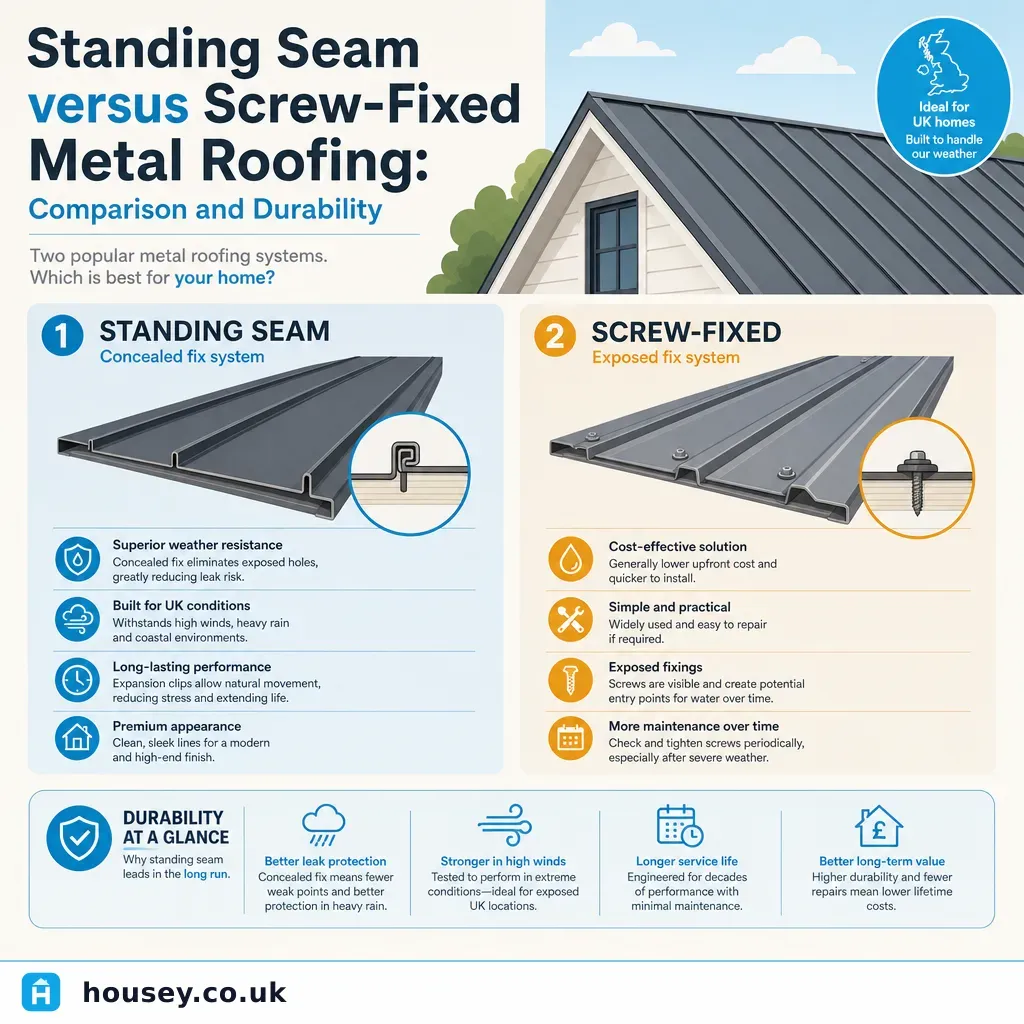
Standing Seam versus Screw-Fixed Metal Roofing: Comparison and Durability
Standing seam uses concealed clips to hold panels, keeping all fasteners out of the weatherline and giving a design life of 40–60 years or more.
 Improvement & Build
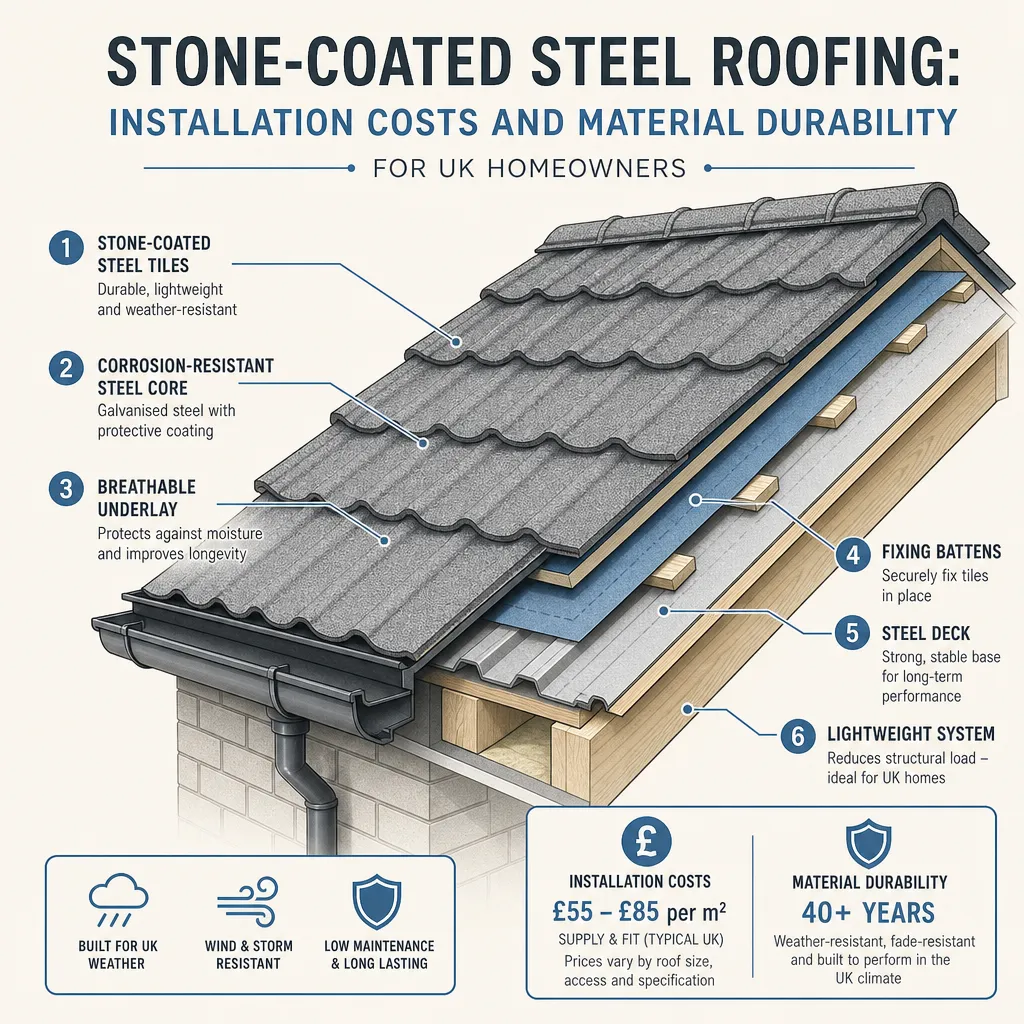
Stone-Coated Steel Roofing: Installation Costs and Material Durability
Stone-coated steel roofing uses a galvanised steel core embedded with acrylic resin and stone granules, creating a durable, lightweight alternative to traditional tiles.
 Improvement & Build
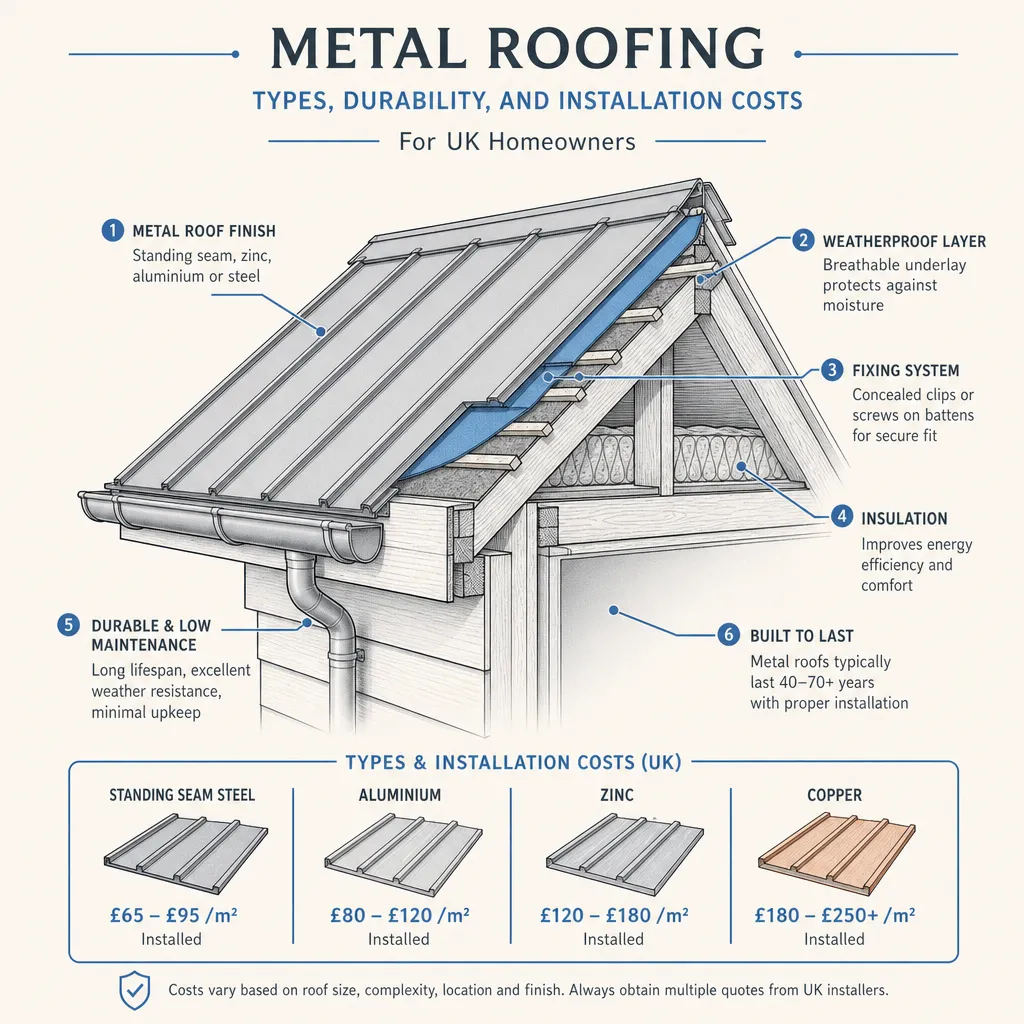
Metal Roofing: Types, Durability, and Installation Costs
Metal roofing in the UK includes standing seam, corrugated sheet, and metal tile systems in steel, aluminium, zinc, or copper.
 Improvement & Build
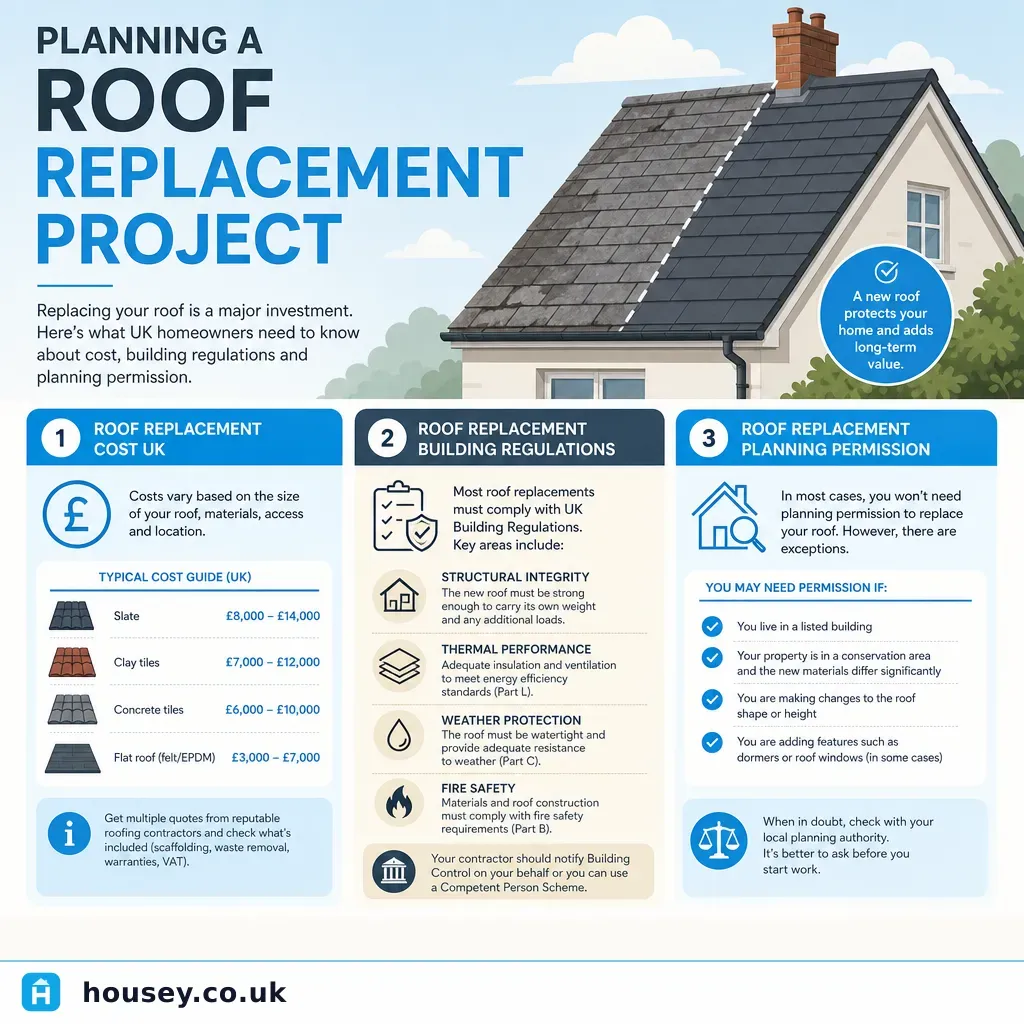
Planning a Roof Replacement Project
A roof replacement project involves stripping the existing covering, renewing the sarking felt and battens, and laying new tiles, slates, or a flat-roof membrane.
 Improvement & Build
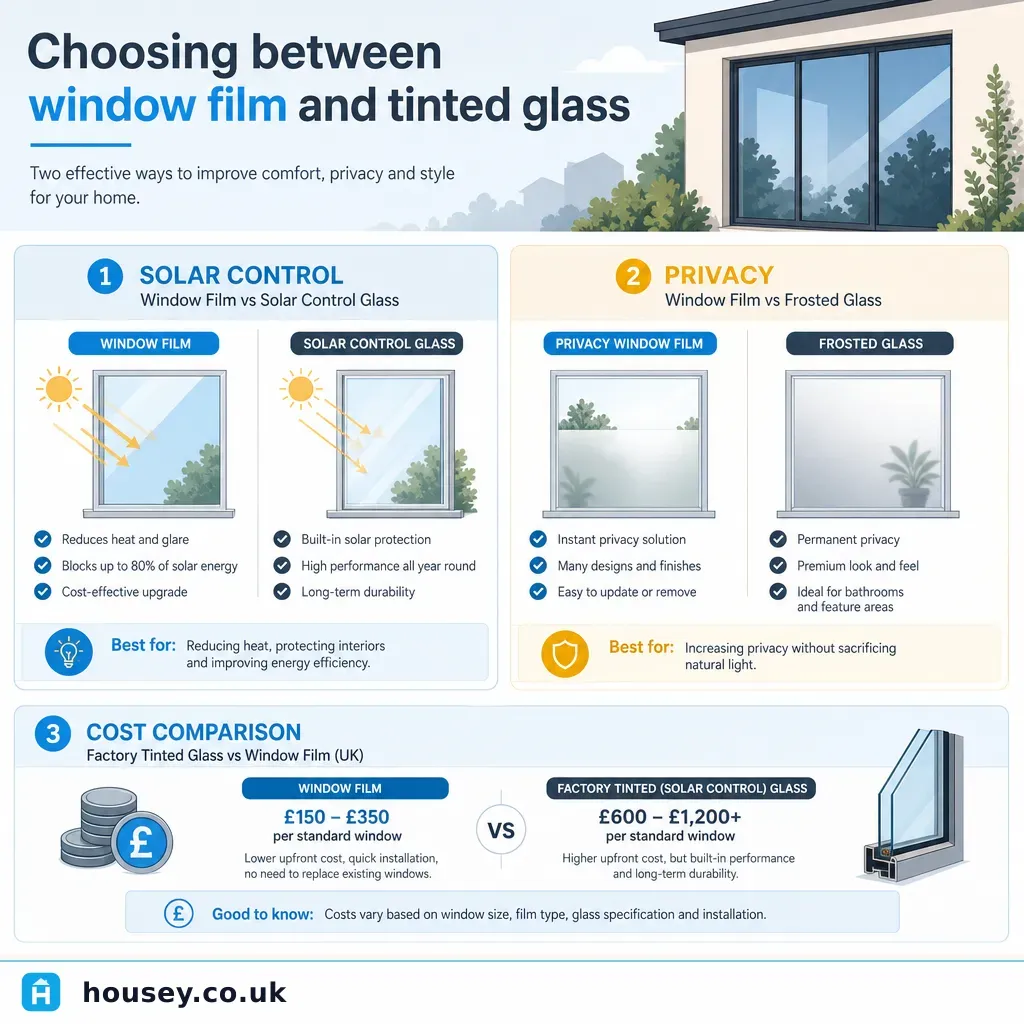
Choosing between window film and tinted glass
Window film is a retrofittable adhesive layer applied to existing glass — cheaper and reversible; factory-tinted or solar-control glass is manufactured with the tint integral to the pane, offering better durability and consistent performance.