Starting a Greenhouse: Growing Guide and Setup
By Housey · Last reviewed 11th of May 2026
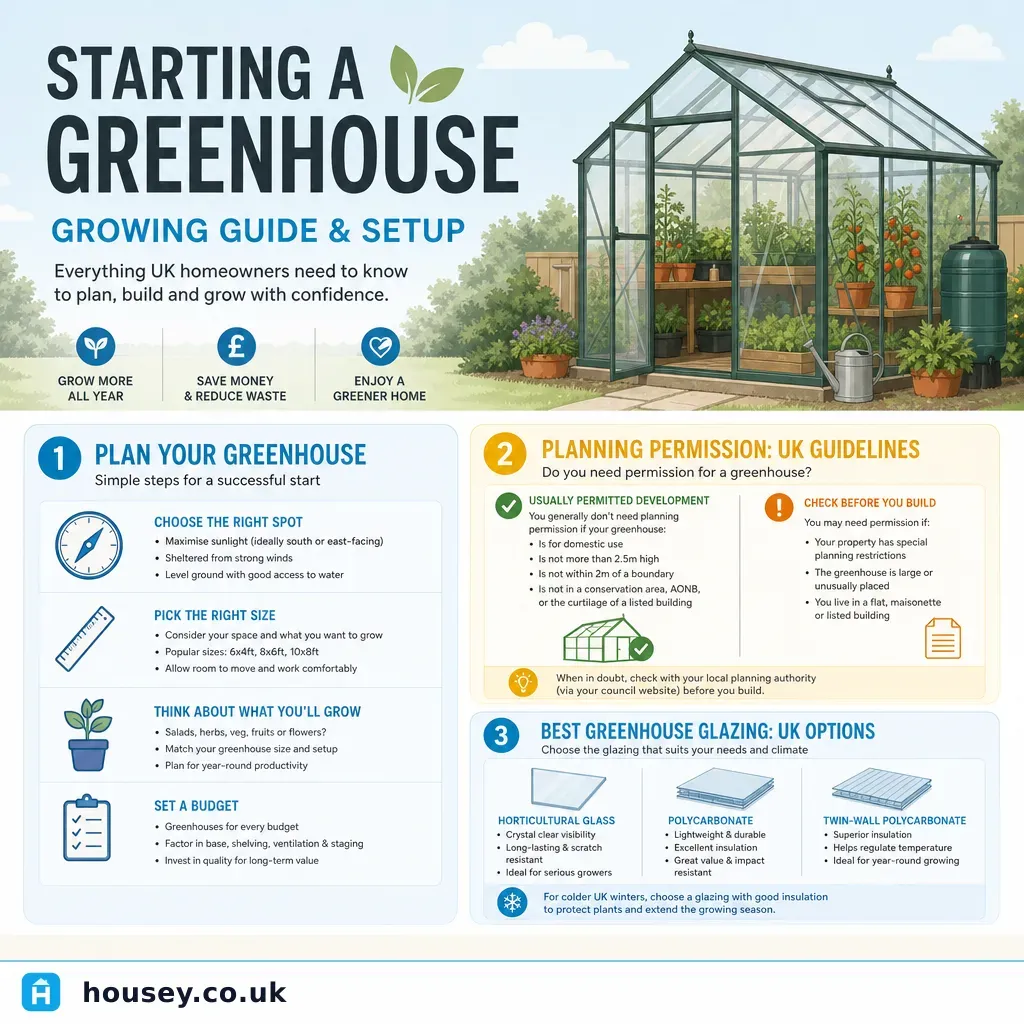
Starting a Greenhouse: Growing Guide and Setup
A greenhouse opens up year-round growing opportunities that UK gardens rarely offer without one — from extending the tomato season into October to overwintering tender perennials and starting seeds weeks ahead of outdoor conditions. Whether you are considering a small lean-to against a south-facing garden wall or a freestanding timber structure on a 1930s semi's plot, the decisions made at the planning stage — size, glazing, orientation, and heating — will shape what the greenhouse can achieve for years to come.
Key points
- Most domestic greenhouses in England are permitted development under Schedule 2, Part 1 of the Town and Country Planning (General Permitted Development) (England) Order 2015, and do not require a planning application.
- South or south-west facing orientation with the long axis running east to west captures the most sunlight during the UK growing season (approximately March to October).
- Twin-wall polycarbonate (6 mm or 16 mm) retains more heat than horticultural glass and is impact-resistant, making it better suited to family gardens where children play.
- The Royal Horticultural Society (RHS) recommends a minimum greenhouse width of 1.8 m to provide practical working space along both sides of a central path.
- A level, solid base — concrete slab, paving slabs, or a gravel board frame with compacted hardcore — is required for most freestanding structures to keep the frame square and stable over time.
Do I need planning permission for a greenhouse?
For most homeowners in England, a domestic greenhouse falls within permitted development rights, meaning no planning application is required. However, a number of conditions apply.
You are likely to need planning permission if:
- The greenhouse is in a conservation area, National Park, or Area of Outstanding Natural Beauty (AONB).
- The property is a listed building — any structure in the curtilage may require listed building consent.
- The greenhouse exceeds 4 m in height (ridged roof) or 3 m (flat or pent roof).
- The structure would cover more than 50% of the garden area around the original house.
- Permitted development rights have been removed by a planning condition — check your title deeds or contact your local planning authority.
Always check the Planning Portal or contact your local planning authority before starting work if any of these factors may apply.
Choosing size and glazing
The right size depends primarily on what you want to grow. A 6 x 8 ft greenhouse is a commonly chosen starting point for kitchen-garden crops such as tomatoes, cucumbers, and peppers. A wider structure (8 x 10 ft or larger) adds meaningful space for propagation staging alongside growing beds.
Glazing comparison
Glazing type | Light transmission | Insulation | Weight | Safety | Typical lifespan |
|---|---|---|---|---|---|
Horticultural glass (3 mm) | Very high (~90%) | Low — single pane | Heavy | Shatters to sharp shards | 20+ years if intact |
Toughened safety glass | Very high | Low — single pane | Heavy | Breaks into rounded pebbles | 20+ years |
Twin-wall polycarbonate (6–16 mm) | High (~80–85%) | Better — air gap | Light | Impact-resistant | 10–15 years before yellowing |
Multi-wall polycarbonate (25 mm+) | Moderate | Best of common options | Very light | Impact-resistant | 10–15 years |
For most UK homeowners, twin-wall polycarbonate offers the most practical combination of insulation, safety, and ease of handling. Glass remains the preference for growers who prioritise maximum light transmission during winter months.
Positioning your greenhouse
Orientation and placement significantly affect productivity. In the UK:
- A south or south-west facing position is ideal for maximum solar gain across the growing season.
- An east-west ridge alignment (long axis east to west) captures more light than a north-south orientation.
- Avoid positions shaded by trees, walls, or buildings, particularly between 10am and 3pm when solar gain is highest.
- Some shelter from the prevailing south-westerly wind is beneficial, but avoid dense hedging that creates shade.
- Access to water (outside tap) and power (RCD-protected outdoor supply) makes day-to-day use considerably easier and enables heating, propagation lighting, and automatic vents.
Which greenhouse setup should you choose?
- Choose a lean-to or wall-mounted structure if space is limited, if a south-facing house or garden wall is available to radiate stored warmth, or if a separate power connection is impractical.
- Choose a freestanding structure (6 x 8 ft or larger) if you intend to grow tall crops (tomatoes, cucumbers, climbing beans), overwinter large container plants, or want separate propagation and growing areas.
- Choose polycarbonate glazing if children use the garden regularly, if the site is exposed, or if weight and handling ease are a consideration.
- Choose glass if maximum winter light is a priority and the structure will be in a sheltered position with lower impact risk.
- Consult a garden designer if the greenhouse will form part of a wider garden redesign, requires a bespoke or custom-built structure, or needs to integrate with paving, raised beds, or an irrigation system.
- Check with your local planning authority if the property is in a conservation area, is listed, or if you are uncertain whether permitted development rights apply.
What to grow in a UK greenhouse by season
Season | Crops and key tasks |
|---|---|
Late winter (Jan–Feb) | Sow tomatoes, peppers, aubergines, chillies under heat; use a propagation mat or heated propagator |
Spring (Mar–Apr) | Pot on seedlings; sow courgettes, cucumbers, basil; begin hardening off hardy seedlings |
Early summer (May–Jun) | Plant out tomatoes and cucumbers into growing bags or greenhouse borders |
Mid-summer (Jul–Aug) | Harvest regularly; ventilate daily to prevent overheating; damp down paths in hot weather |
Autumn (Sep–Oct) | Continue harvesting; sow winter salads, mizuna, pak choi, spinach |
Winter (Nov–Jan) | Overwinter tender perennials; sow broad beans and sweet peas; maintain minimum 2°C if possible |
Homeowner checklist: setting up a greenhouse
When to get professional help
Setting up a greenhouse is a practical DIY project for most homeowners. However, consider professional input if:
- The greenhouse will be incorporated into a larger garden design or landscaping project — a garden designer can integrate the structure with paving, raised beds, and seasonal planting.
- Electrical work is required — any permanent outdoor wiring must be carried out by a qualified electrician and comply with BS 7671 (the IET Wiring Regulations) and Part P of the Building Regulations.
- The structure requires a concrete foundation on sloping ground where levelling and drainage need careful planning.
- The property is listed or in a conservation area, where a planning or heritage consultant's input may be useful before proceeding.
How Housey can help
If your greenhouse is part of a wider garden project, working with a garden designer through Housey can help you integrate the structure into the landscape, optimise positioning and access, and plan planting around your seasonal growing goals. Housey connects UK homeowners with vetted local garden design professionals.
Frequently asked questions
Do I need planning permission for a greenhouse in a conservation area?
Permitted development rights are restricted for many garden structures in conservation areas. You should contact your local planning authority before erecting a greenhouse if your property falls within a conservation area, National Park, or Area of Outstanding Natural Beauty. The Planning Portal's postcode-based check can help confirm your property's designation before you start work.
What is the best orientation for a UK greenhouse?
A south or south-west facing position, with the long axis running east to west, captures the most sunlight across the UK growing season. Avoid positions shaded by buildings or trees between 10am and 3pm. Some shelter from prevailing winds is beneficial, but windbreak hedging that casts shade into the greenhouse is counterproductive and should be avoided.
What can I grow in a UK greenhouse year-round?
In an unheated greenhouse, winter salads (lamb's lettuce, mizuna, winter purslane), hardy herbs, and overwintered broad beans are practical options. A small heated greenhouse extends this considerably — tomatoes, cucumbers, peppers, and chillies thrive in summer. Maintaining a minimum of 2–5°C using a thermostatically controlled fan heater significantly expands what can be overwintered successfully.
How do I keep a small greenhouse warm in winter?
Double-layer bubble wrap insulation fixed to the inside of the glazing can reduce heat loss by up to 50%, according to the RHS, at minimal cost. Electric fan heaters with thermostats offer the most controllable heat source. Paraffin heaters are cheaper to run but increase humidity and require ventilation. Propagation mats provide localised warmth for seedlings without heating the whole structure.
Sources and further reading
- Outbuildings permitted development — Planning Portal — guidance on permitted development rules for garden structures in England
- Greenhouse growing guide — Royal Horticultural Society — RHS guidance on greenhouse setup, glazing choices, and growing
- Town and Country Planning (General Permitted Development) (England) Order 2015 — legislation.gov.uk — the legal basis for permitted development rights in England
Useful next reads
 Improvement & Build
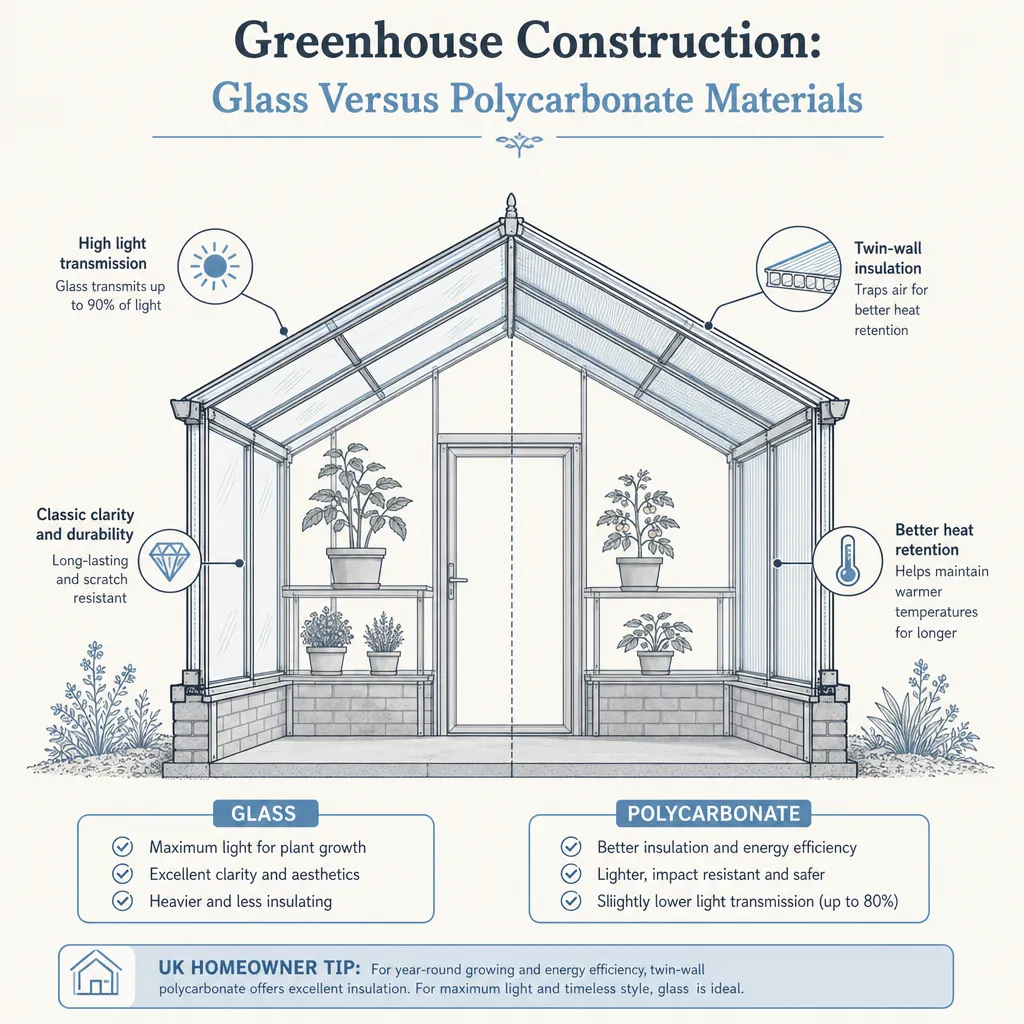
Greenhouse Construction: Glass Versus Polycarbonate Materials
Glass transmits around 90% of available light and lasts indefinitely if unbroken, but insulates poorly and shatters into sharp fragments.
 Improvement & Build
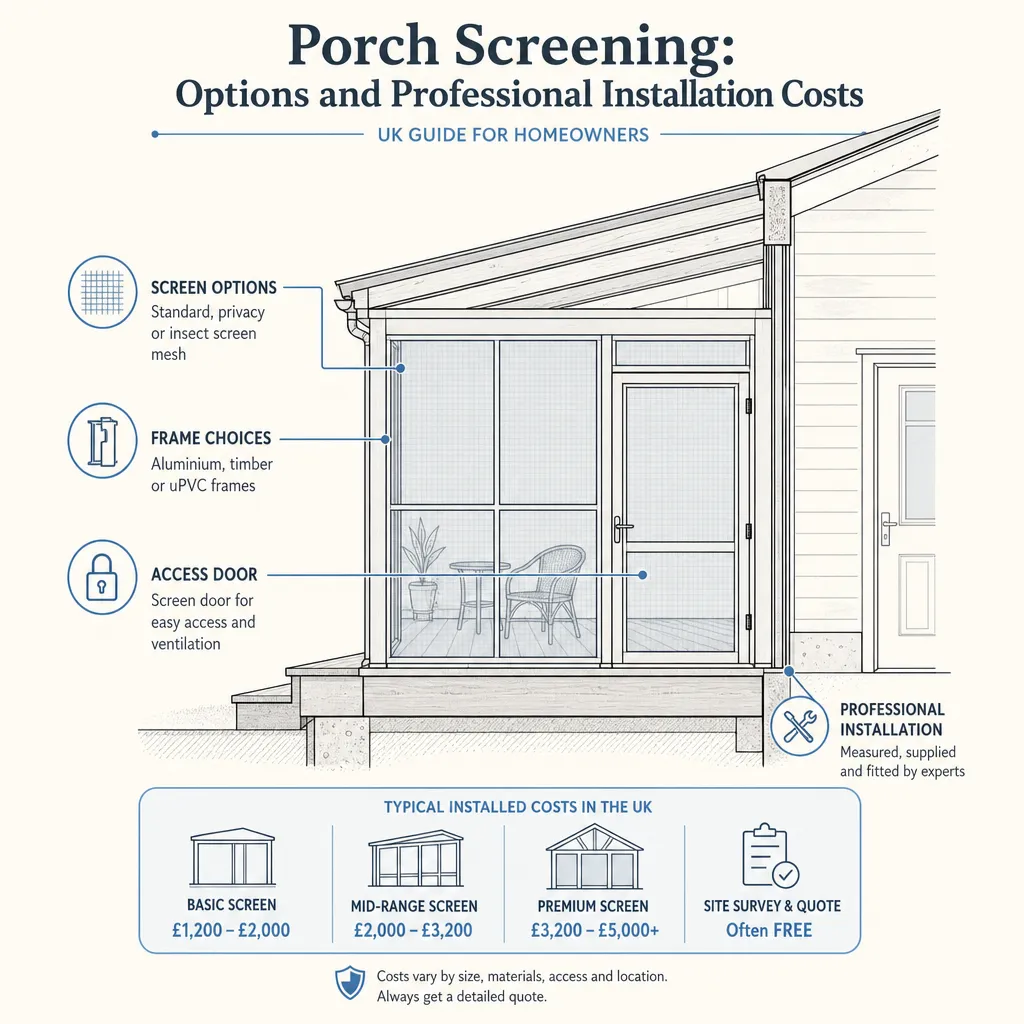
Porch Screening: Options and Professional Installation Costs
Porch screening ranges from simple insect mesh on a timber frame to bespoke aluminium-framed glazed enclosures.
 Improvement & Build
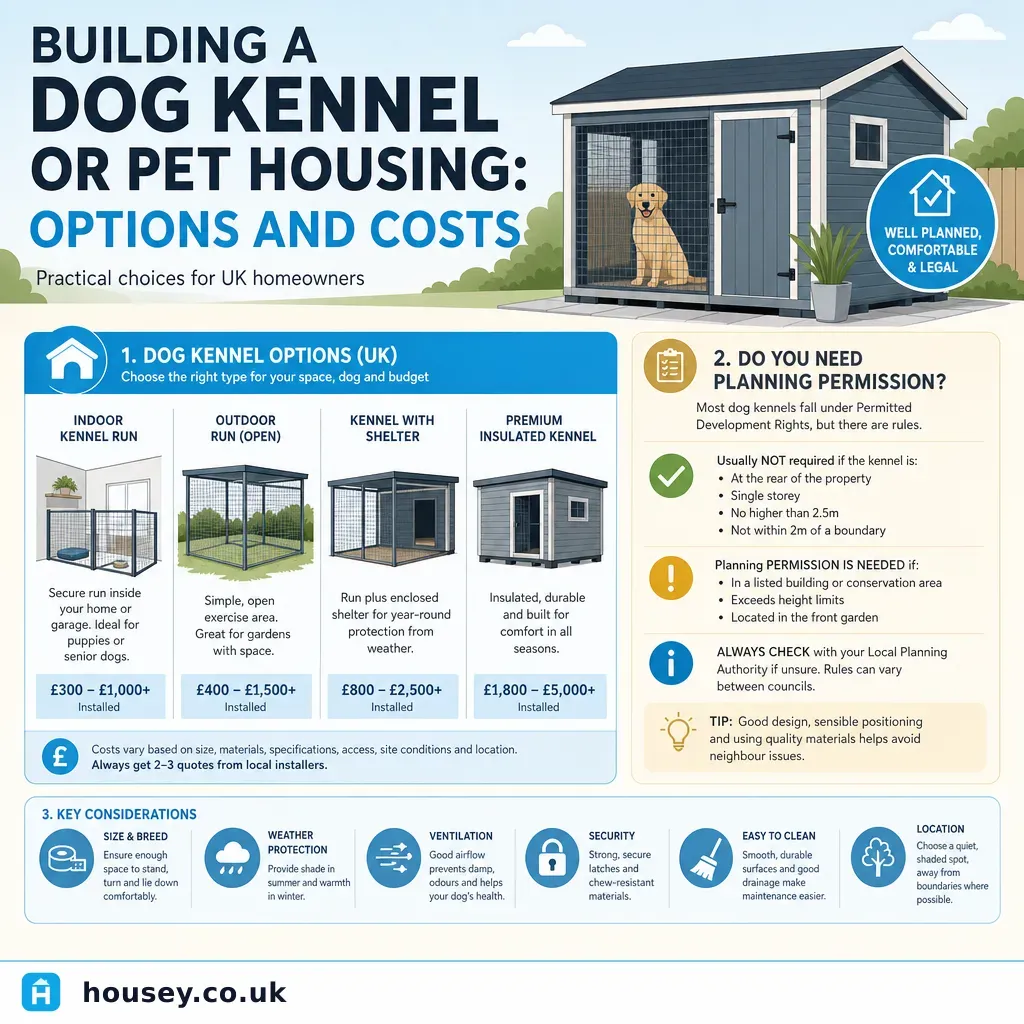
Building a Dog Kennel or Pet Housing: Options and Costs
A domestic dog kennel or pet housing structure is almost always permitted development in England and does not need planning permission if sited behind the house, below 2.
 Improvement & Build
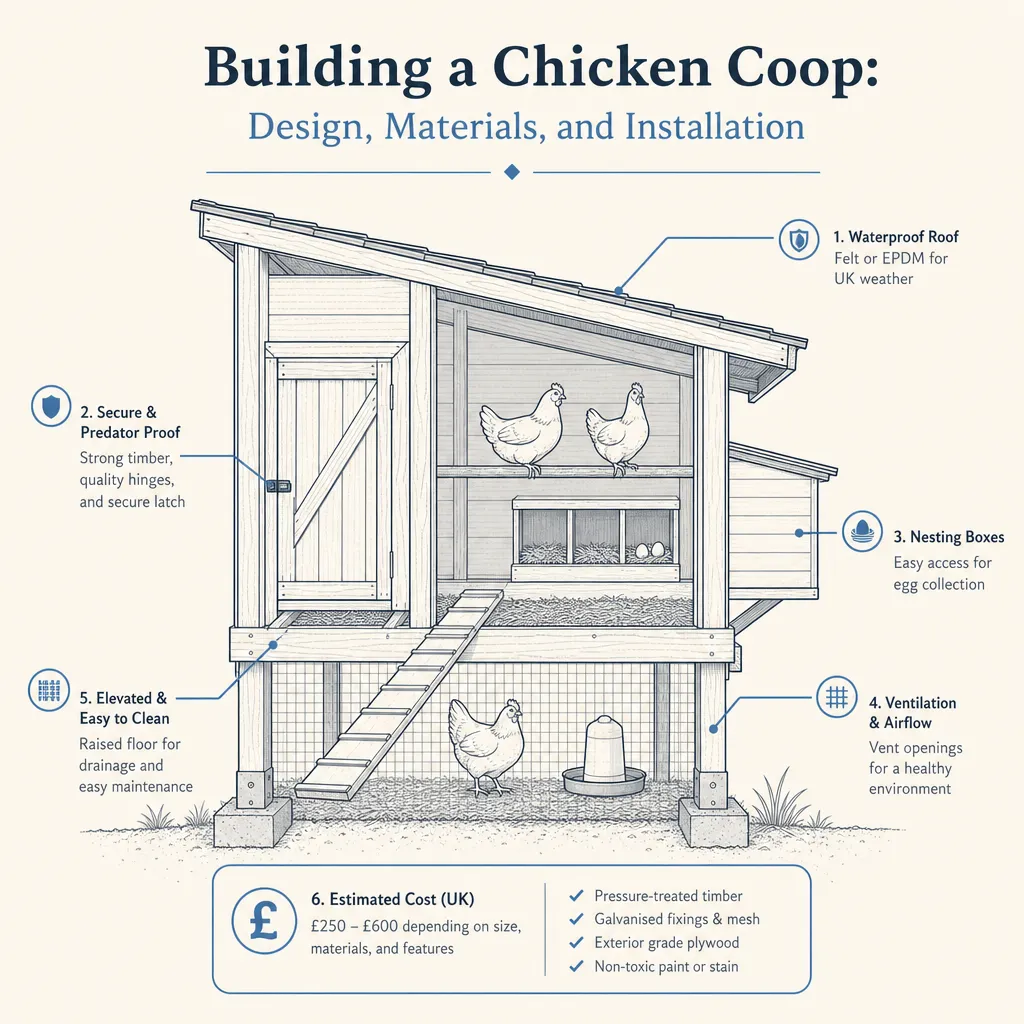
Building a Chicken Coop: Design, Materials, and Installation
A domestic chicken coop is usually permitted development in England and does not need planning permission, provided it meets height and coverage limits.
 Improvement & Build
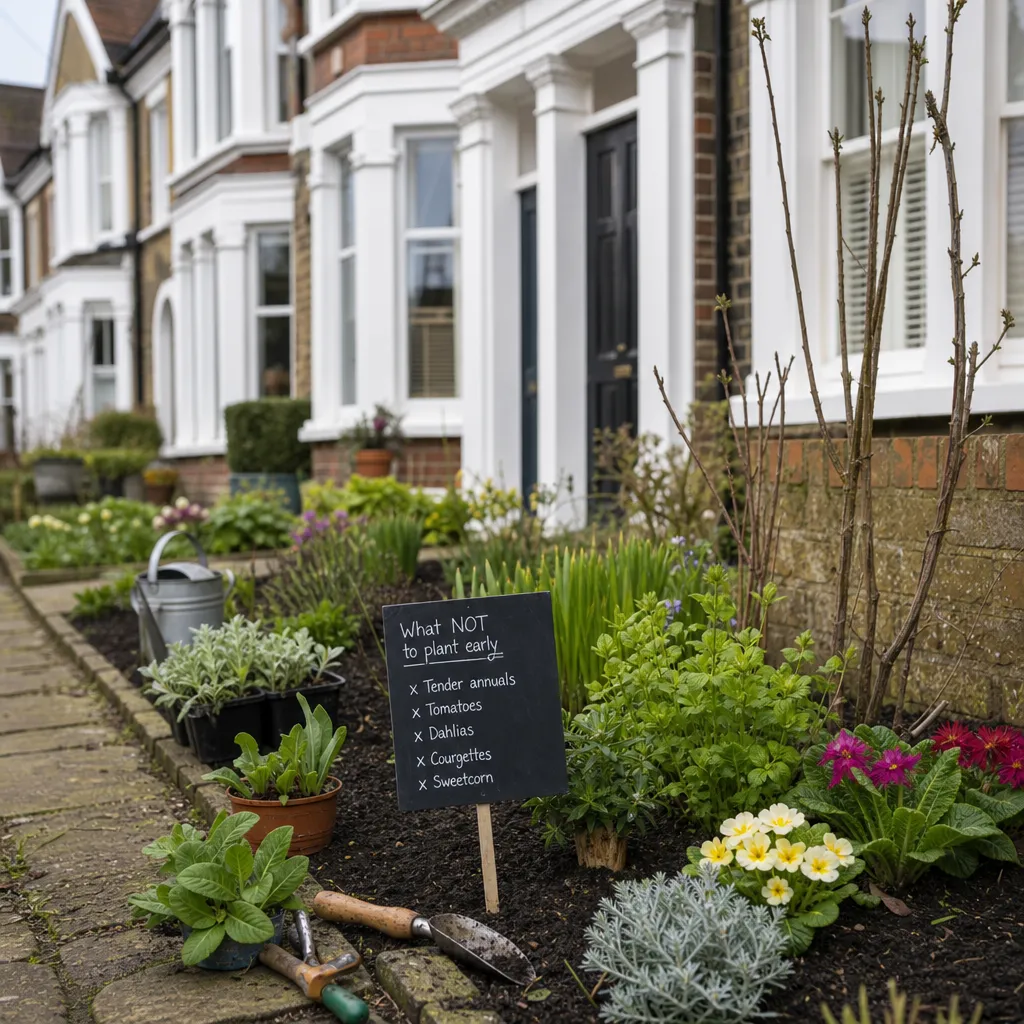
Spring Gardening: What Not to Plant Early and Season-Appropriate Planting Guide
In most of the UK, courgettes, French beans, runner beans, tomatoes, sweet corn, and half-hardy annuals must not go outside until after the last frost — typically late May to early June in England.