Steel Window Installation: Costs, Performance and Heritage Suitability
By Housey · Last reviewed 24th of May 2026
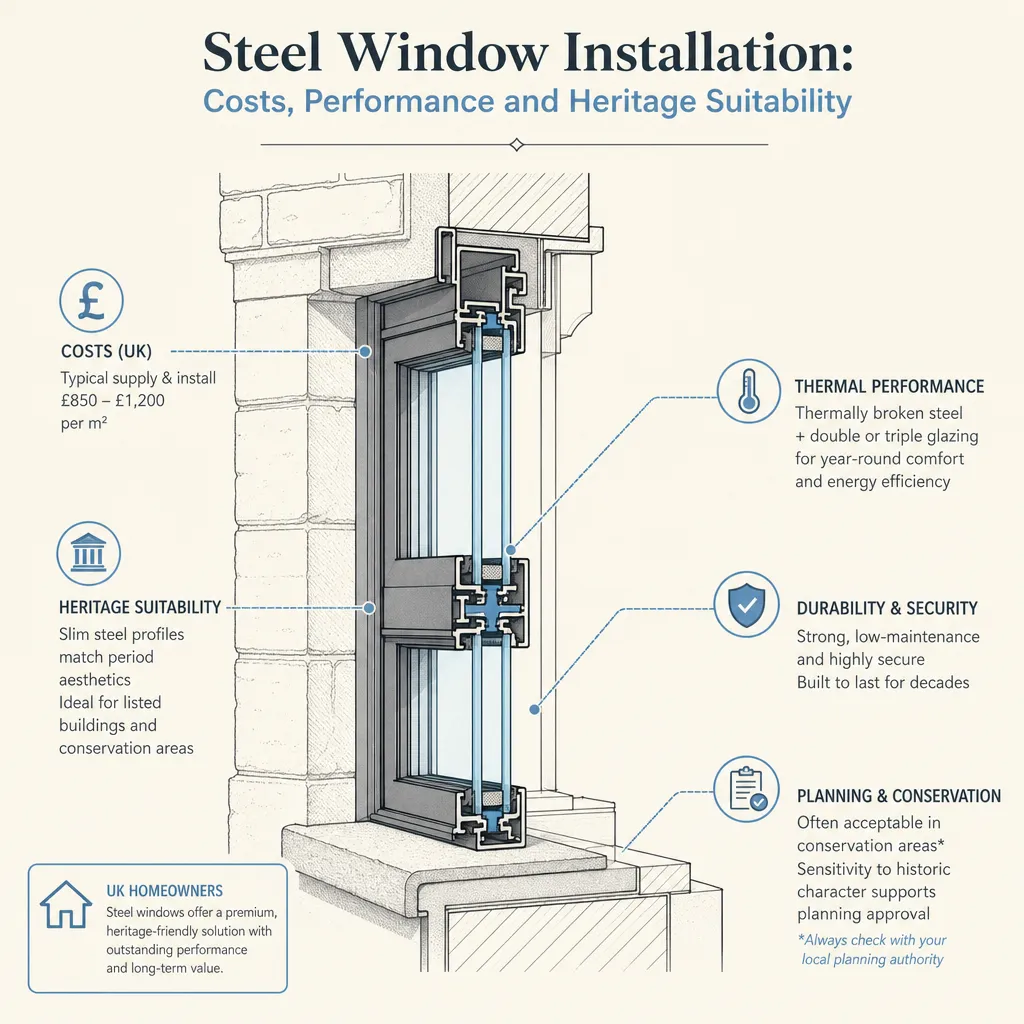
Steel Window Installation: Costs, Performance and Heritage Suitability
Steel windows occupy an unusual position in UK renovation: closely associated with Crittall-style frames from the 1920s to 1950s, they have experienced a strong revival among buyers renovating period properties, pursuing slim sightlines, or facing conservation area and listed building requirements that restrict alternative materials. Understanding their costs, thermal performance, and planning implications helps homeowners avoid expensive mistakes before any specialist fabricator is instructed.
Key points
- Thermally broken steel windows can achieve whole-window U-values of approximately 1.4–1.6 W/m²K, meeting Building Regulations Approved Document L (2021) requirements for replacement windows in England.
- Original or matching steel window profiles are commonly required by local planning authorities as a condition of listed building consent or conservation area approval.
- FENSA registration — or notification to local authority building control — is a legal requirement for replacement windows in England and Wales, including steel frames.
- Indicative installed costs range from around £600 to £2,500 or more per window, depending on size, thermal specification, and whether bespoke fabrication is required (Indicative UK costs, last reviewed 2026-05-24).
- Steel windows generally have a service life of 50 to 100 years with proper maintenance — significantly longer than uPVC alternatives.
What are steel windows and which properties typically use them?
Steel windows use rolled or extruded steel sections for the frame and sash. The most recognised style in the UK is the Crittall window — a trade name for hot-rolled steel frames with small panes and a distinctive industrial character, common in properties built between the 1920s and 1950s. They also appear in mid-century commercial conversions and contemporary new builds seeking a slimmer sight line than aluminium or timber can achieve.
Two main types are available:
Non-thermally broken: A single steel section without an insulating break. Common in pre-1980 originals; poor thermal performance and prone to condensation on the inner frame. Not generally suitable for new installations in habitable rooms under current Building Regulations.
Thermally broken: Modern steel frames incorporating a polyamide thermal break, significantly reducing heat loss and condensation risk. The current standard for any new steel window installation.
How much do steel windows cost in the UK?
Steel windows are among the most expensive window types per unit. Key cost drivers include:
- Profile type: Thermally broken profiles cost considerably more than non-broken equivalents.
- Fabrication: Standard sizes cost less than bespoke or complex multi-light configurations.
- Glazing specification: Slim double or triple glazing units add cost but improve thermal performance.
- Heritage requirements: Conservation area or listed building projects may require matching original profiles, adding fabrication cost and lead time.
- Installation complexity: Solid-wall or unusual reveal conditions affect labour time.
Specification | Indicative installed cost per window | Notes |
|---|---|---|
Standard thermally broken, double-glazed, small casement | £700–£1,200 | Off-the-shelf size, minimal brickwork disturbance |
Bespoke thermally broken, double-glazed, medium | £1,200–£2,000 | Custom profile, moderate complexity |
Heritage or conservation-matched profile | £1,500–£2,500+ | Matching existing sections, specialist fabricator required |
Non-thermally broken, like-for-like repair | £500–£900 | Usually for listed buildings only, where change is resisted |
Indicative UK costs, last reviewed 2026-05-24. Costs vary significantly by region, fabricator, and site conditions. Obtain at least three comparable quotes.
Do steel windows require planning permission?
For most properties, replacing windows with a similar appearance falls under permitted development and does not require a planning application. However, permission or consent is commonly required in the following situations:
- Conservation areas: Many local planning authorities (LPAs) have removed the permitted development right for window replacement in conservation areas via Article 4 Directions. Check your LPA before proceeding.
- Listed buildings: Any alteration to a listed building's windows — even like-for-like replacement — requires listed building consent. Unauthorised alteration is a criminal offence under the Planning (Listed Buildings and Conservation Areas) Act 1990.
- Flats: Permitted development rights for window replacement do not apply to flats; permission may be required.
- Material change: Replacing existing steel or timber windows with a material the LPA considers inappropriate is frequently refused.
Steel windows are often viewed positively by conservation officers in heritage settings because their slim profiles match original detailing. Check the Planning Portal's permitted development guidance and your LPA's website for local restrictions before instructing any contractor.
Steel windows compared with aluminium and timber
Feature | Steel | Aluminium | Timber |
|---|---|---|---|
Sight line width | Narrowest | Narrow | Wider |
Thermal performance (thermally broken) | Good (approx. 1.4–1.6 W/m²K whole window) | Good (comparable) | Good (varies by species and specification) |
Weight | Heavy | Lighter | Varies |
Heritage appropriateness | Excellent for inter-war and modernist | Acceptable in many contexts | Best for pre-1920 traditional |
Typical service life | 50–100 years | 30–45 years | 30–60 years (maintained) |
Maintenance requirement | Repaint every 5–10 years; treat rust promptly | Low | High (redecorate every 3–5 years) |
Relative installed cost | High | Medium-high | Medium-high |
Conservation area acceptance | High | Medium | High |
Which type of property suits steel windows?
Use this guide to decide whether steel windows are right for your project:
- Choose steel if your property is inter-war (1920s–1950s), a mid-century modernist build, or a contemporary new build where the slim sight line suits the architectural character.
- Choose thermally broken steel if you are replacing non-broken originals and need to meet Building Regulations thermal requirements without changing the aesthetic.
- Choose timber or conservation-approved aluminium if your property is pre-1920 and the local planning authority is unlikely to accept steel on heritage grounds.
- Ask a conservation officer or heritage architect before instructing any fabricator if your property is listed or in a conservation area.
- Check Article 4 Directions on your LPA's planning portal if your property is in a conservation area and you want to confirm whether permitted development applies to your windows.
Thermal performance and Building Regulations compliance
Approved Document L (2021 edition) for England requires replacement windows to achieve a minimum whole-window energy rating of Band C, or a U-value of no more than 1.4 W/m²K (whole window). Thermally broken steel windows can meet this requirement when correctly specified with an appropriate double or triple glazing unit.
Non-thermally broken steel windows cannot meet current Part L standards. They should only be installed as a like-for-like replacement in listed buildings where a departure from performance requirements has been accepted as part of the listed building consent.
FENSA-registered installers self-certify compliance with Building Regulations. Installations not carried out by a FENSA or CERTASS member must be notified to local authority building control for inspection.
What to ask before accepting a quote
- Is the frame thermally broken, and what whole-window U-value does it achieve?
- Is the installer FENSA or CERTASS registered, or will the installation require local authority building control notification?
- Does the design require planning permission or listed building consent, and who is responsible for the application?
- What finish is applied to the frame — primer and paint, or powder coat — and what maintenance interval is recommended?
- What glazing unit is specified, and what is its centre-pane U-value and gas fill?
- What assumptions does the quote make about the existing lintel condition, reveals, and brickwork?
- Is VAT included in the quoted price?
When to get professional help
Steel window installation is specialist work. Instruct a qualified professional and seek additional advice when:
- Your property is listed or in a conservation area — engage a conservation architect or heritage specialist before selecting a fabricator, as their recommendation must align with any consent conditions.
- You are unsure whether existing structural elements — lintels or masonry reveals — are adequate for the new frame.
- The installation involves unusually large or complex openings.
- A conservation officer's requirements conflict with what a fabricator is proposing — the consent authority's position takes precedence.
How Housey can help
Housey connects homeowners with vetted window and door installers experienced in steel and heritage window projects across the UK. Describe your property and requirements to receive comparable quotes from local specialists who understand conservation area and listed building constraints.
Frequently asked questions
Do I need planning permission to replace steel windows?
In most cases, replacing windows falls under permitted development and does not require planning permission. However, if your property is listed, in a conservation area subject to an Article 4 Direction, or a flat, you may need listed building consent or planning permission. Unauthorised alteration of a listed building is a criminal offence. Always check with your local planning authority before instructing a fabricator.
Are thermally broken steel windows as efficient as uPVC?
A well-specified thermally broken steel window with a quality double-glazing unit can achieve whole-window U-values comparable to many uPVC products, typically around 1.4 to 1.6 W/m²K. Thermal performance depends primarily on the glazing unit rather than the frame material alone. Very low U-values are harder to achieve in steel because the slim profile cannot accommodate as thick a glazing cavity as uPVC.
How long do steel windows last?
Well-maintained steel windows typically last 50 to 100 years, significantly longer than uPVC alternatives. The main maintenance requirement is periodic repainting every 5 to 10 years depending on exposure, and prompt treatment of any rust. Many original Crittall frames installed in inter-war homes during the 1930s and 1940s remain serviceable today with periodic upkeep.
Can I get a grant to help pay for steel window replacement?
Window replacement is not eligible for major Government grant schemes such as ECO4 or the Boiler Upgrade Scheme. Some local authority schemes and the Great British Insulation Scheme may cover window improvements for eligible fuel-poor households. Contact the Energy Saving Trust or your local authority for current eligibility criteria, as funding availability and thresholds change periodically.
Sources and further reading
- Windows, doors and rooflights: planning guidance — Planning Portal
- Repair of Windows in Traditional Buildings — Historic England
- Approved Document L: Conservation of fuel and power (2021) — Ministry of Housing, Communities & Local Government
- FENSA: consumer guidance on window replacement — FENSA
- Windows and glazing: energy advice — Energy Saving Trust
Useful next reads
 Improvement & Build
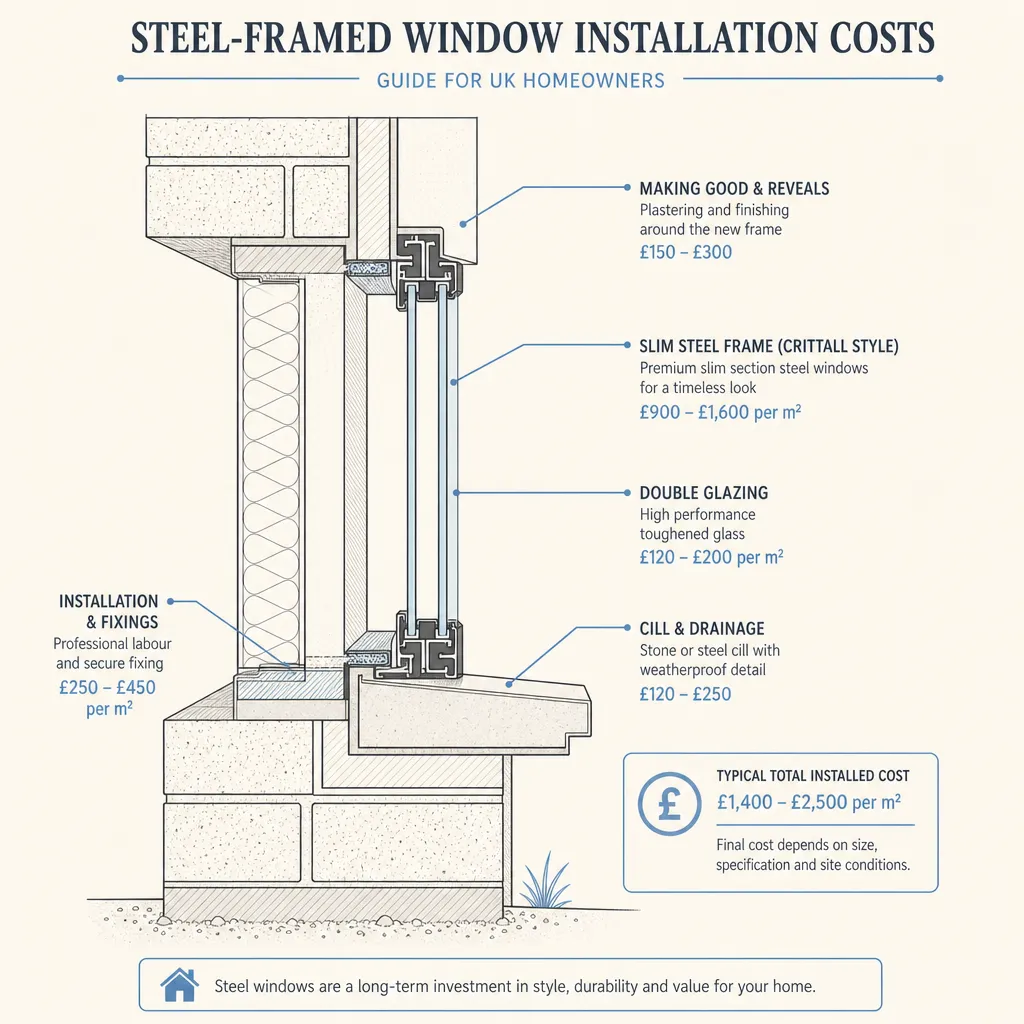
Steel-Framed Window Installation Costs
Steel-framed windows cost between £800 and £3,500 or more per window installed in the UK, depending on size, profile type, glazing specification, and whether old frames need removing.
 Improvement & Build
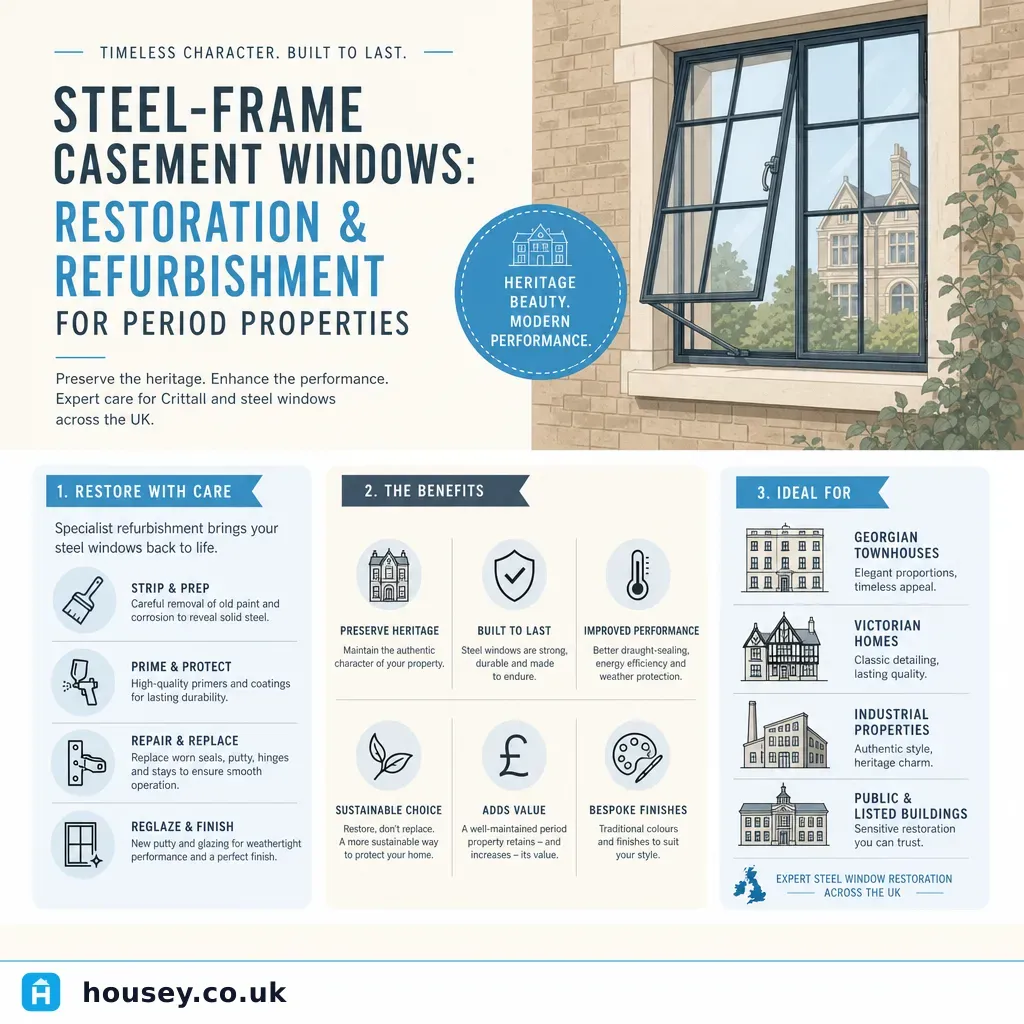
Steel-Frame Casement Windows: Restoration and Refurbishment for Period Properties
Original steel casement windows on listed buildings and conservation area properties should almost always be restored rather than replaced, as planning consent for alternative materials is usually refused.
 Improvement & Build
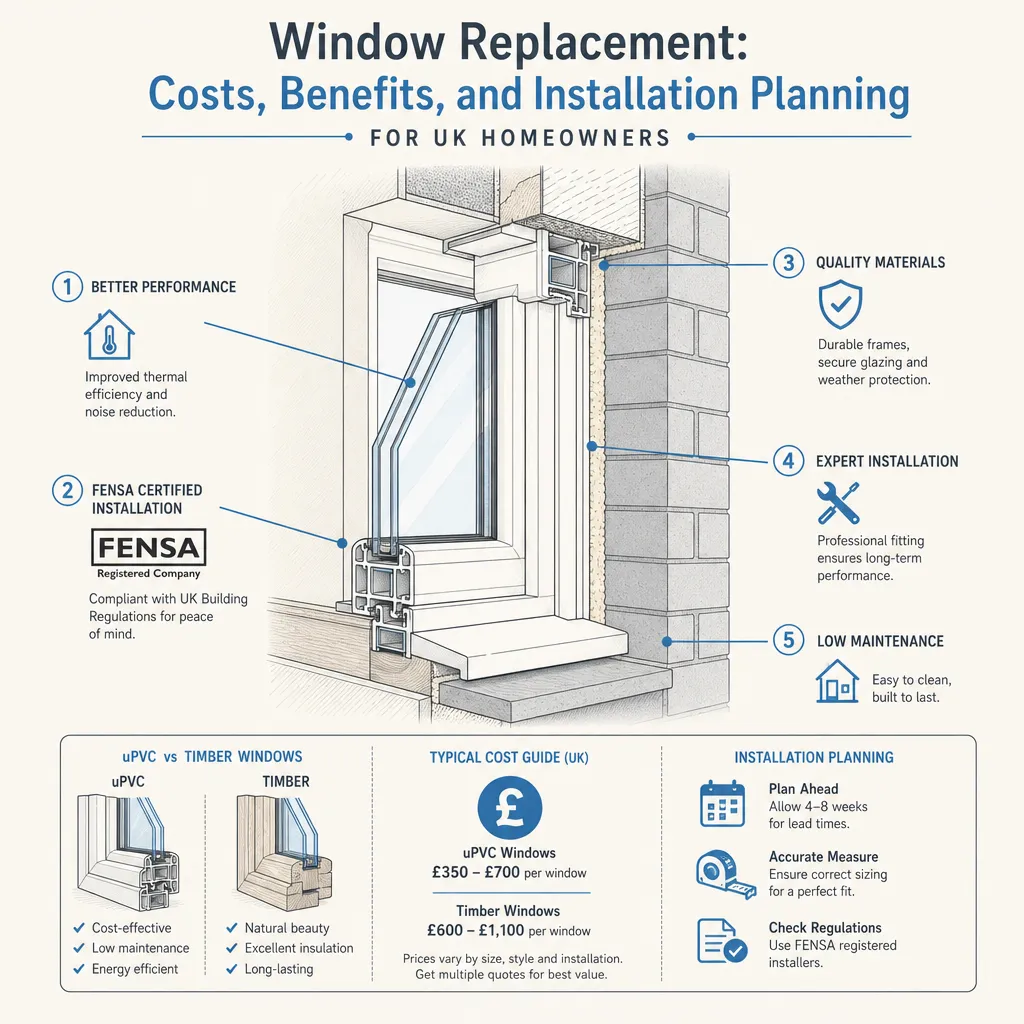
Window Replacement: Costs, Benefits, and Installation Planning
Replacing windows in most UK homes is permitted development but must meet Building Regulations Part L, requiring a whole-window U-value of 1.
 Improvement & Build
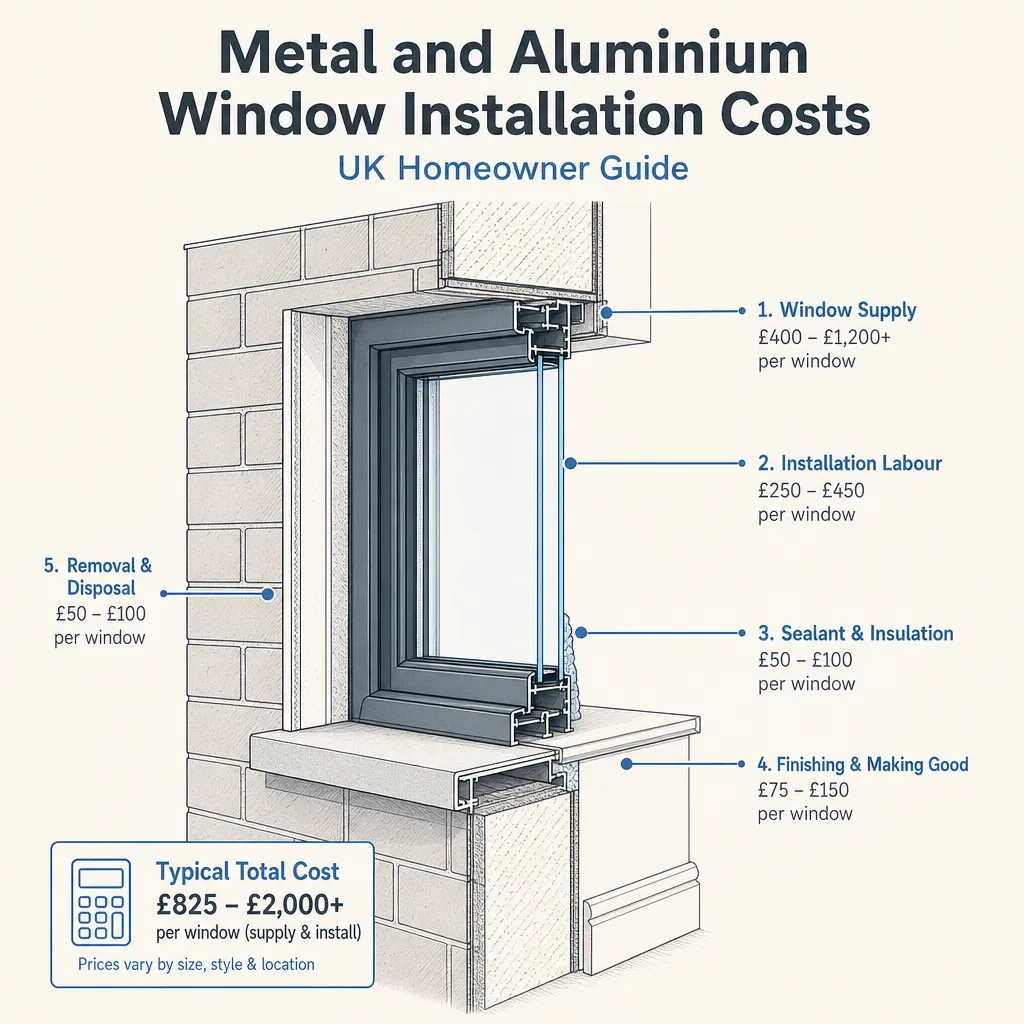
Metal and Aluminium Window Installation Costs
Aluminium window installation in the UK typically costs £450 to £1,800 per window depending on size, glazing, and frame system.
 Improvement & Build
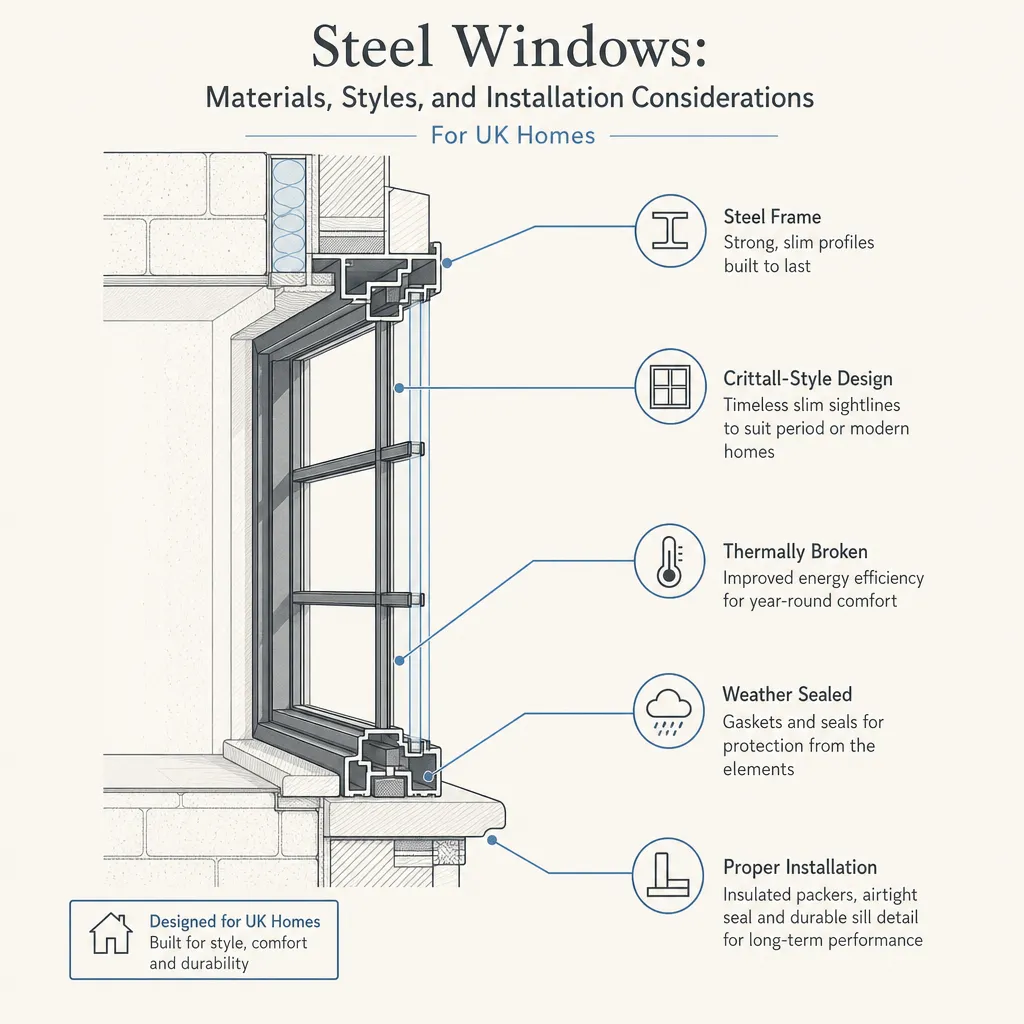
Steel Windows: Materials, Styles, and Installation Considerations
Steel windows offer exceptionally slender sightlines — as narrow as 20–38 mm — making them popular for heritage and contemporary projects alike.