Stone Wall Repair And Boundary Restoration
By Housey · Last reviewed 11th of May 2026
Stone Wall Repair And Boundary Restoration
Stone boundary walls are a common feature of older UK properties — from dry-stone field boundaries in rural areas to lime-mortared garden walls around Victorian terraces. When they fall into disrepair or fail, the questions that arise are practical, legal, and sometimes regulatory: who is responsible for the repair, whether planning consent or building control involvement is needed, and whether the structure is safe to leave while works are arranged. Getting clarity on each of these before instructing anyone saves wasted cost and avoids complications with neighbours or the local authority.
Key points
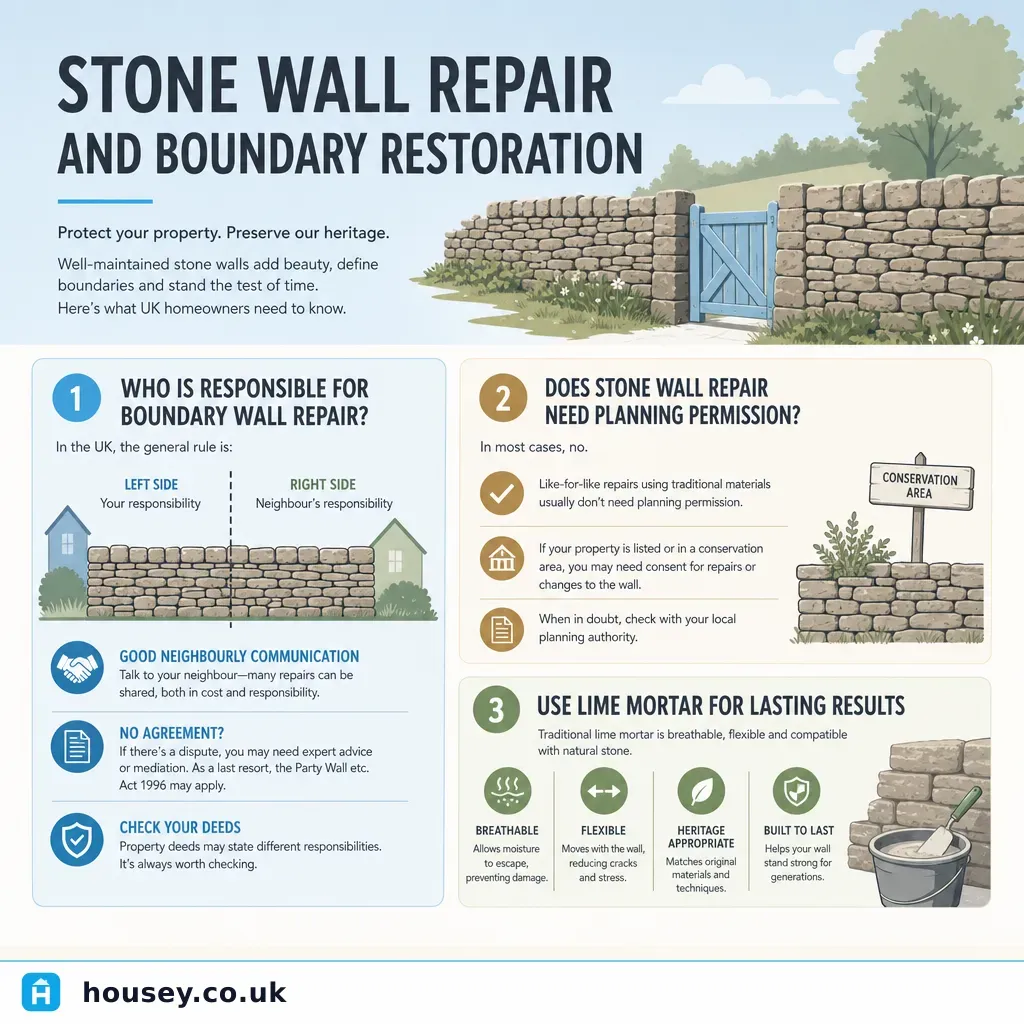
- Boundary ownership is determined by title deeds and the HM Land Registry title plan using T-marks — the party whose T-mark faces the wall has the maintenance obligation; informal conventions such as the wall always belonging to the left-hand neighbour have no legal basis.
- Planning permission may be required to rebuild or significantly alter a boundary wall exceeding 1 metre in height adjacent to a highway, or 2 metres elsewhere — and any works to walls in conservation areas or forming part of a listed building require consent regardless of height.
- Lime mortar (typically Natural Hydraulic Lime NHL 2 or NHL 3.5) must be used for repointing masonry walls built before around 1920 — Portland cement traps moisture, accelerates freeze-thaw spalling, and can cause irreversible stone damage.
- Dry-stone walls depend on the correct placement of through-stones (tie-stones binding both outer faces) and copestones at the top — repairs that omit these elements tend to fail prematurely and may affect eligibility for heritage or countryside stewardship grants.
- The Party Wall etc. Act 1996 does not directly cover boundary walls but may apply to walls on the line of junction between two properties — check whether your situation requires a party wall notice before starting work.
Is the boundary wall your responsibility?
Before spending money on repair, establish who owns the wall and holds the maintenance obligation.
How to confirm boundary ownership
- Check your title deeds or HM Land Registry title plan: T-marks indicate maintenance responsibility. A T-mark on your side of the boundary means the wall is likely yours to maintain; a T-mark on the neighbour's side suggests it is theirs; marks on both sides (an H-mark) indicate shared responsibility.
- Download the official title register: Available from the HM Land Registry search service on GOV.UK for a small fee (currently £3 for the register and £3 for the title plan).
- Check transfer deeds and covenants: Older properties may have express covenants in the transfer deed that specify maintenance obligations for boundary structures.
- Instruct a chartered boundary surveyor: If the title documents are ambiguous or a neighbour disputes responsibility, a boundary surveyor can interpret the documents and, if needed, prepare a formal boundary determination report.
Do you need planning permission or listed building consent?
Situation | Likely requirement | Who to contact |
|---|---|---|
Like-for-like repair of a standard boundary wall (non-conservation, non-listed) | Usually no consent needed under Permitted Development | Local planning authority if uncertain |
Rebuilding a wall over 1m in height adjacent to a highway | Planning permission likely required | Local planning authority |
Rebuilding a wall over 2m in height elsewhere | Planning permission may be required | Local planning authority |
Any wall in a conservation area (any height) | Prior approval or full planning permission may be needed | Conservation officer at the local planning authority |
Wall forming part of, or attached to, a listed building | Listed building consent required | Local planning authority listed buildings team |
Wall adjacent to or forming part of a scheduled monument | Scheduled monument consent required | Historic England |
Note: Article 4 Directions can remove Permitted Development rights in specific areas — always check with your local planning authority before starting any work.
Building regulations consent is not normally required for standard boundary wall repairs, but structural alterations to a retaining wall that affect ground stability or drainage may need building control sign-off.
How stone wall repair is carried out
Dry-stone walls
Dry-stone walling uses no mortar — structural integrity depends entirely on correct stone selection, coursing, and the placement of through-stones.
- Collapsed sections are rebuilt from the base up, reusing original stone where possible and maintaining batter (the slight inward lean of the faces toward the centre).
- Through-stones must be reinstated at correct intervals — approximately every metre of length and every third course of height — to bind the two outer faces together.
- Copestones should be set in a continuous, close-fitting run to shed water and consolidate the top course.
- Matching stone from the same geological formation (sandstone, limestone, gritstone, or slate) matters for structural integrity and is often required for heritage grant eligibility.
- The Dry Stone Walling Association (DSWA) accredits skilled wallers and can recommend certified contractors for restoration work.
Lime-mortared stone walls
- Loose, cracked, or Portland cement-contaminated mortar should be raked out to a minimum depth of 20mm before repointing begins.
- Replacement mortar should match the original in composition — typically an NHL mortar with local aggregate chosen to complement the stone colour.
- Movement cracks should be investigated before repointing; sealing an active crack will fail quickly and may mask a worsening structural problem.
- Masonry that has spalled due to freeze-thaw action or cement contamination may need consolidation or stone replacement rather than repointing alone.
- Historic England's published guidance on mortars, renders, and plasters provides detailed advice on lime mortar specification for traditional buildings.
When to get professional help
A skilled stonemason or traditional building contractor can handle most routine repairs to dry-stone and lime-mortared walls. Involve a specialist when:
- The wall is leaning, bulging, or has partially collapsed — particularly if near a public footpath, highway, or neighbouring property.
- There are signs of foundation movement, root intrusion, or water tracking under or through the base.
- The wall retains a significant volume of earth — a structural engineer should assess loading, drainage, and root cause before repair begins.
- Planning consent, listed building consent, or scheduled monument consent may be required.
- Boundary ownership is disputed — a chartered boundary surveyor should determine responsibility before any works are instructed.
- The wall is taller than approximately 1.5 metres or is adjacent to a public highway.
Important limitations
This article provides general information about stone wall repair and boundary ownership in England and Wales. Rules on planning permission, listed buildings, scheduled monuments, and boundary obligations vary significantly depending on a property's location, age, designation, and the specific wording of its title documents. Nothing in this article constitutes legal advice. If a boundary dispute exists, seek advice from a solicitor specialising in property law. If planning or heritage consent may be required, contact your local planning authority before starting any work.
When this becomes urgent
Seek professional assessment without delay if:
- The wall is leaning noticeably, has bulged, or has partially collapsed close to a public footpath, highway, or neighbouring property — there may be an immediate liability for injury or damage.
- A vehicle or tree has struck the wall.
- You can see progressive cracking or movement in the foundation zone.
- The wall retains significant earth and water is pooling at its base or tracking through the structure.
- A neighbour or third party is claiming the wall is your responsibility and threatening legal action.
What to ask a qualified professional
Before instructing a stonemason, masonry contractor, or structural engineer for stone wall repair, ask:
- What is causing the damage — is the wall still moving, or has it stabilised?
- Do I need planning permission, listed building consent, or any other approval before works begin?
- Is this a like-for-like repair, or does the design need to change (for example, adding a drainage channel or altering the foundation)?
- What lime mortar specification will you use, and why is it appropriate for this particular wall?
- Can you source matching stone, and where will it come from?
- What is your assessment of the wall's remaining service life after repair?
- Are there underlying issues — ground movement, root intrusion, or drainage problems — that need to be addressed alongside the repair?
- Do you carry Professional Indemnity and Public Liability insurance?
- Will you provide a written specification and completion report?
How Housey can help
If you need to establish who is responsible for a boundary wall or require a formal boundary determination, chartered boundary surveyors accessible through Housey can interpret title documents and produce the reports you need. For walls showing signs of structural movement or foundation failure, structural engineering consultants can assess the root cause and specify the correct repair approach before you appoint a contractor.
Frequently asked questions
Who is responsible for a boundary wall between two properties?
Responsibility is determined by the title deeds and HM Land Registry title plan, not by informal conventions. T-marks on the plan indicate the maintaining party. If there are no T-marks, responsibility may be shared or the position unclear. A chartered boundary surveyor or property solicitor can advise on the legal position.
Can I use cement mortar to repair an old stone wall?
You should avoid Portland cement mortar on stone walls built before around 1920. Cement is harder and less permeable than the original lime mortar and surrounding stone, trapping moisture and accelerating freeze-thaw damage and progressive spalling. Lime mortar matched to the original mix and aggregate is the correct approach for traditional masonry.
Do I need permission to repair a stone wall in a conservation area?
Possibly. Even like-for-like repairs in a conservation area may require prior approval or planning permission depending on the wall's height and location. Contact your local planning authority's conservation officer before starting any work — this applies to boundary walls and to walls forming part of a building's historic fabric.
What are the most common causes of stone boundary wall failure?
Common causes include ground movement from seasonal shrinkage and swell in clay soils, root intrusion from nearby trees or shrubs, poor drainage causing water to accumulate at the base, freeze-thaw action on saturated masonry, incompatible cement mortar repairs that trap moisture, impact damage, and lack of ongoing maintenance allowing water ingress into the wall core.
Sources and further reading
- Search for property information at HM Land Registry — GOV.UK
- Planning permission: walls, fences and gates — GOV.UK
- Conservation areas — Historic England
- Mortars, renders and plasters — Historic England
- Party Wall etc. Act 1996 guidance — GOV.UK
- Dry Stone Walling Association — DSWA
Useful next reads
 Planning & Pre-Build
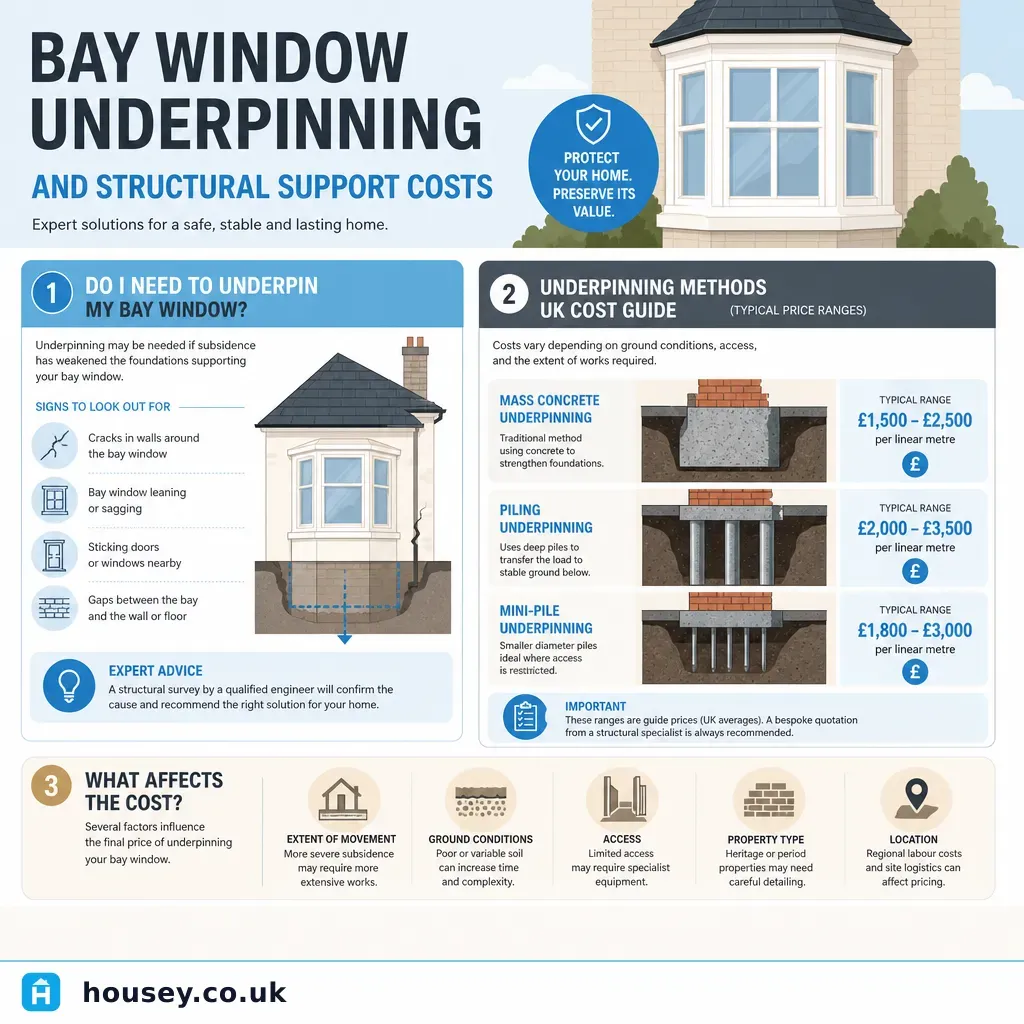
Bay Window Underpinning and Structural Support Costs
Bay window underpinning in the UK typically costs £3,000–£10,000 per bay for traditional mass concrete methods, with resin injection and mini-piling in a similar range depending on depth and site conditions.
 Planning & Pre-Build
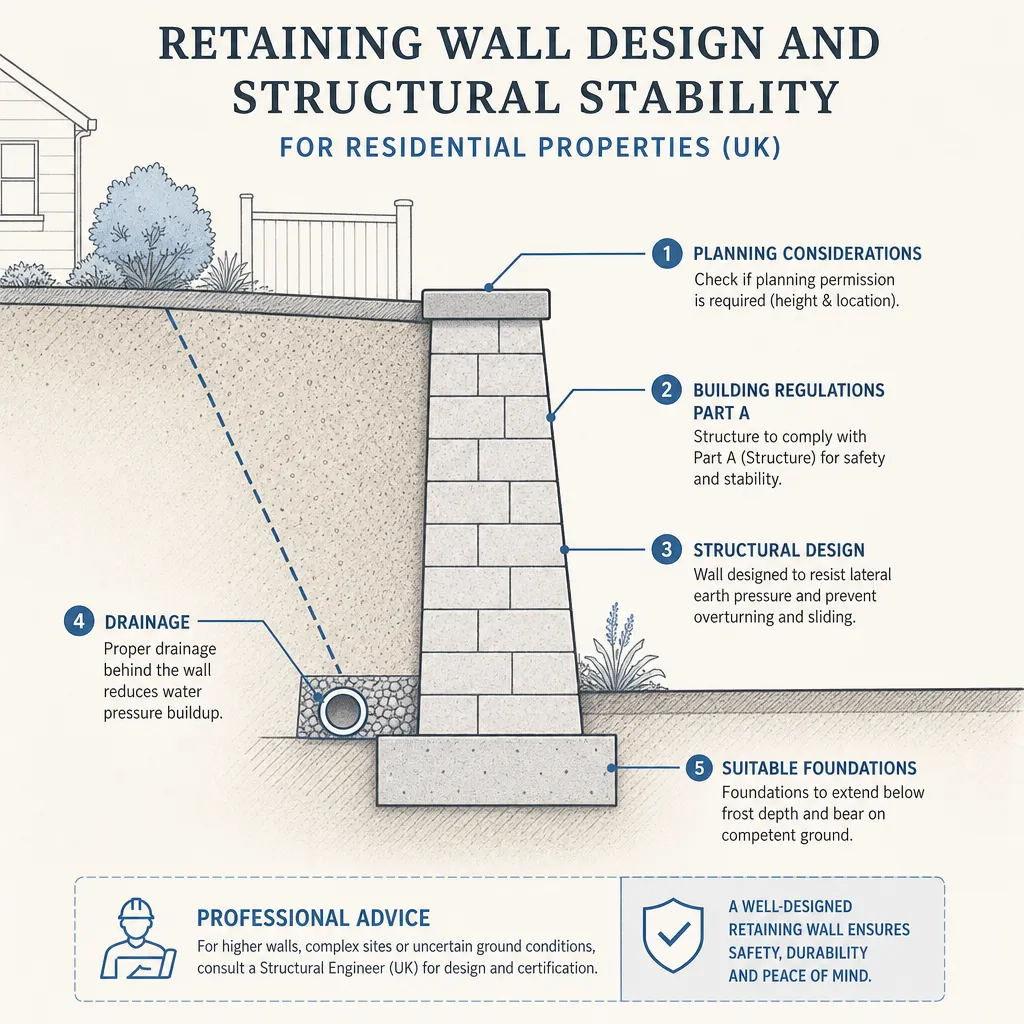
Retaining Wall Design and Structural Stability for Residential Properties
Retaining walls over around 1 m in height usually need structural engineer assessment; walls over 2 m almost always require a formal structural design and building control approval.
 Planning & Pre-Build
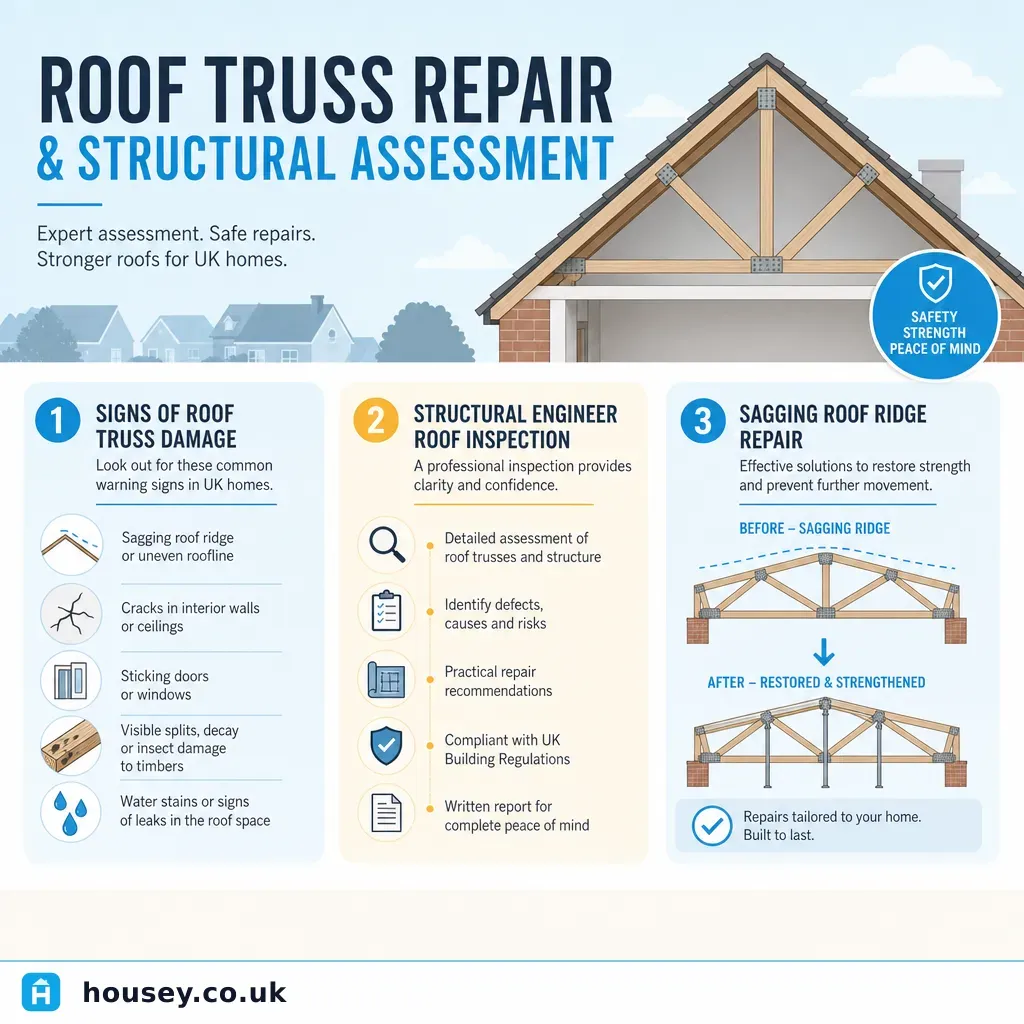
Roof Truss Repair and Structural Assessment
Roof truss damage — from rot, woodworm, overloading, or accidental cutting — requires a structural engineer's assessment before any repair work begins.
 Planning & Pre-Build
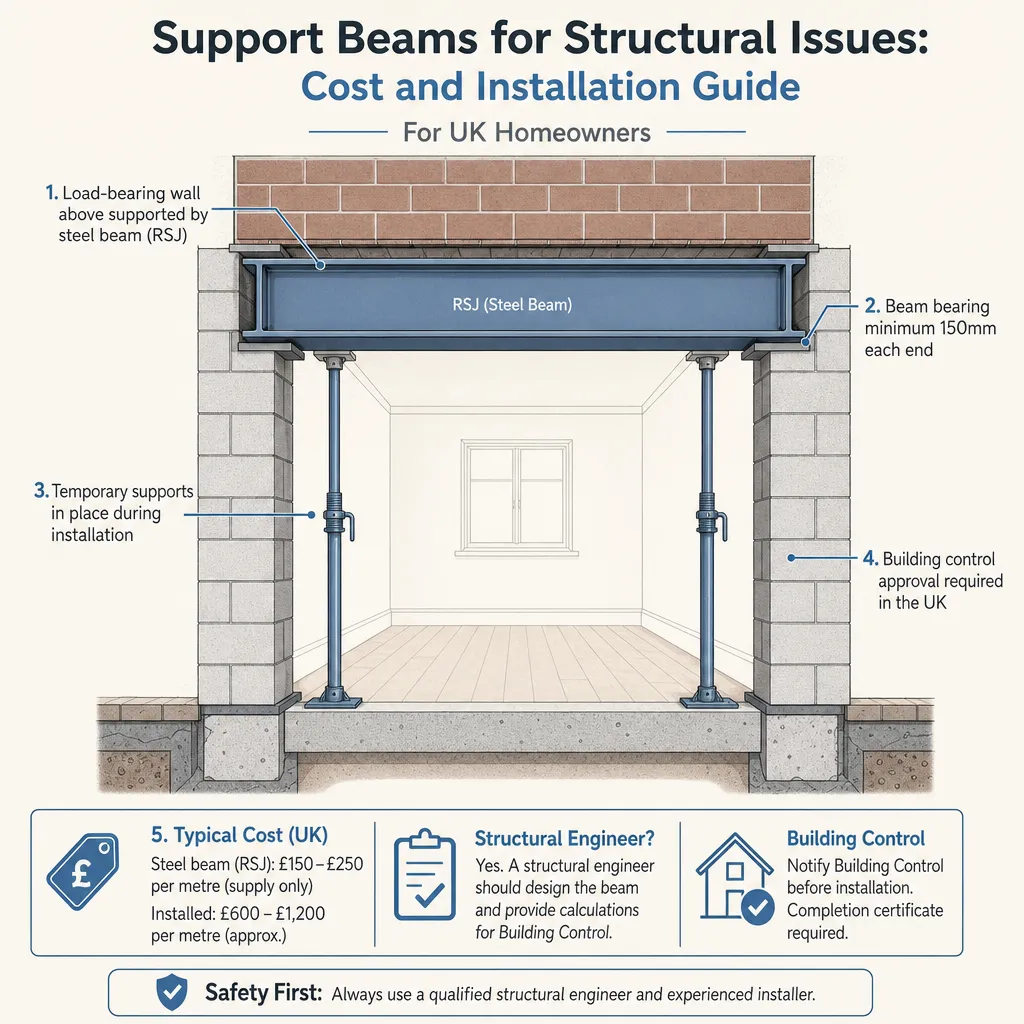
Support Beams for Structural Issues: Cost and Installation Guide
Installing a structural support beam in a UK property typically involves a structural engineer's calculations, temporary propping, and building control sign-off.
 Planning & Pre-Build
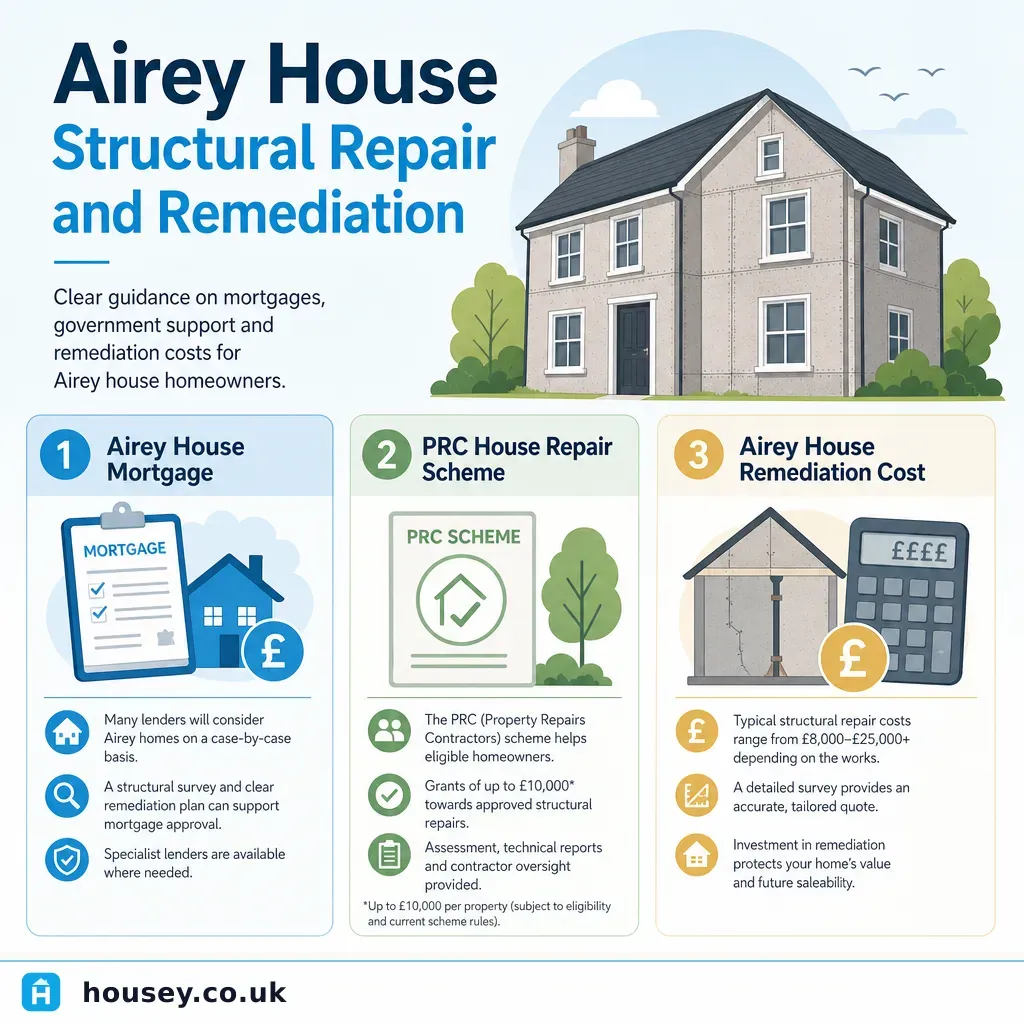
Airey House Structural Repair and Remediation
Unremediated Airey houses are generally unmortgageable.