Strategic Guide To Planning And Budgeting Property Renovation Investments
By Housey · Last reviewed 18th of May 2026
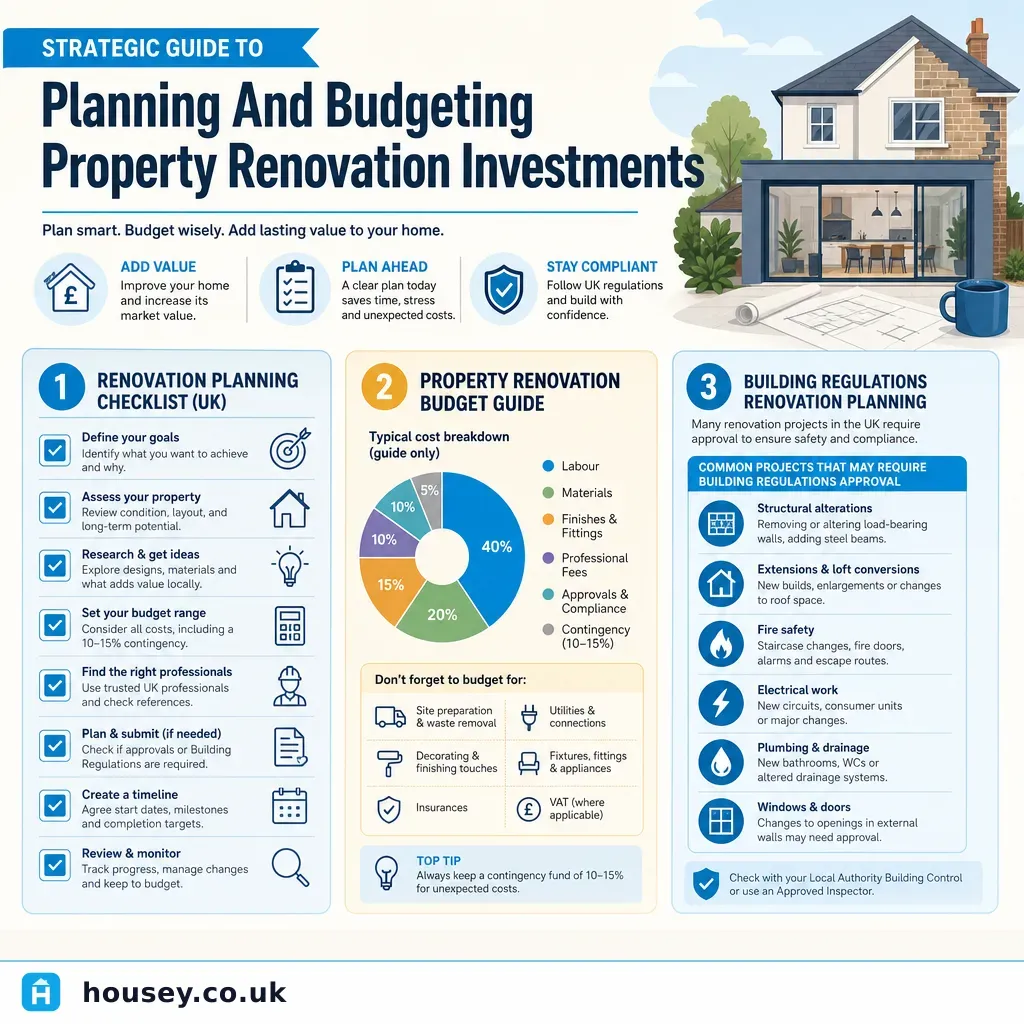
Strategic Guide To Planning And Budgeting Property Renovation Investments
Renovation projects in the UK fail most often not because of poor workmanship but because of inadequate planning at the outset — scope that grows mid-project, budgets without contingency, and regulatory surprises that halt work and trigger abortive costs. Whether you are renovating a 1930s semi for your own occupation or refurbishing a buy-to-let flat, the quality of your pre-build preparation determines the outcome more than any individual trade decision.
Key points
- Building regulations approval is legally separate from planning permission; many structural and services works require approval regardless of whether planning permission is needed.
- A well-structured renovation budget has three distinct layers: trade contract costs, professional fees (typically 5–15% of build cost), and a contingency of 15–20%.
- The standard renovation critical path is: structural and weatherproofing → demolition and strip-out → first fix (electrics, plumbing) → insulation → plastering → second fix → decoration → finishes.
- A written contract — such as a JCT Minor Works Building Contract — with every trade is a legal protection, not an optional formality; verbal agreements are difficult to enforce.
- Phasing projects into logical stages can reduce borrowing costs and allow learning from early phases to inform later specification decisions.
Phase 1: Defining what the project involves
The most common renovation planning failure is starting with an incomplete scope. Before professional fees are incurred or contractors approached, the homeowner needs to establish three things:
- What the property currently has — existing condition, regulatory compliance status, and any previous works (for example, is there a valid FENSA certificate for the windows? Has prior electrical work been notified to building control under Part P?)
- What the project needs to achieve — both to meet minimum legal and safety standards, and to reach the desired end state
- What triggers planning permission versus building regulations — these are different legal tests with different processes
Planning permission versus building regulations: a comparison
Test | Planning permission | Building regulations |
|---|---|---|
What it controls | Visual impact, land use, neighbourhood character | Structural safety, energy performance, fire safety, drainage |
Who administers | Local planning authority (LPA) | Local authority building control (LABC) or Approved Inspector |
Typical timescale | 8 weeks for householder applications | Stage inspections throughout; full plans approval within 5 weeks |
Exemptions | Many works are permitted development | No equivalent — most structural and services works require approval |
Consequences of non-compliance | Enforcement notice; possible requirement to reverse works | Unsafe structure; difficulties on sale; missing completion certificates |
Works that often require both: extensions, loft conversions, outbuildings exceeding permitted development thresholds, garage-to-habitable-space conversions.
Works that typically require building regulations only (not planning): structural internal alterations, rewiring, new heating systems, replacement windows via a non-FENSA installer.
Works that typically require neither: redecorating, replacing like-for-like kitchen units to an existing layout (check if drainage alterations are involved), non-structural partition walls in most cases.
Always check with your local planning authority (LPA) if you are uncertain — permitted development rights can be removed by Article 4 Directions in conservation areas and some other designations.
Phase 2: Establishing a realistic budget
A renovation budget that survives contact with reality has three distinct components.
Component 1 — Trade contract costs The sum of all priced and scoped quotes from builders, electricians, plumbers, plasterers, decorators, and other specialists. This should be based on at least three comparable itemised quotes per major trade.
Component 2 — Professional fees Architect or architectural technician, structural engineer, project manager, building control consultant, energy assessor. For minor projects, professional fees may be modest; for loft conversions, extensions, or significant structural alterations, expect 10–15% of build cost.
Component 3 — Contingency
- 15% for properties in known reasonable condition, post-1960 construction
- 20% for pre-1945 properties, unusual construction, or any property with an incomplete service history
- 25% where significant structural unknowns exist or concealed works are anticipated
Quote comparison template
When gathering quotes from contractors, use this template to ensure you are comparing like for like:
Item | Contractor A | Contractor B | Contractor C | Notes |
|---|---|---|---|---|
Scope: what is included |
|
|
| Check exclusions carefully |
Scope: what is excluded |
|
|
| Identify gaps between quotes |
Start date |
|
|
| Confirm availability |
Programme duration |
|
|
| Verify against similar projects |
Payment schedule |
|
|
| Avoid more than 30% upfront |
VAT included? |
|
|
| Confirm before comparing totals |
Building regs notifications |
|
|
| Who submits and manages? |
Qualifications and accreditations |
|
|
| NICEIC, Gas Safe, FMB, etc. |
Warranty or guarantee |
|
|
| Workmanship and materials |
References provided |
|
|
| Request and follow up |
The lowest headline price frequently omits items that other quotes include — always reconcile the scope before comparing totals.
Phase 3: Programme and sequencing
Renovation works must proceed in a logical order to avoid abortive work and to comply with building regulations inspection requirements.
Renovation critical path — decision points at each stage
- Start with surveys and specialist reports — asbestos assessment (mandatory for pre-2000 properties before demolition or drilling), EICR, drain survey, structural assessment if required. Do not begin physical works without these.
- Structural works first — underpinning, new beams, roof structure. Building control stage inspection required before structural elements are covered.
- Weatherproofing before internal works — roof covering, windows, external walls. Protect the structure before committing to internal finishes.
- Demolition and strip-out — once the building is watertight and structural works are complete.
- First fix — electrical cabling, plumbing pipework, central heating pipework and radiators. Do not plaster before first fix.
- Insulation — loft, cavity fill, or solid wall insulation; building control inspection may be required before covering.
- Plastering and screeding — after first fix inspections are signed off.
- Second fix — electrical fittings, plumbing connections, kitchen and bathroom installation.
- Decoration, flooring, and finishes — last.
- External works — paths, drainage, landscaping, often run in parallel with later internal stages.
Renovation planning checklist
Use before instructing any professional or accepting any quote:
Phase 4: Risk management
The risks that most frequently derail UK renovation projects:
Hidden defects — pre-existing conditions not visible at survey stage. Mitigate with a thorough pre-works condition survey and a realistic contingency budget.
Asbestos — present in most properties built or altered before 2000. Any demolition, drilling, or removal of suspect materials requires a licensed asbestos assessment before work begins. Do not disturb suspect materials.
Regulatory non-compliance — works done without building regulations approval cannot easily be retrospectively approved and cause significant problems on conveyancing. Keep all completion certificates.
Contractor insolvency or abandonment — a real risk on fixed-price contracts. Mitigate with stage payments tied to inspected work and a retention held until defects liability expires.
Programme overruns — most renovation projects in the UK run 10–20% longer than initial programmes suggest. Build float into the timeline, particularly around trade handovers and material delivery windows.
When to get professional help
Renovation projects of significant scale benefit from professional input at the planning stage. In particular:
- If the project involves structural alterations, engage a qualified structural engineering assessment before preparing or finalising the scope — load paths must be understood before specification is fixed
- For complex multi-trade projects, a project manager can coordinate sequencing, procurement, and site management and will often save more than their fee in abortive costs avoided
- For building regulations submissions, a building control consultant can advise on compliance requirements and manage the inspection process throughout the build
- Any project involving structural alterations or an extension will require building regulations drawings prepared to an appropriate standard for submission
How Housey can help
Housey connects homeowners with qualified professionals for every stage of renovation planning — from structural engineering assessments and project managers to building regulations drawings and building control consultants. Submit a job request to receive comparable quotes from vetted local professionals.
Frequently asked questions
Do I need an architect for a renovation project in the UK?
Not always. For straightforward works — replacing services, redecorating, or minor non-structural alterations — an architect is not required. For loft conversions, extensions, structural alterations, or anything requiring planning permission, drawings prepared by an architect or architectural technician are usually needed for both planning and building control submissions. A structural engineer is also required wherever beams or load-bearing walls are involved.
How do I verify that a contractor is qualified for regulated works?
For electrical work, check that the contractor is registered with a Competent Person Scheme such as NICEIC or NAPIT. For gas work, the engineer must appear on the Gas Safe Register — verifiable at gassaferegister.co.uk. For general building work, look for membership of the Federation of Master Builders (FMB) and ask for evidence of current public liability insurance and at least two recent references.
What happens if I carry out works without building regulations approval?
If building regulations approval was required and not obtained, you may face enforcement action. More practically, when you sell the property, the conveyancing process will reveal missing completion certificates. This can slow or prevent a sale and may require a retrospective regularisation application or indemnity insurance. The safest approach is always to obtain approval before work begins.
Can I phase a renovation project to spread the cost?
Yes, and for larger projects this is often sensible. Phasing allows you to learn from early stages, refine the specification before committing to later works, and spread financing over a longer period. The key is ensuring earlier phases do not create problems for later ones. A logical phasing plan should be agreed with your project manager or lead contractor before any works begin.
Sources and further reading
- Building Regulations: applying for approval — GOV.UK
- Planning permission — GOV.UK guidance — GOV.UK
- JCT Minor Works Building Contract — Joint Contracts Tribunal
- NICEIC — electrical competent person scheme — NICEIC
- Gas Safe Register — check an engineer — Gas Safe Register
- Federation of Master Builders — find a builder — Federation of Master Builders
Useful next reads
 Planning & Pre-Build
Designing Homes That Are Accessible and Inclusive
Accessible home design in the UK is guided by Building Regulations Approved Document M, which sets three standards for new dwellings: Category 1 (Visitable), Category 2 (Accessible and Adaptable), and Category 3 (Wheelchair User Dwelling).
 Planning & Pre-Build
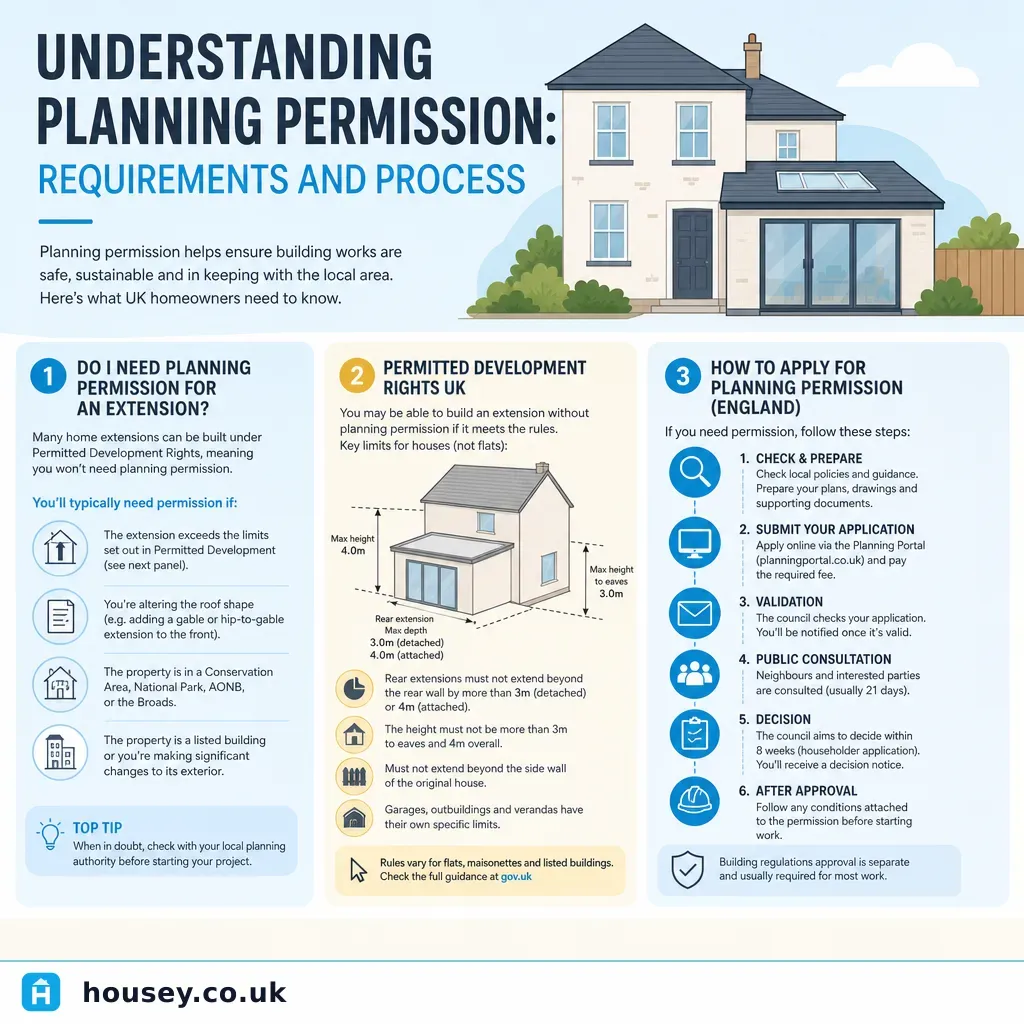
Understanding Planning Permission: Requirements and Process
Planning permission is required for most new buildings, significant extensions, and material changes of use in England and Wales.
 Planning & Pre-Build
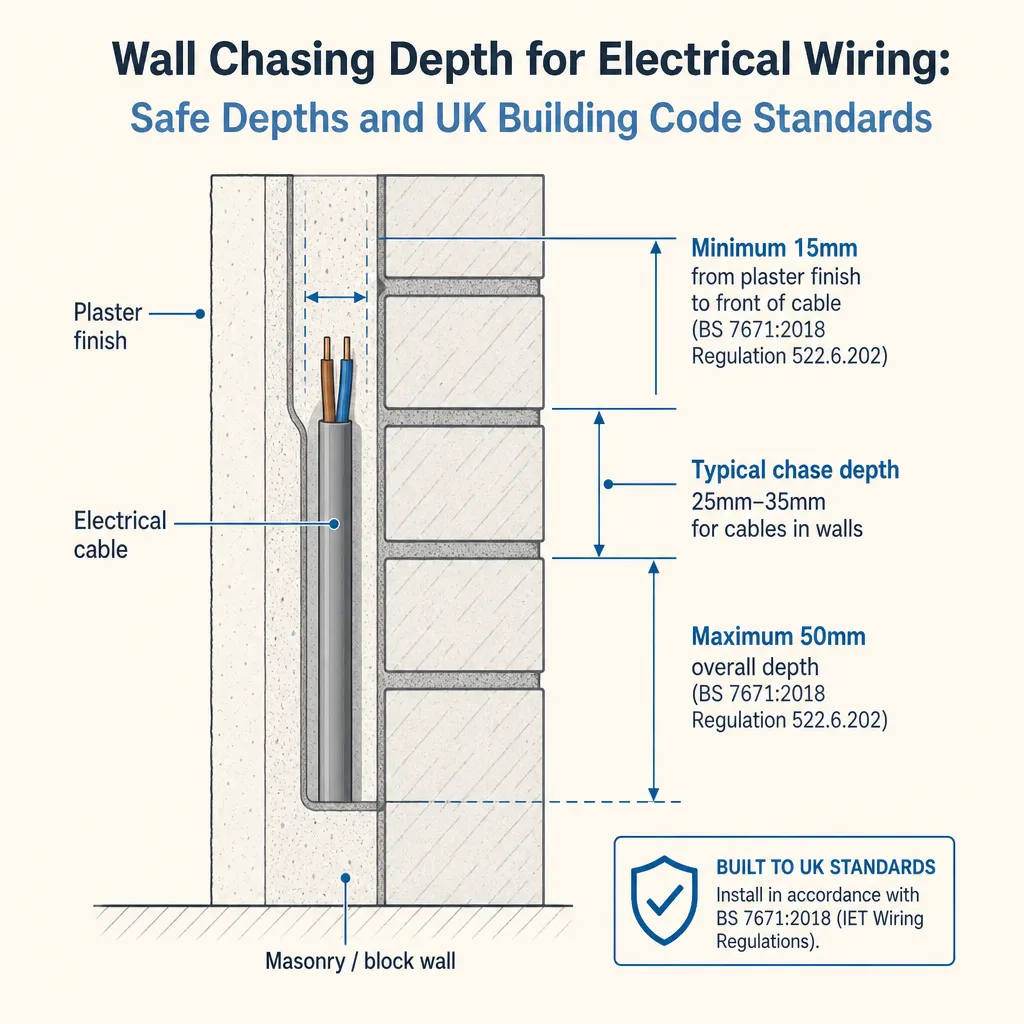
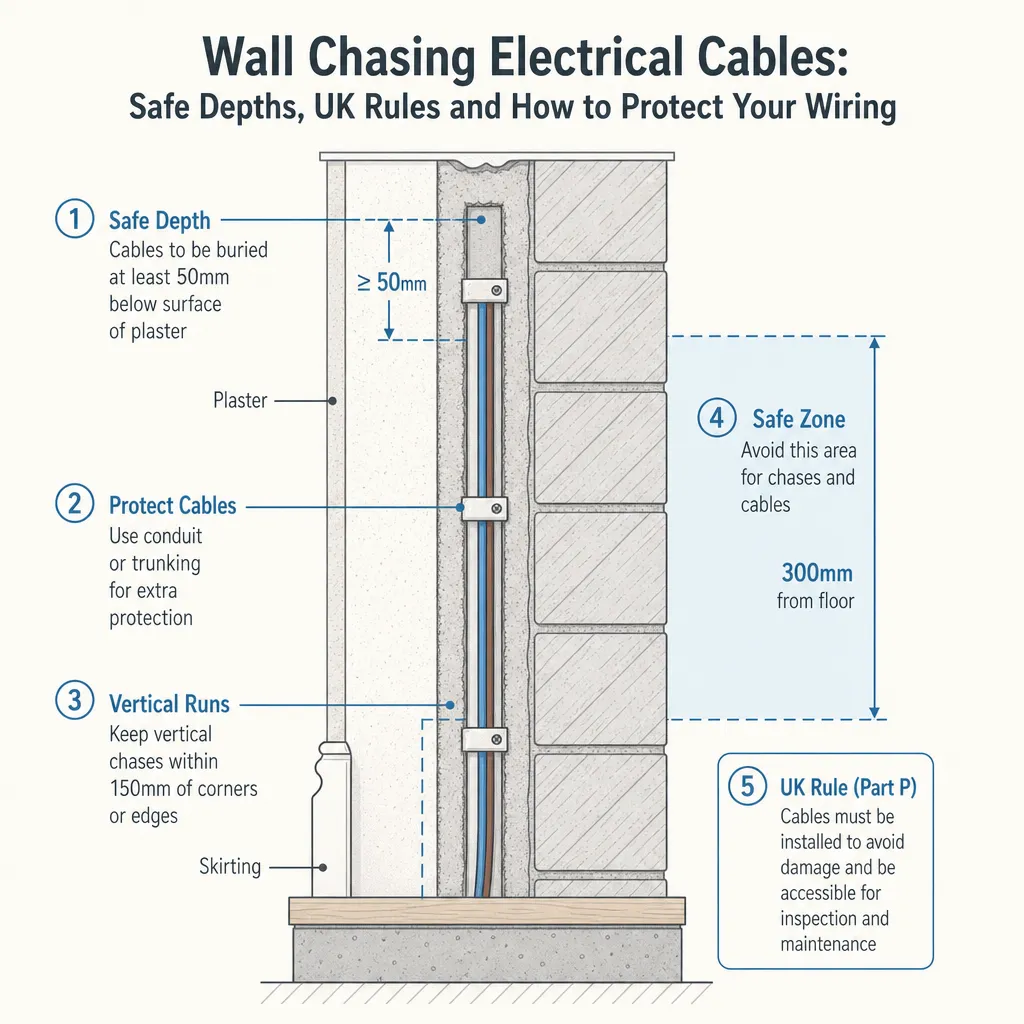
Wall Chasing Depth for Electrical Wiring: Safe Depths and UK Building Code Standards
Cables chased into walls must be within BS 7671 safe zones — within 150 mm of a ceiling, floor, or corner junction — or enclosed in rigid conduit for mechanical protection.
 Planning & Pre-Build
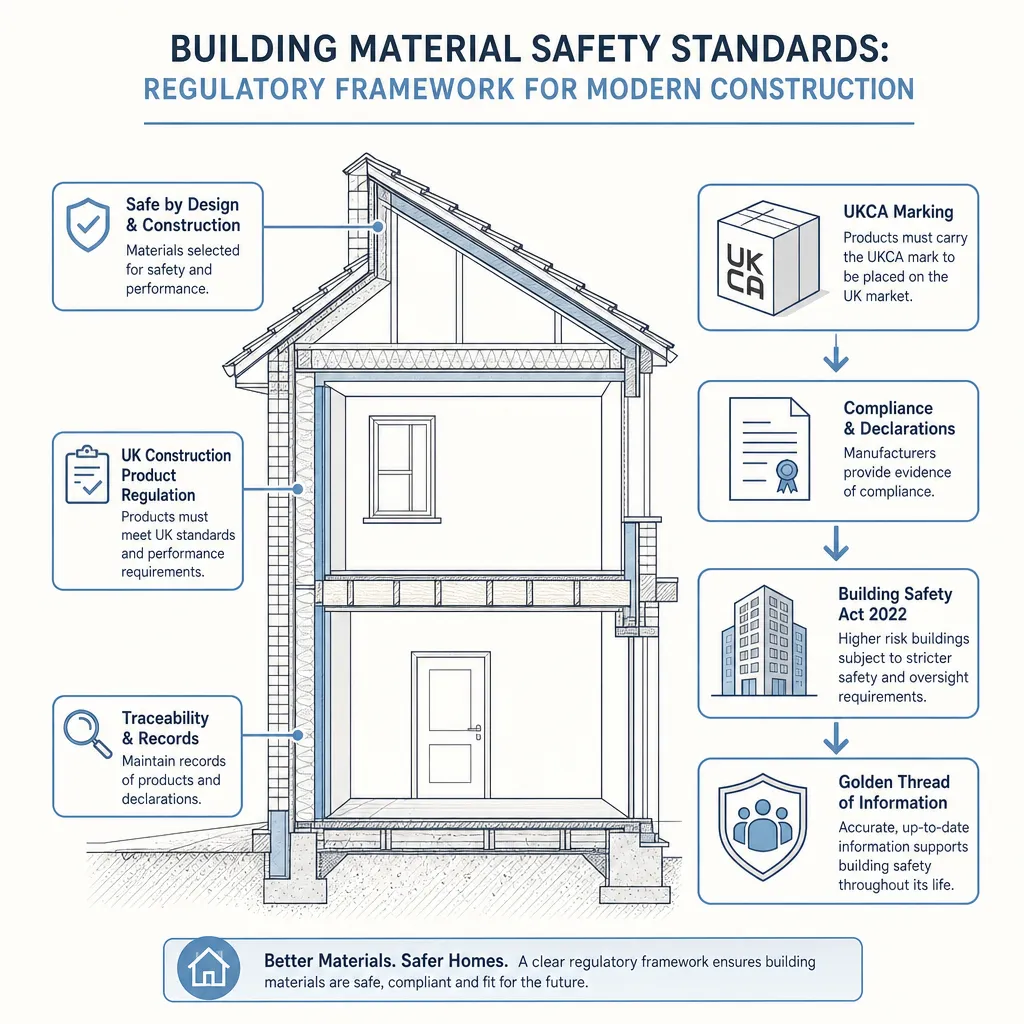
Building Material Safety Standards: Regulatory Framework for Modern Construction
UK building material safety standards are set through the Building Regulations 2010 and associated Approved Documents covering structure, fire, damp, energy, and ventilation.
 Planning & Pre-Build
Wall Chasing Electrical Cables: Safe Depths, UK Rules and How to Protect Your Wiring
Wall chasing depth for electrical cables in UK homes must allow around 25mm of plaster or render cover over the cable.