Complete Guide to Stripping and Re-felting Roof Coverings
By Housey · Last reviewed 6th of May 2026
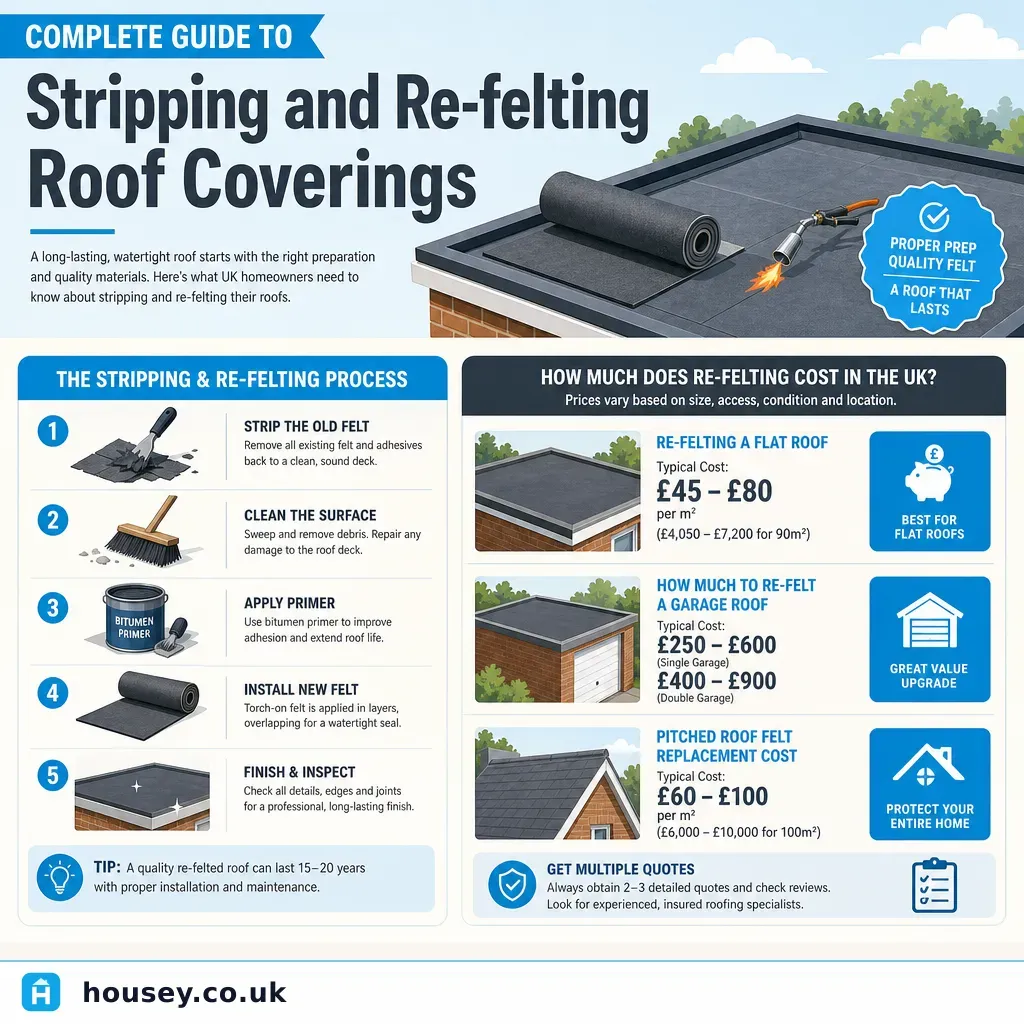
Complete Guide to Stripping and Re-felting Roof Coverings
Re-felting a roof becomes a priority when homeowners notice damp patches on interior ceilings, blistering or cracked felt, or standing water on a flat roof. The question most often arises with garages, outbuildings, flat-roofed extensions, and older bay windows — though pitched roofs with degraded underfelt also need attention when re-tiling is undertaken. Understanding what the work involves, which covering system suits your roof, and what a reasonable cost looks like will help you instruct the right contractor with confidence.
Key points
- Traditional bitumen felt on flat roofs has a service life of approximately 10–20 years; modern alternatives such as EPDM rubber and GRP fibreglass can last 25–50 years or more.
- Working at height beyond 2 metres should not be attempted as a DIY task — use a qualified roofer with appropriate access equipment, and confirm they hold public liability insurance before work starts.
- Re-felting without stripping the old covering is rarely advisable: the condition of the deck boards and structural timbers must be assessed before a new covering is specified.
- For flat roof replacements on heated habitable spaces, Building Regulations Part L (conservation of fuel and power) may require upgraded insulation to be incorporated as part of the works.
- Indicative costs for re-felting a standard garage roof (approximately 20–25 m²) range from £800–£1,800 using traditional felt, rising to £1,500–£3,000 for EPDM or torch-on systems (Indicative UK costs, last reviewed 2026-05-06).
When does a roof covering need replacing?
Felt and other bituminous coverings degrade over time through UV exposure, freeze-thaw cycling, thermal movement, and ponding water. Signs that a roof covering needs attention include:
- Blistering or bubbling on the felt surface, indicating moisture trapped beneath the membrane.
- Cracking or splitting at seams, drip edges, and upstands — these are the most common points of water entry.
- Ponding water that remains on a flat roof for more than 48 hours after rainfall, suggesting the drainage falls have deteriorated or the deck has deflected.
- Interior damp patches on ceilings below, which can track some distance from the actual entry point.
- Moss and vegetation growth along seams and upstands, which hold moisture and accelerate deterioration of the membrane.
- Age — if a bitumen felt roof is over 15 years old and shows any of the above signs, a full strip and re-cover is usually more cost-effective than repeated patch repairs.
What the work involves
Strip-out and deck inspection
A proper re-felting job begins with stripping the old covering back to the structural deck. On a typical flat roof, this exposes the timber deck boards — usually tongued-and-grooved softwood boarding or exterior-grade plywood. The roofer should inspect for:
- Rot, delamination, or deflection in deck boards — any soft or springy areas should be replaced before the new covering is applied.
- Inadequate falls — flat roofs should have a minimum fall of 1:80 to drain effectively; some systems require 1:40 or better.
- Condition of joists and structural timbers — if significant rot or movement is suspected, a structural survey may be advisable before the new covering is specified and priced.
Replacing the decking
Rotten or delaminating deck boards must be replaced before any new membrane is laid. New boards — typically 18 mm exterior-grade plywood or OSB3 — are fixed to the existing joists. Deck replacement adds to the project cost: typically £80–£180 per sheet fitted, depending on access and joist condition.
Applying the new covering
The specification of the new covering depends on the roof type, the required service life, and budget.
Covering type | Suitable for | Typical lifespan | Approx. installed cost per m² | Notes |
|---|---|---|---|---|
Three-layer bitumen felt (traditional) | Garages, sheds, outbuildings | 10–20 years | £30–£60 | Lowest upfront cost; shortest lifespan |
Torch-on felt (SBS/APP modified bitumen) | Garages, extensions, balconies | 20–30 years | £50–£80 | Better performance; requires trained installer with gas equipment |
EPDM rubber membrane | All flat roof types | 25–50+ years | £60–£100 | Cold-applied; excellent longevity and UV resistance |
GRP fibreglass | Balconies, bay windows, complex shapes | 25–40+ years | £70–£120 | Hard, walkable surface; suits intricate details and upstands |
Liquid waterproofing | Awkward shapes, refurbishment overlays | 20–25 years | £50–£90 | Cold-applied; some systems can be laid over existing surfaces |
Indicative UK costs per m², last reviewed 2026-05-06. Costs exclude deck replacement, scaffolding, and VAT.
Upstands, flashings, and drainage
A re-felting job must address all upstands — where the covering turns up against a wall, parapet, or kerb — and all drainage outlets. These are the most common points of water ingress. Lead or aluminium flashings where the roof covering meets a vertical wall should be inspected and replaced or repointed as part of the works, not left to the next maintenance cycle.
Do I need Building Regulations approval?
A like-for-like replacement of a roof covering — stripping old felt and applying a new felt or similar membrane — generally does not require Building Regulations approval as a routine repair and maintenance activity.
However, approval may be required if:
- The work constitutes a material alteration, such as changing the structural deck or significantly altering drainage arrangements.
- The roof is over a heated habitable space and the project represents an opportunity to upgrade insulation to meet Part L standards — check with your local authority building control whether the replacement triggers a compliance obligation.
- The property is a listed building or in a conservation area, where consent may be required before changing the appearance or material of the roof covering.
- The building is subject to an HMO licence, where maintenance and fire-safety standards are more prescriptive than for single dwellings.
Red flags when hiring a roofer
Before instructing any roofing contractor, watch for these warning signs:
- No written quote or specification — always obtain a written quote detailing the covering system, deck replacement provisions, flashing details, drainage treatment, and guarantee terms.
- Cash-only with no VAT receipt — legitimate contractors carry insurance and provide documentation; a cash-only offer offers no recourse if work fails.
- No evidence of public liability insurance — ask before work starts; minimum £1 million cover is standard, ideally £2 million or more for domestic roofing work.
- High-pressure doorstep selling — unsolicited callers who claim to have spotted your roof from the road and press for an immediate decision should be declined; always obtain at least three independent written quotes.
- No mention of a deck inspection — a roofer who proposes to felt over an uninspected deck without stripping is cutting corners that will cost you more later.
- No manufacturer guarantee discussed — reputable EPDM and GRP systems carry manufacturer-backed guarantees when installed by an approved applicator; ask whether the installer holds that status and whether the guarantee is transferable on sale.
Indicative cost guide
Job | Low estimate | High estimate | Notes |
|---|---|---|---|
Garage flat roof (20–25 m²), traditional felt | £800 | £1,800 | Strip, new felt, flashings |
Garage flat roof (20–25 m²), EPDM | £1,500 | £3,000 | Strip, EPDM membrane, flashings |
Extension flat roof (30–40 m²), torch-on felt | £1,800 | £3,500 | Strip, torch-on, deck check included |
Extension flat roof (30–40 m²), GRP | £2,500 | £4,500 | Strip, GRP system, deck boards included |
Bay window flat roof (5–8 m²), GRP | £600 | £1,200 | Small area, high detailing required |
Partial deck board replacement | £80/sheet | £180/sheet | 18 mm exterior plywood, fitted |
Indicative UK costs, last reviewed 2026-05-06. Add scaffold costs (typically £300–£800 for a garage-scale job) and VAT at 20% on top of these figures.
When to get professional help
Re-felting is not suitable as a DIY task where working at height is involved. Engage a qualified structural survey provider or qualified roofers if:
- The roof is above single-storey height — scaffolding or proper access equipment is required by law for most roofing work above 2 metres.
- Deck boards show significant deflection, softness, or rot — this may indicate joist damage requiring a structural assessment before the new covering is specified.
- Interior damp is already established — the extent of water damage needs professional assessment before re-covering proceeds.
- The roof is on a listed building or within a conservation area — contact your local planning authority before any work begins.
Never walk on a flat roof without proper boarding-out; a weakened deck can give way without warning, causing serious injury.
How Housey can help
Housey makes it straightforward to request quotes from qualified roofers across the UK. If your roof inspection has revealed structural concerns — deflecting joists, rot in ceiling timbers, or signs of prolonged water damage — Housey can also connect you with providers offering a structural survey to assess the extent of any damage before re-covering work begins.
Frequently asked questions
How long does re-felting a garage roof take?
A straightforward garage flat roof re-felt typically takes one to two days, depending on deck condition and the covering system chosen. If deck boards need replacing, allow an additional half-day to a full day. GRP and some liquid systems require curing time and may extend the programme by a further day before the area can be used normally.
Is EPDM better than traditional felt for a UK flat roof?
For most UK flat roofs, EPDM rubber offers significantly better longevity — 25 to 50 years versus 10 to 20 for traditional felt — and is cold-applied, removing the fire risk of torch-on systems. It is also highly resistant to UV exposure and freeze-thaw cycling. The higher upfront cost is generally offset by the extended service life and reduced maintenance.
Can I re-felt a roof myself?
Single-storey garden sheds at or very near ground level can in principle be re-felted by a competent DIYer using traditional bitumen felt. Any roof requiring work above approximately 2 metres should only be tackled by a professional with appropriate access equipment and insurance. Torch-on felt and GRP systems involve specialist tools and resins and are not suitable for DIY installation.
Does re-felting a flat roof add value to my home?
A failing flat roof can deter buyers and affect mortgage valuations. Replacing it with a quality long-life system — particularly one with a manufacturer-backed guarantee — removes a known defect and supports the sale process. It does not typically add value directly but can prevent a reduction in achieved price associated with a disclosed roof defect.
What guarantee should I expect on a new roof covering?
Traditional bitumen felt typically carries a one to five year contractor's workmanship guarantee. EPDM and GRP systems installed by trained applicators can carry manufacturer-backed guarantees of 20 to 25 years, subject to the installer holding approved-applicator status with the manufacturer. Always request the guarantee documentation before the contractor leaves site.
Sources and further reading
- Building Regulations Approved Document L (Conservation of Fuel and Power) — GOV.UK
- Working at height: a brief guide — Health and Safety Executive (HSE)
- Roofs: Historic England technical guidance — Historic England
- NHBC Technical Standards — NHBC
Useful next reads
 Improvement & Build
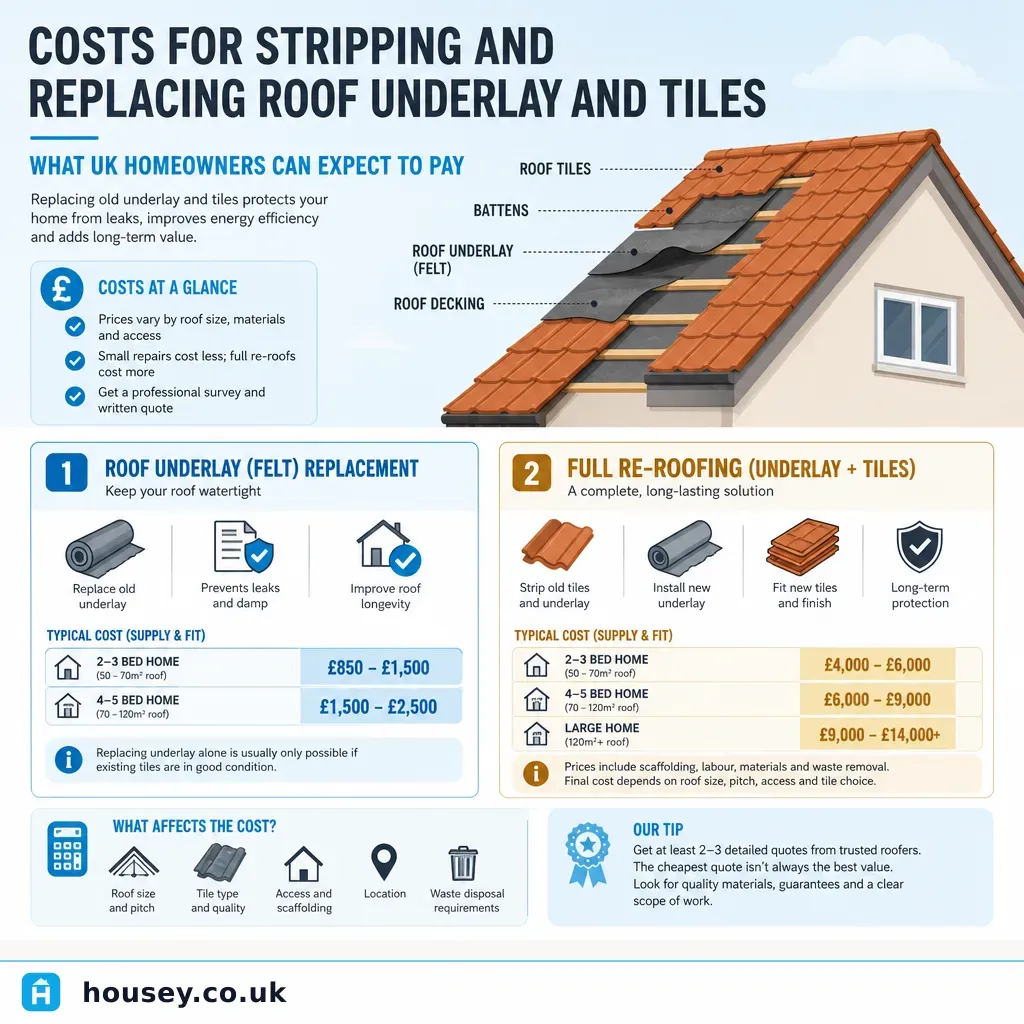
Costs for Stripping and Replacing Roof Underlay and Tiles
Stripping and replacing roof underlay and tiles on a typical UK semi-detached house costs £5,000–£12,000, depending on roof size, tile type, and access.
 Improvement & Build
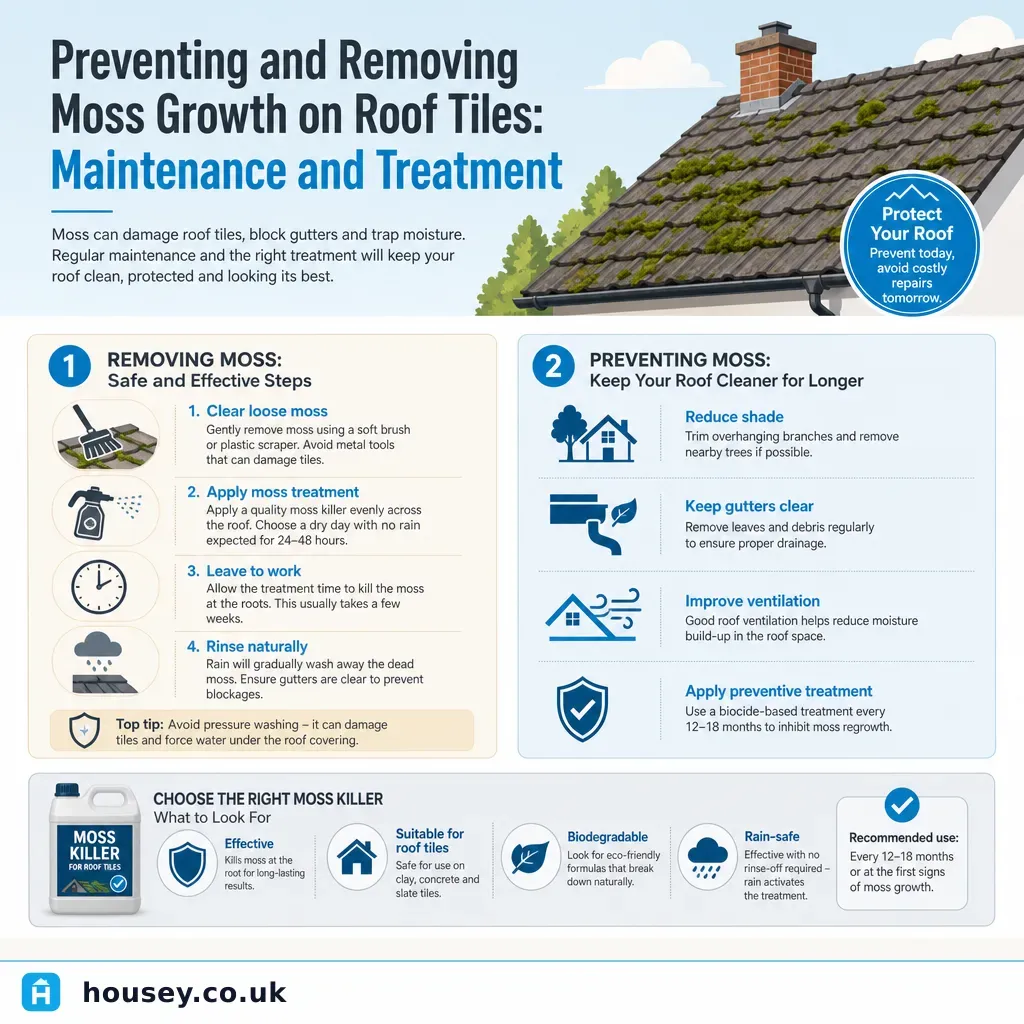
Preventing and Removing Moss Growth on Roof Tiles: Maintenance and Treatment
Moss on roof tiles is best treated with a proprietary biocide spray, left to die back over several weeks, then carefully cleared.
 Improvement & Build
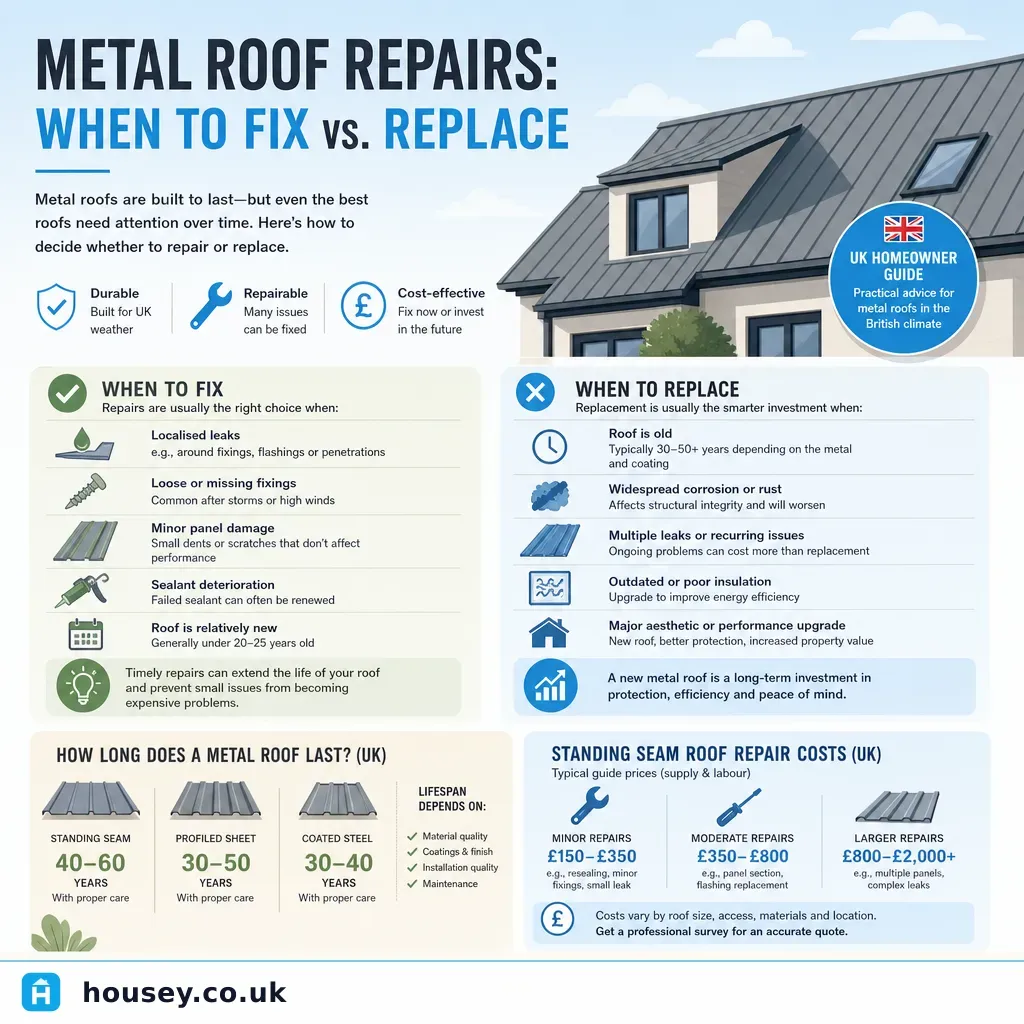
Metal Roof Repairs: When to Fix vs. Replace
For a metal roof, repair is usually right when damage is localised — a failed flashing, isolated corrosion, or one or two damaged panels.
 Improvement & Build
Sealing and Maintaining Historic Leaded Glass Windows: Preservation and Performance
Leaded glass windows are maintained using traditional linseed oil cement — not silicone or modern sealants, which prevent natural movement in the lead came.
 Improvement & Build
Evaluating And Planning Renovations For Properties Requiring Modernisation
Start by commissioning a condition survey — RICS Level 3 for pre-1919 properties — to identify structural defects, damp, and services issues before finalising a budget.