Structural Assessment Before Cladding and Siding Installation
By Housey · Last reviewed 1st of June 2026
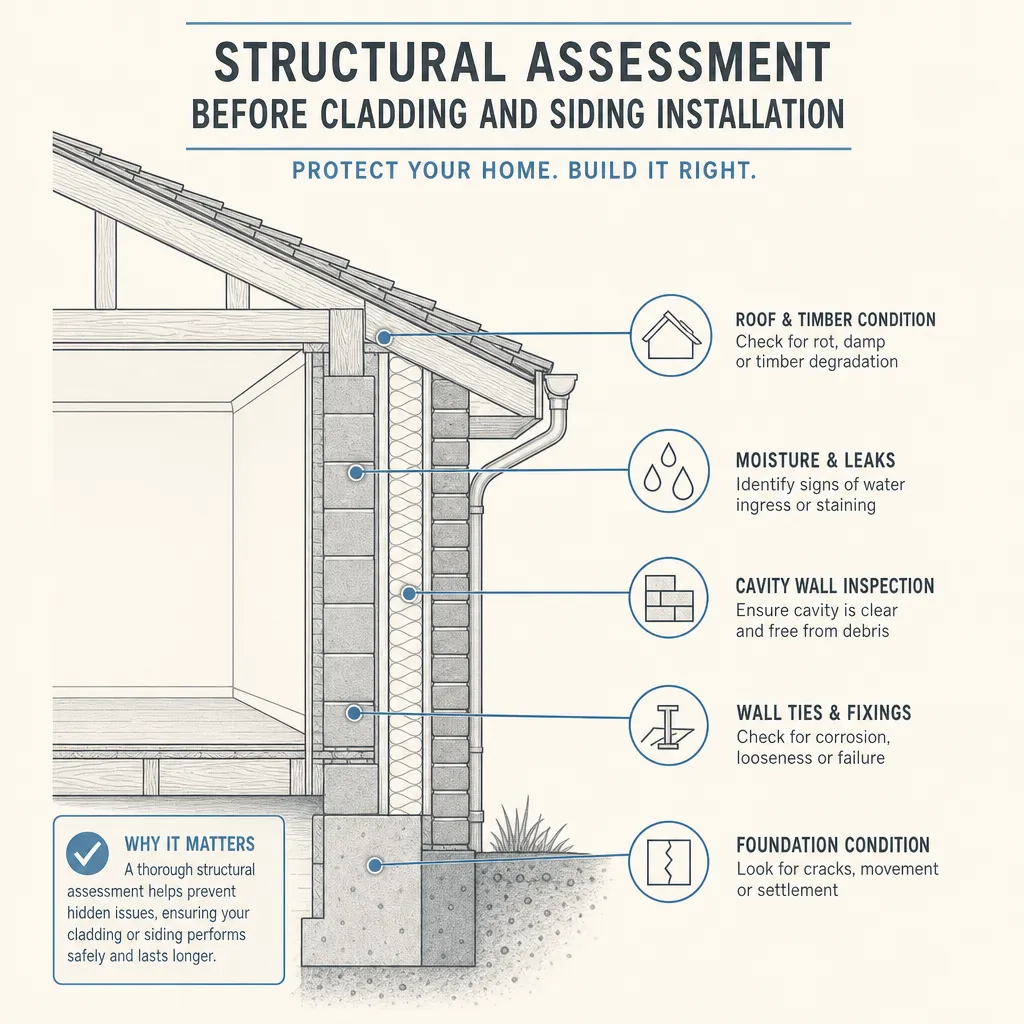
Structural Assessment Before Cladding and Siding Installation
External cladding and overcladding projects can transform the appearance and thermal performance of a UK property, but in our varied building stock — from Victorian brick terraces to 1970s timber-frame homes — substrate defects concealed beneath existing render, weatherboarding, or brickwork are common. Once new cladding is fixed in place, access to those defects becomes significantly more difficult and expensive to restore.
Key points
- Building Regulations Approved Document A requires that any new or replacement cladding system does not adversely affect the structural stability of the building; Approved Document B governs the fire performance of external wall materials and systems.
- The Building Safety Act 2022 introduced new duties for external wall systems on higher-risk buildings (18 metres or more / 7 or more storeys), and the EWS1 form process remains relevant to leaseholders in affected buildings seeking to sell or remortgage.
- The Structural Timber Association (STA) advises that a full fabric inspection should be carried out before overcladding any timber-frame home, given the risk of concealed moisture damage at cladding junctions.
- A specific defect survey carried out by a RICS-accredited chartered surveyor is the standard starting point for identifying hidden structural problems before domestic cladding works begin.
- Cavity wall properties should be inspected with a borescope camera before external cladding is specified, to check wall tie condition, cavity debris, and any existing insulation that may affect the overcladding design.
Why structural assessment matters before you clad
Cladding systems fix to the building substrate — whether timber studs, masonry, or a rainscreen carrier rail system. Any structural weakness in that substrate, whether rot, spalling brickwork, failed wall ties, or historic damp damage, becomes much harder and more costly to remedy once an outer skin is in place.
In the UK, where a significant proportion of homes were built before 1970 and have been subject to decades of weathering and informal repair, the likelihood of finding substrate defects during a pre-cladding inspection is high. Common problems include:
- Timber decay in sarking boards, wall plates, and joist ends, particularly where a previous render or cladding system has permitted moisture ingress at junctions
- Failed or corroded wall ties in 1930s–1960s cavity wall properties — a structural concern that must be assessed before additional weight is added via overcladding
- Spalling or eroded mortar joints in external masonry, which may allow water to track behind the new cladding system
- Existing damp damage to the internal leaf of a cavity wall or to the inner face of a solid-wall property
- Unauthorised or non-compliant alterations — blocked-in window openings, removed lintels, or inadequately supported structural openings that affect the cladding fixing design
What a pre-cladding structural assessment covers
A thorough pre-cladding assessment should address the following areas:
Assessment area | What is being checked | Why it matters for cladding |
|---|---|---|
Substrate integrity | Condition of masonry, render, or timber frame | Cladding fixings require sound substrate to bear loading |
Moisture and damp | Active damp penetration, previous water damage | Moisture trapped behind new cladding accelerates hidden decay |
Wall ties | Tie condition and spacing in cavity walls | Failed ties present a collapse risk under additional cladding load |
Cavity condition | Debris, insulation, ventilation (borescope inspection) | Affects thermal performance, moisture balance, and cavity barrier positioning |
Structural openings | Lintels, arches, window and door reveals | Cladding loads and fixing depths must account for opening structure |
Fire performance | Combustibility of existing and proposed materials | Approved Document B compliance, cavity barrier continuity |
Alteration history | Any undocumented structural changes | Affects fixing depths, loading calculations, and compliance history |
Which type of survey or professional do you need?
The appropriate professional depends on the complexity of the project and the nature of suspected defects.
Situation | Recommended professional | Assessment type |
|---|---|---|
Suspected hidden defect or localised problem | RICS-accredited chartered surveyor | Specific defect survey |
Damp, timber decay, or suspected rot | RICS surveyor or specialist timber/damp surveyor | Damp and timber survey |
Whole-property assessment ahead of major overcladding | Structural engineer (MEng / CEng MICE or MIStructE) | Structural report or engineering assessment |
Cavity wall condition and wall tie check | Specialist cavity wall inspector or chartered surveyor | Cavity inspection report with borescope images |
Fire performance assessment (buildings 11 metres or more) | MRICS fire-risk assessor or fire engineer | EWS1 form or external wall fire review |
Roof-to-wall junction, eaves, soffits, or verges | Roofing specialist or chartered surveyor | Targeted inspection |
For most domestic cladding projects on a single house, a specific defect survey is a focused and cost-effective starting point. A full structural engineer's report may be warranted for larger, more complex, or notably deteriorated properties.
Red flags that should halt cladding work
The following signs require professional investigation before any cladding installation proceeds. Do not allow a contractor to proceed past these points on a visual check alone.
- Active damp or staining on internal walls adjacent to the proposed cladding area
- Stepped cracking in external masonry — following mortar joints diagonally, or horizontal cracking at damp-proof course level
- Diagonal cracking radiating from window or door corners, suggesting differential movement or lintel failure
- Soft, springy, or hollow-sounding floors close to external walls, suggesting decay in joists or wall plates
- Visible rust staining below mortar joints in a cavity wall property, indicating corroded wall ties
- Sagging or bowing in the external wall plane, visible when sighting along the face
- Previous unauthorised works such as blocked window openings without evidence of a correctly sized and supported lintel
- Evidence of previous roof or parapet leaks that may have caused concealed damage to the wall plate and rafter feet
Fire safety and Building Regulations
Building Regulations Approved Document B (Fire Safety) governs the combustibility and performance of external wall materials. Since 2018, the use of combustible materials in external wall systems has been restricted for buildings containing flats above 18 metres; this threshold was lowered to 11 metres in 2021 for certain building types.
For single-family houses, Part B requirements are less prescriptive, but:
- Cavity barriers must be correctly installed within any ventilated cavity — a detail that must be factored into the structural and fire assessment before specification is finalised
- A building control application is likely required where the external wall thermal performance or fire characteristics are being altered — check with your local building control body
- The Building Safety Act 2022 introduced new requirements for higher-risk buildings, and the EWS1 (External Wall Survey) assessment process remains relevant to leaseholders in affected multi-occupancy buildings wishing to sell or remortgage
For buildings above 18 metres, consult a qualified MRICS fire-risk assessor before specifying any external wall system.
Important limitations
This article provides general guidance on pre-cladding structural assessment for UK homeowners. Structural and fire-safety requirements, planning rules, and the need for building regulations approval vary by property type, age, height, tenure, and location. Rules in Scotland and Wales may differ from those in England.
The information in this guide does not constitute a structural assessment, engineering report, or fire risk assessment. A qualified professional should always inspect the property before cladding work is specified or commenced. Do not rely on a contractor's visual inspection as a substitute for an independent survey.
When this becomes urgent
Seek professional structural advice immediately if:
- You can see cracking, bowing, or apparent detachment in the existing external wall
- There is active damp ingress or visible mould on internal walls adjacent to the proposed works
- The property is a timber-frame home and the external cladding is visibly damaged, warped, or weathered
- The building contains flats and you are uncertain of the EWS1 status of the external wall system
- A contractor has raised concerns about substrate condition during preliminary work or stripping back
What to ask a qualified professional
Before commissioning a pre-cladding structural or defect survey, ask:
- Are you RICS-accredited, and do you have direct experience with this construction type?
- Will the survey include a borescope inspection of the cavity for cavity wall properties?
- What areas will be inspected, and are there any access limitations that may affect the scope?
- Will I receive a written report with prioritised findings and clearly recommended remedial actions?
- Can you advise on whether a building regulations application is required for the proposed cladding system?
- Are there any fire performance, cavity barrier, or EWS1 considerations relevant to this property?
- Under what circumstances would you recommend escalating to a full structural engineer's assessment?
When to get professional help
A specific defect survey by a RICS-qualified surveyor is the standard starting point for domestic cladding projects. For complex, older, or significantly deteriorated properties, a structural engineer's assessment may also be required. Always obtain professional advice before:
- Proceeding with cladding specification if any of the red flags above are present
- Commissioning overcladding on a timber-frame home
- Planning external works on a listed building or within a conservation area, where planning consent is likely required
- Managing a communal external wall in a leasehold or shared freehold building
How Housey can help
Housey connects you with qualified surveyors who can carry out a specific defect survey or a damp and timber survey before your cladding project begins. Where safe access to eaves, soffits, or roof-to-wall junctions is needed as part of the inspection, our network of roofers can also assist with access and any targeted repairs identified.
Frequently asked questions
Do I need building regulations approval to fit new external cladding?
In many cases, yes. Changes to the thermal performance or fire characteristics of an external wall may require a building regulations application under Approved Document L or Approved Document B. You should check with your local building control authority before starting work. Permitted development rights do not override the requirement for building regulations compliance where it applies.
How much does a specific defect survey cost in the UK?
Costs vary depending on property size, location, and scope of inspection. Indicative UK costs, last reviewed 2026-06-01: specific defect surveys for a standard domestic property typically range from £250 to £600 for a focused assessment, though complex cases, larger properties, or those requiring borescope inspection may cost more. Always obtain at least two quotes and confirm precisely what is included.
Is a damp and timber survey always needed before cladding?
Not always, but it is strongly advisable for pre-1970 properties, timber-frame homes, or any property where previous cladding or render has been present. A damp and timber survey is specifically designed to quantify the type and severity of decay and moisture conditions that a general structural survey may not fully assess or report on.
Does fitting external cladding require planning permission?
For most houses, changing external cladding material may fall within permitted development rights, but this depends on the material proposed, the location of the property, whether an Article 4 direction applies, and whether the building is listed. Always check with your local planning authority before committing to a specification, particularly in conservation areas.
Sources and further reading
- Building Regulations Approved Document A: Structure — GOV.UK / DLUHC
- Building Regulations Approved Document B: Fire Safety — GOV.UK / DLUHC
- Building Safety Act 2022 — legislation.gov.uk
- RICS guidance note: Surveys of residential property (4th edition) — RICS
- Structural Timber Association: Timber Frame Guidance — Structural Timber Association
- Planning Portal: External walls guidance — Planning Portal
Useful next reads
 Surveys & Inspections
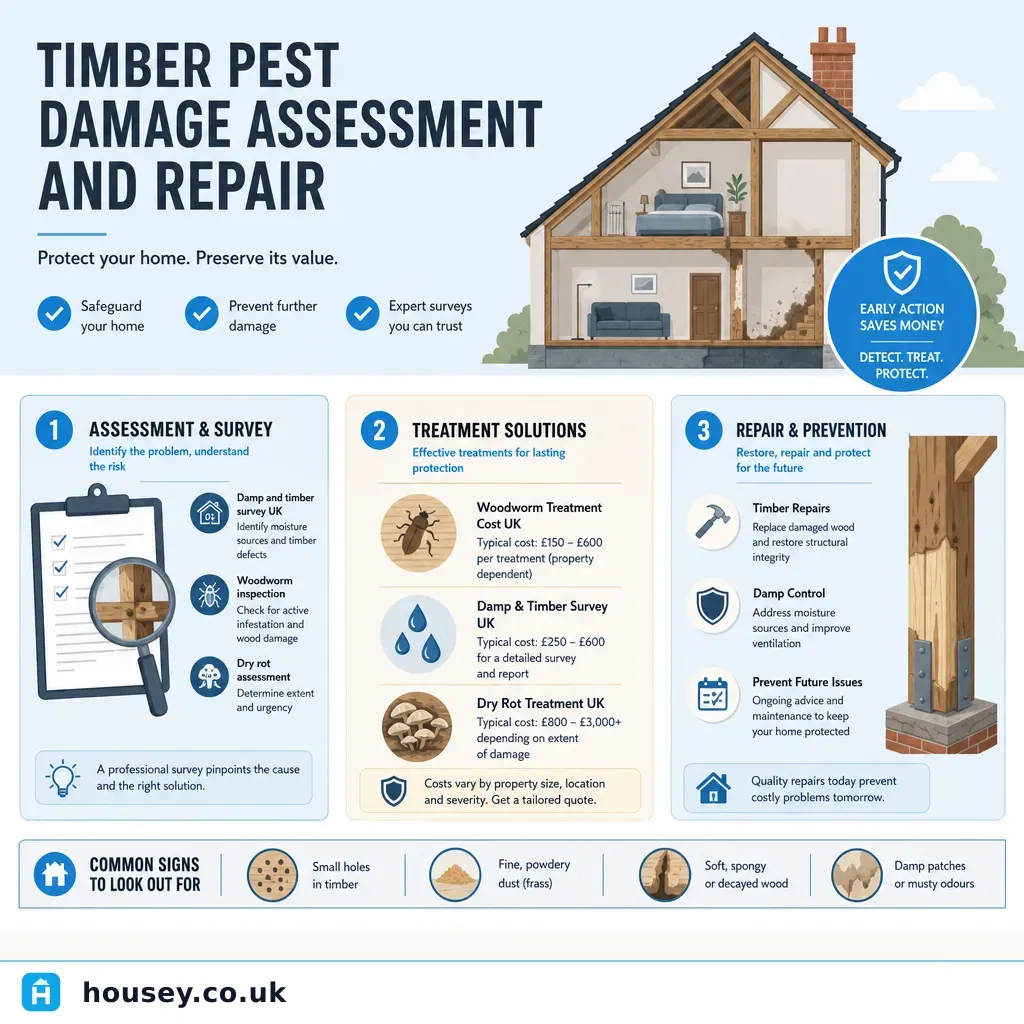
Timber Pest Damage Assessment and Repair
Timber pest damage in UK homes is most commonly caused by Common Furniture Beetle (woodworm), Death Watch Beetle, or fungal decay such as dry rot.
 Surveys & Inspections
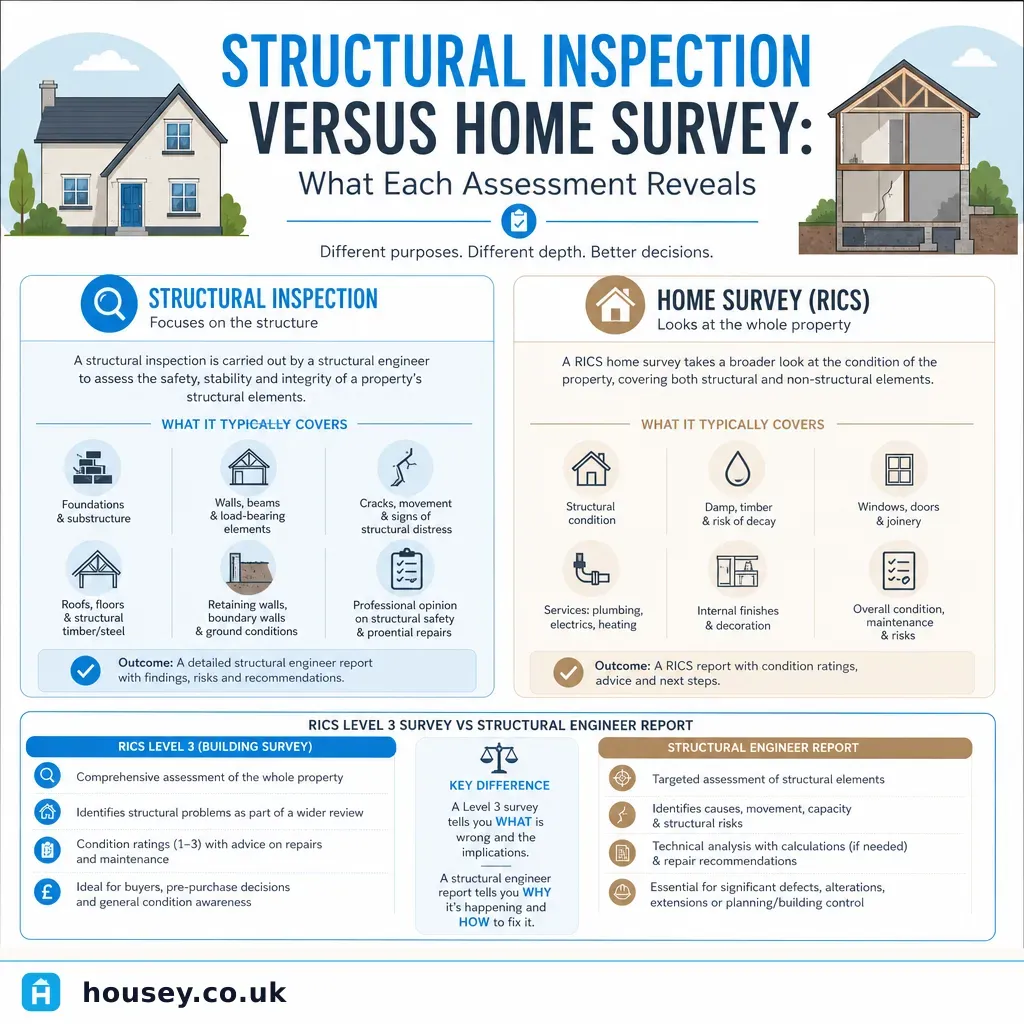
Structural Inspection versus Home Survey: What Each Assessment Reveals
A RICS Home Survey assesses overall property condition across all elements using condition ratings 1 to 3.
 Surveys & Inspections
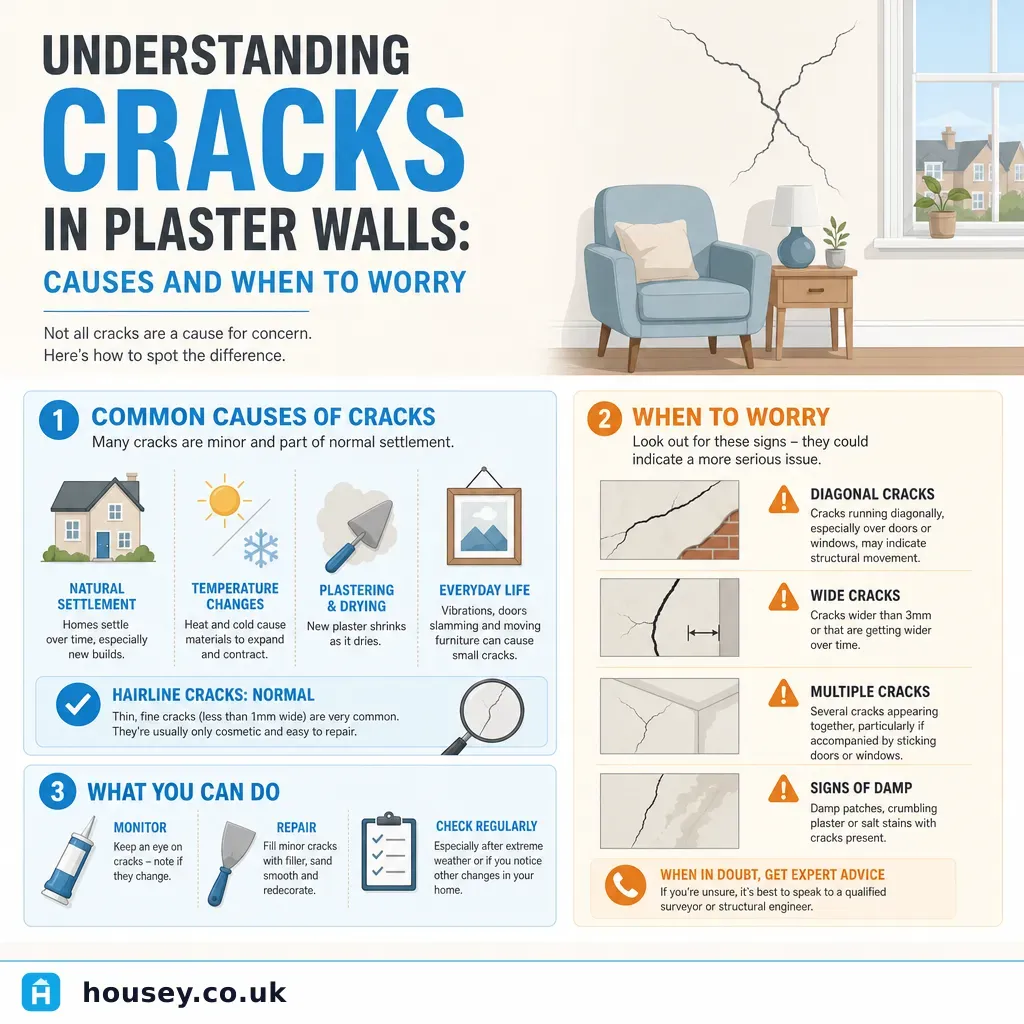
Understanding Cracks in Plaster Walls: Causes and When to Worry
Most hairline plaster cracks are cosmetic, caused by seasonal shrinkage or minor settlement.
 Surveys & Inspections
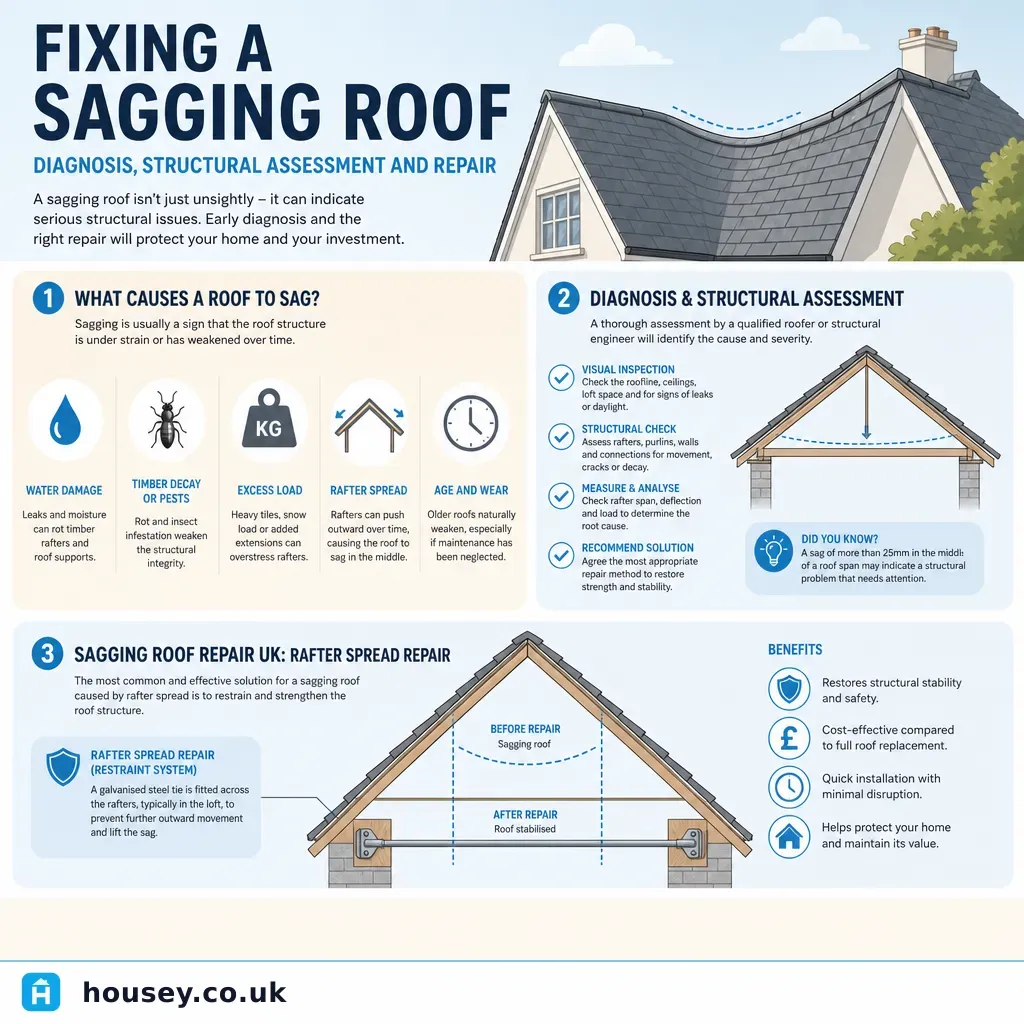
Fixing a Sagging Roof: Diagnosis, Structural Assessment and Repair
A sagging roof usually points to failed or overloaded roof timbers, rafter spread, or a compromised ridge board.
 Surveys & Inspections
Japanese Knotweed and Property Purchase: Impact on Mortgages and Valuations
Japanese knotweed can prevent mortgage approval and reduce a property's value, especially if it is within 7 metres of a habitable structure.