Structural Insulated Panels for Extension Building
By Housey · Last reviewed 10th of May 2026
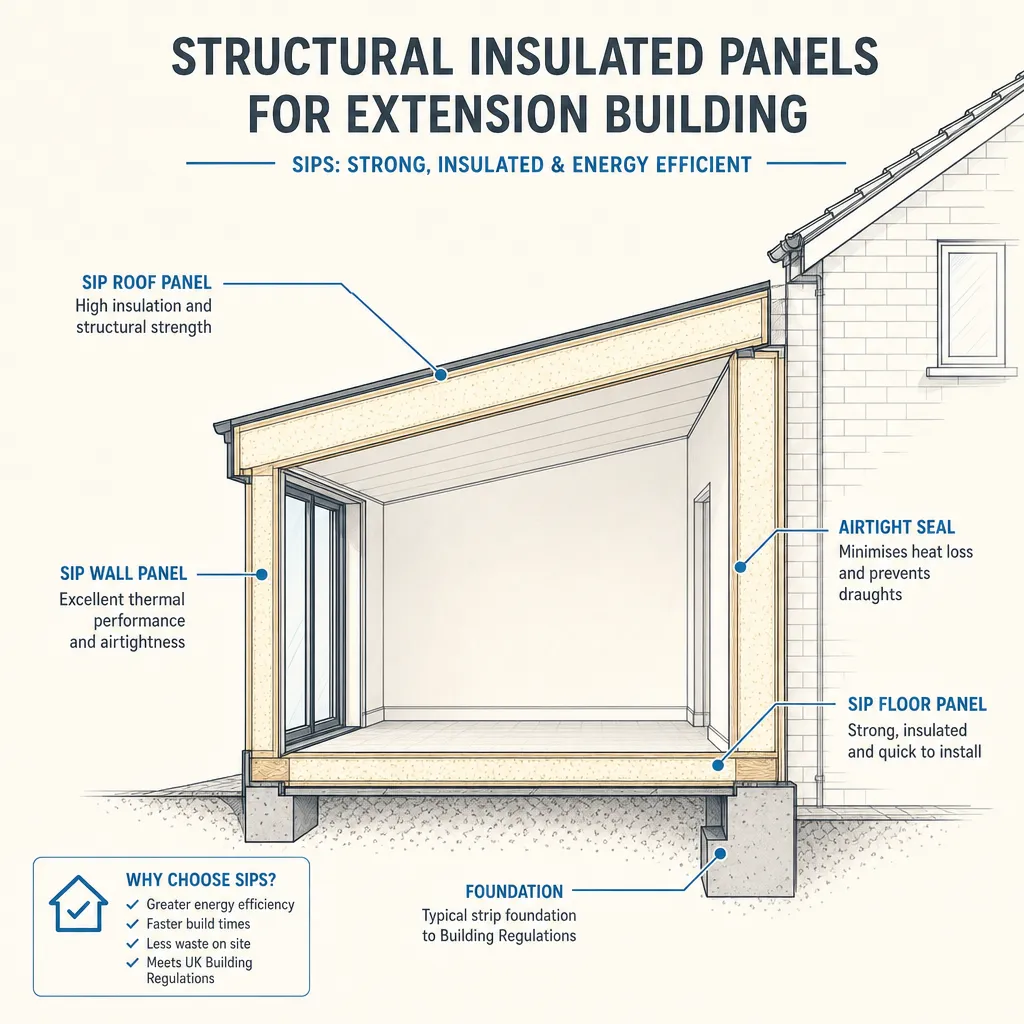
Structural Insulated Panels for Extension Building
Choosing a construction method for a home extension shapes build speed, thermal performance, and which specialists you will need to manage the project. Structural insulated panels (SIPs) have moved from niche to mainstream in UK self-build and extension markets over the past decade, driven partly by tightening Part L energy requirements and partly by the appeal of precision-fabricated, rapid-erect construction. Understanding where SIPs perform well — and where traditional methods may serve better — helps you make an informed choice before appointing a builder or system supplier.
Key points
- SIP panels typically achieve wall U-values of 0.15–0.18 W/m²K, comfortably within the 2021 Building Regulations Part L requirement of 0.18 W/m²K for new extension walls.
- Building Regulations Part A (Structure) requires that structural design of a SIP extension is carried out or verified by a suitably qualified engineer — panel manufacturer load tables alone are not sufficient for building control sign-off.
- SIP buildings are inherently airtight; this brings energy benefits but requires a ventilation strategy (typically MVHR) specified from the outset, not retrofitted as an afterthought.
- The SIPA (Structural Insulated Panel Association) publishes a member directory of UK registered installers; using a non-registered installer may affect warranty validity and building control acceptance.
- Build programme for a SIP shell is typically 30–50% faster than equivalent masonry cavity construction for the superstructure; groundworks, glazing, and fit-out timescales are unchanged.
What are SIP panels and how do they work?
A structural insulated panel is a composite of rigid insulation — usually expanded polystyrene (EPS) or polyisocyanurate (PIR) — bonded between two structural facing boards, typically oriented strand board (OSB). The composite action of the facings and core creates a panel that is stiff, strong, and thermally efficient without requiring a separate structural frame in the wall.
Panels are factory-fabricated to precise dimensions from engineered drawings, with openings for windows, doors, and services cut in a controlled environment before delivery. On site, a typical single-storey extension shell can be weather-tight within days of delivery, compared to several weeks for equivalent masonry. This reduces wet trades on site and minimises disruption to an occupied property.
SIP panels vs timber frame vs masonry: a comparison
Feature | SIP panels | Timber frame | Masonry cavity wall |
|---|---|---|---|
Typical wall U-value achievable | 0.15–0.18 W/m²K | 0.15–0.20 W/m²K | 0.18–0.25 W/m²K |
Speed of shell erection | Fast (days to weeks) | Moderate | Slower (several weeks) |
Inherent airtightness | High | Moderate–high (detailing-dependent) | Lower |
Design flexibility | Moderate (panel sizes limit long spans) | High | High |
UK contractor availability | Specialist installers required | Wider availability | Widest availability |
Thermal bridging at junctions | Low (if well-detailed) | Low–moderate | Moderate |
Building control route | Full plans or registered approver | Full plans or registered approver | Full plans or registered approver |
Decision tree: is a SIP extension right for your project?
- Choose SIPs if speed of construction is a priority and you want to minimise disruption while living in the property during the works.
- Choose SIPs if the plan is straightforward and rectangular and you want high thermal performance without a complex layered insulation specification.
- Choose timber frame or masonry if the extension involves irregular geometry, curved elements, or complex structural integration with a listed or heritage building.
- Choose masonry if planning conditions require materials or visual appearance matching an existing masonry structure and render or cladding is not acceptable to the planning authority.
- Ask a structural engineer before finalising the method if the extension involves large open-plan spans, flat or complex roof loading, or integration with a potentially weakened existing structure.
- Check with your local planning authority if the property is listed or in a conservation area — SIP construction is technically neutral for planning purposes, but wall thickness and external finish specification may require justification.
Building regulations and SIP construction
A SIP extension requires building control approval in the same way as any other construction method. You can use local authority building control (LABC) or a registered building control approver (the term introduced under the Building Safety Act 2022). Structural design calculations must be provided by a qualified structural engineer independently of the panel manufacturer.
Part L compliance must be demonstrated via a SAP or SBEM calculation. SIP panels generally make compliance straightforward given their inherent thermal performance and airtightness. However, ventilation strategy under Approved Document F must be addressed from the outset — a SIP shell can achieve air permeability well below 5.0 m³/(h.m²) at 50 Pa, making controlled mechanical ventilation necessary in most cases to maintain adequate air quality and prevent condensation.
What to ask before choosing a SIP system or installer
- Is the SIP system independently assessed — for example, by BBA or KIWA BDA?
- Who provides the structural engineer's sign-off for building control — the installer, the manufacturer, or a separately appointed engineer?
- What warranty is provided, and is it backed by a recognised provider such as NHBC or Checkmate?
- How are electrical conduits, water pipes, and ventilation ducts accommodated within the SIP structure?
- Who is responsible for detailing the junctions between the SIP shell and the existing building, and what happens if moisture bridging is found?
- Is VAT included, and does the quote cover all groundworks, glazing, and fit-out, or just the SIP shell?
When to get professional help
SIP construction requires specialist lifting equipment and precise junction tolerances — it is not suited to DIY installation. Always use a SIPA-registered installer. Engage a structural engineer independently of the manufacturer for building control calculations. If the extension materially changes the whole-dwelling energy balance, an energy assessor should review SAP calculations before building control submission.
How Housey can help
Housey connects homeowners with experienced extension builders familiar with SIP systems, and with structural engineering professionals who can provide independent sign-off for building control. Comparing vetted quotes before committing to a system supplier helps ensure you get the right method and specification for your project.
Frequently asked questions
Do SIP panels need planning permission for an extension?
The construction method does not itself require planning permission. Whether consent is needed depends on the size, location, and nature of the extension under normal permitted development rules. SIP walls are typically slightly thinner than masonry cavity walls, which can affect dimensions in constrained plots but has no bearing on whether planning permission is required.
How long do SIP panels last?
SIP panels with quality-graded OSB facing and EPS or PIR insulation cores are generally expected to last the life of the building — 60 years or more — when protected from sustained moisture exposure. Maintaining the external cladding or render and ensuring junction detailing prevents interstitial condensation are the critical long-term factors.
Are SIP extensions more expensive than traditional blockwork?
Indicative UK costs, last reviewed 2026-05-10. SIP shell costs are broadly comparable to timber frame and typically slightly above blockwork per m², but the speed advantage reduces on-site preliminaries and scaffolding costs. Whole-project costs depend heavily on specification and fit-out. Obtain comparable quotes specifying the same internal and external finish standards before drawing conclusions.
Can SIP panels be used for a flat roof extension?
Yes. SIP roof panels suit both flat and pitched applications. Flat roof panels can incorporate a factory-formed fall and require a compatible waterproofing system specified as part of the package. Structural design for flat roof loading must be independently verified by a qualified engineer before building control submission.
Sources and further reading
Useful next reads
 Improvement & Build
Noise-Reducing Window Installation Costs
Noise-reducing window installation in the UK typically costs £400–£1,500 per window depending on glazing specification, frame material, and property type.
 Improvement & Build
Conservatory Roof Insulation Installation Costs
Conservatory roof insulation costs typically range from around £1,500 to £4,000 for internal insulated panel systems, or £8,000 to £25,000 or more for a solid tiled roof replacement.
 Improvement & Build
UPVC Sliding Sash Window Installation Pricing
UPVC sliding sash windows are priced by size, glazing specification, balance system, finish, and access requirements.
 Improvement & Build
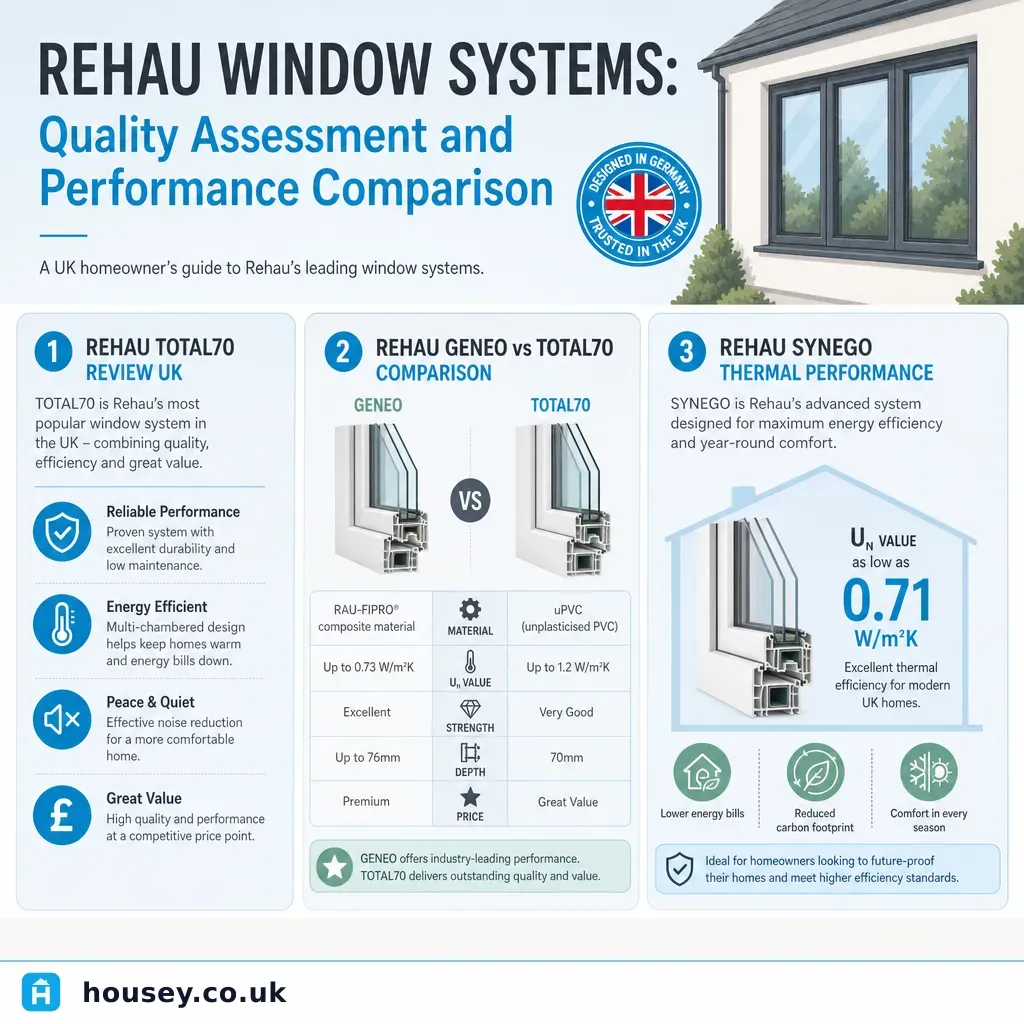
Rehau Window Systems: Quality Assessment and Performance Comparison
Rehau offers several uPVC window systems for the UK market, from the mainstream TOTAL70 to the high-performance Geneo with fibre-reinforced polymer construction.
 Improvement & Build
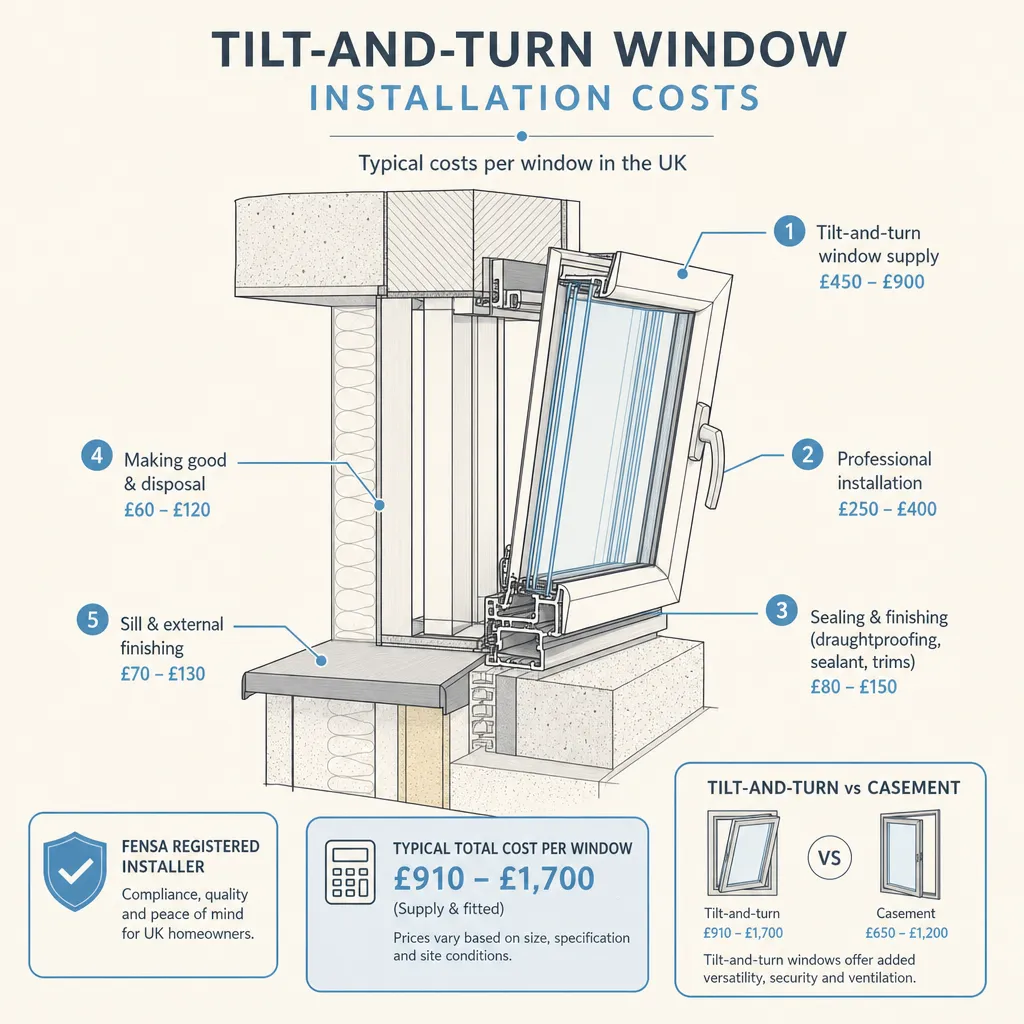
Tilt-and-Turn Window Installation Costs
Tilt-and-turn windows typically cost £400–£900 per window supply and fit in uPVC, rising to £600–£1,300 in aluminium and £700–£1,400 in timber.