Stucco Facade Inspection: Assessing Condition and Identifying Defects
By Housey · Last reviewed 25th of May 2026
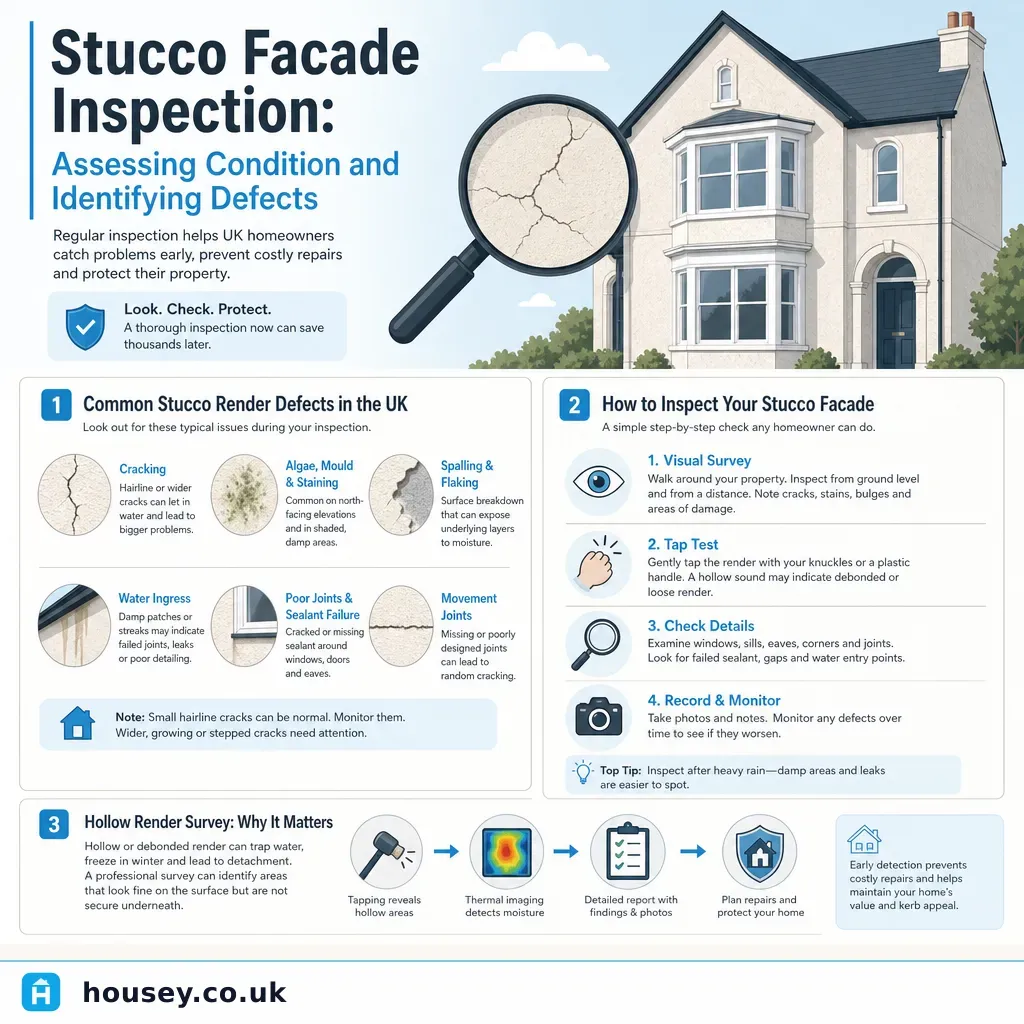
Stucco Facade Inspection: Assessing Condition and Identifying Defects
Stucco and cement render facades are found on millions of UK homes, from grand Georgian and Victorian townhouses to inter-war semis and post-war flats. Questions about facade condition most often arise when a homeowner notices cracking, staining, or hollow-sounding patches — or when a surveyor flags render as a concern during a property purchase. Getting the assessment right matters: a poorly diagnosed facade can lead to either costly unnecessary re-rendering or, worse, allowing damp and structural movement to worsen undetected.
Key points
- Pre-1919 render is typically lime-based and breathable; post-1960s render is usually cement-based — the composition affects both failure mode and repair method.
- The "tap test" — tapping with a mallet, coin, or knuckle — is the primary low-tech method for detecting debonded (hollow) render that cannot be identified by visual inspection alone.
- Cracks wider than 1 mm, or any crack that is stepped through masonry or has visible displacement, should be assessed by a chartered surveyor or structural engineer rather than treated as cosmetic.
- Moisture readings above 17–20% in the substrate behind render, measured with a calibrated moisture meter, may indicate active damp penetration through failed render.
- A RICS Level 3 Building Survey (formerly Full Structural Survey) is the appropriate inspection level for properties with significant render defects or suspected underlying movement.
What stucco render is and why it fails
"Stucco" in the UK context usually refers to an external lime or cement render applied to the outer leaf of a masonry wall to provide weather protection, a smooth decorative finish, or both. On Georgian and Victorian properties, traditional stucco was lime-based, often formed in a series of coats with a fine finishing layer. From the mid-twentieth century, Portland cement-based renders became more common, sometimes applied directly over earlier lime coats.
Render fails for several reasons:
- Age and carbonation: Over decades, lime or cement binders lose strength and the render becomes friable.
- Incompatible repairs: Applying a hard cement coat over softer lime substrate traps moisture and causes delamination.
- Thermal movement: Facades exposed to direct sun and frost repeatedly expand and contract, opening cracks and weakening adhesion.
- Sulphate attack: In older properties, soluble sulphates in the masonry can react with cement render, causing expansion and cracking.
- Inadequate movement joints: Long runs of render without movement joints concentrate thermal stress and cause cracking.
- Penetrating damp: Where render already allows water ingress, freeze-thaw cycles accelerate debonding.
Understanding which failure mechanism is present is necessary before specifying repairs.
How to carry out a basic condition assessment
A basic stucco facade inspection proceeds in three stages: visual survey, tap test, and moisture assessment.
Visual survey
Walk the full perimeter of the building at close range, ideally using binoculars for areas above first-floor level. Photograph and map all defects. Look for:
- Cracks of any width, noting their pattern and orientation
- Staining, efflorescence (white crystalline salt deposits), or tide marks indicating past damp
- Bulging, bowing, or uneven render surface
- Paint flaking or delamination
- Gaps at junctions — window surrounds, soffits, DPC level
Tap test
Sound out the render by tapping systematically with a mallet, rubber hammer, or large coin. A dull, hollow sound indicates the render has debonded from the substrate. Mark hollow areas with chalk or painter's tape. Visual inspection alone consistently underestimates the extent of debonding.
Moisture assessment
A calibrated electronic moisture meter (resistance or capacitance type) can indicate elevated moisture in the wall substrate. Consistently elevated readings in a pattern corresponding to cracked or hollow render areas suggest active water ingress. Specialist surveyors may use thermographic (infrared) cameras, especially in cooler months, to identify moisture distribution not detectable by probe meters.
Pre-inspection checklist
Common defects: types, causes, and what to do
The table below summarises the main crack types and facade defects encountered during stucco inspections.
Defect type | Likely cause | Risk | Recommended action |
|---|---|---|---|
Hairline cracks (<0.3 mm), random pattern | Shrinkage, thermal movement, carbonation | Low — usually cosmetic | Monitor; address when redecorating |
Map cracking / crazing | Cement-rich coat over weaker substrate; shrinkage | Low to moderate | Investigate substrate adhesion; may need re-rendering |
Diagonal or stepped cracks | Differential settlement; structural movement | Potentially significant | Commission RICS Level 3 survey or structural engineer |
Horizontal cracks at DPC level | Sulphate attack; rising damp affecting lime render | Moderate to high | Specialist investigation required |
Debonding (hollow areas) | Loss of adhesion, damp behind render, frost damage | Moderate — risk of falling material | Remove and re-render affected area; survey extent before works |
Vertical cracks at wall junctions | Thermal expansion; inadequate movement joints | Low to moderate | Seal and monitor; large displacement warrants survey |
Bulging or bowing areas | Severe debonding; possible structural movement | High — safety risk | Immediate professional assessment required |
Damp and moisture risks
Failed render is one of the most common routes for penetrating damp in solid-wall properties. Unlike cavity-wall construction, solid-wall homes (common pre-1920) have no secondary barrier to moisture: the render is the primary weatherproofing. When render cracks or debonds, water penetrates the wall, saturating internal plasterwork and potentially leading to:
- Dampness to internal finishes and insulation
- Mould growth and associated health risks
- Timber decay in embedded floor joists or lintels
- Salt crystallisation causing ongoing damage to masonry
Where damp ingress is suspected, a damp and timber survey may be required alongside the facade assessment to establish the extent of internal impact. Thermal imaging, borescope inspection, or carefully opening up internal plaster may be necessary.
Red flags that require immediate professional attention
- Bulging or bowing render panels — risk of render falling, particularly over pedestrian areas
- Large diagonal or stepped cracks with visible displacement — may indicate active structural movement
- Horizontal cracking at DPC level across multiple elevations — possible sulphate attack or deep-seated moisture problem
- Cracks that have been previously repaired and have re-opened — indicates an ongoing active cause rather than a settled defect
- Hollow areas covering more than 25% of an elevation — re-rendering the full elevation may be unavoidable
- Staining or damp internally corresponding to facade defect locations — active water ingress is occurring
Important limitations
This article provides general guidance on facade inspection methodology for UK homeowners. Render defects can have multiple causes, and the significance of any individual defect depends on the property's age, construction, repair history, and local exposure conditions. This article does not constitute a structural or building survey. A qualified chartered surveyor or structural engineer should assess any facade where cracks show displacement, where bulging is present, or where structural movement is suspected. Rules and responsibilities may also differ for listed buildings and properties within conservation areas, where works to render are subject to Listed Building Consent or Conservation Area Consent.
When this becomes urgent
Seek immediate professional advice if:
- Render is visibly bulging and at risk of falling onto occupants or passers-by
- Any crack has visibly widened since first noticed, particularly if accompanied by sticking doors or windows
- Internal dampness is worsening despite no change in weather conditions
- A crack is stepped through mortar joints in the masonry beneath the render
What to ask a qualified professional
Before commissioning a facade survey or repair works, ask the surveyor or contractor:
- Is the existing render lime-based or cement-based, and how does this affect the repair specification?
- Do any cracks indicate structural movement that requires a separate structural engineer's report?
- What moisture readings are you measuring behind the render, and what do they suggest about the moisture pathway?
- What is the estimated area of debonded render, and will the facade need partial or full re-rendering?
- Is the property listed or within a conservation area, and do proposed works require consent?
- What render specification do you recommend for the replacement, and why?
- What warranties do you offer on new render work?
When to get professional help
A basic visual and tap-test inspection can identify obvious defects, but professional assessment is needed when:
- Any crack is wider than 1 mm or shows displacement
- Bulging or bowing is present
- Damp is appearing internally in locations corresponding to render defects
- The property is pre-1919, listed, or within a conservation area
- You are about to buy or sell the property and need a documented condition assessment
- Insurance or mortgage conditions require a formal survey
A chartered surveyor accredited by RICS can carry out a specific defect survey to diagnose facade condition in detail. Where internal damp is also a concern, a damp and timber survey can establish the full extent of moisture damage.
How Housey can help
If you are concerned about the condition of a stucco or rendered facade, Housey connects you with qualified surveyors who carry out specific defect surveys and damp and timber surveys across the UK. Submit your requirements and compare quotes from accredited professionals.
Frequently asked questions
How do I know whether my render is lime or cement-based?
The property's age is the most reliable indicator: pre-1919 render is likely lime-based; post-1960s is usually cement. A surveyor or specialist can confirm by examining a small sample. Lime render is typically softer, slightly textured, and off-white; hard cement render often shows fine surface shrinkage cracks and a greyish tone.
Can I repair cracked render myself?
Hairline cracks and small localised areas can often be filled with a compatible flexible sealant or specialist render filler. However, large areas of debonding, hollow render, or any crack associated with suspected structural movement should be assessed professionally before repairs begin. Applying a hard cement patch over soft lime render often worsens delamination.
Does render failure always mean damp inside?
Not necessarily. Hairline cracks may allow minimal moisture ingress that dries without causing internal damage. However, open cracks, debonding, or missing render sections on solid-wall properties significantly increase penetrating damp risk. An internal inspection alongside the facade survey helps establish whether active water ingress is occurring.
Is stucco render the same as external wall insulation render?
No. Traditional stucco is a weather coat applied directly to masonry. External Wall Insulation (EWI) uses an insulation board fixed to the wall with a reinforced basecoat and finish render on top. EWI systems have their own inspection and defect regime; if you suspect the property has EWI, note this specifically in your survey request.
How long does external render last?
Lifespan depends on specification, exposure, and maintenance. Well-maintained lime render on a sheltered property can last 50–100 years or more. Cement render exposed to harsh weather may show defects within 20–30 years if the specification was unsuited to the substrate or climate. Regular repainting and prompt crack repair extend service life significantly.
Sources and further reading
- Building Regulations Approved Document C — GOV.UK
- RICS Home Survey Standard — RICS
- Repairing Historic Buildings: External Render — Historic England
- BRE Good Repair Guide: Repairing masonry walls — Building Research Establishment
Useful next reads
 Surveys & Inspections
Costs of Damp-Proofing and Waterproofing Solutions for UK Properties
Damp-proofing costs vary by treatment: chemical DPC injection typically costs £300–£800 for a standard terraced house, while internal basement tanking runs £50–£150 per m² and cavity drain membrane systems £30–£80 per m².
 Surveys & Inspections
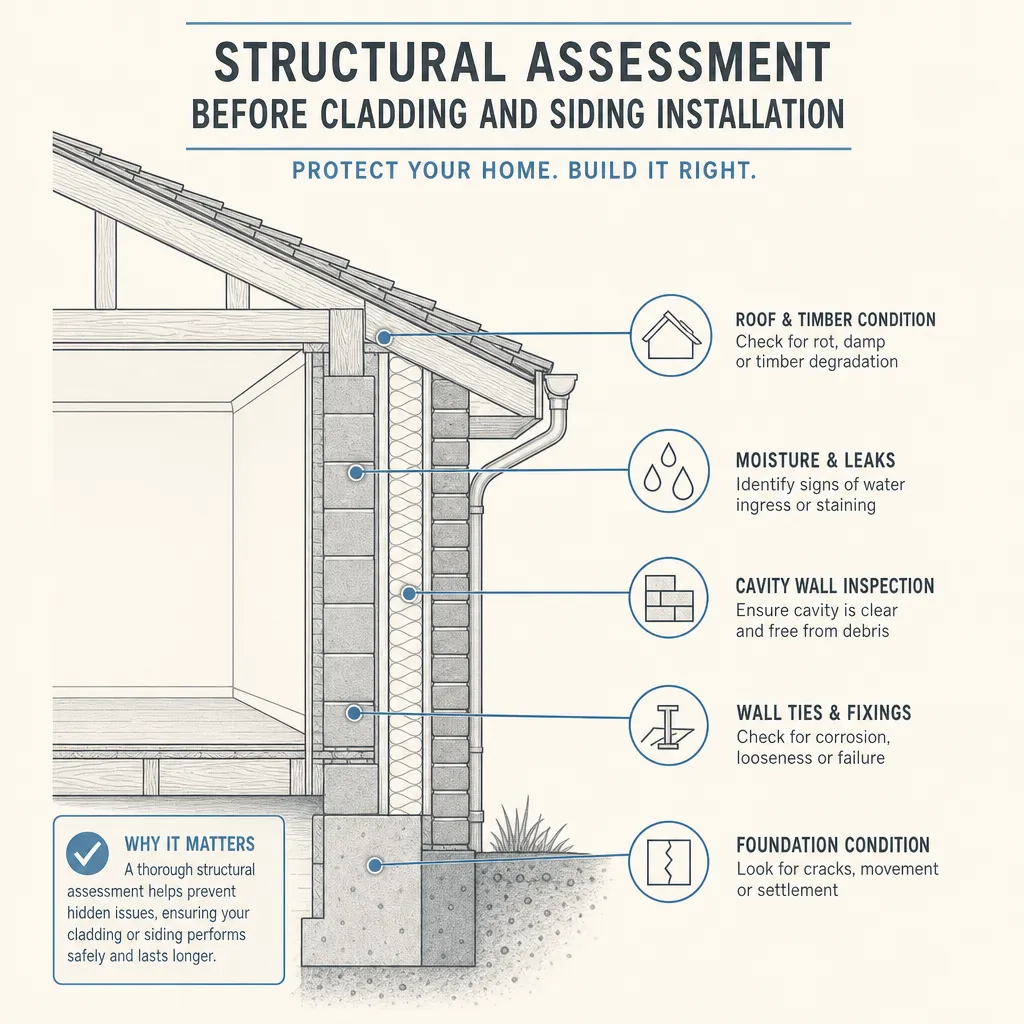
Structural Assessment Before Cladding and Siding Installation
Before installing external cladding or siding, a structural or specific defect assessment is needed to identify hidden timber decay, damp penetration, cavity wall defects, and any load-bearing implications.
 Surveys & Inspections
Essential Factors for Property Buyers to Consider Before Exchange
Before exchanging contracts on a UK property, buyers should commission an appropriate RICS survey, review the property's legal title and search results, check the planning history, assess structural condition, and confirm the EPC rating.
 Surveys & Inspections
Why Property Boundaries Matter: Surveying and Dispute Prevention
Property boundaries in England and Wales are recorded as general boundaries by HM Land Registry — not precise measurements.
 Surveys & Inspections
Safe Property Viewing Practices: Protecting Yourself During Inspections
When viewing a property in the UK, always tell someone where you are going and share the full address before you leave.