Stump Grinder Rental: Equipment Options for DIY Tree Removal
By Housey · Last reviewed 25th of May 2026
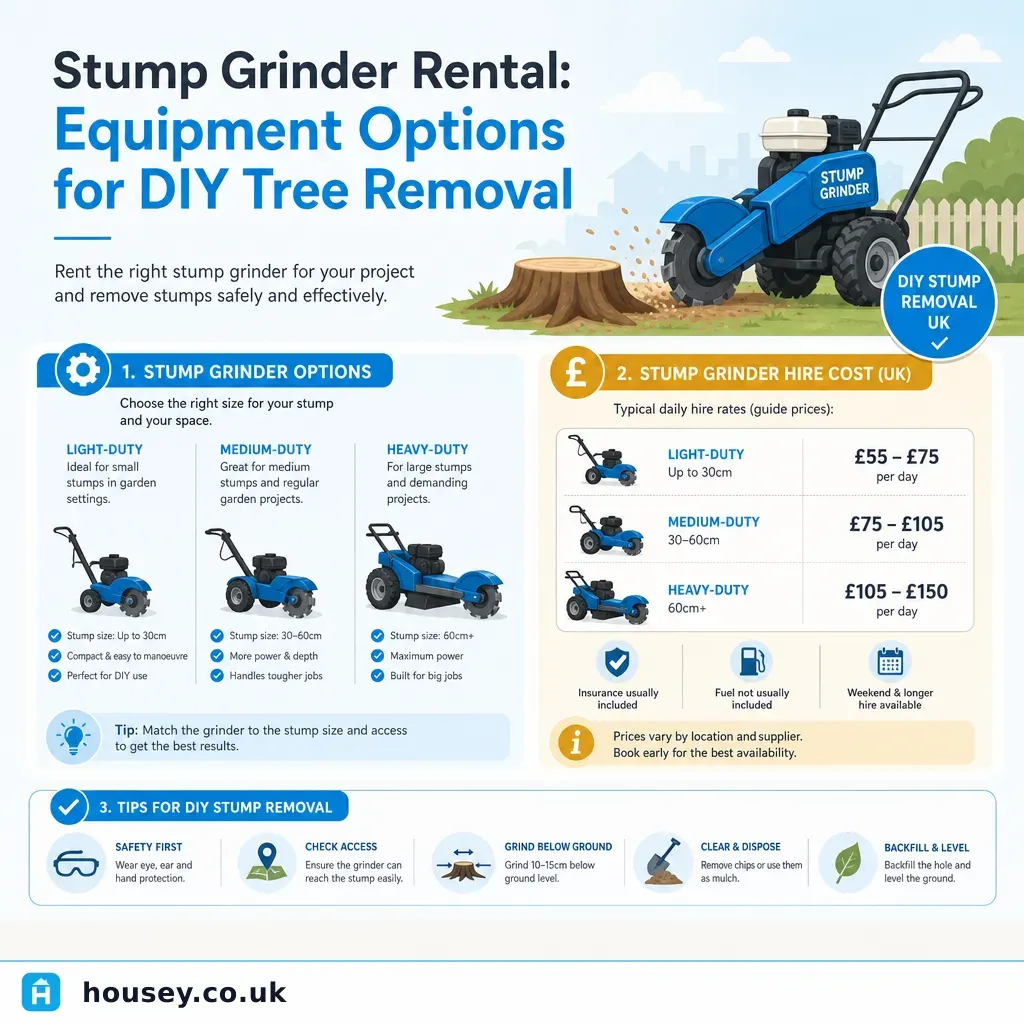
Stump Grinder Rental: Equipment Options for DIY Tree Removal
Tree stumps left after felling can become an eyesore, a trip hazard, and a potential source of root disease — particularly honey fungus, which can spread to neighbouring plants. Whether you are clearing a garden before landscaping, removing a hazard from a lawn, or preparing ground for a new fence or extension, hiring a stump grinder is a practical option for many UK homeowners with basic mechanical confidence and safe access to the stump. Understanding which machine suits your stump, what safety checks are required before you start, and when the job calls for a professional tree surgeon will save you time, money, and risk.
Key points
- Stump grinders are available to hire from most UK tool hire companies at day rates; providers include HSS Hire, Brandon Tool Hire, and local independent hire shops.
- Before hiring, you must check for underground services — gas, water, electricity, and telecoms — using the free Linesearch Before U Dig service (linesearchbeforeudig.co.uk).
- Machine sizes range from compact walk-behind units (suitable for stumps up to roughly 300 mm diameter) to mid-size tracked models; domestic hire is almost always limited to walk-behind or compact ride-on machines.
- If the tree was protected by a Tree Preservation Order (TPO) or is in a conservation area, check with your Local Planning Authority before removing the stump.
- PPE requirements for stump grinding include EN 166-rated eye protection, ear defenders (stump grinders operate at 95–110 dB), steel-toed footwear, and heavy-duty gloves.
Types of stump grinder available to hire
Stump grinders work by rotating a carbide-tipped cutting wheel that chips away at the wood. The operator moves the cutting head from side to side, progressively lowering the cutting depth until the stump is chipped to the required level below the soil surface.
Three broad categories are available in UK hire fleets:
Machine type | Cutting capacity | Access needed | Best for | Not ideal for |
|---|---|---|---|---|
Walk-behind compact | Up to ~300 mm stump diameter | Standard garden gate (600 mm+) | Single small-to-medium stumps in accessible gardens | Large stumps, multiple stumps, sites with no gate access |
Ride-on compact / mini-tracked | Up to ~400 mm stump diameter | Double gate or side access (~900 mm+) | Medium stumps, sloped ground, multiple stumps per day | Small gardens, soft lawns where tracked marks matter |
Towable / trailer-mounted | 400 mm+ stumps | Driveway or vehicle access to site | Large or multiple stumps in open ground | Rear gardens with no vehicle access |
Walk-behind models are the most widely available and are the right starting point for most DIY jobs. If the stump is from a mature tree — say, an oak with a butt diameter over 400 mm — a compact hire machine may struggle, and a professional tree surgeon with a dedicated commercial grinder is likely to be more efficient and safer.
Before you hire: checks you must carry out
Hiring the machine is the easy part. The preparation work is what keeps the job safe and legal.
Check for underground services
Gas pipes, water mains, electricity cables, and telecoms ducts often run through gardens, particularly near buildings. Contact your utility providers or use the Linesearch Before U Dig service (free for homeowners) to obtain service drawings before breaking ground. Even a walk-behind stump grinder can reach depths of 300 mm — enough to contact a shallow cable or pipe.
Check for a Tree Preservation Order
If the tree was protected by a TPO, or if your property is in a conservation area, the stump may still fall within the scope of that protection. Contact your Local Planning Authority (LPA) before proceeding. Removing a stump without consent where one is required can lead to enforcement action.
Clear the work area
Remove any rocks, bricks, wire, or other debris from around the stump and from the potential throw zone. Stump grinders project debris — stone fragments and wood chips — at high velocity. Keep a zone of at least 10–15 metres around the machine clear of people and pets during operation.
Inspect the stump
Check for nails, fencing staples, old wire, or embedded ironwork. These can shatter the carbide cutter teeth, creating a projectile hazard, and will usually incur a damage charge from the hire company.
PPE and safe operation checklist
Before starting the machine, confirm each of the following:
HSE guidance on the safe use of woodworking and chipping machinery, including stump grinders, is available at hse.gov.uk/woodworking.
What to expect from a hire
Indicative UK costs (last reviewed 2026-05-25): walk-behind compact stump grinders typically hire at £100–£200 per day, with half-day rates often available. Rates vary by region and hire company. You will normally pay a refundable deposit and be responsible for any damage to the cutting teeth caused by hitting stones or embedded metal. Check whether delivery is included — many hire companies offer local delivery within a set radius, but you may need a van or trailer for self-collection.
Fuel is almost always charged separately — most compact grinders run on petrol, so budget for a few litres. Return the machine clean and with a full fuel tank as the hire company instructs.
When a professional tree surgeon is the better choice
Hiring makes sense for a single, accessible stump from a modest tree. Consider engaging a qualified tree surgeon instead if:
- The stump diameter exceeds 400 mm (a mature oak, beech, or horse chestnut, for instance).
- The stump is close to a building foundation, boundary wall, or drain run.
- The garden has no safe access route for hire equipment.
- You are uncertain whether utility services run through the area and cannot obtain reliable drawings.
- The stump shows signs of honey fungus (Armillaria spp.) — a professional can advise on the safest management approach.
- Multiple stumps are involved and the volume of work would exceed a full day's hire.
A professional arborist with a commercial-grade grinder will also clear and dispose of the arisings, which can amount to several barrowloads of wood chip per stump.
When to get professional help
Stop the machine immediately if you hit unexpected resistance beneath the soil, notice sparks, smell burning, or observe damaged cutting teeth. Contact the hire company before re-starting. If at any point you are uncertain about underground services in the work area, do not proceed — arrange for a cable avoidance tool (CAT) survey before continuing any ground-breaking work.
How Housey can help
If the stump is large, awkward to access, or part of a wider garden clearance, a qualified tree surgeon can assess the job, bring the right equipment, and handle disposal — often more cost-effectively than a day's hire plus fuel, damage risk, and repeat visits. Use Housey to compare quotes from local, vetted tree surgeons without obligation.
Frequently asked questions
Do I need permission to remove a tree stump in my garden?
Generally, no — but if the original tree was covered by a Tree Preservation Order, or if your property is in a conservation area, the stump may still fall within the scope of that protection. Check with your Local Planning Authority before proceeding if you are unsure.
How deep do stump grinders cut?
Walk-behind hire grinders typically cut to 150–300 mm below the original soil surface. This is usually sufficient to allow turfing or planting over the site, though for paving or hard landscaping a deeper grind or full excavation may be required.
Can I dispose of the wood chip from stump grinding myself?
Yes. The wood chip is an excellent mulch and can be spread around garden borders or composted. Allow it to partially break down before using it around ornamental plants. Do not use it directly around trees where honey fungus is suspected, as this can spread the pathogen.
How long does it take to grind a stump?
A small to medium stump (under 300 mm diameter) typically takes 30–90 minutes for an experienced operator. Larger or multi-stemmed stumps can take considerably longer. Allow extra time if you are new to the machine, and factor in PPE fitting, stump inspection, and debris clearing.
Sources and further reading
- Linesearch Before U Dig — free utility service plan requests before excavation
- HSE: Safe use of woodworking machinery — guidance on chipper and grinder-type equipment
- GOV.UK: Tree Preservation Orders and trees in conservation areas — consent requirements for protected trees
- Arboricultural Association — professional arborist standards and find-a-professional directory
Useful next reads
 Improvement & Build
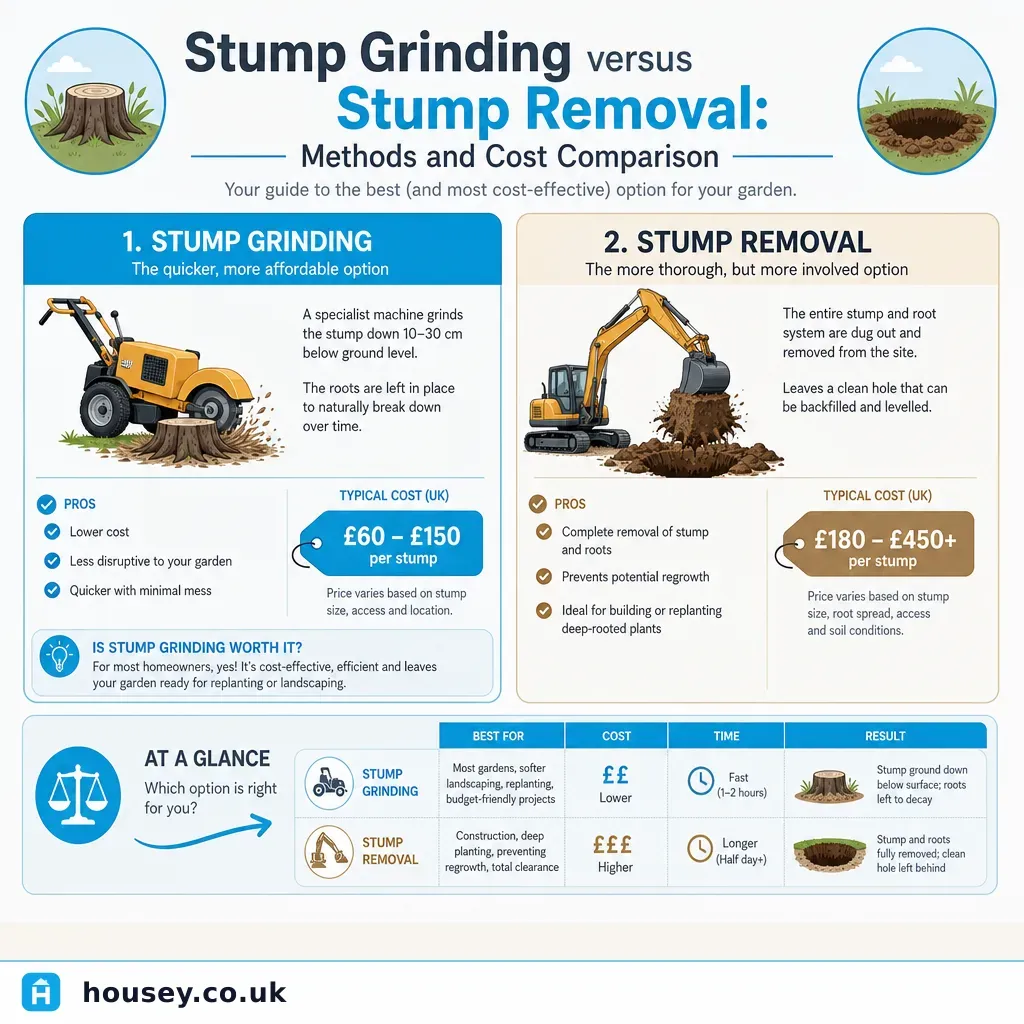
Stump Grinding versus Stump Removal: Methods and Cost Comparison
Stump grinding chips the stump to 150–300 mm below ground and leaves the roots to decay in situ — the lower-cost, lower-disruption option suitable for re-seeding or planting.
 Improvement & Build
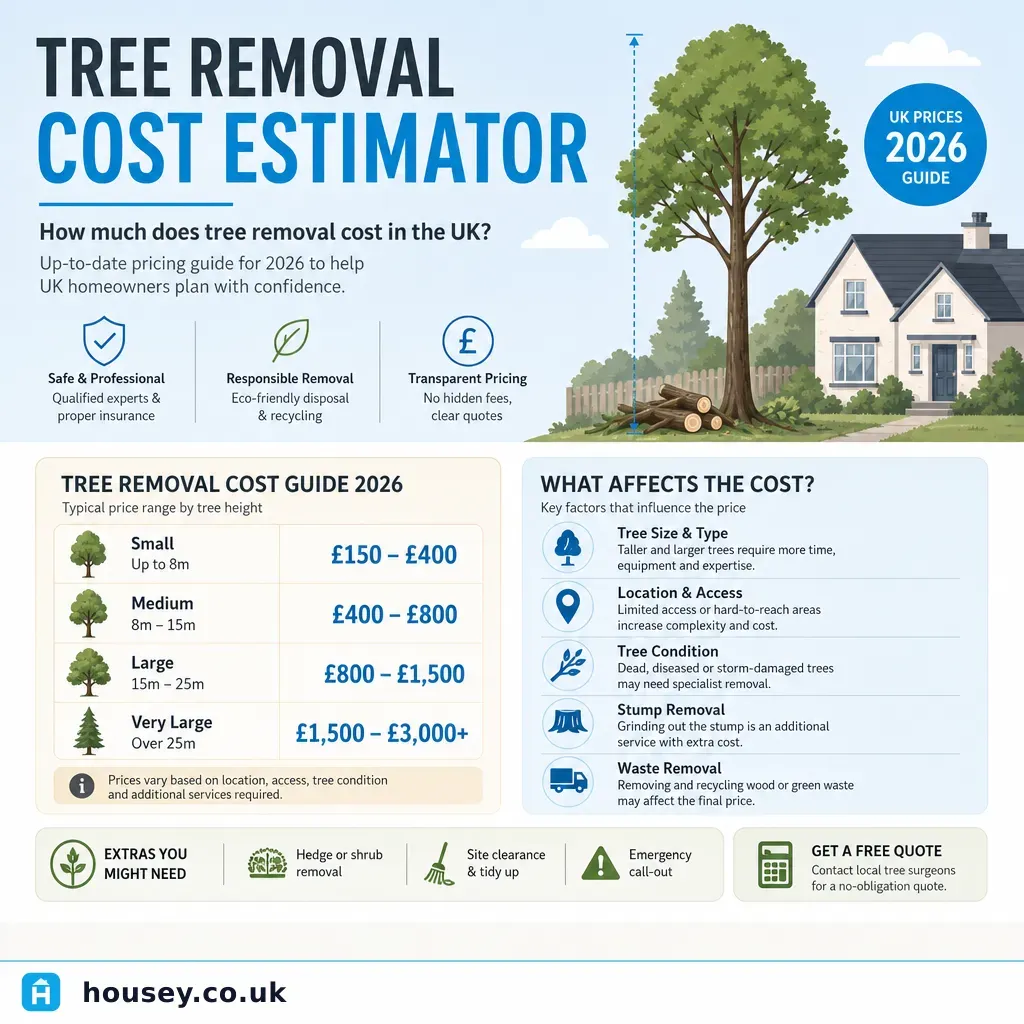
Tree Removal Cost Estimator
Tree removal in the UK costs roughly £150 to £5,000 or more, depending on the tree's height, species, access conditions, and whether stump removal is needed.
 Improvement & Build
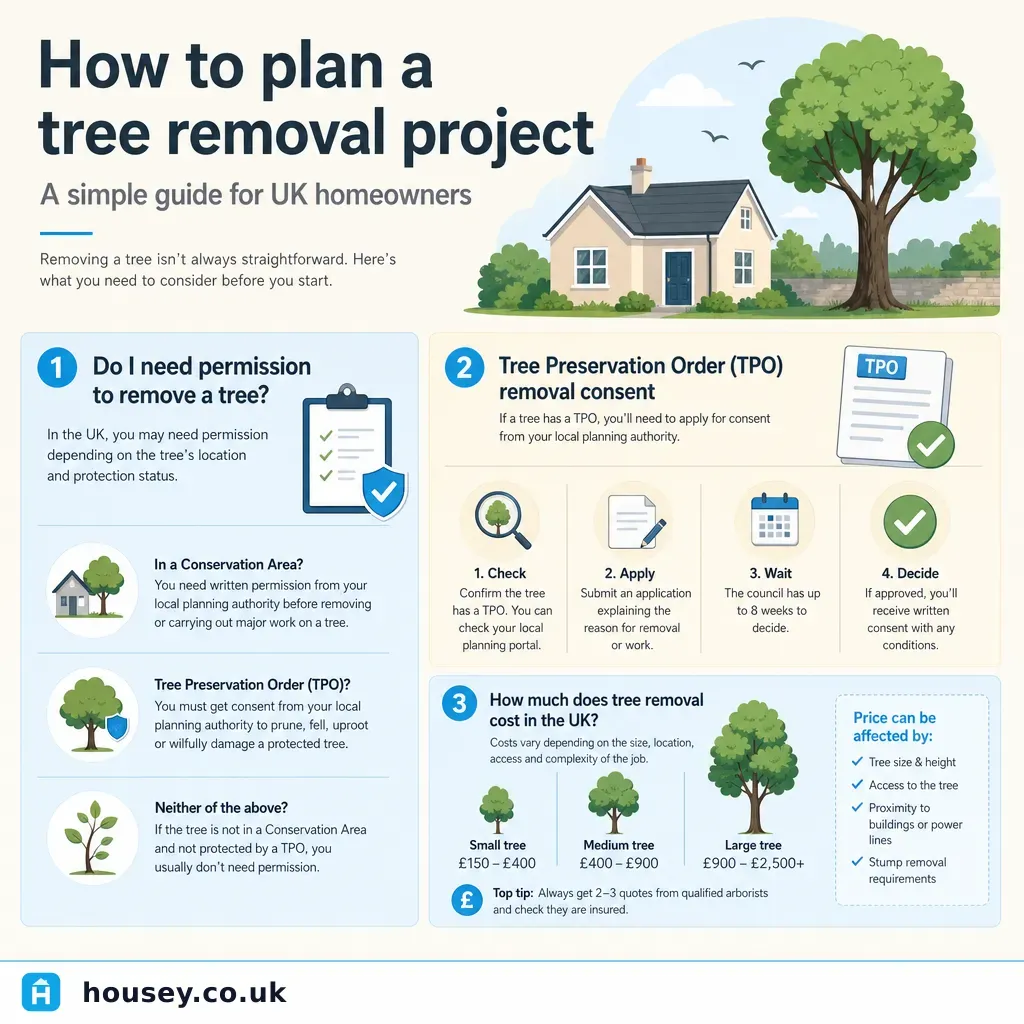
How to plan a tree removal project
Planning a tree removal project starts with checking whether the tree is protected by a Tree Preservation Order or sits in a conservation area, as both require council consent before any work begins.
 Improvement & Build
Professional Weed Control: Service Options and Cost Factors
Professional weed control in the UK typically involves herbicide treatment, manual removal, or a combination of both.
 Improvement & Build
Creating a New Garden Design for Your Property
Creating a new garden design involves assessing your space, setting a realistic budget, deciding on hard and soft landscaping, and choosing a planting scheme suited to your soil and aspect.