Stump Removal: Cost Factors and Process for Complete Tree Elimination
By Housey · Last reviewed 25th of May 2026
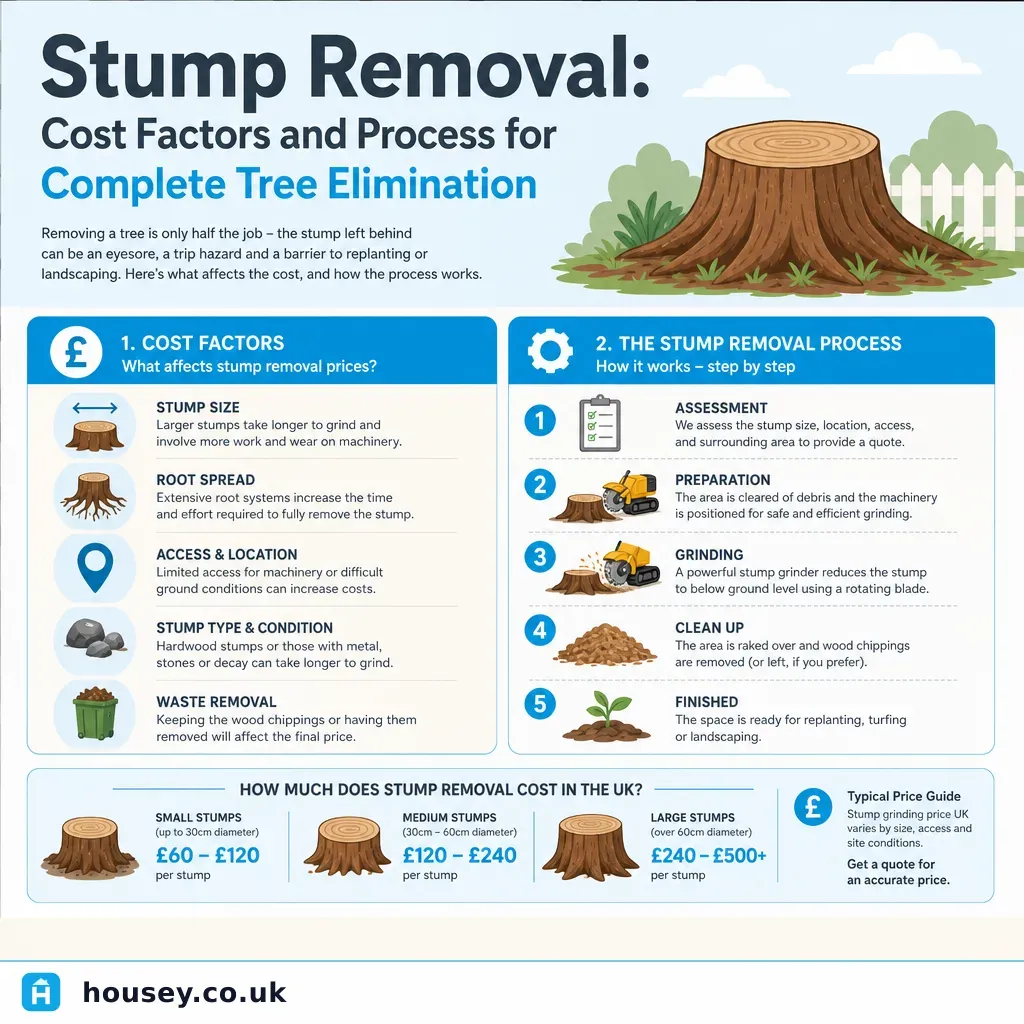
Stump Removal: Cost Factors and Process for Complete Tree Elimination
Stump removal in UK gardens is frequently quoted as a separate job from tree felling — and for good reason. The method required, the equipment needed, and the cost can vary significantly depending on the stump's size, species, location, and what you plan to do with the ground afterwards. Getting these factors clear before you request quotes prevents misunderstandings, avoids costly revisits, and ensures the site is properly prepared for whatever comes next.
Key points
- Stump removal costs in the UK are almost always priced per stump and are strongly influenced by diameter, typically measured at the widest point at ground level.
- A basic stump grind on a small-to-medium stump typically costs £60–£250; full excavation of larger stumps can reach £400–£800 or more (indicative UK costs, last reviewed 2026-05-25).
- Before instructing any stump work, confirm whether a Tree Preservation Order (TPO) applies — consent from your Local Planning Authority may be required even after the tree has been felled.
- Disposal of the excavated root ball or wood chip arisings is a significant variable in quotes — always confirm whether it is included in the price before accepting.
- Underground utility services must be identified and marked before any mechanical ground-breaking; use the free Linesearch Before U Dig service (linesearchbeforeudig.co.uk) to obtain utility plans.
What stump removal actually means
The term stump removal is used loosely across the industry to describe several distinct operations. Before requesting a quote, clarify what you are actually asking for:
Service type | What is removed | Ground condition after | Best suited to |
|---|---|---|---|
Stump grinding | Stump chipped to 150–300 mm below ground | Depression filled with wood chip; roots decay in situ | Re-seeding, planting, low-level landscaping |
Full excavation / extraction | Entire root ball removed | Open void — must be backfilled | Hard standing, concrete, extension footings |
Chemical treatment | Nothing physically removed — stump treated to rot in place | Stump and roots decay over 12–24 months | Poor-access situations or where speed is not essential |
Deep grind | Stump and major laterals chipped to 300 mm+ | Deeper void, more chip produced | Sub-surface use where full clearance is not required |
If you are planning hard landscaping, paving, or building foundations near the stump, make the intended end use clear to your contractor — this directly affects the method recommended and the final price.
What drives the cost of stump removal?
Stump diameter
Most tree surgeons price stump grinding using a diameter-based formula — for example, a base rate per stump plus an additional charge per 100 mm of diameter above a threshold. A stump from a mature oak at 600 mm diameter will cost substantially more to grind than a 200 mm garden cherry or laurel.
Species
Hardwoods — oak, beech, horse chestnut, elm — are denser and harder to grind than softwoods such as pine, birch, or cherry. Grinding a hardwood stump takes longer and wears equipment faster, which is typically reflected in the price.
Access
Stump grinders need to reach the stump. A stump at the end of a long narrow garden with a 600 mm side gate is a very different access challenge to one adjacent to a driveway. Poor access may require smaller but slower equipment, additional manual work, or machine dismantling, all of which increase cost.
Number of stumps
If you have multiple stumps, there is usually a significant economy of scale. Most of a contractor's time and overhead is in mobilisation — getting equipment to and from site. Multiple stumps ground in a single visit are substantially cheaper per unit than separate visits for each.
Proximity to structures
Stumps near walls, foundations, utility pipes, or drains require more careful and slower work, which increases cost and may require a specialist assessment beforehand.
Disposal
Professional grinding produces a considerable volume of wood chip — potentially several barrowloads per stump. Some contractors include chip removal in their price; others leave it for you to use or dispose of (wood chip is excellent garden mulch). Full root ball excavation always requires a skip or a vehicle capable of transporting the material off-site, which adds to the total cost.
Indicative UK cost guide
Stump type | Method | Indicative cost range |
|---|---|---|
Small stump (under 200 mm diameter) | Grinding | £60–£120 |
Medium stump (200–400 mm diameter) | Grinding | £120–£250 |
Large stump (400–600 mm diameter) | Grinding | £200–£400 |
Very large stump (600 mm+ diameter) | Grinding | £300–£600+ |
Medium stump (200–400 mm diameter) | Full excavation | £250–£500 |
Large stump (400 mm+ diameter) | Full excavation | £400–£800+ |
Multiple stumps — same visit | Any method | Typically 20–50% reduction per additional stump |
Indicative UK costs, last reviewed 2026-05-25. Prices vary by region, contractor, access conditions, species, and disposal requirements. Always obtain at least two itemised quotes.
The stump removal process: what to expect
Before work begins
- The contractor should confirm whether the stump is subject to a TPO or is in a conservation area, and advise on any consent requirements.
- Provide any available information on underground services. For stumps near utility trenches or driveways, a cable avoidance tool (CAT) scan is advisable.
- Agree access routes with the contractor — particularly whether the machine will cross lawn or soft ground, and whether protective boards are needed to prevent surface damage.
On the day
- The stump grinder is positioned over the stump and the cutting head lowered progressively, moving side to side in overlapping passes.
- The operator reduces the cutting depth incrementally until the required level is reached — typically 150–300 mm for a standard grind.
- Wood chip arisings are raked back to fill the depression, or collected for removal, depending on what was agreed in the quote.
- For full excavation, a mini-digger or large machine breaks up and extracts the root ball, leaving a void to be backfilled.
After the work
- The depression from grinding should be topped up with topsoil and allowed to settle before turfing or seeding.
- The void from full excavation must be filled with compacted clean fill material, then topsoil, before any surfacing or construction.
- Allow several weeks of settlement before turfing and several months before any hard landscaping over a previously ground stump.
Quote comparison checklist
Use this when comparing quotes from different contractors:
When to get professional help
Always use a qualified contractor for stump removal near buildings, drains, or underground services. If you have a large stump, a species known for aggressive root growth (willow, poplar, bamboo), or if the original tree was subject to a TPO, seek professional advice before instructing any work to avoid enforcement action and unexpected costs.
If you plan to build over or close to the former stump location, a structural engineer or RICS-accredited chartered surveyor may need to confirm the ground is suitable — particularly for extensions where Building Regulations approval is required.
How Housey can help
Getting accurate stump removal quotes means finding contractors who will visit the site and price the actual job. A qualified tree surgeon can assess stump diameter, species, access conditions, and proximity to services, and provide itemised quotes that make comparison straightforward. Use Housey to request quotes from local, vetted tree surgeons without obligation.
Frequently asked questions
Does stump removal cost include the tree felling?
Almost always not — felling and stump removal are separate jobs priced separately. If you are having a tree felled, ask the contractor to quote for stump removal at the same time; you may receive a combined rate that is more competitive than returning for a separate visit once the trunk has gone.
Can I claim on home insurance for stump removal?
Generally not for routine removal. If a tree fell in a storm and the stump forms part of a storm damage insurance claim, it may be included — check your policy wording and contact your insurer directly. Routine maintenance and planned tree removal are typically excluded from standard home insurance policies.
How do I know if my stump has a Tree Preservation Order?
Check with your Local Planning Authority — most councils publish their TPO register online or will confirm in writing on request. You can also search through the Planning Portal (planningportal.co.uk). If the tree was felled by a previous owner and you are unsure of its history, checking the TPO register before instructing any stump work is the safest approach.
What qualifications should a stump removal contractor have?
Look for NPTC or City & Guilds Land-based certification in stump grinding, and public liability insurance of at least £5 million — standard for professional arboricultural contractors. Membership of the Arboricultural Association or TrustMark scheme provides additional assurance that the contractor meets recognised professional and insurance standards.
Can I grind a stump myself?
Small stumps in accessible gardens can be managed with a hired compact stump grinder, provided you have the appropriate PPE and have confirmed no underground services are present. For larger stumps, stumps close to structures, or where utility services are nearby, engaging a qualified tree surgeon is strongly recommended.
Sources and further reading
- Arboricultural Association — contractor directory and stump management guidance
- GOV.UK: Tree Preservation Orders and trees in conservation areas — consent requirements before instructing stump work
- Linesearch Before U Dig — free utility service plans for homeowners before excavation
- Planning Portal — search for TPOs and planning area designations
- HSE: Safe use of woodworking machinery — stump grinder operator safety
Useful next reads
 Improvement & Build
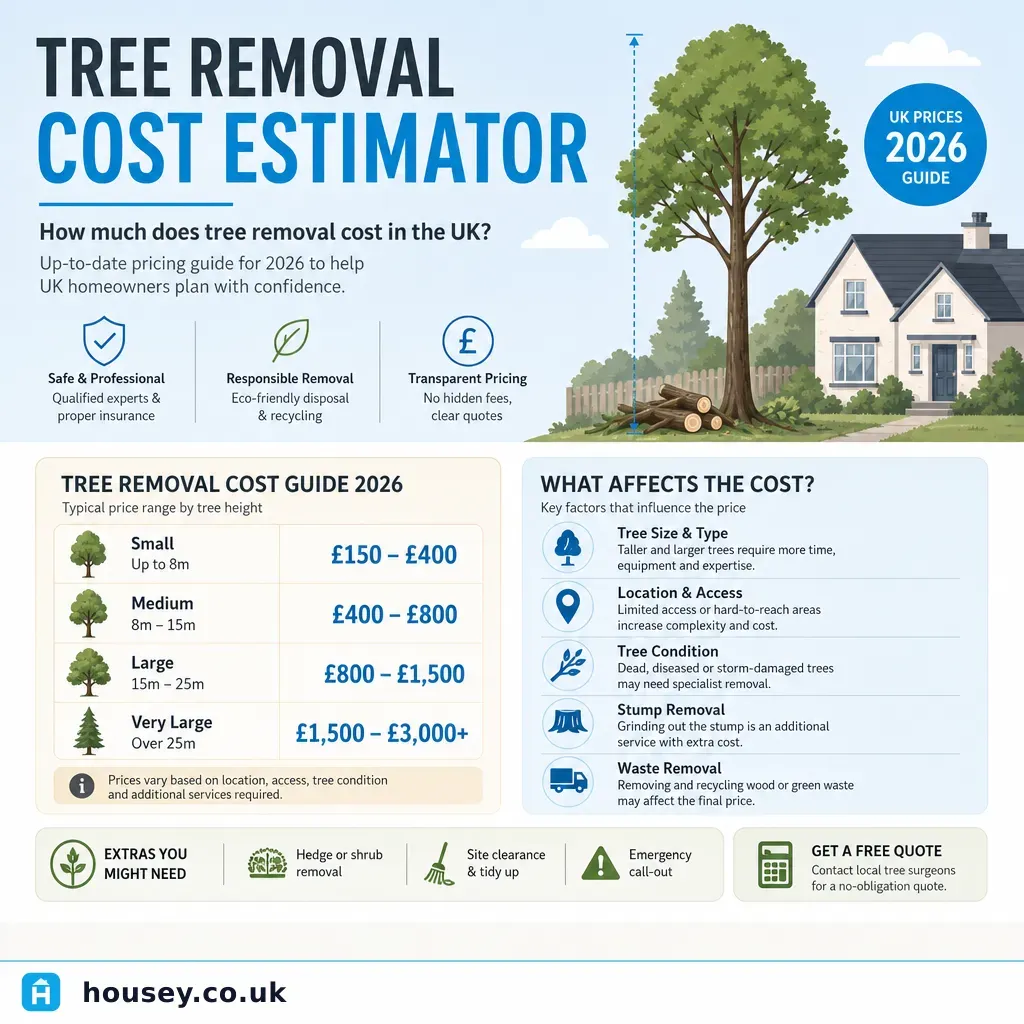
Tree Removal Cost Estimator
Tree removal in the UK costs roughly £150 to £5,000 or more, depending on the tree's height, species, access conditions, and whether stump removal is needed.
 Improvement & Build
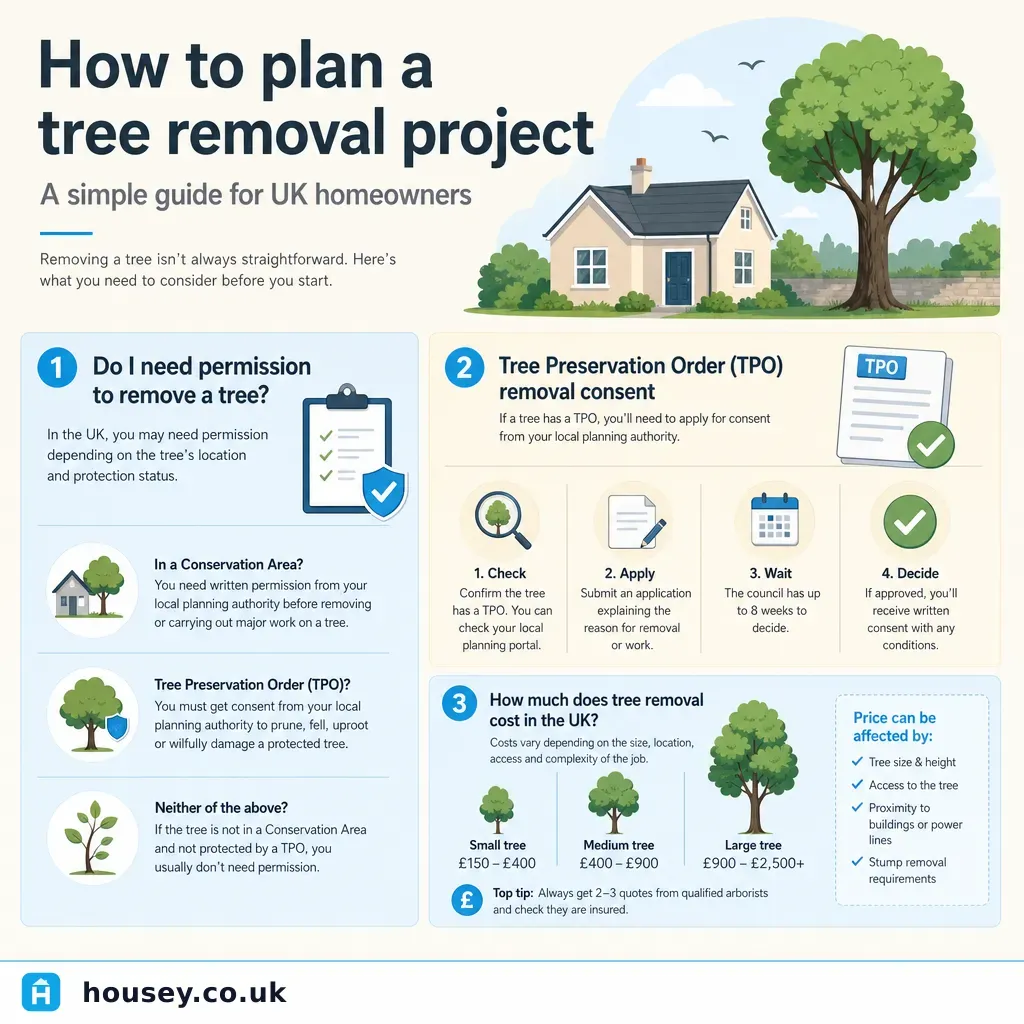
How to plan a tree removal project
Planning a tree removal project starts with checking whether the tree is protected by a Tree Preservation Order or sits in a conservation area, as both require council consent before any work begins.
 Improvement & Build
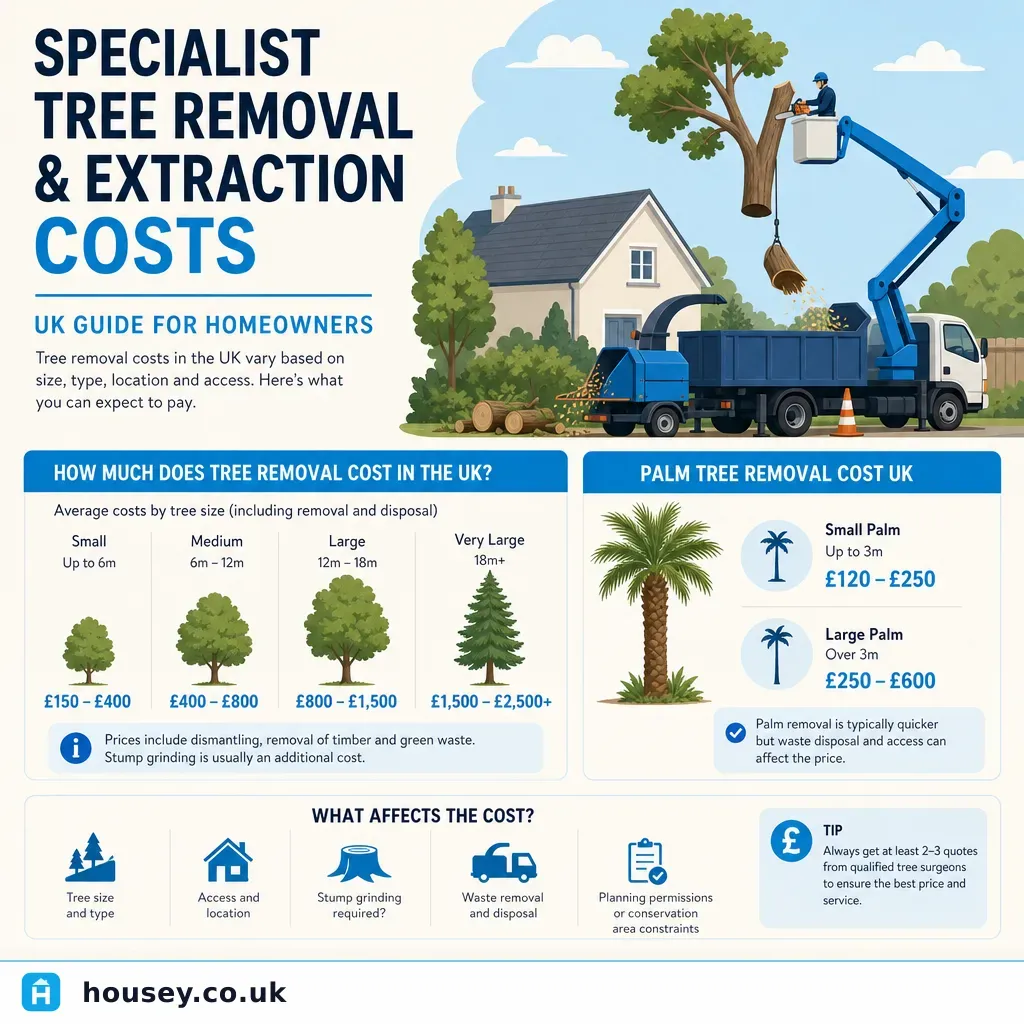
Specialist Tree Removal and Extraction Costs
Specialist tree removal costs in the UK range from around £150 for small trees to £3,000 or more for large mature specimens, with palm trees typically costing more due to specialist technique.
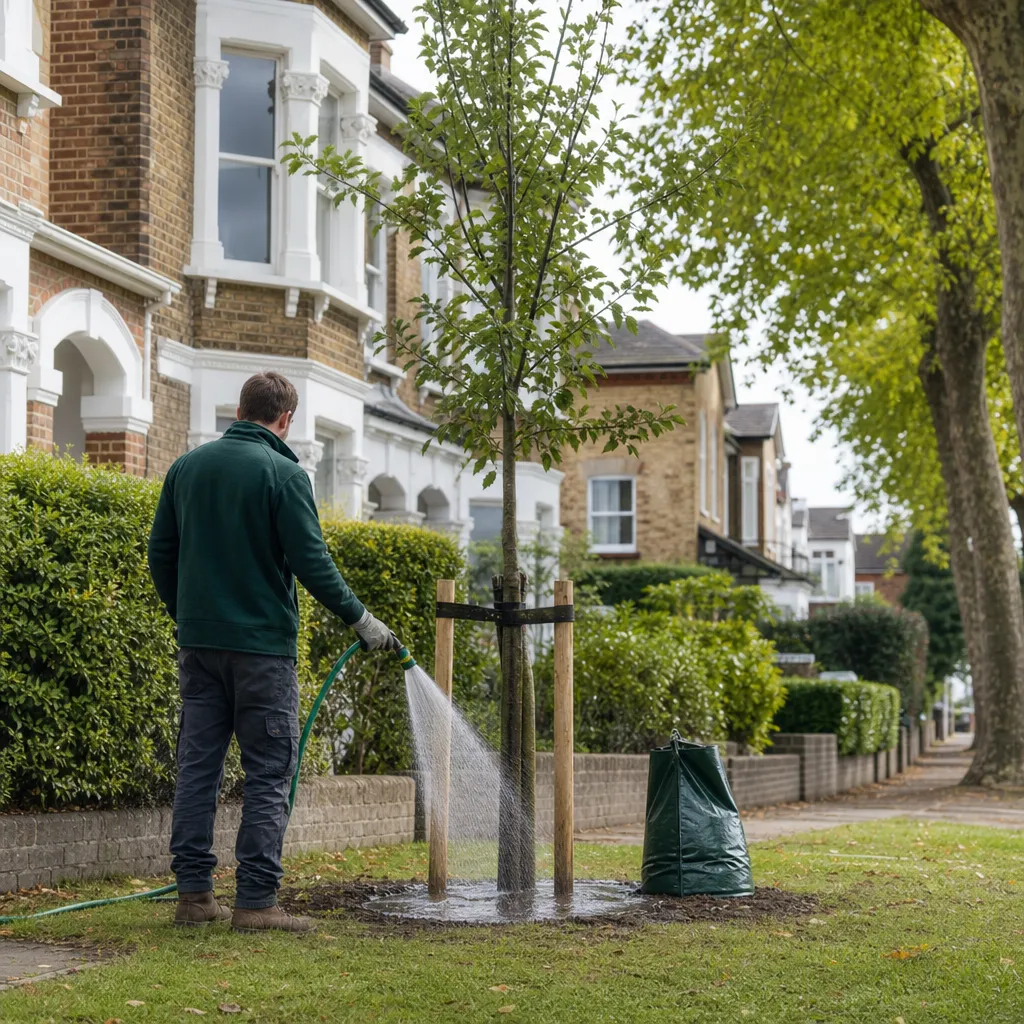 Improvement & Build
Watering Large Trees: Techniques and Frequency for Establishment
Newly planted large trees typically need 50–90 litres of water per week during the growing season for the first two to three years.
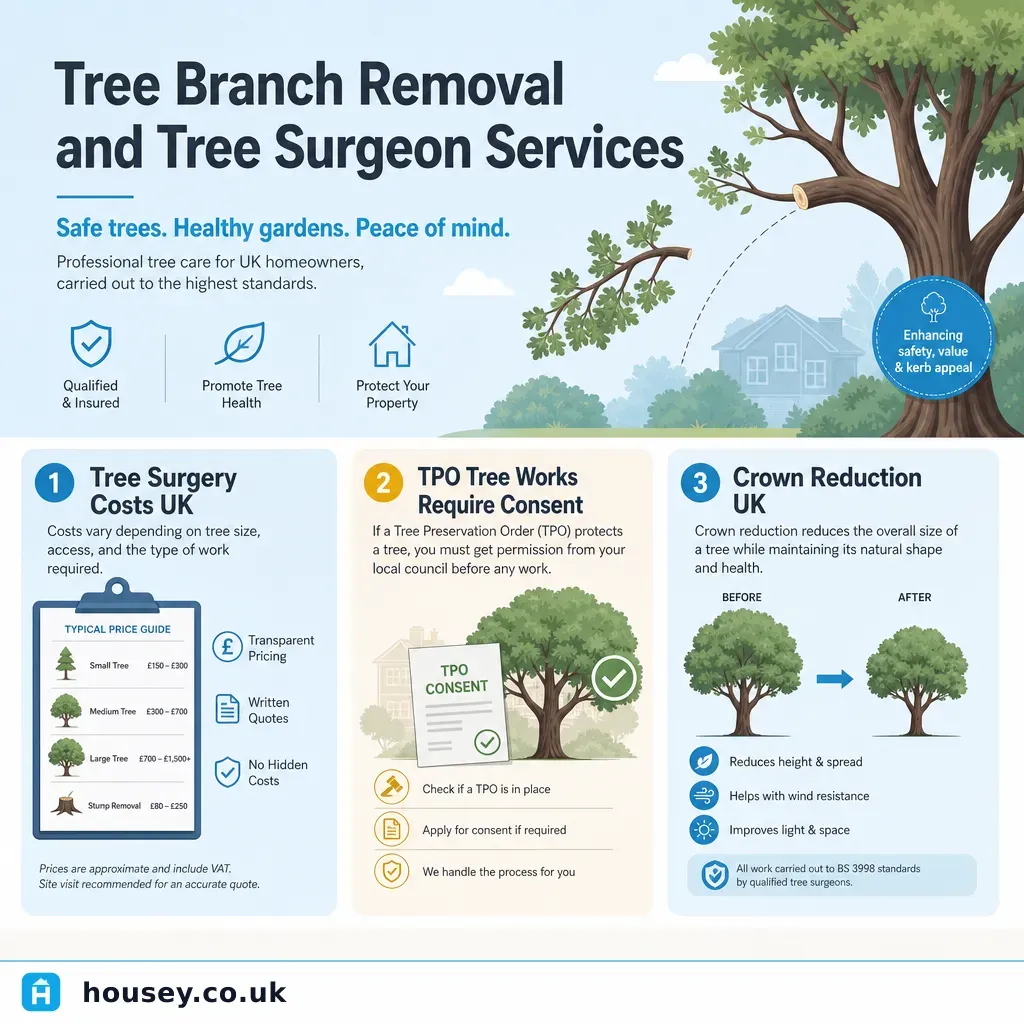 Improvement & Build
Tree Branch Removal and Tree Surgeon Services
Tree surgery — from deadwooding and crown reduction to branch removal and felling — must be carried out by qualified, insured contractors in the UK.