Subfloor Replacement and Repair: Cost Factors and Construction Process
By Housey · Last reviewed 25th of May 2026
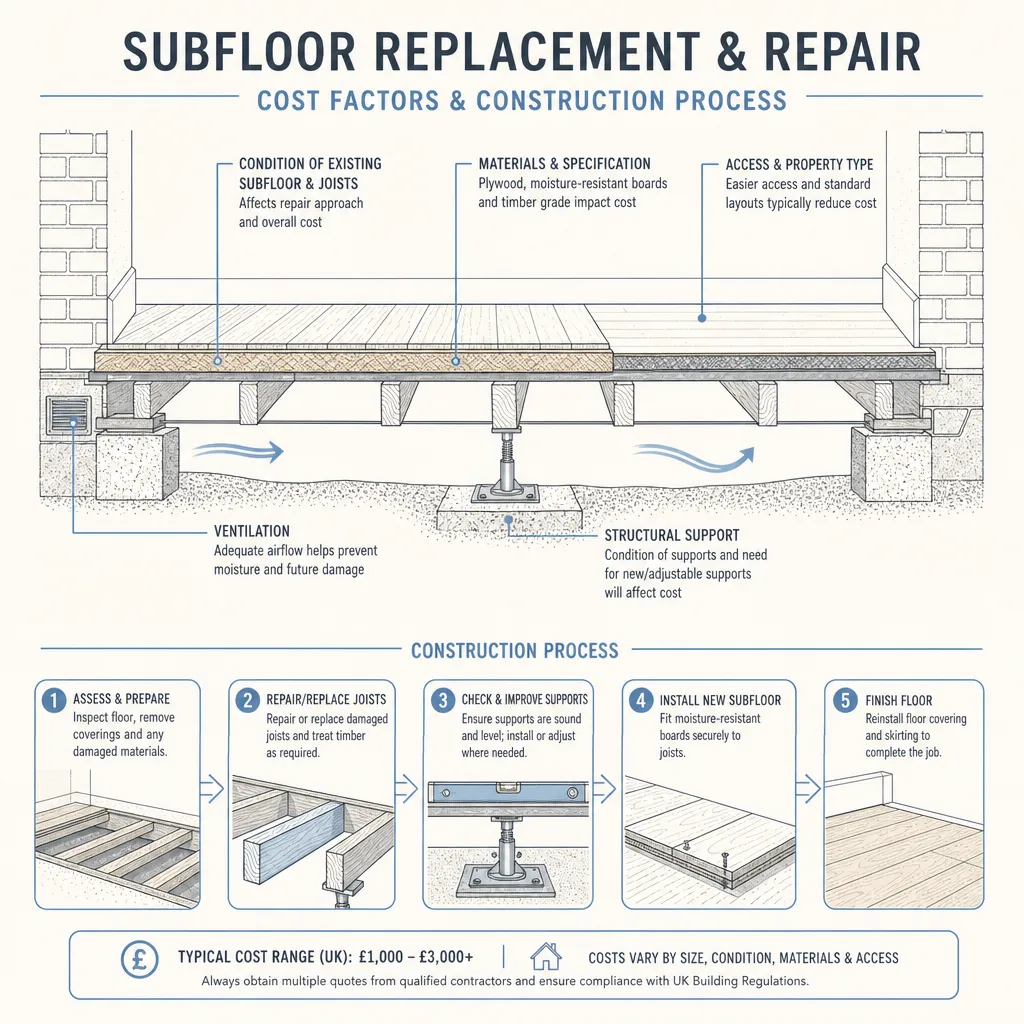
Subfloor Replacement and Repair: Cost Factors and Construction Process
Ground-floor subfloor problems most commonly come to light during a RICS Level 3 Home Survey, when laying new flooring, or when a room starts to feel springy, uneven, or cold underfoot. In Victorian terraces, 1930s semis, and other pre-1950s UK homes, suspended timber subfloors sit over a ventilated void — making them vulnerable to rot, woodworm, and ground moisture. In post-war and newer homes, concrete ground-bearing slabs present a different set of failure modes, from cracking to rising damp.
Key points
- Suspended timber subfloors are common in UK homes built before the 1950s; concrete slabs are more typical in post-war and new-build properties.
- Building Regulations Approved Document A (Structure) and Approved Document C (Site Preparation and Moisture Resistance) apply to structural or damp-related subfloor work.
- A RICS Level 3 Home Survey or a structural engineer's assessment is the appropriate starting point when rot, movement, or moisture is suspected.
- Indicative UK costs range from around £500 for localised timber patch repairs to over £10,000 for full ground-floor suspended floor replacement across a typical three-bedroom semi (Indicative UK costs, last reviewed 2026-05-25).
- Work involving removal of older insulation or boarding materials — particularly from homes built between the 1950s and 1990s — may carry a risk of asbestos exposure; always arrange testing before disturbing existing materials.
UK subfloor types and what can go wrong
Most UK ground floors fall into one of two categories.
Suspended timber floors sit above a ventilated underfloor void. The subfloor is typically tongue-and-groove boarding or sheet material fixed to timber joists. Common problems include joist rot from persistent moisture, blocked airbricks or a failed damp-proof course, woodworm infestation in older timbers, and cold draughts caused by collapsed draught-proofing or failed insulation.
Concrete ground-bearing slabs are bonded directly to the ground. They can fail through cracking caused by ground movement or inadequate base preparation, and through rising damp where the damp-proof membrane (DPM) is absent or has failed.
Subfloor type by property era
Property era | Likely subfloor type | Common issues |
|---|---|---|
Pre-1914 (Victorian/Edwardian) | Suspended timber | Joist rot, woodworm, poor underfloor ventilation |
1919–1945 (inter-war) | Suspended timber or solid | Rot, possible asbestos-containing materials |
1945–1980 | Often solid concrete | Rising damp, cracking, failed DPM |
Post-1980 | Concrete or beam-and-block | Settlement, poor insulation specification |
New-build | Beam-and-block or concrete | Early settlement, radon in certain regions |
What affects subfloor repair and replacement costs
Cost drivers for subfloor work in UK residential properties include:
- Extent of damage — localised rot in a small section of boarding is far cheaper to address than widespread joist failure across an entire ground floor.
- Access — lifting existing floor finishes such as ceramic tiles, hardwood, or engineered boards adds labour time and disposal cost.
- Material specification — treated structural timber, moisture-resistant sheet materials, and rigid insulation all vary in price and specification.
- Subfloor type — replacing suspended timber joists requires different skills and duration than repairing or overlaying a concrete slab.
- Structural involvement — where load-bearing elements are affected, a structural engineering assessment is essential before any remedial work proceeds.
- Root-cause remediation — it is rarely cost-effective to repair a subfloor without also addressing the underlying cause of moisture or movement.
Indicative cost ranges
Indicative UK costs, last reviewed 2026-05-25. Figures vary significantly by region, access, and specification. Always obtain itemised quotes.
Repair or replacement type | Typical indicative cost |
|---|---|
Patch repair of a few floorboards | £300–£600 |
Section replacement (1–2 joists and boarding) | £600–£1,500 |
Full room suspended floor replacement (~20m²) | £2,000–£4,500 |
Full ground-floor suspended floor replacement (3-bed semi) | £6,000–£12,000+ |
Concrete slab repair (crack injection, DPM overlay) | £800–£2,500 |
Concrete slab replacement (one room) | £2,500–£6,000+ |
The subfloor replacement process
A typical suspended timber subfloor replacement follows this sequence:
- Structural assessment — a RICS chartered building surveyor or structural engineer identifies the extent of damage and specifies the remedial works.
- Floor-finish removal — existing tiles, boards, or carpet are lifted and disposed of.
- Subfloor removal — damaged boards and, where necessary, joists are removed.
- Underfloor void inspection — airbricks, DPC, and the condition of the void are checked before new work begins.
- Joist installation — new treated structural timber joists are fitted to the correct span and centres.
- Insulation — rigid or semi-rigid insulation is installed between joists to current Part L requirements.
- Subfloor boarding — tongue-and-groove chipboard or structural plywood is fixed.
- Building control sign-off — where notifiable work has been carried out, a building control completion certificate should be obtained.
For concrete slab replacement, the existing slab is broken out, the sub-base re-compacted, a new DPM laid, and a new concrete slab poured to the specified mix. This is highly disruptive and warrants structural engineer involvement where load-bearing capacity is a consideration.
Pre-work homeowner checklist
Before instructing contractors for subfloor replacement:
Red flags: when to stop and seek professional advice
The following signs indicate that the problem may extend beyond a routine repair:
- Floors that slope noticeably across a room, or doors and windows that have recently started sticking
- Cracks in internal walls running alongside or above the affected floor area
- Stepped or diagonal cracking in external brickwork, particularly at wall corners — this can indicate subsidence
- Significant bounce or movement affecting more than one room
- Any indication that load-bearing walls are implicated in the floor failure
If any of these signs are present, commission a structural engineering assessment before instructing any repair contractors. Work carried out before the cause of movement is properly diagnosed risks recurrence and may conceal evidence that a professional needs to see.
Important limitations
This guide provides general information about subfloor repair and replacement in UK residential properties. The appropriate course of action depends on your specific property, the cause and extent of damage, local ground conditions, and whether structural elements are involved. Rules and requirements vary with property age, tenure, and local authority. A qualified professional — a RICS chartered surveyor or structural engineer — should assess your specific situation before significant subfloor work is undertaken. This guide does not constitute structural or legal advice.
When this becomes urgent
Seek professional advice promptly if:
- Floors are deflecting visibly under normal domestic load
- You can smell or see mould or fungal growth in the underfloor void
- The property has recently flooded and the subfloor void has not dried out within a reasonable period
- You are preparing to sell or remortgage — undisclosed structural defects may affect valuation, mortgage offer, or legal disclosure obligations
What to ask a qualified professional
Before commissioning subfloor replacement works:
- What is the confirmed cause of the damage, and has that cause been resolved before new materials are installed?
- Will this work require building regulations approval, and who will notify building control?
- What timber treatment specification is appropriate for the exposure category in my property?
- Are there any signs of asbestos-containing materials in the existing floor build-up?
- Does any part of the works require a structural engineer's sign-off?
- What guarantee or warranty will be provided on the completed works, and for how long?
How Housey can help
If a structural assessment is needed before subfloor work begins, Housey can connect you with qualified structural engineering professionals in your area. For the construction work itself — from joist replacement to full floor installation — extension builders on the Housey platform regularly carry out ground-floor structural and subfloor replacement projects across the UK.
Frequently asked questions
Do I need building regulations approval to replace a subfloor?
Usually yes, where work involves structural elements such as joists or affects the moisture resistance of the floor. Cosmetic board replacement may not require notification, but where load-bearing timbers or concrete slabs are being replaced, building control should be notified. Confirm requirements with your local authority building control or an approved inspector before starting work.
How do I know whether to repair or fully replace my subfloor?
A surveyor or structural engineer can advise after inspection. Full replacement is generally warranted when joists show widespread rot or woodworm across most of their length, when affected boarding exceeds roughly half the floor area, or when moisture or structural movement has compromised the overall system rather than an isolated section.
Can I remain in the property during subfloor replacement?
This depends on the scale of works. Localised repairs to one room are often manageable around normal occupation. Full ground-floor replacement is disruptive, typically removing kitchen or living-area access for one to three weeks. Agreeing a phased programme with your contractor can help if remaining in the property is essential.
Is subfloor damage covered by home insurance?
Generally only if caused by a defined insurable event such as a flood or burst pipe. Gradual deterioration, rot from long-term damp, and woodworm from poor maintenance or inadequate ventilation are typically excluded. Check your policy wording carefully and contact your insurer before instructing work if you are uncertain.
Sources and further reading
- Building Regulations: Approved Document A (Structure) — GOV.UK
- Building Regulations: Approved Document C (Site Preparation and Moisture Resistance) — GOV.UK
- RICS Home Survey Standard — Royal Institution of Chartered Surveyors
- Asbestos: the survey guide HSG264 — Health and Safety Executive
Useful next reads
 Improvement & Build
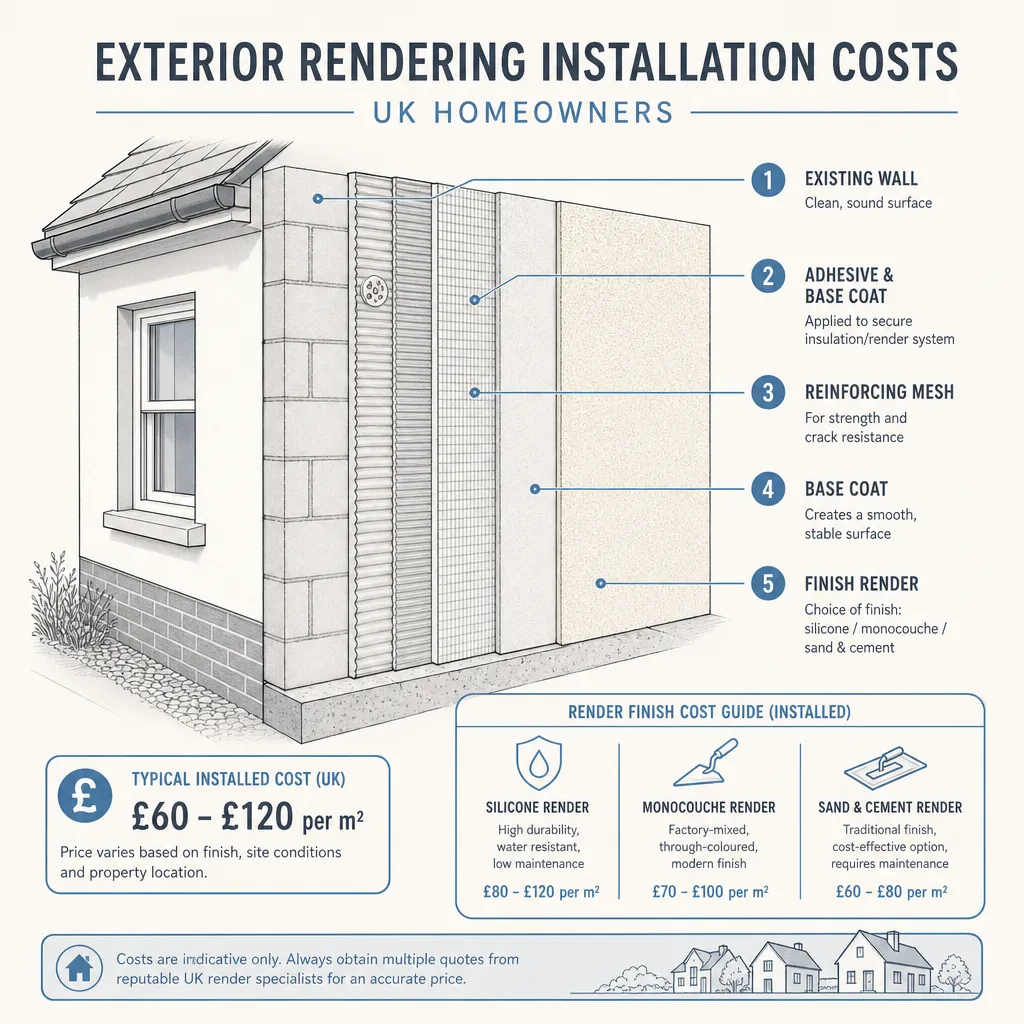
Exterior Rendering Installation Costs
Exterior rendering in the UK typically costs £20–£60 per square metre for standard render systems, or £80–£150 per square metre for External Wall Insulation with a render finish.
 Improvement & Build
Designing an outdoor kitchen for entertaining and garden living
An outdoor kitchen in a UK garden needs a stable, level base — typically a concrete slab or quality paving — with weather-rated materials such as stainless steel grade 316 or frost-rated porcelain.
 Improvement & Build
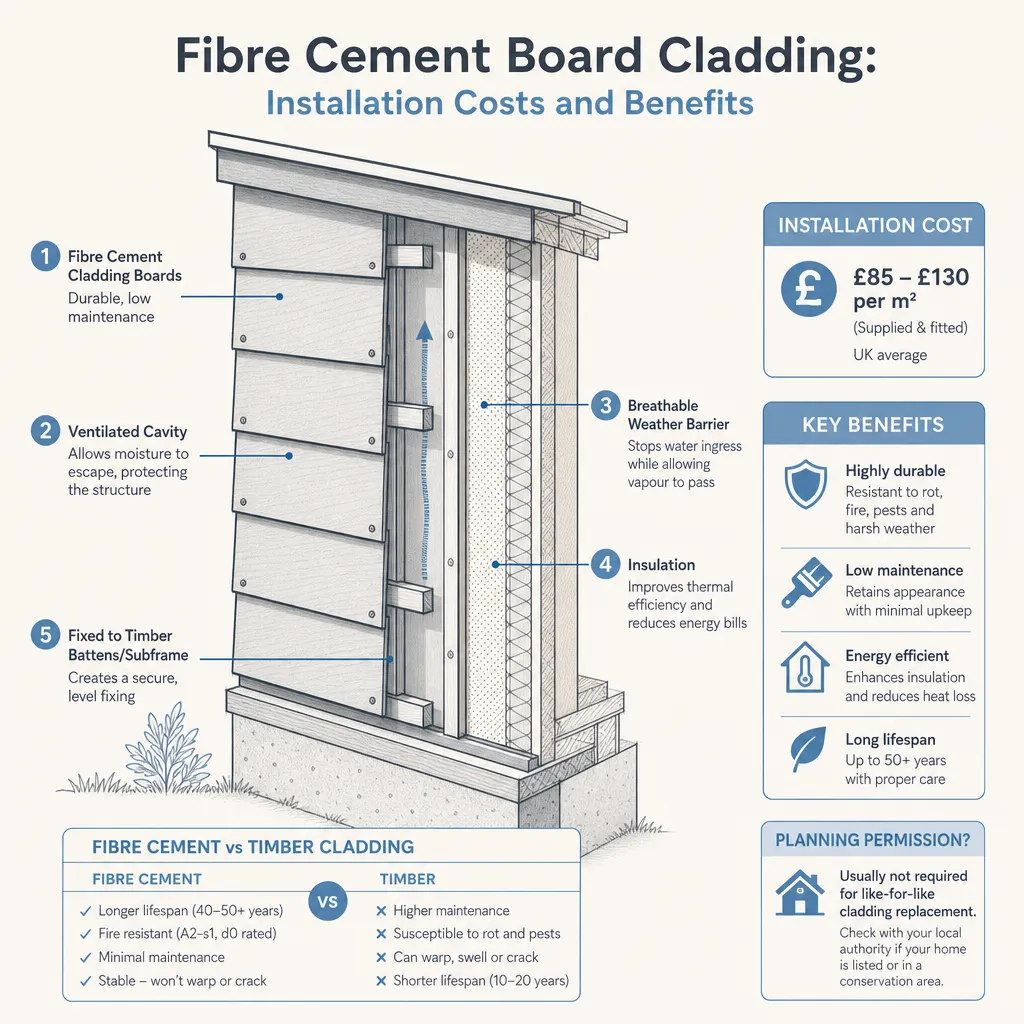
Fibre Cement Board Cladding: Installation Costs and Benefits
Fibre cement board cladding typically costs £80–£180 per m² installed in the UK, including boards, battens, breather membrane, and labour.
 Improvement & Build
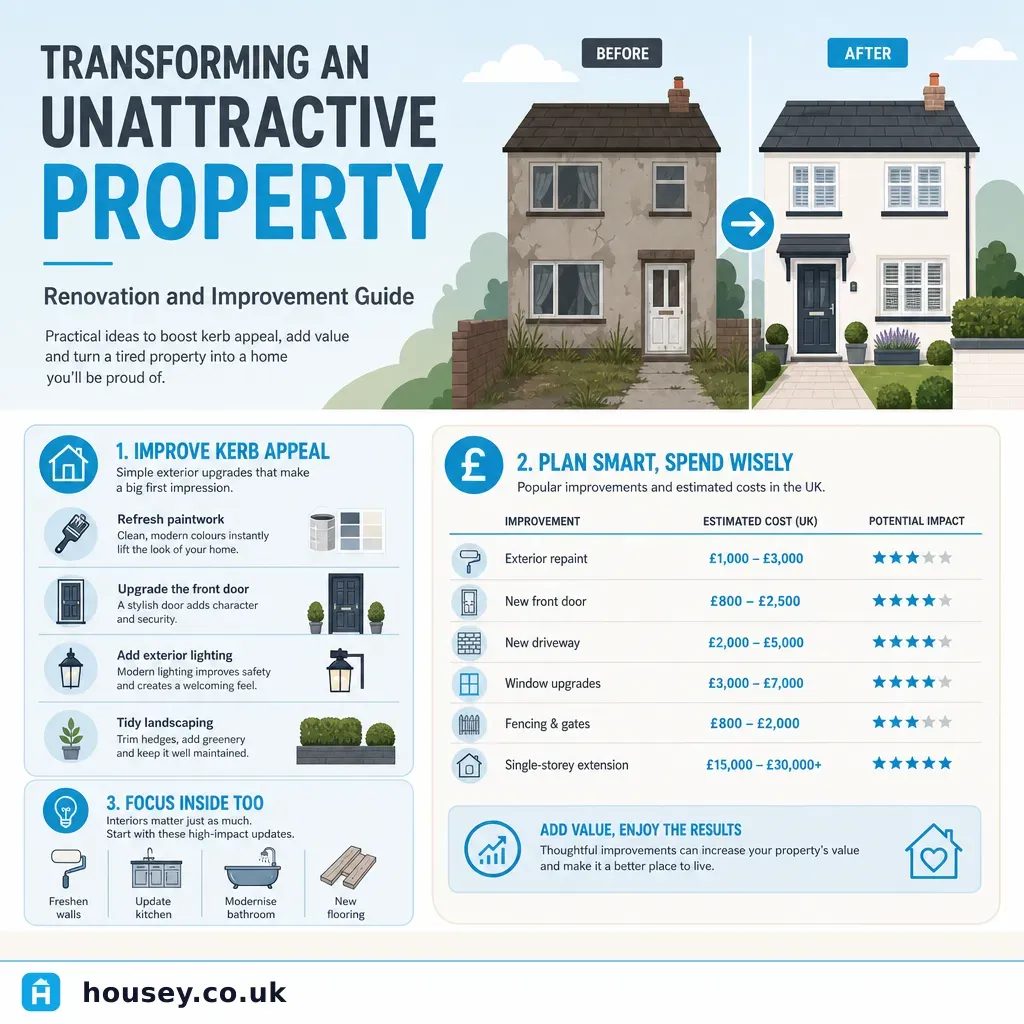
Transforming an Unattractive Property: Renovation and Improvement Guide
Transforming an unattractive UK property usually starts with surface-level improvements — render, windows, doors, and front landscaping — before tackling structural changes like extensions.
 Improvement & Build
London Property Renovation: Complete Modernisation Case Study
Modernising a London property means navigating conservation area restrictions, party wall obligations, and Building Regulations alongside the build work itself.