Subgrade Conditions: Understanding Wet, Moist, and Damp Soil
By Housey · Last reviewed 11th of May 2026
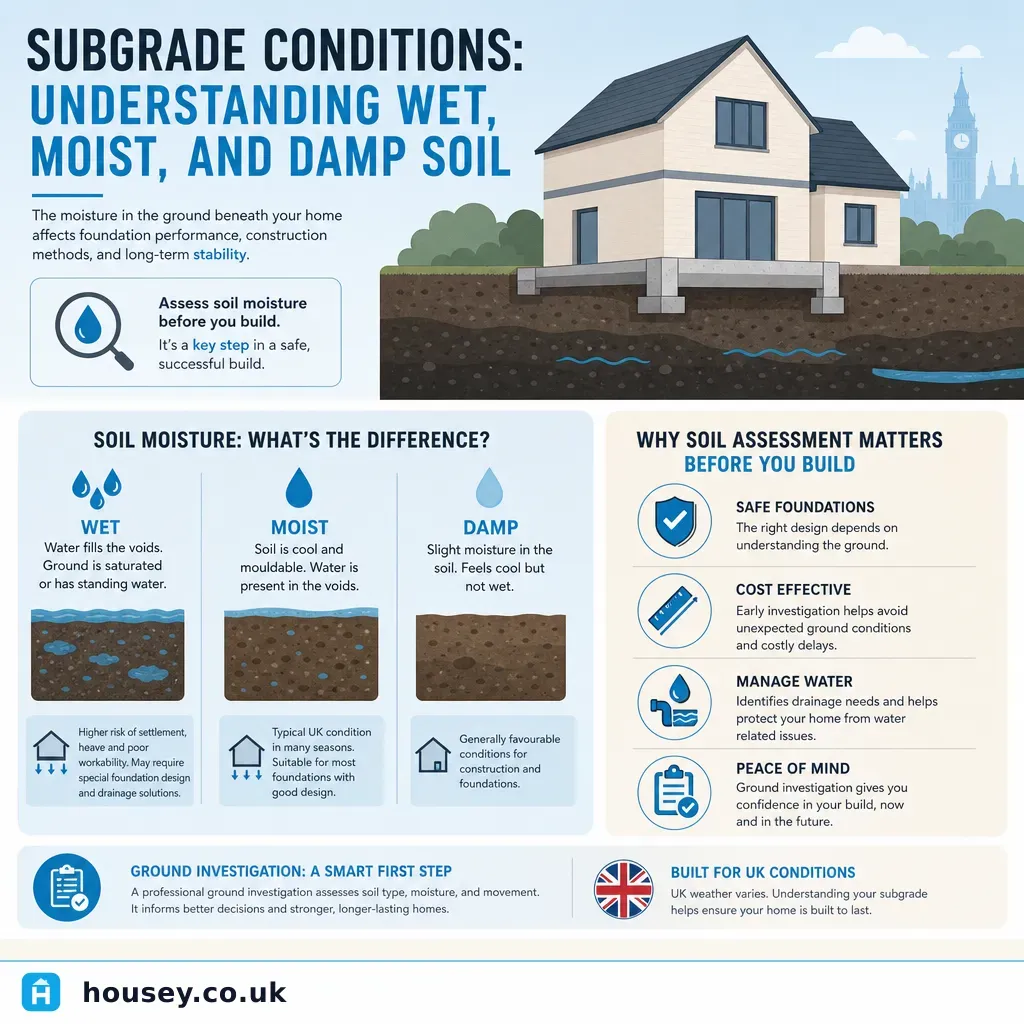
Subgrade Conditions: Understanding Wet, Moist, and Damp Soil
The ground beneath a building is as important as the structure above it, yet it is frequently under-assessed until problems emerge. Questions about subgrade moisture conditions most often arise during the planning or design phase of a new build, extension, or significant groundworks project — or when a structural engineer raises concerns about differential settlement in an existing building. Getting the ground assessment right at the outset can prevent costly remedial work and serious structural damage later.
Key points
- BS 8004:2015 (Code of Practice for Foundations) is the principal UK standard governing foundation design in relation to soil conditions, including moisture-affected subgrades.
- Shrinkable clay soils — common across much of southern, eastern, and central England — can expand when wet and shrink when dry, typically requiring strip foundation depths of at least 1 m under NHBC Standards Chapter 4.2.
- Building Regulations Approved Document A (Structure) requires foundations to be taken to a depth at which the bearing capacity and stability of the ground are adequate for the loads imposed.
- A residential ground investigation report typically costs £1,500–£5,000 depending on plot size and complexity — Indicative UK costs, last reviewed 2026-05-11.
- Made-up ground, fill, or contaminated land requires specialist geotechnical assessment well beyond standard soil moisture classification.
What do wet, moist, and damp mean for a subgrade?
Subgrade moisture terminology describes the degree to which soil beneath a proposed or existing foundation contains water and how that moisture affects bearing capacity and structural behaviour.
Wet subgrade — Soil that is saturated or near-saturated, often with standing or perched water present. Wet conditions dramatically reduce bearing capacity in cohesive soils such as clays, and cause instability in granular soils including sands and gravels. Construction on a wet subgrade without ground improvement or appropriate foundation engineering can lead to immediate settlement or shear failure.
Moist subgrade — Soil with moisture content above optimum for compaction but not fully saturated. This is the most common condition encountered on UK residential sites. A moist subgrade can still provide adequate bearing capacity but may settle under load, particularly if moisture state changes seasonally or during construction.
Damp subgrade — Soil with elevated but relatively controlled moisture, often found just above the water table or in soils with moderate natural drainage. Damp conditions are generally the least structurally problematic of the three but still require attention, particularly for ground floors, damp-proof courses, vapour barriers, and any below-ground construction.
Which soils are most affected by moisture in the UK?
Soil behaviour under varying moisture conditions depends heavily on soil type. The following are the most commonly encountered types across England, Wales, and Scotland:
Soil type | UK distribution | Moisture sensitivity | Foundation implication |
|---|---|---|---|
London Clay / Gault Clay | South-east England, Cambridge area | High — pronounced shrink-swell behaviour | Deep strip or pad foundations; raft often used near trees |
Boulder Clay / glacial till | Northern England, Scotland, Midlands | Moderate — variable bearing capacity | Investigation essential; depth requirements vary |
Made ground / fill | Urban brownfield sites nationally | Very high — unpredictable bearing and settlement | Piled or engineered raft foundation usually needed |
Chalk | South-east and east England | Low moisture sensitivity but risk of dissolution | Check for swallow holes and dissolution features |
Sandy / gravelly soils | East Anglia, coastal areas | Low cohesion when saturated; generally free-draining | Good bearing capacity; check groundwater level |
Peat / organic soils | Scotland, Wales, Somerset Levels | Very high — highly compressible and moisture-variable | Rarely suitable for direct founding; piling is usual |
Decision tree: what type of foundation investigation do you need?
- New build on a greenfield plot with no known ground issues: minimum desk study plus trial pits (typically 2–4 pits to 1.5–3 m depth) with laboratory testing of disturbed samples.
- New build on a brownfield or previously developed site: full Phase 1 desk study and walkover, followed by Phase 2 ground investigation including boreholes, contamination testing, and groundwater monitoring.
- Extension to an existing building: desk study and at least one trial pit adjacent to existing foundations to confirm bearing stratum depth and check for groundwater.
- Visible signs of wet ground, springs, or seasonally waterlogged areas: intrusive investigation with boreholes or trial pits and groundwater level monitoring over multiple seasons before finalising design.
- Clay soil with trees or large shrubs within 10 m of the proposed building: Atterberg limits (shrinkability) test to confirm soil class; check NHBC Standards Chapter 4.2 zone maps for required foundation depth.
- Any existing settlement or structural movement in the vicinity: commission a structural engineer and geotechnical engineer jointly before committing to a foundation approach.
What happens if a wet or weak subgrade is found?
Discovering a problematic subgrade does not mean a project cannot proceed — but it does mean foundation design must be adapted to suit the ground conditions.
Ground improvement — Techniques such as vibro-compaction, dynamic compaction, or lime and cement stabilisation can increase bearing capacity in appropriate soil types. Ground improvement is typically more cost-effective than piling for large footprints on moderately weak ground.
Piled foundations — Driven or bored piles transfer building loads through weak upper soils to a competent bearing stratum below. Commonly used on soft clays, peat, and made-up ground. Mini-piles are frequently used on constrained residential sites.
Raft foundations — A reinforced concrete slab spanning the full building footprint, distributing loads and bridging localised weak spots. Frequently used on moderately weak or variable clays and on sites with made ground.
Trench-fill or deep strip foundations — Taken below the zone of seasonal moisture variation; typically 1 m minimum on shrinkable clays, potentially 1.5 m or deeper near mature trees. Economical for simple residential plans on clay.
Important limitations
This article provides general information about subgrade moisture conditions and their implications for foundation design. Ground conditions vary enormously — even within a small area of a single plot. The only reliable way to determine what is present beneath a specific site is through an appropriate ground investigation carried out by a competent geotechnical professional. Nothing in this article constitutes structural or geotechnical advice for any specific project. Rules and requirements may also vary depending on local authority, building control body, and site-specific risks.
When to get professional help
Subgrade assessment is not a DIY task. Seek professional input in all of the following situations:
- Before submitting planning or building regulations applications where ground conditions are unknown or uncertain.
- If topsoil, peat, made ground, or evidence of historic landfill is present anywhere on the plot.
- If the site is within 10 m of trees with canopy spread near the proposed building on clay soils.
- If groundwater, springs, or seasonally waterlogged areas are visible on or adjacent to the site.
- If any existing structure on or near the site shows signs of differential settlement — stepped cracks, sticking doors or windows, or visibly sloping floors.
- If the local planning authority or building control officer requests a ground investigation report as a planning condition or building regulations requirement.
What to ask a qualified professional
Before instructing a geotechnical engineer or ground investigation contractor:
- What scope of investigation do you recommend for this site — trial pits, boreholes, laboratory testing — and what does each reveal?
- Will you provide a Ground Investigation Report to BS 5930:2015 + A1:2020?
- Will the report include foundation recommendations, or do I need a separate structural engineer to interpret the findings?
- Are there known ground hazards in this area — former mining, dissolution features, historic landfill — that would affect scope?
- What are the groundwater implications for my proposed foundation type and any subfloor void or below-ground structure?
- How will the findings be shared with building control, and what level of approval do you expect the report to support?
How Housey can help
If you are at the pre-build or planning stage and need a ground investigation, Housey connects you with qualified professionals. A geotechnical and soil investigation specialist can advise on investigation scope, carry out trial pits and boreholes, and produce a report to the required standard to support foundation design. A building control consultant can advise on compliance with Approved Document A and ensure your foundation approach meets your local building control body's requirements.
Frequently asked questions
Does building control always require a ground investigation report?
Not always, but building control bodies often request one for new builds, extensions, or where ground conditions are uncertain. The requirement depends on the site, the proposed foundation type, and the building control body's assessment of risk. Providing a ground investigation report proactively often speeds up approval and reduces the likelihood of conditional requirements being imposed after works begin.
How deep should foundations be in wet clay soil?
On shrinkable clays, NHBC Standards Chapter 4.2 typically requires a minimum depth of 1 m for strip foundations, increasing to 1.5 m or more near trees depending on species, height, and proximity. Building Regulations Approved Document A requires foundations to be taken to a depth where bearing capacity is adequate — on reactive clays this is generally well below the 0.45 m minimum for non-reactive ground.
Can wet ground be improved before building?
In many cases, yes. Ground improvement techniques including vibro-compaction, dynamic compaction, and lime or cement stabilisation can increase the bearing capacity of cohesive or granular soils. Suitability depends on soil type, moisture content, and the loads involved. A geotechnical engineer should assess options and specify any improvement works before ground is disturbed.
What is the difference between a Phase 1 and Phase 2 ground investigation?
A Phase 1 investigation is a desk study and walkover survey reviewing historical maps, records, and visible site features to identify potential ground hazards. A Phase 2 investigation is intrusive — involving trial pits, boreholes, sampling, and laboratory testing to characterise actual soil and groundwater conditions. Phase 2 is usually required before foundation design can be finalised on any site with identified risks.
Sources and further reading
- Approved Document A: Structure — GOV.UK
- BS 8004:2015 Code of Practice for Foundations — BSI
- BS 5930:2015+A1:2020 Code of Practice for Ground Investigations — BSI
- NHBC Standards Chapter 4.2 — Building near trees — NHBC
- Contaminated land: how to manage the risks — GOV.UK / Environment Agency
- BRE Digest 318 — Site investigation for low-rise building — BRE Group
Useful next reads
 Planning & Pre-Build
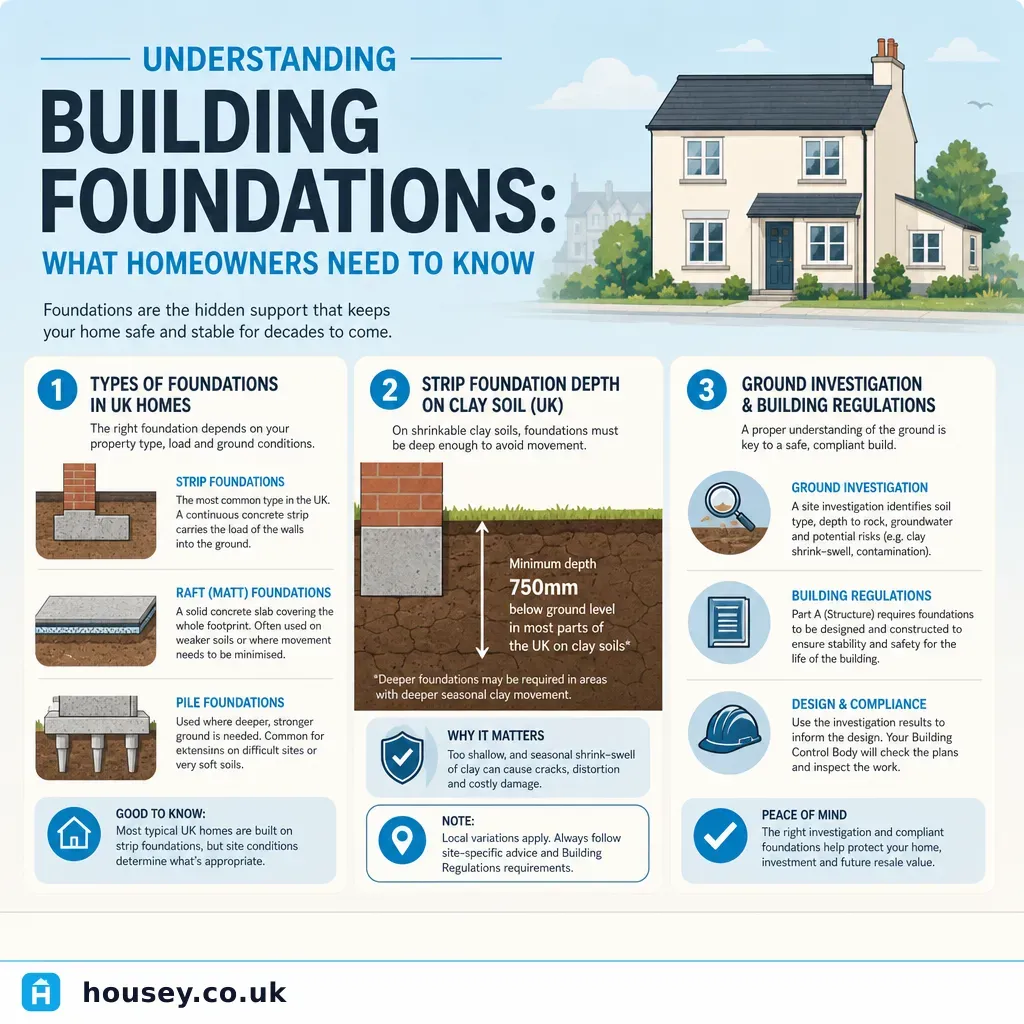
Understanding building foundations: what homeowners need to know
Building foundations transfer a structure's load safely to the ground beneath it.
 Planning & Pre-Build
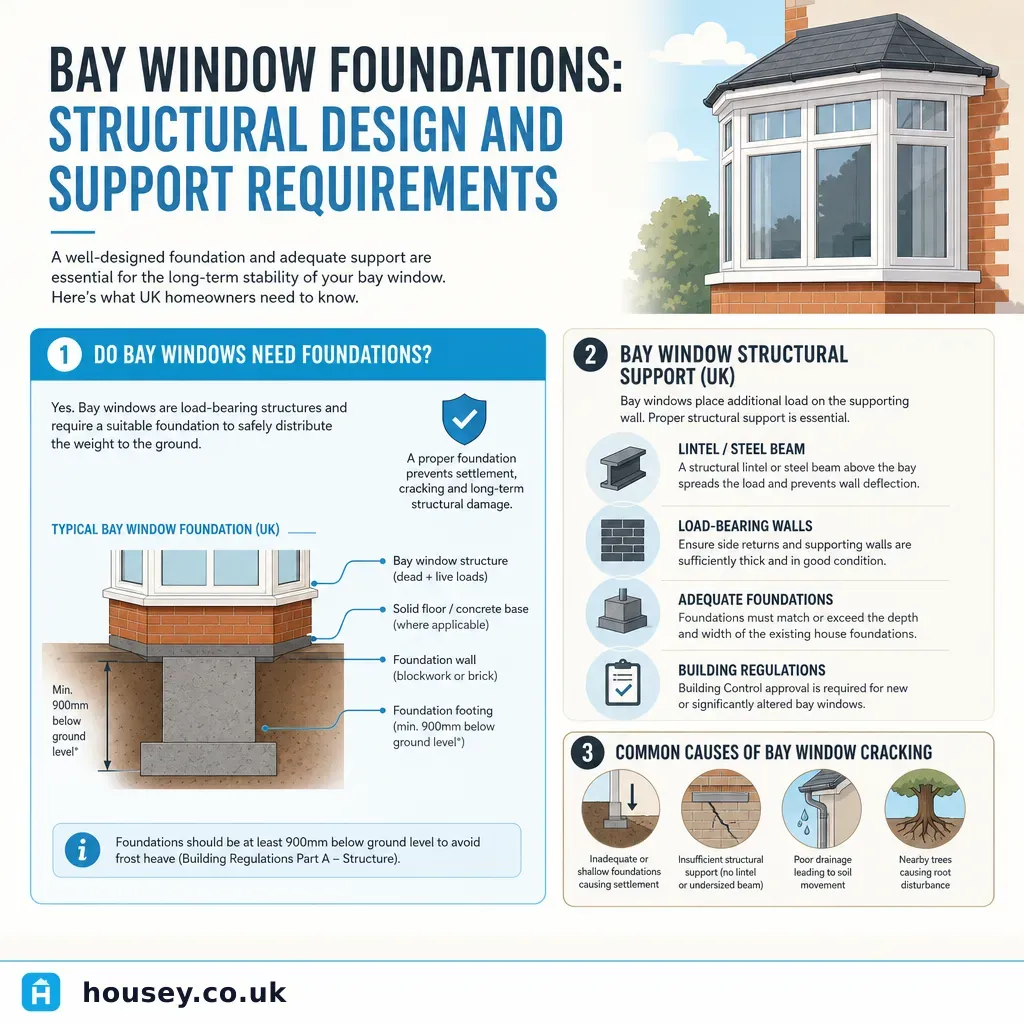
Bay Window Foundations: Structural Design and Support Requirements
Bay window foundations must transfer the bay's structural load to the ground independently of the main wall.
 Planning & Pre-Build
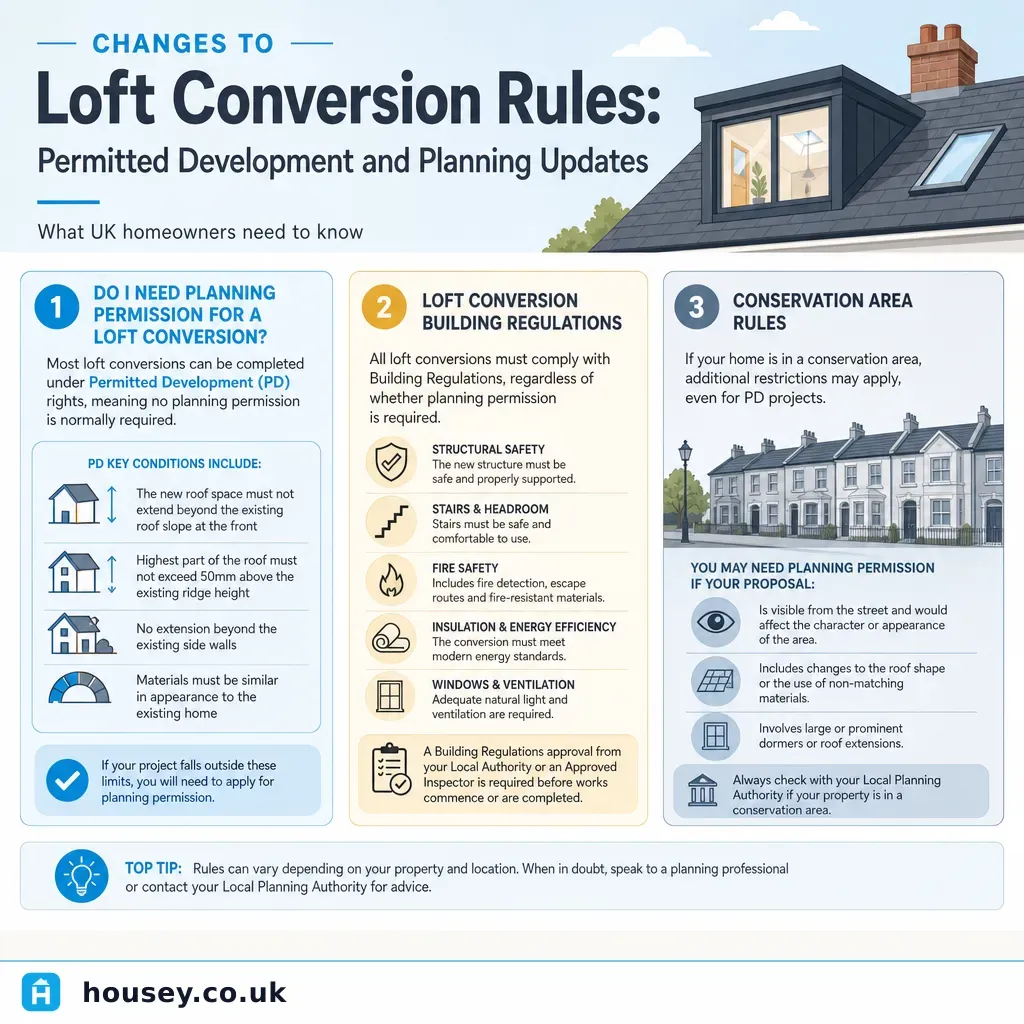
Changes to Loft Conversion Rules: Permitted Development and Planning Updates
In England, most loft conversions on standard houses qualify as Permitted Development under Class B of the GPDO 2015, allowing up to 40 cubic metres (terraced) or 50 cubic metres (detached or semi-detached) without a planning application — if conditions are met.
 Planning & Pre-Build
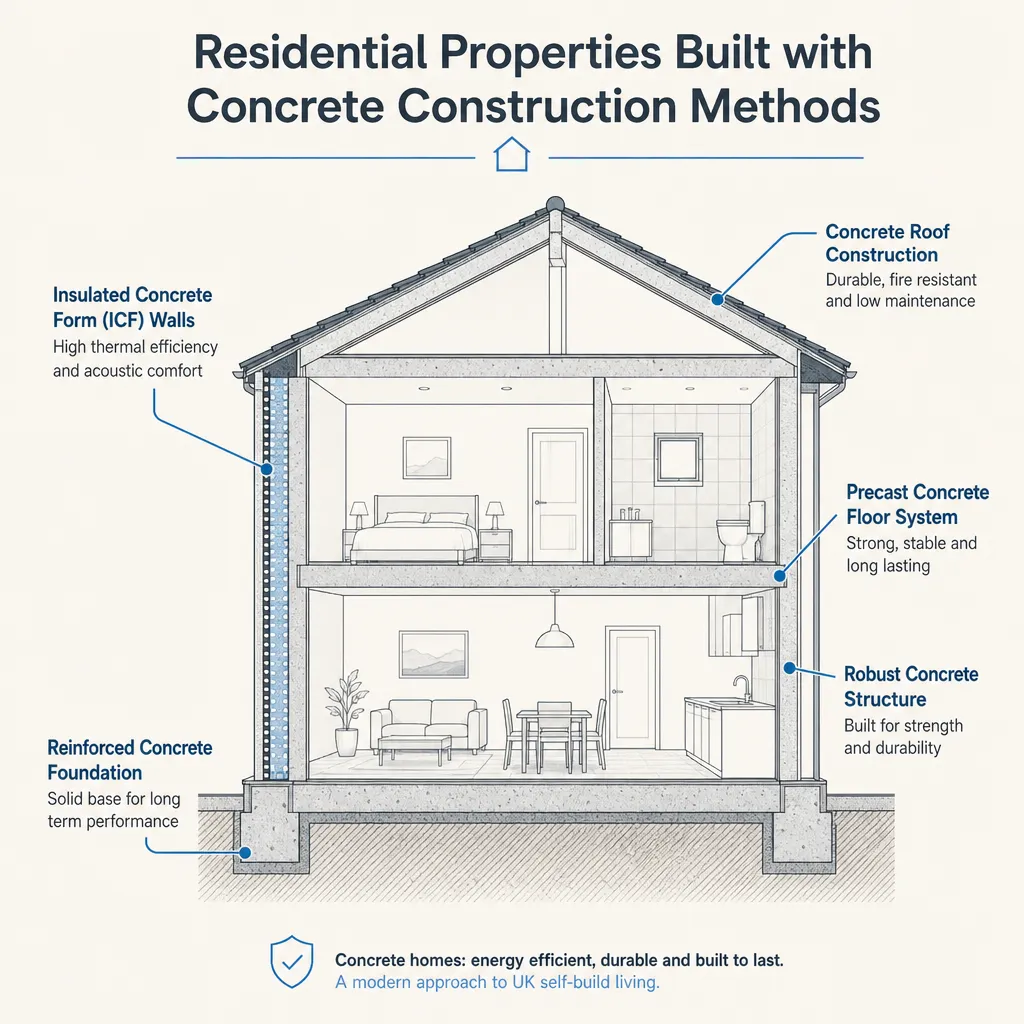
Residential Properties Built with Concrete Construction Methods
UK homes are built using several concrete methods: in-situ cast concrete, precast panel systems, insulating concrete formwork (ICF), and older non-traditional types such as Wimpey No-Fines and Laing Easiform.
 Planning & Pre-Build
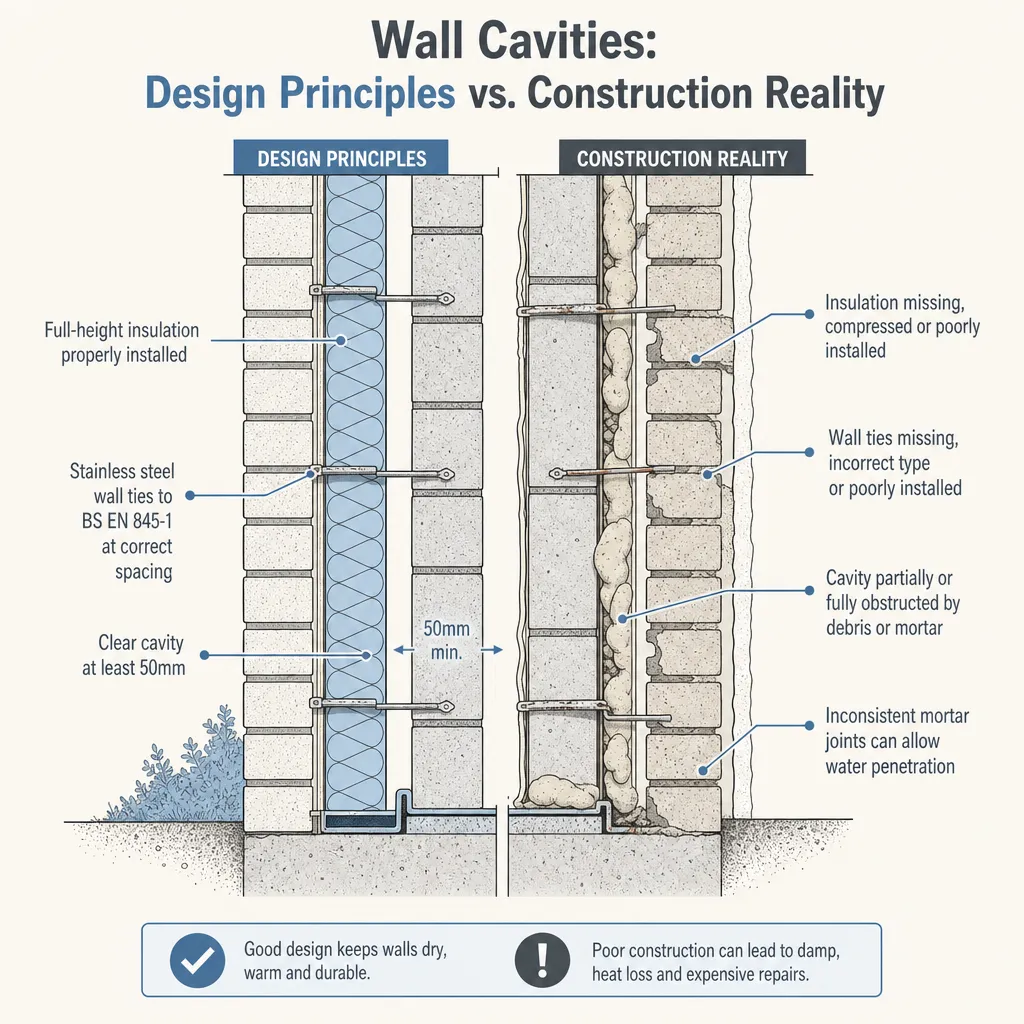
Wall Cavities: Design Principles vs. Construction Reality
A UK cavity wall is designed to resist weather, control heat loss, and structurally link two masonry leaves.