What to Expect from a Survey on a Penthouse or High-Floor Apartment
By Housey · Last reviewed 7th of May 2026
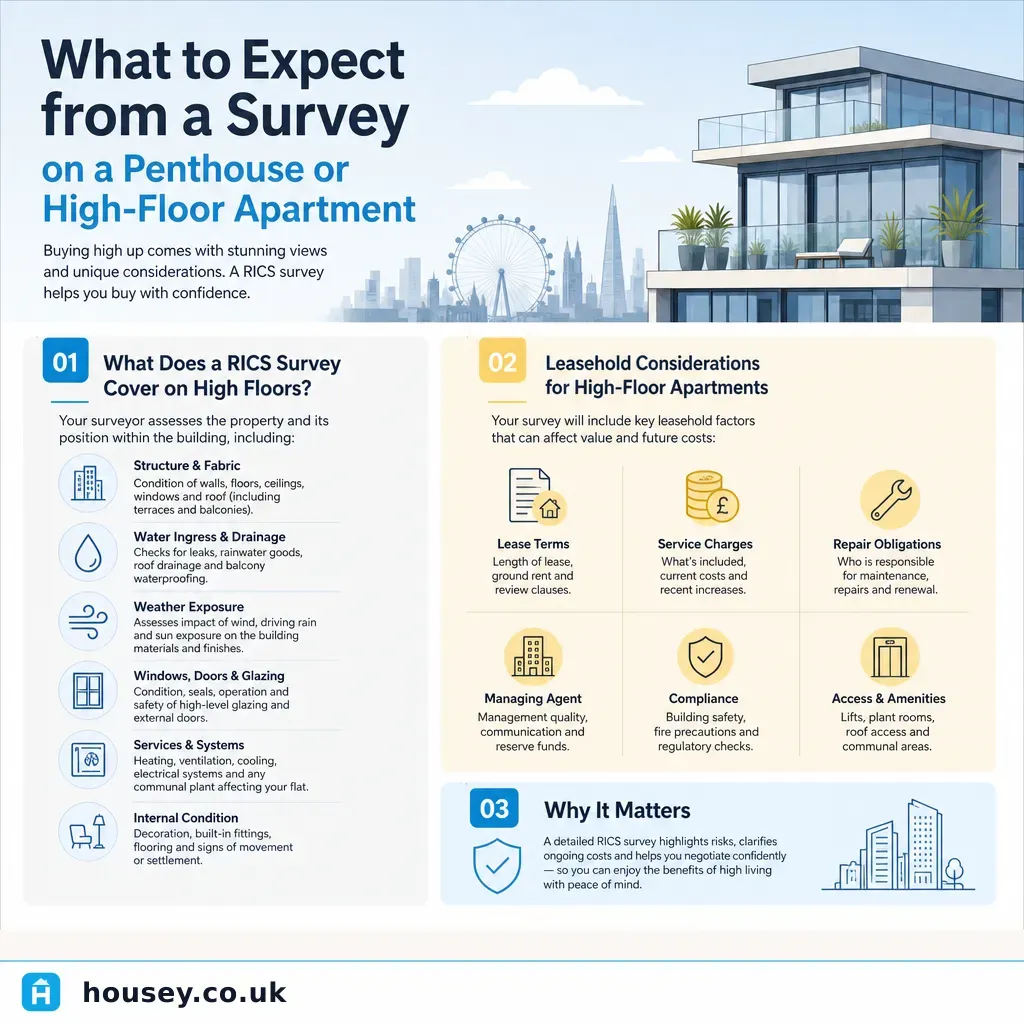
What to Expect from a Survey on a Penthouse or High-Floor Apartment
Buying a penthouse or high-floor apartment raises questions that a standard flat purchase does not — from how surveyors physically access roof terraces and plant rooms, to which elements of the building fall within your ownership and which remain the freeholder's or residents' management company's responsibility. Whether you are purchasing for owner-occupation or as an investment, commissioning the right survey and understanding what it will and will not cover is important before you exchange contracts.
Key points
- Most penthouses and high-floor apartments are suited to a RICS Level 2 Home Survey, but properties with visible defects, unusual construction, or significant access limitations may warrant a RICS Level 3 Building Survey.
- Roof terraces, roof lights, and green roofs associated with a penthouse fall within the surveyor's scope but may be reported with access limitations if entry is unavailable on inspection day.
- The surveyor inspects the demised premises only — the space legally defined within your lease — not common parts, shared structure, or elements owned by the freeholder.
- Leasehold documentation — lease length, service charge history, planned major works, and ground rent — is not reviewed by a building surveyor; this is your solicitor's responsibility.
- On high-rise buildings (typically 18 metres or more in height), cladding and fire safety may require an EWS1 (External Wall System) form, which is separate from any RICS survey and must be obtained from a qualified fire engineer.
Which survey is right for a penthouse or high-floor apartment?
The choice between survey types depends on the property's age, construction, condition, and complexity — not simply its value or position on the building.
Survey type | Best for | Not ideal for | What the surveyor produces | Main risk if wrong choice |
|---|---|---|---|---|
RICS Level 2 Home Survey | Modern or well-maintained apartments in reasonable condition, standard construction | Older buildings, visible defects, unusual materials, significant alterations | Condition ratings (1–3) with commentary; optional valuation | Missing defects that require more detailed investigation |
RICS Level 3 Building Survey | Older buildings, complex structure, visible movement or water ingress, unusual construction | Straightforward modern flats where the additional cost is not justified | Detailed description of construction, defects, repair options, and cost guidance | Underspending at survey and missing significant defects |
Basic valuation | Lender's minimum requirement only | Buyers wanting meaningful condition information | Market value figure only | Very limited defect information provided |
For a penthouse in a modern high-rise built after 2000, a RICS Level 2 Home Survey is usually appropriate. For a penthouse in a converted Victorian or Edwardian mansion block, or any property showing signs of movement, damp, or roof terrace deterioration, a RICS Level 3 is worth requesting. If you only need a value figure for a straightforward purchase, a valuation survey covers that purpose.
What surveyors look for in a penthouse or high-floor apartment
A chartered surveyor inspecting a penthouse follows the same methodology as for any flat, but certain elements are particularly significant at high floors or within penthouse-specific layouts.
Roof and waterproofing
The penthouse is typically directly below or at the top of the building's roof structure. The surveyor will assess:
- Condition of the flat roof membrane or green roof above the apartment or accessible via a roof terrace.
- Signs of water ingress on ceiling surfaces, around roof lights, or at the junction of the parapet wall and roof surface.
- Condition of gutters, outlets, and drainage points if accessible from the terrace or roof level.
If roof access is unavailable on inspection day, the report will note this as a limitation and may recommend a follow-up inspection once access can be arranged.
External walls at height
The condition of external walls at high levels is often harder to assess than at ground floor. A surveyor will use binoculars and direct inspection where access allows to look for:
- Cracking, spalling, or deterioration in masonry, render, or cladding panels.
- Window and door frame condition, gaps in seals, and the state of any pointing or flashings.
- On modern high-rise buildings, the presence and visible condition of any cladding system, noting whether further specialist fire safety assessment appears warranted.
Roof terrace
Where a roof terrace forms part of the demise, the surveyor will inspect:
- Surface condition of the terrace deck — tiles, decking boards, or waterproof membrane.
- Drainage falls and outlet condition to check that water drains away effectively.
- Condition of the parapet wall, balustrades, and any glazed balustrade panels for safety and weathertightness.
- Condition of any planters, raised structures, or external storage areas on the terrace.
Condensation and ventilation
High-floor apartments are often exposed to greater temperature differentials and wind-driven rain than lower-floor units. The surveyor will note signs of condensation on walls, ceilings, and window reveals, and will check whether ventilation to kitchens, bathrooms, and habitable rooms appears adequate for residential use.
Plant rooms and services
Many penthouses include access to a dedicated plant room or are near shared plant on the same level. The building surveyor does not inspect shared plant, but will note if the plant room appears to serve the apartment and may recommend a specialist assessment of the heating or hot water system if concerns are identified.
What a building survey does not cover in a leasehold apartment
Understanding the limits of a building survey matters as much as knowing what it includes:
- Common parts and shared structure: The surveyor inspects the demised flat only. The structure, fabric, and common areas of the building are typically the freeholder's or management company's responsibility. Requesting the freeholder's maintenance records and recent inspection reports can help fill this gap.
- Leasehold terms and service charges: A surveyor does not review the lease. Lease length, ground rent, service charge history, sinking fund balance, and planned major works are legal and financial matters for your solicitor and, where relevant, a specialist leasehold surveyor.
- EWS1 forms: On high-rise buildings, lenders increasingly require an EWS1 form confirming the external wall construction has been assessed for fire safety. This is not produced by a RICS Level 2 or Level 3 surveyor — it requires a suitably qualified fire engineer and is commissioned separately.
- Structural calculations: If the building shows signs of structural movement, or if the penthouse includes significant structural alterations, a separate structural survey or structural engineer's report may be necessary beyond the scope of a standard RICS inspection.
Homeowner checklist: before your survey
Before the surveyor attends, check or arrange the following:
What to ask before instructing a surveyor
- Do you have experience surveying penthouses and high-floor apartments in buildings of this type and age?
- If access to the roof terrace is restricted on inspection day, what is your process — will you note limitations and recommend a reinspection, and is there an additional fee for that?
- Can you comment on the visible external cladding from accessible areas, and can you advise whether an EWS1 form is likely to be required by lenders?
- Is a market valuation included in your fee, or is it a separate charge?
- How long after the inspection will I receive the written report?
- If you identify significant concerns during the inspection, will you contact me before the final report is issued?
When to get professional help
For most penthouse purchases, a RICS-qualified surveyor is the right starting point. However, you may need additional professional input if:
- The inspection report identifies structural movement, significant water ingress, or major roof terrace defects — a structural survey or structural engineer's assessment may be warranted.
- The building is 18 metres or taller and no EWS1 form exists — a suitably qualified fire engineer should be instructed.
- The lease has fewer than 80 years remaining — a specialist leasehold valuer can advise on the likely cost of lease extension before you commit.
- Service charge history shows very large fluctuations or a major works programme is pending — your solicitor should review all section 20 notices before exchange.
- The penthouse is within an older converted building and you are uncertain about the construction — a RICS Level 3 Building Survey will provide more detailed investigation and repair guidance.
How Housey can help
Housey makes it straightforward to request quotes from RICS-qualified surveyors experienced with leasehold flats and high-floor apartments. Whether you need a RICS Level 2 Home Survey, a valuation survey, or a structural survey for a more complex inspection, Housey connects you with the right professional for your penthouse purchase.
Frequently asked questions
Can a surveyor always access a penthouse roof terrace?
Not always. Access depends on the terms of the lease, building management rules, and whether the agent or vendor makes arrangements in advance. If access is unavailable on inspection day, the surveyor must note this as a limitation in the report and may recommend a follow-up inspection. It is worth confirming access arrangements with the selling agent well before the inspection date.
Does a RICS survey cover the whole building when buying a penthouse flat?
No. A RICS survey covers the demised flat — the space defined within your lease. The surveyor does not inspect common parts, shared structure, or other flats in the building. If you want the wider building's condition assessed, a separate building condition survey would be needed, typically arranged through the freeholder or residents' management company.
What is an EWS1 form and does my penthouse purchase need one?
An EWS1 (External Wall System) form confirms that the external wall construction and cladding of a high-rise building have been assessed for fire safety. Lenders typically require it for buildings of 18 metres or more in height (roughly six or more storeys). It is produced by a qualified fire engineer, not a general building surveyor. Check with your mortgage lender before instructing any surveys.
Is a valuation included in a RICS Level 2 survey?
A RICS Level 2 Home Survey can include a market valuation, but this is often an optional add-on rather than automatic — confirm this when requesting quotes. A standalone mortgage valuation commissioned separately by your lender is distinct from a RICS Level 2 or Level 3 survey and provides very limited condition information about the property.
How much does a survey on a penthouse typically cost?
Survey costs vary by property value, location, building type, and survey level. As a general guide, RICS Level 2 surveys on leasehold flats typically range from around £400 to £800 or more, with higher-value penthouses at the upper end of the range. RICS Level 3 Building Surveys cost more. Always request itemised quotes and confirm whether a valuation is included. Indicative UK costs, last reviewed 2026-05-07.
Sources and further reading
- RICS Home Surveys Standard — RICS
- Leasehold property — GOV.UK
- EWS1 — External Wall Systems guidance — RICS
- Leasehold Advisory Service (LEASE) — Leasehold Advisory Service
- UK Finance: EWS1 and high-rise residential buildings — UK Finance
Useful next reads
 Surveys & Inspections
How Professional Home Surveys Deliver Real Value For Buyers
A professional home survey by a RICS-registered surveyor can identify defects, legal compliance gaps, and cost liabilities before exchange of contracts, giving buyers an evidence base for negotiation or withdrawal.
 Surveys & Inspections
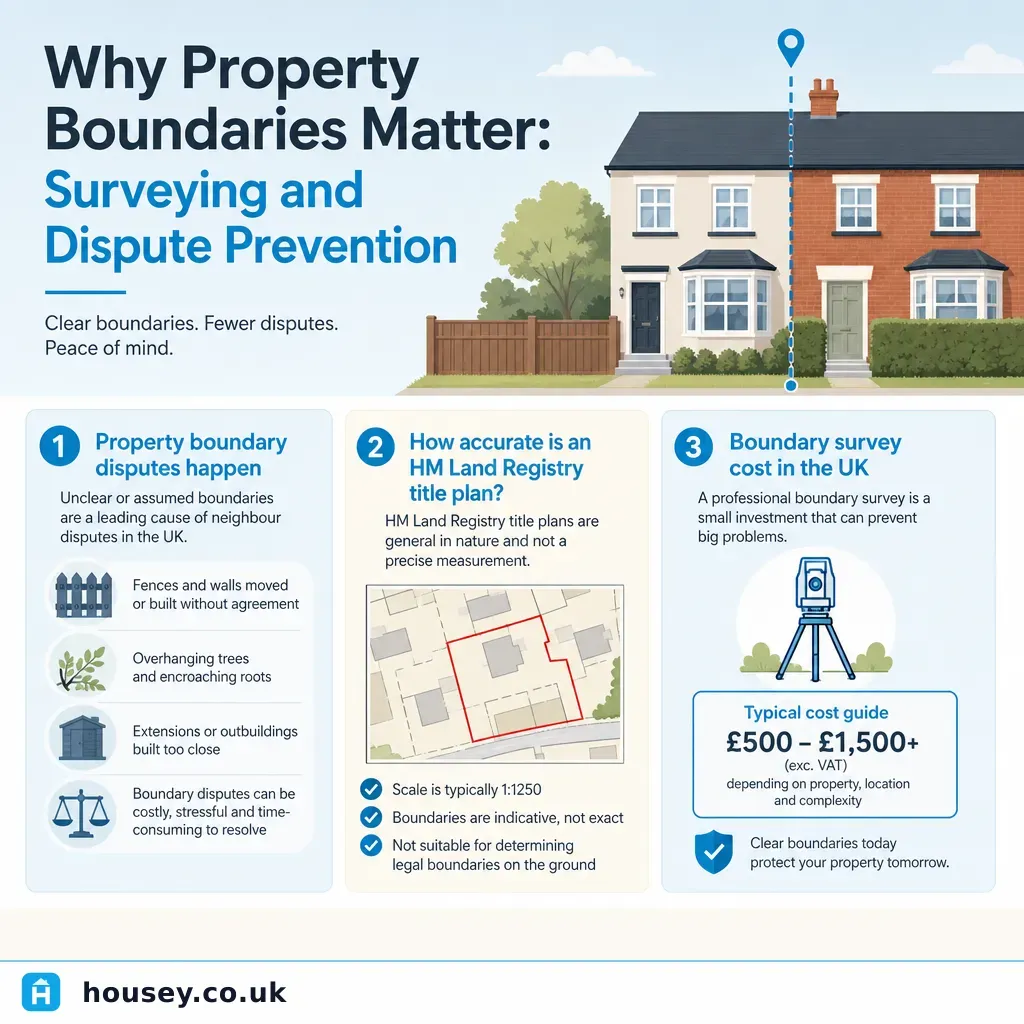
Why Property Boundaries Matter: Surveying and Dispute Prevention
Property boundaries in England and Wales are recorded as general boundaries by HM Land Registry — not precise measurements.
 Surveys & Inspections
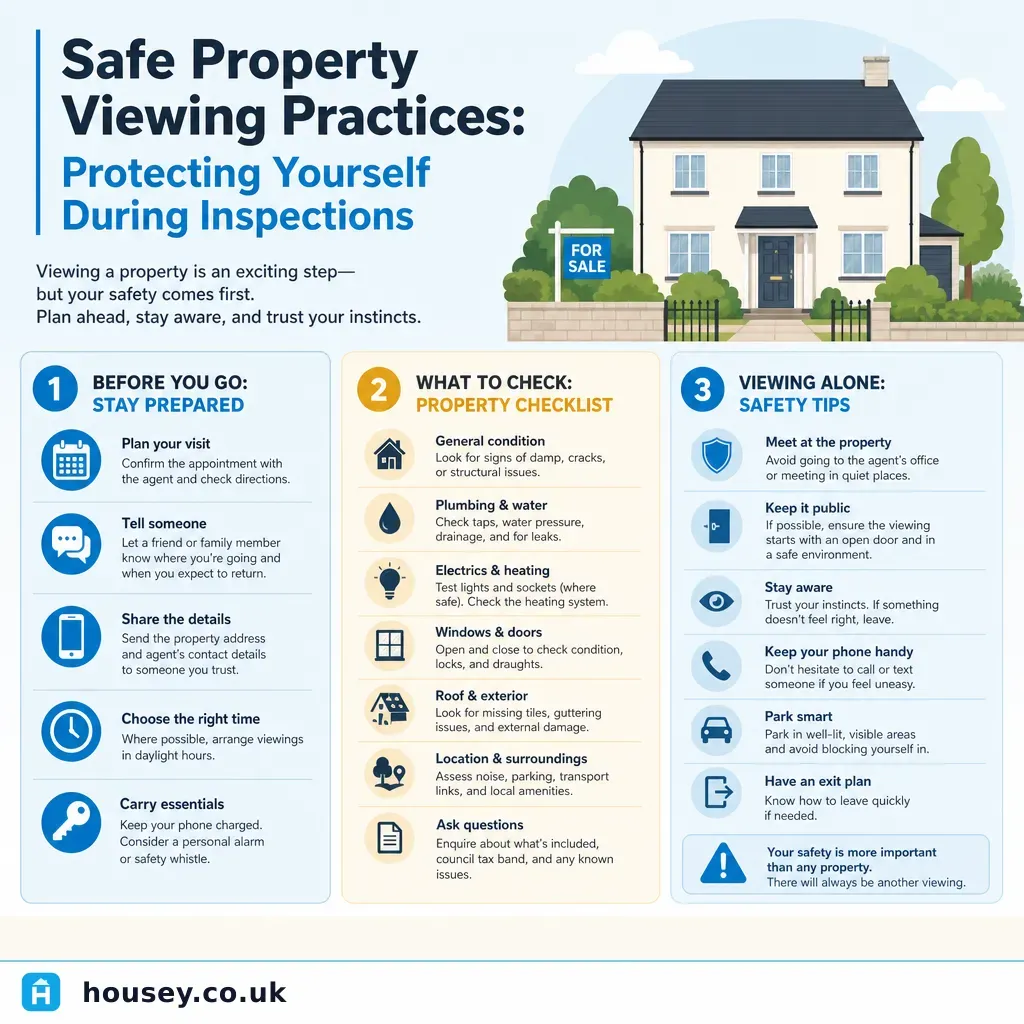
Safe Property Viewing Practices: Protecting Yourself During Inspections
When viewing a property in the UK, always tell someone where you are going and share the full address before you leave.
 Surveys & Inspections
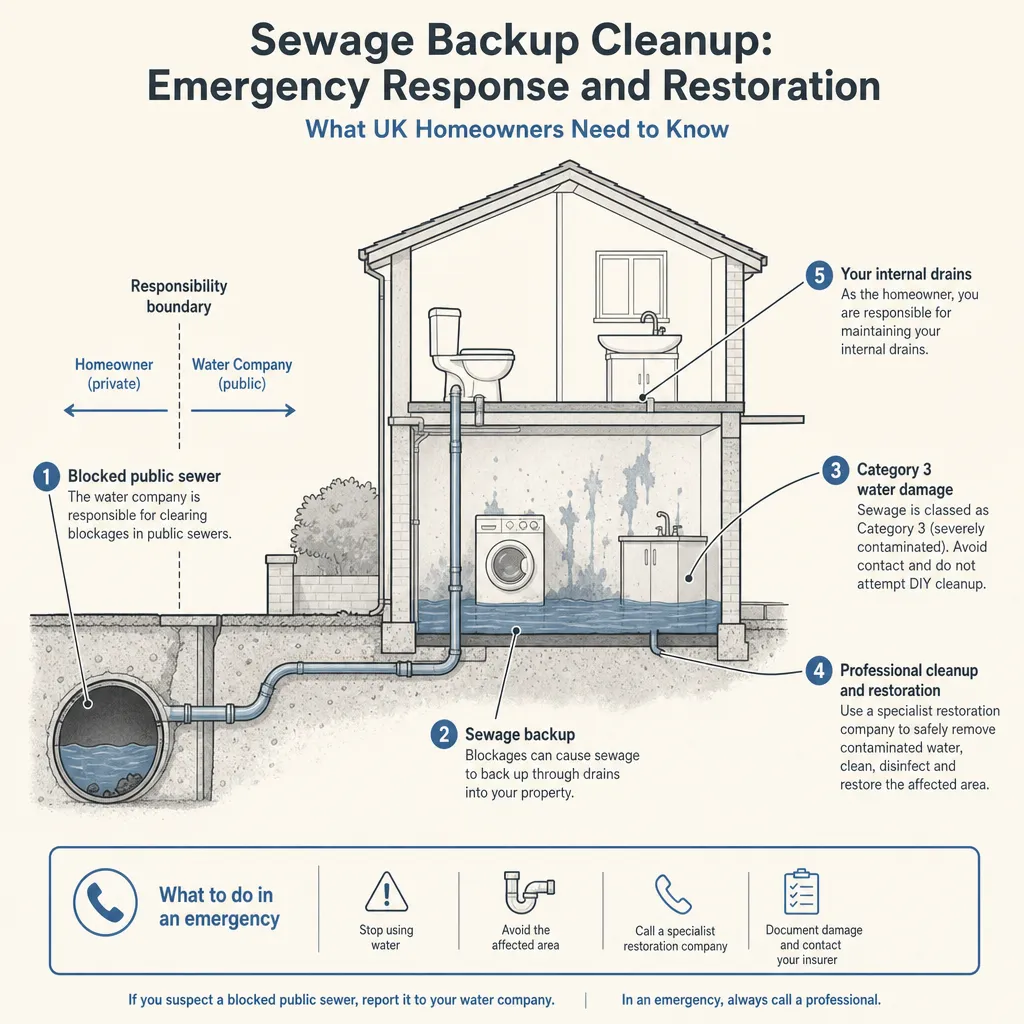
Sewage Backup Cleanup: Emergency Response and Restoration
A sewage backup should be treated as a Category 3 contamination event.
 Surveys & Inspections
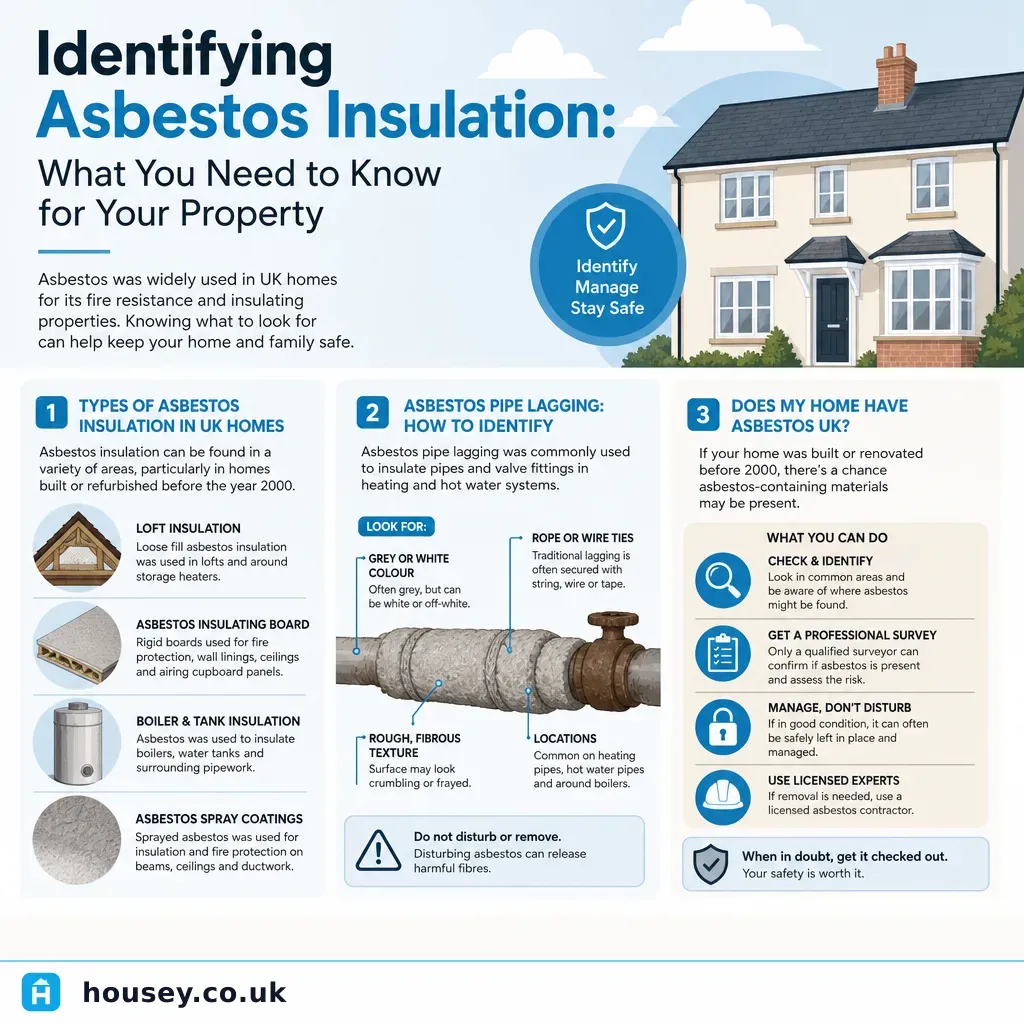
Identifying Asbestos Insulation: What You Need to Know for Your Property
Asbestos insulation was widely used in UK properties built before 2000, commonly found in pipe lagging, ceiling tiles, loose-fill loft insulation, and around boilers.