Sustainable Home Upgrades During Renovation
By Housey · Last reviewed 11th of May 2026
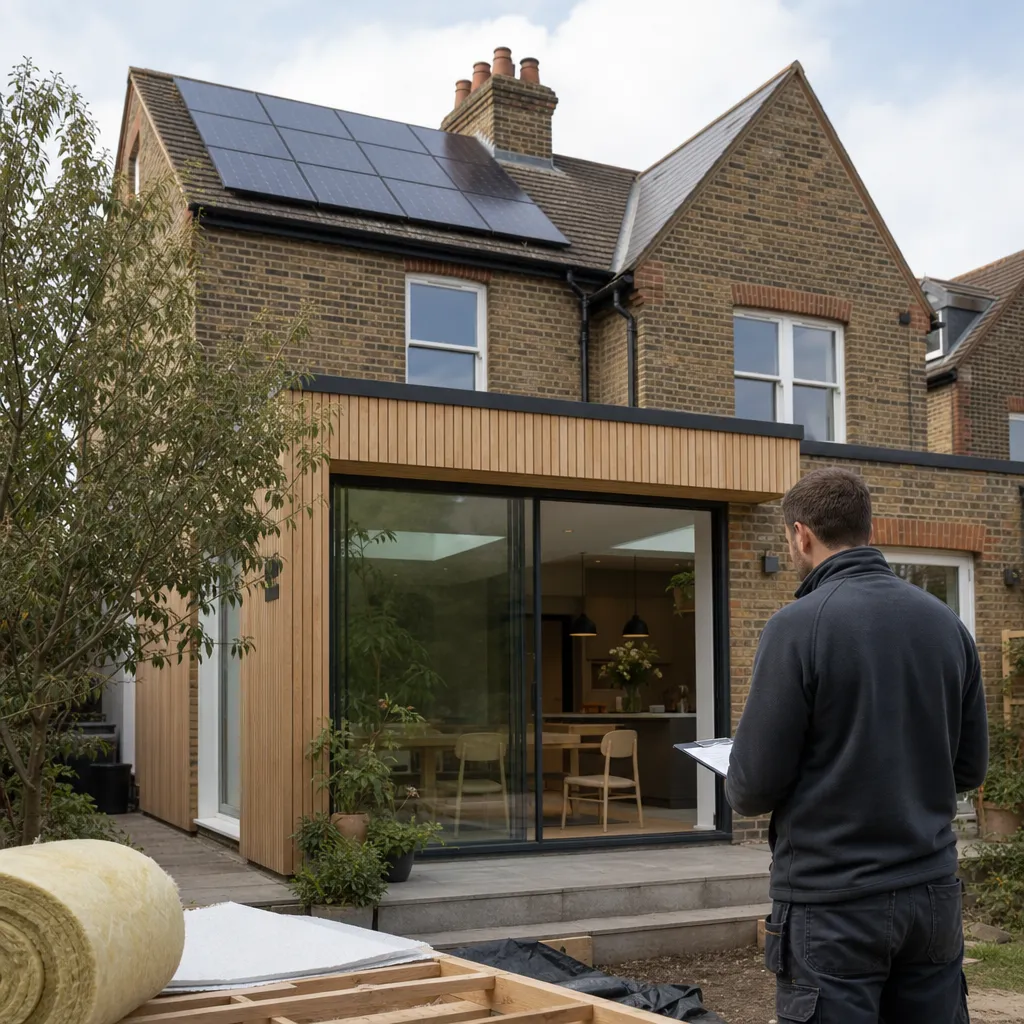
Sustainable Home Upgrades During Renovation
Renovation is one of the most effective moments to embed energy and environmental improvements into a home — work that would otherwise require revisiting walls, floors, and roof structures is already in progress. For UK homeowners, particularly those in older pre-1980 housing stock, a renovation presents a rare chance to address fabric performance, heating systems, and renewable generation in a coordinated way. Getting the sequence and specification right from the outset avoids costly rework and reduces the risk of introducing moisture problems or voiding warranties.
Key points
- PAS 2035:2023 is the UK standard governing whole-house retrofit; it requires a Retrofit Assessment and, for grant-funded work, a qualified Retrofit Coordinator.
- The Great British Insulation Scheme (GBIS) and ECO4 offer grant funding for insulation and low-carbon heating for eligible households; check gov.uk for current eligibility criteria.
- Adding insulation to a solid-wall or poorly ventilated home without improving ventilation can trap moisture, causing condensation and mould — a recognised risk that PAS 2035 was designed to prevent.
- Replacement windows, doors, and heating systems must meet minimum standards under Part L (Conservation of Fuel and Power) of the Building Regulations.
- Heat pumps must be sized using MCS 020 methodology; an incorrectly sized unit will perform poorly and may not qualify for the Boiler Upgrade Scheme (BUS) grant of £7,500.
The fabric-first principle: why sequence matters
Most energy advisers and retrofit coordinators recommend a fabric-first approach: reduce heat loss through walls, roof, floors, and windows before upgrading heating or adding renewables. Improving the building envelope first means a smaller, more efficient heating system will suffice, and solar panels or a heat pump will perform closer to their rated output.
A common mistake is installing a heat pump or solar PV system into a poorly insulated home and adding insulation later — which may then require repositioning radiators or re-assessing system sizing at significant additional cost.
Recommended sequence for a whole-house green renovation:
- Retrofit Assessment (PAS 2035) — establishes baseline and recommends measures in priority order.
- Airtightness and ventilation strategy — decide this before adding insulation.
- Loft and roof insulation — highest priority; typically cheapest per unit of heat saved.
- Wall insulation — external, internal, or cavity fill depending on construction type.
- Floor insulation — particularly for suspended timber ground floors.
- Windows and doors — replace or upgrade to current Part L standards.
- Low-carbon heating — heat pump or high-efficiency boiler once fabric is improved.
- Renewables — solar PV and battery storage once demand is reduced.
- Controlled ventilation — MVHR or dMEV to manage air quality in the tighter envelope.
Comparing common sustainable upgrades
Upgrade | Best suited to | Indicative cost (2026) | Key interaction risk | Grant potentially available |
|---|---|---|---|---|
Loft insulation (top-up to 270 mm) | Pre-2000 homes with accessible loft | £300–£600 installed | Low if loft ventilation maintained | GBIS / ECO4 |
Cavity wall insulation | Post-1920 homes with 50 mm+ cavity in good condition | £800–£1,800 | Moisture penetration if walls have defects | GBIS / ECO4 |
External wall insulation (EWI) | Solid-wall homes; terraces | £8,000–£25,000 | Planning may apply; junction detailing critical | ECO4 / local authority |
Internal wall insulation (IWI) | Solid-wall homes where EWI is not viable | £6,000–£18,000 | Reduces room width; cold bridge and condensation risk | ECO4 / local authority |
High-performance double or triple glazing | Any home replacing windows | £500–£1,500 per window | Increased airtightness needs ventilation review | None standard |
Air source heat pump (ASHP) | Well-insulated homes with outdoor space | £8,000–£15,000 installed | Must be correctly sized; may need low-temp radiators | Boiler Upgrade Scheme (£7,500) |
Solar PV (4 kWp typical) | South-facing pitched or flat roofs | £6,000–£9,000 | Usually permitted development; roof condition check | Smart Export Guarantee |
MVHR ventilation | Highly airtight retrofits and new builds | £3,000–£8,000 installed | Ductwork space required; airtightness target ~3 m³/(h·m²) | None standard |
Indicative UK costs, last reviewed 2026-05-11. Quotes vary significantly by property size, location, and specification.
Insulation: choosing the right type for your property
The appropriate insulation method depends on your property's construction type and condition. Most UK homes built before 1940 have solid-wall construction; those built between roughly 1930 and 1990 are typically cavity wall; post-1990 homes often have some factory-installed insulation but may still benefit from improvement.
Solid-wall homes (Victorian terraces, Edwardian semis, pre-war cottages) require either external or internal insulation. External wall insulation (EWI) preserves internal floor area and avoids thermal cold bridges but changes the building's external appearance — relevant in conservation areas and for listed buildings where planning or listed building consent may be required. Internal wall insulation avoids external changes but reduces room width and requires careful detailing to prevent interstitial condensation.
Cavity-wall homes (1930s–1990s semis and estates) may be suitable for cavity fill if the cavity is at least 50 mm wide and the walls are in sound condition. A pre-installation survey should assess wall tie condition, moisture penetration risk, and exposure to driving rain before any fill is specified.
Flat roofs on extensions should use a warm-deck or inverted build-up when being replaced, as cold-deck configurations are more prone to moisture problems and are generally considered poor practice under current guidance.
Ventilation — the step most homeowners miss
Sealing gaps and adding insulation reduces uncontrolled air infiltration — beneficial for energy efficiency, but also reducing the background air exchange that removes moisture, cooking fumes, and volatile organic compounds (VOCs). Without planned ventilation, condensation and mould can develop, particularly in bathrooms, kitchens, and bedrooms.
Options range from continuous mechanical extract ventilation (dMEV) for targeted moisture removal to Mechanical Ventilation with Heat Recovery (MVHR) for whole-house controlled airflow in highly airtight homes. The ventilation strategy must be specified before insulation is installed, not as an afterthought.
Grants and funding available in the UK
- ECO4: Funded by energy suppliers for fuel-poor and low-income households. Covers insulation and heating upgrades.
- Great British Insulation Scheme (GBIS): Broader eligibility; focused on single insulation measures for poorly insulated homes.
- Boiler Upgrade Scheme (BUS): £7,500 off a qualifying air source heat pump; applied by your MCS-accredited installer at point of installation.
- Smart Export Guarantee (SEG): Energy suppliers pay for electricity exported from solar PV — rates vary by supplier.
- Local authority schemes: Some councils operate Warm Homes funding or additional top-up grants. Check your local authority website for current offers.
Eligibility for most grants depends on EPC rating, property type, income, and benefits status. Requirements change; always check gov.uk for current scheme details before committing to a contractor.
Homeowner checklist: planning a green renovation
Important limitations
This article provides general information about sustainable renovation approaches in the UK. Energy and retrofit specifications must be tailored to each individual property — age, construction type, condition, tenure, and location all affect which measures are appropriate and safe. PAS 2035 exists specifically because poorly specified retrofit can cause significant harm, including moisture damage and structural deterioration. Nothing in this article constitutes a Retrofit Assessment or professional advice from a qualified Retrofit Coordinator.
When this becomes urgent
Seek professional input before proceeding if:
- You are planning wall insulation on a home that has any existing damp, cracking, or water ingress.
- A contractor proposes insulation without first recommending a ventilation strategy.
- Your home uses non-standard construction — prefabricated concrete, no-fines concrete, or timber frame — where standard insulation approaches may not apply.
- You are in receipt of a grant and unsure whether the proposed works comply with TrustMark and PAS 2035 requirements.
What to ask a qualified professional
- Is my property suitable for a Retrofit Assessment under PAS 2035, and will you act as Retrofit Coordinator?
- Which insulation measures are most appropriate for my construction type and current condition?
- How will ventilation be maintained or improved alongside the insulation works?
- Have you identified any existing damp, cold bridging, or condensation risk on site?
- Is my property eligible for ECO4, GBIS, or Boiler Upgrade Scheme funding?
- Will the works require Building Regulations approval or planning permission?
- What warranties will the installed measures carry, and are you TrustMark-registered?
When to get professional help
Retrofit is a regulated activity for good reason. Always use a qualified Retrofit Coordinator for grant-funded work or any whole-house programme. Seek specialist input if:
- There is evidence of damp, mould, or condensation anywhere in the property.
- A contractor is quoting for wall insulation without discussing ventilation.
- There is any uncertainty about the construction type of the home.
- The property is listed or in a conservation area — permitted development rights may not apply.
- Heat pump installation is proposed — this must be sized by an MCS-accredited installer.
How Housey can help
Housey connects UK homeowners with vetted professionals for every stage of a green renovation. Book a retrofit assessment to establish your property's baseline and prioritise measures under PAS 2035, or find qualified energy-efficiency consultants to guide your project from design to completion. For the insulation work itself, Housey's network of insulation installers can provide quotes based on your property's specific construction and condition.
Frequently asked questions
Do I need planning permission for external wall insulation?
In most cases external wall insulation is permitted development, but listed buildings always require listed building consent. Properties in conservation areas, Article 4 Direction areas, or on some housing estates may need planning permission if the appearance of the building is materially altered. Check with your local planning authority before specifying external wall insulation.
What is PAS 2035 and do I need to follow it?
PAS 2035:2023 is the UK standard for whole-house retrofit of domestic buildings. It is mandatory for any work funded through ECO4 or the Great British Insulation Scheme, and strongly recommended for all multi-measure projects. It requires a Retrofit Assessment and, for complex schemes, a qualified Retrofit Coordinator to prevent poorly specified works from causing moisture or structural harm.
Can I fit a heat pump in a Victorian terrace?
Yes, but preparation is usually needed. Solid-wall Victorian terraces typically have high heat loss, so fabric improvements should come first — loft insulation and wall insulation where feasible. Radiators may need upgrading to low-temperature emitters, and the system must be sized using MCS 020 methodology. A site-specific assessment is essential before specifying any heat pump system for an older property.
Will solar panels affect my home insurance?
Most standard home insurance policies cover solar panels as part of the structure once declared. Notify your insurer before installation and confirm your policy includes them. Check that your installer provides product and workmanship warranties, that panels are MCS-certified, and review your policy for any sub-limits or exclusions relating to roof-mounted equipment.
Sources and further reading
- PAS 2035:2023 — Retrofitting dwellings for improved energy efficiency — BSI
- Great British Insulation Scheme — GOV.UK
- Boiler Upgrade Scheme — GOV.UK
- Energy Company Obligation (ECO4) — Ofgem
- Insulation guidance — Energy Saving Trust
- Building Regulations Approved Document L (Conservation of Fuel and Power) — GOV.UK
Useful next reads
 Energy & Retrofit
Climate-Ready Home Improvements for the Future
Climate-ready home improvements tackle four main risks for UK properties: overheating, increased rainfall and flooding, storm damage, and energy cost volatility.
 Energy & Retrofit
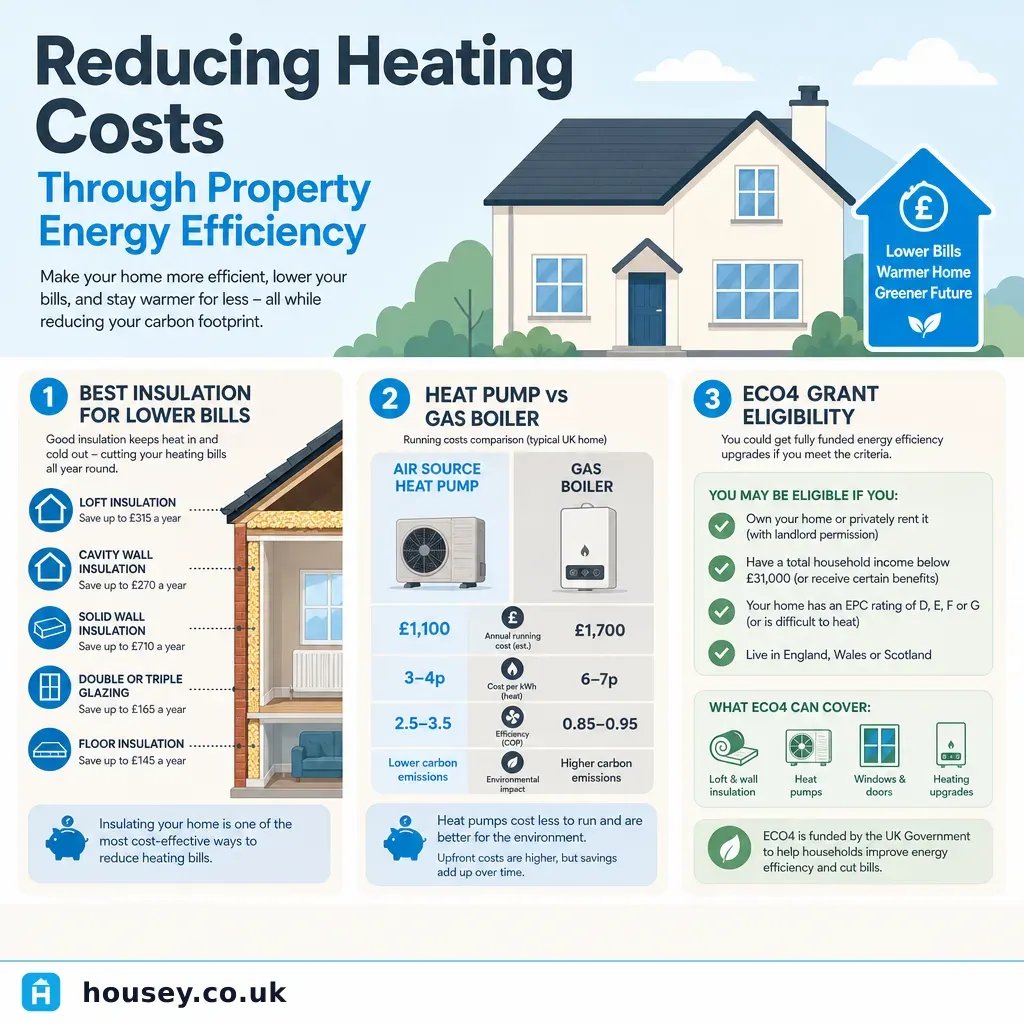
Reducing Heating Costs Through Property Energy Efficiency
Reducing heating costs starts with identifying where heat is lost — typically walls (30–35%), roof (20–25%), and windows.
 Energy & Retrofit
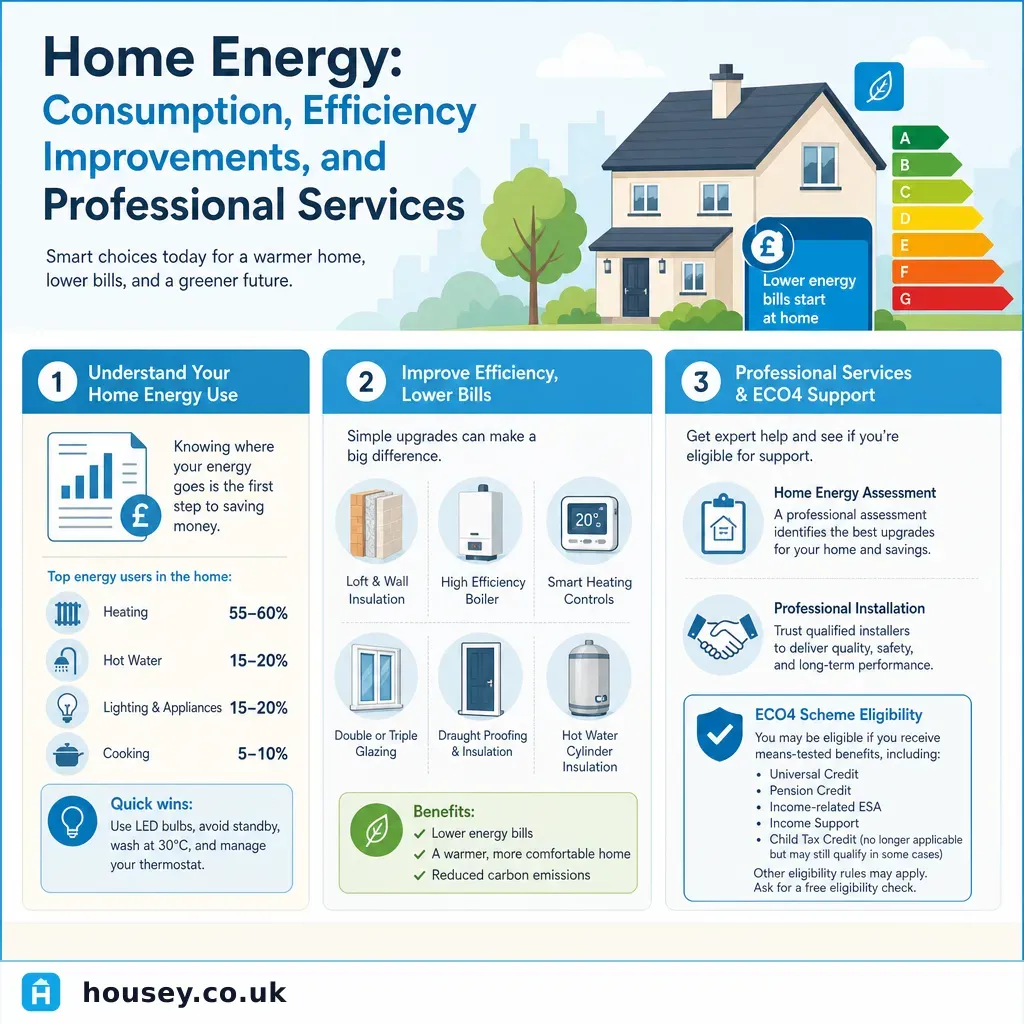
Home Energy: Consumption, Efficiency Improvements, and Professional Services
Most UK homes can cut energy use by 20–40% through insulation, upgraded heating controls, and appliance improvements.
 Energy & Retrofit
Choosing a Heating System for Your Conservatory
The most practical conservatory heating options are electric panel heaters, underfloor heating (electric or wet), infrared panels, and extending an existing central heating circuit.
 Energy & Retrofit
The Rise of Green-Rated Homes: Energy Efficiency, Sustainability, and Long-Term Property Value
Homes with higher EPC ratings typically sell faster and can command a premium of up to 10% over equivalent lower-rated properties.