Swimming Pool Infill: Options And Costs
By Housey · Last reviewed 30th of May 2026
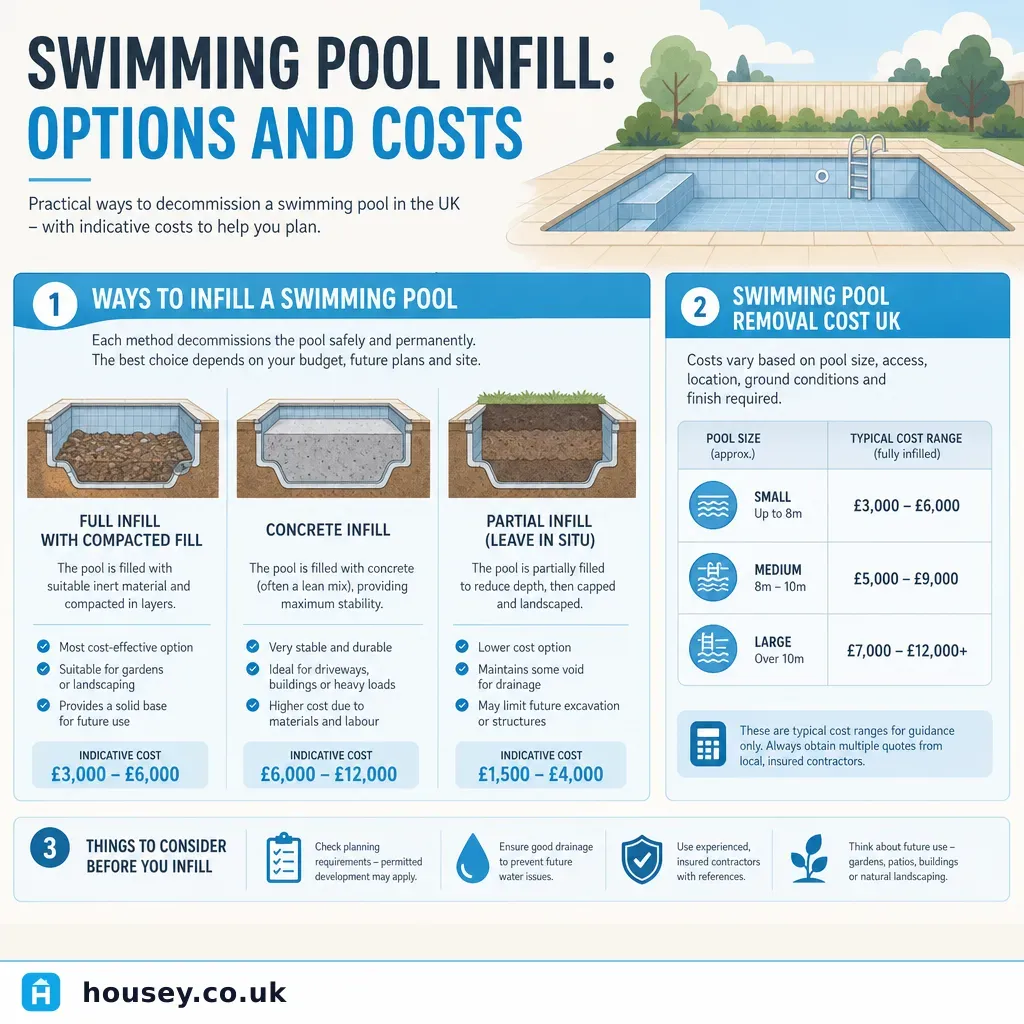
Swimming Pool Infill: Options And Costs
Deciding to fill in or remove a garden swimming pool is usually prompted by rising maintenance costs, safety concerns, a desire to reclaim outdoor space, or plans to build on the site. The process is more involved than many homeowners anticipate: the choice of infill method affects future ground stability, whether you can build or pave over the area, how much the project costs, and what regulatory obligations arise — particularly where asbestos may be present in older pool structures or associated plant rooms.
Key points
- There are two main approaches: partial infill (breaking or perforating the pool shell and backfilling in place) and full excavation and removal (breaking out the entire structure and disposing of all material off site).
- Planning permission is generally not required to fill in a swimming pool in England, but may be needed if you intend to construct any building or hard structure over the infilled area.
- Pools constructed before 2000 may contain asbestos-containing materials in pump rooms, boiler flues, or older structural elements — a professional asbestos demolition survey from a UKAS-accredited surveyor is required before any demolition work begins.
- Indicative UK costs range from approximately £2,000–£6,000 for partial infill to £10,000–£25,000+ for full excavation and landscaping — costs vary by pool size, depth, access, and location (last reviewed 2026-05-30).
- Ground stability after infill must be assessed and confirmed by a qualified professional before any building, paving, or significant planting is carried out over the filled area.
Partial infill vs full removal: choosing the right approach
The right method depends on your plans for the site, the pool's construction and depth, available access for plant machinery, and your budget.
Method | Best for | Not ideal for | Typical outcome | Main risk if wrong |
|---|---|---|---|---|
Partial infill — break shell, backfill in place | Garden restoration only; no future building or hard paving over site | Any plan to build or pave over the area; deep or heavily reinforced shells | Lawn or planting restored; pool structure remains below ground | Settlement, void formation, drainage problems if fill is poorly compacted |
Full excavation and removal | Building or paving over the site; maximising ground stability; property sales | Very limited site access; very deep or complex pools | Clean site with certifiable fill; suitable for construction | Higher cost; greater disruption; significant waste disposal required |
Full demolition with engineered fill and certification | Planning applications for new build over site; situations requiring formal confirmation of stable ground | Budget-constrained projects with no building plans | Engineer-certified stable ground | Programme length; professional fees |
Which option should you choose?
- Choose partial infill if you only want to restore the area to garden use and have no plans to build or lay hard paving over it within the foreseeable future.
- Choose full excavation if you intend to construct any building, extension, or hard surface over the area, or if you are preparing the property for sale and want to remove future uncertainty for buyers.
- Commission a structural or geotechnical engineer's report if you are planning to build over the site, or if the pool is deep (over 1.5m), heavily reinforced, or of unusual construction.
- Arrange an asbestos demolition survey before any demolition work if the pool was built before 2000 or if there is any associated plant room, pump house, or boiler equipment on site.
Planning permission and legal considerations
In England, filling in an existing swimming pool does not generally require planning permission. The work is considered a restoration of the land to garden use.
You may need consent in these situations:
- Building over the filled area: any new construction — extension, outbuilding, driveway, or new dwelling — will require planning permission and building regulations approval in the usual way.
- Listed building or curtilage: if the pool is within the curtilage of a listed building, or forms part of a listed structure, Listed Building Consent may be required before any works.
- Conservation area: consult your LPA if the pool, pump room, or associated structures are visible from a public area or affect the character of the conservation area.
- Building over or disconnecting a public sewer: disconnection of the pool's drainage from a public sewer must be agreed with your water company under the Water Industry Act 1991. Do not block or sever public sewer connections without formal consent.
Asbestos: a critical risk in older pools
Pools built before 2000 may contain asbestos-containing materials (ACMs) in:
- Pump room or plant room roofing and wall panels (corrugated asbestos cement sheet was widely used in outbuilding construction up to the 1990s).
- Boiler flue systems or lagging on pipework insulation.
- Older structural renders or screeds, particularly in pools dating from before the 1980s.
Under the Control of Asbestos Regulations 2012, any person who manages or carries out demolition work on buildings that may contain asbestos has legal duties. For demolition work, a type 3 demolition survey — undertaken by a UKAS-accredited surveyor before any demolition begins — is required to identify the location and condition of all ACMs. Do not drill, break, or disturb any material suspected to contain asbestos. Arrange professional testing first.
The infill process: what to expect
Partial infill — typical stages:
- Drain and clean the pool; ensure no pool chemicals remain before works begin.
- Disconnect all utilities — electricity, gas (if pool is heated), and drainage.
- Complete asbestos survey and any required licensed removal before any demolition.
- Perforate or partially collapse the pool shell — holes are broken in the base and walls to allow drainage and prevent void formation.
- Backfill in compacted layers using granular fill such as MOT Type 1 sub-base or clean crushed concrete aggregate.
- Place topsoil and carry out surface reinstatement — turf, planting, or hard landscaping as required.
Full excavation adds:
- Complete break-out of the pool shell and surround.
- Removal of all concrete, pipework, and materials by a licensed waste carrier.
- Engineered fill placed and compacted in layers to specification; engineer certification available on request.
All construction waste must be removed by a contractor holding a current Waste Carrier Licence under the Environmental Protection Act 1990. Check that your contractor holds this licence before instructing them.
Homeowner checklist before you start
Red flags: warning signs that need professional attention
Do not proceed without specialist advice if you observe any of the following:
- Cracking or movement in nearby structures — paving, fencing, outbuildings, or the house itself near the pool. This may indicate the pool is already affecting ground stability and an engineer's assessment is needed before infill begins.
- High water table or persistent waterlogging: if the pool fills with groundwater frequently, specialist drainage design is required before backfilling — incorrect fill in waterlogged conditions will settle and may fail.
- Pool depth over 1.8 metres: the structural risk during shell perforation or collapse is higher at this depth; engineer input is advisable before proceeding.
- Old pump rooms, plant rooms, or insulated pipework: halt all demolition work and arrange an asbestos test before touching any materials.
- Leasehold or shared freehold property: consult your solicitor and the freeholder before starting any ground works — your lease may require consent for structural alterations to the land.
Important limitations
This article provides general information only. Pool infill projects vary considerably in complexity depending on the pool's construction, ground conditions, the presence of asbestos or contaminated materials, property tenure, and local planning requirements. Cost ranges are indicative and based on typical domestic UK projects; actual costs can differ substantially. A structural engineer, UKAS-accredited asbestos surveyor, and experienced groundworks contractor should all be consulted before work is instructed.
When this becomes urgent
Stop work immediately and seek professional advice if:
- Demolition has already started and you discover materials that may contain asbestos — under the Control of Asbestos Regulations 2012, all work must stop until a proper survey has been completed and any licensed removal carried out.
- Ground movement, cracking, or subsidence is observed in or near the pool area during or after works.
- The pool shell has partially collapsed unexpectedly, creating void or collapse risk near adjacent structures.
- The pool's drainage was connected to the public sewer and this connection was blocked or severed without water company consent.
What to ask a qualified professional
Before appointing a contractor, ask:
- Does this pool require a full asbestos demolition survey before any work begins, and can you recommend a UKAS-accredited surveyor?
- What method of infill do you recommend given this pool's construction and my plans for the site?
- What compaction specification will you use for the fill, and can you provide an engineer's certificate on completion?
- If I want to build over the site in future, what fill specification and documentation would I need?
- What Waste Carrier Licence do you hold, and where will the waste material be taken?
- How will the existing drainage connections be formally disconnected from the public sewer?
- Are you a member of the National Federation of Demolition Contractors or an equivalent trade body?
When to get professional help
Always involve a qualified professional before starting pool infill if:
- The pool predates 2000 — an asbestos survey is the minimum required before any demolition.
- You plan to build any structure or lay hard surfaces over the filled area.
- The site is close to the house, retaining walls, or boundary structures.
- There is any history of ground movement or drainage problems in the area.
- The property is listed, in a conservation area, or leasehold.
A demolition contractor with experience in pool removal can advise on the most appropriate method and carry out the structural demolition safely. For backfilling, compaction, and surface reinstatement, a specialist groundworker will ensure the fill meets the required specification and minimises future settlement risk.
How Housey can help
Housey connects you with vetted demolition contractors and groundworkers experienced in pool infill and site restoration across the UK. Compare detailed written quotes from local specialists before any work begins, and use the Housey platform to review credentials and experience.
Frequently asked questions
Do I need planning permission to fill in a swimming pool?
In most cases, no planning permission is required to fill in a swimming pool in England. However, if you plan to build any structure over the infilled area, or if the property is listed or in a conservation area, you should confirm with your Local Planning Authority before starting work.
How much does it cost to fill in a swimming pool in the UK?
Costs vary considerably by pool size, construction, depth, and access. Partial infill typically costs £2,000–£6,000; full excavation, removal, and landscaping can cost £10,000–£25,000 or more. Indicative UK costs, last reviewed 2026-05-30. Obtain at least three written quotes with full stage breakdowns before proceeding.
Can I fill in a pool myself?
Partial infill may appear straightforward, but incorrect compaction can lead to long-term ground settlement and drainage problems. If the pool predates 2000 and may contain asbestos, DIY demolition is not permitted without appropriate licensing and training under the Control of Asbestos Regulations 2012. Professional contractors are strongly recommended for any pool infill project.
Will filling in a pool affect my property value?
A well-executed infill that restores a safe, usable garden typically improves a property's marketability. Poorly executed infill with residual settlement risk, incomplete asbestos management, or undocumented fill specifications can reduce value and complicate future sales. Where possible, obtain an engineer's certificate for the fill material and compaction achieved.
How long does pool infill take?
A straightforward partial infill of a domestic pool typically takes 3–5 working days. Full excavation and removal may take 1–2 weeks or longer depending on access, pool depth, and waste disposal logistics. Any required asbestos survey and removal will add time — typically several days for a survey, plus additional programme if licensed removal is needed.
Sources and further reading
- Control of Asbestos Regulations 2012 — legislation.gov.uk
- HSE: Asbestos — the survey guide (HSG264) — Health and Safety Executive
- Environmental Protection Act 1990 — legislation.gov.uk
- Water Industry Act 1991 — legislation.gov.uk
- Planning Portal: Do I need permission? — Planning Portal
- National Federation of Demolition Contractors — NFDC
Useful next reads
 Improvement & Build
Who Provides House Demolition Services
House demolition in the UK is carried out by specialist demolition contractors, often members of the National Federation of Demolition Contractors (NFDC).
 Improvement & Build
Open Plan Living Space Conversion Costs
Opening up a living space in the UK typically costs £3,000–£15,000+ depending on whether walls are load-bearing, the beam specification required, and the extent of remodelling.
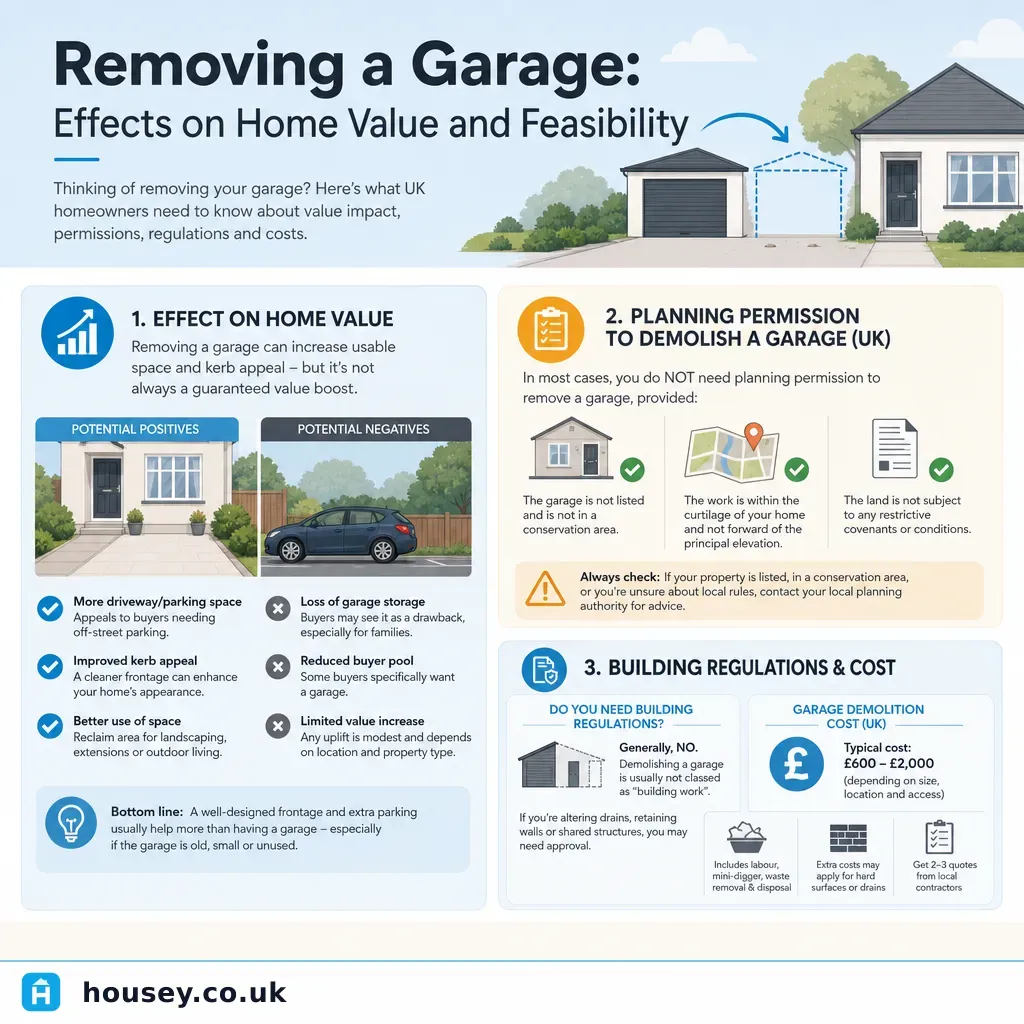 Improvement & Build
Removing a Garage: Effects on Home Value and Feasibility
Demolishing a garage in England may require prior notification to the local planning authority, and structural or building regulations assessments are often needed if the garage is attached to or integral with the house.
 Improvement & Build
Removing a Conservatory: Value and Feasibility Considerations
Removing a conservatory in England usually does not need planning permission if the original structure was permitted development, but reinstating the original wall almost always requires a building regulations application covering structural, thermal, and moisture elements.
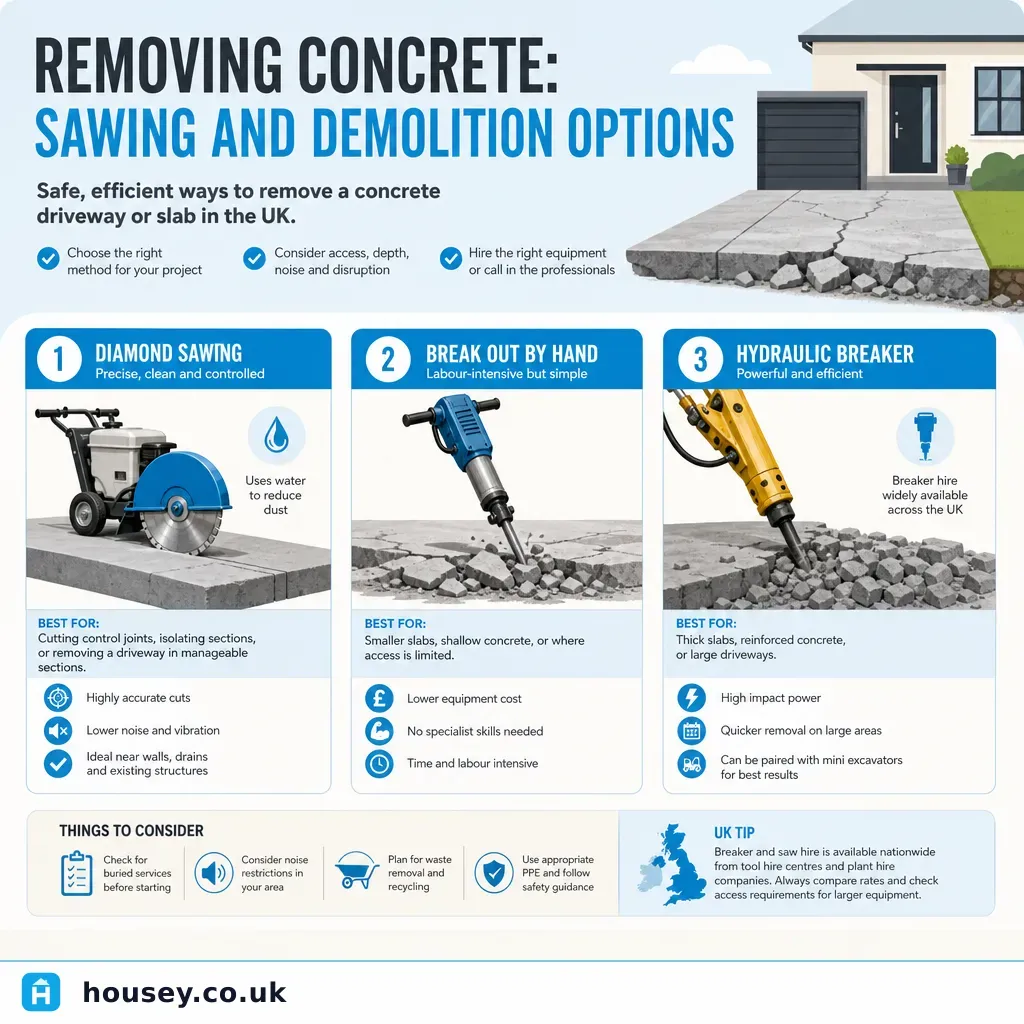 Improvement & Build
Removing Concrete: Sawing and Demolition Options
Concrete removal methods include hydraulic or electric breakers for bulk demolition, diamond disc or wire sawing for precision cuts, and hand tools for small areas.