Tarmac Driveway Installation: A Comprehensive Pricing Guide
By Housey · Last reviewed 30th of May 2026
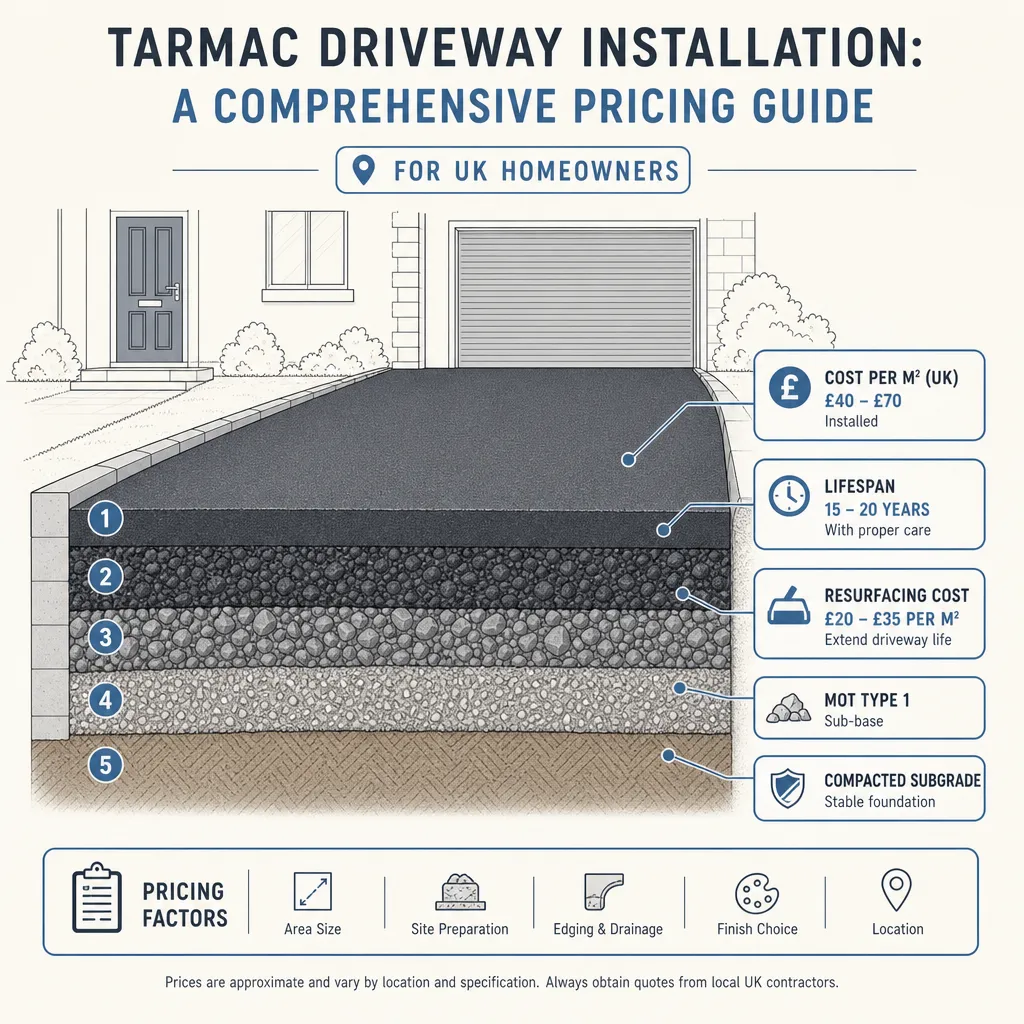
Tarmac Driveway Installation: A Comprehensive Pricing Guide
A new or resurfaced tarmac driveway is one of the more practical front-of-house improvements a UK homeowner can make — it reduces maintenance compared with loose gravel, creates a clean finish, and adds kerb appeal. Questions about cost most often arise when an existing drive has cracked or potholed beyond reasonable repair, when a front garden is being converted to off-street parking, or when an extension changes the layout of the approach. The price range is wider than many expect, and understanding what drives it helps you compare quotes fairly.
Key points
- Standard tarmac (macadam) consists of a compacted sub-base, a base course, and a surface course — budget installations that omit the base course typically fail within 10 years.
- Permitted development rules allow most residential driveways in England without planning permission, but sustainable drainage (SUDS) rules require either a permeable surface or run-off directed away from the public highway.
- A dropped kerb (vehicle crossover) requires a separate licence from your local highway authority; typical costs range from £1,000 to £3,000 depending on the council and kerb works involved.
- Tarmac driveways can be resurfaced (overlaid) if the base remains structurally sound — typically 30–50% cheaper than full excavation and installation.
- VAT at 20% applies to most driveway installations; always confirm whether quotes are inclusive or exclusive of VAT before comparing them.
How much does a tarmac driveway cost in the UK?
Costs depend on driveway size, the amount of preparation required, and the installation method. The figures below are indicative; obtain at least three quotes from local contractors before making a decision.
Indicative UK costs, last reviewed 2026-05-30. Figures include labour and materials but exclude dropped kerb applications, decorative edging, drainage connections, and VAT unless stated.
Driveway size | Full installation (new base) | Resurfacing (sound existing base) |
|---|---|---|
Single car (~20–30 m²) | £1,200–£2,500 | £600–£1,200 |
Double car (~40–60 m²) | £2,200–£4,500 | £1,100–£2,200 |
Large or triple (~70–100 m²) | £3,500–£8,000+ | £1,800–£3,500 |
Prices in London and the South East typically sit 10–20% above those in the Midlands or North.
What drives tarmac driveway installation costs?
Cost factor | Lower cost end | Higher cost end |
|---|---|---|
Ground preparation | Existing firm, level base | Major excavation, tree root removal, imported sub-base material |
Existing surface removal | Nothing to remove | Breaking out concrete or block paving (skip hire, disposal charges) |
Drainage | Run-off directed to lawn or border | New drainage channels or soakaway required |
Edging | None or simple timber edging | Concrete block edging or brick soldier course |
Surface finish | Plain black tarmac | Coloured or printed macadam |
Access | Open frontage, level approach | Narrow access or steep gradient |
Location | Rural, Midlands, or North | London or South East |
Tarmac versus other driveway surfaces
Surface | Indicative cost per m² | Typical lifespan | Maintenance level | SUDS / drainage notes |
|---|---|---|---|---|
Tarmac (macadam) | £40–£90 | 15–25 years | Low | Needs drainage solution for SUDS compliance |
Block paving | £60–£120 | 20–30 years | Moderate (weeding) | Permeable block paving meets SUDS requirements |
Resin-bound gravel | £70–£150 | 15–25 years | Low | Permeable; meets SUDS |
Loose gravel | £10–£25 | Ongoing replenishment | Low (raking) | Permeable by default |
Concrete | £50–£100 | 25–40 years | Low | Needs drainage solution for SUDS compliance |
Indicative UK costs per m², last reviewed 2026-05-30.
Planning permission and drainage rules for driveways
Under permitted development rights, most residential driveways in England do not require planning permission — provided the surface drains to a lawn, border, or soakaway rather than directly to the public highway. Installing an impermeable surface (including standard tarmac) without adequate drainage requires householder planning permission under the Town and Country Planning (General Permitted Development) (England) Order 2015.
Exceptions where planning permission may still be required:
- Properties in conservation areas or subject to an Article 4 direction.
- Listed buildings (which also require listed building consent for external changes).
- New-build estates where permitted development rights have been removed by planning condition.
A dropped kerb (vehicle crossover) is a separate matter — it always requires a licence from your local highway authority, regardless of permitted development rights. Costs vary by council; GOV.UK provides a dropped kerb application process with links to local highway authorities.
Rules differ in Scotland, Wales, and Northern Ireland — check with your local planning authority before starting work.
Decision tree: resurfacing or full installation?
- Choose resurfacing if the existing base is firm and level, surface cracks are superficial rather than structural, and the driveway is 10–15 years old with no significant deformation or water pooling.
- Choose full installation if the base is failing, there is significant cracking, rutting, or tree root disruption, or the drive is more than 20 years old.
- Get a contractor to inspect the base before deciding — a reputable installer should advise against resurfacing if the base is not sound, even though resurfacing is lower cost.
- Check drainage requirements before any installation to avoid retrofitting channels or soakaways after the fact.
What to ask before accepting a quote
- Is sub-base preparation, base course, surface course, edging, and drainage all included, or are any elements excluded?
- Will a base course be laid, and what depth of sub-base is specified?
- Is the price inclusive or exclusive of VAT?
- What skip and disposal costs are included for removed materials?
- What guarantee period applies to the finished surface?
- Who will carry out the physical work — the company you are quoting with, or a subcontractor?
- What happens if ground conditions are worse than expected once excavation begins?
- Are there any services (gas, water, electricity, telecoms) running under the driveway that need protecting during excavation?
When to get professional help
Tarmac driveway installation is generally low-risk, but take extra care in these situations:
- Services under the driveway — ask your contractor to check for gas pipes, water mains, drain runs, and telecoms ducting before any excavation. Use a utility-locating service if there is any uncertainty.
- Dropped kerb required — apply to your local highway authority directly; do not rely solely on the driveway contractor to manage the licence application.
- Unusual ground conditions — if there is any sign of buried tanks, underground structures, or contaminated land, investigate before excavating.
How Housey can help
Housey connects homeowners with experienced driveway installers who can provide free site assessments and itemised quotes. Use Housey to compare at least three installers in your area, review their track record with previous customers, and make sure you receive a detailed written quotation before committing to any work.
Frequently asked questions
How long does a tarmac driveway last?
A properly installed two-layer tarmac driveway with a compacted sub-base typically lasts 15–25 years. Resurfaced (overlaid) driveways usually last 10–15 years before further work is needed. Longevity depends on the quality of installation, traffic loading, drainage, tree root proximity, and local weather conditions.
Can tarmac be laid over concrete or block paving?
Tarmac can sometimes be overlaid on a concrete or block paving base if the existing surface is stable, level, and well-bonded, avoiding excavation costs. However, if the existing surface shows lifting blocks, cracked concrete, poor drainage, or significant unevenness, overlay is not appropriate — the new surface will replicate the faults of the base beneath it.
Is planning permission needed for a dropped kerb?
A dropped kerb requires a licence application to your local highway authority — separate from planning permission and required regardless of permitted development rights. Costs typically run £1,000–£3,000 depending on the council, and crossing works must usually be carried out by council-approved contractors. Apply via GOV.UK's dropped kerb guidance.
Does a tarmac driveway need to be permeable?
In England, an impermeable surface including plain tarmac that drains to the highway requires planning permission. To avoid this, use a permeable surface such as permeable block paving or resin-bound gravel, or ensure run-off drains to a lawn, border, or soakaway on your own land. Rules differ in Scotland, Wales, and Northern Ireland — check with your local planning authority.
Sources and further reading
- When is planning permission required: paving your front garden — GOV.UK
- Driveways and paths: planning guidance — Planning Portal
- Apply for a dropped kerb — GOV.UK
- Sustainable drainage systems (SuDS) — Environment Agency / GOV.UK
Useful next reads
 Improvement & Build
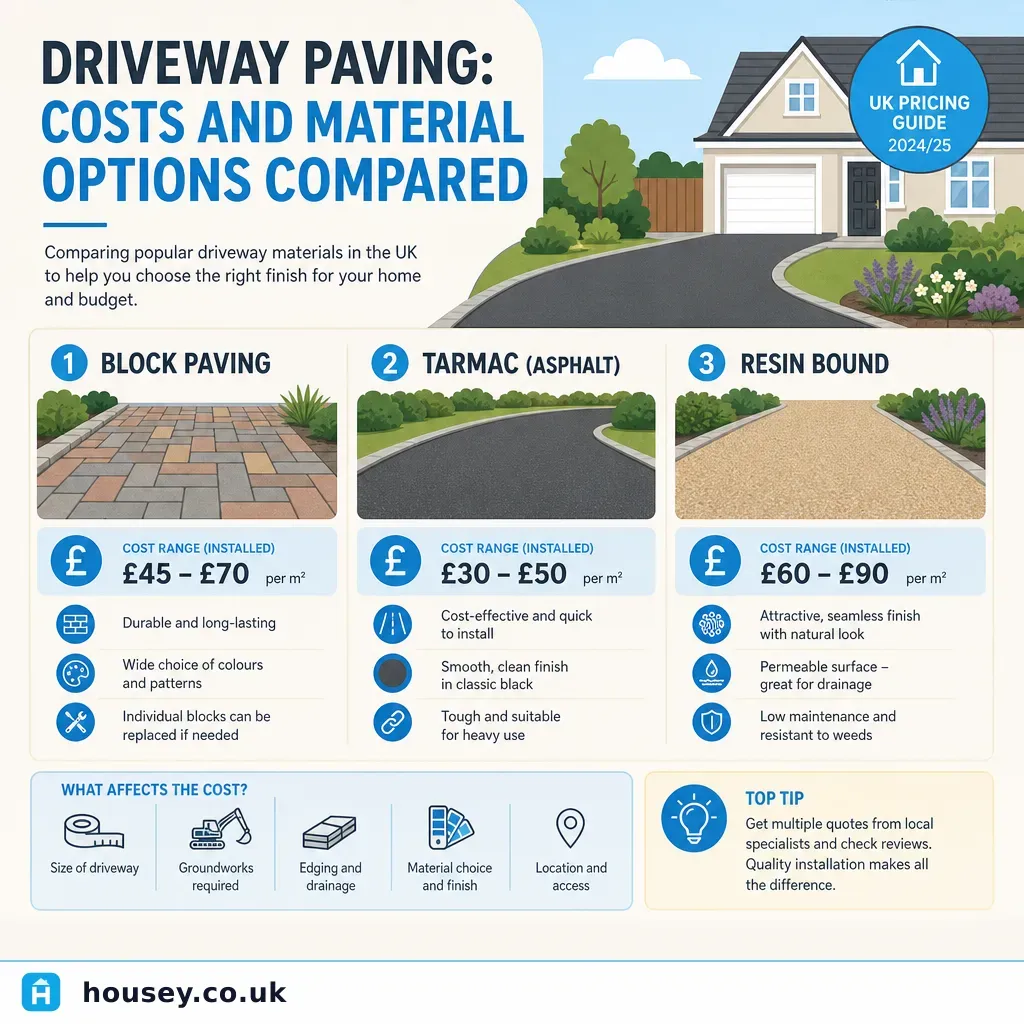
Driveway Paving: Costs and Material Options Compared
Driveway installation costs in the UK typically range from £50–£90 per m² for tarmac to £80–£150 per m² for block paving and £70–£120 per m² for resin-bound surfaces.
 Improvement & Build
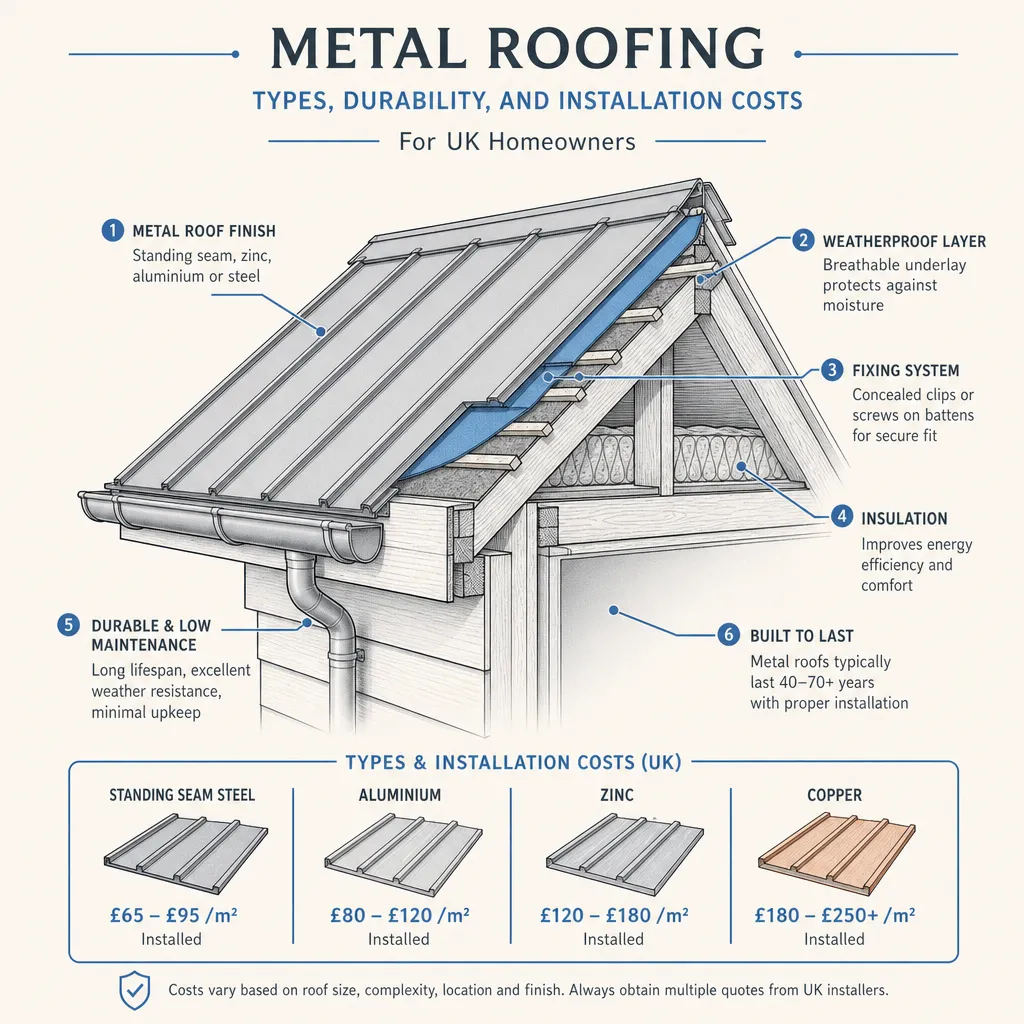
Metal Roofing: Types, Durability, and Installation Costs
Metal roofing in the UK includes standing seam, corrugated sheet, and metal tile systems in steel, aluminium, zinc, or copper.
 Improvement & Build
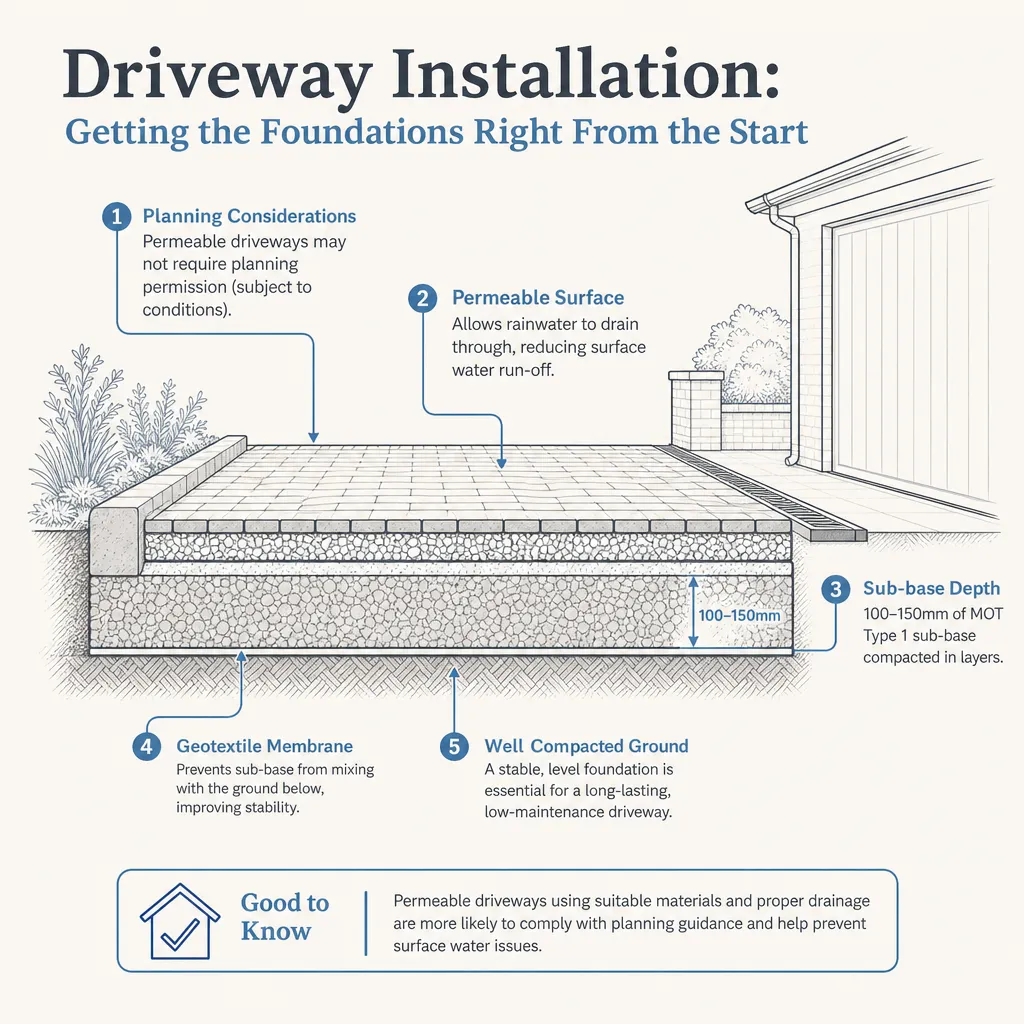
Driveway Installation: Getting the Foundations Right From the Start
A long-lasting driveway depends more on sub-base depth and drainage design than on the surface material chosen.
 Improvement & Build
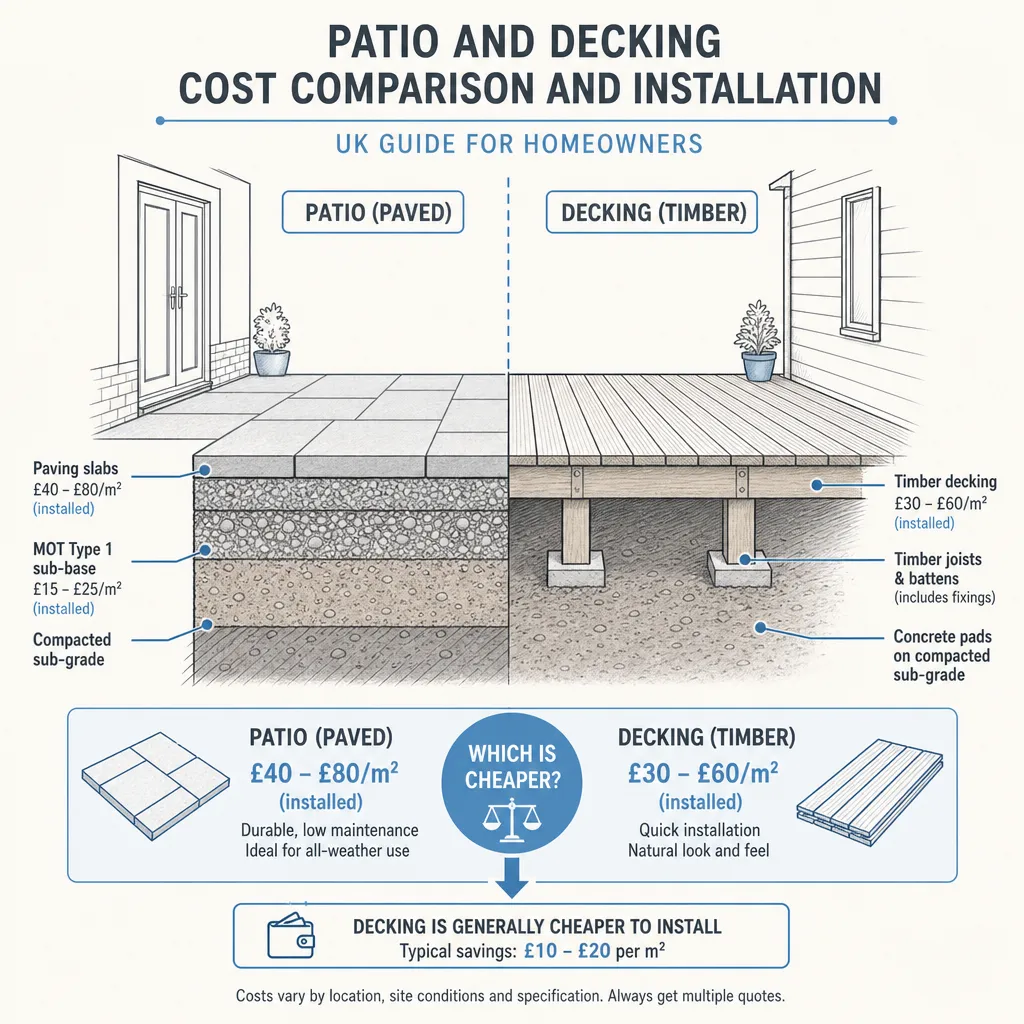
Patio and Decking Cost Comparison and Installation
A 20 m² porcelain or natural stone patio typically costs £2,000–£5,000 installed; block paving starts lower at £1,200–£3,000.
 Improvement & Build
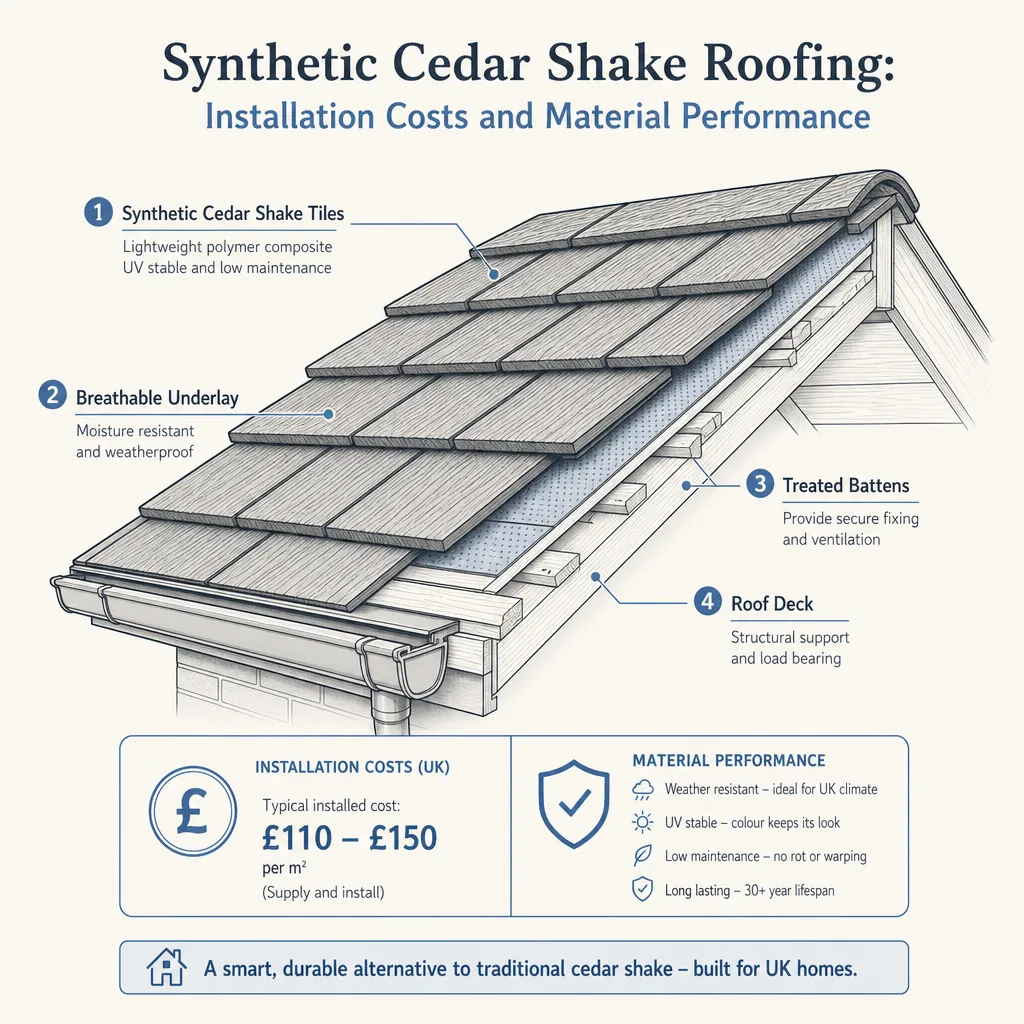
Synthetic Cedar Shake Roofing: Installation Costs and Material Performance
Synthetic cedar shake roofing uses polymer composite, rubber, or fibre-cement tiles to replicate the look of natural cedar wood shingles.