Tesla Powerwall Battery Storage: Installation Costs and Home Energy Storage
By Housey · Last reviewed 25th of May 2026
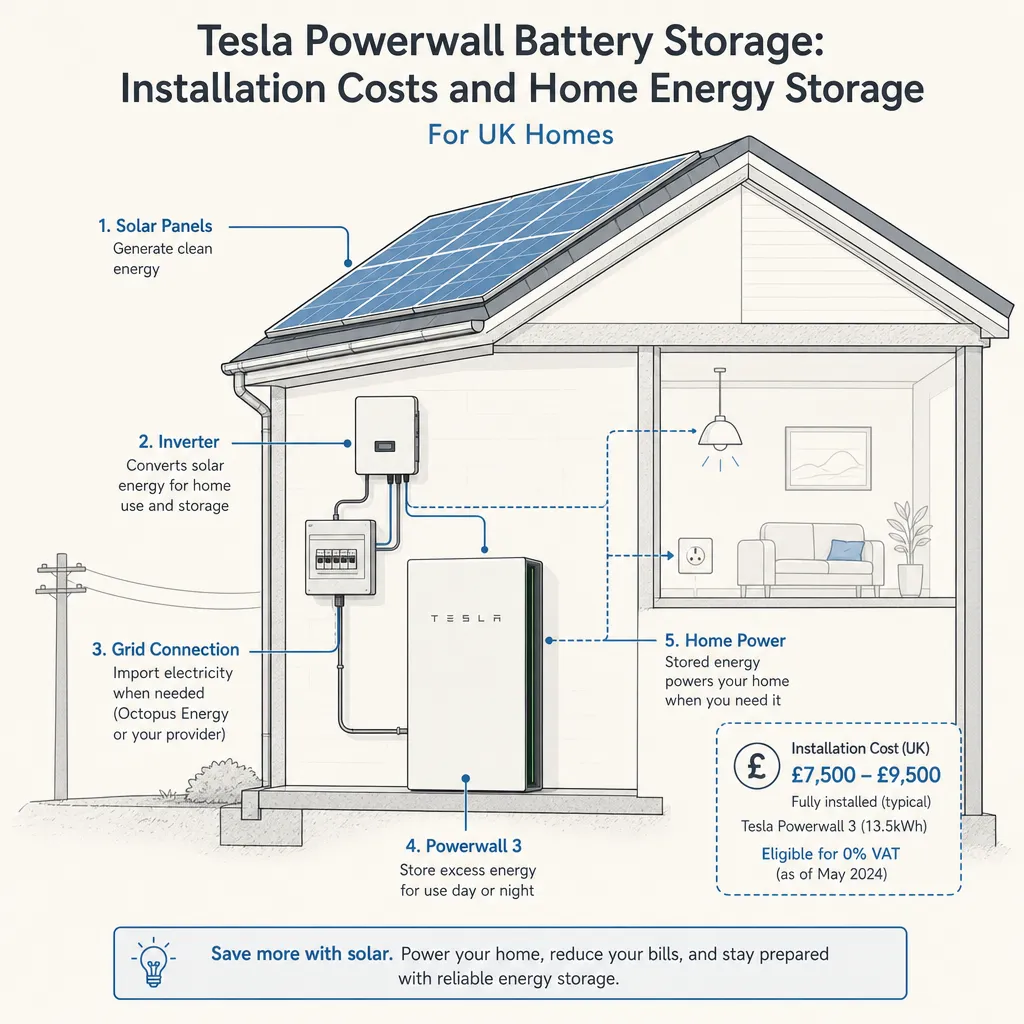
Tesla Powerwall Battery Storage: Installation Costs and Home Energy Storage
For UK homeowners with solar panels — or those exploring ways to reduce grid dependence and lower energy bills — home battery storage has moved from niche technology to a mainstream consideration. The Tesla Powerwall, currently in its third generation, is among the most widely recognised home battery systems available in the UK, but understanding its actual installed cost, what it can realistically do for a typical household, and how it compares with alternatives helps avoid both over-investment and disappointment.
Key points
- The Tesla Powerwall 3 has a usable storage capacity of 13.5 kWh per unit and a continuous power output of 11.5 kW — both higher than earlier Powerwall generations.
- Indicative UK installed costs for a single Powerwall 3 are approximately £8,000–£12,000, including the required gateway unit, though prices vary by installer, region, and site complexity. (Indicative UK costs, last reviewed 2026-05-25.)
- Battery storage installation must be carried out by a qualified electrician; systems connected to solar PV should be installed by an MCS-certified contractor to maintain eligibility for Smart Export Guarantee (SEG) payments.
- Home battery storage systems supplied and installed by a VAT-registered contractor currently qualify for 0% VAT under HMRC energy-saving materials relief — confirm with your installer as rules can change.
- A typical UK three-bedroom home uses approximately 7–10 kWh of electricity per day, meaning one Powerwall 3 can cover a significant share of daily use when charged from solar generation or overnight off-peak grid electricity.
What is the Tesla Powerwall?
The Powerwall is a wall-mounted home battery system manufactured by Tesla and sold through Tesla-approved installers in the UK. It stores electricity from solar panels or from the grid during off-peak periods, then supplies that stored energy during peak usage times or during grid outages.
The current Powerwall 3 (as of 2026) includes a built-in solar inverter — unlike the earlier Powerwall 2, which required a separate inverter. This makes it a more integrated solution when installed alongside a new solar PV system.
Powerwall 3 key specifications:
- Usable storage capacity: 13.5 kWh
- Continuous power output: 11.5 kW
- Round-trip efficiency: approximately 90%
- Chemistry: lithium iron phosphate (LFP)
- Warranty: 10 years, with 70% capacity retention guaranteed at end of term
- Form factor: wall-mounted, suitable for indoor or outdoor installation
What does a Tesla Powerwall cost in the UK?
Tesla sets the unit price and approved installers add their installation charges. Costs vary by site complexity, whether solar is being installed at the same time, and location.
Scenario | Indicative total installed cost |
|---|---|
Powerwall 3 standalone (battery + gateway, no solar) | £8,000–£11,000 |
Powerwall 3 retrofitted to existing solar (AC-coupled) | £8,500–£12,000 |
Powerwall 3 + new 4 kWp solar PV system | £14,000–£20,000 |
Two Powerwall 3 units (larger home or whole-home backup) | £15,000–£20,000+ |
Indicative UK costs, last reviewed 2026-05-25. Prices vary by installer, region, and whether additional electrical work such as consumer unit modifications or new cable routes is required. Obtain at least three quotes from Tesla-approved or MCS-accredited installers.
VAT note: Battery storage systems supplied and installed by a VAT-registered contractor currently qualify for 0% VAT under HMRC energy-saving materials rules. Confirm the current position with your installer before work begins.
Decision tree: is a Powerwall right for your home?
- Choose a Powerwall (or comparable battery) if you have solar PV already installed, your current self-consumption rate is low, and you want to store daytime generation for evening use.
- Consider a smaller or lower-cost system if your primary requirement is grid backup rather than solar self-consumption — a Powerwall can do this, but competing systems at lower cost may meet that specific need.
- Check your tariff first if you do not have solar PV — a time-of-use tariff such as Octopus Go is a prerequisite for cost-effective grid-charging of a home battery; a standard flat-rate tariff will extend payback significantly.
- Ask an MCS-certified installer to run a self-consumption and payback calculation using your actual annual energy data before committing to any system.
- Notify your DNO (Distribution Network Operator) if you plan to install a battery above 3.68 kW (16 A per phase) — G98 or G99 grid connection notification is required under Energy Networks Association engineering documents.
Payback and financial considerations
Payback periods for home battery storage in the UK vary widely depending on solar generation levels, household consumption pattern, and tariff structure. The Energy Saving Trust notes that payback periods of around 10–15 years are typical, though this is sensitive to several variables:
- Your current solar self-consumption ratio (higher existing self-consumption leaves less room for improvement)
- Whether you use a time-of-use tariff to charge the battery at cheap overnight rates
- How evening-heavy your household consumption is
- Future electricity price movements — a meaningful source of uncertainty in any long-term calculation
The Smart Export Guarantee (SEG) pays homeowners for electricity exported to the grid via an Ofgem-regulated tariff. Storing more solar reduces exports and therefore reduces SEG income, though this is typically offset by the greater value of electricity consumed directly rather than bought from the grid. Your installer should model the net position for your specific situation.
Worked UK property scenario
Scenario: 3-bedroom semi-detached in the East Midlands, existing 4 kWp south-facing solar PV system
A homeowner generates approximately 3,500 kWh per year. Without battery storage, they self-consume around 35% (roughly 1,225 kWh) and export the remainder at a low SEG rate. After installing a Powerwall 3 and switching to an Octopus Go time-of-use tariff:
- Self-consumption increases to approximately 70–80%
- Evening and overnight demand is partially met from stored solar and overnight cheap-rate grid charging at around 7–10p/kWh
- Peak-rate grid imports are significantly reduced
Estimated net annual bill saving: approximately £450–£700 (at 2026 indicative energy prices — this varies with usage patterns and tariff rates). At a £10,000 installed cost, payback is approximately 14–22 years on savings alone. Favourable tariff optimisation or further energy price increases may shorten this range.
Comparing home battery storage options
The Powerwall is not the only home battery system available in the UK. Other widely installed options include:
System | Usable capacity | Indicative installed cost | Notes |
|---|---|---|---|
Tesla Powerwall 3 | 13.5 kWh | £8,000–£11,000 | Built-in solar inverter; large approved installer network |
GivEnergy All-in-One | 9.5–22.4 kWh | £6,000–£10,000 | Popular with UK installers; modular capacity expansion |
SolarEdge Home Battery | 9.7 kWh | £5,500–£9,000 | Works best with SolarEdge inverters; strong monitoring |
Sungrow SBR | 9.6–25.6 kWh | £5,000–£9,000 | Modular; competitive on price; growing UK installer base |
Solis hybrid + Pylontech | 5–15 kWh (typical) | £5,000–£8,500 | Flexible pairing; widely available from independent installers |
Indicative UK costs, last reviewed 2026-05-25. Prices vary by installer, region, and system configuration.
What to check before accepting a quote
- Is the installer MCS-certified? MCS certification is required to maintain Smart Export Guarantee eligibility.
- Is the Powerwall being supplied through a Tesla-approved channel?
- Is the gateway device included in the quote? It is required for all Powerwall 3 installations.
- Will any consumer unit modifications be carried out under Part P of the Building Regulations by a qualified electrician?
- Is G98 or G99 notification to the Distribution Network Operator included in the scope and cost?
- Does the quote include commissioning and system registration with Tesla?
- Is 0% VAT being applied to the supply and installation?
- Will the system provide Backup (Island) Mode during a grid outage, and is any additional hardware required for this?
- What is the warranty period and how are claims handled if an issue arises after installation?
When to get professional help
Battery storage installation involves connection to your home's electrical system and, in most cases, to your solar inverter or consumer unit. This work must be carried out by a qualified electrician. Do not attempt any wiring or electrical connection yourself.
Seek a qualified, MCS-accredited installer if:
- You want to retain Smart Export Guarantee eligibility from an existing solar system
- The installation is above 3.68 kW (16 A, single phase), requiring G98 or G99 DNO notification
- Consumer unit modifications are needed as part of the installation
- The property is listed or in a conservation area — check whether permitted development applies before any external work
How Housey can help
Housey connects you with accredited battery storage installers who can assess your home's energy profile, carry out MCS-compliant installation, and help you understand the likely payback for your specific situation. Get quotes from multiple installers before committing.
Frequently asked questions
Does a Tesla Powerwall work without solar panels?
Yes. A Powerwall can be charged directly from the grid, which makes it useful for time-of-use tariff optimisation — charging overnight on a cheap-rate tariff (such as Octopus Go) and discharging during expensive peak periods. Without solar, savings are smaller and payback periods considerably longer. Most UK Powerwall installations are paired with solar PV to maximise the financial benefit.
Do I need planning permission for a Tesla Powerwall installation?
In most cases, no. Home battery storage is generally considered permitted development in England, Wales, and Scotland. However, if the property is listed or in a conservation area, check with your local planning authority before installation. The requirement to notify your Distribution Network Operator under G98 or G99 is a separate technical process, distinct from planning permission.
What is the Tesla Powerwall 3 warranty?
The Powerwall 3 comes with a 10-year product warranty from Tesla, including a guarantee that the battery will retain at least 70% of its original energy capacity at the end of the warranty period. Warranty claims are handled through the approved installer network. Confirm with your installer that the system is registered with Tesla at commissioning, as this is required to activate warranty coverage.
Can a Powerwall power my whole house during a blackout?
The Powerwall 3 in Backup Mode can supply the entire home during a grid outage, subject to total stored energy and connected loads. At 13.5 kWh, it will run a typical UK home's essential loads — lighting, refrigeration, phone charging, and moderate heating — for several hours to over a day. Very high loads such as electric showers or unrestricted EV charging will deplete the battery significantly faster.
Is home battery storage worth it in the UK?
For homes with solar PV and a time-of-use electricity tariff, battery storage typically offers meaningful bill savings and a reasonable long-term payback horizon. For homes without solar or on a standard flat tariff, payback periods are considerably longer and the case is weaker. The answer is highly site-specific: an MCS-certified installer should model your actual annual generation, consumption, and tariff structure before you commit.
Sources and further reading
- Smart Export Guarantee — guidance for small-scale generators — Ofgem
- Battery storage for your home — Energy Saving Trust
- MCS — find a certified installer — Microgeneration Certification Scheme
- G98 and G99 connection requirements for energy storage — Energy Networks Association
- VAT on energy-saving materials and heating equipment — HMRC
Useful next reads
 Energy & Retrofit
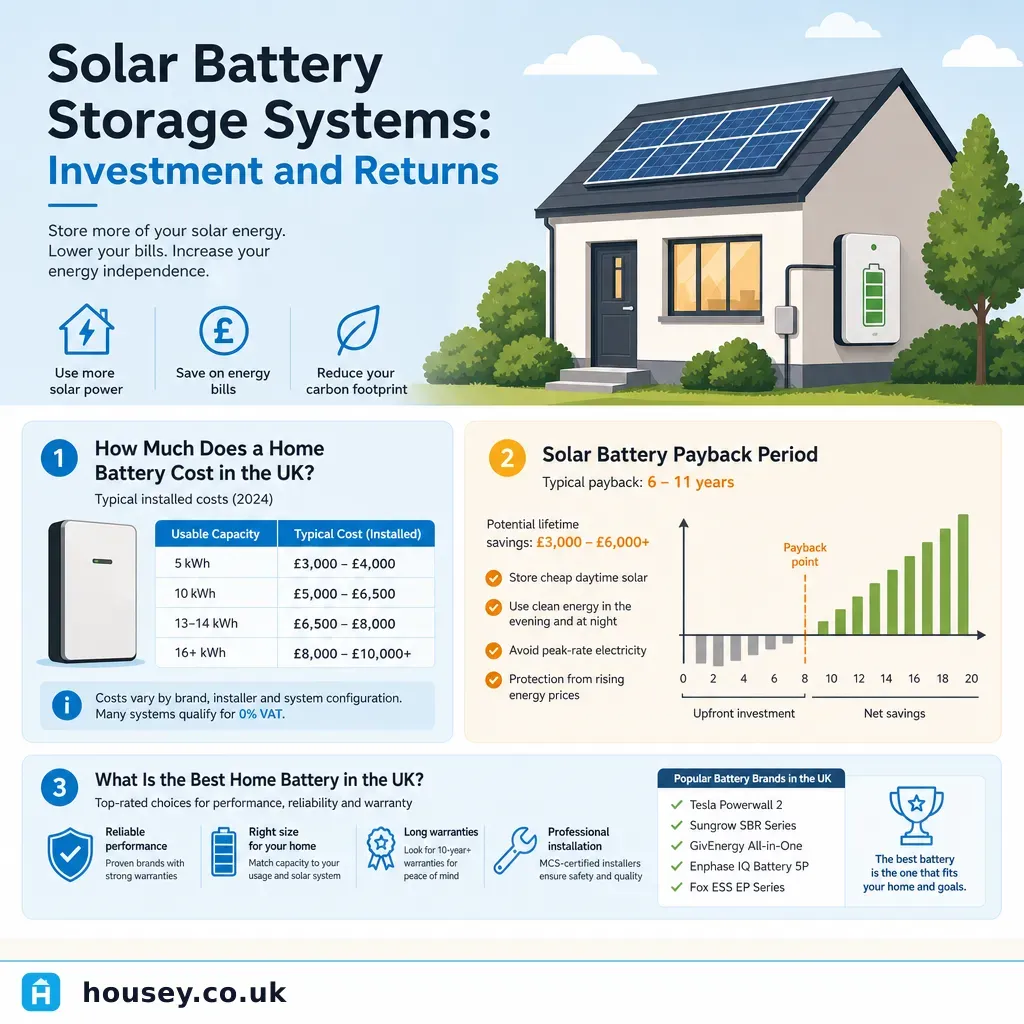
Solar Battery Storage Systems: Investment and Returns
A home battery storage system stores surplus solar energy for use in the evening, reducing grid electricity imports.
 Energy & Retrofit
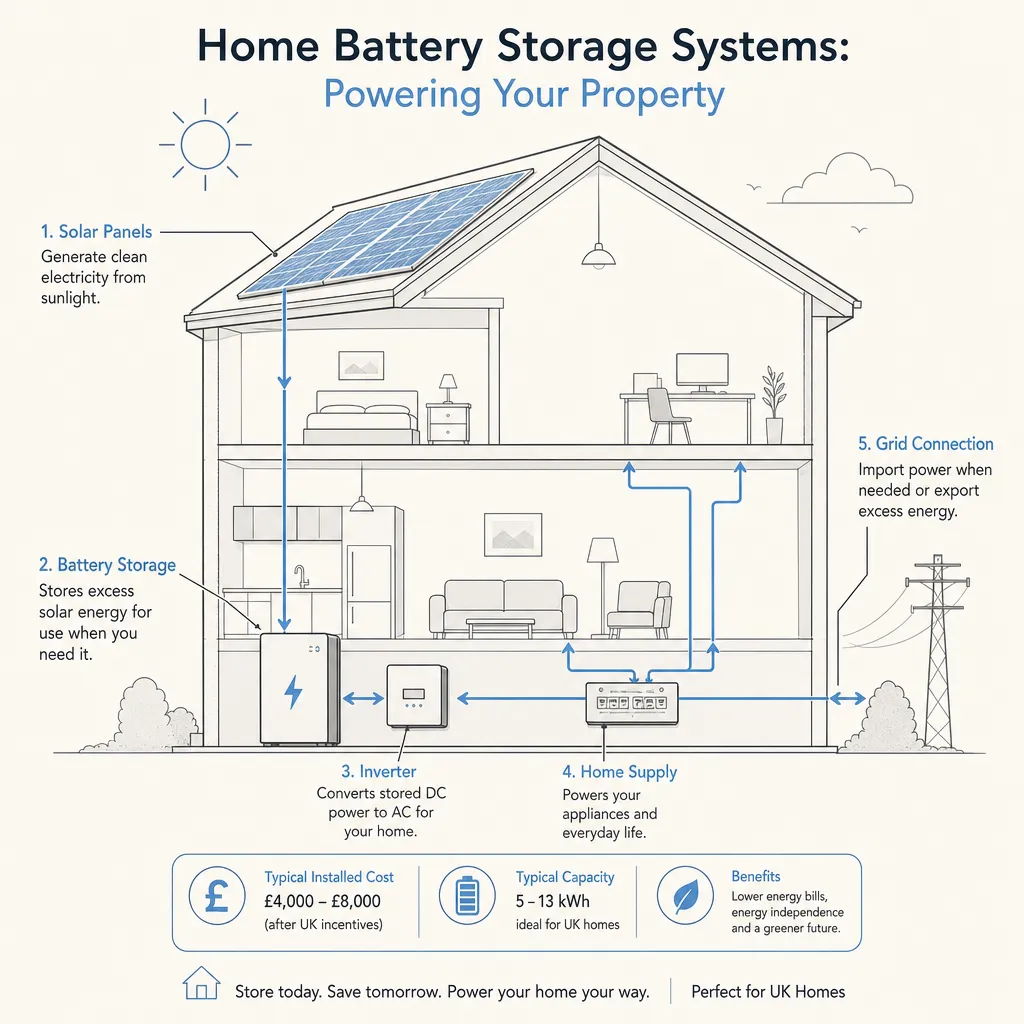
Home Battery Storage Systems: Powering Your Property
Home battery storage systems store electricity from solar panels or the grid — typically 5 to 15 kWh capacity — for use when generation is low or tariffs are high.
 Energy & Retrofit
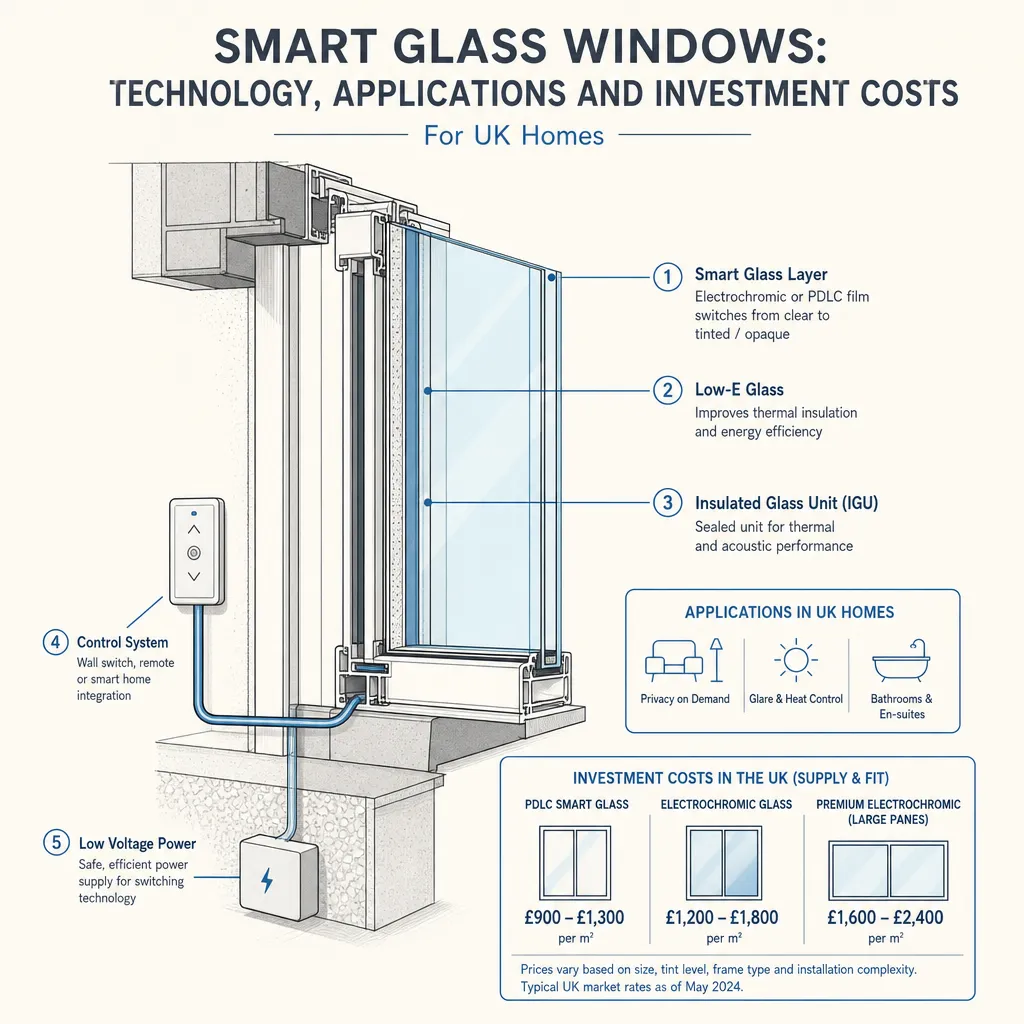
Smart Glass Windows: Technology, Applications and Investment Costs
Smart glass windows switch between transparent, tinted, or opaque states using electrical signals or heat.
 Energy & Retrofit
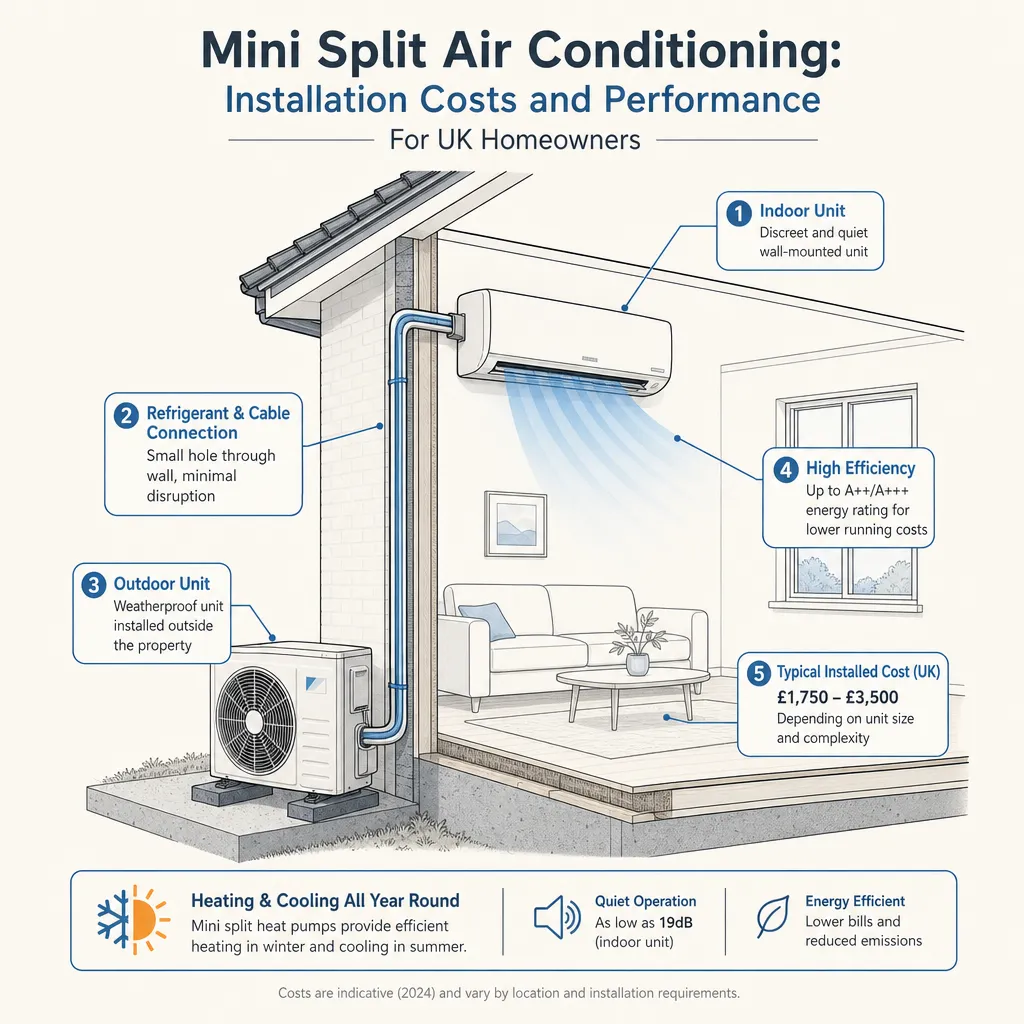
Mini Split Air Conditioning: Installation Costs and Performance
A mini-split (ductless) air conditioning unit costs roughly £1,500–£4,000 installed for a single room in the UK.
 Energy & Retrofit
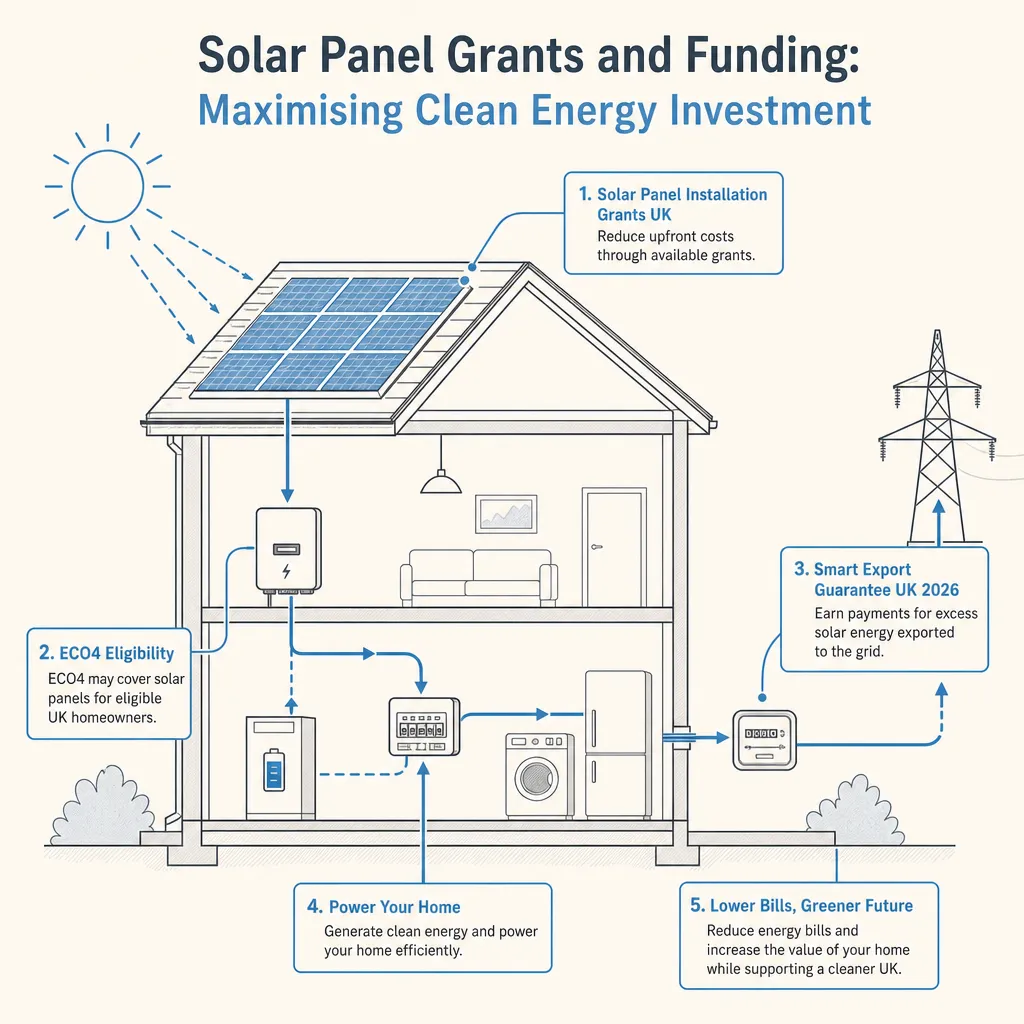
Solar Panel Grants and Funding: Maximising Clean Energy Investment
Several UK solar funding schemes are currently open: the Smart Export Guarantee pays homeowners for surplus electricity exported to the grid, ECO4 can fund free or subsidised panels for eligible low-income households, and 0% VAT on installation applies until at least March 2027.