The Property Conveyancing Process: Key Stages Explained
By Housey · Last reviewed 25th of May 2026
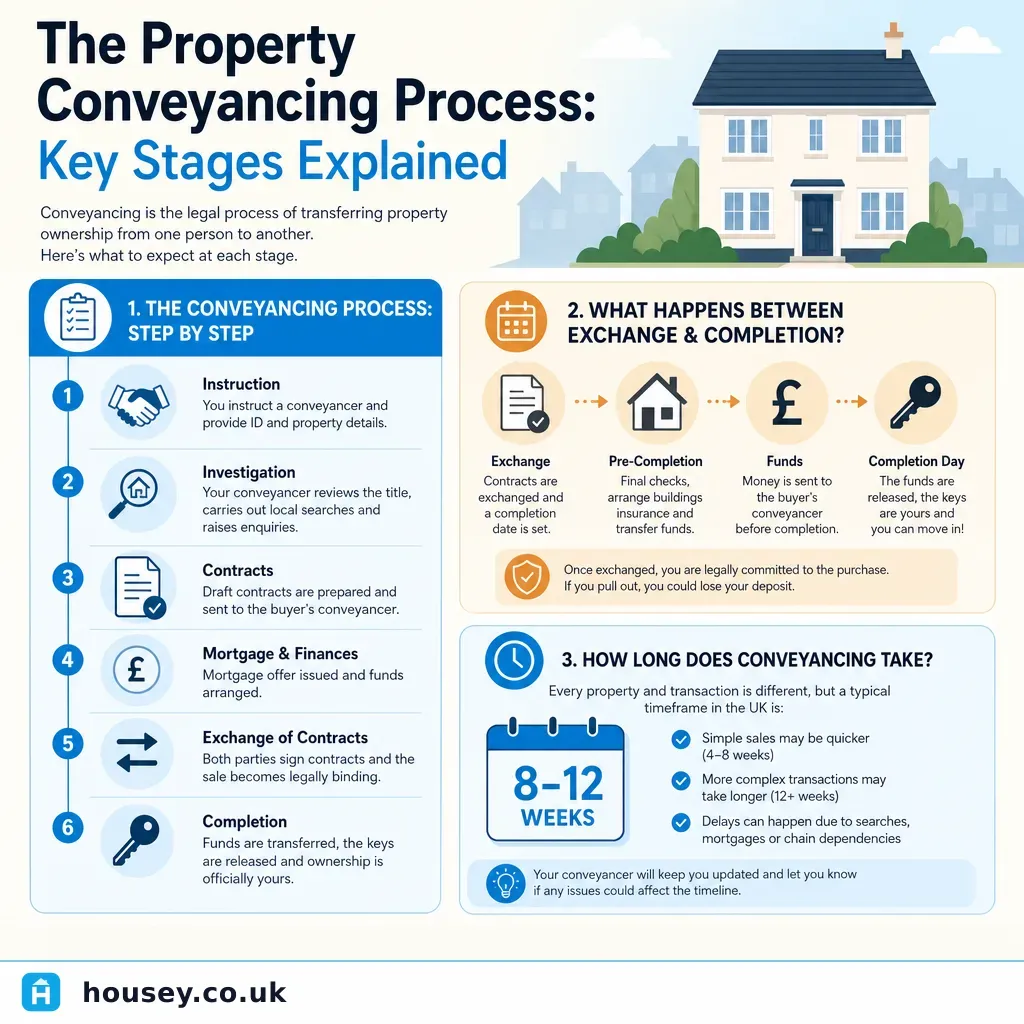
The Property Conveyancing Process: Key Stages Explained
When an offer is accepted on a property in England or Wales, the period between that moment and receiving the keys involves a defined legal sequence that must happen in order. Many buyers — and sellers — are caught out by the volume of documentation involved, the number of parties that need to act in step, and the reality that a delay at any single point can hold up an entire chain. Understanding what happens at each stage, what you need to prepare, and where the common sticking points are is the most practical way to stay in control of your transaction.
Key points
- The conveyancing process has five stages: instruction and identity verification, pre-contract searches and enquiries, exchange of contracts, completion, and post-completion filing.
- Exchange of contracts is the legal point of no return — both parties are bound and withdrawal triggers financial penalties, typically including loss of the deposit.
- Stamp Duty Land Tax (SDLT) must be filed and paid to HMRC within 14 calendar days of completion; automatic penalties apply for late submission.
- Local Authority search turnaround times vary dramatically by council — from a few days to ten weeks or more — and are among the most common causes of delay in England and Wales.
- HM Land Registry registration of title can take several weeks to months after completion; your legal ownership passes on completion day regardless of when registration is processed.
Stage 1: Instruction and identity verification
As soon as an offer is accepted, both buyer and seller should instruct their solicitors without delay. Instructing early does not commit you to the transaction; it starts the legal process and reduces the overall timeline.
On instruction, your solicitor will:
- Verify your identity under the Money Laundering Regulations 2017 — you will need to provide photo ID (passport or driving licence) and proof of address.
- Request evidence of your source of funds: bank statements covering the deposit, a gift letter if funds include a gift, or documentation for equity from a sale.
- Send client care documentation including a fee quote showing professional charges and disbursements.
- Apply for the draft contract pack from the seller's solicitor.
Documents to prepare at this stage:
- Passport or driving licence
- Recent utility bill or bank statement (within 3 months) for proof of address
- Bank statements showing deposit funds (typically 3–6 months of statements)
- Gift letter from any donor contributing to the deposit
- Details of your mortgage offer once received
Stage 2: Pre-contract searches and enquiries
This is the longest stage and the one most likely to surface issues. Your solicitor investigates the title and the property's legal standing before asking you to commit to exchange.
Property searches ordered:
- Local Authority (LLC1 and CON29): checks planning decisions, enforcement notices, road and footpath adoption, financial charges, and local land charges. Turnaround varies most with this search.
- Drainage and water search (CON29DW): confirms whether the property is connected to public sewers and whether a public sewer crosses the site (which can restrict building).
- Environmental search: checks for contaminated land, landfill sites, flood risk, and ground stability near the property.
- Additional searches: depending on location — coal mining, limestone cavities, tin mining, chancel repair liability, or HS2 safeguarding zones.
Pre-contract enquiries:
Your solicitor raises written enquiries with the seller's solicitor covering boundaries, rights of way, disputes with neighbours, alterations, planning consents, building regulations approvals, service contracts, and any guarantees or warranties. The seller's answers form part of the contract documentation.
Your solicitor will also:
- Review the TA6 (property information form) and TA10 (fixtures and fittings form) completed by the seller.
- Check for planning permissions, building regulations completion certificates, FENSA or CERTASS certificates for replacement windows, party wall awards, and relevant guarantees.
- Check the mortgage offer against lender requirements and report any discrepancies.
- Report to you in writing on all findings before recommending that you proceed to exchange.
Typical duration: 4–10 weeks, depending primarily on search turnaround times and the seller's speed in answering enquiries.
Stage 3: Exchange of contracts
Exchange is the legal commitment. Neither party can withdraw without penalty once contracts have been exchanged.
At exchange:
- Your solicitor confirms all searches are returned, all enquiries are resolved, and your mortgage offer is in place.
- You sign the contract (by post, in person, or electronically as advised by your solicitor).
- The deposit — usually 10% of the purchase price, though this can be negotiated — is transferred to the seller's solicitor's client account.
- Both solicitors exchange signed contracts simultaneously, fixing the completion date.
Your exchange checklist:
Stage 4: Completion
Completion is the day you become the legal owner of the property.
What happens:
- Your solicitor transfers the balance of the purchase price (minus the deposit already paid) to the seller's solicitor by CHAPS bank transfer.
- Once the seller's solicitor confirms receipt of cleared funds, the estate agent is authorised to release keys — typically between 1pm and 3pm, though this varies.
- In a chain, completions happen sequentially: each transaction relies on the previous one receiving funds before releasing its own.
What you should do on completion day:
- Do not plan to access the property before midday; CHAPS transfers can take until early afternoon to clear.
- Keep your solicitor's direct contact number to hand.
- Take meter readings as soon as you enter the property.
- Change the locks after taking possession.
Stage 5: Post-completion
Two time-critical tasks fall to your solicitor after completion.
Stamp Duty Land Tax (SDLT): Your solicitor must submit an SDLT return to HMRC and pay any tax due within 14 calendar days of completion. Failure to meet this deadline triggers automatic penalties. First-time buyer relief, the higher rates for additional dwellings, and other reliefs must be correctly applied — errors can be costly to correct after the fact.
HM Land Registry registration: Your solicitor applies to register the new ownership — and any mortgage — at HMLR. Registration times currently vary; HMLR publishes estimated processing times on its website. You are the legal owner from completion day regardless of when registration is processed, and HMLR records your application priority from the date of the pre-completion official search.
Conveyancing process at a glance
Stage | Key events | Typical duration | Your main tasks |
|---|---|---|---|
Instruction | ID verification, source of funds, draft contract requested | 1–3 days | Provide ID, proof of address, fund evidence |
Pre-contract | Searches, enquiries, contract review, mortgage check | 4–10 weeks | Respond promptly; locate planning and building regs documents |
Exchange | Contracts signed and exchanged; deposit paid; completion date fixed | Single day | Confirm deposit, insurance, removal booking |
Completion | Purchase price transferred; keys released | Single day | Take meter readings; change locks |
Post-completion | SDLT filed within 14 days; HMLR registration | SDLT: 14 days; registration: weeks to months | Provide cleared SDLT funds; retain title documents safely |
What causes delays — and how to reduce them
The most common sources of delay in English and Welsh residential conveyancing:
- Long chains: a problem anywhere in the chain delays everyone. Ask your solicitor whether a conditional exchange fixing a completion date is possible.
- Slow Local Authority searches: turnaround times vary from 48 hours to ten weeks or more depending on the council. Your solicitor should advise on expected timescales for the specific authority involved.
- Missing documents: sellers who have not located building regulations completion certificates, planning permissions, FENSA certificates, party wall awards, or lease consents before going to market cause avoidable delays. Sellers should compile a document bundle before marketing.
- Mortgage delays: lender valuations, property queries, or changes to your financial circumstances can hold up the formal mortgage offer.
- Leasehold complications: management information packs from freeholders or managing agents are frequently slow; add 2–4 weeks for leasehold purchases as a baseline.
Important limitations
This article describes the typical residential conveyancing process for registered properties in England and Wales. Scotland operates under a different system (missives and the Registers of Scotland); Northern Ireland has its own distinct framework. Timescales, costs, and complexity vary significantly between transactions. This is general guidance only and does not constitute legal advice. Always instruct a solicitor or licensed conveyancer regulated by the SRA or CLC.
What to ask a qualified professional
- What searches are required for this property, and would you recommend any additional searches given its location or history?
- Are there any outstanding enquiries that could affect whether or when I should exchange?
- Is there anything in the title or search results that could affect the property's value, use, or future saleability?
- What is your current average time from instruction to exchange for this type of transaction?
- If the seller cannot provide planning or building regulations documentation, what are my options?
- How will I be kept updated, and who should I contact if I have not heard from you within an agreed period?
When to get professional help
Conveyancing for any mortgaged property must involve a regulated solicitor or licensed conveyancer; your lender requires it. For cash purchases, while self-conveyancing is technically possible, the risk of undetected title defects, missed enforcement notices, and SDLT errors makes professional instruction strongly advisable.
Red flags that require immediate professional advice:
- You are being asked to exchange with outstanding searches or unresolved enquiries.
- A search has revealed an enforcement notice, an environmental liability, or a restriction affecting your intended use.
- The title plan does not match the physical boundaries of the property.
- The property has been extended or converted without planning permission or a building regulations completion certificate.
- The lease has fewer than 85 years remaining — many lenders require at least 70–85 years, and below 80 years the lease extension premium increases significantly.
- There is a dispute between current neighbours about boundaries, rights of way, or shared facilities.
How Housey can help
Housey makes it straightforward to find a regulated conveyancing solicitor or licensed conveyancer for your purchase, sale, or remortgage. Compare transparent quotes and check accreditations through our conveyancing service and get matched with firms experienced in your property type and local area.
Frequently asked questions
How long does conveyancing take in England and Wales?
A straightforward freehold purchase with no chain typically takes 8–12 weeks from instruction to completion. Leasehold properties, long chains, and slow Local Authority searches regularly extend this to 16 weeks or more. There is no legal maximum; mortgage offers typically remain valid for 3–6 months, after which a re-application may be needed.
What is the difference between exchange and completion?
Exchange is when both parties legally commit by swapping signed contracts; withdrawal after exchange usually triggers forfeiture of the buyer's deposit or a financial claim. Completion is when the purchase price is paid in full, ownership transfers, and keys are released. The two events are normally separated by one to four weeks.
Can conveyancing fall through after exchange?
Very rarely, and with serious financial consequences. A buyer who withdraws after exchange typically forfeits the deposit; a seller may face a claim for wasted costs. Courts can order specific performance requiring the transaction to proceed. If a genuine emergency arises, take immediate legal advice specific to your circumstances.
Do I need to attend my solicitor's office?
Usually not. Exchange is handled by solicitors by telephone or electronically. Most documentation can be signed electronically or by post. On completion day you do not need to visit a solicitor's office; keys are normally collected from the estate agent once your solicitor confirms funds have cleared.
Sources and further reading
- Buying or selling your home — GOV.UK
- Stamp Duty Land Tax — GOV.UK / HMRC
- Registering land or property — GOV.UK
- Buying a home — Law Society
- Buying a home — Citizens Advice
- UK Finance Mortgage Lenders' Handbook — UK Finance
Useful next reads
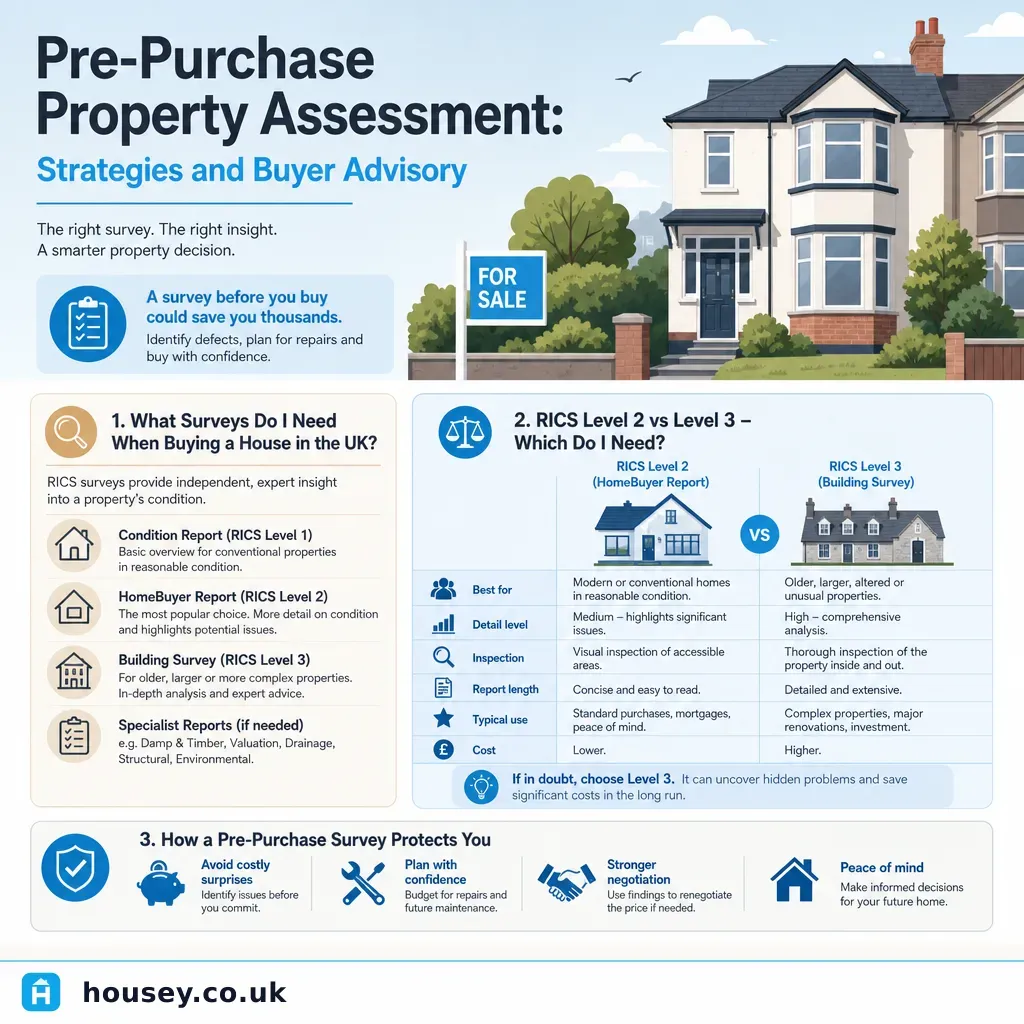 Buying & Moving
Pre-Purchase Property Assessment: Strategies and Buyer Advisory
A pre-purchase property assessment in the UK typically combines an independent RICS Home Survey, conveyancing searches, and specialist inspections for damp or electrical condition where needed.
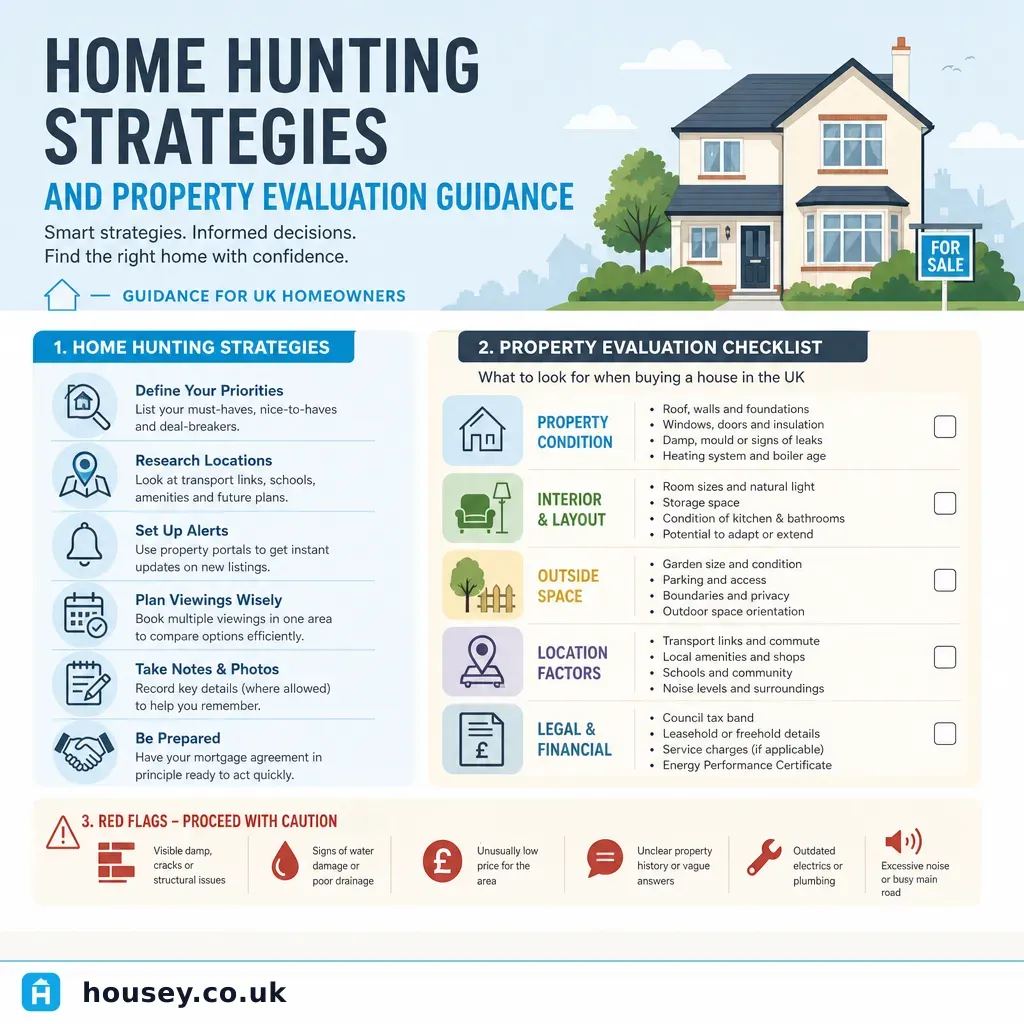 Buying & Moving
Home Hunting Strategies and Property Evaluation Guidance
To find and evaluate the right home, define your non-negotiable criteria before browsing, use HM Land Registry sold prices to check comparables, and inspect properties systematically for structural, damp, and electrical issues.
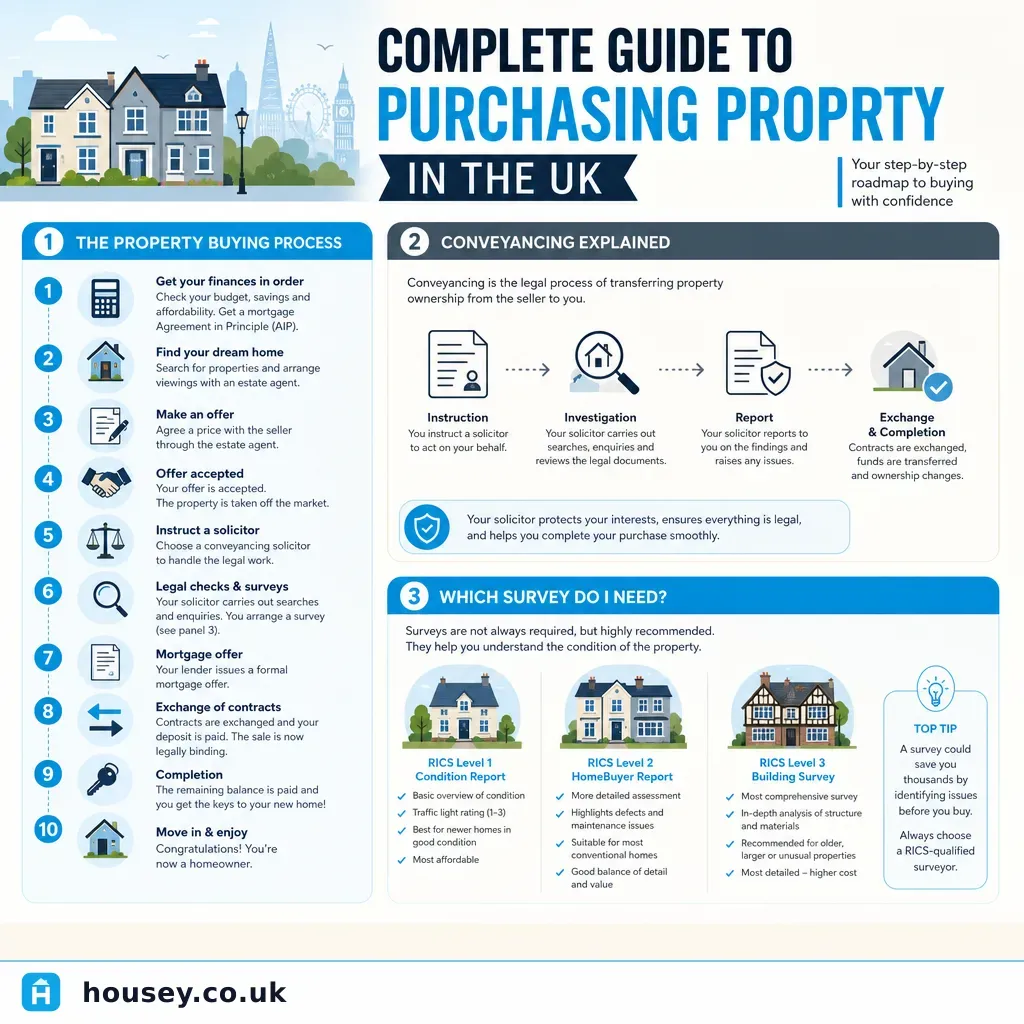 Buying & Moving
Complete Guide to Purchasing Property in the UK
Buying property in England and Wales typically takes 12 to 16 weeks from offer acceptance to completion.
 Buying & Moving
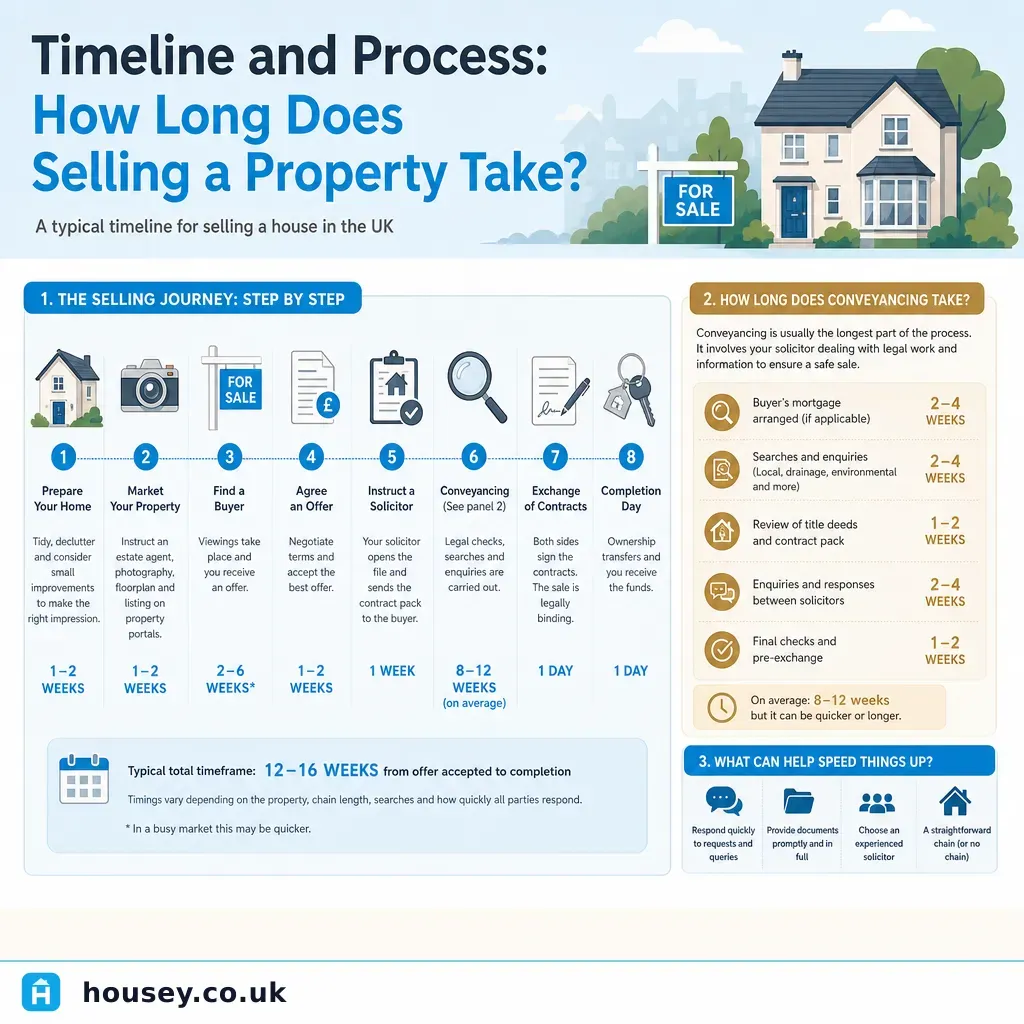
Timeline and Process: How Long Does Selling a Property Take?
Selling a property in England and Wales typically takes 4 to 6 months from listing to completion.
 Buying & Moving
How to find a property that matches your needs and budget
Finding the right property starts with separating non-negotiable needs from preferences, then building a realistic budget that includes SDLT, survey fees, and legal costs — typically 2–4% of the purchase price on top.