Tree Assessment: Identifying Signs Your Property Needs Professional Tree Removal
By Housey · Last reviewed 1st of June 2026
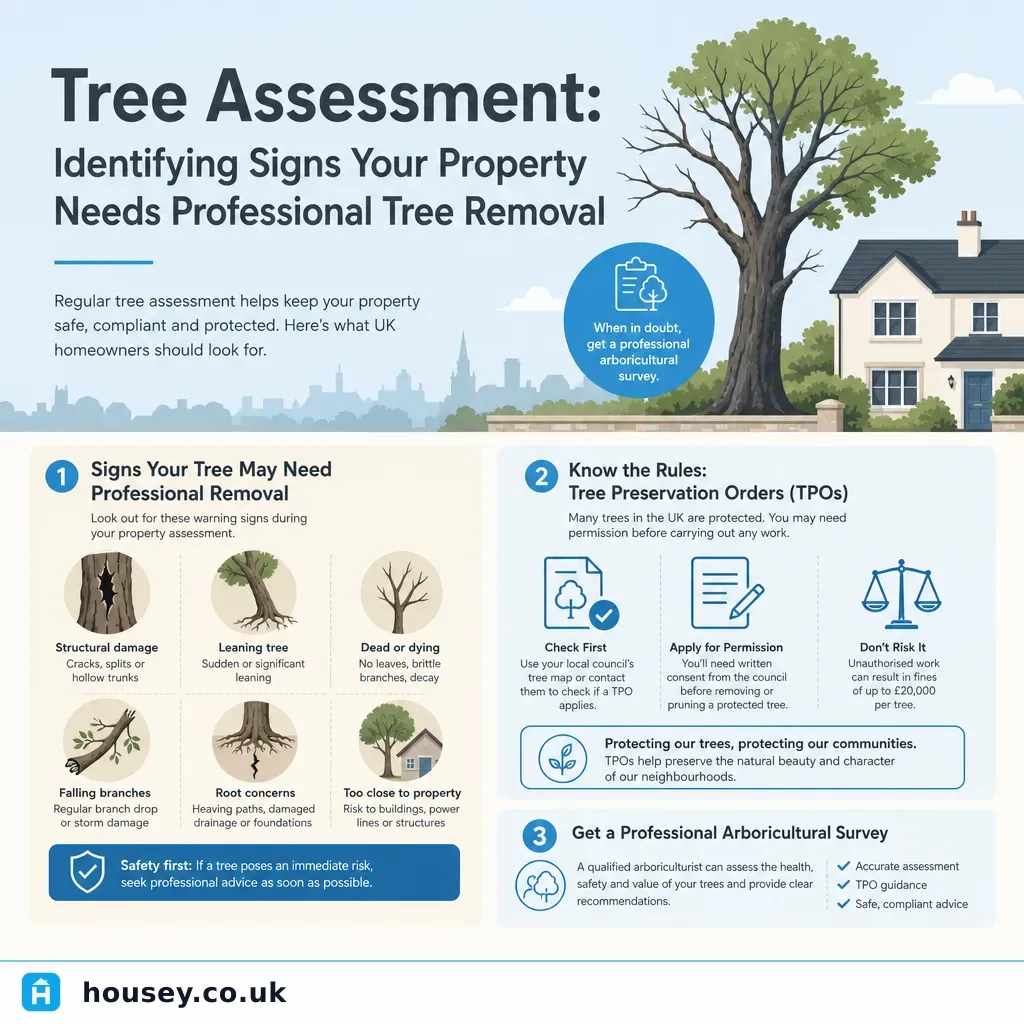
Tree Assessment: Identifying Signs Your Property Needs Professional Tree Removal
Trees add genuine value, character, and biodiversity to UK properties, but when their structural integrity or health is compromised they can present serious safety and legal risks. The question of whether a tree needs removing typically arises after a storm, when visible decay appears, when roots begin affecting structures, or when planning a garden redesign. Reaching the wrong conclusion — felling a tree unnecessarily or leaving a structurally unsound one — carries significant legal, financial, and safety consequences for UK homeowners.
Key points
- Trees subject to a Tree Preservation Order (TPO) cannot be removed, pruned, or uprooted without prior written consent from the local planning authority; unauthorised removal is a criminal offence carrying an unlimited fine under the Town and Country Planning Act 1990.
- In a conservation area, any tree with a stem diameter above 75 mm measured at 1.5 m above ground level is automatically protected; you must give the local planning authority six weeks' written notice (a Section 211 notice) before carrying out any felling or significant pruning.
- An arboricultural survey conducted to BS 5837:2012 is the standard UK methodology for assessing trees in relation to design and development, categorising trees as A (high retention value), B (moderate), C (low), or U (recommended removal).
- Visual Tree Assessment (VTA) is the principal method used by arborists for identifying structural defects and decay in individual trees; Quantified Tree Risk Assessment (QTRA) provides a more detailed probabilistic approach for high-footfall or high-consequence locations.
- Fungal brackets (fruiting bodies of wood-decay fungi) growing at the root collar or on the main stem are one of the most reliable visible indicators of serious internal decay and should prompt an urgent professional inspection.
Visual signs that a tree may need professional assessment
The following signs do not automatically mean a tree must be removed — that decision requires professional diagnosis — but each indicates that a qualified arborist should inspect the tree without significant delay.
Structural defects:
- Large cracks or splits running vertically or spirally along the trunk.
- A lean that has developed or worsened recently, especially after a storm — not all leaning trees are hazardous, but a change in lean is a red flag.
- Co-dominant stems (two roughly equal leaders) with included bark at the union, which indicates a structurally weak attachment prone to splitting under load.
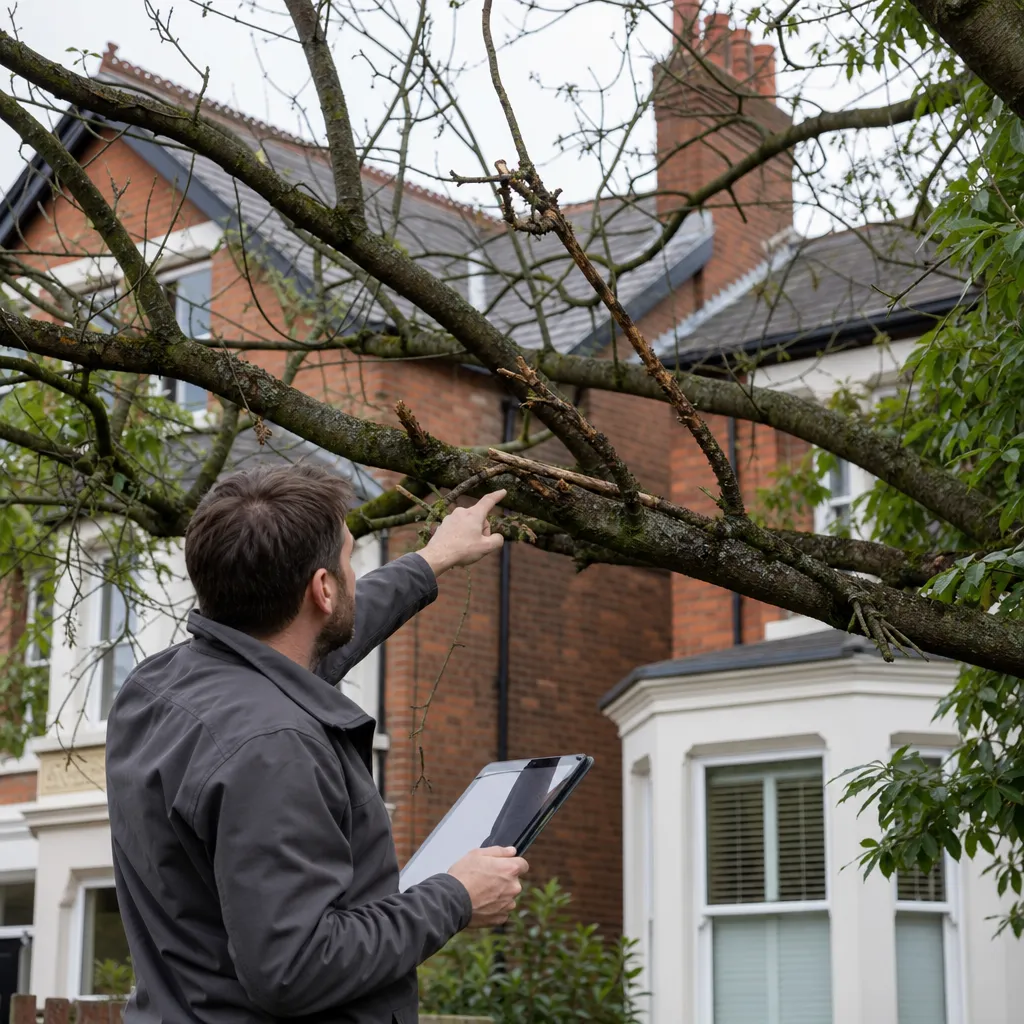
- Dead or hanging branches (widow-makers) in the crown, particularly over paths, buildings, or occupied spaces.
- Root damage: severed, excavated, or heavily compacted roots on one side of the tree can significantly reduce stability.
Signs of disease and decay:
- Fungal brackets, conks, or shelf fungi growing from the root collar, trunk, or major limbs — these indicate active wood decay that is often substantially more advanced internally than external signs suggest.
- Cavities or hollows in the trunk or major branches where wood has rotted away.
- Bark abnormalities: cankers, sunken patches, unusual discolouration, or areas where bark has fallen away to reveal discoloured wood beneath.
- Dieback in the crown: dead branches concentrated in a particular crown sector, or general thinning across the canopy, may indicate vascular disease, drought stress, or root system failure.
- Epicormic growth — clusters of small shoots erupting from the trunk or main branches — is often a stress response and warrants investigation.
Environmental context:
- Recent construction, excavation, or hard surfacing within the root protection area (typically calculated as 12 times the stem diameter as a radius from the base of the tree, per BS 5837:2012).
- Storm damage, lightning strike, or vehicle impact.
- Prolonged flooding or waterlogging at the base.
Tree Preservation Orders: check before you act
Before instructing any tree work — including removal — you must establish whether the tree is legally protected. The two main forms of statutory protection in England are:
Tree Preservation Orders (TPOs): Made by local planning authorities (LPAs) under the Town and Country Planning Act 1990. A TPO can protect individual trees, groups, or woodlands. Carrying out unauthorised work on a protected tree is a criminal offence; penalties include an unlimited fine, and the LPA may require the landowner to plant a replacement tree.
Conservation areas: Under Section 211 of the Town and Country Planning Act 1990, any tree with a stem diameter exceeding 75 mm at 1.5 m height in a conservation area is automatically protected. You must submit a Section 211 notice giving the LPA six weeks to consider whether to make a TPO before commencing any felling or significant pruning, unless the work is urgently necessary to remove an immediate risk to life.
You can check for TPOs on your LPA's website or through the Planning Portal. If you purchased the property recently, your conveyancing search pack may include TPO information, though TPOs can be made after purchase.
What an arboricultural survey involves
A professional arboricultural survey produces a structured, evidence-based assessment of the trees on a site. The most commonly requested formats in the UK are:
Survey type | Purpose | When typically required |
|---|---|---|
BS 5837:2012 tree survey | Catalogues trees as Category A (high value), B (moderate), C (low), or U (recommended removal) | Planning applications near trees |
Visual Tree Assessment (VTA) | Qualitative inspection of visible defects and hazard potential | General health check, post-storm, insurance query |
Quantified Tree Risk Assessment (QTRA) | Probabilistic risk assessment combining failure likelihood and consequences | High-footfall areas, schools, public open spaces |
Arboricultural Impact Assessment (AIA) | Assesses the effect of proposed development on retained trees | Planning applications |
For a domestic enquiry about whether a specific tree should be removed, a VTA is usually the appropriate starting point. If the tree is large, close to a structure, or overhangs a frequently used area, the arborist may recommend a QTRA. Always check that the practitioner is a member of the Arboricultural Association (AA) or holds equivalent recognised qualifications.
Which professional do you need: tree surgeon or arboricultural consultant?
Situation | Who to instruct |
|---|---|
Tree shows signs of decay or structural defect; need diagnosis | Arboricultural consultant (advises on removal vs retention) |
TPO consent application or Section 211 notice preparation required | Arboricultural consultant (can prepare and submit application) |
Tree confirmed for removal; physical works required | AA-registered tree surgeon or arboricultural contractor |
Emergency storm damage posing immediate risk to life | Tree surgeon for emergency make-safe; consultant for follow-up assessment |
Planning application near trees (BS 5837 survey required) | Arboricultural consultant |
Routine pruning, crown reduction, or deadwooding | Tree surgeon |
Red flags requiring urgent professional assessment
The following signs warrant contacting a qualified arborist within days, not weeks:
- Fungal brackets or conks at the root collar or on the main stem — species such as Ganoderma spp. or Meripilus giganteus (giant polypore) are associated with serious root and butt decay and can indicate extensive internal failure.
- Sudden or progressive lean toward a building, highway, or occupied space, particularly if the lean is new or worsening.
- Root heave: the ground around the base is lifting or cracking, which may indicate root plate failure.
- A major limb partially broken and suspended in the crown — a common post-storm hazard known as a widow-maker.
- After any significant storm, if the tree shows new signs of lean, crown damage, or disturbance at the root zone.
- Weeping or bleeding wounds on the trunk accompanied by dead wood in the crown above, which may indicate bacterial wetwood, canker, or vascular disease.
If a tree fails and causes injury or property damage, and a prior risk was documented but not acted upon, the landowner may face civil liability. Seeking a professional assessment and keeping a record of it is important risk management for any property owner.
When to get professional help
If you observe any of the red flags above, do not delay. A qualified arborist from the Arboricultural Association's register can assess structural integrity and advise on whether removal is necessary. If removal is recommended, always establish TPO status and obtain any required consents before instructing a contractor.
Note that even when a tree is clearly dangerous, you must not fell it without appropriate consents unless it presents an immediate risk to life. Emergency works should be documented and reported to the LPA promptly. The LPA retains the power to require replanting where a protected tree has been removed without consent.
How Housey can help
Housey connects UK property owners with vetted local professionals for arboricultural surveys — including BS 5837:2012 assessments for planning applications and Visual Tree Assessments for health and safety queries — and tree surgery services for agreed removal or maintenance works. Whether you need a formal survey, an emergency assessment, or a qualified contractor to carry out safe removal, Housey can help you find the right specialist for your property.
Frequently asked questions
Can I remove a tree in my garden without permission?
Not always. If the tree is subject to a TPO, or is in a conservation area with a stem diameter above 75 mm at 1.5 m height, you need LPA consent or must give six weeks' written notice before proceeding. For trees with no statutory protection, you may instruct removal without formal consent, though it is worth checking TPO records with your LPA before starting work.
How do I check if a tree has a Tree Preservation Order?
Contact your local planning authority's planning department or search their online mapping system. The Planning Portal (planningportal.co.uk) also provides guidance on finding TPO records. If you purchased the property recently, your conveyancing search pack may include TPO information, though records can change after purchase.
What qualifications should I look for in an arborist or tree surgeon?
Look for Arboricultural Association (AA) membership — Approved Contractor status for tree surgery firms, or Registered Consultant status for advisory work. Individual practitioners may hold a Level 3 Award in Arboriculture or higher. Check that the contractor carries adequate public liability insurance — at least £5 million is standard for tree work on domestic properties.
Does home insurance cover damage caused by a falling tree?
Most standard UK buildings insurance policies cover damage caused by falling trees or branches to the insured structure. However, cover varies and exclusions can apply — for example, if pre-existing decay was known or should reasonably have been identified. Check your policy wording carefully, and contact your insurer before instructing removal of a tree that has already caused or threatens to cause damage.
Sources and further reading
- Tree Preservation Orders and trees in conservation areas — GOV.UK
- Town and Country Planning Act 1990, Section 211 — legislation.gov.uk
- Arboricultural Association: find a registered professional — Arboricultural Association
- Planning Portal: trees and hedges guidance — Planning Portal
- BS 5837:2012 Trees in relation to design, demolition and construction — BSI Group
Useful next reads
 Improvement & Build
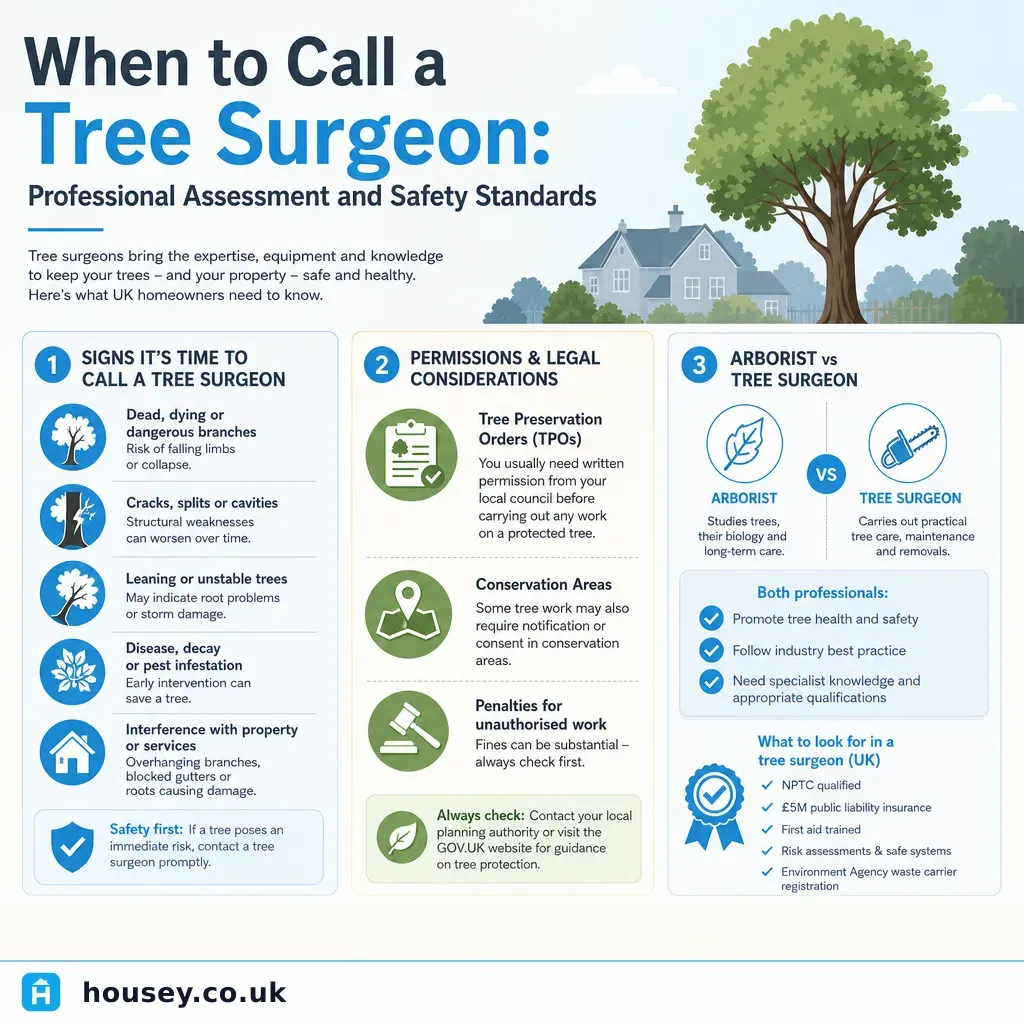
When to Call a Tree Surgeon: Professional Assessment and Safety Standards
Call a tree surgeon when a tree shows signs of disease, structural failure, or poses a risk to people or property.
 Improvement & Build
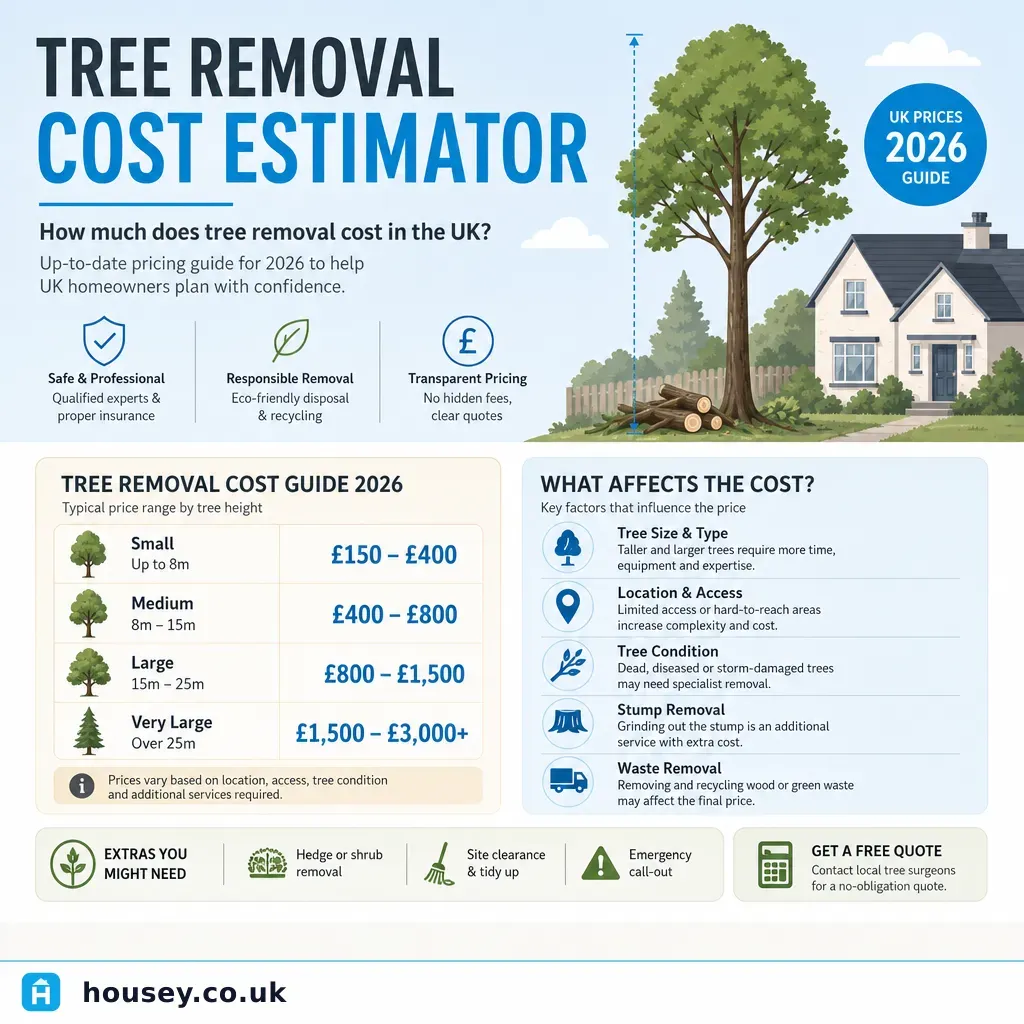
Tree Removal Cost Estimator
Tree removal in the UK costs roughly £150 to £5,000 or more, depending on the tree's height, species, access conditions, and whether stump removal is needed.
 Improvement & Build
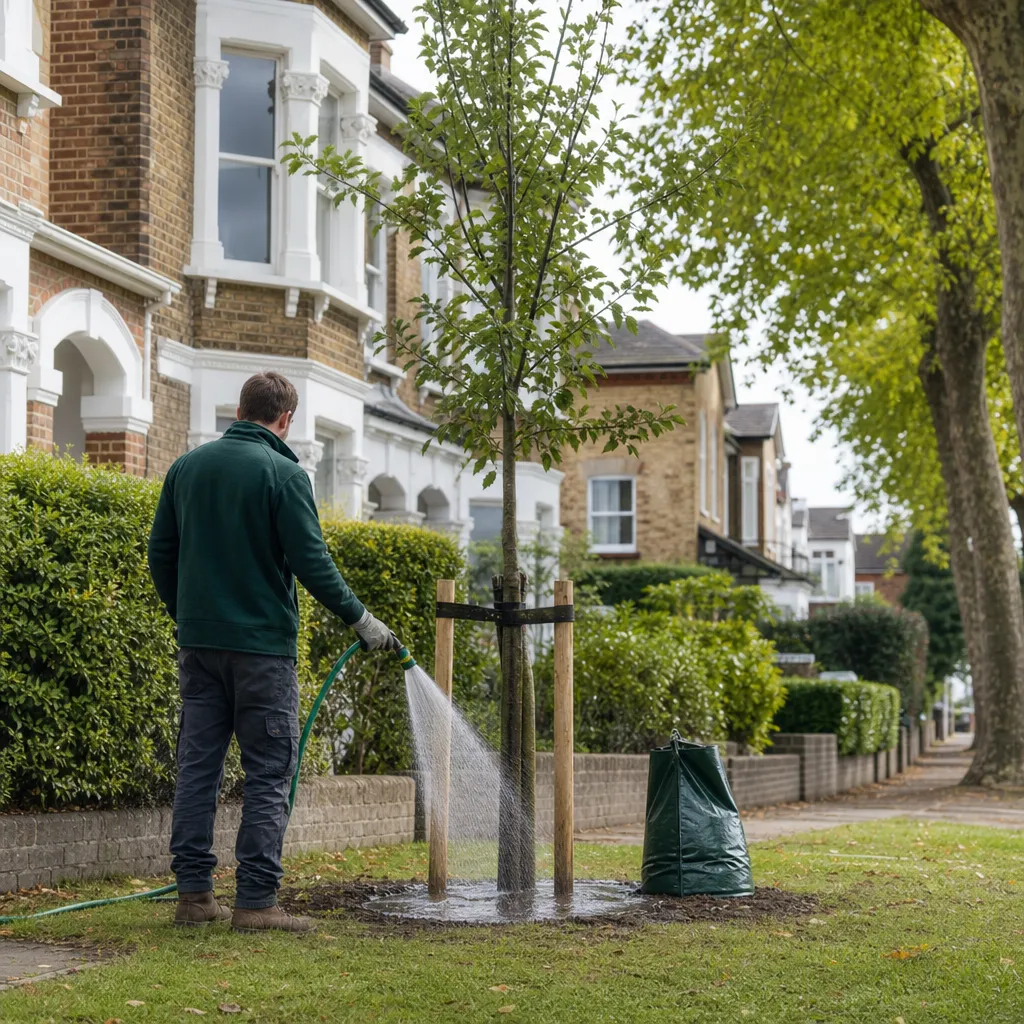
Watering Large Trees: Techniques and Frequency for Establishment
Newly planted large trees typically need 50–90 litres of water per week during the growing season for the first two to three years.
 Improvement & Build
Identifying and Addressing Dying Tree Branches: Common Causes
Dying branches on UK garden trees can result from fungal diseases such as ash dieback or honey fungus, pest damage, drought stress, physical injury, or root problems.
 Improvement & Build
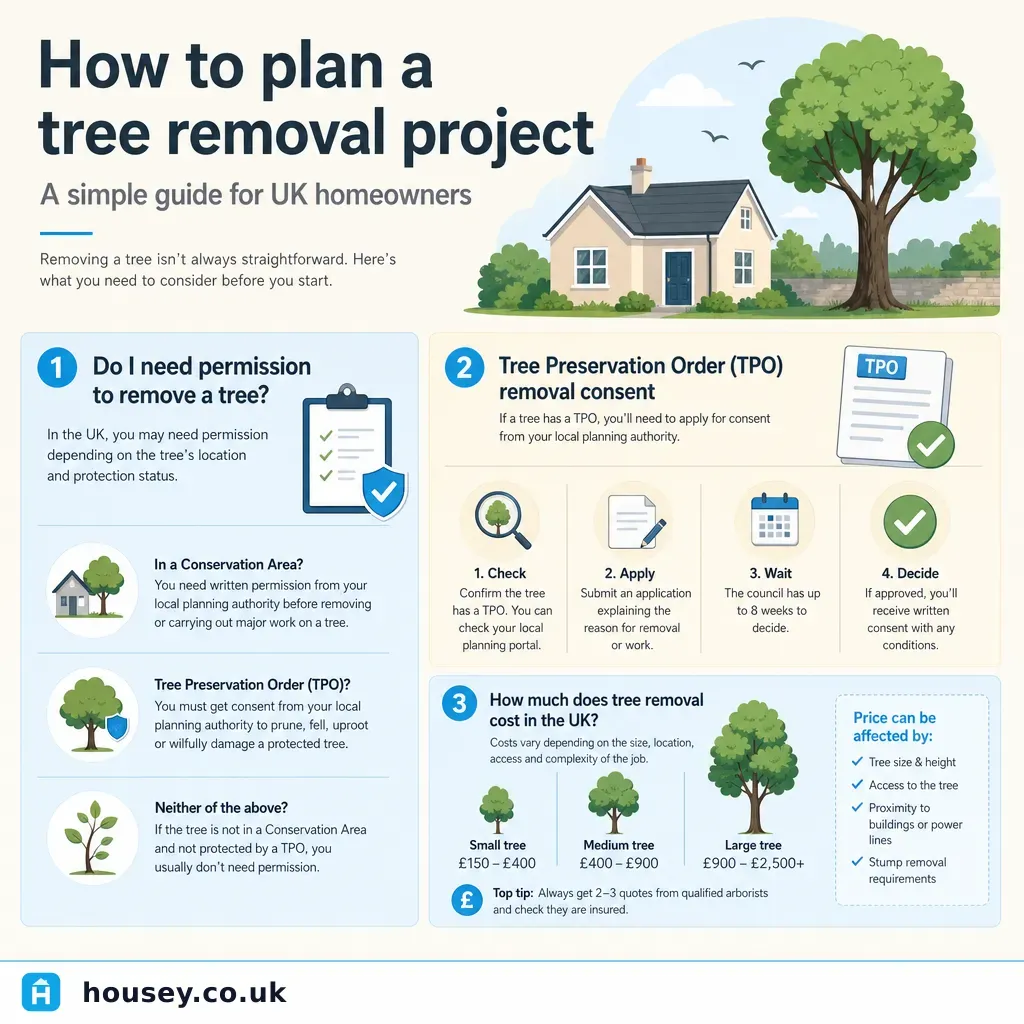
How to plan a tree removal project
Planning a tree removal project starts with checking whether the tree is protected by a Tree Preservation Order or sits in a conservation area, as both require council consent before any work begins.