Tree Removal Services for Fallen Trees
By Housey · Last reviewed 31st of May 2026
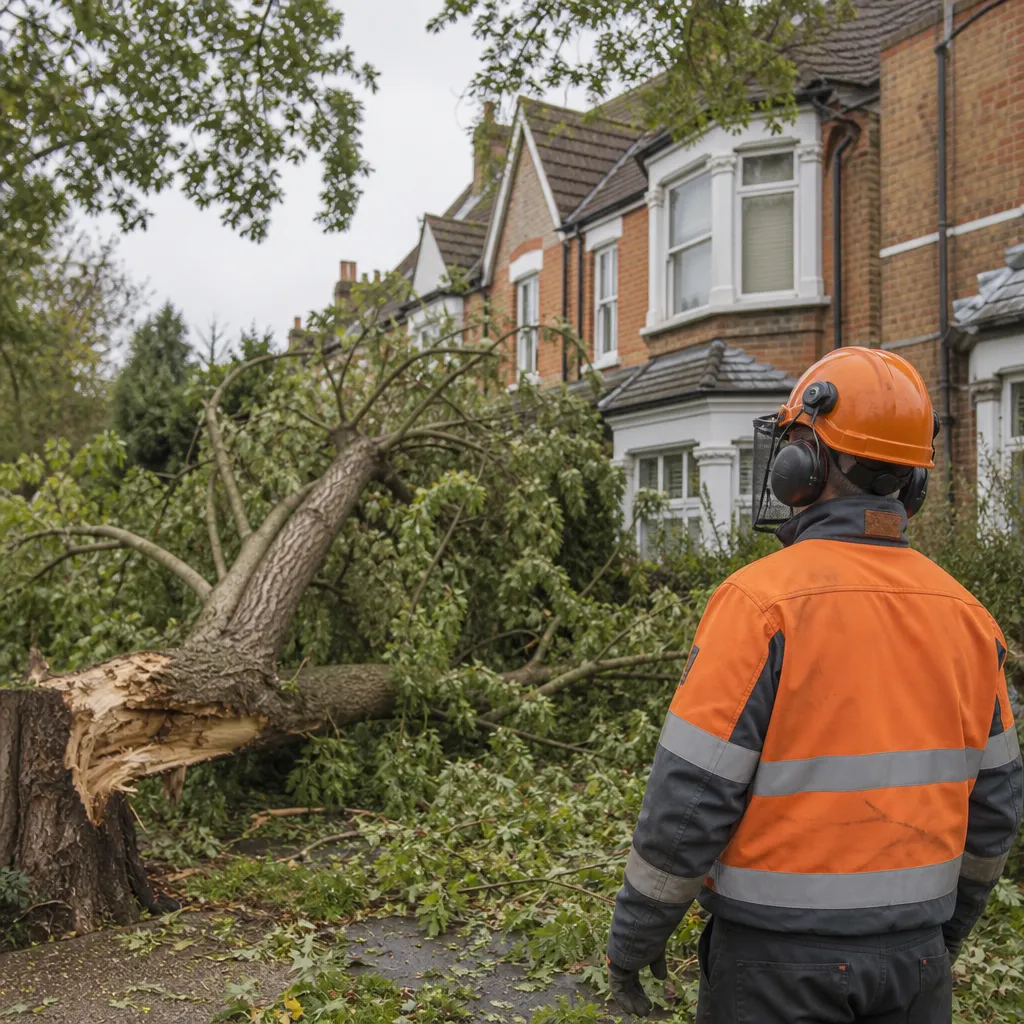
Tree Removal Services for Fallen Trees
A tree coming down unexpectedly — whether brought by storm, disease, or root failure — creates an immediate set of practical and legal questions for the homeowner. Who is responsible for the clearance cost? Does buildings insurance cover the damage? And — a point that catches many people out — does a Tree Preservation Order still apply to a tree that has already fallen? Getting the answers right in the first hours and days can mean the difference between a straightforward insurance claim and a protracted dispute.
Key points
- Responsibility for a fallen tree generally follows the land it was growing on, not where it has landed — but proven negligence, such as ignoring prior written warnings about a dangerous tree, can shift liability to the tree owner.
- Tree Preservation Orders (TPOs) and conservation area protections can still apply to a fallen tree; contact your local planning authority before undertaking any clearance beyond emergency safety works.
- Emergency clearance of trees from or around structures must be carried out by a qualified arborist; the Arboricultural Association maintains a register of Approved Contractors who hold appropriate insurance and training.
- Chainsaws, unstable root plates, and overhead cables all create serious injury risks — large fallen tree clearance is not safe DIY work.
- Most buildings insurance policies cover structural damage caused by a fallen tree; they typically do not cover the cost of removing the tree from the garden unless it is blocking a door, gateway, or access route.
Who is responsible for a fallen tree?
The tree was on your land and fell on your property
The clearance cost is yours. Buildings insurance may cover resulting structural damage to the building — check your policy wording — but removal of the tree from your garden is often excluded unless it is blocking a doorway, gateway, or access route.
The tree was on your land and fell on a neighbour's property
If the tree was healthy and fell due to storm, your neighbour is not automatically entitled to recover costs from you. Their own buildings insurance typically covers damage to their structure. However, if your neighbour had previously notified you in writing that the tree appeared diseased or dangerous and you failed to act, negligence may be established and liability could shift.
The tree was on your neighbour's land and fell on your property
The same principle applies in reverse. Your buildings insurance covers damage to your structure. If you believe your neighbour's negligence contributed, you may be able to pursue a civil claim, but this requires evidence: photographs, prior written notices, and ideally an independent arborist's condition report. Citizens Advice sets out the general legal position on tree responsibilities between neighbours.
The tree was on highway land or a local authority's land
Contact your local authority. Many councils operate an emergency out-of-hours line for dangerous trees on public land. If the tree is within or overhanging the public highway, the highways authority is responsible for clearance.
Decision tree: what to do first
- Tree has fallen on your house or is causing structural risk → Call an emergency arborist immediately; photograph the damage; contact your buildings insurer as soon as it is safe to do so.
- Tree has fallen into the garden with no structural contact → Not usually an immediate emergency; instruct a tree surgeon to assess and quote; check TPO status before any cutting begins.
- Tree is on or near overhead cables → Do not approach; call your electricity distributor's 24-hour emergency line; never attempt to move timber near live cables.
- Uncertain whether the tree has a TPO → Check your local planning authority's online TPO register before cutting anything; most councils maintain a searchable map.
- Tree fell from a neighbour's land → Photograph from your side; notify your insurer; contact your neighbour; instruct your own tree surgeon for a condition assessment if needed to support a claim.
Tree Preservation Orders and fallen trees
A TPO does not automatically become void because the tree has fallen. Local planning authorities can take the view that removal of the trunk and root plate of a fallen TPO tree still requires consent. The specific position varies by council and by circumstances — storm damage usually qualifies for emergency works without prior consent — but it is always safer to notify your local planning authority before clearing a fallen TPO tree.
Conservation area rules similarly protect trees: any tree in a conservation area that is not covered by a TPO still requires six weeks' prior written notification to the local planning authority before removal, with limited exceptions for urgent safety works.
Emergency exemption: if a tree is in such a condition that it poses an immediate risk to life, emergency works may be carried out without prior authority. You must notify the local planning authority as soon as reasonably practicable before any further works beyond those strictly necessary for safety. Keep photographs and any arborist's written assessment as evidence that emergency conditions existed. GOV.UK guidance on TPOs provides the full statutory framework.
Red flags: when this becomes urgent
Do not attempt any DIY intervention and call a professional immediately if:
- The tree or any part of it is resting on the roof, walls, or any part of the structure.
- Root plates have lifted and created an unstable crater near foundations.
- The tree has fallen across or near overhead electricity or telecommunications cables.
- You can smell gas — a fallen tree can rupture an underground gas main; call the National Gas Emergency Service immediately on 0800 111 999.
- Adjacent trees are leaning, cracked at the base, or showing signs of uprooting — a large fall can destabilise neighbouring trees.
- Floodwater is present around the root plate area, indicating severely undermined ground.
In all of the above situations, keep everyone clear of the tree and call a professional before anyone approaches.
Important limitations
This article provides general information for UK homeowners dealing with fallen trees. Responsibility, insurance cover, planning obligations, and the safety of clearance operations all depend on the specific circumstances — the property, the tree's location and protection status, tenure, and the nature of the fall. This guidance cannot substitute for assessment by a qualified arborist, advice from your buildings insurer, or confirmation from your local planning authority on TPO status. Rules vary between local authorities, and individual circumstances can alter the legal position significantly.
What to ask a qualified professional
Before instructing a tree surgeon for fallen tree removal, ask:
- Are you an Arboricultural Association Approved Contractor, and do you hold current public liability insurance?
- Have you confirmed whether this tree is subject to a TPO or within a conservation area, and have you notified the local planning authority where required?
- In your professional opinion, does the root plate or any remaining standing timber pose an ongoing structural or safety risk to the property?
- Can you provide a written condition report or assessment for use with an insurance claim?
- Do you hold a registered Waste Carrier's Licence? (All contractors removing and transporting tree waste must be registered with the Environment Agency.)
- Does the quoted price include full clearance and removal of timber and debris, or only clearance to the boundary?
- Is VAT included in the quoted price?
When to get professional help
Never attempt to cut or move a large fallen tree without professional equipment and training. Chainsaw injuries are severe; unstable root plates can shift without warning; overhead cables are not always identifiable from ground level. The Arboricultural Association maintains a searchable register of Approved Contractors who have the training, insurance, and equipment to carry out fallen tree clearance safely. After major storms — such as Storm Eunice or Storm Ciarán — demand for emergency arborists is high; contact multiple firms and instruct your insurer as early as possible.
How Housey can help
Housey connects homeowners with qualified local tree surgeons who handle fallen tree clearance, emergency storm response, and post-clearance site assessment. Enter your postcode to request quotes from accredited arborists in your area.
Frequently asked questions
Who pays for removing a tree that fell from my neighbour's garden?
If the tree was healthy and fell due to storm, your neighbour is not automatically liable for clearance costs on your property. Your own buildings insurance typically covers damage to your structure, though removal of the tree from the garden is often excluded. If negligence contributed — your neighbour ignored written warnings about a dangerous tree — you may have grounds for a civil claim, but evidence is required.
Does a Tree Preservation Order still apply after a tree has fallen?
Potentially yes. Local planning authorities differ in how they apply TPOs to fallen trees. Emergency safety works are generally exempt, but you must notify your local planning authority as soon as reasonably practicable before undertaking any clearance beyond what immediate safety requires. Contact your council's tree officer before proceeding with full clearance.
How quickly can an emergency tree surgeon reach me?
Most Arboricultural Association Approved Contractors offer emergency response, particularly after storm events. Response times vary by region and demand — after widespread storms, contractors can be committed for several days. Contact multiple firms and, if your property is structurally compromised, also notify your insurer, who may have emergency contractors available.
Can I keep the timber from the fallen tree?
If the tree was growing on your land, the timber belongs to you. If it fell from a neighbour's land, ownership is less certain and best agreed between neighbours. If the tree was subject to a TPO, check with your local planning authority whether any notification is required regarding retention or disposal of the timber.
Is damage from a fallen tree always covered by buildings insurance?
Most standard buildings insurance covers damage caused by a fallen tree to the insured structure — roof, walls, windows. It typically does not cover removing the tree from your garden unless it is blocking a door, gateway, or access route. Read your policy wording carefully and contact your insurer before instructing contractors, as some policies require use of approved contractors for claims to be valid.
Sources and further reading
- Tree Preservation Orders and trees in conservation areas — GOV.UK
- Find an Arboricultural Association Approved Contractor — Arboricultural Association
- Trees: rights and responsibilities between neighbours — Citizens Advice
- Register as a waste carrier — GOV.UK
Useful next reads
 Improvement & Build
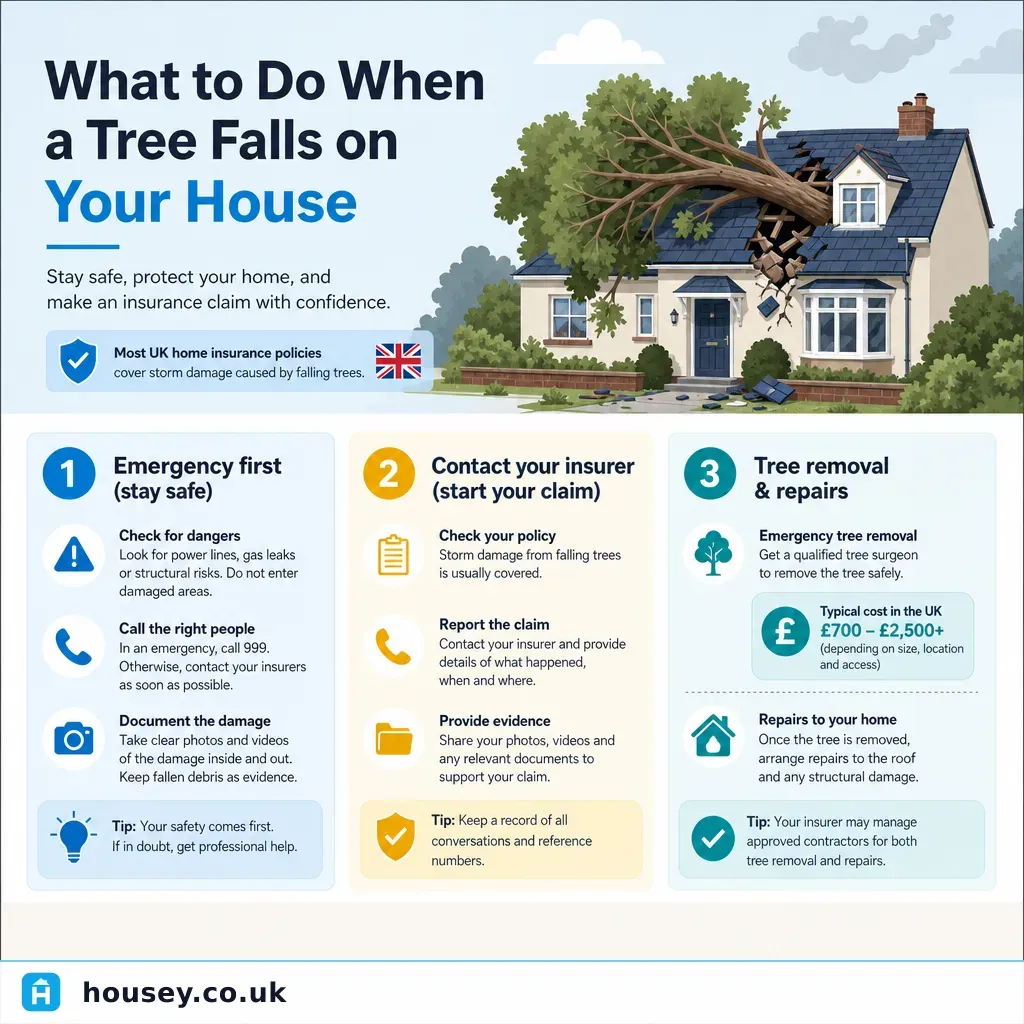
What to Do When a Tree Falls on Your House
If a tree falls on your house, evacuate immediately and call 999 if anyone is trapped, you smell gas, or you see sparks or fire.
 Improvement & Build
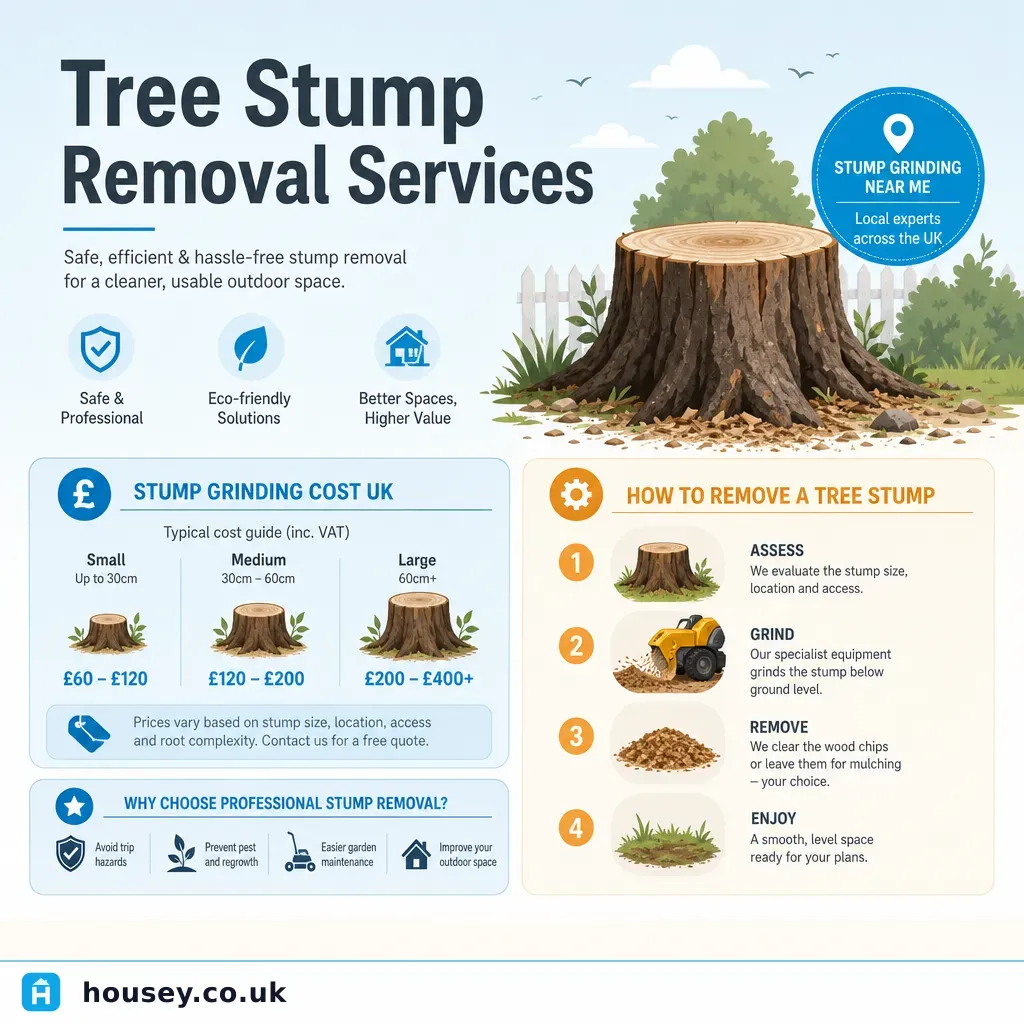
Tree Stump Removal Services
Tree stump removal in the UK is most commonly done by stump grinding, which reduces the stump to around 150–300 mm below ground level.
 Improvement & Build
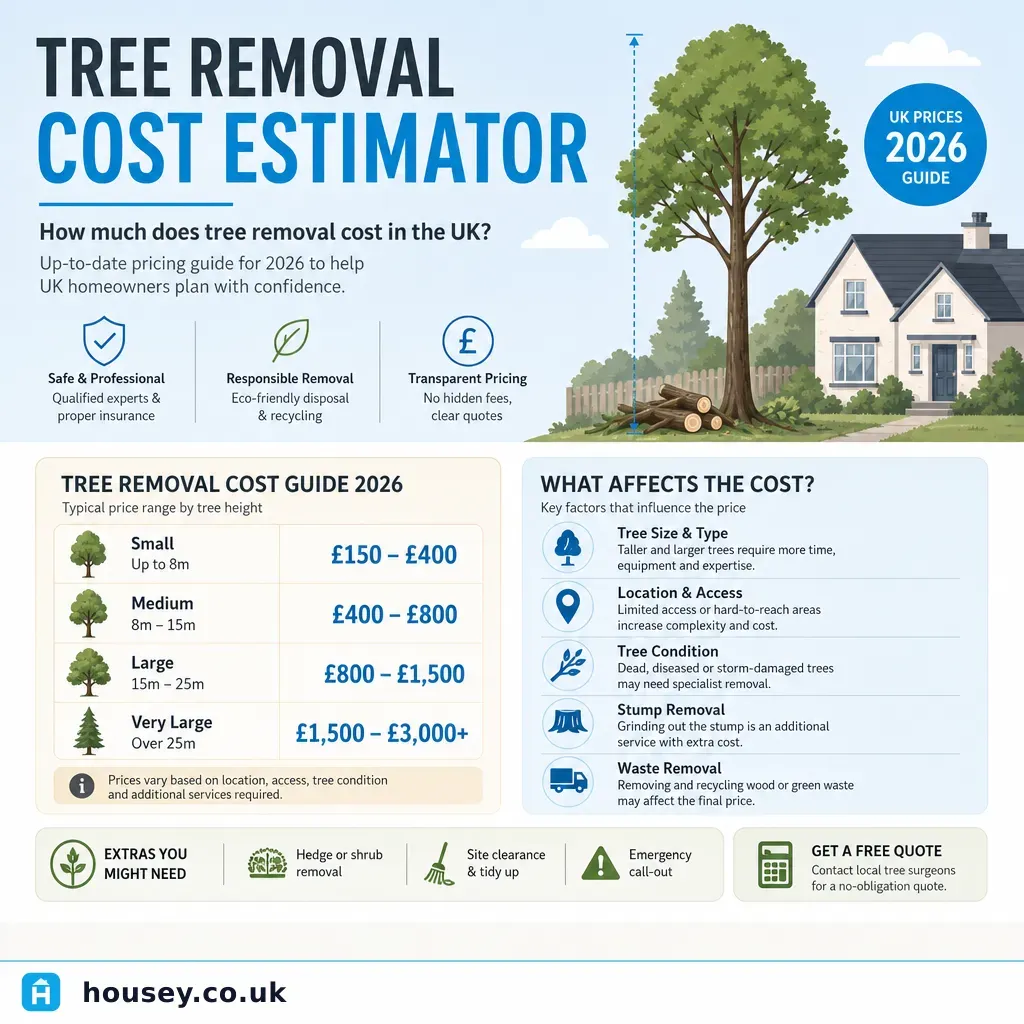
Tree Removal Cost Estimator
Tree removal in the UK costs roughly £150 to £5,000 or more, depending on the tree's height, species, access conditions, and whether stump removal is needed.
 Improvement & Build
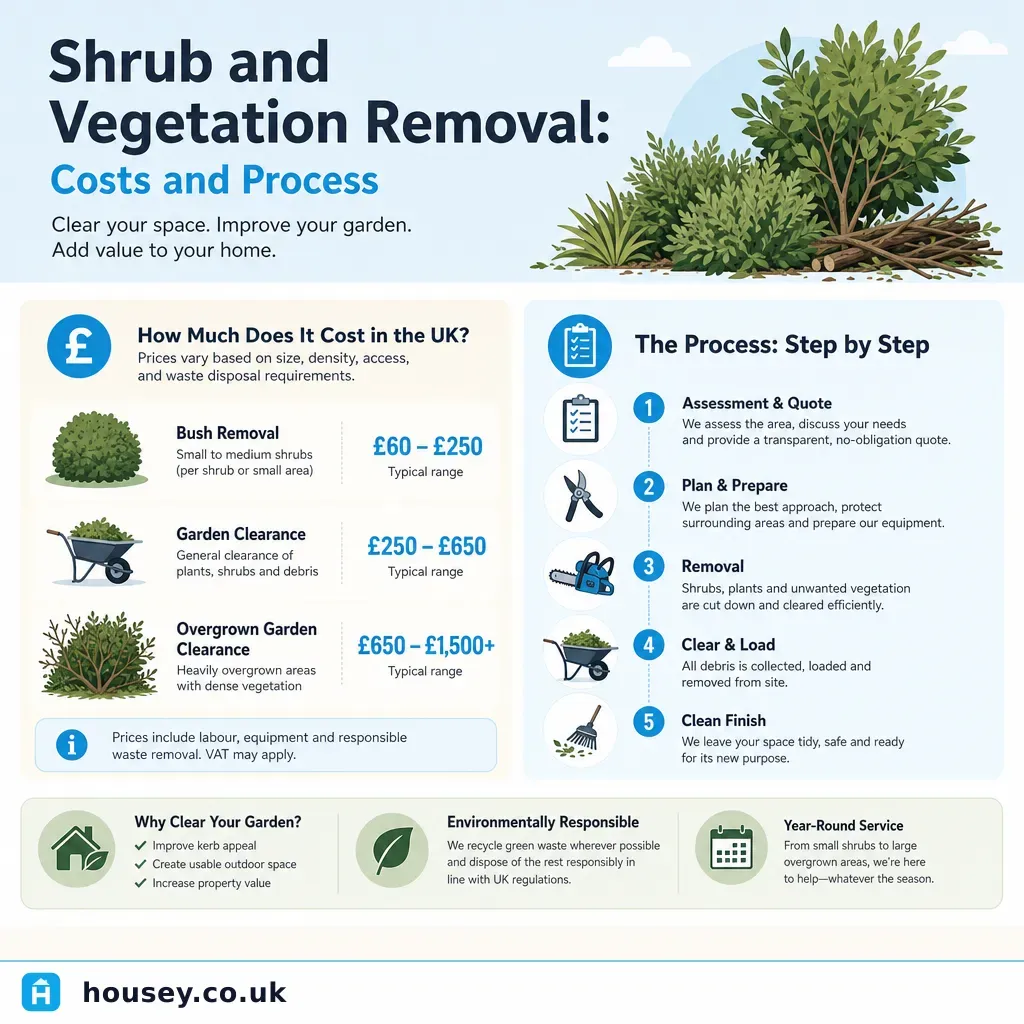
Shrub and Vegetation Removal: Costs and Process
Shrub and vegetation removal costs £50–£2,500 or more depending on area size, species involved, and whether stumps need grinding.
 Improvement & Build
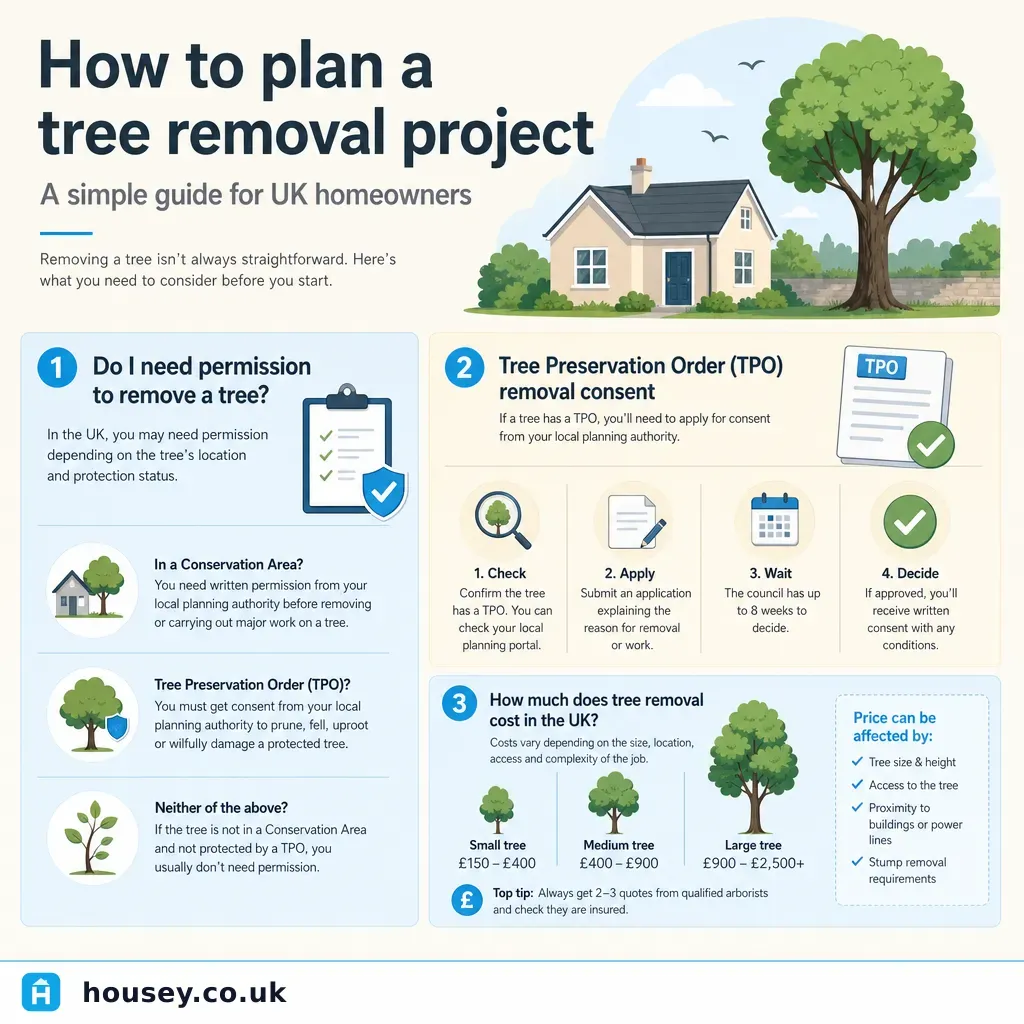
How to plan a tree removal project
Planning a tree removal project starts with checking whether the tree is protected by a Tree Preservation Order or sits in a conservation area, as both require council consent before any work begins.