Tree Stump Removal Services
By Housey · Last reviewed 11th of May 2026
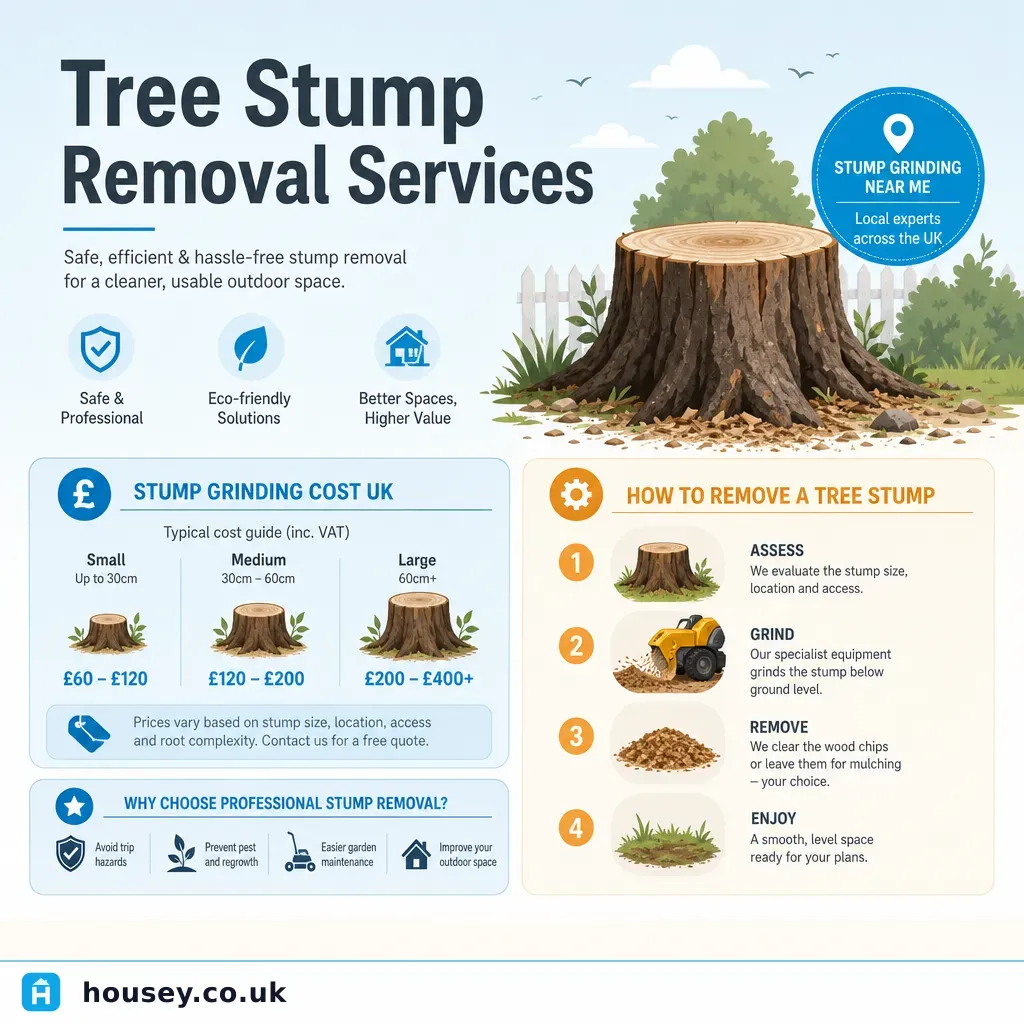
Tree Stump Removal Services
A leftover tree stump is more than an eyesore — it can be a trip hazard, a source of honey fungus, and an obstacle to relaying turf, installing hard paving, or planting a replacement tree. Most UK homeowners only think about stump removal after a tree has been felled, but the method chosen and the professional hired will determine whether the cleared ground is genuinely ready for what comes next.
Key points
- Stump grinding is the most common professional method in the UK, typically reducing the stump to 150–300 mm below ground level using a rotating cutting wheel.
- Trees subject to a Tree Preservation Order (TPO) or located in a Conservation Area may require local planning authority consent for both the original felling and any subsequent stump treatment or removal.
- Honey fungus (Armillaria species) can spread through decaying root systems left after grinding; if present, further advice from a qualified arborist or plant pathologist may be needed before replanting.
- Chemical stump treatments based on glyphosate or potassium nitrate typically take 12–18 months to render the stump soft enough to break apart — they are not a substitute for grinding in most landscaping situations.
- After grinding, the ground may settle 50–100 mm as the wood chip mulch decomposes; factor this into any subsequent hard landscaping, turfing, or construction schedule.
Stump removal methods compared
Method | How it works | Best for | Not ideal for | Typical timescale |
|---|---|---|---|---|
Stump grinding | Rotating disc reduces stump to chips below ground | Most domestic gardens pre-landscaping | Very large stumps in restricted access (may need specialist machinery) | 30 minutes–3 hours per stump |
Full extraction | Excavation removes stump and major lateral roots | Pre-construction groundworks; very large stumps | Confined or access-limited gardens | Half day or more per stump |
Chemical treatment | Herbicide applied to cut surface accelerates decay | Inaccessible locations; low urgency | Replanting in the same spot; any urgent situation | 12–18 months |
Burning | Controlled combustion of dried stump | Rural properties; stumps well clear of structures | Urban gardens; near fences, buildings, or overhead cables | Several hours (plus weeks of prior drying) |
Most domestic tree surgeons offer stump grinding as a standard service. Full extraction is typically quoted separately, often as part of a wider groundworks or landscaping package.
Do I need consent to remove a tree stump?
If the original tree required consent to fell — because it was subject to a TPO or located in a Conservation Area — the stump and root system are generally covered by the same legal protection. Removing or treating a protected stump without consent attracts the same penalties as felling the tree: under the Town and Country Planning Act 1990 (as amended), fines can be unlimited.
Before instructing a stump removal contractor:
- Check your local planning authority's online TPO register — most councils make this publicly searchable.
- For trees in Conservation Areas, you must normally give the council at least six weeks' written notice before most tree works. Emergency safety works may be exempt, but seek advice before proceeding.
- GOV.UK's guidance on protected trees sets out the full notification and consent process.
Will the stump resprout?
Many deciduous species resprout vigorously from cut stumps if the root system remains alive. Species particularly prone to resprouting include ash (Fraxinus excelsior), sycamore (Acer pseudoplatanus), willow (Salix species), elder (Sambucus nigra), and poplar (Populus species). Most conifers do not resprout after felling.
If grinding is not planned immediately, a qualified arborist can apply an approved herbicide to the freshly cut stump surface at the time of felling to prevent resprouting. Treatment of an older, weathered cut surface is considerably less effective.
What to ask before hiring a stump removal contractor
- What depth will you grind to, and is that sufficient for my intended use — turf, paving, replanting, or a shed base?
- Will you remove the wood chip mulch produced, or is disposal charged separately?
- Is the stump protected by a TPO? Will you check the council's register before starting?
- Do you hold NPTC / Lantra Awards qualifications for stump-grinding operations?
- What public liability insurance do you carry — minimum £2 million is standard; £5 million is common for arborists?
- Will the ground level need topping up after grinding, and is that included?
- Have underground services near the stump been checked before the grinder starts?
- Is VAT included in the quote?
Homeowner checklist before stump removal
When to get professional help
Stump grinding involves powerful rotating machinery and carries real risks from flying debris and proximity to buried services. Do not use hired equipment without formal training on the machine. Always instruct a qualified professional if:
- The stump is within 2 metres of underground services, a boundary wall, or a building foundation.
- The original tree was subject to a TPO or located in a Conservation Area.
- The cleared area will be used for hard landscaping, a structure, or construction works.
- There are visible signs of honey fungus on or near the root system.
How Housey can help
Housey connects you with qualified tree surgeons who offer stump grinding and removal across the UK. Describe the stump — species, approximate diameter, and access conditions — and receive competitive quotes from vetted local professionals.
Frequently asked questions
How much does stump grinding cost in the UK?
Indicative UK costs, last reviewed 2026-05-11. Stump grinding typically costs £75–£250 per stump for a standard domestic stump up to around 500 mm in diameter. Larger stumps, multiple stumps, or restricted access will increase the price. Most contractors apply a minimum call-out charge — commonly £100–£150 — regardless of stump size. Obtain at least three written quotes, as prices vary considerably by region and contractor.
How deep does stump grinding go?
Typically 150–300 mm below the original ground level. This is usually adequate for returfing or replanting shrubs. For laying paving, a concrete slab, or a shed base over the cleared area, a deeper grind or full extraction is advisable to prevent future ground settlement as the remaining root mass decays beneath the surface.
Can I replant a tree in the same spot after stump grinding?
Usually yes, but allow six to twelve months for the ground to stabilise and initial root decay to begin. Fill the void with a blend of topsoil and compost rather than the wood chip mulch produced by grinding, which ties up nitrogen as it breaks down and can inhibit new plant establishment in the early months.
Does home insurance cover stump removal?
Generally no. Standard buildings or contents insurance covers sudden accidental damage, not planned maintenance. If a tree has fallen and damaged your property, emergency clearance costs may be included under your buildings policy, but routine stump grinding following a planned felling is not typically covered. Check your policy wording if you are unsure.
Sources and further reading
- Tree Preservation Orders and trees in Conservation Areas — GOV.UK
- Town and Country Planning Act 1990 (as amended) — legislation.gov.uk
- Honey fungus — Royal Horticultural Society
- Line Search Before U Dig — underground service searches — LSBUD
- NPTC / Lantra Awards arboriculture qualifications — Lantra
Useful next reads
 Improvement & Build
Dead Tree Removal and Clearance Services
Dead tree removal involves felling or dismantling a tree that has died or become a hazard, then usually grinding the stump.
 Improvement & Build
Tree Removal Services for Fallen Trees
When a tree falls, your first priority is safety — keep clear of structures, unstable root plates, and overhead cables.
 Improvement & Build
Fixing Leaking Back Doors and Water Ingress
Most leaking back doors in UK homes fail at one of three points: the threshold or door sill joint, the frame-to-masonry mastic seal, or the door weatherstrip.
 Improvement & Build
Who Provides House Demolition Services
House demolition in the UK is carried out by specialist demolition contractors, often members of the National Federation of Demolition Contractors (NFDC).
 Improvement & Build
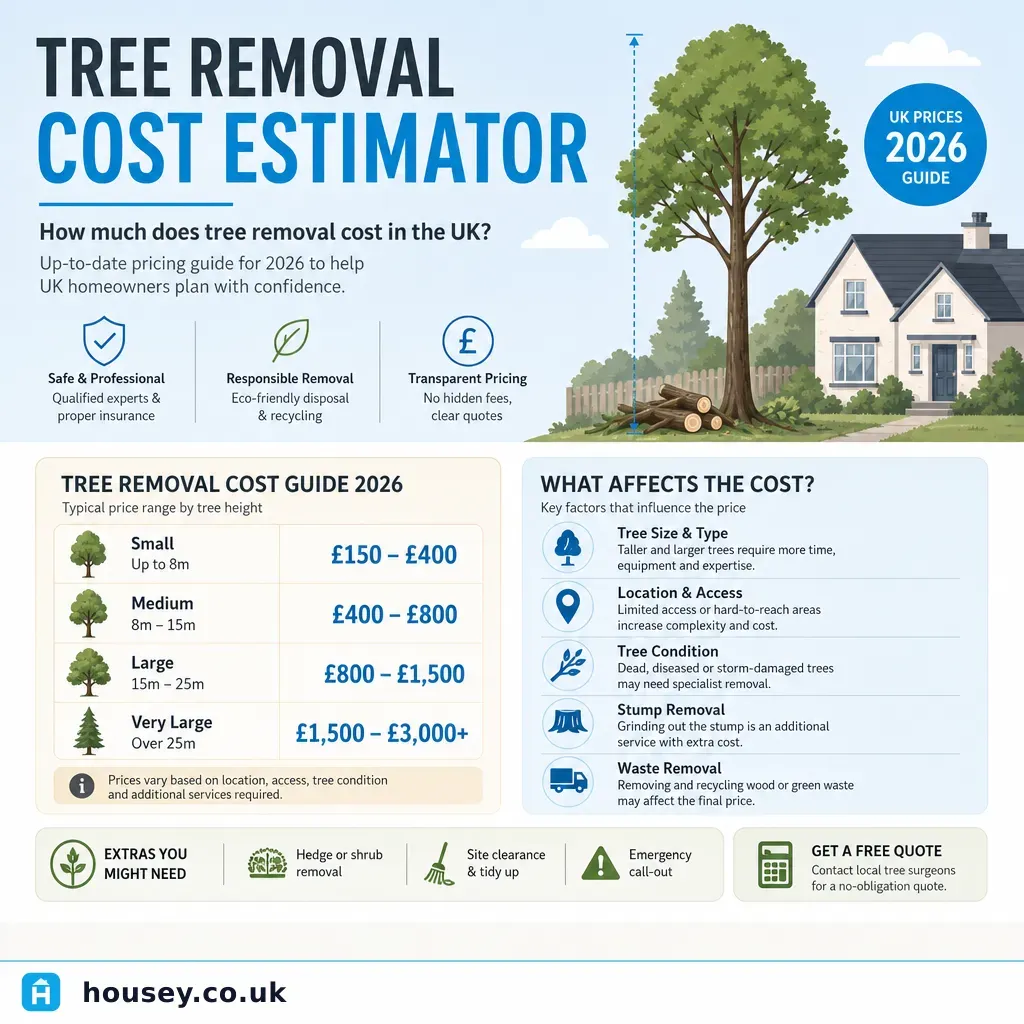
Tree Removal Cost Estimator
Tree removal in the UK costs roughly £150 to £5,000 or more, depending on the tree's height, species, access conditions, and whether stump removal is needed.