Understanding Tree Root Systems: Impact on Property and Safety
By Housey · Last reviewed 19th of May 2026
Understanding Tree Root Systems: Impact on Property and Safety
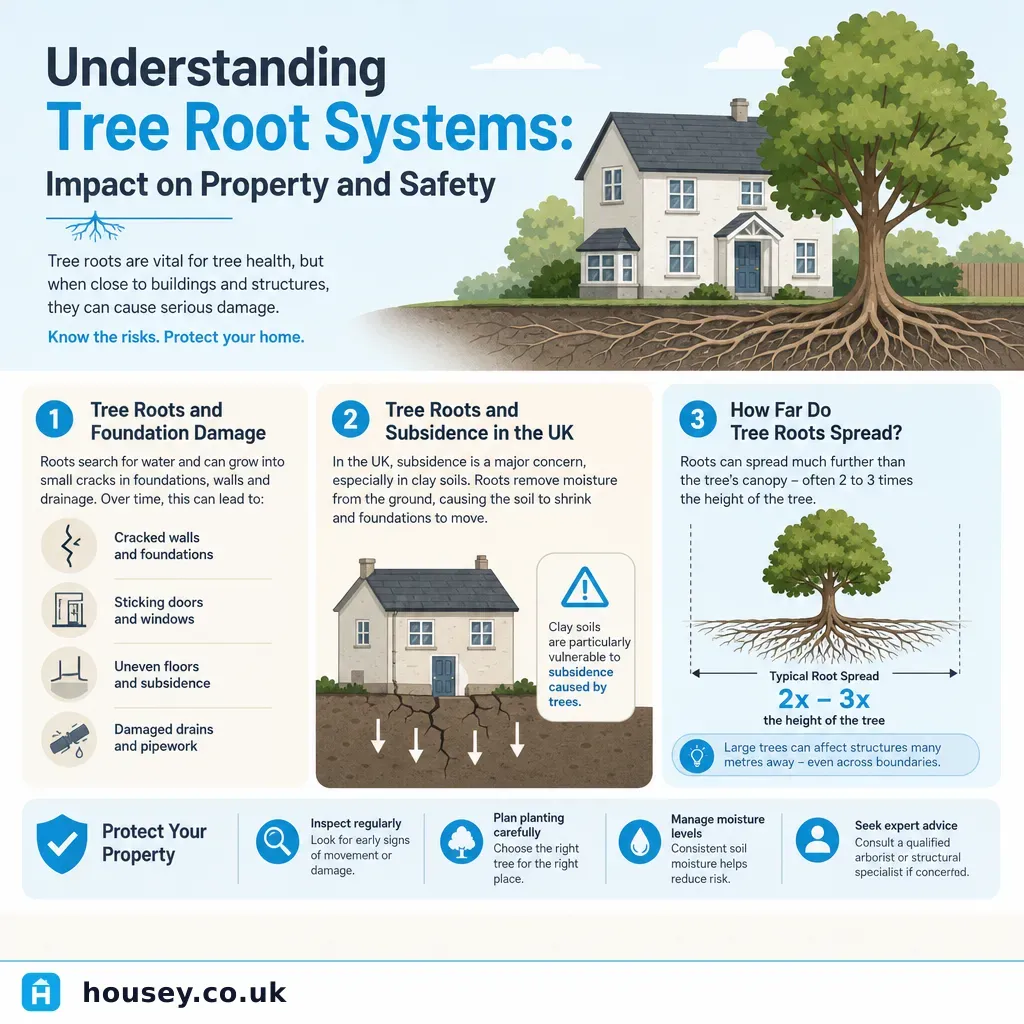
Tree roots are one of the more underestimated risks to UK homes, particularly those built before the 1980s on shrinkable clay soils that cover much of southern and eastern England. Whether you are buying a property with mature trees nearby, planning an extension close to established planting, or noticing new cracks in walls or sticking doors, understanding how root systems behave — and what they can do to foundations, drainage, and hard landscaping — helps you act before minor issues become expensive structural problems.
Key points
- Tree roots typically spread laterally to 1.5–3 times the height of the tree, mostly within the top 600 mm of soil; for a 15 m oak, that is a potential spread of 22–45 m.
- The NHBC Standards (Chapter 4.2) and BRE Digest 298 publish species-specific safe planting distances for new builds, based on tree type and soil shrinkability.
- Root-related subsidence is a significant source of UK buildings insurance claims, particularly during prolonged dry summers on clay soils in southern and eastern England.
- Removing a large tree from a clay soil site without specialist advice can trigger heave — upward ground movement as soil re-absorbs moisture — which can be as damaging as the original subsidence.
- If a tree has a Tree Preservation Order (TPO) or stands in a conservation area, both the tree and its root system may be legally protected; removal or significant pruning requires prior consent from your local planning authority.
How tree roots spread and why it matters
Contrary to the popular image of deep taproots, most tree roots — including those of large species — grow within the top 600 mm of soil, spreading outward in search of water and oxygen. On clay-rich soils, roots extract moisture from the ground, causing the clay to shrink and the surface to settle. This process, called desiccation, is the primary mechanism behind tree-related subsidence across the UK.
On sandy or gravelly soils, root-induced subsidence is much less common, but roots can still cause mechanical damage: lifting paving slabs, fracturing retaining walls, and blocking or cracking older clay drainage pipes.
Tree species and root risk on shrinkable clay
Tree species | Typical mature height | Approximate root spread radius | Risk on shrinkable clay |
|---|---|---|---|
Oak | 20–30 m | 30–45 m | Very high |
Poplar / Lombardy poplar | 20–35 m | 30–40 m | Very high |
Willow | 15–25 m | 25–40 m | Very high |
Lime | 15–25 m | 15–25 m | High |
Ash | 15–25 m | 15–20 m | High |
Sycamore / Maple | 15–25 m | 10–20 m | Moderate–high |
Silver birch | 10–20 m | 8–15 m | Moderate |
Apple / ornamental cherry | 6–10 m | 5–10 m | Low–moderate |
Distances based on NHBC Standards Chapter 4.2 and BRE Digest 298. Risk is considerably lower on sandy or gravelly soils.
Root impact on drains and services
Older clay or pitch-fibre drain runs — common in homes built before the 1970s — are particularly vulnerable to root ingress. Roots penetrate hairline cracks at pipe joints, then grow and expand inside the pipe, eventually causing partial or complete blockage, pipe collapse, and localised ground settlement.
Signs that may indicate root ingress in drainage include:
- Recurring slow drainage across multiple fittings, not isolated to one basin or WC
- Gurgling sounds from soil stacks or inspection chambers
- Persistent damp patches in the garden along the line of known drain runs
- Visible settlement or collapse at inspection chamber covers
A CCTV drain survey will confirm whether root ingress is present and identify pipe material, condition, and extent of damage. This is a standard recommendation for any property with mature trees within approximately 5 m of drain runs, and is especially worthwhile before exchange of contracts.
Root impact on foundations and structures
Most UK homes built before the 1970s have shallow strip foundations, often 600–900 mm deep — frequently within the zone of influence of nearby trees on clay soils. Root-related subsidence tends to progress slowly over months or years, worsen during prolonged dry periods, and partially recover in wet winters. Physical signs include:
- Diagonal cracking at the corners of windows, door frames, or where walls meet at angles
- Cracks wider than approximately 5 mm, or cracks progressing in a stepped pattern through brickwork
- Doors or windows sticking in hot, dry summers and easing again in wet weather
- Sloping or uneven floors near external walls
An equally important risk is heave. If a large tree is removed from shrinkable clay soil, the desiccated clay re-absorbs moisture and can swell upward — sometimes progressively over several years. Heave can crack foundations from below and cause significant internal damage. This is why tree removal near a building on clay soil should never happen without specialist advice.
Which professional do you need?
Decision tree
- Suspect active subsidence (diagonal cracking, sticking doors or windows, floor movement near a mature tree): instruct a chartered surveyor (MRICS or FRICS) with subsidence experience; they may refer on to a structural engineer for diagnosis.
- Tree is close to the building but no symptoms yet: commission an arboricultural consultant to assess the root zone and recommend management options before problems develop.
- Planning an extension or development near a tree: an Arboricultural Impact Assessment (AIA) under BS 5837:2012 is usually required by the local planning authority before consent is granted.
- Blocked or collapsed drains near trees: arrange a CCTV drain survey; involve a structural engineer if collapse has caused ground movement.
- Considering removing a large tree near the house on clay soil: instruct an arboricultural consultant first, then a geotechnical engineer if a heave risk assessment is needed.
- Tree has a TPO or is in a conservation area: contact your local planning authority before any work — failure to obtain consent is a criminal offence.
Which professional for which situation
Situation | Professional to instruct | Accreditation to look for |
|---|---|---|
Root-related subsidence suspected | Chartered surveyor | MRICS or FRICS (RICS) |
Structural assessment of crack damage | Structural engineer | MIStructE (Institution of Structural Engineers) |
Tree root zone and management advice | Arboricultural consultant | Registered Consultant, Arboricultural Association |
Planning application near trees (BS 5837) | Arboricultural consultant | Arboricultural Association accreditation |
Soil and foundation investigation | Geotechnical engineer | ICE or Engineering Council member |
Drain condition near tree roots | CCTV drainage contractor | NADC membership or equivalent |
Important limitations
This article provides general information about tree root behaviour and typical risks to UK residential properties. The actual risk to any specific property depends on soil type and shrinkability, tree species and age, proximity to foundations and drainage, foundation depth and construction method, and local groundwater conditions. Regulations on Tree Preservation Orders and conservation area consent vary by local planning authority. Do not take or avoid action based on this article alone — a qualified professional should assess your specific situation.
When this becomes urgent
Seek professional advice without delay if you observe any of the following:
- New or widening diagonal cracks at corners of windows, doors, or where walls meet
- Any crack wider than approximately 5 mm, or a crack progressing in a stepped pattern through brickwork
- Doors or windows that have recently started sticking in dry weather and easing in wet weather — particularly if new in the last one to two seasons
- Visible settlement or sinking of external paths, patios, or internal floors near mature trees
- Sewage smells or persistent drainage problems along the line of drain runs near trees
- A large tree within 10 m of your home on clay soil that has recently died, been removed by a neighbour, or suffered major limb loss
What to ask a qualified professional
Before instructing a surveyor, arboricultural consultant, or engineer:
- What soil type is present at this location, and is it classified as shrinkable clay?
- Does the tree species and size put it within the zone of influence for this building's foundation type and depth?
- Is there a Tree Preservation Order or conservation area designation covering this tree?
- If the tree is removed, what is the heave risk, and over what timeframe might movement occur?
- Will your report be in a format my insurer or mortgage lender can accept?
- Should this property have a CCTV drain survey before purchase or before building works begin?
- What monitoring programme would you recommend if we decide not to act on the tree immediately?
When to get professional help
If you are buying a property with established trees, planning an extension near significant planting, or noticing any of the symptoms described above, do not rely on visual inspection alone. A RICS Level 3 Building Survey will flag tree-related risks, but a specific arboricultural assessment or structural engineer's report is often needed for a definitive conclusion. Insurers and mortgage lenders may require specialist reports before offering cover or a mortgage on a subsidence-affected property.
How Housey can help
Housey connects you with qualified local professionals for arboricultural surveys, tree surgery and management, and geotechnical and soil investigations — so you can get the right specialist quickly, whether you are buying a property, planning building works near trees, or dealing with an existing root-related problem.
Frequently asked questions
Can tree roots damage a house foundation?
Yes. On shrinkable clay soils — common across southern and eastern England — tree roots extract moisture and cause ground settlement (subsidence). This can crack foundations and walls over time. The risk depends on tree species, soil type, and proximity to the building. A chartered surveyor or structural engineer can assess whether active movement is occurring.
How far do tree roots spread from the trunk?
Most tree roots spread laterally to roughly 1.5 to 3 times the tree's height, mainly within the top 600 mm of soil. For a 20 m oak, roots may extend 30–60 m from the trunk. The NHBC and BRE publish species-specific distance tables used in new-build design and planning applications.
Do I need permission to remove a tree that is damaging my property?
Possibly. If the tree has a Tree Preservation Order (TPO) or stands in a conservation area, you must apply to your local planning authority before pruning or felling, regardless of the reason. Felling a protected tree without consent is a criminal offence. Always check with your local council before instructing any contractor.
What is heave, and can removing a tree cause it?
Heave is upward ground movement that occurs when desiccated clay re-absorbs moisture after a tree is removed. On shrinkable clay, it can be as damaging as subsidence and may take several years to stabilise. Always commission a geotechnical or arboricultural assessment before removing large trees near a building on clay soil.
Will home insurance cover tree root damage?
Most buildings insurance policies cover subsidence damage, but exclusions and excess levels vary significantly. Some policies exclude pre-existing subsidence or damage from trees the policyholder knew about. Notify your insurer promptly if you suspect tree-related movement, obtain a professional report, and check your policy wording carefully.
Sources and further reading
- Tree Preservation Orders and trees in conservation areas — GOV.UK
- NHBC Standards Chapter 4.2 — Building Near Trees — National House-Building Council
- BRE Digest 298 — Low-rise buildings on shrinkable clay soils — Building Research Establishment
- BS 5837:2012 Trees in relation to design, demolition and construction — British Standards Institution
- Arboricultural Association — Find a Consultant — Arboricultural Association
Useful next reads
 Planning & Pre-Build
Managing Overhanging Trees: Legal Rights, Responsibilities and Remedies
In the UK, a tree belongs to whoever owns the land in which it is rooted.
 Planning & Pre-Build
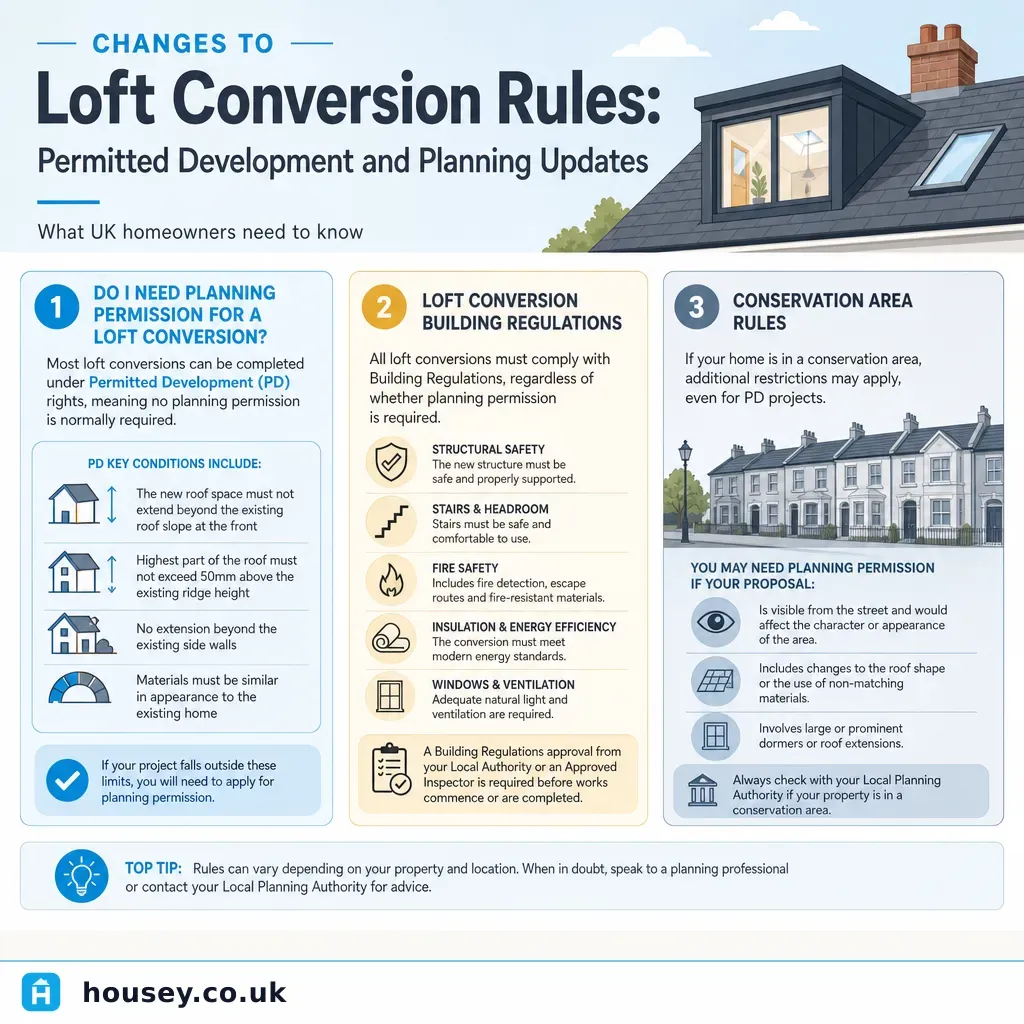
Changes to Loft Conversion Rules: Permitted Development and Planning Updates
In England, most loft conversions on standard houses qualify as Permitted Development under Class B of the GPDO 2015, allowing up to 40 cubic metres (terraced) or 50 cubic metres (detached or semi-detached) without a planning application — if conditions are met.
 Planning & Pre-Build
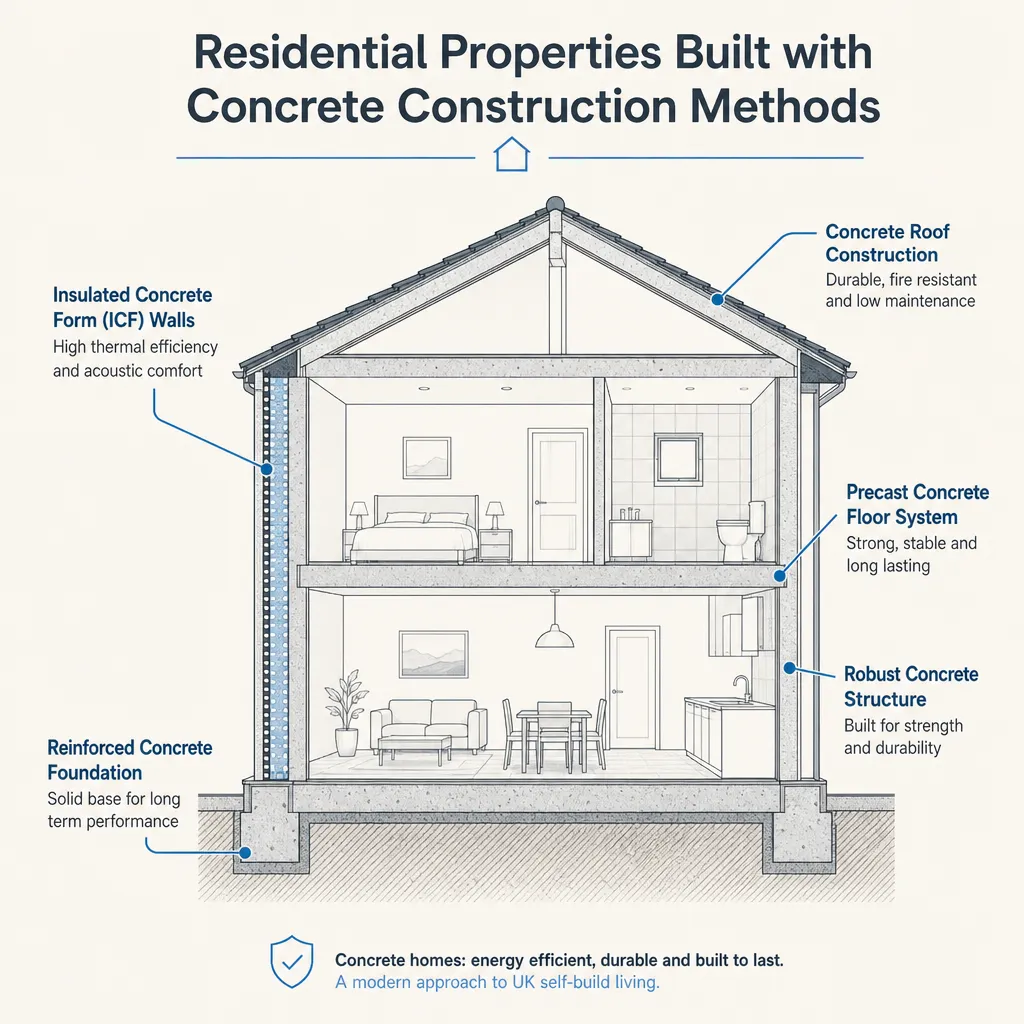
Residential Properties Built with Concrete Construction Methods
UK homes are built using several concrete methods: in-situ cast concrete, precast panel systems, insulating concrete formwork (ICF), and older non-traditional types such as Wimpey No-Fines and Laing Easiform.
 Planning & Pre-Build
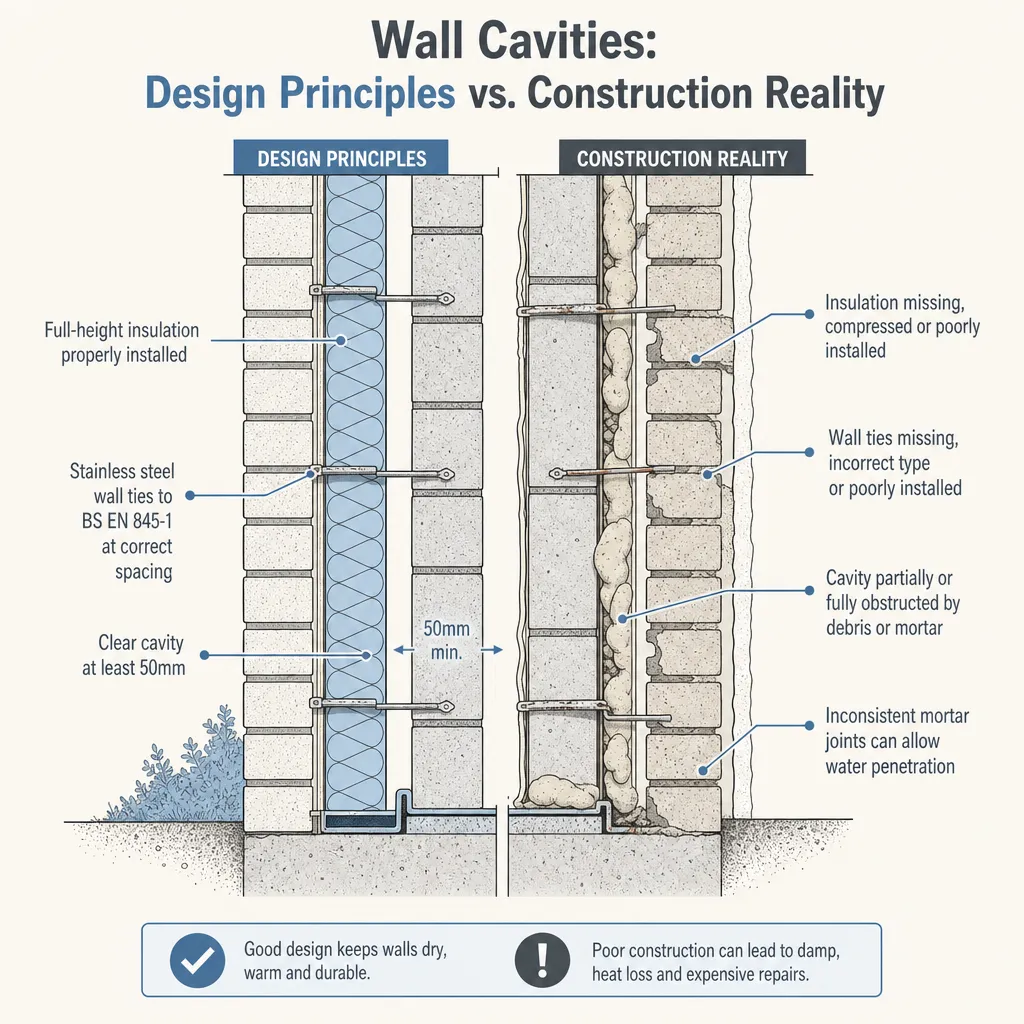
Wall Cavities: Design Principles vs. Construction Reality
A UK cavity wall is designed to resist weather, control heat loss, and structurally link two masonry leaves.
 Planning & Pre-Build
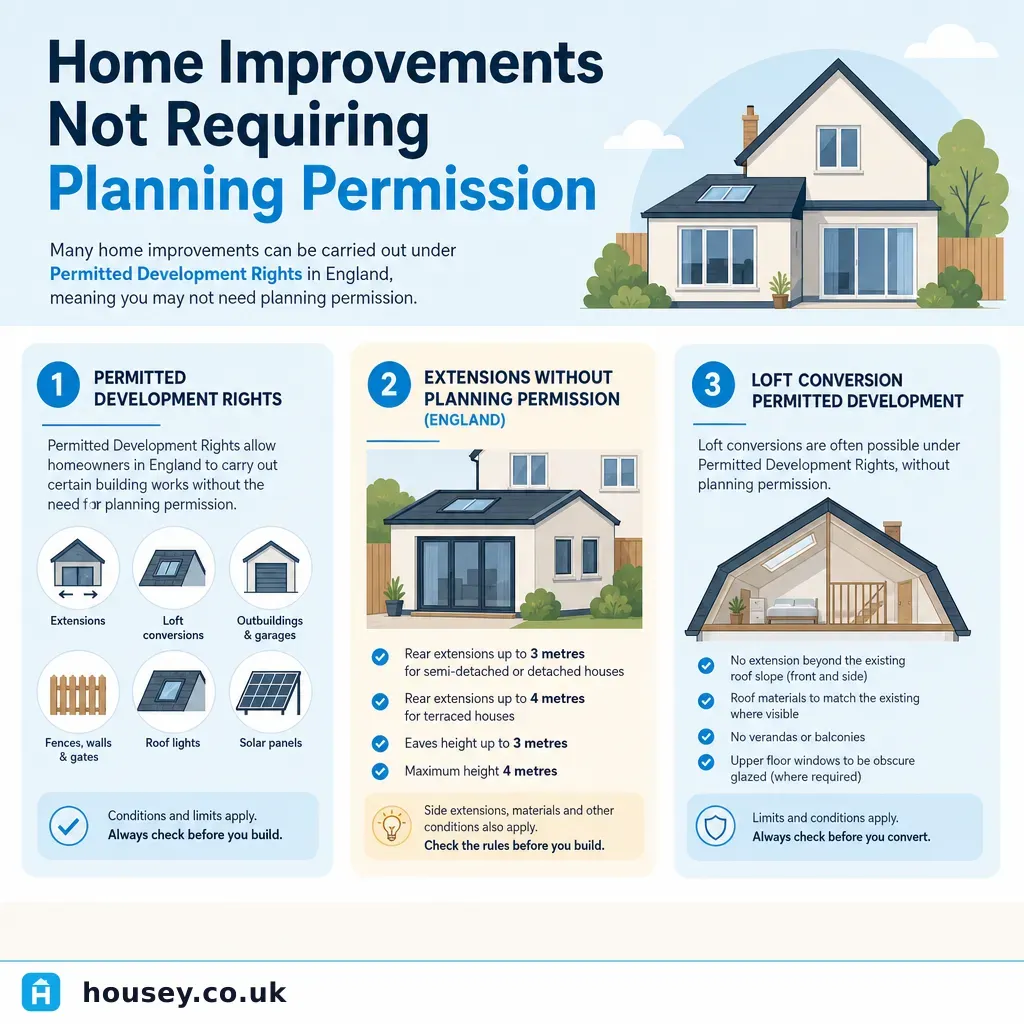
Home Improvements Not Requiring Planning Permission
Many common home improvements in England fall under Permitted Development Rights and do not require a planning application.