Tree Surveys and Shading Analysis for Solar Panel Installation
By Housey · Last reviewed 1st of June 2026
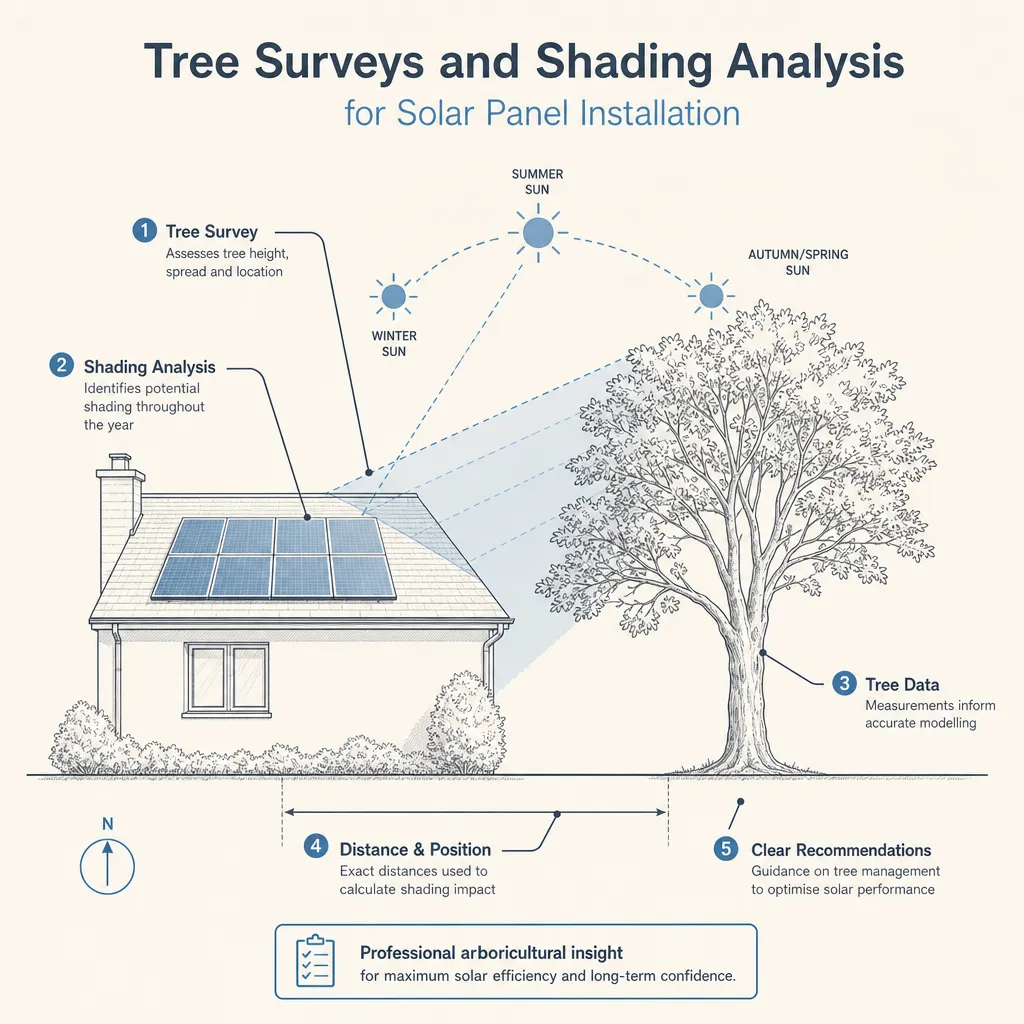
Tree Surveys and Shading Analysis for Solar Panel Installation
Solar panel installations succeed or fail on their energy yield, and for many UK properties — particularly Victorian terraces with mature street trees, 1930s semis with large rear gardens, or rural homes surrounded by woodland — nearby trees are the primary factor in whether a system will pay back its cost within the expected timeline. Addressing tree-related shading before committing to installation, and understanding the legal constraints around any necessary tree works, are steps that can save significant expense and frustration.
Key points
- A shading analysis should be part of any solar feasibility assessment; even partial shading for two hours per day can reduce system output by 20–30%, depending on the inverter technology used.
- Arboricultural surveys in the UK follow BS 5837:2012 (Trees in relation to design, demolition and construction), the recognised methodology for assessing tree condition, root protection zones, and the implications of pruning or removal.
- Trees covered by a Tree Preservation Order (TPO) cannot be pruned or felled without prior written consent from the local planning authority (LPA); unauthorised works are a criminal offence under the Town and Country Planning Act 1990 and can result in fines of up to £20,000 on summary conviction.
- Trees in Conservation Areas are subject to a 6-week prior notification requirement under section 211 of the Town and Country Planning Act 1990, even without a formal TPO.
- MCS-accredited installers are required to assess and account for shading as part of the system design process under MCS 012, the UK standard for photovoltaic system installation.
What is a shading analysis and why does it matter?
A shading analysis models how much of the solar radiation reaching your roof is blocked or reduced by obstacles — trees, neighbouring buildings, chimneys, dormer windows — at different times of day and across all seasons. For solar photovoltaic (PV) systems, shading is particularly significant because:
- PV cells wired in series mean that even one shaded cell can reduce the output of an entire string, depending on inverter configuration.
- Winter sun sits lower in the sky — a deciduous tree that causes no shading in summer may shadow critical roof sections during December and January, when electricity demand is highest and daylight hours are shortest.
- Trees grow. A young silver birch or ash that currently presents no shading concern may significantly reduce output within five to ten years.
Shading analysis tools range from desktop horizon-profile software to site-specific modelling using LiDAR data or drone survey. A competent solar installer or independent solar surveyor should carry this out as a standard part of feasibility assessment.
What is an arboricultural survey?
An arboricultural survey — often called a tree survey — is a professional assessment of trees on or adjacent to a property. For solar installation purposes, the relevant questions it addresses are:
- Which trees are causing or likely to cause shading on the proposed panel area?
- Can those trees be safely pruned to reduce shading without causing long-term harm to their health or amenity value?
- Are any trees protected by a TPO or located within a Conservation Area?
- Is removal feasible, legally permissible, and ecologically appropriate?
Arboricultural surveys are carried out by qualified arboriculturists — typically members of the Arboricultural Association or the Institute of Chartered Foresters. For planning-related matters (TPO applications, development proposals), a survey report structured to BS 5837:2012 is usually required by the local planning authority.
Comparison: shading analysis vs arboricultural survey
Assessment | What it answers | Who carries it out | When you need it |
|---|---|---|---|
Shading analysis | How much energy yield is lost due to tree or obstacle shading; whether the installation is financially viable | Solar installer or independent solar surveyor (MCS-accredited) | Before committing to any solar installation where nearby trees or obstructions are present |
Arboricultural survey (BS 5837:2012) | Tree condition, root protection areas, protection status, and feasibility of pruning or removal | Qualified arboriculturist (Arboricultural Association member or Institute of Chartered Foresters) | When a tree may need pruning or removal, or when LPA consent is required for tree works |
Combined assessment | Full picture of feasibility, planning requirements, and projected yield impact | Solar surveyor and arboriculturist working together or in sequence | Recommended whenever shading is identified and tree works may be needed before or after installation |
TPOs, Conservation Areas, and your legal position
This is the area where homeowners most frequently misjudge the situation. Removing or significantly pruning a tree is not always within a homeowner's rights, even in their own garden.
Tree Preservation Orders: A TPO is made by a local planning authority under the Town and Country Planning (Tree Preservation) (England) Regulations 2012. It is a criminal offence to cut down, uproot, top, lop, or wilfully damage a protected tree without written consent from the LPA. Fines can reach £20,000 on summary conviction, or an unlimited fine on indictment. Check your LPA's online TPO register before commissioning any tree works.
Conservation Areas: Under section 211 of the Town and Country Planning Act 1990, any tree with a stem diameter of 75 mm or more at 1.5 m above ground level in a Conservation Area requires 6 weeks' written notice to the LPA before works are carried out. The LPA may use that period to apply a TPO. Failure to give notice is a criminal offence.
Neighbour's trees: If the shading tree belongs to a neighbour, you have no automatic legal right to require pruning or removal. You may request consent, but the LPA's position on any protected tree must be considered regardless of ownership.
Decision tree: what do you need?
- No significant trees or obstructions near the proposed panel area: Shading analysis is still good practice but an arboricultural survey is unlikely to be needed.
- Mature trees adjacent to the roof area, unclear impact on yield: Carry out a shading analysis first to quantify the likely loss; then decide whether tree works are economically justified before commissioning a tree survey.
- Trees identified by shading analysis as causing significant yield reduction and works are desired: Arboricultural survey required. Check the LPA's TPO register before proceeding with any works.
- Property in a Conservation Area: Notify the LPA 6 weeks in advance of any tree works, regardless of whether a TPO applies.
- TPO confirmed on a shading tree: Apply to LPA for consent; a BS 5837:2012 arboricultural report will typically be required to support the application.
- Shading is from a neighbour's tree: Seek advice on your legal position; installation may still be viable using microinverter or DC optimiser technology to reduce the yield impact.
What to ask before hiring an arboriculturist or solar surveyor
Before instructing an arboriculturist, ask:
- Are you a member of the Arboricultural Association and do you hold professional indemnity insurance?
- Can you confirm TPO status for any relevant trees before any works are planned?
- Will you prepare a report to BS 5837:2012 if required for a planning submission?
- What is your assessment of the tree's long-term condition, and would pruning cause significant harm?
Before instructing a solar surveyor, ask:
- Does your shading analysis use site-specific data or desktop modelling, and what is the margin of error?
- Will your report quantify the estimated annual energy yield reduction attributable to identified trees?
- Are you MCS-accredited, and will the installation comply with MCS 012?
- If shading is unavoidable, how will the system design account for it — for example, through microinverters or DC power optimisers?
When to get professional help
Tree and solar decisions intersect planning law, structural assessment, and financial investment in ways that make professional advice consistently worthwhile. Seek specialist input if:
- Any tree near the proposed array appears mature, significant, or of amenity value — even if you believe it is not protected.
- Your property is in a Conservation Area or adjacent to a listed building.
- A solar installer has flagged shading concerns but has not provided a quantified analysis.
- You are uncertain whether trees are on your land or a neighbour's.
How Housey can help
Housey can connect you with the right professionals at each stage. Our listed arboricultural surveys specialists can assess tree condition and protection status, solar surveys providers give you a quantified yield analysis for your property, and our tree surgeons can provide competitive quotes for TPO-compliant pruning or removal once consent is in place.
Frequently asked questions
Do I always need an arboricultural survey before installing solar panels?
No — if there are no significant trees near your proposed panel area, a shading analysis carried out as part of the solar installation feasibility assessment is usually sufficient. An arboricultural survey becomes necessary when trees may need to be pruned or removed, or when local planning authority consent for tree works is required.
How long does a TPO application take?
LPAs aim to determine applications for works to protected trees within 8 weeks, though timescales vary by authority and case complexity. A well-prepared application supported by a BS 5837:2012 arboricultural report typically progresses more smoothly than one submitted without professional evidence. Factor this lead time into your solar installation programme.
Can I install solar panels if a neighbour's tree is causing shading?
Yes — panels can still be installed. You can discuss with your neighbour whether they would consent to pruning, but you have no automatic legal right to require this. An independent shading analysis will quantify the yield loss so you can make an informed decision, and technologies such as microinverters or DC optimisers can reduce the financial impact of partial shading.
What technology options exist to reduce shading losses?
Microinverters (one per panel) and DC power optimisers can significantly reduce the impact of partial shading compared to a conventional string inverter, because each panel operates independently at its own maximum output. Discuss these options, including any cost premium, with your MCS-accredited installer as part of the system design.
Sources and further reading
- Tree Preservation Orders and trees in conservation areas — GOV.UK
- BS 5837:2012 Trees in relation to design, demolition and construction — BSI Group
- MCS 012: Requirements for PV system installation — MCS
- Solar panels advice for homeowners — Energy Saving Trust
- Arboricultural Association: finding a qualified arboriculturist — Arboricultural Association
Useful next reads
 Energy & Retrofit
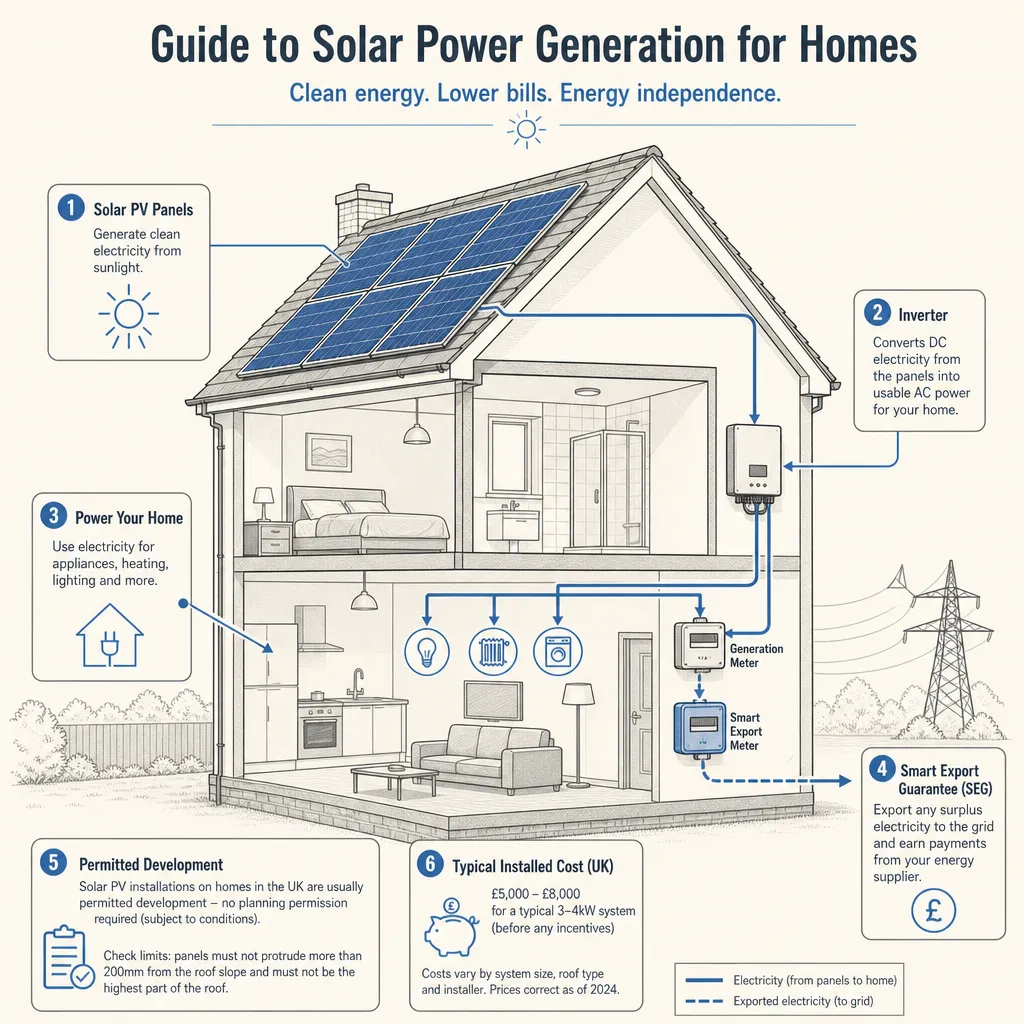
Guide to Solar Power Generation for Homes
Solar photovoltaic (PV) panels convert daylight into electricity and export surplus to the grid via the Smart Export Guarantee (SEG).
 Energy & Retrofit
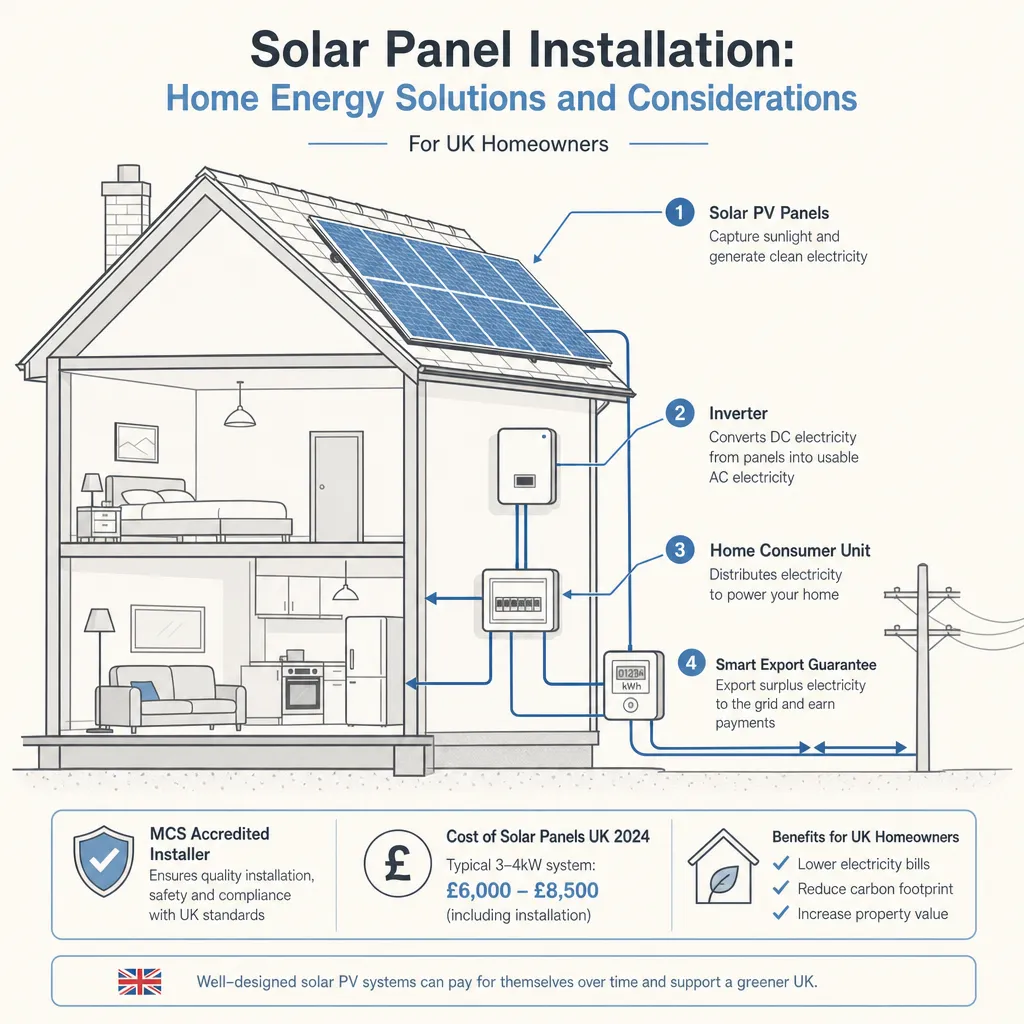
Solar Panel Installation: Home Energy Solutions and Considerations
A typical 4 kWp solar PV system costs £6,000–£9,000 installed and generates around 3,400–3,800 kWh per year on a south-facing roof in southern England.
 Energy & Retrofit
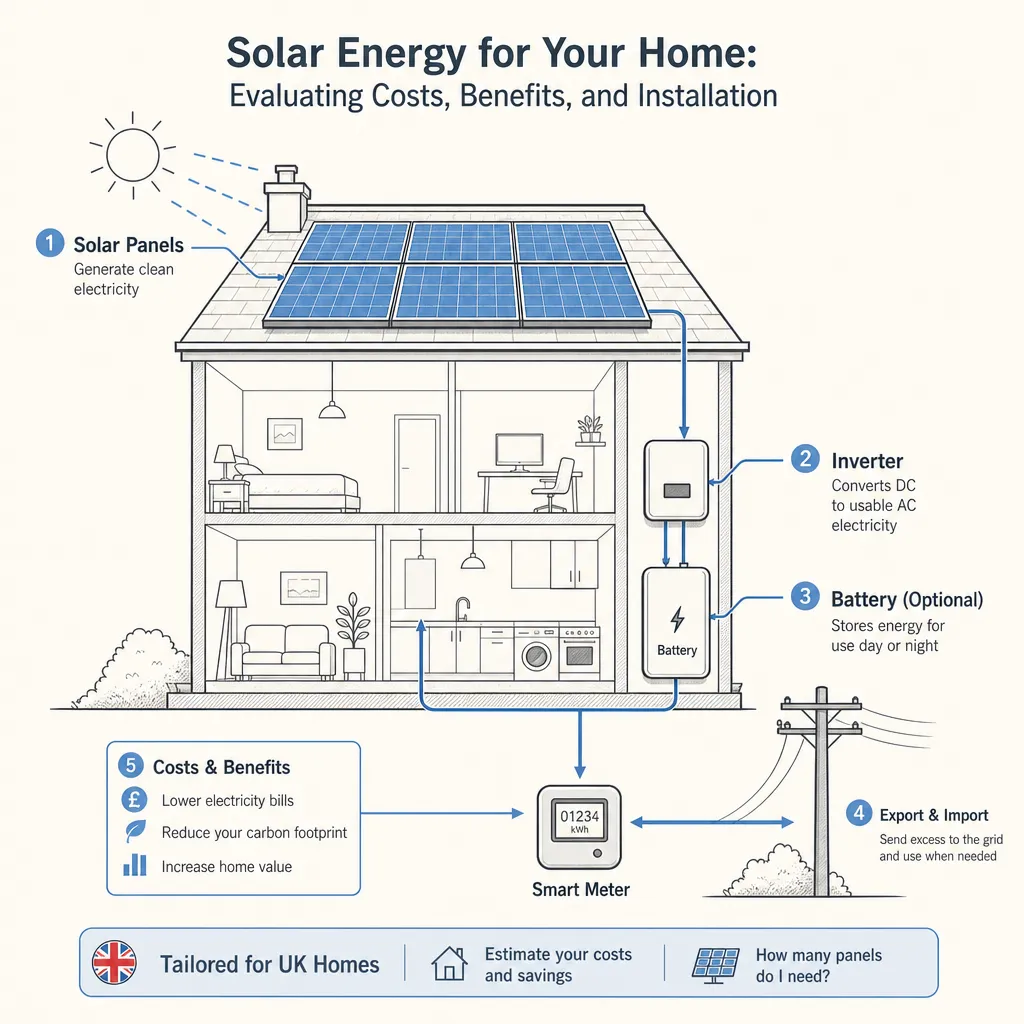
Solar Energy for Your Home: Evaluating Costs, Benefits, and Installation
A typical UK home solar PV system of 3–4 kWp costs approximately £5,000–£8,000 fully installed and can generate 2,600–3,800 kWh per year, covering 40–60% of average household electricity use.
 Energy & Retrofit
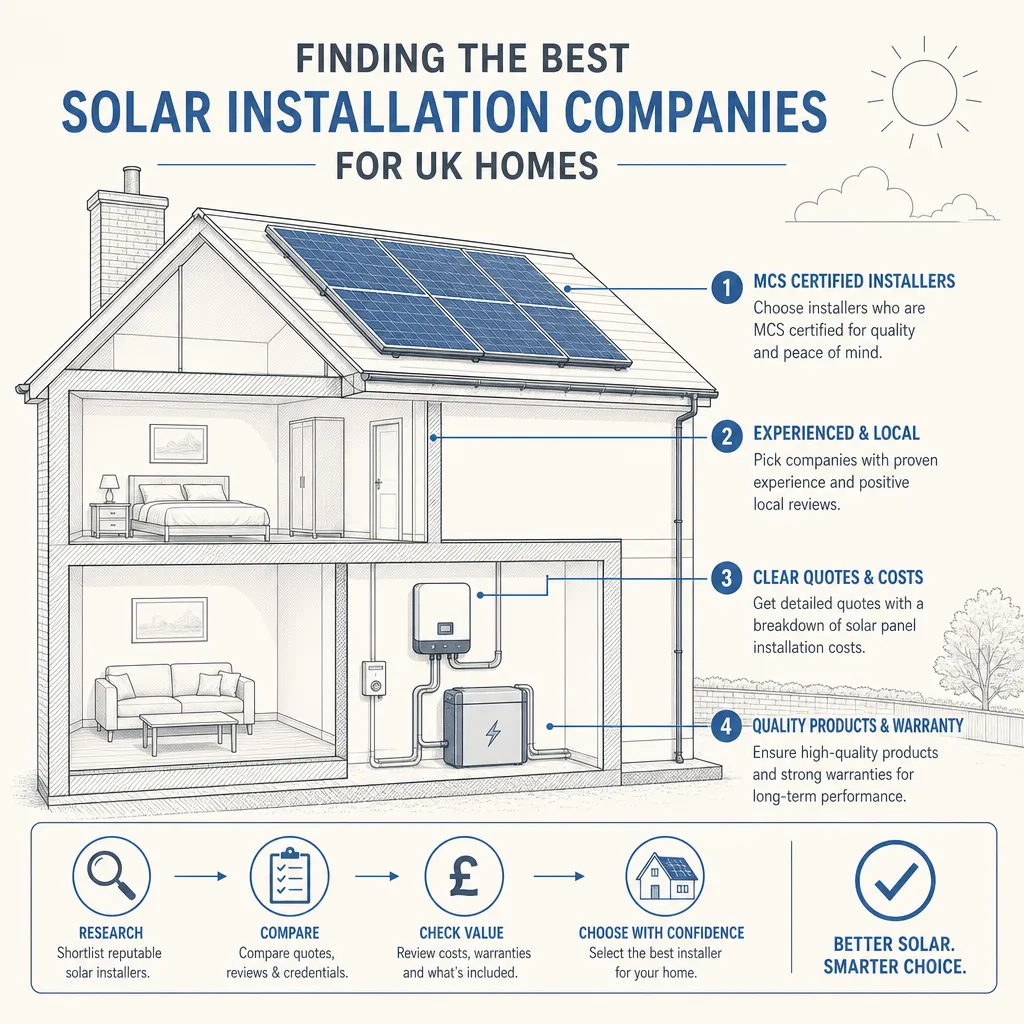
Finding the Best Solar Installation Companies for UK Homes
To find a reliable solar installation company in the UK, look for MCS (Microgeneration Certification Scheme) certification — required for Smart Export Guarantee eligibility — plus NICEIC or NAPIT electrical registration.
 Energy & Retrofit
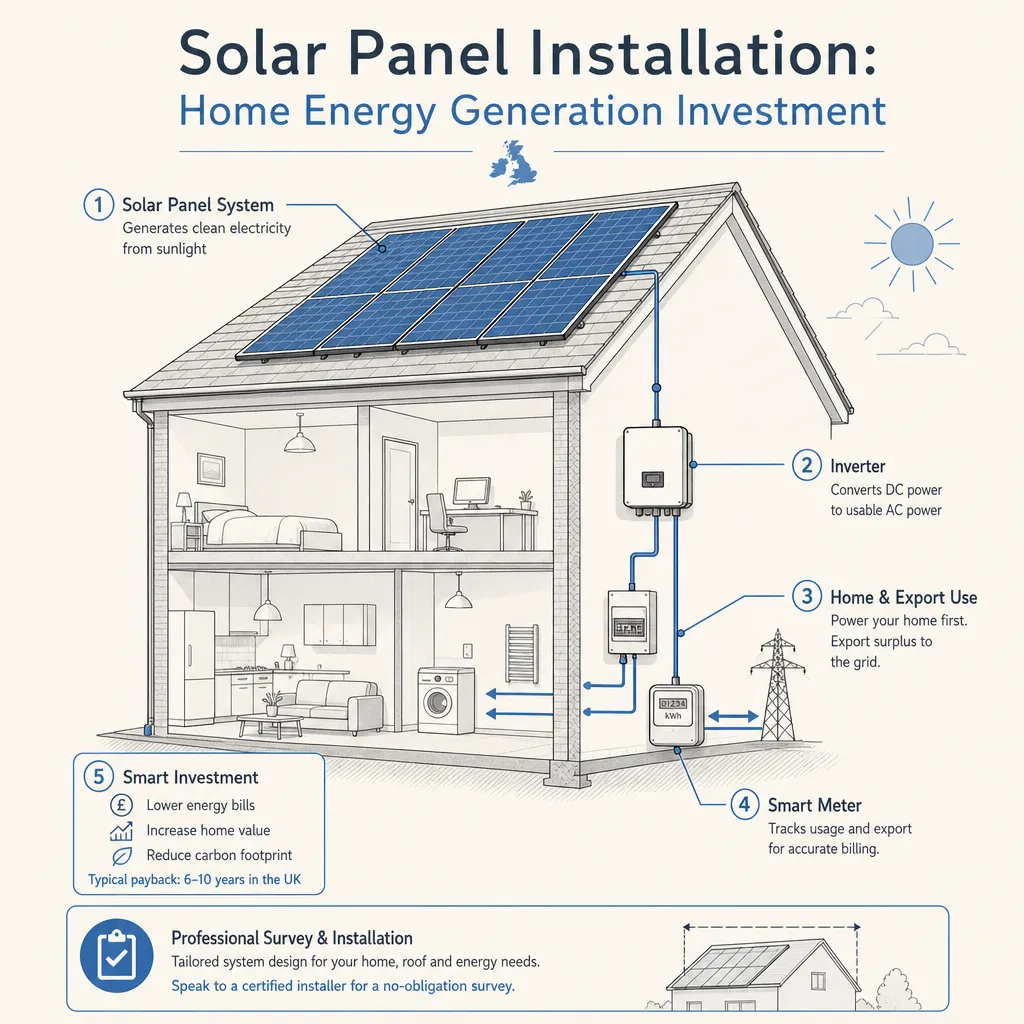
Solar Panel Installation: Home Energy Generation Investment
Solar panel installation in the UK typically costs £5,000–£9,000 for a 3–4 kWp system.