Tree Transplanting Costs and Mature Specimen Relocation
By Housey · Last reviewed 6th of May 2026
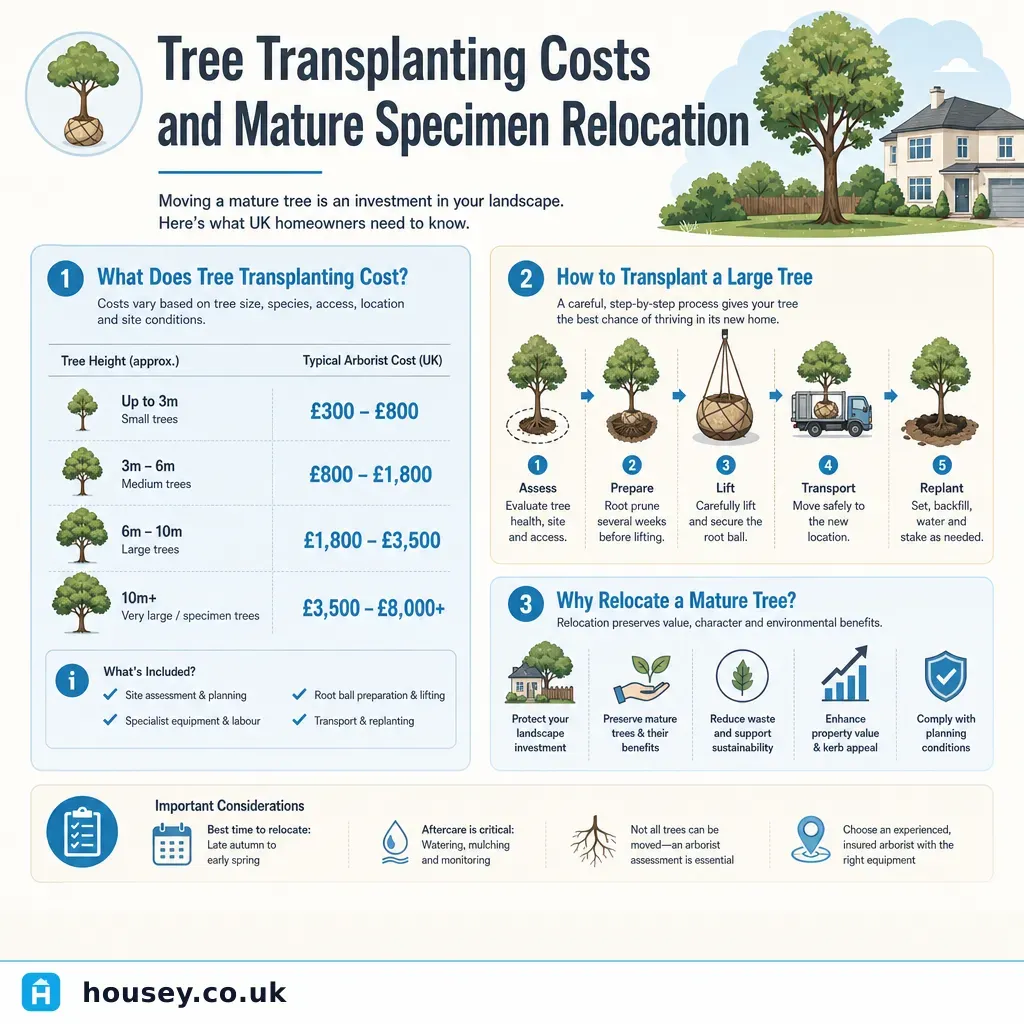
Tree Transplanting Costs and Mature Specimen Relocation
Transplanting a tree — whether repositioning a specimen during a garden redesign or preserving a mature oak ahead of construction — is one of the most technically demanding arboricultural tasks a UK homeowner can commission. Costs and survival rates vary considerably with the tree's age, species, trunk diameter, and root spread, and any work on a protected tree requires local authority consent before it begins.
Key points
- Trees subject to a Tree Preservation Order (TPO) or located in a conservation area require written consent from the local planning authority before transplanting — not just for removal or pruning.
- A tree's rootball diameter for successful transplanting is typically 10–12 times the trunk diameter measured at 1.3 m height (diameter at breast height, or DBH).
- The dormant season — late October to early March — offers the best survival rates for most UK deciduous species; evergreens are often moved in early autumn or late spring.
- Indicative UK costs range from approximately £300–£800 for small trees (up to 3 m) to £1,500–£10,000+ for large mature specimens requiring specialist machinery. (Indicative UK costs, last reviewed 2026-05-06. Costs vary by species, site access, and location; obtain written quotes.)
- Hiring a contractor registered with the Arboricultural Association or an International Society of Arboriculture (ISA)-certified arborist provides independent assurance of technical competence.
Does your tree need planning consent before it is moved?
Any tree covered by a TPO requires consent from your local planning authority (LPA) before transplanting — the same consent route used for pruning or felling. In a conservation area, you must give the LPA six weeks' written notice before carrying out any work on a tree with a trunk diameter above 75 mm at 1.5 m from ground level, even if no TPO exists.
Check whether your tree is protected using your council's online planning portal or the GOV.UK guidance on tree preservation orders. Failure to obtain consent can result in an unlimited fine under the Town and Country Planning Act 1990.
If the tree is within the curtilage of a listed building, additional listed building consent may be required. An arboricultural survey can confirm protected status and help prepare the supporting information required by the LPA.
How transplanting method affects cost
The method used determines both the price and the tree's post-move survival prospects.
Method | Best for | Limitations | Indicative cost range |
|---|---|---|---|
Hand-digging with rootball | Small trees (DBH under 10 cm), restricted access sites | Labour-intensive; rootball must stay intact throughout | £300–£800 |
Mechanical tree spade | Medium trees (DBH 10–25 cm) in accessible gardens | Machine access essential; may require driveway lifted | £800–£2,500 |
Crane with specialist rootball preparation | Large specimen trees (DBH over 25 cm) | Highest cost; advance root-pruning season usually required | £2,500–£10,000+ |
Root-pruning preparation season | Any tree being readied for future relocation | Carried out 6–12 months before the move itself | £500–£1,500 additional |
Indicative UK costs, last reviewed 2026-05-06. Costs depend on species, site access, distance of relocation, and contractor. Obtain at least three written quotes.
Large specimen trees are typically root-pruned one full growing season before the move to encourage a compact, fibrous root system within the intended rootball diameter. Skipping this step significantly increases transplant shock and reduces survival rates.
What determines whether a tree can be successfully transplanted?
Not every tree is a suitable candidate for relocation. Success depends on several interrelated factors.
Species tolerance: Many UK native species transplant well when dormant — field maple, hornbeam, hawthorn, and silver birch are generally more tolerant. Beech and oak can be moved but require more careful preparation. Conifers and large evergreens carry higher risk outside their optimal transplanting windows.
Age and root spread: The older the tree, the more extensive the root system and the smaller the proportion that can be retained in a viable rootball. Most arborists consider trees over 15–20 years old or with a DBH above 30 cm to carry elevated transplant risk.
Post-move care: Even a well-executed transplant requires aftercare — deep watering during dry spells for at least two growing seasons, mulching to retain soil moisture, and staking where necessary to prevent wind rock.
An experienced tree surgeon can assess the tree on site and give an honest appraisal of viability before you commit to the cost.
Decision guide: transplant, retain, or remove?
- Transplant if the tree is under 15 years old, the species is known to be transplant-tolerant, site access allows appropriate machinery, and the value of the specimen justifies the cost.
- Retain in place if the tree is protected, the project can be redesigned around it, or a qualified arborist assesses the transplant risk as high.
- Remove and replace with a nursery specimen if the tree is too large to move economically, survival probability is low, and there is no legal obligation to retain it. A young nursery tree often establishes more quickly than a stressed transplanted specimen.
- Seek specialist advice if the tree has a TPO, falls within listed building curtilage, or if trunk diameter exceeds 25 cm — the margin between a successful move and a lost specimen is narrow at this scale.
Homeowner checklist before commissioning a transplant
When to get professional help
Transplanting anything larger than a small ornamental or semi-mature shrub generally warrants professional input. Consult a qualified arborist when:
- The tree has a TPO or is in a conservation area — professional input also helps when preparing the LPA consent application.
- The trunk diameter exceeds 10 cm — rootball excavation at this scale requires experience to avoid severing structural roots that would destabilise the tree.
- The tree is visibly stressed, shows crown dieback, or has signs of decay — a diseased tree is a poor transplant candidate.
- The destination site has compacted soil, poor drainage, or is close to foundations or services.
- Access requires roadworks, scaffolding, or lifting over structures or boundaries.
How Housey can help
If you need expert input on transplant viability, TPO status, or choosing the right transplanting method, Housey can connect you with qualified professionals. Find arboricultural survey specialists for protected-tree assessments and pre-application advice, or tree surgeons for transplanting, root-pruning preparation, and post-move aftercare.
Frequently asked questions
How long does it take for a transplanted tree to establish?
Most deciduous trees need two to three growing seasons to re-establish a functional root system after transplanting. Consistent watering during dry spells and annual mulching are important throughout this period. Evergreens and conifers may take longer. The larger and older the tree, the slower the recovery — and the higher the risk that establishment fails entirely.
Can I transplant a tree myself?
For small ornamental trees up to around 2–3 m with a rootball you can physically handle, DIY transplanting is feasible during the dormant season with the right technique. For anything larger, or any protected tree, professional help is strongly advisable. An incorrectly prepared rootball or a move at the wrong time of year can kill a valuable specimen.
Do I need planning permission to transplant a tree in my garden?
You do not need planning permission to move a tree within your garden, but you do need local planning authority consent if it is protected by a TPO. In a conservation area, you must give six weeks' written notice before starting work on any tree above 75 mm trunk diameter at 1.5 m. Always check with your council before starting work.
What is root-pruning and why does it matter?
Root-pruning involves cutting a circle of roots around the tree 6–12 months before the planned transplant, encouraging a compact, fibrous root mass within the intended rootball. Without this preparation, a large proportion of the root system is severed during the move, causing severe transplant shock. Root-pruning significantly improves survival rates for trees with a DBH above around 15 cm.
How do I find a qualified tree transplanting specialist?
Look for contractors who are Arboricultural Association Approved Contractors or hold ISA Certified Arborist credentials. Both schemes require demonstrated competence and carry professional indemnity and public liability insurance. Your local council's tree officer may also suggest approved specialists familiar with local protected-tree requirements.
Sources and further reading
- Tree Preservation Orders and trees in conservation areas — GOV.UK
- Find an Arboricultural Association Approved Contractor — Arboricultural Association
- Trees: transplanting advice — Royal Horticultural Society
- ISA Certified Arborist programme — International Society of Arboriculture
Useful next reads
 Planning & Pre-Build
Managing Overhanging Trees: Legal Rights, Responsibilities and Remedies
In the UK, a tree belongs to whoever owns the land in which it is rooted.
 Planning & Pre-Build
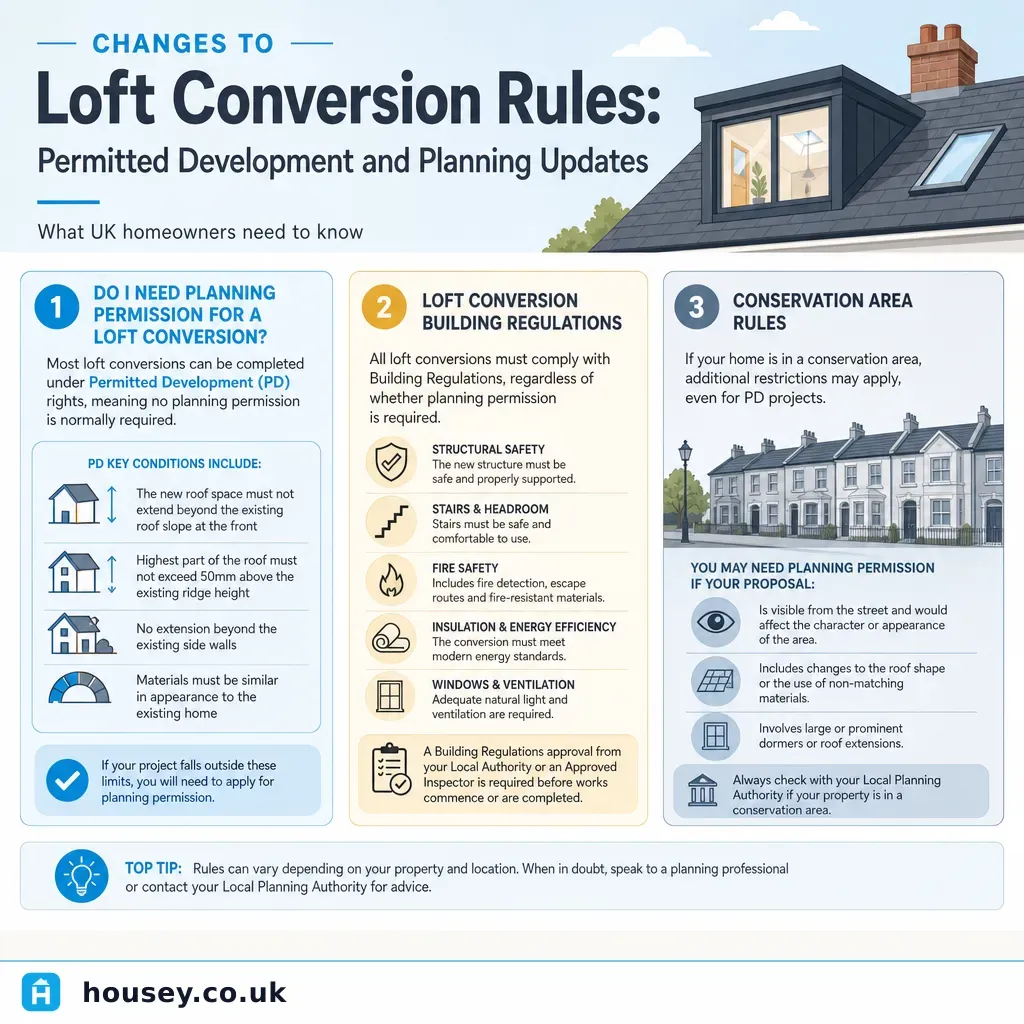
Changes to Loft Conversion Rules: Permitted Development and Planning Updates
In England, most loft conversions on standard houses qualify as Permitted Development under Class B of the GPDO 2015, allowing up to 40 cubic metres (terraced) or 50 cubic metres (detached or semi-detached) without a planning application — if conditions are met.
 Planning & Pre-Build
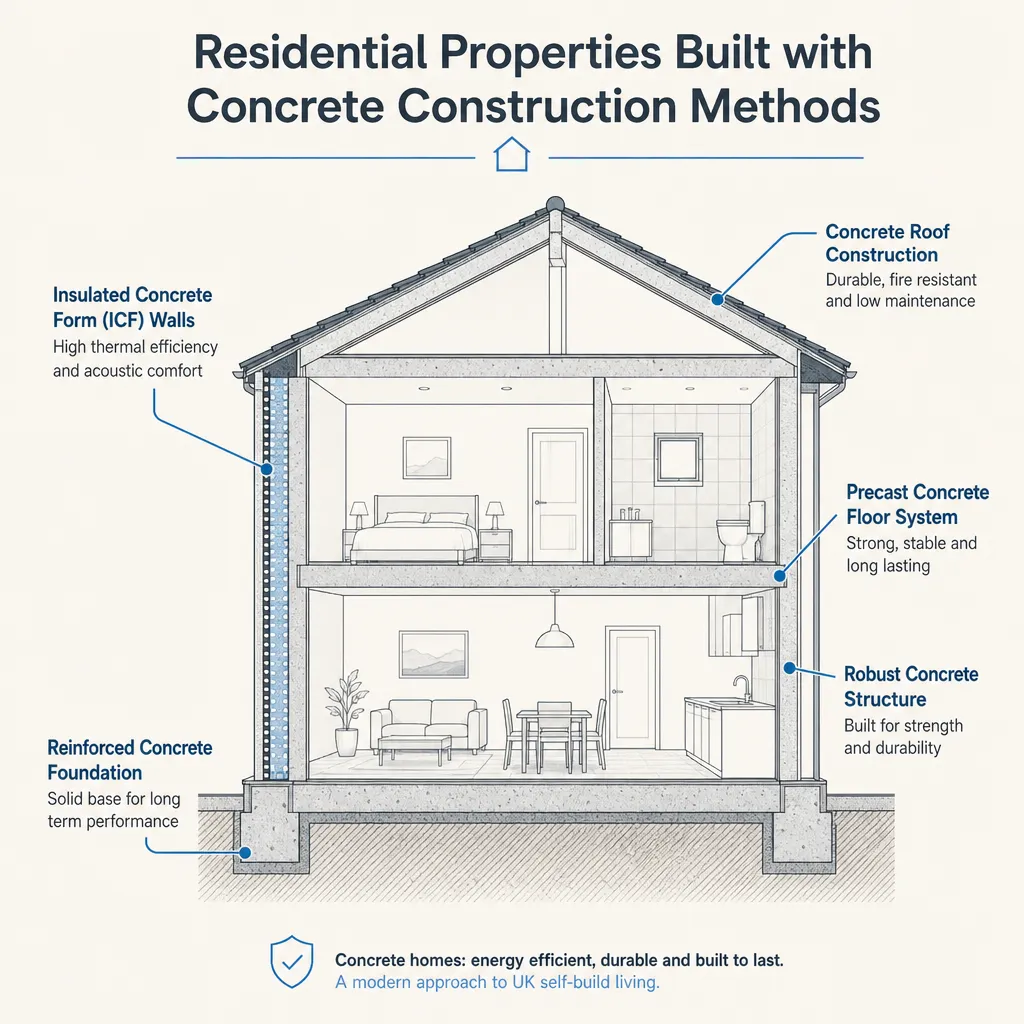
Residential Properties Built with Concrete Construction Methods
UK homes are built using several concrete methods: in-situ cast concrete, precast panel systems, insulating concrete formwork (ICF), and older non-traditional types such as Wimpey No-Fines and Laing Easiform.
 Planning & Pre-Build
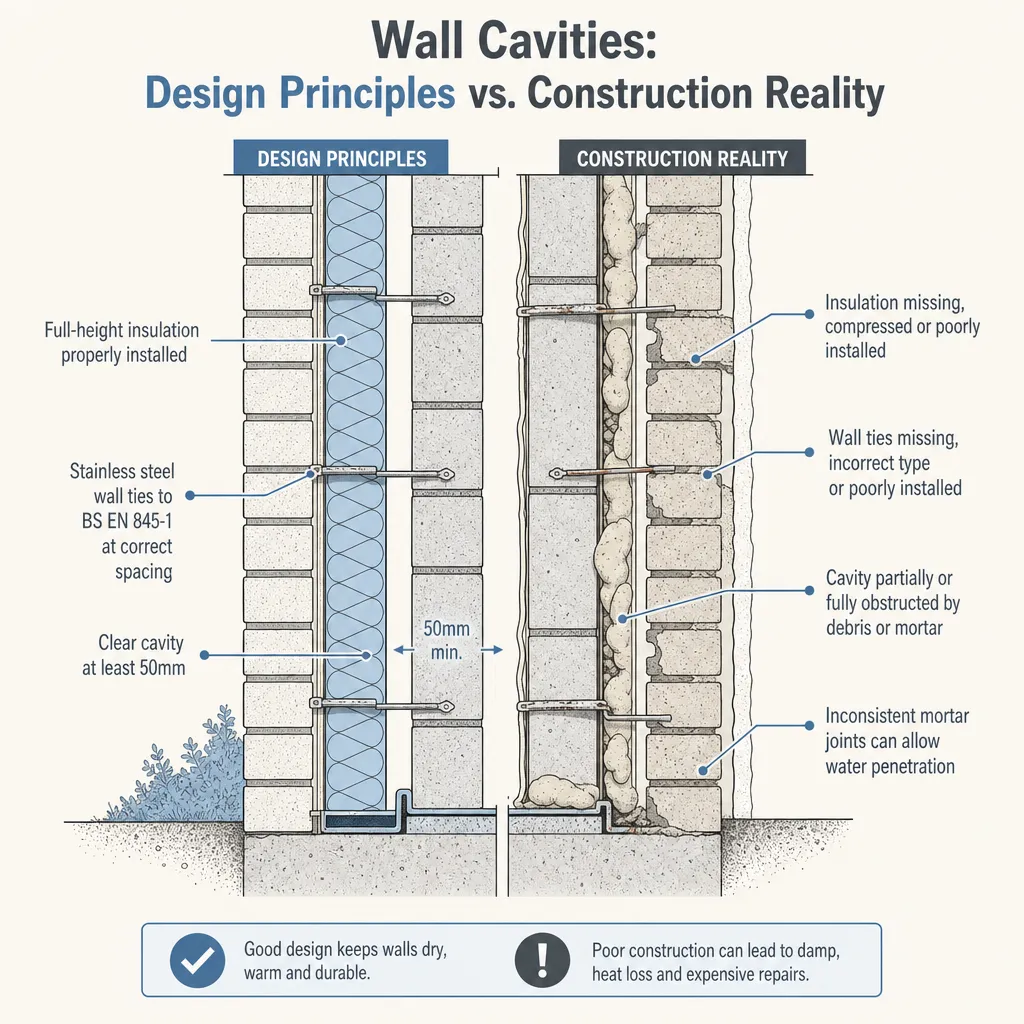
Wall Cavities: Design Principles vs. Construction Reality
A UK cavity wall is designed to resist weather, control heat loss, and structurally link two masonry leaves.
 Planning & Pre-Build
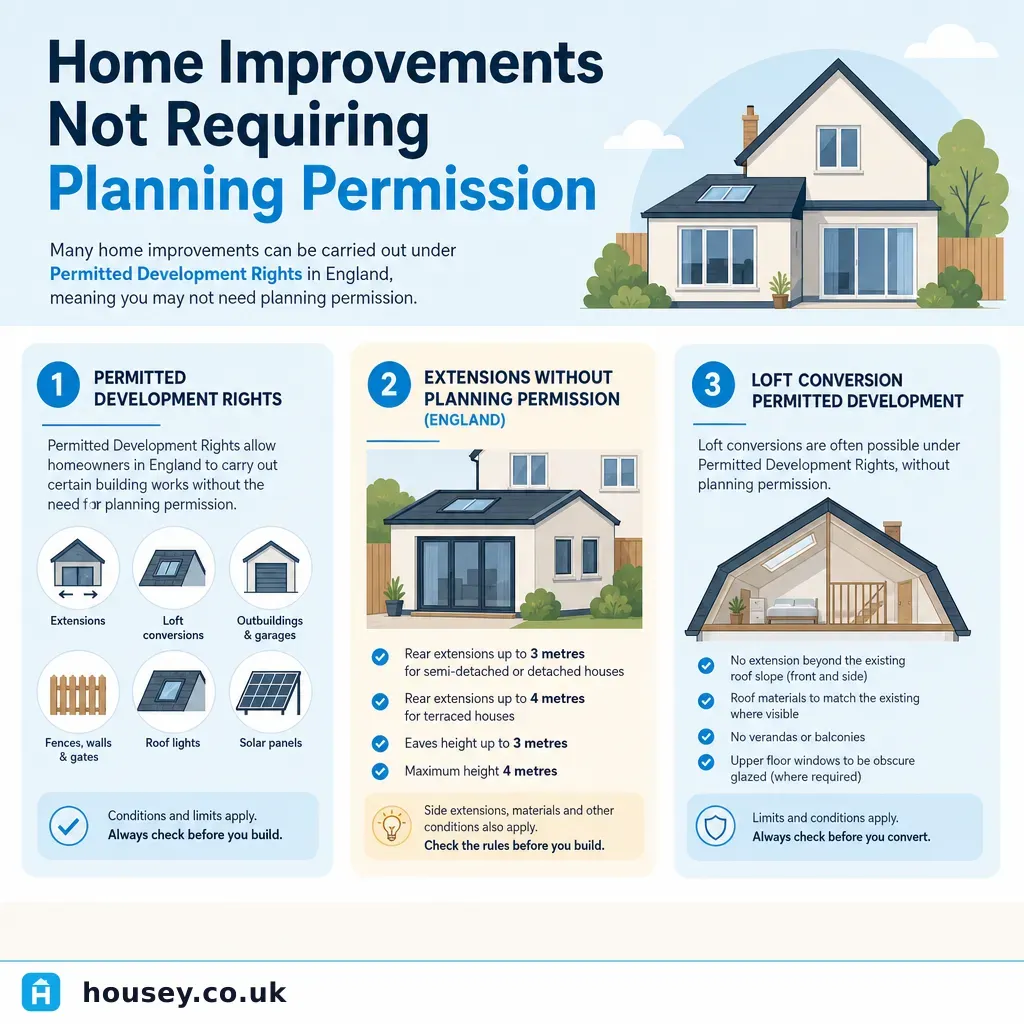
Home Improvements Not Requiring Planning Permission
Many common home improvements in England fall under Permitted Development Rights and do not require a planning application.