Understanding UK Home Inspection Costs and What's Included
By Housey · Last reviewed 11th of May 2026
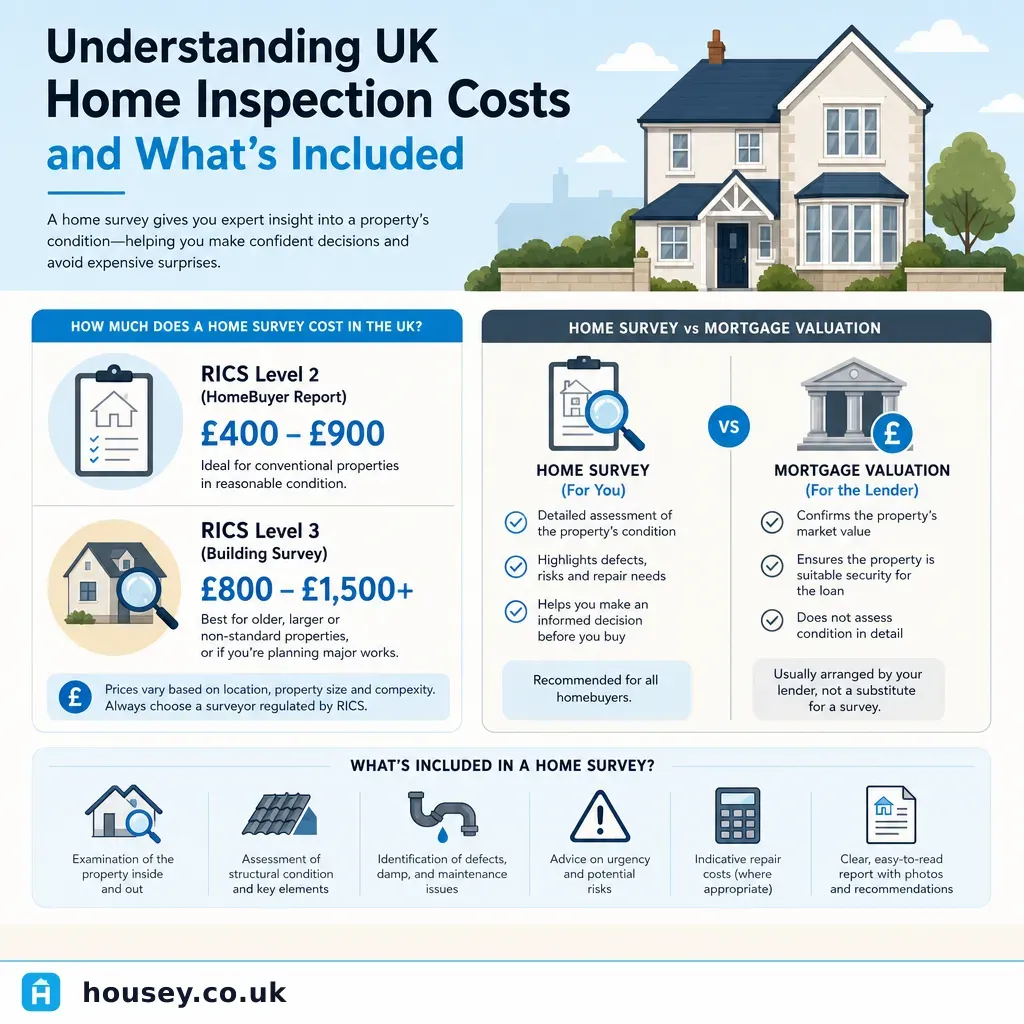
Understanding UK Home Inspection Costs and What's Included
For most buyers, the question of which survey to commission — and how much to budget — arises in the weeks between having an offer accepted and approaching exchange of contracts. Survey costs in the UK vary considerably by survey level, property size, age, and region, and the consequences of undercommissioning can be significant: a survey pitched below what a property warrants risks missing defects that would have warranted a renegotiation, a repair request, or even a withdrawal before exchange.
Key points
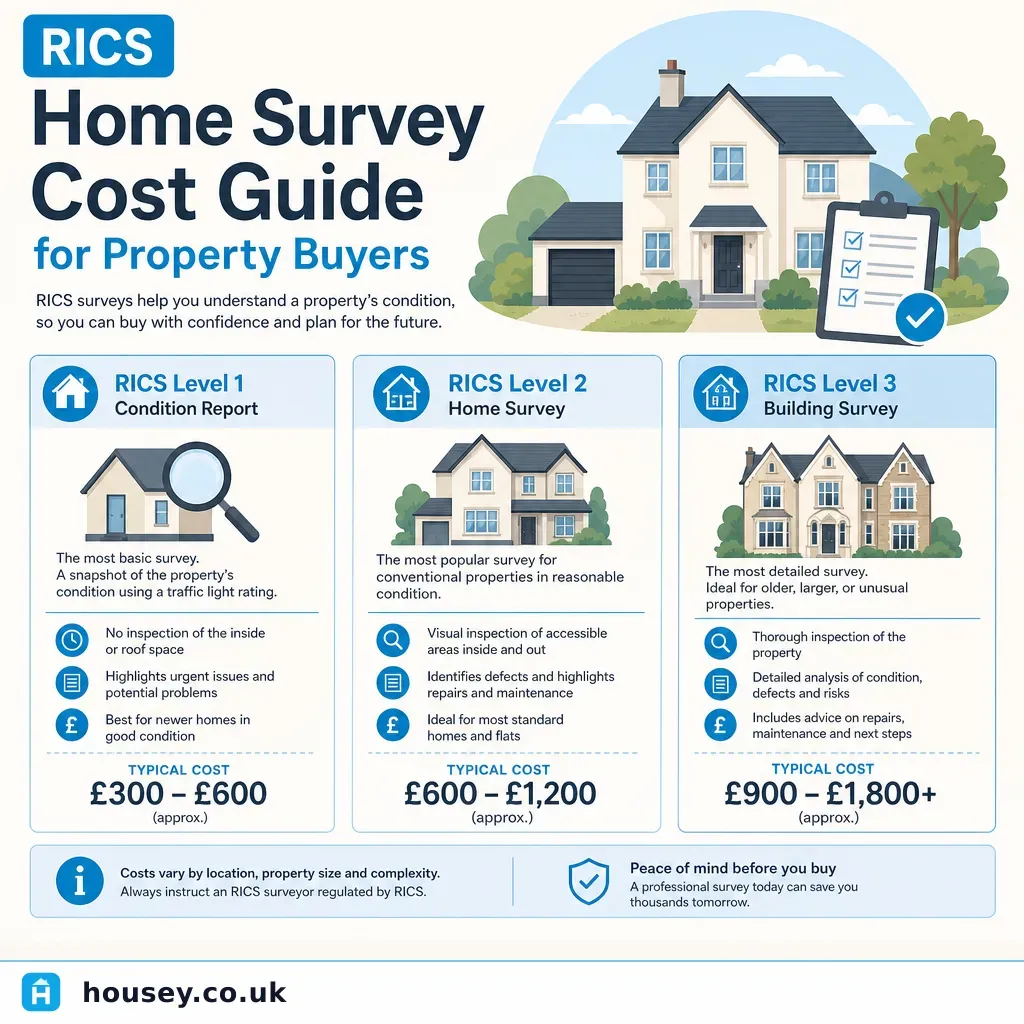
- RICS-regulated surveys are available at three levels: Level 1 (Condition Report), Level 2 (HomeBuyer Report or equivalent), and Level 3 (Building Survey), each with a distinct scope and corresponding fee range.
- Indicative fees for a typical three-bedroom semi-detached property range from roughly £300–500 for a Level 1, £400–800 for a Level 2, and £600–1,500+ for a Level 3 (Indicative UK costs, last reviewed 2026-05-11; fees vary significantly by firm, property size, and location).
- A mortgage lender's valuation is not a survey: it protects the lender's security interest and provides very limited information about property condition — it does not protect the buyer.
- VAT is charged on survey fees at the standard rate of 20%; always confirm whether a quoted fee is inclusive or exclusive of VAT before instructing.
- A structural engineer's inspection — commissioned separately from a RICS survey — typically costs £300–700 for a standard residential property, with fees rising for complex defects or detailed written engineering reports (Indicative UK costs, last reviewed 2026-05-11).
How much does a home survey cost in the UK?
The table below provides indicative cost ranges for the most common survey and inspection types for a standard UK residential property. Fees increase for larger, older, more complex, or higher-value properties, and regional variation is significant — expect higher fees in London and the South East compared with the North of England, Scotland, or Wales.
Survey type | Indicative cost range | What is included | Most suitable for |
|---|---|---|---|
RICS Level 1 Condition Report | £300–500 | Traffic-light condition ratings, summary of significant defects, no detailed repair advice | Modern or recently built property in apparent good condition |
RICS Level 2 HomeBuyer Report | £400–800 | Condition ratings, defect descriptions, repair advice, legal and insurance notes, optional market valuation | Conventional property in reasonable condition, broadly post-1900 construction |
RICS Level 3 Building Survey | £600–1,500+ | In-depth inspection, detailed defect analysis, construction description, repair options and urgency ratings | Older, larger, unusual, altered, listed, or visibly defective properties |
Structural engineer's inspection | £300–700 | Assessment of a specific structural concern; written report with remediation recommendations | Any property with active cracking, suspected subsidence, or structural movement |
Mortgage lender's valuation | £150–500 (often added to the mortgage) | Lender confirmation of minimum acceptable value; minimal condition comment | Required by lender — not a substitute for an independent buyer's survey |
CCTV drain survey | £100–300 | Camera inspection of accessible drainage runs; report on pipe condition and blockages | Older properties or where the surveyor flags a drainage concern |
Indicative UK costs, last reviewed 2026-05-11. Fees vary by firm, property size, location, and complexity. Obtain at least two quotes before instructing.
What affects the cost of a survey?
Several factors drive fees above or below the indicative ranges:
- Property size: A five-bedroom detached house takes considerably longer to inspect than a one-bedroom flat. Most firms charge on a sliding scale based on floor area or bedroom count.
- Property age and construction: Pre-Victorian properties, listed buildings, and unusually constructed homes — timber frame, solid-wall, cob, thatched — require more time and specialist knowledge.
- Location: Surveyors in London and the South East generally charge higher fees reflecting regional cost structures, travel time, and local demand.
- Survey level: A Level 3 Building Survey involves a far more thorough inspection methodology than a Level 1 — the fee reflects the additional time on site, depth of analysis, and reporting requirements.
- Optional market valuation: Some Level 2 reports include an optional valuation; this typically adds £50–150 to the base fee.
- Accessibility: A restricted loft hatch, absence of a subfloor access point, or limited external access can extend inspection time and may affect the fee.
- Urgency: Some firms charge a premium for expedited turnaround, particularly during busy periods in the conveyancing market.
What is included — and what is not
Understanding the scope of each survey level prevents disappointment when the report arrives.
Included in all RICS surveys:
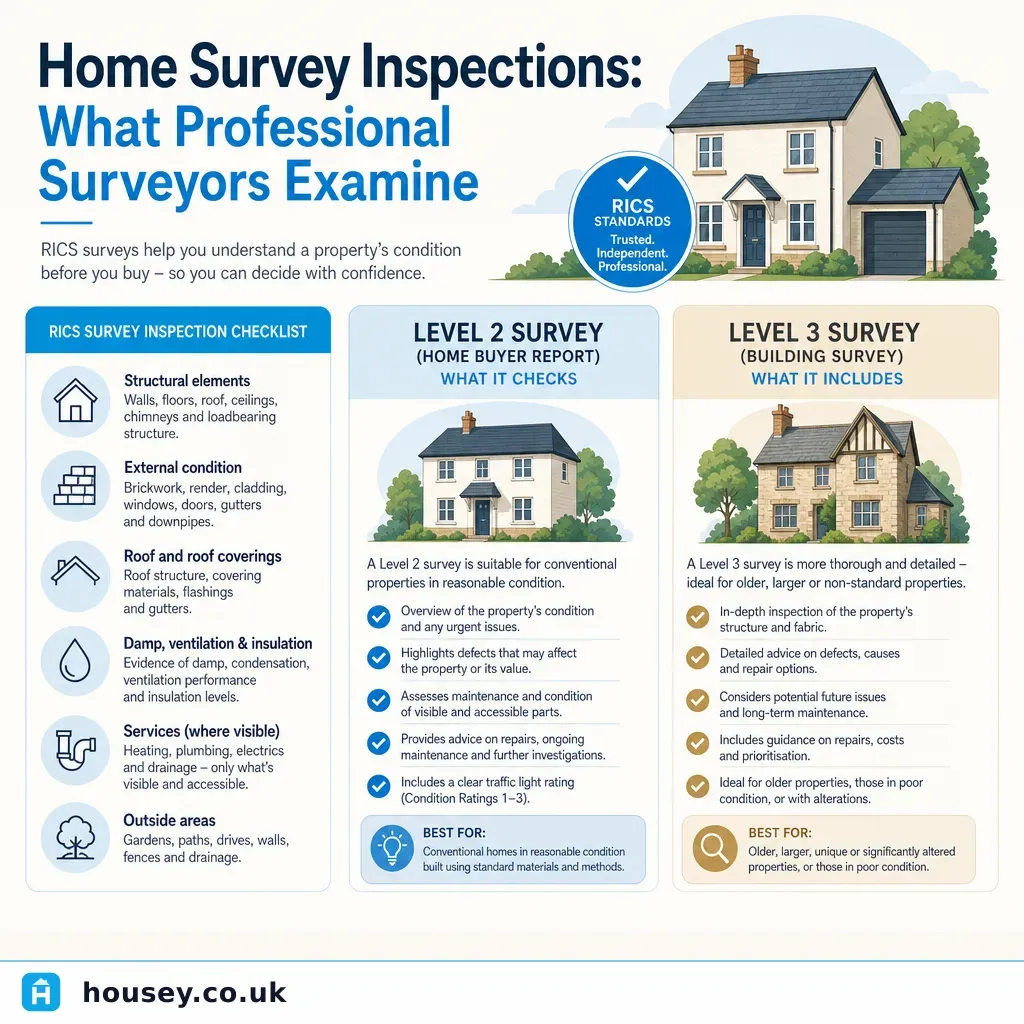
- Visual inspection of accessible areas of the property
- Condition ratings for key building elements (roof, walls, floors, joinery, and services)
- Notes on urgent defects requiring prompt attention
- Recommendations for further specialist investigations where concerns are identified
Additional scope at Level 2 and Level 3:
- Legal and insurance notes relating to the property
- Energy efficiency observations
- Level 3 adds: detailed defect descriptions, construction methodology, estimated repair urgency, and access to roof spaces and subfloor voids where practicable
Not included in a standard RICS survey:
Item | Why excluded | What to instruct instead |
|---|---|---|
Gas installation safety certification | Requires a Gas Safe registered engineer | Gas Safety Certificate |
Electrical installation condition | Requires a qualified electrician | Electrical Installation Condition Report (EICR) |
Drainage condition | Requires CCTV equipment | Separate CCTV drain survey |
Structural engineering diagnosis | Requires engineer-level analysis beyond survey scope | Structural engineer's written report |
Asbestos presence and type | Requires sampling and laboratory analysis | Asbestos management or R&D survey by UKAS-accredited provider |
Japanese knotweed rhizome extent | Requires specialist ecological identification | Specialist invasive species survey |
What to ask before accepting a quote
Use this checklist when comparing quotes from RICS surveyors:
- What survey level are you quoting for, and do you consider it the appropriate level for this specific property?
- Does the fee include VAT?
- For a Level 2 quote: does it include or exclude a market valuation?
- What qualifications does the surveyor hold — MRICS or FRICS?
- How long will the inspection take, and when will I receive the written report?
- How will urgent findings be communicated — by phone before the report is issued, or only within the written document?
- What is your policy if parts of the property are inaccessible on the day of inspection?
- Does the firm carry adequate professional indemnity insurance, and what is the level of cover?
- What is your complaints procedure if I am dissatisfied with the report?
Which survey level should you choose?
- Choose a RICS Level 1 Condition Report if the property is newly built or under 10 years old and covered by an NHBC or equivalent structural warranty — or if you require only a basic condition check on a straightforward modern flat with no visible concerns.
- Choose a RICS Level 2 HomeBuyer Report if the property is a conventional house or flat of broadly post-1900 construction in apparent reasonable condition, with no significant defects flagged during your viewing — this is the most common choice for standard purchases.
- Choose a RICS Level 3 Building Survey if the property is Victorian or older, unusually large, of non-standard construction, listed, has undergone significant alterations, or if visible concerns were noted during your viewing or by the estate agent.
- Commission a structural survey or standalone structural engineer's inspection if there is active cracking, evidence of past underpinning, suspected subsidence, or if a Level 2 or Level 3 report specifically recommends further structural assessment.
- Never rely solely on a mortgage lender's valuation as your only check on condition — its purpose is to protect the lender's security, not to protect you as the buyer.
When to get professional help
A RICS survey is the professional help for property condition — but interpreting a report that identifies significant issues may itself require follow-up:
- If the survey recommends a structural engineer's inspection and the seller is pressing for a quick exchange, instruct the engineer before committing to exchange
- If the report flags possible asbestos-containing materials and you intend to carry out renovation work, instruct an asbestos survey before exchange so you understand the scope and cost of any required management measures
- If material defects emerge after completion that could not reasonably have been identified through a visual inspection, consult your solicitor about your legal options
- If the seller disputes the surveyor's findings, obtain a second professional opinion before renegotiating or withdrawing
How Housey can help
Housey connects buyers and homeowners with RICS-regulated surveyors offering RICS Home Surveys at all three levels, alongside structural surveys and valuation surveys for more specific needs. Comparing at least two quotes before instructing is good practice — Housey's platform makes it straightforward to receive quotes from qualified local surveyors and compare their scope, fees, and turnaround times side by side.
Frequently asked questions
Is a mortgage lender's valuation the same as a home survey?
No. A mortgage lender's valuation is carried out for the lender's benefit to confirm the property provides adequate security for the loan. It is not a structural or condition report and buyers typically receive only a brief summary. You should commission your own RICS Level 1, 2, or 3 survey separately to protect your interests before exchange of contracts.
Can I negotiate the cost of a home survey?
Surveyors are independent professionals who set their own fees, but it is reasonable to ask whether a firm has any flexibility, particularly for lower-value properties or where you are instructing additional services. The most important consideration is the surveyor's qualifications, local knowledge, and RICS regulation — not simply the lowest available price.
How quickly can I get a home survey booked?
Most RICS surveyors can attend a property within one to two weeks of instruction, with written reports typically issued within five to ten working days of the inspection. Turnaround times vary by firm and regional demand. Some firms offer expedited services for an additional fee. Always confirm expected timescales when requesting a quote.
What happens if the survey finds significant defects?
Survey findings often give buyers legitimate grounds to renegotiate the purchase price, request that the seller carries out repairs before completion, or in serious cases consider withdrawing from the purchase. Share the report with your solicitor promptly and take specialist advice on any defects classified as urgent or requiring immediate action before you commit to exchange.
Sources and further reading
- Surveys and valuations: buying or selling your home — GOV.UK
- RICS Home Survey Standard (2021) — RICS
- Property surveys — Citizens Advice
- Types of property survey explained — Which?
Useful next reads
 Surveys & Inspections
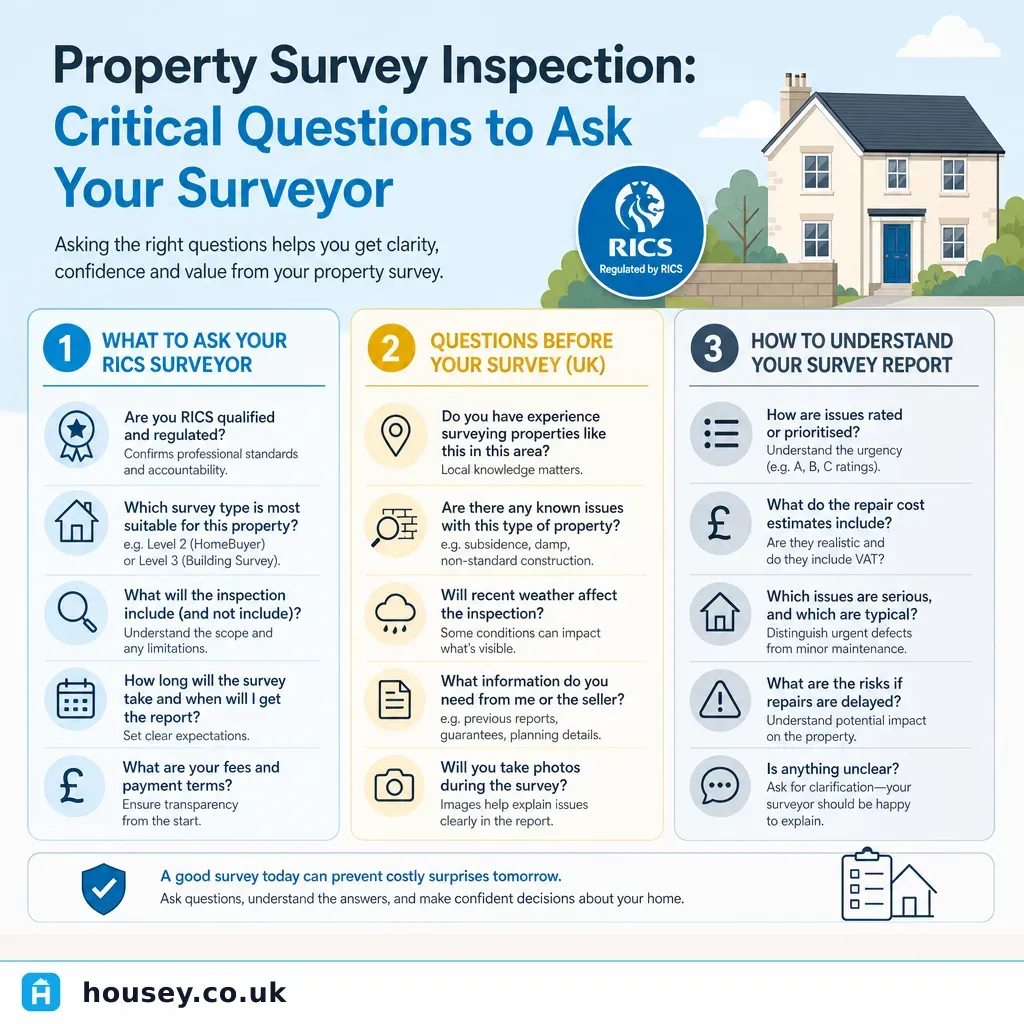
Property Survey Inspection: Critical Questions to Ask Your Surveyor
Before instructing a surveyor, ask which RICS level suits your property and what the report will and will not cover.
 Surveys & Inspections
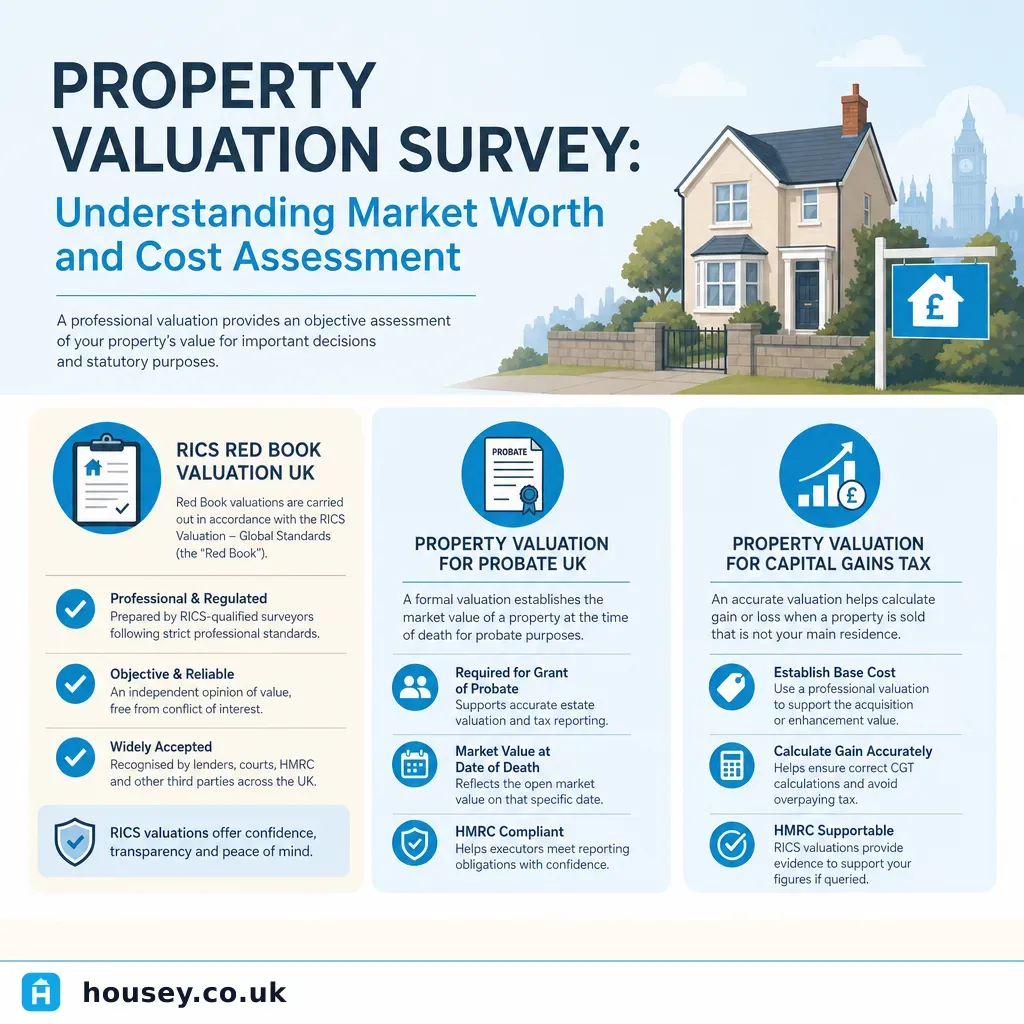
Property Valuation Survey: Understanding Market Worth and Cost Assessment
A property valuation survey establishes a property's market value at a specific date.
 Surveys & Inspections
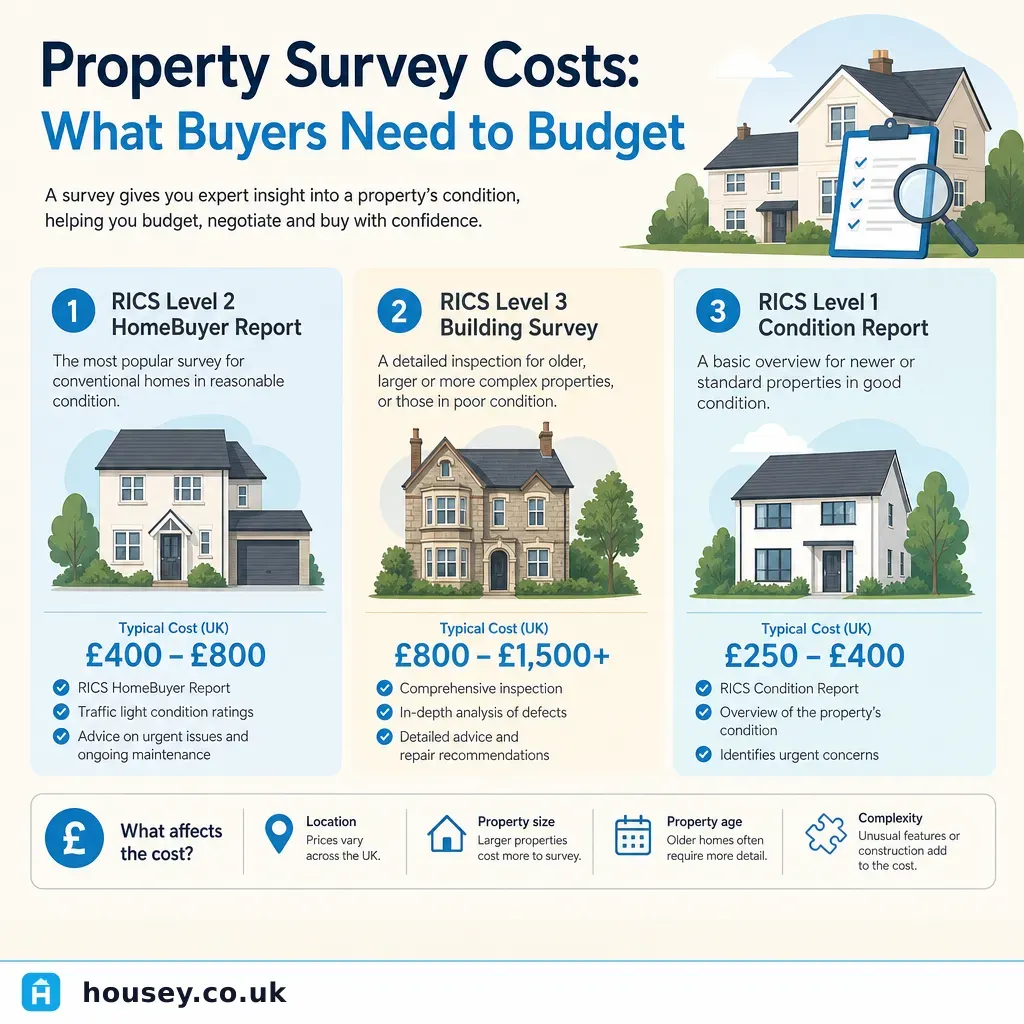
Property Survey Costs: What Buyers Need to Budget
A RICS Level 1 survey typically costs £300–£500, a Level 2 Home Survey £400–£900, and a Level 3 Building Survey £600–£1,500 or more.
 Surveys & Inspections
RICS Home Survey Cost Guide for Property Buyers
A RICS Level 2 Home Survey typically costs £400–£700 in the UK, while a Level 3 Building Survey ranges from £600 to £1,500 or more.
 Surveys & Inspections
Home Survey Inspections: What Professional Surveyors Examine
A RICS home survey involves a visual inspection of a property's structure, roof, walls, floors, and services.