UK Home Renovation Market Dynamics and New Construction Growth
By Housey · Last reviewed 24th of May 2026
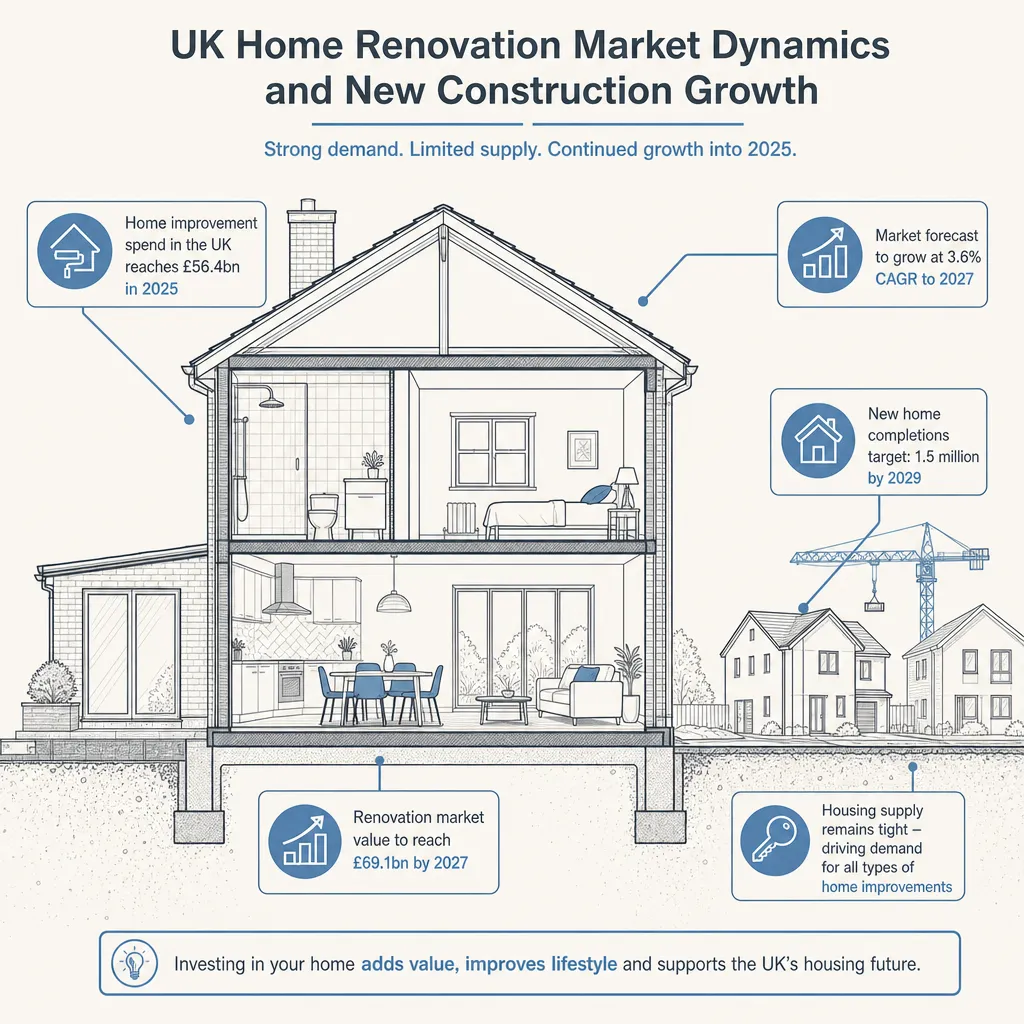
UK Home Renovation Market Dynamics and New Construction Growth
The UK renovation and construction market reflects broader economic conditions — interest rates, planning policy, material costs, and labour availability — all of which affect what homeowners can realistically plan and afford. Understanding these dynamics helps set realistic expectations around timelines, costs, and contractor availability before committing to a project, and can inform whether the timing of a planned improvement makes practical sense.
Key points
- The Office for National Statistics (ONS) tracks repair, maintenance, and improvement (RMI) output separately from new-build; RMI activity has historically accounted for a significant share of total UK construction output.
- RICS and the Construction Products Association (CPA) publish quarterly forecasts covering housing starts, RMI output, and infrastructure — useful benchmarks when considering the timing of a major renovation.
- New housebuilding in England is measured against government housing delivery targets; delivery has consistently fallen short of the 300,000 homes per year ambition set in recent housing policy documents.
- Labour shortages in specialist trades — bricklayers, roofers, joiners, and groundworkers — remain a structural constraint cited in successive Federation of Master Builders State of Trade Surveys.
- Material cost inflation between 2021 and 2023 significantly affected renovation budgets; price growth has since moderated, improving cost predictability for homeowners planning works in 2025 and 2026.
How is the UK renovation market currently structured?
The UK's residential improvement and repair sector divides broadly into two segments:
- Repair, maintenance, and improvement (RMI): Work carried out on existing homes — extensions, conversions, refurbishments, energy upgrades, and routine maintenance. This segment is driven by homeowner confidence, equity levels, and the cost and availability of moving.
- New private housing: New-build homes delivered by volume housebuilders, SME developers, and self-builders. Supply is constrained by land availability, planning capacity, and build-cost economics.
When the cost and complexity of moving rises — as stamp duty, legal fees, mortgage rates, or available stock change — many homeowners choose to extend or upgrade their existing home instead. This improve, don't move behaviour pushes demand into the RMI sector and can affect contractor availability and lead times in a given area.
What is driving renovation demand in the UK?
Demand driver | Effect on renovation market |
|---|---|
High mortgage rates (2022–2025) | Reduced incentive to upsize; homeowners renovate in place instead |
Stamp Duty Land Tax costs | Moving is expensive; extending is often cheaper than trading up |
Ageing housing stock | Large proportion of pre-1980 homes need energy and structural upgrades |
Energy price rises | Accelerated demand for insulation, heat pumps, and fabric-first retrofits |
Hybrid working | Increased demand for home office space, extensions, and garden offices |
EPC regulatory pressure | Landlords improving properties to reach EPC C ahead of proposed rental reforms |
What is happening with new construction in the UK?
New housebuilding in England is tracked by the Ministry of Housing, Communities and Local Government (MHCLG) through quarterly housing supply statistics. Key dynamics include:
- Planning reform: The National Planning Policy Framework (NPPF) revisions in 2024 introduced mandatory housing targets for local planning authorities and a framework to release lower-quality green belt land for housing.
- Build-to-rent growth: The private rented sector has seen significant institutional investment in purpose-built rental housing in major cities, adding to overall housing completions.
- SME housebuilder capacity: The proportion of new homes delivered by smaller builders has declined since the 1980s; policy efforts to reverse this through small sites registers and Help to Build remain ongoing.
- Self-build and custom build: The Self and Custom Build Register, held by local authorities under the Self-build and Custom Housebuilding Act 2015, records demand for serviced plots; delivery against this demand remains limited in most areas.
How do market conditions affect a homeowner planning a renovation?
Worked example: timing an extension in a cost-conscious market
A homeowner in Bristol with a 1960s semi plans a single-storey rear extension. In late 2021 and 2022, material shortages and high contractor demand pushed indicative costs for this type of project well above pre-pandemic levels. By mid-2024, material price growth had moderated and contractor availability had improved across many regions outside London and the South East.
The practical lesson: if your renovation is flexible in timing, obtaining three comparable quotes at different points and monitoring the BCIS (the RICS Building Cost Information Service) tender price indices can provide a useful read on whether market conditions are moving in your favour. Committing to a contract at a demand peak without adequate contingency is a known risk that careful preparation can reduce.
What to watch when tracking the UK renovation market
Red flags that market conditions may affect your project
- Long lead times from contractors: waiting more than six weeks for an initial site visit may indicate high local demand and a risk of programme slippage once work starts on site.
- Large spread between quotes: a 30–40% or greater variation between the lowest and highest quote often signals differing scope interpretations, not simply price differences — always clarify what each quote includes and excludes.
- Material price volatility: ask contractors to specify material costs separately so you can see where price risk sits, and ask how they will handle material cost increases during the build.
- Planning backlogs: if your project requires planning permission, check your local planning authority's current determination timescales on GOV.UK — some authorities are running significantly over the eight-week statutory target for householder applications.
- Regulatory capacity constraints: post-Grenfell fire safety remediation and the Building Safety Act 2022 have absorbed significant contractor and professional capacity in certain markets, particularly for multi-storey residential buildings.
When to get professional help
Market intelligence provides useful context, but it does not replace a professional assessment of your specific project:
- If you are planning a significant extension or conversion, commission a cost plan from a quantity surveyor before instructing a contractor. A QS can benchmark contractor quotes against current market rates and identify potential cost overruns early.
- If planning timescales are critical to your mortgage or chain arrangements, consider engaging an architect or planning consultant to prepare a pre-application enquiry before submitting a formal application.
- If your project involves energy-efficiency measures eligible for government grant schemes — ECO4, the Great British Insulation Scheme, or the Boiler Upgrade Scheme — check current eligibility criteria on GOV.UK, as schemes open and close to new applicants at different times.
How Housey can help
Housey provides access to vetted local tradespeople and specialists across the UK. Using Housey's quote comparison tool, homeowners can see what multiple qualified contractors offer for the same project scope — making it straightforward to calibrate whether a quote reflects current market conditions or sits significantly outside them.
Frequently asked questions
Is now a good time to start a home renovation in the UK?
Market timing for renovation depends on your financial position, how long you plan to stay in the property, whether your project requires planning permission, and local contractor availability. No single market signal tells you whether to proceed; the best preparation is a clear brief, comparable quotes from at least three contractors, and a contingency budget of at least 10–15% of total project cost.
Why do renovation costs vary so much across the UK?
Labour costs vary significantly by region: work in London and the South East typically commands a substantial premium over equivalent work in the North of England, Wales, or Scotland, based on BCIS regional cost data. Material costs are more consistent nationally, but transport to remote locations adds cost. Local planning requirements and property types also affect project complexity and overall price.
What does the government's housing target mean for homeowners?
Housing targets primarily affect developers and local planning authorities rather than individual homeowners directly. However, planning reform that increases housing supply can affect local property values, neighbourhood character, and service availability — all factors worth monitoring if you are making a long-term investment decision in a specific area.
What is the Building Safety Act 2022 and does it affect home renovation projects?
The Building Safety Act 2022 introduced new regulatory requirements for higher-risk buildings — generally residential buildings over 18 metres or seven storeys. For most homeowners renovating a house or low-rise flat, it does not directly apply. If your property is in a multi-storey block, speak to a solicitor or building safety professional before committing to works that may trigger Act requirements.
Sources and further reading
- Construction Output in Great Britain — Office for National Statistics
- Housing Supply: Net Additional Dwellings — MHCLG
- RICS Construction and Infrastructure Market Survey — RICS
- State of Trade Survey — Federation of Master Builders
- National Planning Policy Framework — GOV.UK
- Building Safety Act 2022 — legislation.gov.uk
- Self-build and Custom Housebuilding Act 2015 — legislation.gov.uk
Useful next reads
 General property advice
Monthly House Price Index: August Market Report and Analysis
The UK House Price Index is published monthly using completed Land Registry transaction data, meaning August figures typically reflect sales agreed months earlier.
 General property advice
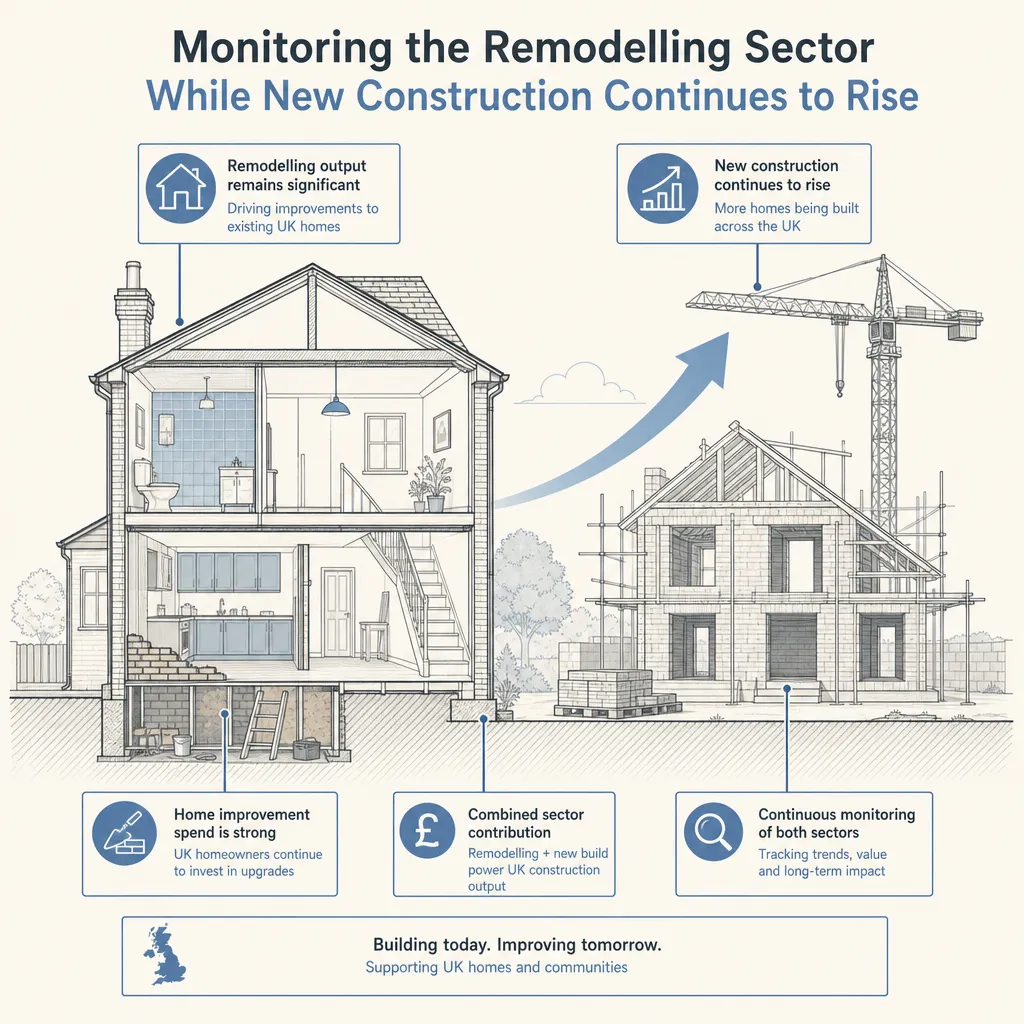
Monitoring the Remodelling Sector While New Construction Continues to Rise
The UK renovation sector runs alongside new-build activity, not in opposition to it — both draw on the same pool of skilled labour and materials.
 General property advice
Market Analysis: How Recent Events Impact Property Asking Prices
UK property asking prices respond to economic events — particularly Bank of England base rate changes, employment data, inflation, and policy shifts such as Stamp Duty thresholds.
 General property advice
UK Property Prices: Understanding Market Dynamics
UK house prices are driven by mortgage affordability, housing supply, employment levels, and policy decisions such as stamp duty changes.
 General property advice
What to do when your boiler stops working
When your boiler stops working, check the pressure gauge (should read 1–1.