UK Trade Skills Index: Identifying Gaps in Professional Services and Employment
By Housey · Last reviewed 19th of May 2026
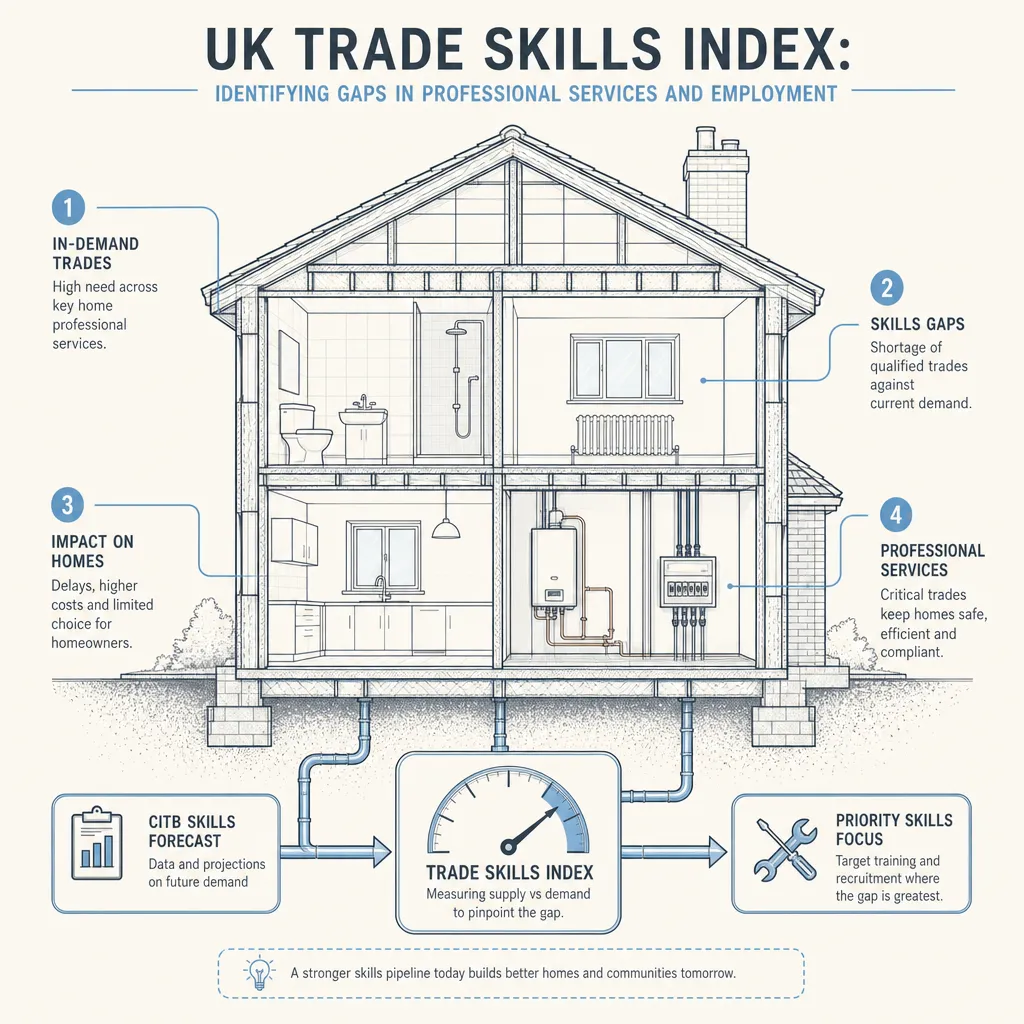
UK Trade Skills Index: Identifying Gaps in Professional Services and Employment
The skills shortage running through UK construction and home improvement trades is not a new phenomenon, but it has deepened noticeably since 2021 and shows up in practical ways for homeowners: longer waits for quotes, higher prices, and a market where unverified operators can exploit tight supply. Whether you are planning a loft conversion, a heat pump installation, or a rewire, understanding which trades are hardest to find — and why — helps you plan ahead and hire wisely.
Key points
- The Construction Industry Training Board (CITB) Construction Skills Network forecasts demand for approximately 251,500 additional workers across the UK construction sector by 2028.
- Electricians, bricklayers, plumbers and heating engineers, and roofers consistently top Federation of Master Builders (FMB) annual skills-shortage surveys.
- Apprenticeship starts in England reached around 23,000 in 2022/23 (Department for Education data), well below the CITB's estimated replacement need.
- Post-Brexit changes to freedom of movement removed a significant cohort of EU-born skilled workers from the UK labour market from January 2021, compounding a pre-existing gap.
- Regional imbalances are material: London and the South East report the highest unmet demand; some northern regions retain more available capacity in general building trades.
Which trades are in shortest supply?
Shortage profiles shift annually, but several trades have appeared consistently across multiple CITB and FMB annual surveys:
Trade | Primary demand driver | Key qualification barrier |
|---|---|---|
Electricians | EV charging points, solar PV retrofits, EICR compliance work | NVQ Level 3 + Part P competent person registration |
Bricklayers | New-build housing targets, extension and renovation work | Apprenticeship completions lag retirements |
Plumbers / heating engineers | Heat pump and boiler upgrades, ECO4 scheme work | Gas Safe Register; MCS certification for heat pumps |
Roofers | Ageing housing stock, insulation upgrades, storm-damage repair | Working-at-height training; NFRC membership often required |
Plasterers | Renovation and refurbishment volume | Mainly on-the-job learning; limited formal routes |
Retrofit assessors and coordinators | PAS 2035-compliant retrofit schemes, ECO4 | Relatively new qualification pathway; supply still maturing |
Data sources: CITB Construction Skills Network annual report; FMB House Builders' Survey. Availability varies significantly by region — always check local trade registers before assuming national shortage figures apply in your area.
Why the shortage exists
Several structural factors combine to create a persistent shortfall:
An ageing workforce. A large proportion of experienced tradespeople are approaching or have already passed typical retirement age. CITB modelling shows retirements outpacing new entrants in several core trades, creating a replacement gap before any growth in demand is factored in.
Post-Brexit labour market changes. Freedom of movement ended on 31 December 2020. Many EU nationals who formed a substantial part of the UK construction workforce have since returned home or redirected to other markets. The Skilled Worker visa route requires employer sponsorship — a process most small trades businesses are not equipped to operate.
A constrained apprenticeship pipeline. The time to qualify a tradesperson from apprenticeship start to competent independent worker is typically three to five years. Even if starts increased significantly today, the effect on available supply would take years to materialise.
Policy-driven demand spikes. Government schemes — ECO4, the Heat Pump Upgrade Scheme (HPUS), the Social Housing Decarbonisation Fund — create concentrated demand for specialist skills that the training sector has not had time to scale up to meet. Retrofit assessors, PAS 2030-certified installers, and MCS-accredited heat pump engineers are in particularly short supply relative to government targets.
Regulatory qualification overhead. Regulated work — gas, electrical, structural — requires multi-year formal qualification routes. This is correct and necessary from a safety perspective, but it means the pipeline is structurally slow to respond to demand signals.
What this means when you are planning home improvements
Homeowners in areas of high demand should factor the following into project planning:
Lead times. In London, the South East, and areas with active new-build programmes, booking a qualified electrician or bricklayer for anything beyond minor work may require several weeks' notice. For larger projects, a wait of months is not unusual. Line up tradespeople before you are ready to start, not after.
Cost pressure. Tight labour supply pushes up day rates and project prices. Obtain at least three written quotes from verified tradespeople and compare them on a like-for-like scope basis, not on headline price alone.
Credential checking. A shortage market creates opportunity for unqualified operators. Verifying credentials before hiring directly affects the safety and legal validity of the work done on your home.
Homeowner checklist: verifying a tradesperson's credentials
Before committing to any significant home improvement work, run through the following:
Regional context and where capacity exists
The CITB's annual forecasts break demand down by region. As of the most recently published data:
- London and South East: consistently the highest unmet demand across almost all trades; lead times and rates tend to be highest.
- East of England and East Midlands: significant demand from new-build housing activity.
- North West and Yorkshire: somewhat more capacity in general building trades, though specialist skills remain tight.
- Scotland and Wales: devolved planning and housing policies create specific demand patterns; Scottish Government and Welsh Government retrofit targets are generating specialist-skills pressure.
When to get professional help
If your project involves regulated work — gas, electrical, structural alterations, or work under Building Regulations — you must use a qualified and registered professional regardless of availability pressures. Do not use an unregistered operator simply because waiting lists are long.
Red flags to watch for when hiring:
- No verifiable business address or company registration number
- Unwilling to provide proof of insurance or trade body membership
- Demands large cash-only upfront payments
- Cannot provide references from recent, comparable UK projects
- Proposes to carry out gas, electrical, or structural work without mentioning permits, building control notifications, or competent person scheme registration
How Housey can help
Housey connects UK homeowners with vetted local service providers across a wide range of trades and professional services. All providers on the platform are assessed for relevant qualifications and insurance before they can respond to your enquiry — helping you cut through a competitive and sometimes opaque market and find verified tradespeople in your area.
Frequently asked questions
Which UK trades have the worst skills shortages right now?
According to CITB forecasts and FMB annual surveys, electricians, bricklayers, plumbers and heating engineers, and roofers consistently face the most acute shortages. Demand for heat pump engineers and PAS 2035 retrofit coordinators is growing rapidly in line with government decarbonisation targets, with supply of these specialist roles well behind projected demand.
Will the skills shortage affect my renovation costs?
In high-demand areas, yes. Tight labour supply supports higher day rates and project prices. Obtaining competitive quotes from at least three verified tradespeople is the most effective way to understand what is reasonable in your local market. Always verify qualifications and insurance before accepting any quote.
How do I find a qualified tradesperson in my area?
Check trade registers directly: Gas Safe Register for gas work, NICEIC or NAPIT for electrical, NFRC for roofing, and TrustMark or FMB for general builders. These registers confirm active registration, which is more reliable than relying on a certificate photograph or an unverified online profile.
Is the skills shortage worse in some parts of the UK?
Yes. London and the South East typically experience the most acute shortages and highest costs. Areas with active new-build programmes — the East of England and East Midlands — also report high unmet demand. Some northern regions have more capacity in general building trades, though specialist skills remain tight nationally.
Sources and further reading
- Construction Skills Network: Forecast 2023–2027 — CITB
- House Builders' Survey — Federation of Master Builders
- Apprenticeships and traineeships: 2022/23 — Department for Education
- Gas Safe Register: check an engineer — Gas Safe Register
- TrustMark: find a registered business — TrustMark
Useful next reads
 Improvement & Build
Liniar uPVC Windows: Performance, Durability, and Quality Assessment
Liniar uPVC window profiles are manufactured in the UK using multi-chambered, foamed frames.
 Improvement & Build
Garden Tap Installation with Hot and Cold Water: Plumbing Options
Adding a cold garden tap is a common DIY project, but routing hot water outdoors requires a plumber to connect to your domestic hot water system and comply with the Water Supply (Water Fittings) Regulations 1999.
 Improvement & Build
Sealing and Maintaining Historic Leaded Glass Windows: Preservation and Performance
Leaded glass windows are maintained using traditional linseed oil cement — not silicone or modern sealants, which prevent natural movement in the lead came.
 Improvement & Build
Greenhouse Construction: Glass Versus Polycarbonate Materials
Glass transmits around 90% of available light and lasts indefinitely if unbroken, but insulates poorly and shatters into sharp fragments.
 Improvement & Build
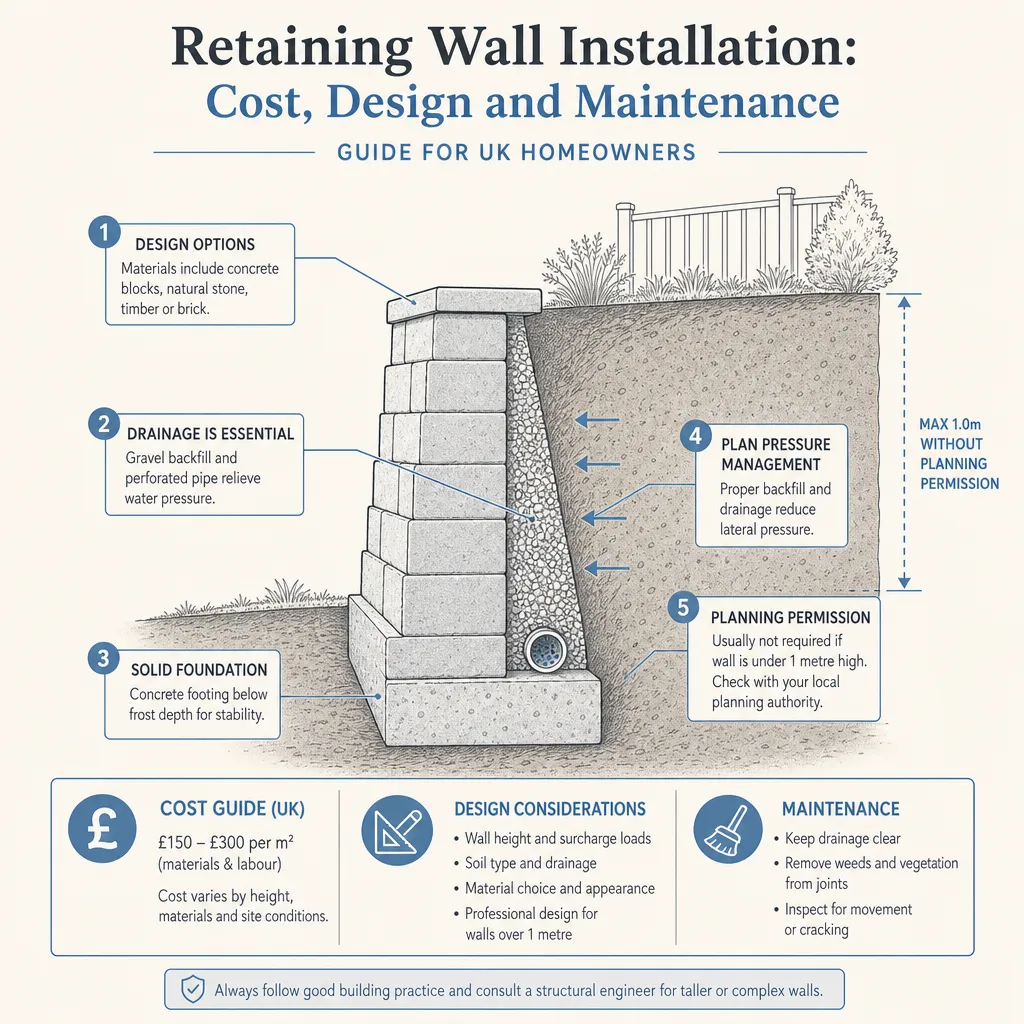
Retaining Wall Installation: Cost, Design and Maintenance
A retaining wall holds back soil on a sloped or banked site.