Underfloor Heating Running Costs and Energy Management
By Housey · Last reviewed 11th of May 2026
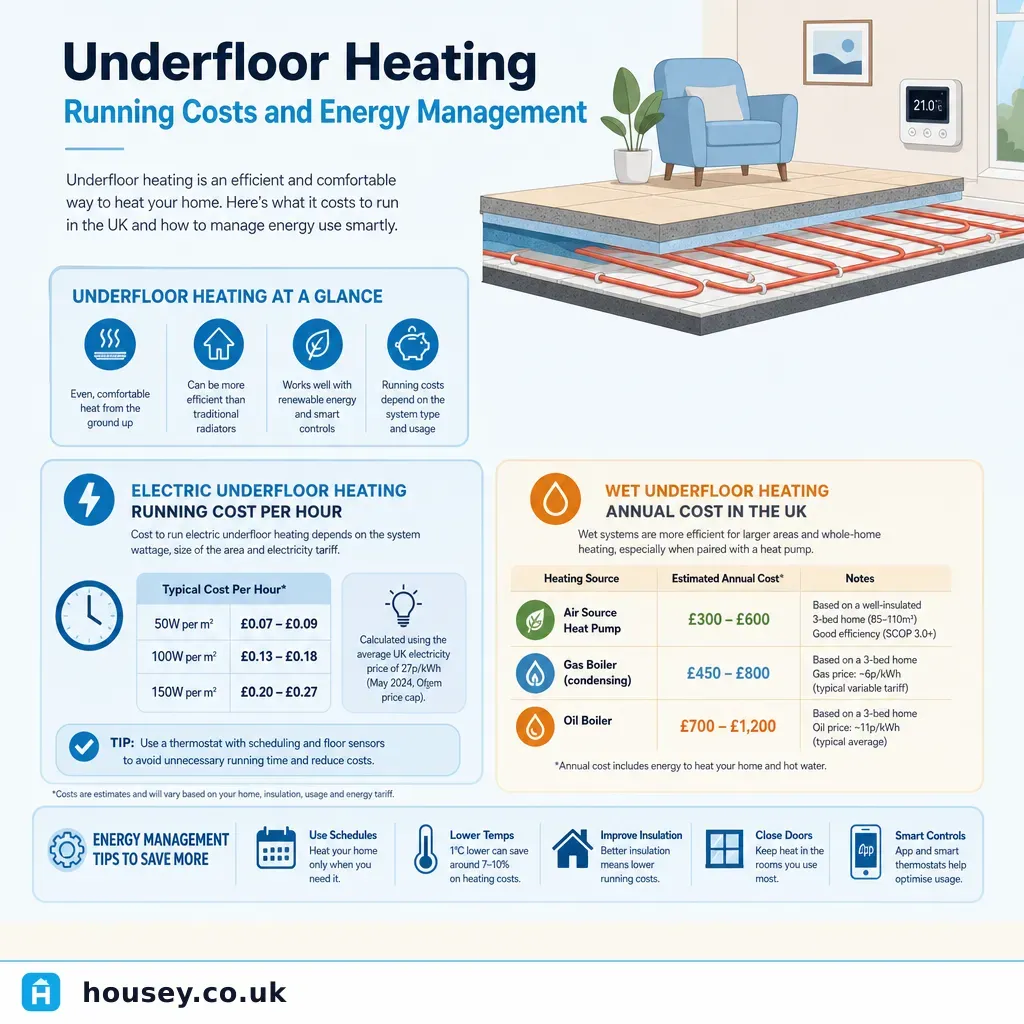
Underfloor Heating Running Costs and Energy Management
Running costs are among the most searched-for questions before any underfloor heating installation, and rightly so — the difference between a well-designed, well-controlled system and a poorly specified one can amount to hundreds of pounds a year on energy bills. UK homeowners face additional complexity because fuel prices change quarterly, heat source efficiency varies widely, and the property's insulation level is a major cost driver.
Key points
- Electric underfloor heating costs approximately 22–34p per kWh to run at early-2026 Ofgem price cap rates; a 10 m² bathroom mat drawing 1.5 kW for 2 hours per day costs roughly £1.50–£2.40 per week.
- Wet UFH paired with a heat pump achieving a SCOP of 3.5 can deliver useful heat at an effective rate of approximately 7–10p per kWh — making it competitive with gas heating per unit of heat delivered.
- The Ofgem energy price cap is revised quarterly; all cost figures in this article are indicative and based on rates applicable in early 2026.
- ECO4 and the Great British Insulation Scheme may fund floor insulation improvements for eligible households, directly reducing UFH heat demand and running costs.
- Smart thermostats and zone controls can reduce UFH energy consumption by 15–30% compared with uncontrolled or poorly zoned systems (Energy Saving Trust).
Wet vs electric underfloor heating: running cost comparison
System type | Fuel | Typical heat cost (2026) | Indicative annual cost (3-bed semi) | Notes |
|---|---|---|---|---|
Wet UFH + gas boiler | Gas | ~4–7p/kWh | £600–£1,200 | Varies significantly with insulation and thermostat settings |
Wet UFH + air source heat pump | Electricity | ~7–10p/kWh of heat (SCOP 3–3.5) | £700–£1,400 | Lower carbon; Boiler Upgrade Scheme grant may offset installation cost |
Wet UFH + ground source heat pump | Electricity | ~5–8p/kWh of heat (SCOP 4–5) | £500–£900 | Highest installation cost; best long-run efficiency |
Electric UFH as primary heating | Electricity | ~22–34p/kWh | £1,500–£3,000+ | Only cost-effective in very well-insulated, small properties |
Electric UFH as supplementary (e.g. bathroom) | Electricity | ~22–34p/kWh | £100–£350 for 1–2 rooms | Common and practical use case |
Indicative UK costs, last reviewed 2026-05-11. Actual costs depend on insulation, climate zone, occupancy, thermostat settings, and current tariff rates. Commission a heat-loss calculation and obtain professional quotes before committing to installation.
What drives underfloor heating running costs?
Heat source and its efficiency
Gas remains cheaper per kWh than electricity at standard tariff rates, but heat pumps deliver 3–5 units of heat per unit of electricity consumed. At wet UFH's low flow temperatures (35–45°C), air source heat pumps typically achieve a SCOP of 3.0–3.5, making the effective cost per unit of useful heat competitive with gas in many cases — and significantly lower in carbon terms.
Property insulation
A poorly insulated home loses heat faster; the UFH system must work harder and run longer. A draughty 1930s semi with uninsulated solid walls can have a heat demand 3–4 times higher than a well-insulated new build of the same floor area. Improving insulation before installing UFH is the single most cost-effective intervention available.
Thermostat settings and controls
Each degree Celsius reduction in thermostat set-point reduces heat demand by approximately 6–8% (Energy Saving Trust). An unzoned system heating the whole house continuously to 21°C costs far more than a smart-zoned system that maintains 18°C in unoccupied rooms and 21°C in occupied zones on a schedule.
Floor finish and build-up
A tiled floor over a well-insulated screed maximises heat transfer efficiency. A thick carpet or dense underlay increases thermal resistance, causing the system to run longer and consume more energy to bring the room to the thermostat set-point.
How to reduce underfloor heating running costs
Optimise the heating schedule
UFH has thermal lag — the floor mass must absorb heat before air temperature rises. Programme the system to begin heating 30–60 minutes before the space is occupied. Avoid relying on manual on/off switching; the energy cost of reheating thermal mass repeatedly from cold is higher than maintaining a setback temperature overnight.
Install zone controls
Divide the system into at least two zones — typically ground floor and upper floor. Each zone should have an independent thermostat. Set unoccupied zones to a setback temperature of 14–15°C rather than switching them off entirely; reheating from very cold costs more energy than holding a low setback.
Consider a time-of-use electricity tariff
For electric UFH systems, an Economy 7, Economy 10, or smart time-of-use tariff can reduce running costs by shifting consumption to off-peak periods. This works best with thermally massive screed floors that store overnight heat for daytime use.
Add solar photovoltaic panels
Excess solar generation can be directed to heat pump operation or electric UFH during daylight hours, reducing the per-kWh cost of heat. An MCS-certified solar installer can specify a diverter device that channels surplus generation to the heating system automatically.
What to ask before accepting a running-cost estimate
Before accepting a supplier's projected annual running cost, ask:
- What insulation specification and heat-loss calculation underpin this estimate?
- What flow temperature and SCOP have you assumed for the heat pump?
- What floor finish and build-up have you allowed for?
- What energy tariff rate have you used, and does it reflect the current Ofgem price cap?
- Does the estimate cover all zones, or only the main living area?
- What thermostat and zone control specification is included in the quote?
- What is the system's designed heat output at the design-day external temperature (typically -3°C for most of England)?
- Is VAT included in the installation quote?
Government support and grants
Several UK government schemes may reduce the cost of installing systems that lower UFH running costs:
- Boiler Upgrade Scheme (BUS): Grants of up to £7,500 towards an air source or ground source heat pump in England and Wales. Check GOV.UK for current figures and eligibility.
- ECO4 (Energy Company Obligation 4): Energy efficiency improvements, including floor insulation, funded by energy suppliers for eligible lower-income households.
- Great British Insulation Scheme: Loft, cavity wall, and solid wall insulation for homes with a lower EPC rating or eligible occupants.
- Home Upgrade Grant (HUG2): Energy efficiency improvements for off-gas-grid homes in England.
Eligibility criteria and funding levels change; check GOV.UK and the Energy Saving Trust for current programme details before assuming eligibility.
When to get professional help
A qualified heating engineer should design and commission any wet UFH system. Seek specialist input if:
- You want accurate projected running costs before committing — ask for a CIBSE-method heat-loss calculation specific to your property.
- You are pairing UFH with a heat pump and want to maximise SCOP and grant eligibility.
- Your existing UFH bills are higher than expected — a heating engineer can check for flow imbalances, faulty actuators, or thermostat configuration faults.
- You are a landlord subject to Minimum Energy Efficiency Standards (MEES) and want to understand whether UFH or insulation improvements count towards EPC rating improvements.
How Housey can help
Housey helps UK homeowners compare quotes from local underfloor heating installers and energy efficiency specialists. Whether you are installing a new system or trying to reduce costs on an existing one, comparing multiple professional quotes is the most reliable way to understand the true running cost for your specific property.
Frequently asked questions
How much does electric underfloor heating cost to run per hour?
A typical 10 m² electric underfloor heating mat draws approximately 1.5–2.0 kW. At the early-2026 Ofgem price cap rate of around 24p per kWh, running costs are approximately 36–48p per hour. A bathroom mat used for 2 hours per day would cost around £2.50–£3.40 per week. Indicative UK costs, last reviewed 2026-05-11; check current Ofgem rates before estimating your bills.
Is wet or electric underfloor heating cheaper to run?
Wet underfloor heating is generally cheaper to run as a whole-house primary heating system, especially when paired with a heat pump. Electric UFH is cost-effective only in small supplementary applications — typically bathrooms or single rooms used intermittently. Running electric UFH as the sole heat source for a full home is very expensive at standard electricity tariff rates and is not recommended for most UK properties.
Does underfloor heating qualify for government grants?
The heat pump element of a wet UFH installation may qualify for the Boiler Upgrade Scheme (up to £7,500 in England and Wales as of 2026). Insulation improvements that reduce UFH running costs may qualify under ECO4 or the Great British Insulation Scheme for eligible households. UFH pipework or electric mats do not attract direct grant funding. Always check current GOV.UK guidance, as eligibility criteria and funding levels change regularly.
Sources and further reading
- Ofgem energy price cap — Ofgem
- Boiler Upgrade Scheme — GOV.UK
- ECO4 scheme — GOV.UK
- Great British Insulation Scheme — GOV.UK
- Heating systems: energy efficiency advice — Energy Saving Trust
Useful next reads
 Energy & Retrofit
Maximising Energy Efficiency: Smart Tips for UK Homes
Improving energy efficiency in a UK home typically starts with draught-proofing and loft insulation — the measures with the fastest payback — before moving to wall insulation, heating system upgrades, and low-carbon technologies such as heat pumps or solar panels.
 Energy & Retrofit
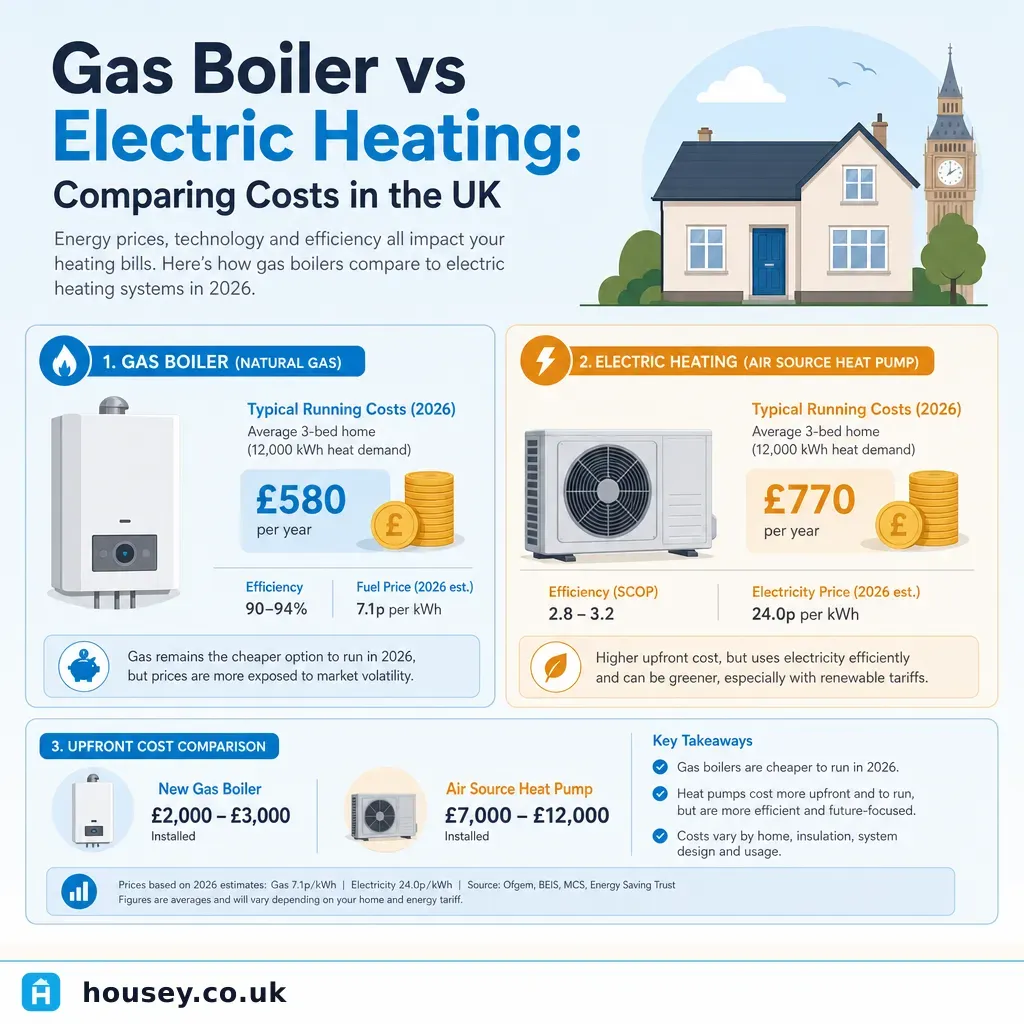
Gas Boiler vs Electric Heating: Comparing Costs in the UK
Gas boilers currently cost around 6.
 Energy & Retrofit
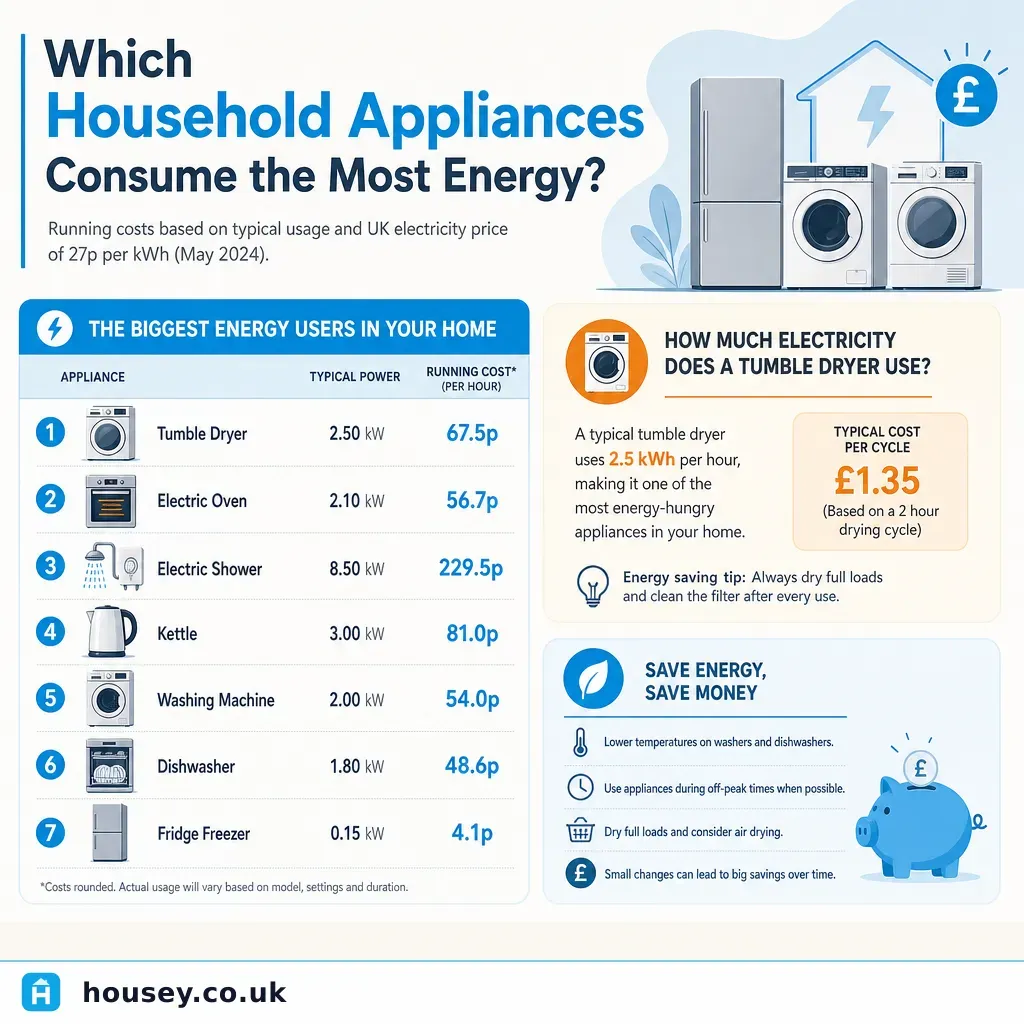
Which Household Appliances Consume the Most Energy?
Tumble dryers, fridge-freezers, and electric showers are typically the biggest electricity consumers in a UK home.
 Energy & Retrofit
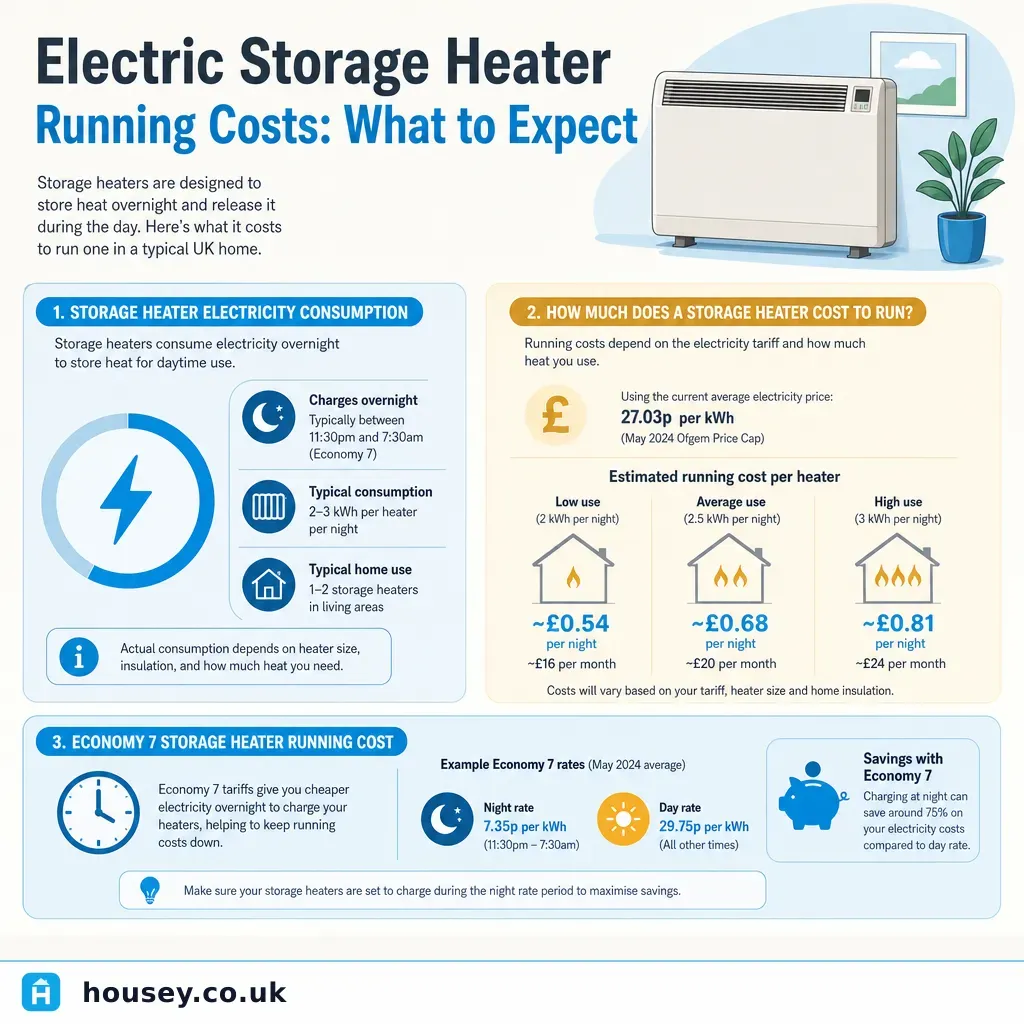
Electric Storage Heater Running Costs: What to Expect
Electric storage heaters typically cost £84–£572 per heater per year to run, depending on size and off-peak tariff rate.
 Energy & Retrofit
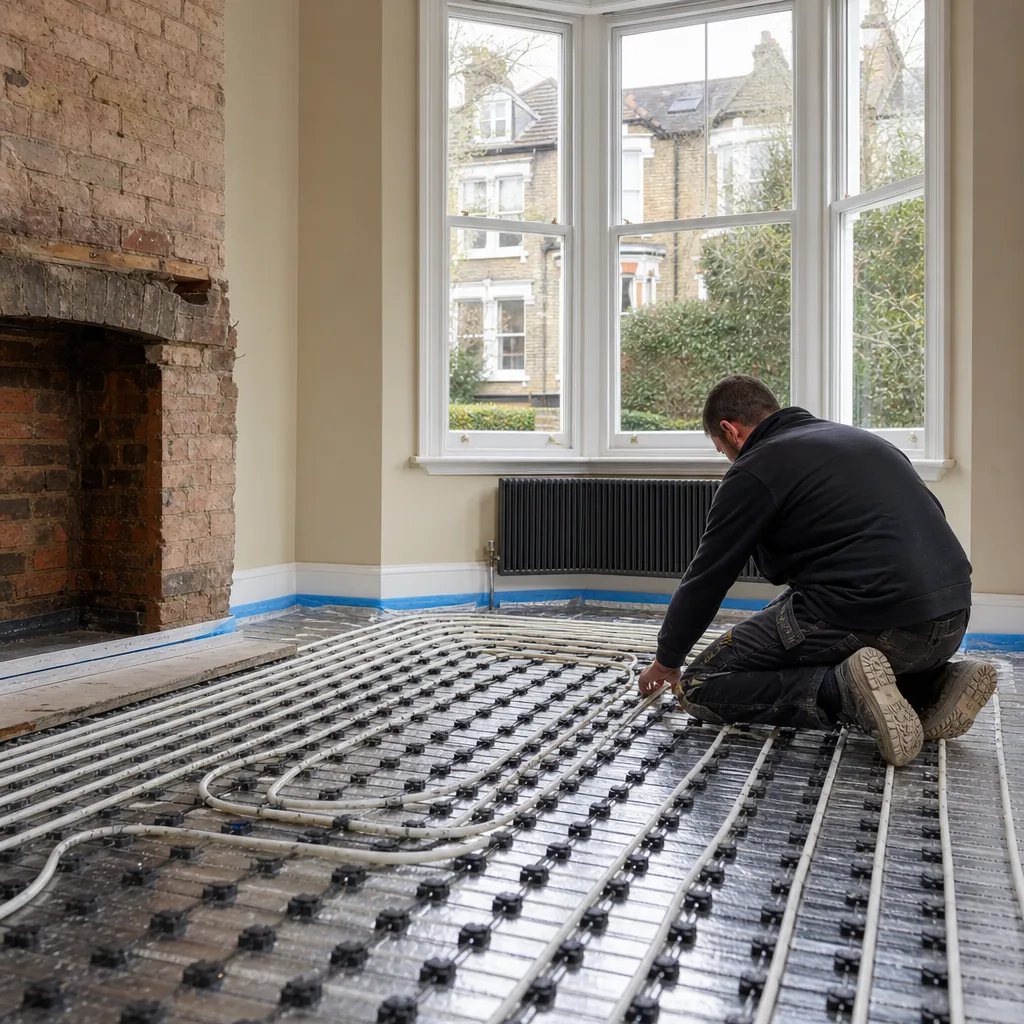
Heating Elements and Radiant Systems in Concrete Floors
Underfloor heating embedded in a concrete floor or screed delivers radiant heat at low flow temperatures (35–50°C), making it highly compatible with heat pumps.