Underfloor Heating Systems: Advantages and Disadvantages
By Housey · Last reviewed 7th of May 2026

Underfloor Heating Systems: Advantages and Disadvantages
Underfloor heating (UFH) is increasingly specified in UK new builds, ground-floor extensions, and whole-house retrofit projects, particularly as interest in heat pumps and low-carbon heating grows. For homeowners weighing UFH against conventional radiators, the decision involves more than comfort preference — it affects running costs, floor construction depth, compatible heat sources, and the practicality of installation in an occupied home.
Key points
- UFH operates in two main forms: wet (hydronic) systems using warm water pumped through embedded pipework, and electric systems using resistance heating cables or mats beneath the floor finish.
- Wet UFH typically operates at flow temperatures of 35–45°C, compared with 70–75°C for traditional radiators, making it significantly more efficient when paired with an air source heat pump (ASHP) or ground source heat pump (GSHP).
- Electric UFH costs less to install but substantially more to run — electricity costs roughly three to four times more per unit than gas under Ofgem's current price cap arrangements.
- Floor build-up for a wet screed system typically adds 70–150 mm of depth depending on insulation, pipe, and screed specification, which must be factored into door heights, step thresholds, and structural loading.
- MCS-certified installers must be used for any heat pump connected to UFH to qualify for the Boiler Upgrade Scheme (BUS) grant, currently £7,500 for eligible ASHP installations in England and Wales.
Wet vs electric underfloor heating: which is right for your home?
The two main UFH technologies differ substantially in how they work, what they cost, and what situations they suit best.
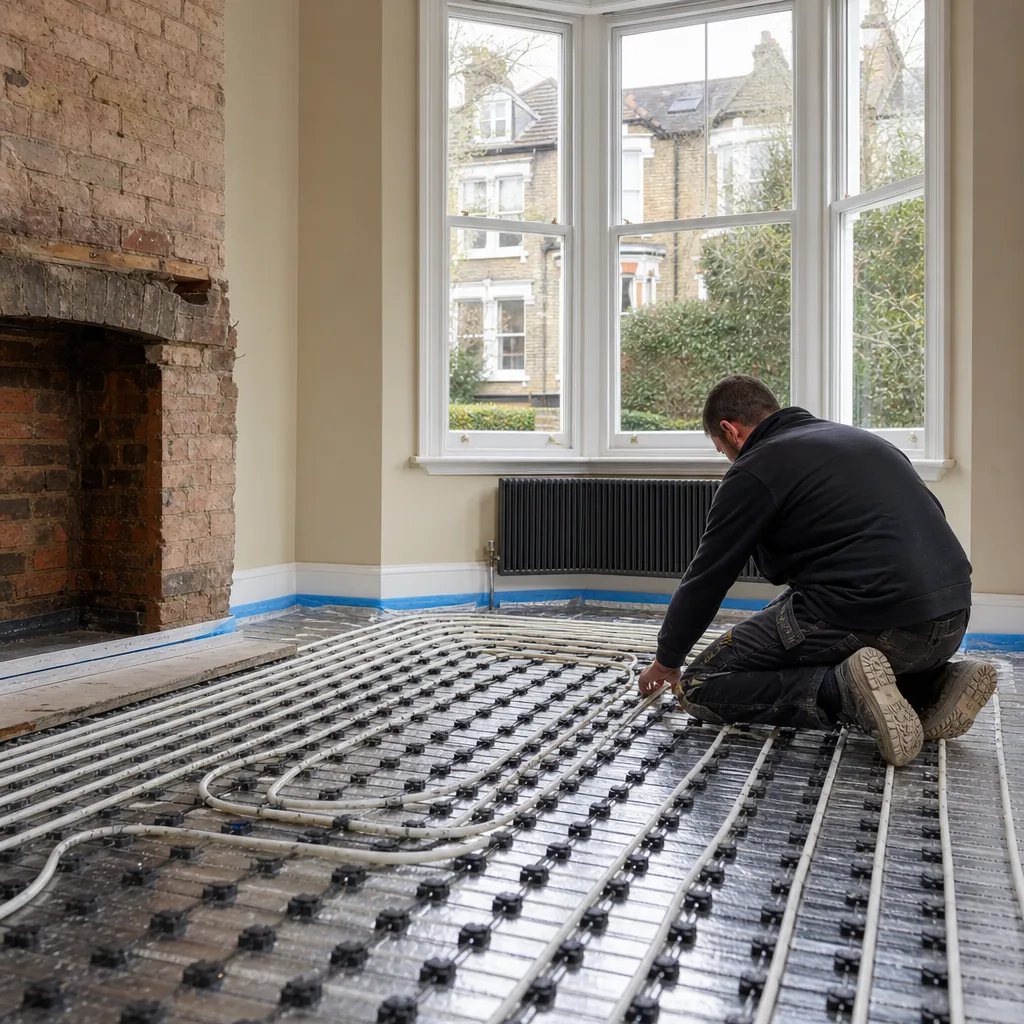
Wet (hydronic) underfloor heating circulates warm water from a boiler, heat pump, or other heat source through plastic pipes (typically polybutylene or cross-linked polyethylene, PEX) embedded in or laid beneath the floor. It is the more efficient option for whole-house or multi-room installations and is the preferred system for use alongside ASHPs and GSHPs, where low flow temperatures are central to efficiency.
Electric underfloor heating uses resistance wires or mats beneath floor coverings. It heats quickly and suits smaller, tile-floored areas such as bathrooms or utility rooms. Installation is simpler and less disruptive, but electricity unit rates make it costly to run as a primary heat source across larger areas.
Feature | Wet (hydronic) UFH | Electric UFH |
|---|---|---|
Upfront installation cost | Higher — pipework, manifold, insulation board, screed or overlay | Lower — mats or cables, straightforward installation |
Running cost | Lower, especially with a heat pump | Higher — electricity costs significantly more per kWh than gas |
Best suited to | Whole rooms, new builds, extensions, heat pump installations | Bathrooms, small rooms, tiled retrofit areas |
Floor build-up | 70–150 mm (screed); 15–25 mm (overlay systems) | Minimal — typically 3–10 mm |
Response time | Slow — 1–2 hours to reach temperature | Faster — 20–40 minutes |
Heat pump compatibility | Excellent — matched to low flow temperatures | Limited benefit — electricity costs offset heat pump savings |
Retrofit suitability | Moderate — requires significant floor work | High — can be laid under most floor finishes |
Advantages of underfloor heating
Even heat distribution. UFH warms the floor surface across an entire room, eliminating cold spots near windows and hot spots adjacent to radiators. Surface temperatures are typically 25–29°C — warm underfoot but not uncomfortable, and lower than a radiator surface.
More usable wall and floor space. Without radiators projecting into rooms, you gain flexibility for furniture placement, fitted kitchens, and built-in storage without designing around heat sources or pipework.
Compatibility with heat pumps. Heat pumps operate most efficiently at lower flow temperatures, and wet UFH is designed to work within exactly that range. The Seasonal Coefficient of Performance (SCOP) of an ASHP is notably higher when connected to a UFH system compared with a high-temperature radiator circuit. For this reason, UFH is routinely included in MCS-certified heat pump system designs.
Potentially improved air quality. Radiators heat air primarily by convection, circulating dust around the room. UFH relies more on radiant warming at floor level, which may benefit those sensitive to airborne dust particles. The extent of this benefit depends on floor type, room ventilation, and household conditions.
Low maintenance once installed. Wet UFH systems have few moving parts. When installed correctly — with appropriate inhibitor dosing, pressure testing, and commissioning — they can operate reliably for many decades. Electric systems require no maintenance beyond occasional thermostat calibration.
Disadvantages and limitations
Slow response time. Wet screed systems take 1–2 hours to reach operating temperature from cold. This makes them well-suited to programmable thermostats and steady background heating rather than rapid on-demand temperature changes. Rooms used intermittently — a study used only on weekends, for example — benefit less from UFH than rooms maintained at a consistent temperature.
Significant floor build-up. A wet screed system adds meaningful depth to the floor construction — typically 70–150 mm when insulation, pipe, and screed are all included. In existing properties, this may require lowering floor levels, raising door thresholds, modifying step heights between rooms, and checking structural loading capacity, particularly on upper timber floors.
Floor covering restrictions. Not all floor finishes transmit heat effectively. Tile and stone are ideal. Engineered wood with a low TOG rating works well. Solid hardwood can be used in some cases but requires careful temperature controls to prevent movement. Thick carpets and high-TOG underlays restrict heat transfer and reduce efficiency. The combined TOG value of carpet plus underlay should not exceed 1.5 TOG for UFH to perform well, and ideally should stay at or below 1.0 TOG.
Higher installation cost and disruption in retrofit. Wet UFH in an existing house is significantly more disruptive and expensive than installing additional radiators. In a ground-floor extension or new build it is cost-effective; retrofitting across multiple rooms in an occupied property usually involves lifting all floor finishes and is rarely straightforward.
Screed drying-in period. After a new sand-and-cement or anhydrite screed is poured, it typically requires 4–6 weeks of curing — including a controlled heating-up programme — before the floor finish can be applied. This affects build programmes and should be factored into project timelines.
Checklist: is underfloor heating right for your project?
Work through these questions before committing to UFH:
What to ask an underfloor heating installer
Before accepting a quote, ask these questions:
- What heat loss calculation method have you used to determine pipe spacing and flow temperature for each room?
- Are you MCS-certified, and will the installation qualify for the Boiler Upgrade Scheme if connected to a heat pump?
- How many zones will the system have, and what manifold specification are you recommending?
- How will the system be commissioned, pressure-tested, and balanced after installation?
- What screed specification do you recommend — depth, type, and drying-in programme — and what are the implications for my build programme?
- Is a blending valve (mixing valve) required to reduce flow temperature if connecting to an existing boiler?
- What warranty covers the pipework, manifold, and thermostatic controls?
- Are there any existing floor or structural constraints that could affect the installation or its performance?
Indicative costs
Indicative UK costs, last reviewed 2026-05-07. Actual costs vary by property, specification, contractor, and region. Always obtain at least three quotes.
- Wet UFH, new screed installation: approximately £50–£100 per m² installed (materials and labour), depending on pipe spacing, screed depth, insulation board, and manifold configuration.
- Wet overlay system (existing house, shallower build-up): approximately £60–£120 per m² installed, reflecting the additional complexity of working around existing finishes.
- Electric UFH mat, bathroom installation: approximately £200–£600 for a typical bathroom, including materials and electrical connection — labour costs vary by location.
- Boiler Upgrade Scheme (BUS) grant: currently £7,500 for eligible ASHP installations in England and Wales — check GOV.UK for current amounts and eligibility conditions, as these are subject to government review.
The BUS grant is only available where the heat pump system is designed and installed by an MCS-certified contractor. Search the MCS certified installer database to find accredited tradespeople in your area.
When to get professional help
Underfloor heating design — particularly when connected to a heat pump — requires a room-by-room heat loss calculation following recognised standards (such as CIBSE or BS EN 12831) to correctly specify pipe spacing, flow temperatures, manifold configuration, and zone controls. An undersized or poorly configured system may fail to reach target temperatures or cause the heat pump to run inefficiently, increasing running costs.
Seek professional input before proceeding if:
- You are combining UFH with a heat pump and have not yet had an MCS-certified pre-installation survey.
- The property is listed or in a conservation area — floor works may require listed building consent.
- The floor structure is timber-suspended rather than concrete — system selection and insulation strategy differ significantly.
- You are retrofitting UFH across multiple rooms in an existing property and need reliable cost and disruption estimates before making a decision.
- The existing boiler is being retained and you are unsure whether it can deliver the flow temperatures and controls UFH requires.
How Housey can help
If you are considering underfloor heating as part of a heat pump installation or wider energy retrofit, Housey can connect you with MCS-certified professionals and qualified consultants. Request a heat pump survey to understand whether your property is well-suited to UFH and a heat pump together, or speak to an energy-efficiency consultant who can advise on whole-system design, compatible heat sources, and which rooms will benefit most.
Frequently asked questions
Can I install underfloor heating in an existing house?
Yes, but the practicalities depend on the system type. Electric UFH mats can be installed under thin floor coverings with minimal disruption. Wet screed UFH in an existing house means lifting all floor finishes, pouring new screed, and allowing 4–6 weeks of curing — practical for a full renovation but disruptive otherwise. Wet overlay systems at 15–25 mm depth offer a less disruptive retrofit option for some rooms.
Does underfloor heating work with a combi boiler?
Wet UFH can be connected to a combi boiler, but most combi boilers are designed to deliver higher flow temperatures suited to radiators. A blending valve (mixing valve) is typically needed to reduce the flow temperature to the 35–45°C range UFH requires. A heating engineer can assess whether your existing boiler is compatible and what controls and blending equipment would be needed.
Is underfloor heating more efficient than radiators?
Wet UFH at low flow temperatures is generally more efficient than radiators when paired with a heat pump, because the heat pump's Seasonal Coefficient of Performance (SCOP) increases significantly at lower flow temperatures. With a gas boiler, the efficiency advantage over radiators is smaller. Electric UFH is generally less efficient overall, as electricity costs substantially more per kWh than gas.
What floor coverings work best with underfloor heating?
Tile, stone, and polished concrete are the most effective as they conduct and radiate heat well. Engineered wood and luxury vinyl tile also work well when manufacturer-rated for UFH. Solid hardwood requires careful temperature controls. The combined TOG value of carpet plus underlay should typically not exceed 1.5 TOG — and ideally remain at or below 1.0 TOG — for efficient UFH operation.
Do I need planning permission for underfloor heating?
Underfloor heating itself does not usually require planning permission. However, if the work forms part of a project that does require permission — such as an extension — the overall project needs the relevant approvals. Listed building consent may be required if floor works affect original fabric in a listed building. Always check with your local planning authority if the property is listed or in a conservation area.
Sources and further reading
- Boiler Upgrade Scheme: guidance for homeowners — GOV.UK
- MCS certified installer database — Microgeneration Certification Scheme
- Heat pumps explained — Energy Saving Trust
- Energy price cap information for households — Ofgem
- Building Regulations Approved Document L: Conservation of fuel and power — GOV.UK
Useful next reads
 Energy & Retrofit
Heating Elements and Radiant Systems in Concrete Floors
Underfloor heating embedded in a concrete floor or screed delivers radiant heat at low flow temperatures (35–50°C), making it highly compatible with heat pumps.
 Energy & Retrofit
Common Home Heating Mistakes: Efficiency and Safety
The most common heating mistakes UK homeowners make include setting the boiler flow temperature too high, assuming constant low heat is cheaper than a timed programme, and neglecting annual Gas Safe servicing.
 Energy & Retrofit
Gas Boiler vs Electric Heating: Comparing Costs in the UK
Gas boilers currently cost around 6.
 Energy & Retrofit
Reducing Heating Costs Through Property Energy Efficiency
Reducing heating costs starts with identifying where heat is lost — typically walls (30–35%), roof (20–25%), and windows.
 Energy & Retrofit
Gas vs Electric Heating: Installation and Running Cost Comparison
Gas central heating usually has lower running costs per kWh than direct electric heating in the UK, though heat pumps can change that equation.