Underfloor Heating Systems for Modern and Renovated Homes
By Housey · Last reviewed 30th of May 2026
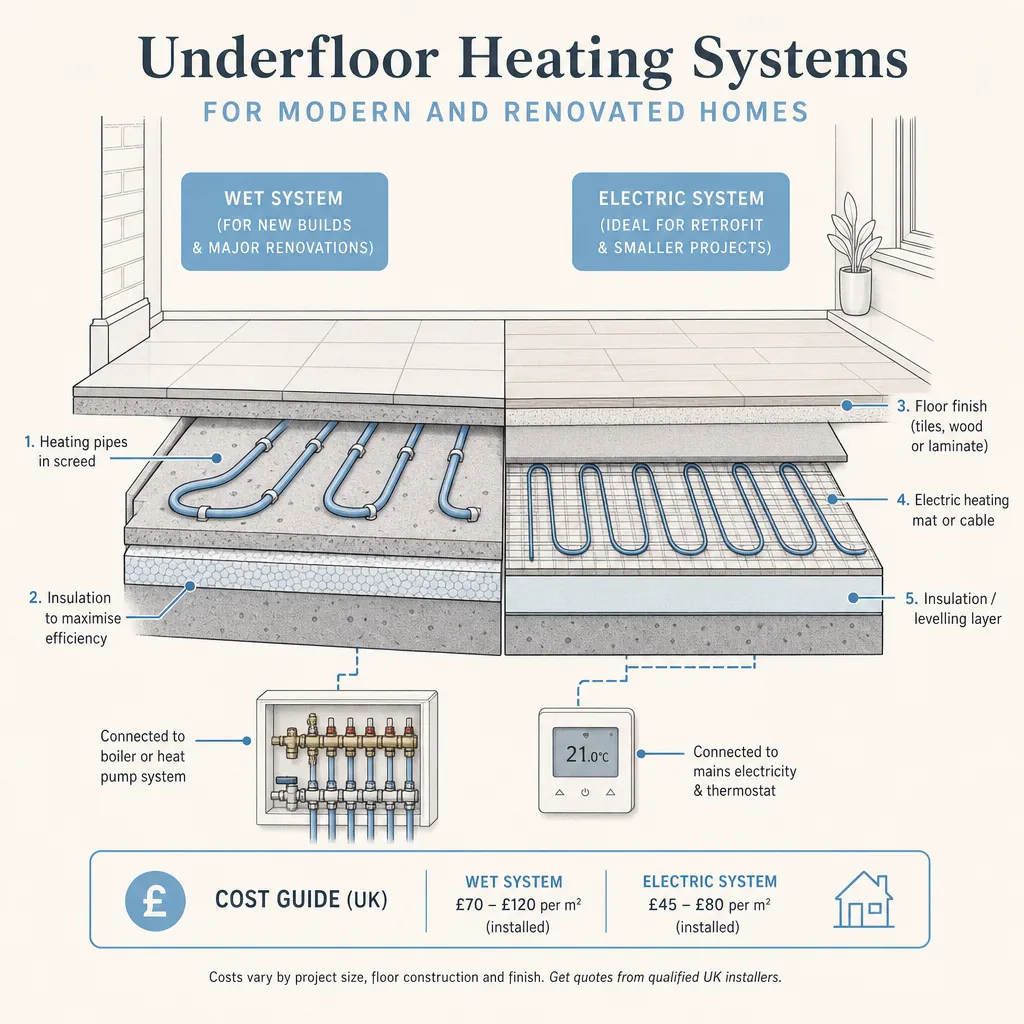
Underfloor Heating Systems for Modern and Renovated Homes
Underfloor heating frequently comes under consideration during a renovation or extension, particularly when a new floor build-up creates the opportunity to lay either electric heating mats or wet pipe systems beneath the finished surface. The decision between the two types — and how they interact with the property's heat source, insulation, and chosen floor finish — has lasting implications for comfort and running costs throughout the life of the home.
Key points
- Electric underfloor heating systems typically trigger Part P of the Building Regulations in England and Wales when a new circuit is required; the work must be carried out by a Part P-registered electrician or notified to building control.
- Wet (hydronic) underfloor heating connected to a boiler or heat pump falls under Building Regulations Part L (energy efficiency); where a gas connection is involved, a Gas Safe registered engineer must carry out the installation.
- Wet UFH operates most efficiently at low flow temperatures of 35–45°C, making it well matched to air source heat pumps, which themselves operate most efficiently when delivering low-temperature output.
- Screed depth affects heat-up time: a standard 65–75 mm sand-cement screed over wet UFH pipes typically takes 1–2 hours to reach operating temperature; thinner anhydrite liquid screeds (around 50 mm) heat up more quickly.
- Floor finish thermal resistance (tog rating) directly affects UFH output — stone and ceramic tiles are the most efficient surface for UFH; thick carpet with a high-tog underlay significantly reduces the heat that reaches the room.
Electric vs wet (hydronic) underfloor heating
Feature | Electric UFH (mat or cable) | Wet (hydronic) UFH |
|---|---|---|
Installation complexity | Lower — mat or cable laid under tiles or within screed | Higher — requires pipe manifold, pressure testing, and screed |
Indicative installed cost (2026) | £50–£150/m² typical range | £100–£200/m² for screed systems |
Running costs | Higher — electric resistance heating | Lower — especially paired with a heat pump or efficient boiler |
Best suited to | Single rooms, retrofit with limited floor build-up, bathrooms and kitchens | Whole-house or multi-room installations, new builds, heat pump systems |
Heat-up time | Fast — 15–30 minutes for most mats | Slower — 1–3 hours for screeded systems |
Maintenance | Minimal — no moving parts | Periodic: manifold checks, inhibitor levels, flow balancing |
Additional floor build-up | Minimal (mat: approximately 3–4 mm under tile adhesive) | 65–150 mm including insulation and screed |
Key regulatory notifications | Part P if a new electrical circuit is required | Part L; Gas Safe if gas-connected; MCS if heat-pump connected |
Indicative UK costs, last reviewed 2026-05-30. Costs vary by floor area, specification, property type, and regional labour rates. Obtain at least three quotes.
Which system suits your home?
- Choose electric UFH if you are retrofitting a single room — particularly a bathroom or kitchen — the floor build-up must remain minimal, or the space is already well insulated and the system is supplementary rather than the primary heat source.
- Choose wet UFH if you are installing across multiple rooms or the whole house, you are connecting to a heat pump (which operates most efficiently at the low flow temperatures UFH requires), or you are undertaking a substantial renovation with an exposed floor structure.
- Ask a heating engineer or retrofit coordinator if your home has poor insulation — solid walls, limited loft insulation, or single glazing — before committing to UFH as the primary heat source. An undersized or poorly matched system will underperform and cost more to run.
- Check your floor structure before specifying: suspended timber floors require specialist UFH systems designed for joist installation, and are less thermally efficient than solid-floor or screeded installations.
- Confirm Building Regulations compliance with your installer before work begins — new electrical circuits and connections to the main heating system both trigger notification or registered competent person requirements.
Underfloor heating in a renovation: key considerations
Retrofitting UFH into an existing home presents challenges that are not present in a new build.
Floor build-up and thresholds Adding 65–150 mm of floor build-up — insulation, screed, and floor finish — raises finished floor levels throughout the affected area. This affects door thresholds, skirting boards, radiator pipework heights, and kitchen unit plinths. In a whole-house renovation this is manageable through co-ordinated detailing; in a single-room retrofit it requires careful transition planning at door openings.
Insulation beneath the system UFH without adequate insulation below it heats downwards into the slab or subfloor rather than upwards into the room. Building Regulations Part L and accepted good practice both require appropriate insulation — typically 25–100 mm of rigid foam board (PIR or EPS) depending on ground condition, floor construction, and available build-up depth.
Manifold location Wet UFH systems need a central manifold — typically housed in a utility room, understairs cupboard, or purpose-built manifold cabinet. The manifold controls water flow to each heating loop and must remain accessible for balancing, inhibitor checks, and long-term maintenance. Planning its position early simplifies pipework routing substantially.
Compatibility with heat pumps An air or ground source heat pump is most efficient when delivering low-temperature water — exactly the operating condition that wet UFH is designed for. If a heat pump is part of the same project, the UFH system should be designed to MCS (Microgeneration Certification Scheme) standards, which require room-by-room heat loss calculations. The installer must be MCS-certified, or work closely alongside an MCS-certified contractor, to qualify for government incentives such as the Boiler Upgrade Scheme.
A worked example: 1930s semi-detached renovation
A homeowner undertaking a full ground-floor renovation of a 1930s semi-detached property in the East Midlands replaces a suspended timber floor — damaged by joist rot — with a new concrete slab. The architect specifies 100 mm PIR insulation board, a 65 mm anhydrite liquid screed, and wet UFH pipework throughout the ground floor covering kitchen, sitting room, hallway, and dining room — approximately 60 m² in total — connected to a new air source heat pump.
The UFH contractor pressure-tests all pipework before the screed is poured. The heating engineer commissions the manifold at a 40°C flow temperature. Ceramic floor tiles, with a low tog rating, are specified throughout to maximise heat output efficiency.
The heat pump installation is MCS-certified, allowing the homeowner to apply to the Boiler Upgrade Scheme (current grant amounts and eligibility must be confirmed at GOV.UK at the time of application, as these change). The installer provides a balancing report, a commissioning certificate, and a full manifold schematic — documents retained with the property records and referenced at resale.
What to ask before accepting a quote
- What type of system (electric or wet) do you recommend for my specific floor construction and heat source, and why?
- What insulation is included, and does the specification meet Building Regulations Part L requirements?
- Who will carry out the electrical connections (electric UFH) or heat source connection (wet UFH), and what qualifications do they hold?
- If a heat pump is involved now or in the future, is the system designed to meet MCS heat loss calculation requirements?
- What floor finishes are compatible, and what is the maximum tog rating the system supports?
- How will each room be controlled — is a programmable thermostat per zone included in the quote?
- What commissioning documentation and product warranty will I receive on completion?
- Is VAT included in the quoted price, and at what rate?
- What happens if the floor build-up creates conflicts with door thresholds or fitted kitchen units?
When to get professional help
- Always use a Part P-registered electrician for any new electrical circuits serving electric UFH systems.
- Always use a Gas Safe registered engineer for work on gas-connected wet UFH systems.
- Seek advice from a qualified heating engineer or retrofit coordinator before specifying UFH as the primary heat source in a poorly insulated or solid-wall home — a heat loss calculation is essential to confirm the system will meet demand.
- If connecting wet UFH to a heat pump, an MCS-certified installer or close collaboration with one is required to qualify for the Boiler Upgrade Scheme and other government incentives.
- If the property is listed or in a conservation area, check with your local planning authority whether floor alterations require listed building consent before work begins.
How Housey can help
Housey connects UK homeowners with qualified heating engineers, UFH specialists, and retrofit professionals. Whether you are planning a wet underfloor heating system for a new ground-floor extension or looking to retrofit electric mats in a bathroom, you can use Housey to request quotes from experienced local installers and compare them clearly before committing to work.
Frequently asked questions
Is underfloor heating suitable for all floor types?
Most floor types can be used with UFH, but thermal resistance is the key variable. Stone, ceramic, and porcelain tiles work best due to their low thermal resistance. Engineered timber can be suitable if it carries a UFH compatibility mark and is installed at the correct moisture content. Solid wood and thick carpet with high-tog underlay are generally not recommended for wet UFH systems.
Can underfloor heating replace radiators entirely?
In a well-insulated modern or recently upgraded home, yes — UFH can be the sole heat source with no radiators. In older homes with significant heat loss through solid walls or single glazing, UFH output may need supplementing, particularly in the coldest rooms. A room-by-room heat loss calculation by a qualified heating engineer will confirm whether UFH alone meets demand.
Does underfloor heating need regular maintenance?
Electric UFH requires very little maintenance. Wet UFH needs periodic attention: inhibitor concentration in the system water should typically be tested annually, and manifold flow rates balanced as required. A service arrangement with a qualified heating engineer is advisable for whole-house wet systems connected to a heat pump or boiler.
How long does underfloor heating last?
Electric UFH mats and cables typically carry 25-year manufacturer warranties. Wet UFH pipework — usually cross-linked polyethylene (PEX or PEX-a) — is similarly long-lived if correctly installed and water chemistry is maintained. Manifold assemblies and thermostatic controls typically have shorter operational lifespans and may need replacement after 15–20 years.
Can I install underfloor heating myself?
Electric UFH mats in a bathroom, connected to an existing circuit, can be a DIY project for a competent homeowner. However, any new electrical circuit requires a Part P-registered electrician or building control notification. Wet UFH installation — including pressure testing, manifold commissioning, and co-ordinating screed curing times — is a professional task in virtually all cases.
Sources and further reading
- GOV.UK: Building regulations — Part L (conservation of fuel and power) — energy efficiency requirements for heating systems in dwellings
- GOV.UK: Building regulations — Part P (electrical safety in dwellings) — notifiable electrical work requirements
- Gas Safe Register — legally required registration for gas engineers in Great Britain
- MCS — Microgeneration Certification Scheme — installation standards for heat pumps and low-carbon heating
- GOV.UK: Boiler Upgrade Scheme — government grant for heat pump and biomass boiler installations
- Energy Saving Trust — independent guidance on heating system choices for UK homes
Useful next reads
 Improvement & Build
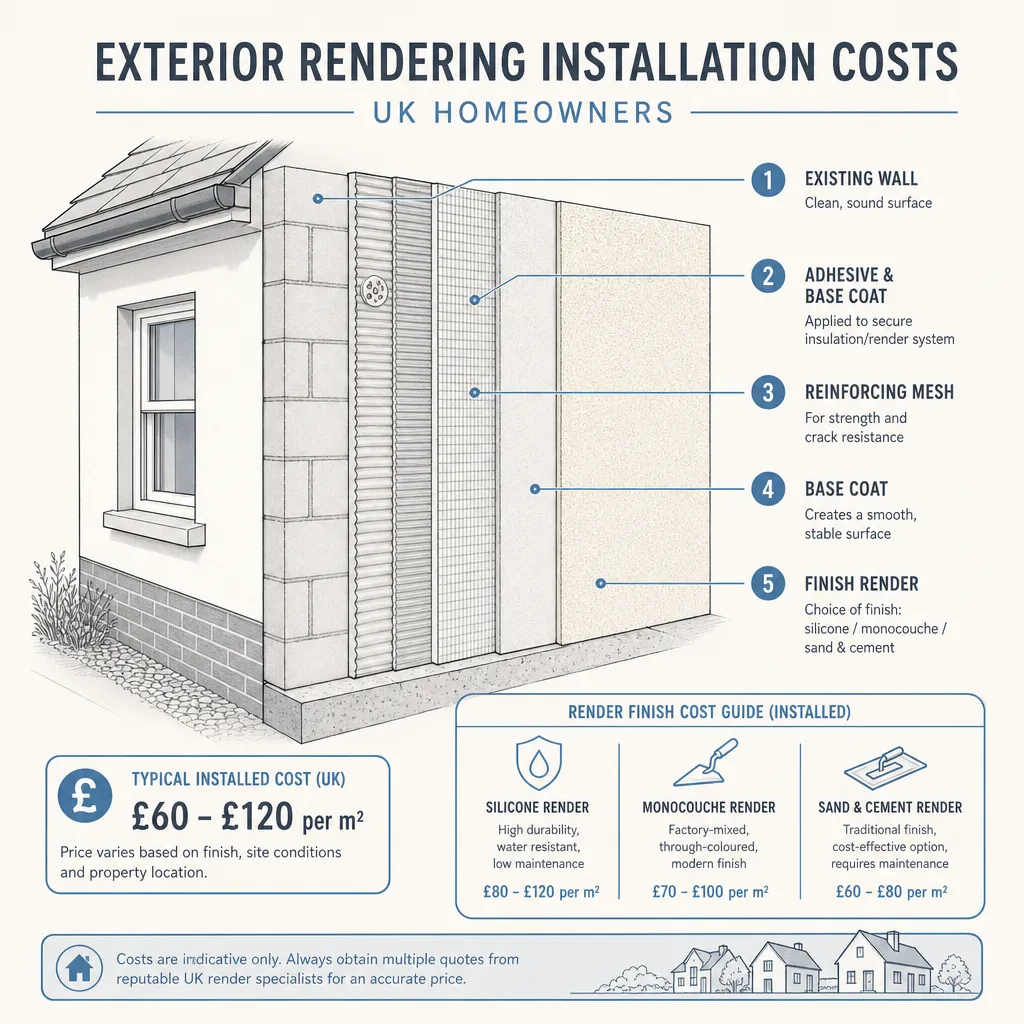
Exterior Rendering Installation Costs
Exterior rendering in the UK typically costs £20–£60 per square metre for standard render systems, or £80–£150 per square metre for External Wall Insulation with a render finish.
 Improvement & Build
Designing an outdoor kitchen for entertaining and garden living
An outdoor kitchen in a UK garden needs a stable, level base — typically a concrete slab or quality paving — with weather-rated materials such as stainless steel grade 316 or frost-rated porcelain.
 Improvement & Build
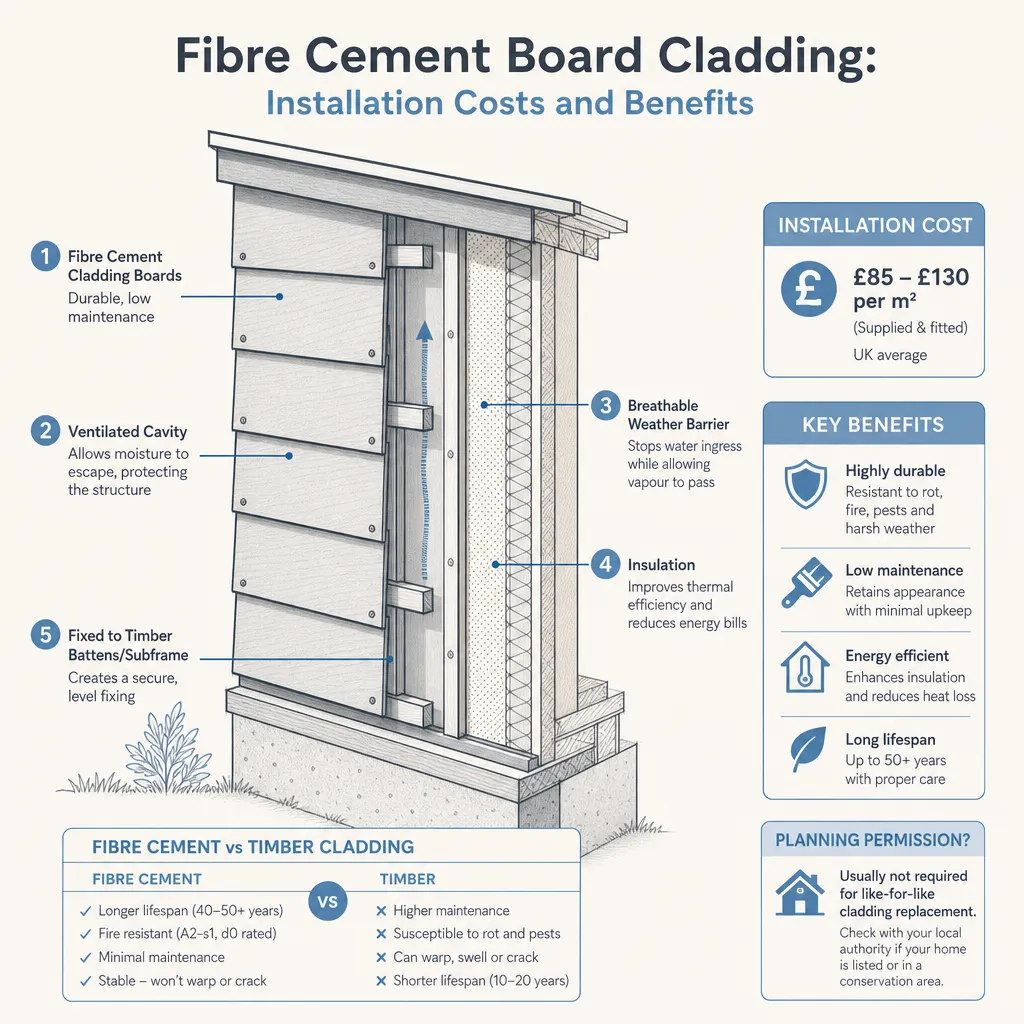
Fibre Cement Board Cladding: Installation Costs and Benefits
Fibre cement board cladding typically costs £80–£180 per m² installed in the UK, including boards, battens, breather membrane, and labour.
 Improvement & Build
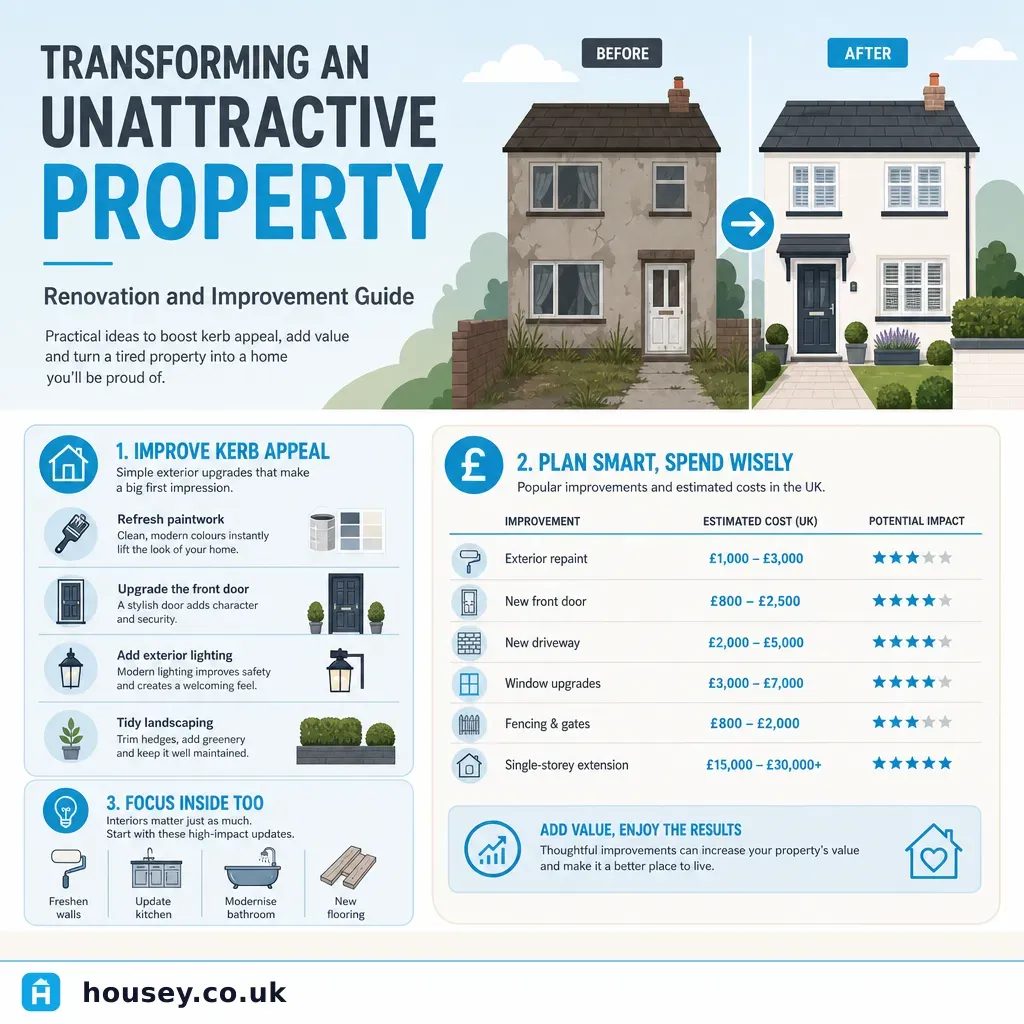
Transforming an Unattractive Property: Renovation and Improvement Guide
Transforming an unattractive UK property usually starts with surface-level improvements — render, windows, doors, and front landscaping — before tackling structural changes like extensions.
 Improvement & Build
London Property Renovation: Complete Modernisation Case Study
Modernising a London property means navigating conservation area restrictions, party wall obligations, and Building Regulations alongside the build work itself.