Understanding Extension Costs: Labour Expenses and Budget Variations
By Housey · Last reviewed 9th of May 2026
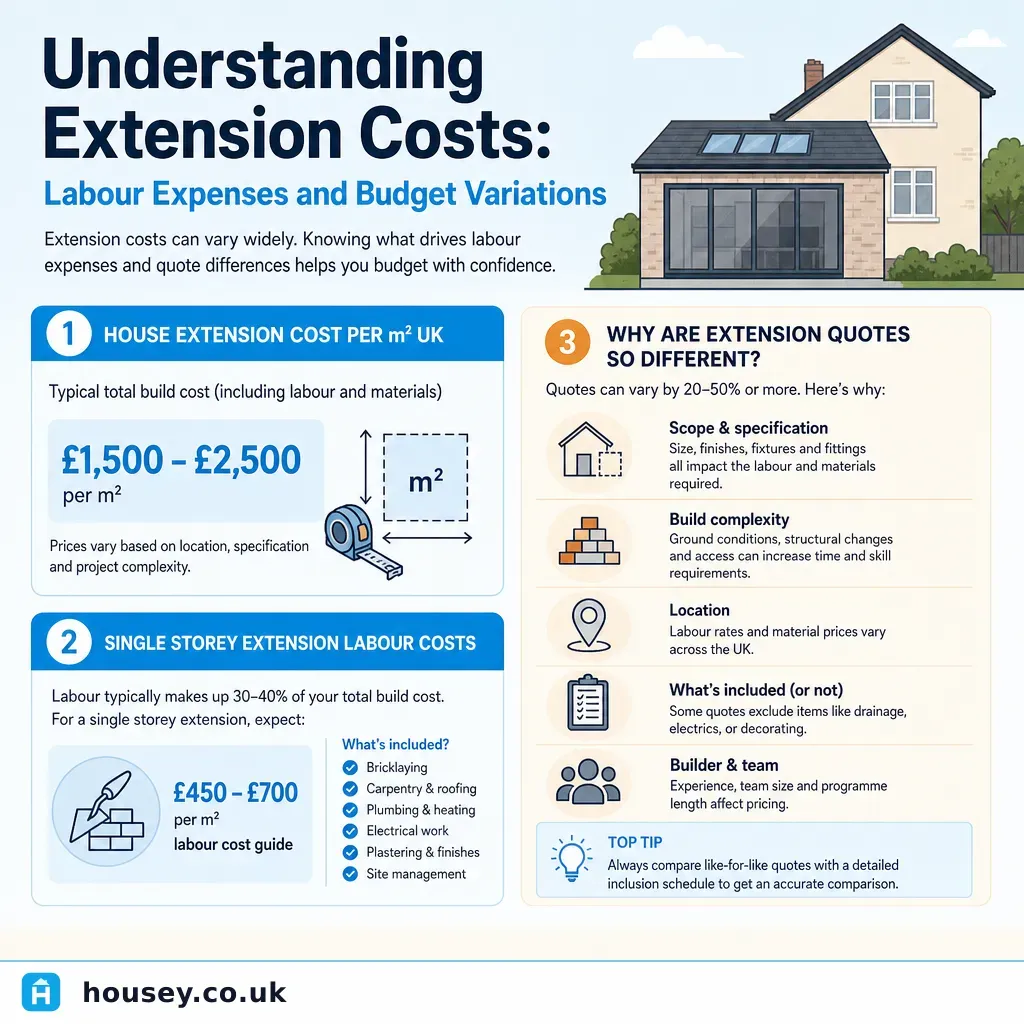
Understanding Extension Costs: Labour Expenses and Budget Variations
Most homeowners planning a house extension arrive with a rough budget and find the actual cost shaped by variables that only emerge once a builder or quantity surveyor has assessed the specific project and site. The gap between the lowest and highest quotes for the same job can run to tens of thousands of pounds. Understanding why costs vary is at least as useful as knowing the headline figures before approaching contractors.
Key points
- Labour typically represents 40–60% of total extension cost; heavily specified builds with premium glazing, underfloor heating, or bespoke joinery shift the balance toward materials.
- A single-storey rear extension in England costs approximately £1,500–£2,500 per square metre in total (labour plus materials, excluding VAT and professional fees); London and the South East add roughly 20–40%.
- Building Regulations approval is required for most extensions regardless of planning permission status; drawings, structural calculations, and building control fees are separate budget items.
- VAT at 20% applies to most new-build extension work; HMRC's VAT Notice 708 sets out limited circumstances where the 5% reduced rate may apply — confirm with your builder and verify independently.
- A contingency of 10–15% of build cost is industry-standard advice; groundworks in particular carry a high risk of unforeseen conditions that generate variation orders.
What drives labour costs in a house extension
Labour costs reflect the range of trades required over a project typically spanning 12–24 weeks for a standard single-storey build. The main drivers are:
Trade mix and sequencing. A standard extension involves groundworkers, bricklayers, carpenters, roofers, plasterers, electricians, and plumbers. The balance shifts with design: a lantern-roof extension uses more glazing labour; a solid-wall build more bricklaying time.
Location. Builders in London and the South East typically charge 20–40% more than regional equivalents to reflect higher overheads and local demand. A groundworker at £250 per day in the Midlands may charge £400 per day in central London.
Site access and ground conditions. Restricted rear access, sloping ground, or significant excavation adds groundworks time and cost. Discovering clay shrinkage, tree root protection zones, or shallow service runs during excavation can generate material variation orders that were not in the original price.
Structural complexity. Extensions requiring steel beams to create wide openings, or involving underpinning, add specialist steelwork and groundworks cost. Building control requires structural engineering calculations before approving this work.
Specification. Underfloor heating, aluminium bi-fold doors, lantern roofs, and bespoke joinery all require more skilled labour and longer installation times than standard specification.
Extension type cost comparison
Indicative total costs (labour plus materials, excluding VAT, professional fees, and external works reinstatement) for England and Wales.
Extension type | Indicative total per m² | Labour share | Key variables |
|---|---|---|---|
Single-storey rear — brick, pitched roof | £1,500–£2,200 | 45–55% | Foundation depth, soil type, window count |
Single-storey rear — flat roof or glazed | £1,800–£2,600 | 40–50% | Glazing spec, flat roof system quality |
Two-storey side or rear | £1,700–£3,000 | 40–55% | Party wall requirements, structural steelwork |
Wrap-around extension | £2,000–£3,500 | 45–55% | Corner junction, beam requirement, roofer complexity |
Garage conversion | £800–£1,500 | 50–60% | Insulation upgrade, window and door changes |
Basement extension | £3,000–£6,000+ | 50–65% | Waterproofing system, underpinning, spoil removal |
Indicative UK costs, last reviewed 2026-05-09. Exclude VAT, architect or technologist fees, structural engineering calculations, building control fees, party wall surveyor fees, and landscaping. London and South East: add approximately 20–40%. Source: RICS Building Cost Information Service (BCIS); Housey market data.
Why quotes vary so much between builders
Different scope assumptions. One builder may assume standard strip foundations; another may allow for piled foundations based on local soil knowledge. Inclusion or exclusion of kitchen connection works, window supply, or external reinstatement creates significant differences that are not always visible in a headline figure.
Subcontractor mark-ups. Builders who subcontract specialist trades build a margin on the subcontractor rate. This varies considerably between firms and is rarely itemised.
Contingency inclusion. An experienced builder who is aware of ground risk will build contingency into their price. A dramatically low quote may have omitted it entirely, creating risk of significant variation orders during the build.
Profit margin and workload. A builder with a full order book will price at a higher margin than one seeking to fill a quiet period. Both quotes may reflect genuine cost structures.
Budget-planning checklist for homeowners
Use this before requesting build quotes to ensure your budget accounts for all likely cost lines.
What to ask before accepting a quote
When comparing quotes, ask each builder:
- What is specifically included and excluded from this price?
- What foundation specification have you assumed, and on what basis?
- Who will carry out each trade — directly employed or subcontracted?
- Does the price include building regulations inspections and the completion certificate?
- How are variations to the agreed scope priced, and what is the change-control process?
- What are the proposed programme and payment milestone stages?
- Is VAT included in the quoted price, and at what rate?
- What happens if groundworks reveal unexpected conditions — how will additional cost be calculated and agreed?
- Can you provide references from similar extension projects completed within the last 12 months?
When to get professional help
Professional input before going to builders for quotes will typically save money at the build stage. Consider instructing:
- An architect or architectural technologist to prepare planning and building regulations drawings that reduce ambiguity and give all builders the same specification to quote against.
- A structural engineer for any extension involving steel beams, underpinning, or changes to the building's load path — building control requires stamped calculations before approving the work.
- A build cost estimator or quantity surveyor for an independent cost check before builder quotes, particularly for projects above £100,000.
- A project manager if you cannot commit the time to coordinate trades, manage the programme, and handle variation orders.
Red flags that warrant caution:
- No written contract or payment schedule before work starts.
- Requests for the full project cost upfront or cash-only payment.
- A quote dramatically below all others with no clear explanation of what has been excluded.
- A builder who cannot produce public liability insurance documentation on request.
- Groundworks starting before a building regulations application has been submitted.
How Housey can help
Housey connects homeowners with vetted professionals across the extension process. Whether you need extension builders for the main build, a professional build cost estimating service to validate your budget before going to tender, structural engineering input for beam or foundation design, or a project manager to coordinate the whole job, you can request quotes from relevant providers through Housey.
Frequently asked questions
How much does labour alone cost for a single-storey rear extension?
Labour-only costs for a standard single-storey rear extension typically range from £700–£1,400 per square metre, depending on location and complexity. Most builders quote on a supply-and-fix basis, so obtaining a labour-only price requires a clear materials specification from your architect or architectural technologist.
Do I need a structural engineer for an extension?
Most extensions involving removal of a load-bearing wall, a steel beam, or an opening wider than approximately 1.8m require structural engineering calculations. Building control will not approve the work without them. Even without beams, a structural engineer may be needed to specify foundations if ground conditions are uncertain or the site has a history of subsidence.
Can I reduce costs by managing the project myself?
Self-managing can save 10–20% in main contractor margin, but requires coordinating multiple trades, managing variation orders, and handling programme delays. Sequencing errors — plasterers arriving before electrical first-fix is complete — can cost as much as the margin saved. It suits available homeowners with some construction knowledge and time to commit throughout the build.
How long does a single-storey extension take to build?
A single-storey rear extension of 20–30m² typically takes 12–20 weeks from start on site to practical completion, excluding the pre-construction phase (design, planning, building regulations approval), which commonly adds 3–6 months. Groundworks and wet trades are most weather-dependent and most likely to extend the programme.
Is VAT charged at 20% on all extension work?
Most new-build extension work is standard-rated at 20%. HMRC's VAT Notice 708 sets out limited circumstances where the 5% reduced rate applies — primarily certain conversions or alterations to qualifying buildings. Your builder should confirm the applicable rate in writing before work starts; verify this against HMRC guidance or seek tax advice on larger projects.
Sources and further reading
- VAT Notice 708: Buildings and Construction — HMRC
- Building regulations approval guidance — GOV.UK
- RICS Building Cost Information Service (BCIS) — RICS
- Party Wall etc. Act 1996: explanatory booklet — GOV.UK / MHCLG
- Planning Portal: Extensions guidance — Planning Portal
Useful next reads
 Improvement & Build
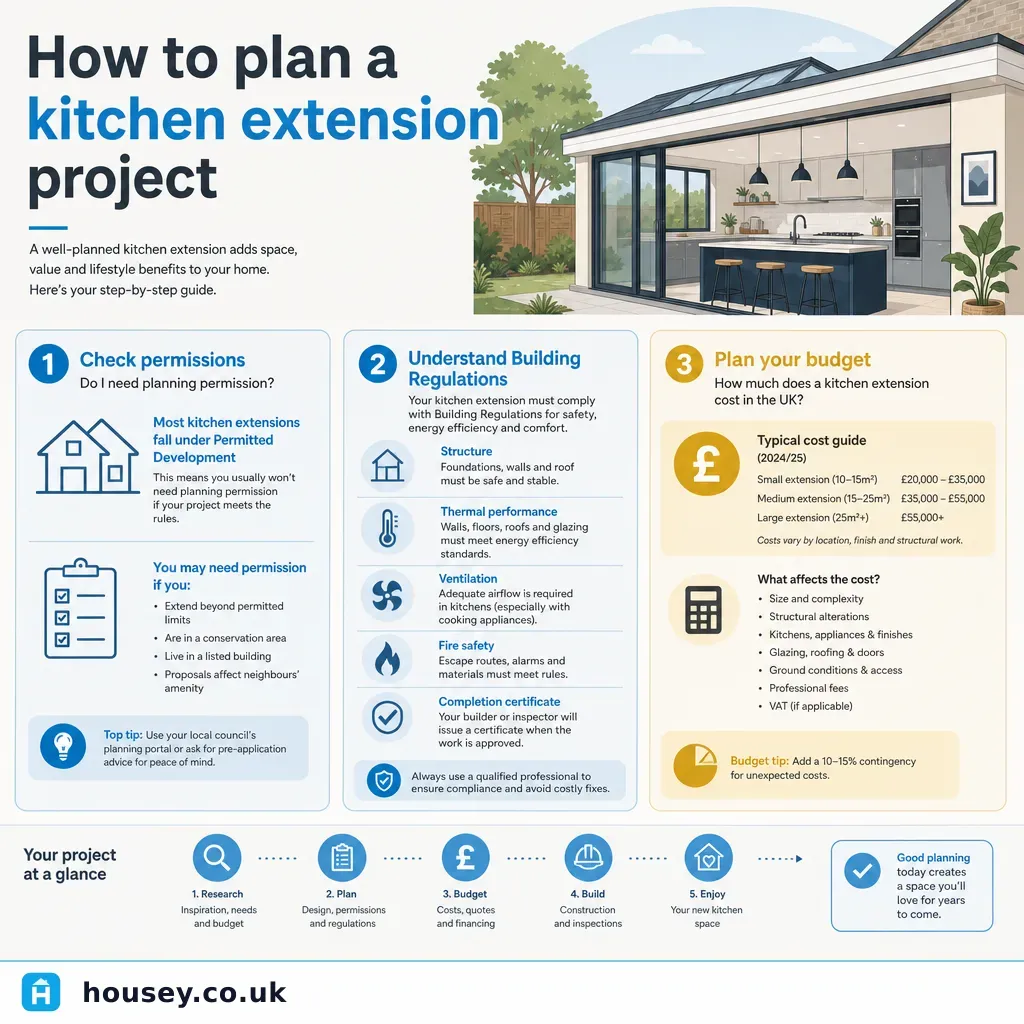
How to plan a kitchen extension project
Planning a kitchen extension means checking whether permitted development or planning permission applies, appointing an architect for drawings, obtaining Building Regulations approval, and commissioning a structural engineer for any wall removals.
 Improvement & Build
Small kitchen renovation: budgeting for costs and planning your project
A small kitchen renovation in the UK typically costs £5,000–£15,000 for a full refresh including new units, worktops, tiling, and appliances, though costs vary widely by specification, region, and whether structural changes or rewiring are involved.
 Improvement & Build
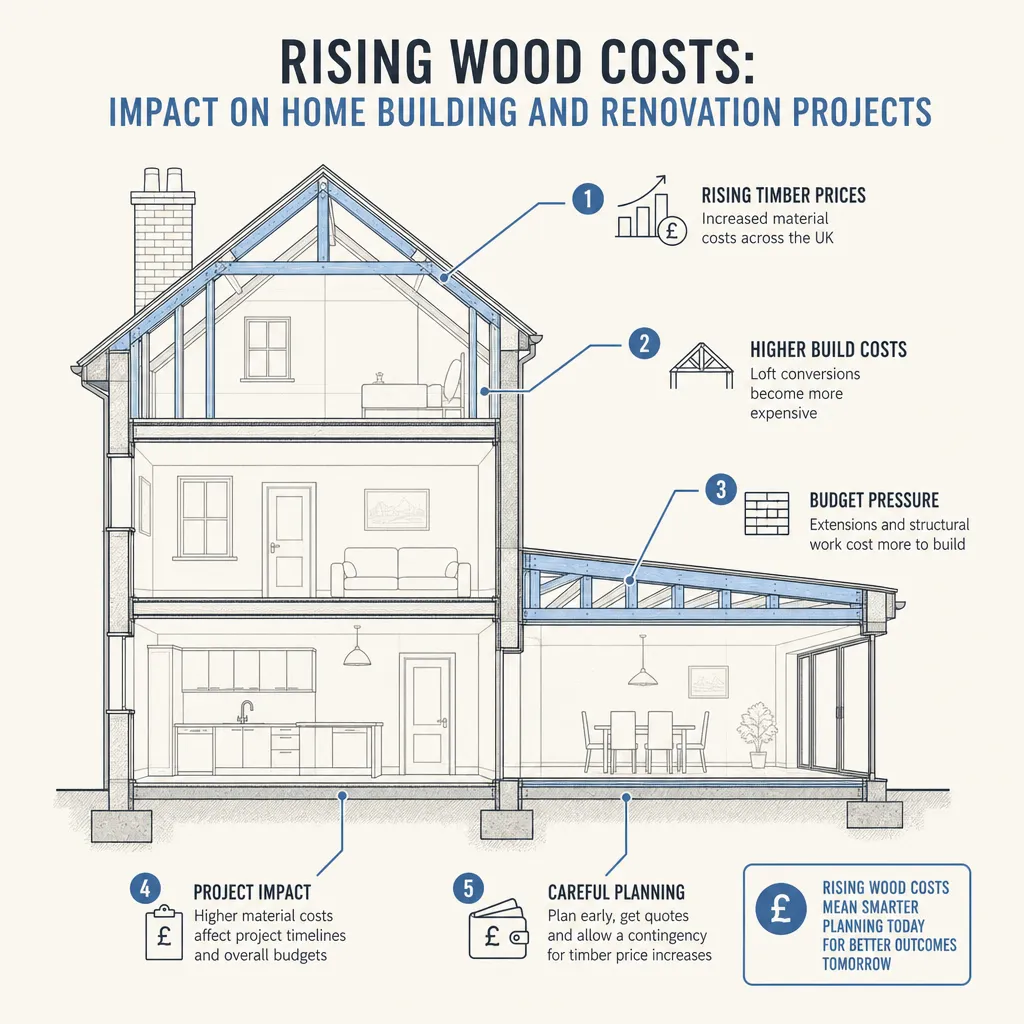
Rising Wood Costs: Impact on Home Building and Renovation Projects
Rising timber prices affect UK home renovation budgets most on timber-frame extensions, loft conversions, and self-builds, where structural wood can account for 15–25% of material costs.
 Improvement & Build
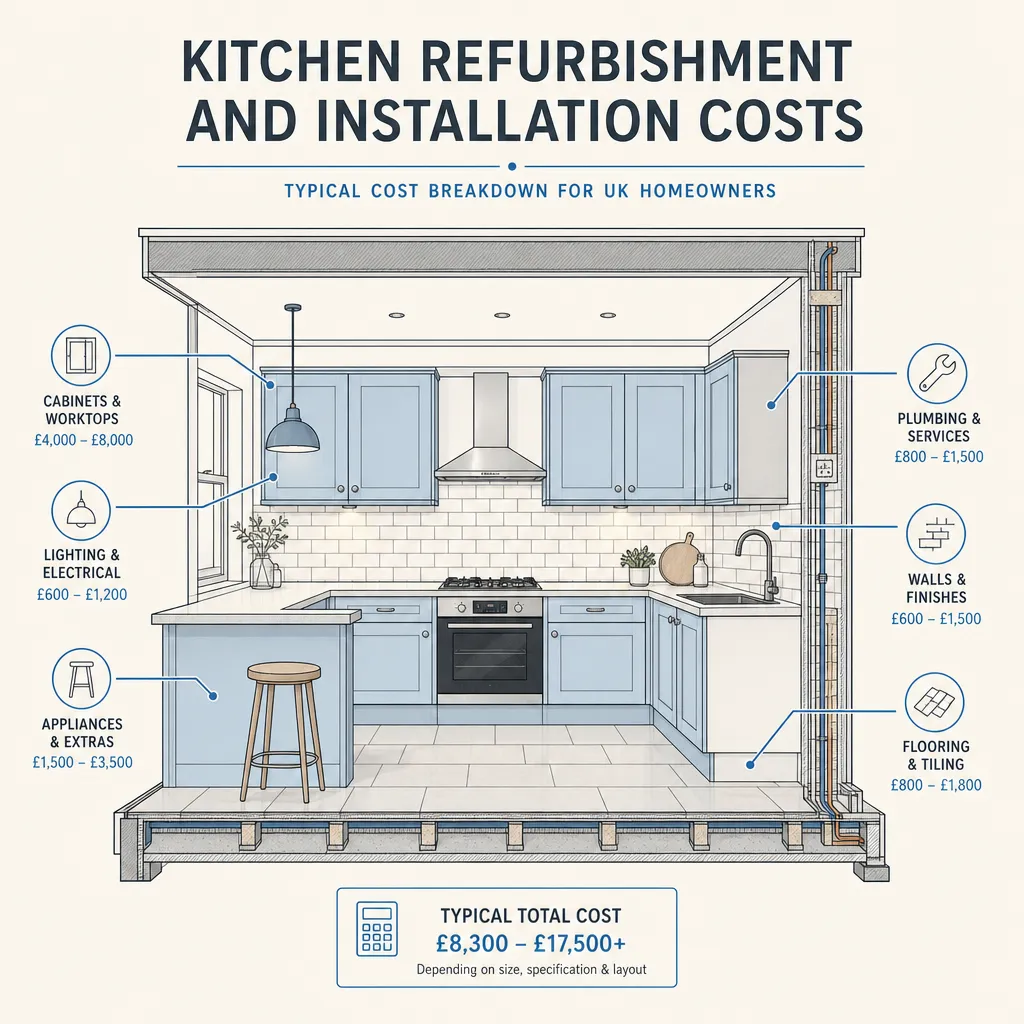
Kitchen Refurbishment and Installation Costs
A kitchen refurbishment in the UK typically costs between £3,000 and £40,000 or more, depending on whether you are replacing units only or carrying out a full design-and-build project.
 Improvement & Build
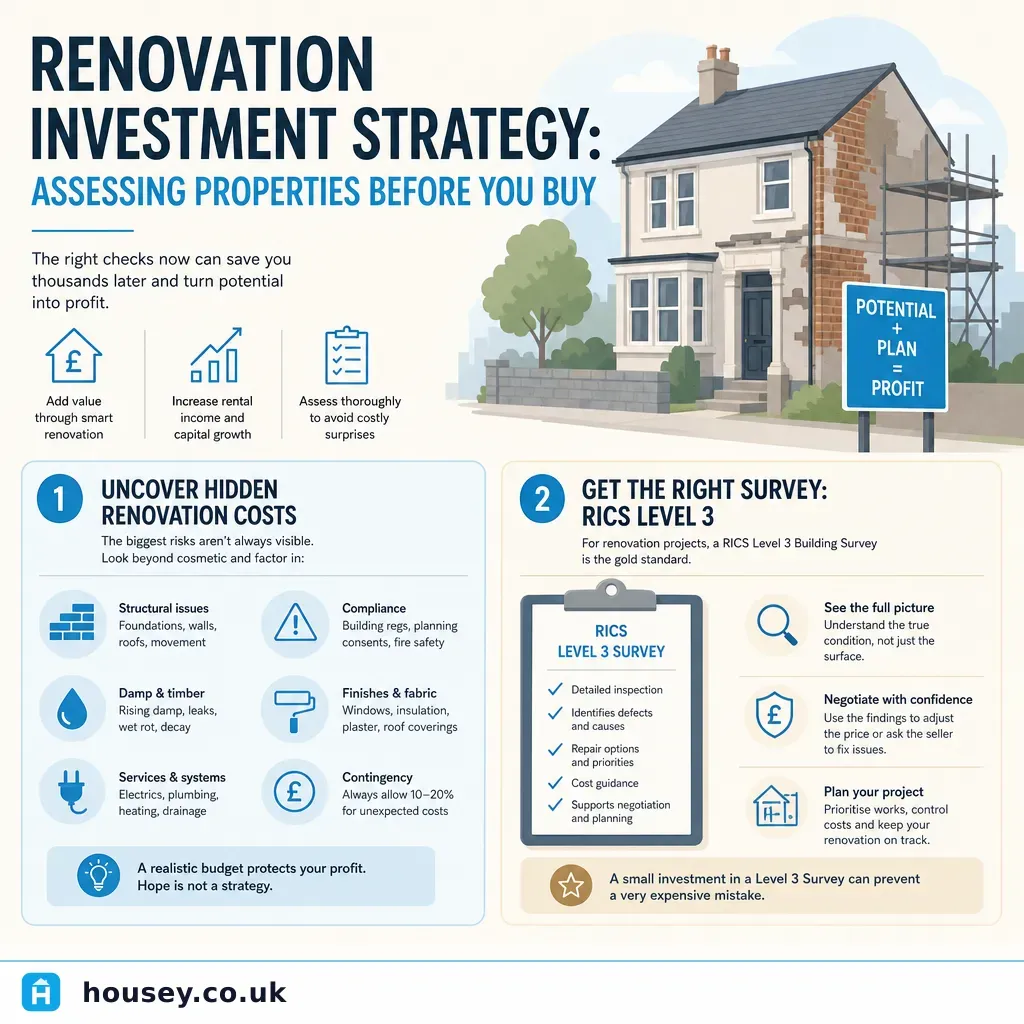
Renovation Investment Strategy: Assessing Properties Before You Buy
Renovation investment properties require more due diligence than a standard home purchase.