Understanding Gazumping in Property Transactions: Risks and Protections
By Housey · Last reviewed 18th of May 2026

Understanding Gazumping in Property Transactions: Risks and Protections
Gazumping costs UK buyers hundreds or thousands of pounds in survey and legal fees, and the frustration of losing a property they believed was agreed. Because English and Welsh property law does not create a binding contract until exchange of contracts, buyers can invest significant time, money, and planning into a purchase only to lose it to a higher bidder at any point in the pre-exchange period — with no legal route to recover costs from the seller.
Key points
- In England and Wales, a property sale is not legally binding until exchange of contracts — a seller can accept a higher offer at any point before that stage, regardless of any prior verbal or written acceptance.
- Scotland operates under a different system (missives) where acceptance of a formal offer creates binding obligations at an earlier stage, making gazumping far less common there.
- Survey and conveyancing costs already incurred are typically unrecoverable if you are gazumped — these can range from £700 to over £2,000 for a standard freehold purchase.
- Lock-out agreements and reservation agreements can provide a degree of contractual protection, but neither is a statutory requirement for open market sales in England and Wales.
- The Law Commission has previously examined reforms to English property law; pilot reservation agreement schemes have been tested, but no legislation mandating them for open market sales was in place as of 2026.
Why gazumping happens — and who is most exposed
Gazumping is most common during periods of rising house prices and low housing stock, when sellers receive multiple expressions of interest and competing buyers are willing to improve their offers after initial acceptance. First-time buyers and those in longer chains are particularly exposed because conveyancing and survey work takes time — and every week before exchange is a week in which the seller can entertain new offers.
The typical window between offer acceptance and exchange of contracts is 8–12 weeks for a freehold property. Leasehold transactions often take longer — sometimes 14–16 weeks — due to enquiries directed to the freeholder or managing agent. This extended pre-exchange period creates the greatest risk.
How does English property law compare to Scotland and Northern Ireland?
Jurisdiction | When is the sale legally binding? | Typical gazumping risk |
|---|---|---|
England and Wales | Exchange of contracts — weeks or months after offer acceptance | High |
Scotland | When missives are concluded — formal offer and acceptance letters at an earlier legal stage | Low — both parties bound much sooner |
Northern Ireland | Exchange of contracts — broadly similar to England and Wales | Moderate to high |
How to reduce your gazumping risk
No buyer in England or Wales can completely eliminate gazumping risk before exchange, but these steps meaningfully reduce exposure:
- Move quickly through conveyancing. Instruct a solicitor before or at the point of making an offer. Request that enquiries, searches, and title review begin immediately. Delays in your own legal process extend your window of vulnerability.
- Commission your survey early. A surveyor instructed promptly after acceptance can typically report within two to three weeks. Waiting prolongs the pre-exchange phase unnecessarily.
- Request that the property is taken off the market. Sellers are not obliged to agree, but many will — particularly if they value a committed buyer who is progressing well.
- Propose a reservation agreement or lock-out agreement. A reservation agreement commits both parties for a defined period with financial penalties for withdrawal. A lock-out agreement prevents the seller from negotiating with other buyers for a fixed window. Both should be drafted by solicitors to be enforceable.
- Keep the selling agent informed of your progress. Agents are motivated by completion — demonstrating that you are actively moving forward reduces their incentive to facilitate competing bids.
Decision tree: what should you do if you are gazumped?
- Assess whether to proceed at the new price. Calculate whether the revised figure still makes financial sense. Check with your mortgage broker whether a higher loan amount remains affordable and does not exceed the lender's maximum loan-to-value.
- Request justification for the competing offer. Ask the estate agent whether the competing buyer has a mortgage Agreement in Principle and proof of funds — some late competing offers are speculative and may not materialise.
- Consider withdrawing and limiting your losses. Survey and legal costs are unlikely to be recoverable from the seller without a reservation agreement. Instruct your solicitor if you believe a formal agreement is already in place.
- Seek legal advice immediately if you believe the seller has breached a lock-out or reservation agreement — a claim for costs or losses may be available depending on the agreement's terms.
- Apply the lesson to future transactions. Instruct your solicitor before offering and propose a reservation agreement from the outset next time.
Red flags that increase gazumping risk
Watch for these warning signs during the pre-exchange period:
- The estate agent continues to advertise the property or arrange viewings after your offer is accepted.
- The seller is slow to instruct a solicitor or delays providing title documents to their own legal team.
- The agent mentions 'other interested parties' repeatedly after your offer has been accepted.
- The seller requests a very long or undefined conveyancing period — this extends your exposure unnecessarily.
- The property is in a high-demand postcode with strong recent price growth, where sellers are aware of active competing interest.
What not to assume about gazumping protection
- Do not assume a counter-signed offer provides legal protection. In England and Wales, a written confirmation of offer acceptance is still not a binding contract — only exchange creates legal obligation.
- Do not assume a verbal commitment not to accept other offers is enforceable. Such promises have no legal standing under English contract law.
- Do not assume gazumping is illegal. Calls to legislate against it have not resulted in statutory reform for open market sales in England and Wales as of 2026.
- Do not assume you are entitled to compensation for lost survey and legal costs. Without a reservation agreement containing a penalty clause, there is typically no contractual basis for a claim against the seller.
Important limitations
This article provides general information about gazumping risk in UK property transactions. Property law varies significantly between England and Wales, Scotland, and Northern Ireland. The enforceability of reservation agreements and lock-out agreements depends on their specific terms, how they are drafted, and the circumstances of the transaction. Nothing in this article constitutes legal advice. Always instruct a qualified solicitor or licensed conveyancer who can advise on your specific situation.
What to ask a qualified professional
When instructing your conveyancer:
- Can you begin searches and raise enquiries as soon as my offer is accepted?
- Are you familiar with reservation agreements and lock-out agreements, and can you draft or review one for this transaction?
- What is a realistic timeline to exchange for this property type and tenure, and what are the most likely causes of delay?
- If I am gazumped, what recourse do I have and what costs should I expect to lose?
Before making an offer:
- Ask the estate agent: will the property be taken off the market once my offer is accepted?
- Ask the seller's solicitor (via your own solicitor): is a reservation agreement acceptable before both parties formally instruct?
When to get professional help
Contact a solicitor or licensed conveyancer immediately if:
- You are gazumped and believe a reservation agreement or lock-out agreement is in place that may have been breached.
- An estate agent is pressuring you to increase your offer or risk losing the property to a competing buyer.
- You are considering any legal claim for costs following gazumping.
- You are a seller who has accepted a late competing offer and want to understand your obligations to the original buyer.
How Housey can help
Housey connects buyers with experienced conveyancing solicitors who understand the risks of the pre-exchange period and can advise on reservation agreements and realistic timelines. Commissioning a valuation survey promptly after offer acceptance also helps reduce the overall time to exchange — shortening your window of gazumping risk.
Frequently asked questions
Is gazumping illegal in the UK?
Gazumping is not illegal in England and Wales. Until exchange of contracts, neither party is legally bound, and a seller is free to accept a higher offer. The practice is widely criticised and governments have consulted on reform, but no statutory prohibition exists for open market sales as of 2026. Scotland's system of missives creates binding obligations at an earlier stage, making gazumping far less common there.
What is a reservation agreement and does it stop gazumping?
A reservation agreement is signed by buyer and seller, committing both parties to proceed for a defined period — typically two to four weeks — with a financial penalty for the party who withdraws without reasonable cause. More common in new-build sales than on the open market, they can be drafted for any transaction. They deter but do not guarantee against gazumping, and their enforceability depends on their specific terms.
How much money could I lose if I am gazumped?
You would typically lose the cost of any survey commissioned and legal fees incurred to that point. A RICS Level 2 survey might cost £400–£900; legal costs to the point of gazumping are often £300–£800. Total out-of-pocket costs in the £700–£1,700 range are realistic for a straightforward freehold transaction, with no statutory right to recover these from the seller.
Does gazumping happen in Scotland?
Rarely. Scottish property law uses a system of formal offer letters and acceptance called missives. Once missives are concluded, both parties are bound and cannot withdraw without legal consequence. This creates a binding contract at an earlier stage than the English exchange of contracts process, which is why gazumping is far less common in Scottish property transactions.
Sources and further reading
- Buying or selling your home — GOV.UK
- Home buying and selling: Law Commission project — Law Commission
- Before you buy a home — Citizens Advice
- Land Registration Act 2002 — legislation.gov.uk
Useful next reads
 Buying & Moving
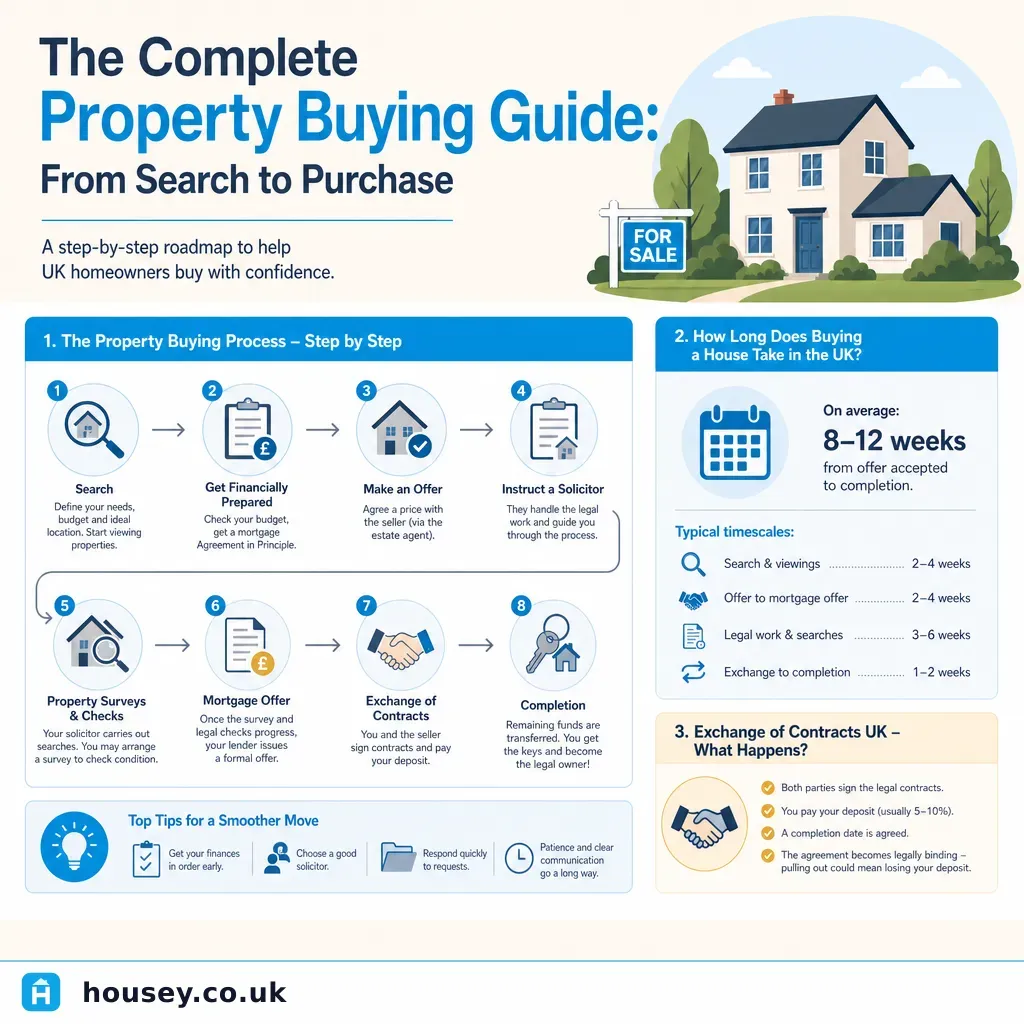
The Complete Property Buying Guide: From Search to Purchase
Buying a property in England and Wales typically takes 3–6 months from accepted offer to completion.
 Buying & Moving
Property Terminology and Listing Definitions: Buyer's Reference Guide
UK property listings and conveyancing documents use specific terms that affect buying decisions.
 Buying & Moving
Conveyancing Glossary: Key Terms and Definitions for Property Buyers
Conveyancing involves specific legal terms that appear throughout a UK property purchase.
 Buying & Moving
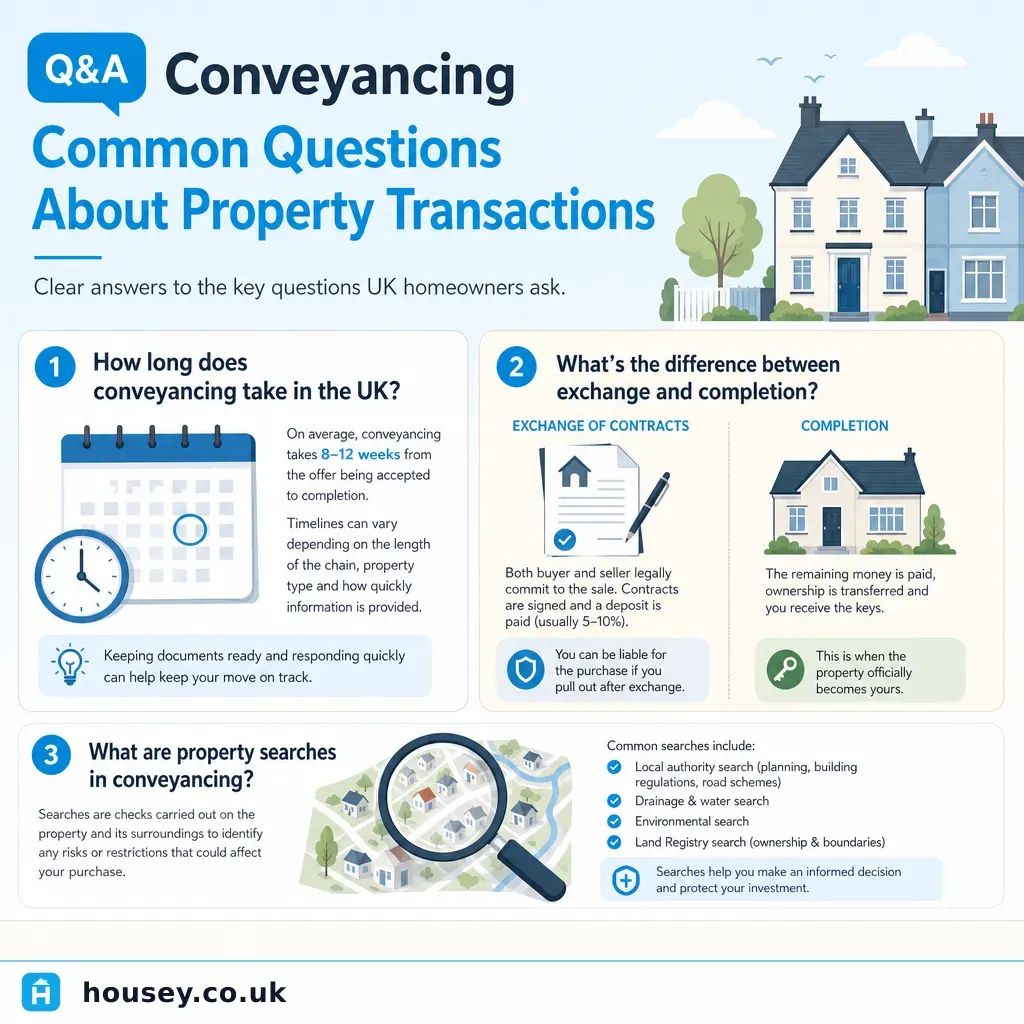
Conveyancing Q&A: Common Questions About Property Transactions
Conveyancing is the legal transfer of property ownership, typically taking 12 to 16 weeks in England and Wales.
 Buying & Moving
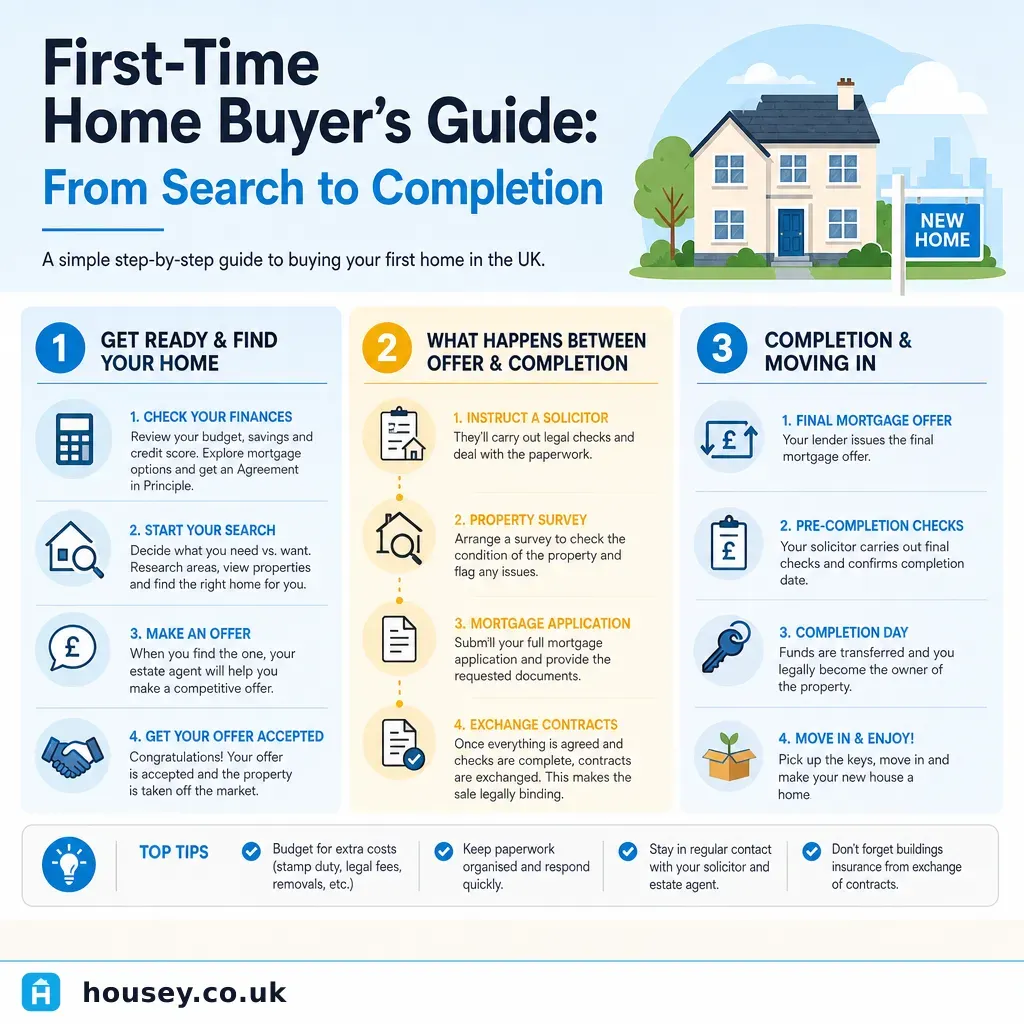
First-Time Home Buyer's Guide: From Search to Completion
Buying your first home in the UK typically takes 3–6 months from offer acceptance to completion.