Understanding Porous Concrete Surfaces and Drainage Properties
By Housey · Last reviewed 25th of May 2026
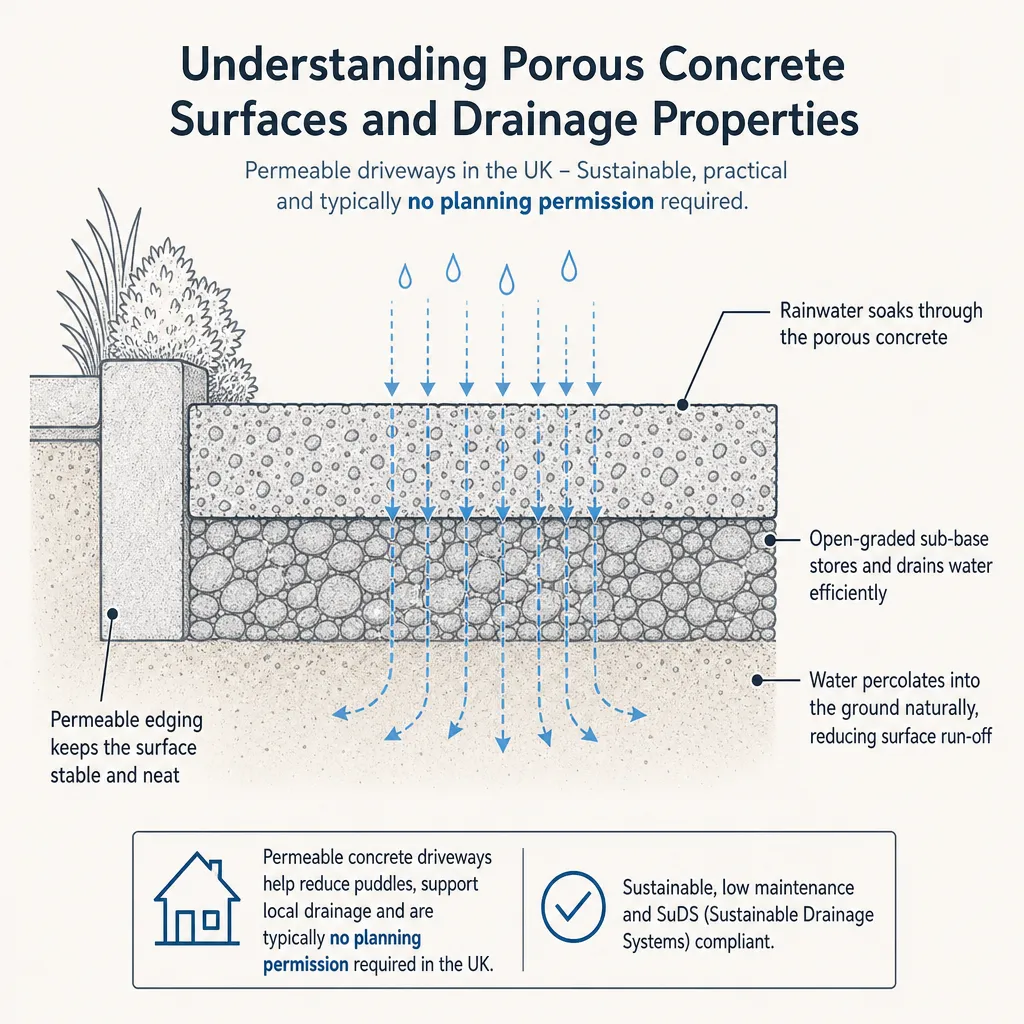
Understanding Porous Concrete Surfaces and Drainage Properties
Choosing a driveway or hard-standing surface involves more than aesthetics. Since October 2008, the permitted development rules for front garden hard-standing in England have been directly tied to surface permeability — meaning your material choice determines whether you need planning permission at all. Porous concrete is one of several permeable options available to UK homeowners, and understanding exactly how it works helps you specify the right system and avoid costly installation mistakes.
Key points
- Since October 2008, laying or replacing a front garden driveway of more than 5 square metres with an impermeable surface requires planning permission in England, unless surface water drains to a lawn or planted border (Town and Country Planning (General Permitted Development) Order 2008, as amended).
- Porous (pervious) concrete achieves permeability by using a gap-graded aggregate mix with little or no fine aggregate (sand), creating a network of interconnected voids — typically 15–25% void content by volume.
- Porous concrete is recognised as a Sustainable Drainage System (SuDS) surface treatment and is compatible with SuDS requirements for driveways and small residential areas.
- The sub-base beneath porous concrete must also be permeable — typically a Type 3 open-graded aggregate — for water to pass through and reach the ground or an underdrain below the surface.
- Porous concrete requires periodic maintenance to prevent clogging from fine particles; pressure washing every one to three years is typically recommended to preserve drainage performance.
How porous concrete works
Standard concrete achieves its strength partly because fine aggregate (sand) fills the gaps between coarse stones, creating a dense, largely impermeable slab. Porous concrete — also called pervious concrete or no-fines concrete — deliberately omits most or all of the fine aggregate. The result is a matrix of coarse aggregate particles bonded together with cement paste, leaving interconnected voids that water can pass through freely.
When rain falls on a porous concrete surface, it filters down through the surface layer, passes through the sub-base, and either infiltrates into the ground beneath or is directed to an underdrain or attenuation system. This reduces surface water runoff, lowers the risk of puddle formation, and can help manage drainage in areas where conventional impermeable surfaces would direct water to the highway or storm sewer.
Porous concrete compared to other permeable driveway surfaces
Surface type | Permeable? | Structural load capacity | Maintenance level | Indicative cost per m² | Planning (front drive over 5m²) |
|---|---|---|---|---|---|
Porous concrete | Yes | Moderate to high | Low to medium | £60–£100 | Permitted development |
Resin-bound aggregate | Yes | Moderate | Low | £70–£130 | Permitted development |
Permeable block paving | Yes | High | Medium | £50–£90 | Permitted development |
Standard concrete | No | High | Low | £50–£80 | Planning permission required |
Standard tarmac | No | High | Low | £40–£70 | Planning permission required |
Loose gravel | Yes | Low | Medium | £20–£40 | Permitted development |
Indicative UK costs, last reviewed 2026-05-25. Costs vary by region, access, sub-base depth, and contractor. Always obtain at least three comparable quotes before committing.
Does porous concrete need planning permission for a front driveway?
In most cases, no — provided the surface genuinely allows water to drain through and the sub-base is also permeable. The key test is whether surface water is managed on site rather than discharged to the highway or a public sewer. The planning rules apply to the drainage outcome, not just the surface material.
Which situation applies to you?
- Back or side garden with no highway frontage — no planning permission required regardless of surface type.
- Conservation area or listed building curtilage — contact your local planning authority before starting any hard-standing works, regardless of surface material.
- Front garden driveway of 5m² or less — no planning permission required, regardless of surface material.
- Front garden driveway over 5m² using porous concrete with a permeable sub-base — permitted development applies in most cases; no planning permission required.
- Front garden driveway over 5m² using standard impermeable concrete or tarmac — planning permission required unless surface water drains naturally to a lawn or planted border.
- Unsure of your situation — check with your local planning authority or ask a driveway installer who is familiar with local requirements before ordering materials.
Why the sub-base matters as much as the surface
One of the most important — and frequently overlooked — considerations is the sub-base beneath the porous concrete. If a permeable surface sits on a compacted, impermeable sub-base (such as Type 1 MOT crushed stone with significant fines content), water cannot pass through to the ground. The result is a surface that appears permeable but functions as an impermeable one, leading to water pooling at the base of the slab and potentially saturating surrounding ground.
For genuine permeability:
- Use a Type 3 open-graded (unbound) aggregate sub-base, typically 100–150mm deep for a domestic driveway carrying standard vehicles.
- Ensure the subgrade beneath is either permeable enough to allow ground infiltration, or is connected to an underdrain directing water to a soakaway or attenuation system.
- Consider the depth to groundwater — if the water table is close to the surface, infiltration-based drainage may not be appropriate without professional drainage design input.
An experienced driveway installer should specify the complete build-up from subgrade to surface, not just the top layer material.
Limitations to be aware of
Porous concrete performs well when correctly installed and maintained, but it is not maintenance-free and has some practical limitations worth understanding before you specify it.
Clogging is the main performance risk over time. Fine particles — silt, leaf debris, tyre rubber — gradually block the voids. Regular pressure washing, typically every one to three years depending on site conditions, helps maintain drainage performance and extends the effective life of the surface.
Freeze-thaw durability may be a concern in exposed locations or during severe winters. Porous concrete has a higher void content than standard concrete, which can increase susceptibility to frost damage if water is trapped in voids during freezing conditions. Specifying air-entrained concrete or a mix designed for UK freeze-thaw exposure classification reduces this risk significantly.
Structural strength is generally lower than standard dense concrete. Porous concrete is suitable for private car parking and light vehicle traffic, but may not be appropriate for heavy loads or regular HGV access without a specialist mix design.
When to get professional help
- If your site has a high groundwater table, consult a drainage contractor before specifying porous concrete — infiltration-based drainage may not be feasible and an alternative approach may be needed.
- If your driveway is in a conservation area or the curtilage of a listed building, always check with your local planning authority before starting any hard-standing works.
- If you are replacing a large existing hard-standing (over 50m²), seek drainage advice to confirm the total impervious area on your plot is not increasing in a way that affects planning compliance or local flood risk assessments.
How Housey can help
Housey connects you with specialist driveway installers who understand permeable surface specifications, sub-base requirements, and local planning rules. A qualified installer will advise on the complete build-up from subgrade to surface — not just the top layer — and will be familiar with SuDS compliance requirements in your area.
Frequently asked questions
Is porous concrete as strong as regular concrete?
Porous concrete typically has a lower compressive strength than standard dense concrete — usually 17–28 MPa compared to 25–40 MPa for standard mixes. For domestic driveways carrying cars and light vans this is usually sufficient. It may not be suitable for HGV access or very heavy point loads without specialist mix design. Your installer or concrete supplier can advise on the appropriate mix for your intended use.
How long does a porous concrete driveway last?
A correctly installed and maintained porous concrete driveway can last 20–30 years, though drainage performance degrades without regular maintenance. Pressure washing every one to three years removes fine particles from the voids and helps preserve the drainage function. Surface deterioration at edges can often be addressed with localised repairs if the underlying sub-base remains sound and stable.
Can porous concrete be used in colder parts of the UK?
Yes, porous concrete can be used across the UK including Scotland and higher-altitude regions, provided the correct mix design is specified. Air-entrained concrete mixes or mixes with lower water-cement ratios improve freeze-thaw resistance. Discuss your location's exposure classification with your installer or concrete supplier before placing an order to ensure the mix is appropriate for local conditions.
Does porous concrete require a building regulations application?
Driveway surfacing alone does not typically require a building regulations application. However, if drainage from the new surface connects to or modifies an existing drainage system, building control notification may be relevant. Check with your local building control body or ask your installer what notifications, if any, they will submit on your behalf as part of the installation.
Sources and further reading
- Town and Country Planning (General Permitted Development) Order 2008 — legislation.gov.uk
- Planning Portal: driveways and hard standing — Planning Portal
- Sustainable Drainage Systems guidance — GOV.UK
- CIRIA SuDS Manual C753 — CIRIA
- Building Regulations Approved Document H: Drainage and Waste Disposal — GOV.UK
Useful next reads
 Improvement & Build
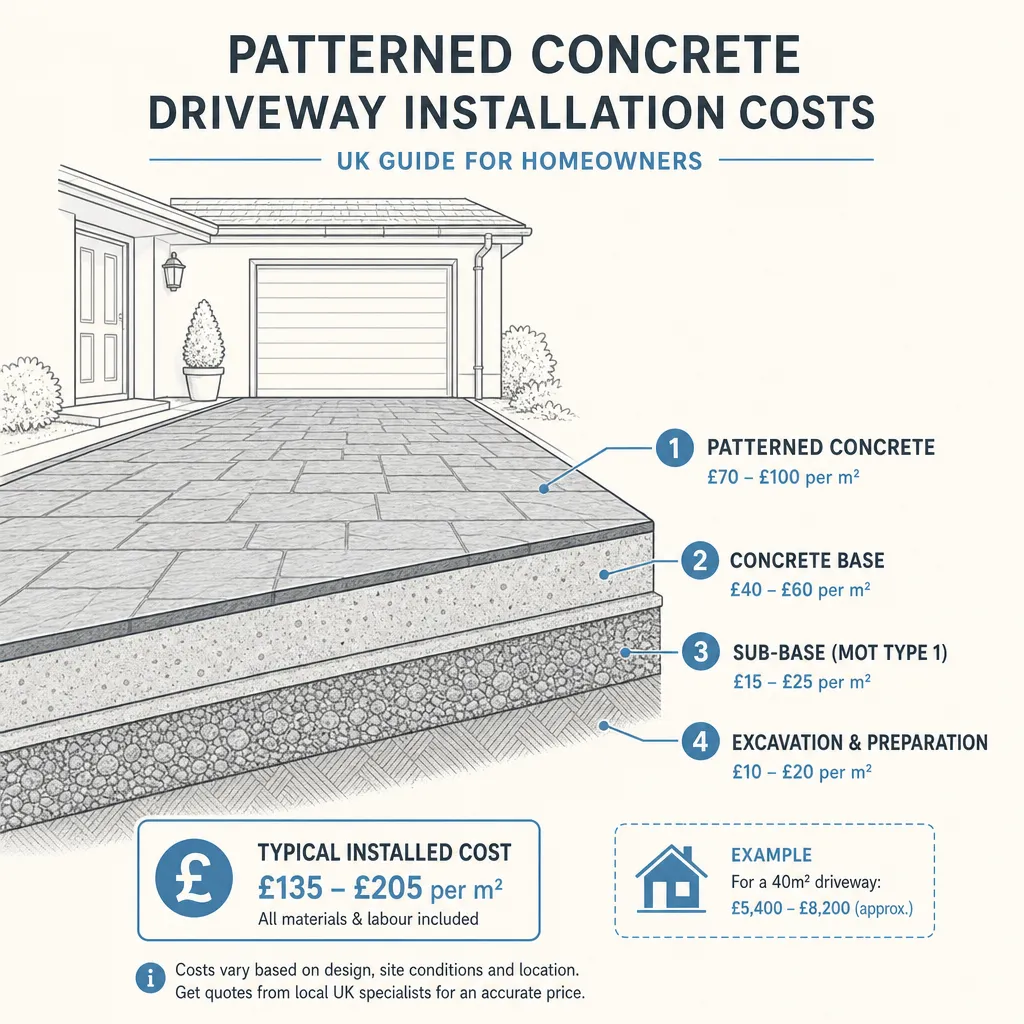
Patterned Concrete Driveway Installation Costs
A patterned concrete driveway in the UK typically costs £50–£120 per square metre installed, depending on pattern complexity, site preparation, and driveway size.
 Improvement & Build
Green Roof Installation: Costs, Benefits and Design Considerations
A green roof costs roughly £50–£150 per m² installed for a shallow extensive system, or £100–£500+ per m² for a deeper intensive planted roof.
 Improvement & Build
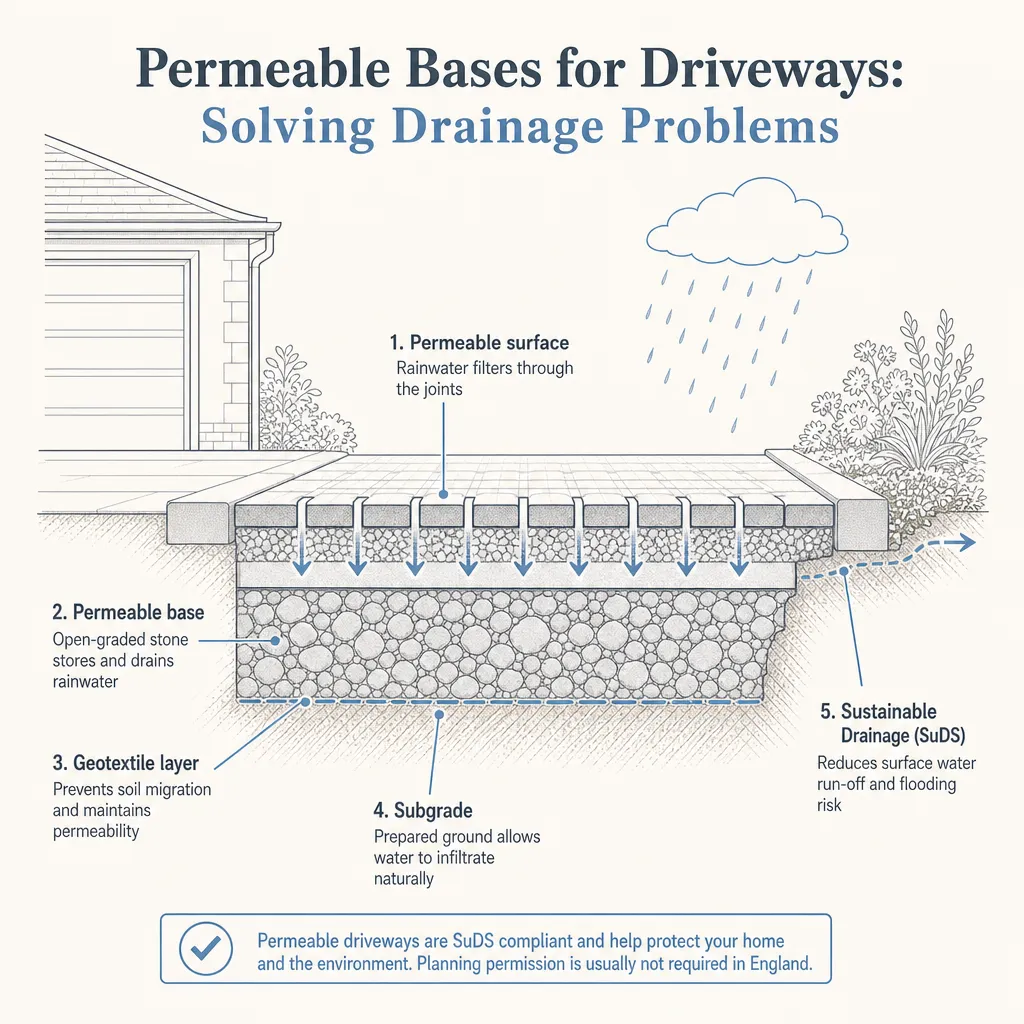
Permeable Bases for Driveways: Solving Drainage Problems
A permeable driveway base allows rainwater to drain through the surface into a sub-base layer or the ground below, reducing run-off and surface pooling.
 Improvement & Build
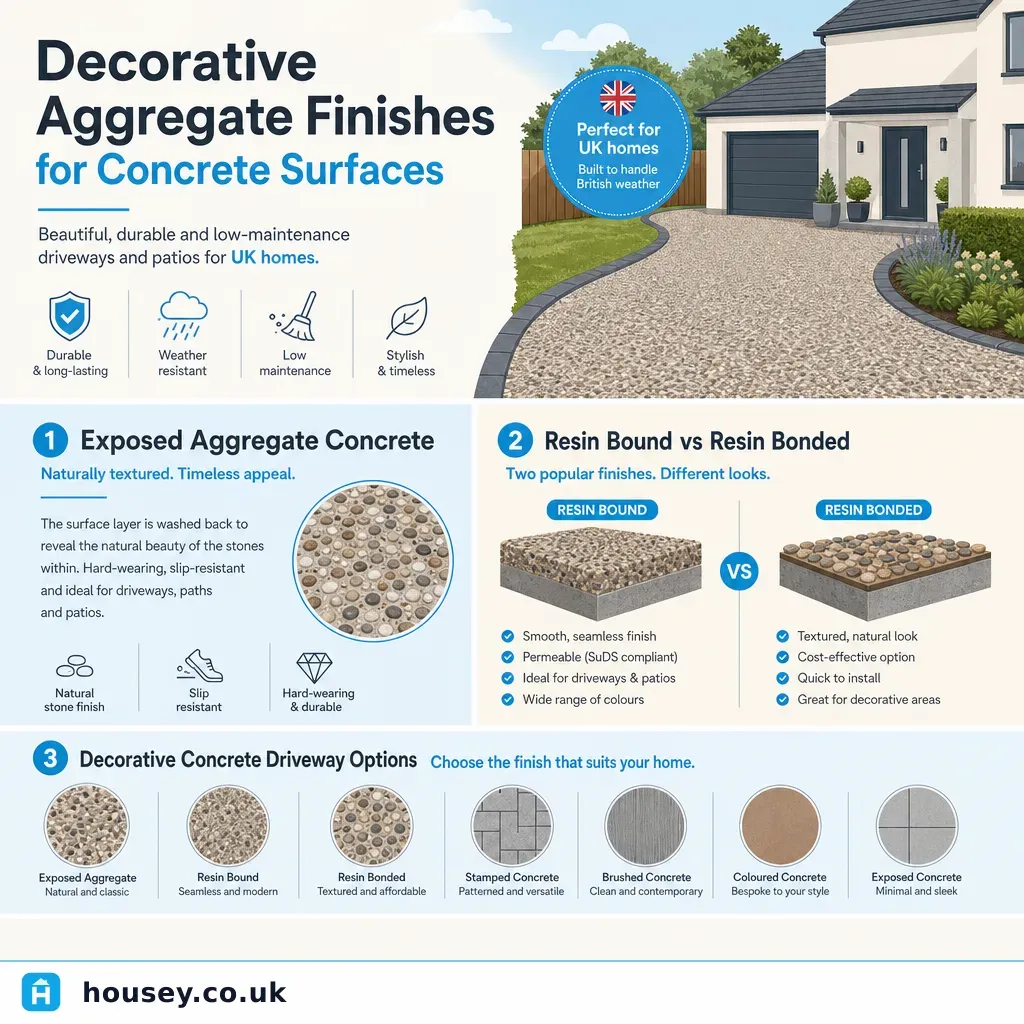
Decorative Aggregate Finishes for Concrete Surfaces
Decorative aggregate finishes for driveways and paths fall into four main types: exposed aggregate concrete, resin-bound aggregate (permeable and SuDS-compliant), resin-bonded aggregate (not permeable), and tar-chip.
 Improvement & Build
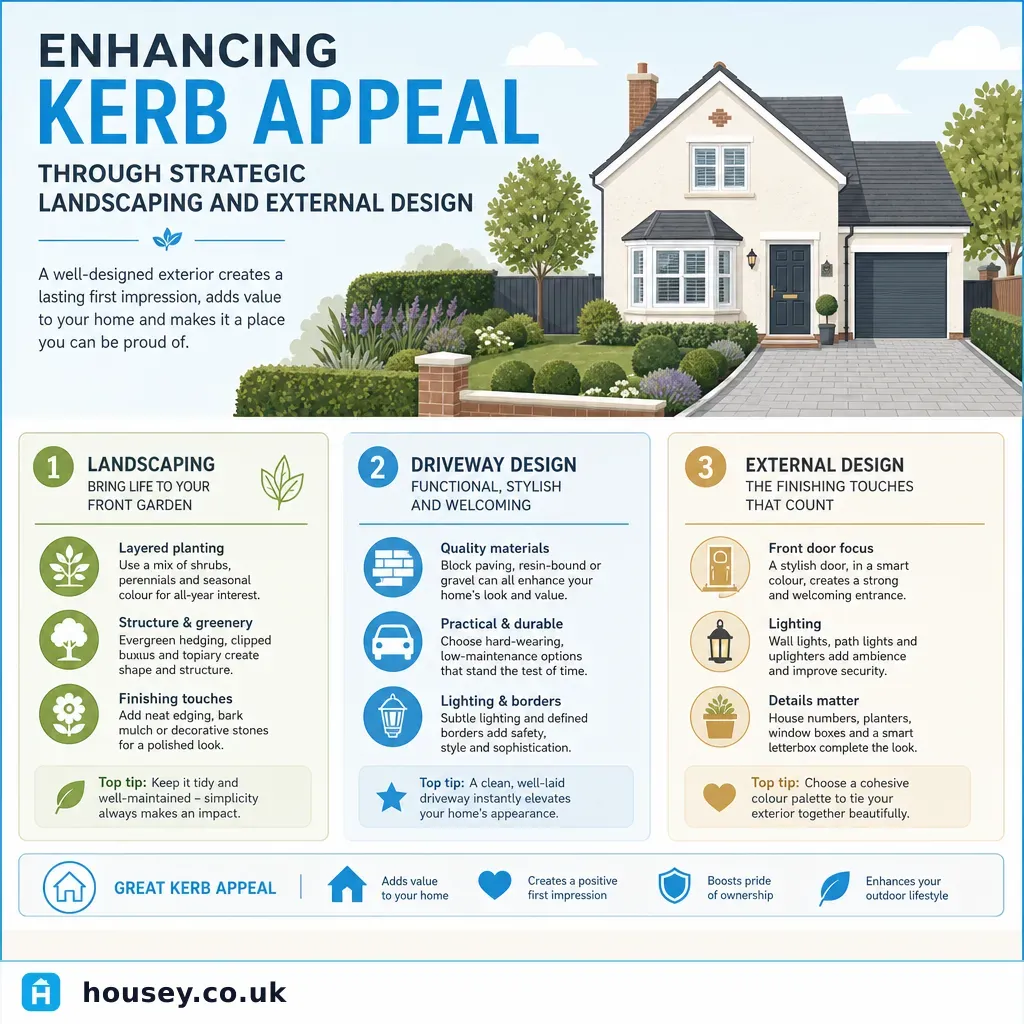
Enhancing Kerb Appeal Through Strategic Landscaping and External Design
Kerb appeal improvements typically combine a well-maintained front garden or driveway, a smart front door, clean gutters and fascias, and appropriate boundary treatments.