What Does a Structural Engineer Do and When You Need One
By Housey · Last reviewed 31st of May 2026
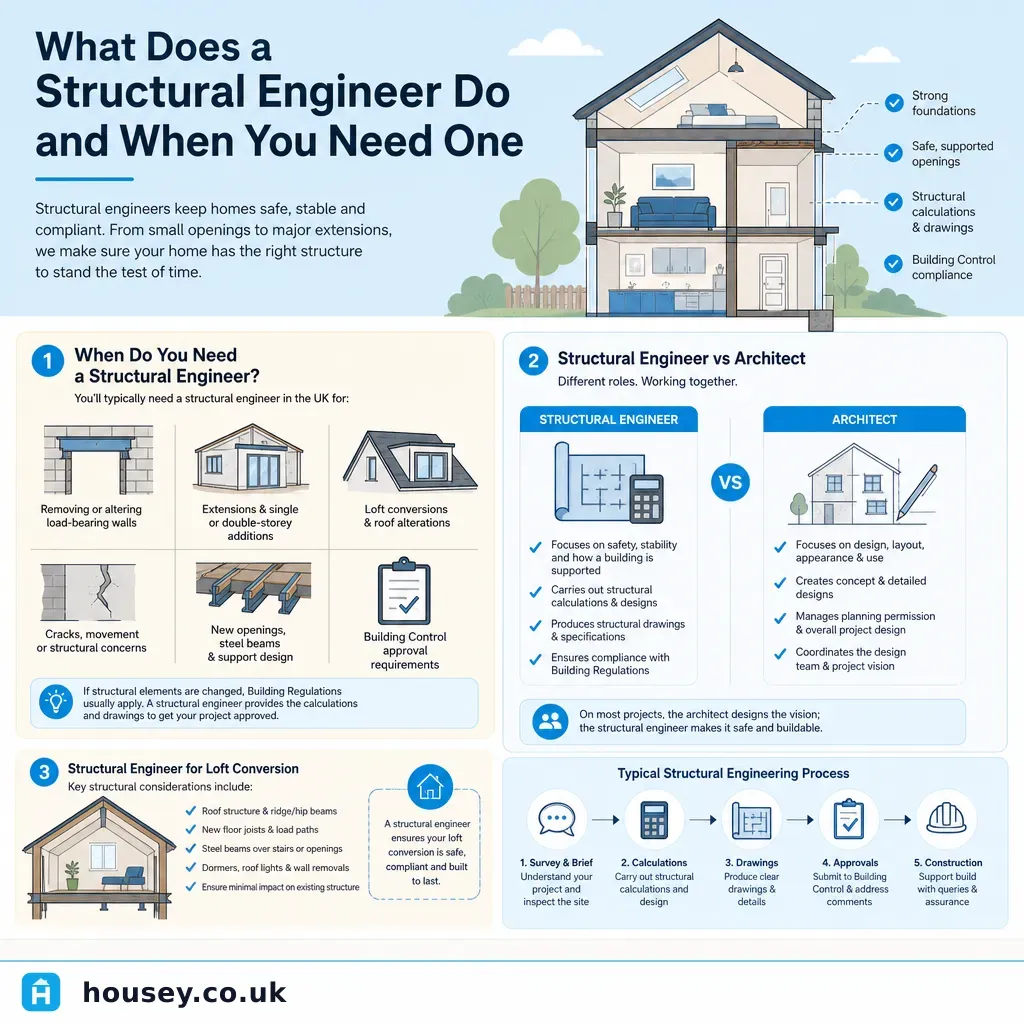
What Does a Structural Engineer Do and When You Need One
Deciding whether your project needs a structural engineer — and at what stage — is one of the more confusing judgement calls for UK homeowners. The question typically arises when a building survey flags suspected movement, when a builder quotes for removing a wall, or when a planning application requires structural calculations. Getting this wrong can mean unsafe works, failed building control inspections, or costly remedial work further down the line.
Key points
- Structural engineers in the UK are typically Chartered Members (MIStructE or MICE) of the Institution of Structural Engineers (IStructE) or the Institution of Civil Engineers (ICE) — verify membership before instructing.
- Building Regulations (England and Wales) require structural calculations — prepared or approved by a structural engineer — for load-bearing wall removals, new openings, loft conversions, and most extensions.
- A structural engineer's report or calculations pack is a different document from a RICS survey: it focuses on specific elements, load paths, and engineering solutions rather than an overall condition assessment.
- The Party Wall etc. Act 1996 often requires structural drawings or calculations when excavating within 3 m or 6 m of a neighbouring boundary, depending on excavation depth.
- Always check a structural engineer holds valid Professional Indemnity (PI) insurance and that their calculations are signed and stamped — building control bodies will usually require this.
What does a structural engineer actually do?
A structural engineer analyses the forces acting on a building — gravity loads, wind loads, and ground movement — and designs or assesses the structural elements that resist those forces: foundations, beams, columns, load-bearing walls, roof structures, and floors.
In residential projects, their work usually falls into three categories:
Assessment and reporting
Investigating an existing condition — cracking, subsidence, movement, or damp penetration at structural junctions — and producing a report that explains the cause, severity, and recommended course of action.
Design and calculations
Producing the structural calculations and drawings needed to support a planning application or building control submission. For example, specifying a steel beam (RSJ) to replace a removed load-bearing wall, or designing a new foundation for a rear extension.
Construction oversight
Inspecting works on site at critical stages — concrete pours, steel beam installation, underpinning — and signing off that works match the approved design. Some building control bodies require this for higher-risk elements.
Structural engineer vs architect: who does what?
These two professions overlap, and many homeowners are unsure which to instruct first.
Role | Primary focus | Typical output | When you need them |
|---|---|---|---|
Architect | Space, aesthetics, planning, project co-ordination | Design drawings, planning application, specification | Extensions, conversions, significant remodels |
Structural engineer | Load paths, structural safety, material sizing | Structural calculations, beam and foundation specs, structural drawings | Any project affecting load-bearing elements |
Both | Complex extensions, loft conversions, structural changes within a design | Coordinated drawings and calculations | Most notifiable building works |
For many projects — a rear extension, a loft conversion with a dormer — you will need both. The architect designs the space and leads the planning application; the structural engineer provides the calculations that building control requires.
When does a homeowner need a structural engineer?
Use this decision tree for common scenarios:
- Removing a wall: Check whether the wall is load-bearing before any work starts. If it is, you will need structural calculations for the replacement beam before building control will approve the works.
- Loft conversion: Most loft conversions require new floor joists, a ridge beam, and modifications to the existing roof structure. Structural calculations are required for building control in virtually all cases.
- Extension: Any new extension affecting ground-bearing foundations or tying into an existing wall will need structural input. Larger or more complex extensions require full structural drawings.
- Suspected subsidence or movement: If a RICS Level 2 or Level 3 survey, or a mortgage lender, flags potential movement or cracking, instruct a structural engineer to assess before exchange or before deciding on a purchase.
- Underpinning: Always requires a structural engineer and a specialist contractor. Do not proceed without engineering design.
- Basement conversion: One of the most structurally complex residential projects — always requires a structural engineer and specialist contractor.
- Party wall works: Excavations within 3 m or 6 m of a neighbour's building under the Party Wall etc. Act 1996 may require structural drawings to satisfy a party wall award.
- Building control self-certification is not available: Where you cannot use a competent person scheme, building control will require structural calculations to be submitted.
What does a structural engineer's report include?
A structural engineer's report — sometimes called a structural inspection report or defect report — typically covers:
- Description of the defect or element inspected.
- Likely cause — for example, differential settlement, thermal movement, or overloading.
- Assessment of severity: monitoring required, repair required, or urgent intervention needed.
- Recommended remedial works or further investigations.
- Sometimes an outline specification for repairs, though detailed design is usually a separate instruction.
A structural calculations pack (for building control) is a distinct document: it contains load calculations, material specifications, beam schedules, and structural drawings. Do not confuse the two when agreeing scope with a structural engineer.
Important limitations
This article provides general information about the role of structural engineers in UK residential property. Structural assessments are specific to individual buildings, their condition, ground conditions, construction type, and intended use. Nothing in this article constitutes engineering advice for your property. Always instruct a qualified structural engineer to assess your specific situation — online guidance cannot substitute for a site inspection.
When this becomes urgent
Stop work and seek professional advice immediately if:
- A crack in a wall, floor, or ceiling is widening progressively or has opened suddenly.
- Doors or windows are sticking and the frame is visibly distorted.
- A floor feels noticeably bouncy or has developed a slope.
- A roof ridge line is visibly sagging.
- There is visible movement in an external wall — bulging, leaning, or rotation.
- A contractor or builder says a wall might be load-bearing without being certain.
What to ask a qualified structural engineer
Before instructing a structural engineer, ask:
- Are you a Chartered Member (MIStructE or MICE) of the Institution of Structural Engineers or the Institution of Civil Engineers, and can I verify this on the register?
- Do you hold valid Professional Indemnity (PI) insurance, and can you provide a current certificate?
- Have you worked on similar property types — for example, Victorian terrace, 1930s semi, or listed building?
- Will you provide signed and stamped structural calculations acceptable to building control?
- What site visits are included in your fee, and will you liaise directly with the building control body?
- What is the likely turnaround for calculations, and will this fit the project programme?
- What additional investigations — for example, trial pit, soil survey, or drain survey — might be required once you have inspected the site?
When to get professional help
If a RICS Level 2 or Level 3 survey identifies suspected structural movement, do not proceed to exchange without obtaining a structural engineer's opinion. A surveyor will flag concern; a structural engineer will diagnose the cause and recommend a remedy.
Red flags that require immediate professional input:
- Any crack wider than 5 mm, particularly if stepped through brickwork or running diagonally from openings.
- Evidence of ongoing, progressive movement rather than historic, repaired cracking.
- A building control rejection citing missing or inadequate structural calculations.
- A mortgage lender's retention pending structural investigation.
How Housey can help
Housey connects UK homeowners with qualified professionals across the construction, survey, and planning lifecycle. Whether you are at the early design stage or responding to a survey report that has flagged structural movement, use Housey to find and compare verified local professionals suited to your project type and budget.
Frequently asked questions
Do I always need a structural engineer to remove a wall?
Only load-bearing walls require structural calculations; non-load-bearing partition walls can usually be removed without them, though building control notification rules still apply in some circumstances. A structural engineer or competent building control surveyor can confirm whether a wall is load-bearing before work starts.
How much does a structural engineer cost in the UK?
Fees vary widely by project complexity, location, and scope. Indicative UK costs, last reviewed 2026-05-31: a single-room structural inspection and report typically ranges from £300–£600; a full loft conversion calculations pack may be £500–£1,200. Always obtain at least two quotes and check what site visits and building control liaison are included.
Can an architect provide structural calculations?
Most architects are not qualified to produce structural calculations for building control. Some practices employ in-house structural engineers or use associate engineers. Check explicitly that the party providing the calculations holds appropriate structural engineering qualifications — do not assume this is included in an architect's scope of services.
What is the difference between a structural engineer and a building surveyor?
A building surveyor provides a broad condition assessment of a property's overall state. A structural engineer focuses specifically on structural integrity, load paths, and engineering solutions. For suspected movement or building control submissions requiring calculations, you usually need a structural engineer rather than a surveyor alone.
Is a structural engineer's report required to sell a house?
There is no legal requirement to provide a structural engineer's report when selling. However, if a buyer's survey identifies structural concerns, the buyer's solicitor is likely to request one before exchange. Having a report ready can help smooth the transaction and reduce the risk of price renegotiation.
Sources and further reading
- Institution of Structural Engineers (IStructE) — Institution of Structural Engineers
- Building Regulations Approved Document A (Structure) — GOV.UK
- Party Wall etc. Act 1996 — explanatory booklet — GOV.UK
- RICS Home Survey Standard — RICS
Useful next reads
 Planning & Pre-Build
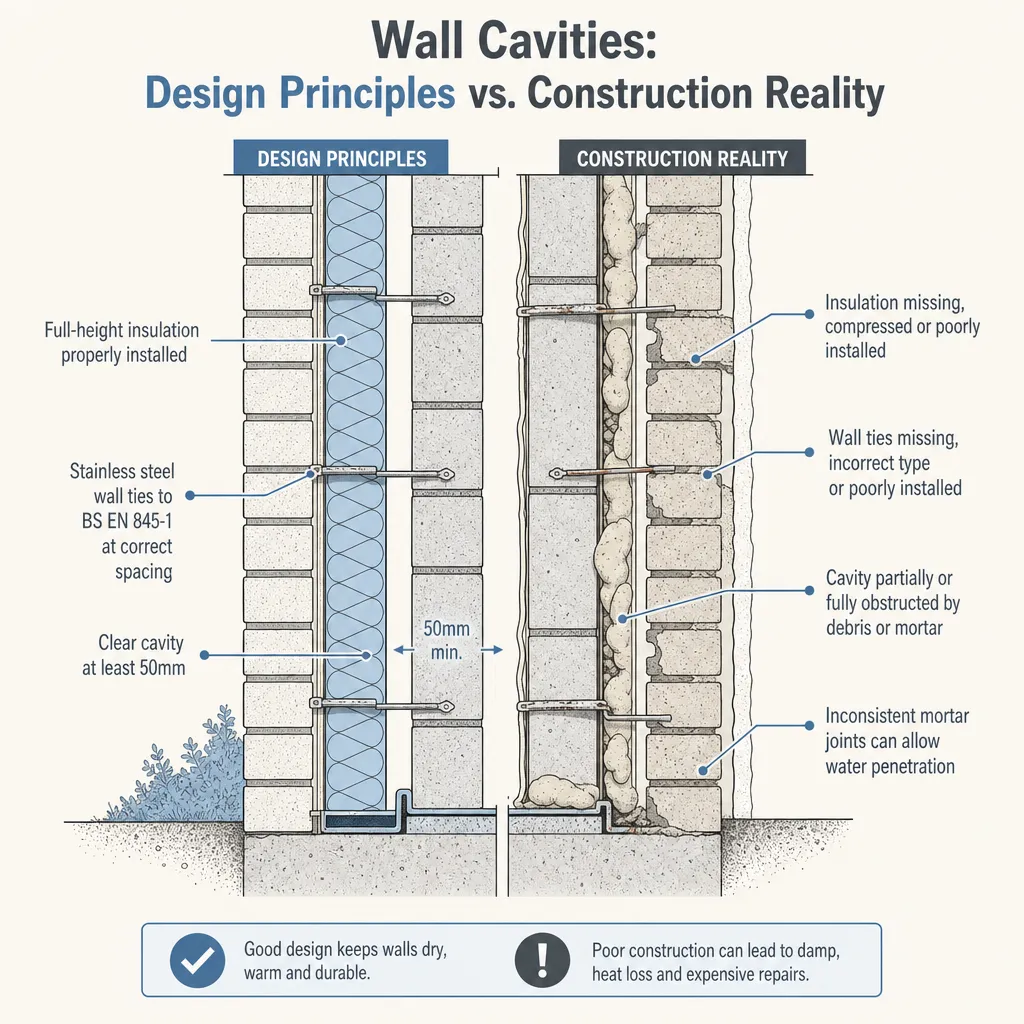
Wall Cavities: Design Principles vs. Construction Reality
A UK cavity wall is designed to resist weather, control heat loss, and structurally link two masonry leaves.
 Planning & Pre-Build
Craftsman Style Homes: Architectural Features and Design Elements
Craftsman style homes are defined by natural materials, low-pitched gabled roofs with wide eaves, covered porches, exposed timber details, and grouped casement windows.
 Planning & Pre-Build
What Is a Patio Home? Understanding This Property Type in the UK
A patio home is a compact, low-maintenance property designed around a private patio or courtyard rather than a traditional lawn garden.
 Planning & Pre-Build
Structural Engineering Consultation and Survey Costs
A structural engineer consultation in the UK typically costs £300–£800 for a specific defect report or pre-purchase assessment.
 Planning & Pre-Build
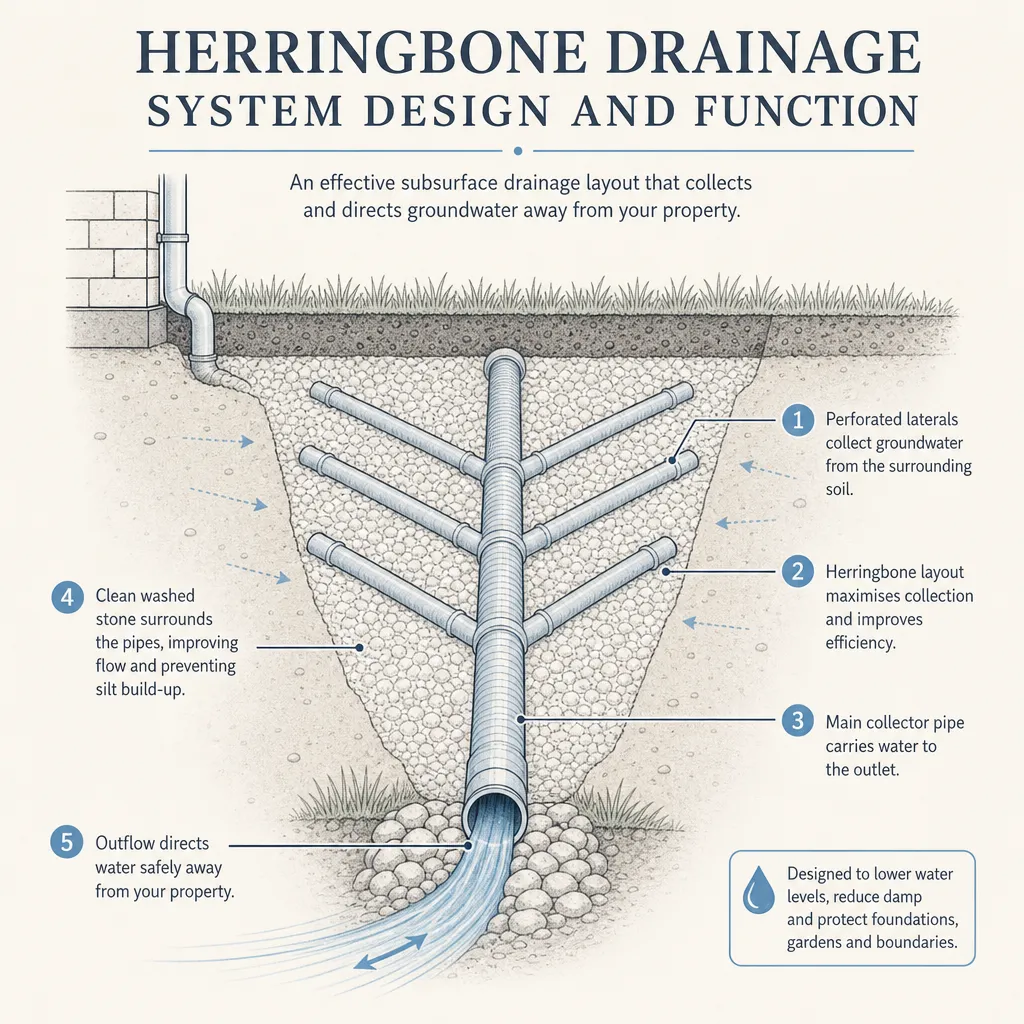
Herringbone Drainage System Design and Function
A herringbone drainage system uses a central collector drain with angled lateral branches — like a fishbone — to carry subsurface water away from a site by gravity.