Understanding Zero-Energy Ready Homes and Ultra-Low Energy Standards
By Housey · Last reviewed 31st of May 2026
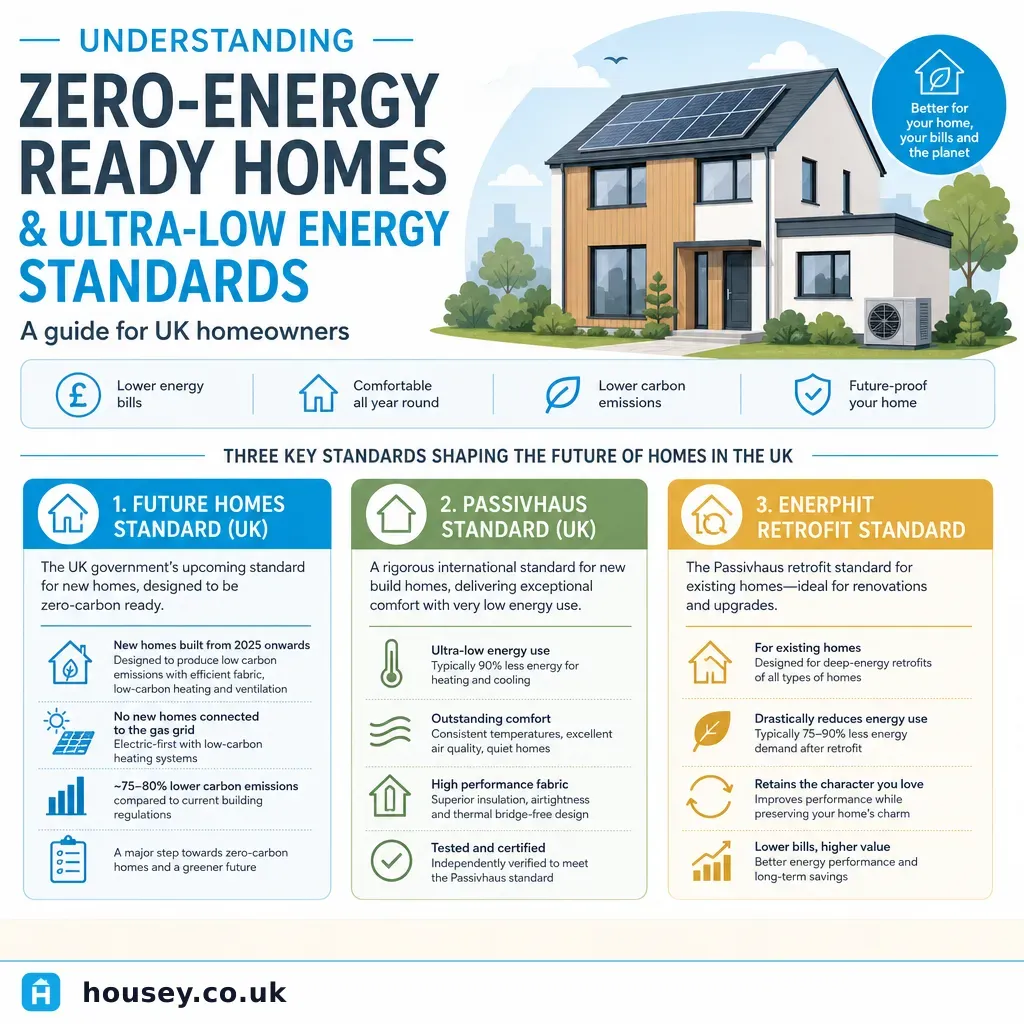
Understanding Zero-Energy Ready Homes and Ultra-Low Energy Standards
The vocabulary around low-energy buildings has expanded rapidly, and terms such as 'zero-energy ready', 'net-zero carbon', 'Passivhaus', and 'ultra-low energy' are used inconsistently across developer marketing, government policy, and planning guidance. For UK homeowners considering a new build, a self-build project, or a deep retrofit, understanding what these terms actually mean — and which carry formal regulatory weight — is essential for making sound decisions about specification, cost, and long-term running costs.
Key points
- The UK's Future Homes Standard (FHS) sets the trajectory for new homes to be built with low-carbon heating systems and significantly improved fabric performance; it builds on the Part L 2021 interim uplift, which required approximately 31% reduction in carbon emissions for new homes compared with 2013 standards.
- Passivhaus Classic is the most widely recognised ultra-low energy standard: it requires a space heating demand of ≤15 kWh/m²/year, a total primary energy renewable (PER) demand of ≤60 kWh/m²/year, and airtightness of ≤0.6 air changes per hour at 50 Pa pressure (n₅₀).
- EnerPHit is the Passivhaus Institut's standard for retrofit projects, with a more achievable space heating demand threshold of ≤25 kWh/m²/year and airtightness of ≤1.0 n₅₀, recognising the constraints of existing building fabric.
- Nearly Zero-Energy Building (NZEB) was a framework derived from the EU Energy Performance of Buildings Directive (EPBD); following Brexit, the UK is no longer bound by the EPBD but continues to develop its own equivalent trajectory through Building Regulations Part L and the Future Homes Standard.
- A home achieving EPC Band A requires primary energy use of approximately 50 kWh/m²/year or less — broadly achievable under Passivhaus specification, but well above the average performance of existing UK housing stock.
What do these standards actually require?
Building Regulations Part L
Part L (Conservation of Fuel and Power) is the legal baseline for energy performance in England and Wales. The 2021 edition requires new dwellings to produce approximately 31% less carbon than homes built to 2013 standards, primarily through improved fabric (lower U-values) and low-carbon heating systems. Part L compliance is assessed using the Standard Assessment Procedure (SAP 10), producing a Target Emission Rate (TER) that new homes must meet or exceed. This is the minimum legal requirement and does not constitute a zero-energy or ultra-low energy standard.
The Future Homes Standard
The Future Homes Standard is the UK government's policy objective to ensure new homes are built with the fabric performance and low-carbon heating systems necessary to support net-zero grid integration. Homes built to FHS specification are intended to be 'zero-carbon ready' — as the electricity grid decarbonises, their operational carbon is designed to approach zero without further modifications to the fabric or systems. The FHS focuses on heat-pump-compatible fabric performance rather than mandatory on-site renewable generation. Check with your building control body or GOV.UK for the current regulatory position as implementation progresses.
Passivhaus
Passivhaus is a voluntary building performance standard — not a UK regulation — administered by the Passivhaus Institut in Darmstadt. Certification requires simultaneously meeting all three core criteria: space heating demand (≤15 kWh/m²/year), primary energy renewable demand (≤60 kWh/m²/year), and airtightness (≤0.6 n₅₀). Passivhaus homes rely on very high levels of insulation, triple-glazed windows, thermal-bridge-free construction details, and mechanical ventilation with heat recovery (MVHR) to minimise heating loads. The PHPP (Passivhaus Planning Package) is the required energy modelling tool. The UK Passivhaus Trust provides the recognised UK certification route.
Net Zero Carbon Buildings Standard
The Net Zero Carbon Buildings Standard (NZCBS) is a UK industry initiative establishing verified criteria for net-zero carbon operation. It is increasingly referenced in planning conditions, developer commitments, and corporate sustainability reporting, though it is not currently a statutory requirement.
Comparison of key low-energy standards
Standard | Regulatory status | Space heating demand | Airtightness target | Best suited to |
|---|---|---|---|---|
Part L 2021 | Mandatory (England & Wales) | Carbon-based TER — no direct kWh limit | No direct limit | All new homes (legal minimum) |
Future Homes Standard | Regulatory trajectory | Heat-pump-ready fabric performance | Tighter than 2021 Part L | New homes (post-FHS implementation) |
Passivhaus Classic | Voluntary certification | ≤15 kWh/m²/year | ≤0.6 n₅₀ | New builds seeking verified ultra-low energy |
EnerPHit | Voluntary certification | ≤25 kWh/m²/year | ≤1.0 n₅₀ | Deep retrofit projects |
EPC Band A | Non-mandatory rating | — | — | Performance comparison only |
Net Zero Carbon Buildings Standard | Voluntary (industry) | Operational carbon focus | Fabric-inclusive | Commercial and residential development |
Worked UK scenario: self-build in the Midlands
A self-builder in Warwickshire is planning a 120 m² detached home and wants to understand whether to target Part L compliance only, or to pursue Passivhaus Classic certification.
Part L route: The home must achieve the SAP 10-based TER. A well-specified Part L home might have wall U-values of around 0.18 W/m²K, double or triple glazing, and an air source heat pump. It will significantly outperform older housing stock, and annual heating costs will be substantially lower than a pre-2000 equivalent.
Passivhaus route: The same home would require wall U-values of 0.10–0.15 W/m²K or lower, triple glazing (whole-window U-value ≤0.80 W/m²K), thermal-bridge-free junction details, MVHR, and airtightness testing during construction to verify ≤0.6 n₅₀. The additional upfront cost over Part L-compliant construction is typically estimated at 5–15%, varying considerably by design team experience, contractor familiarity with the standard, and specification choices.
The outcome: Passivhaus provides independently verified ultra-low energy performance and a rigorous quality assurance process throughout construction. Part L is the legal minimum and represents a meaningful performance improvement over pre-2021 stock — but without third-party verification of actual in-use performance.
Decision tree: which standard should you target?
- Target Part L compliance if you are building any new home in England or Wales — this is the legal minimum regardless of other ambitions.
- Confirm FHS requirements with your building control body if your development may fall under Future Homes Standard provisions — check GOV.UK for the current regulatory position.
- Target Passivhaus Classic if you want independently verified ultra-low energy performance, are self-building or commissioning a bespoke home, and have engaged a design team with demonstrated Passivhaus experience.
- Target EnerPHit if you are undertaking a whole-house deep retrofit and want a recognised, verified standard for low-energy performance.
- Engage an energy-efficiency consultant if you are uncertain which standard applies, want energy modelling (PHPP or SAP 10) for planning or building control submission, or want a cost-benefit comparison before committing to a specification level.
When to get professional help
Passivhaus and EnerPHit design require specialist skills from the earliest stages of a project. Errors in thermal bridging, airtightness detailing, or MVHR specification are difficult and expensive to correct once construction is under way. Seek specialist advice from a qualified energy-efficiency consultant if:
- You are planning a new build and want to explore performance levels beyond the Part L minimum.
- You are considering a whole-house retrofit and want to establish whether EnerPHit is achievable for your property type.
- You need energy modelling for planning permission or building control submission.
- You are buying a property marketed as Passivhaus or zero-carbon and want to verify the claim independently.
A retrofit assessment can establish your existing home's baseline performance and model the improvements needed to approach ultra-low energy standards under EnerPHit or the Future Homes Standard.
How Housey can help
Housey connects homeowners, self-builders, and landlords with qualified energy-efficiency consultants who can advise on specifications, energy modelling, and route to compliance with Part L, the Future Homes Standard, or Passivhaus. If you are considering a whole-house retrofit, a retrofit assessment through Housey can establish your starting point and map the pathway to ultra-low energy performance.
Frequently asked questions
Is Passivhaus certification a planning requirement in the UK?
No — Passivhaus is not a statutory planning requirement across the UK. Some local planning authorities, housing associations, and developers specify Passivhaus or an equivalent standard in planning conditions or development briefs, particularly for social housing and publicly funded projects. Always check your local planning authority's adopted local plan policies before assuming any voluntary standard is required.
Does building to the Future Homes Standard mean a home is net-zero?
Not exactly. The Future Homes Standard aims to make new homes 'zero-carbon ready' — specified with low-carbon heating and improved fabric performance so that, as the electricity grid decarbonises, their operational carbon will approach zero. This is distinct from being operationally net-zero carbon at the point of construction or sale.
What is the difference between zero-energy and net-zero carbon?
'Zero energy' typically refers to a building that produces as much energy as it consumes on-site over a year, often through solar PV or other renewables. 'Net-zero carbon' refers to a building whose operational carbon emissions are balanced by offsets or on-site generation. The terms overlap but are not interchangeable, and neither automatically accounts for embodied carbon in materials.
Can an existing home be retrofitted to Passivhaus standard?
Passivhaus Classic on an existing home is extremely challenging due to airtightness and thermal-bridge requirements in older construction. EnerPHit is the more achievable target, allowing a space heating demand of up to 25 kWh/m²/year and airtightness of up to 1.0 n₅₀. A whole-house retrofit assessment is the appropriate starting point for establishing whether EnerPHit is feasible for your property type and construction.
Sources and further reading
- Future Homes Standard — GOV.UK / Department for Energy Security and Net Zero
- Approved Document L: Conservation of fuel and power — GOV.UK
- Passivhaus Institut: Building criteria — Passivhaus Institut
- UK Passivhaus Trust — Passivhaus Trust
- Energy Saving Trust: Home energy — Energy Saving Trust
Useful next reads
 Energy & Retrofit
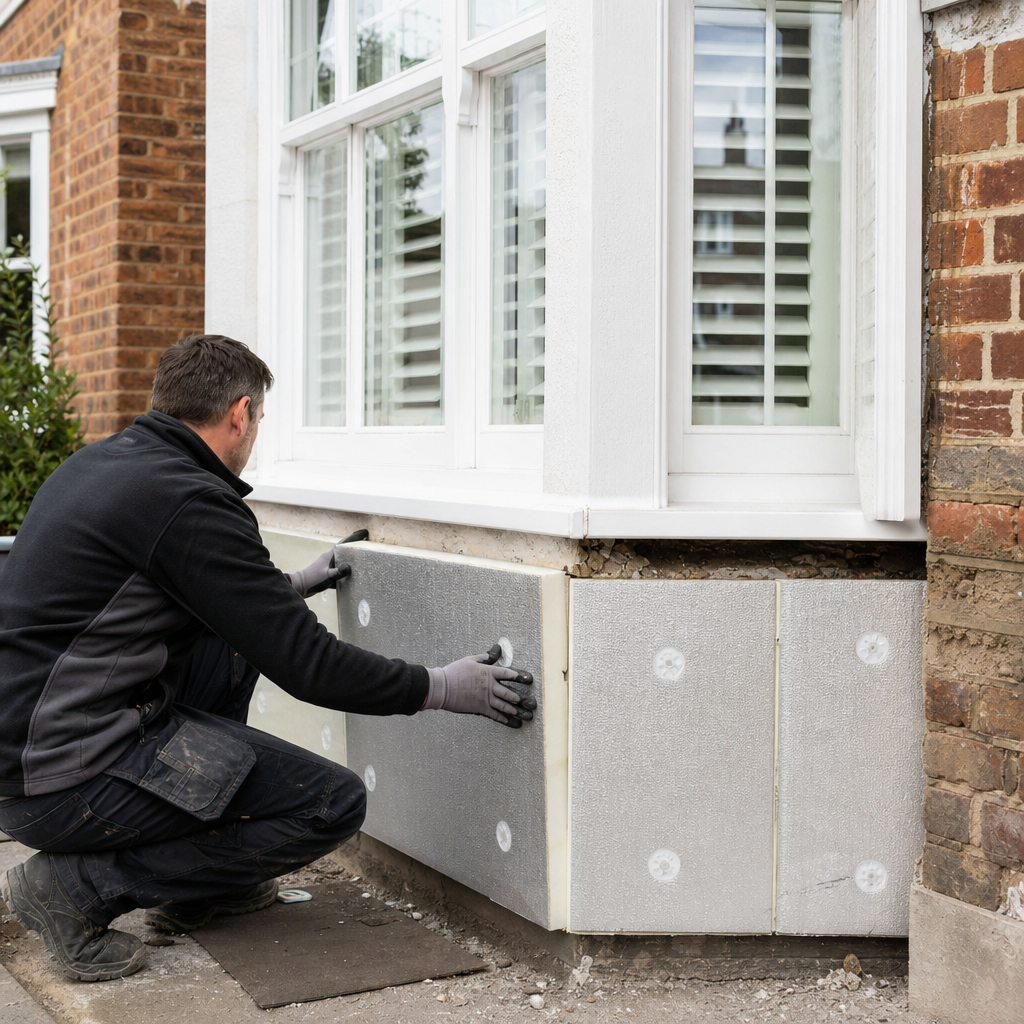
Insulating Solid Masonry Walls Under Bay Windows: Technical Guidance
Insulating solid masonry walls under bay windows requires specialist detailing at angled wall faces, window reveals, and the bay floor and ceiling junctions.
 Energy & Retrofit
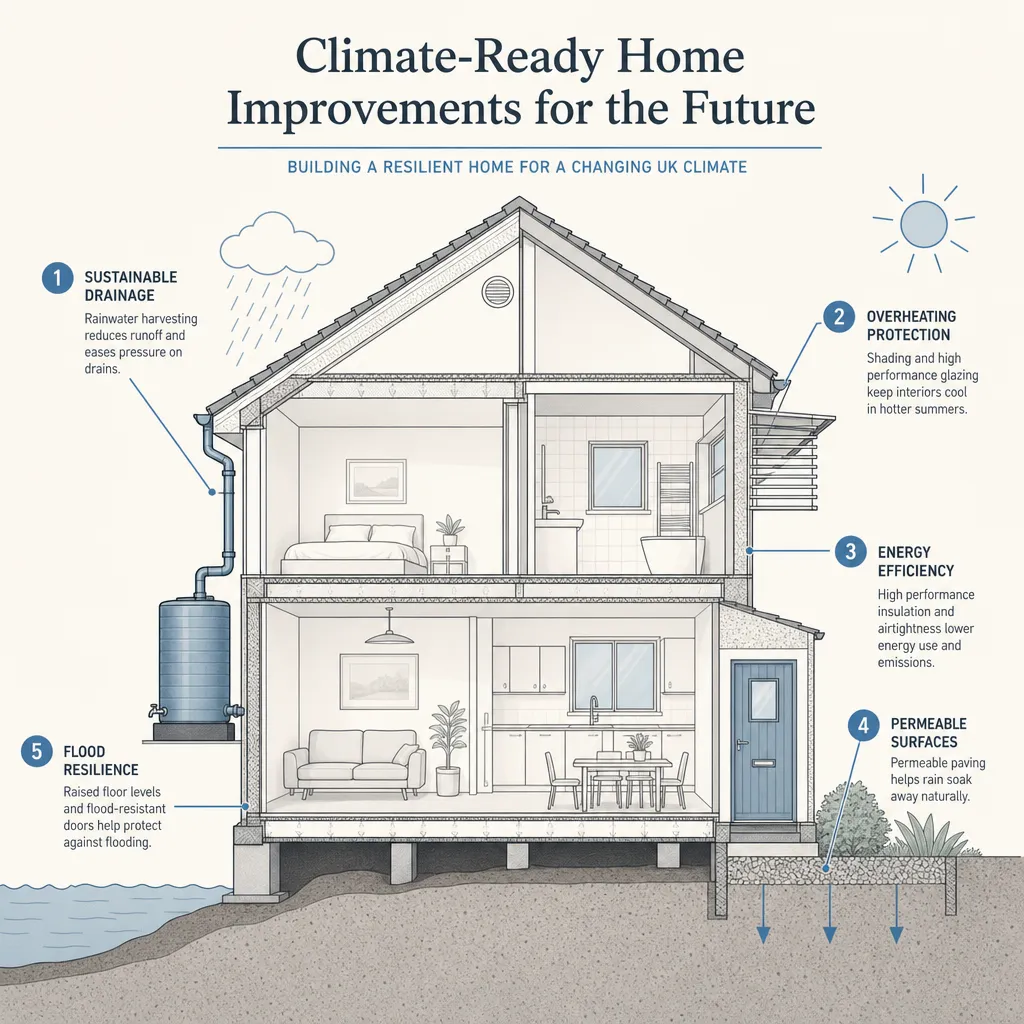
Climate-Ready Home Improvements for the Future
Climate-ready home improvements tackle four main risks for UK properties: overheating, increased rainfall and flooding, storm damage, and energy cost volatility.
 Energy & Retrofit
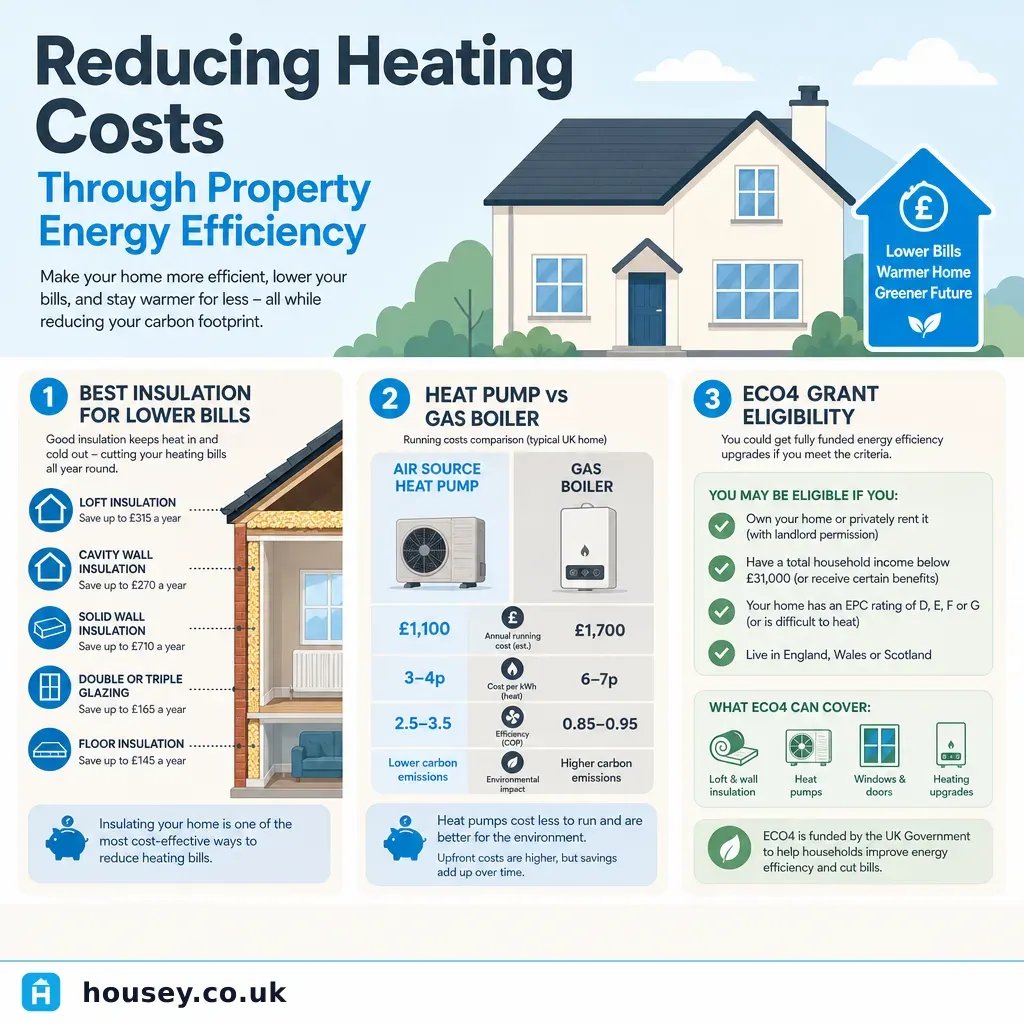
Reducing Heating Costs Through Property Energy Efficiency
Reducing heating costs starts with identifying where heat is lost — typically walls (30–35%), roof (20–25%), and windows.
 Energy & Retrofit
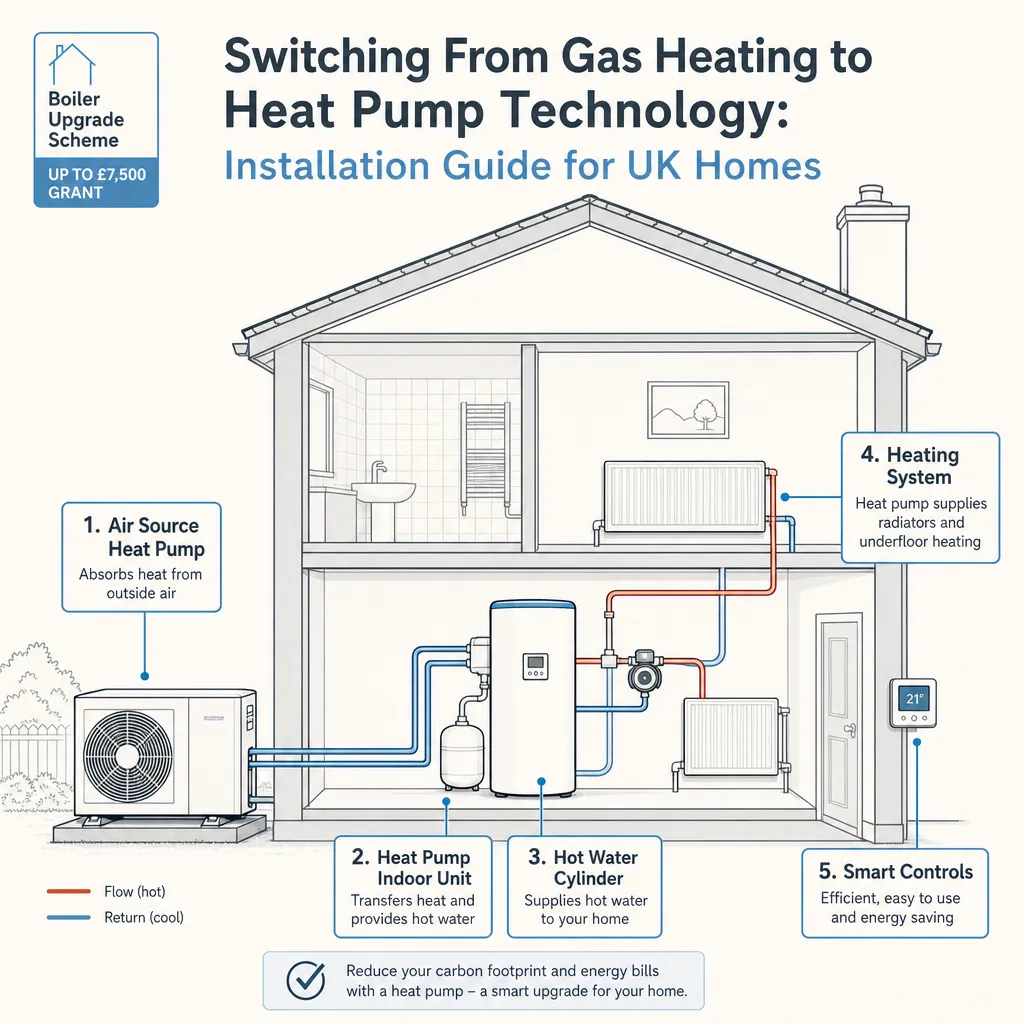
Switching From Gas Heating to Heat Pump Technology: Installation Guide
Switching from gas to a heat pump requires a heat loss calculation, correctly sized equipment, and often radiator upgrades before installation.
 Energy & Retrofit
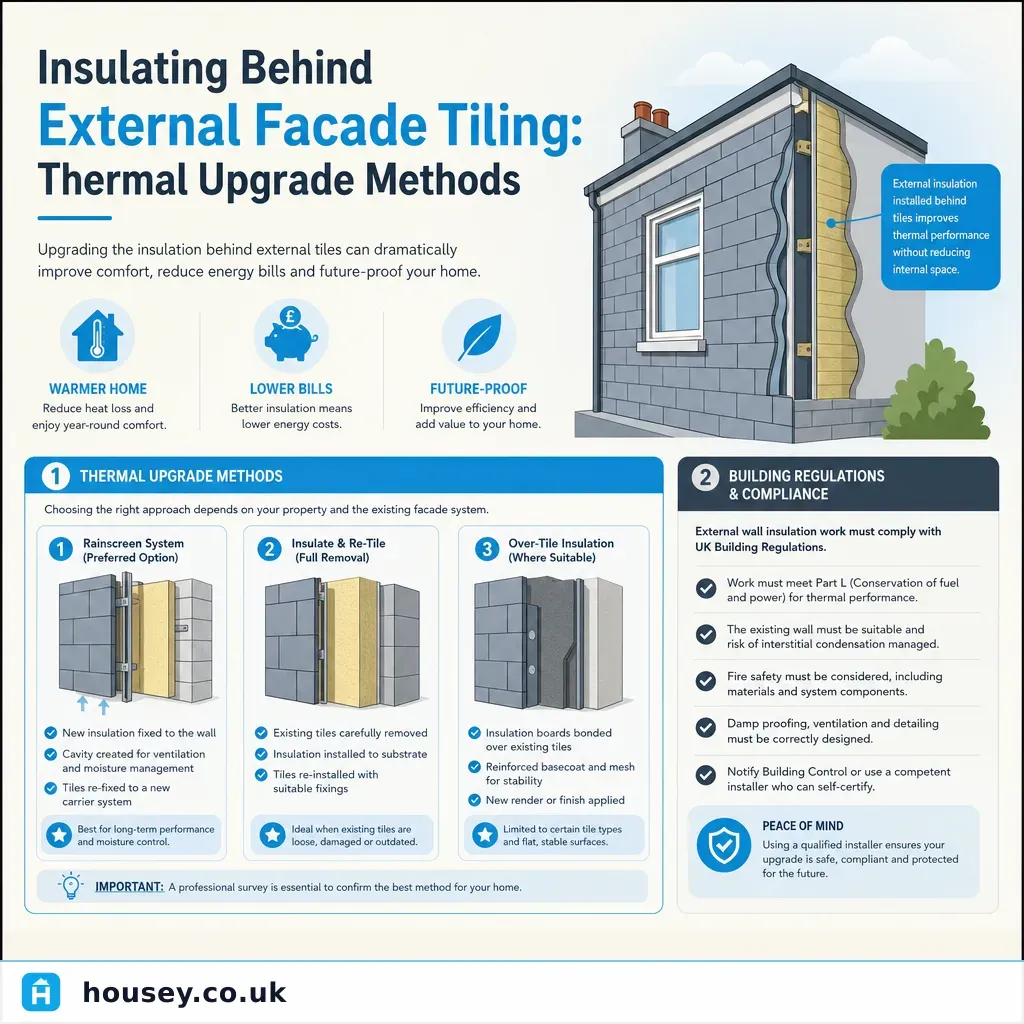
Insulating Behind External Facade Tiling: Thermal Upgrade Methods
Insulating behind external facade tiling is technically complex — the insulation layer must be compatible with tile fixings, manage moisture correctly, and comply with Building Regulations Part L.