Updating Interior Wall Cladding or Replacing Wood Panelling
By Housey · Last reviewed 6th of May 2026
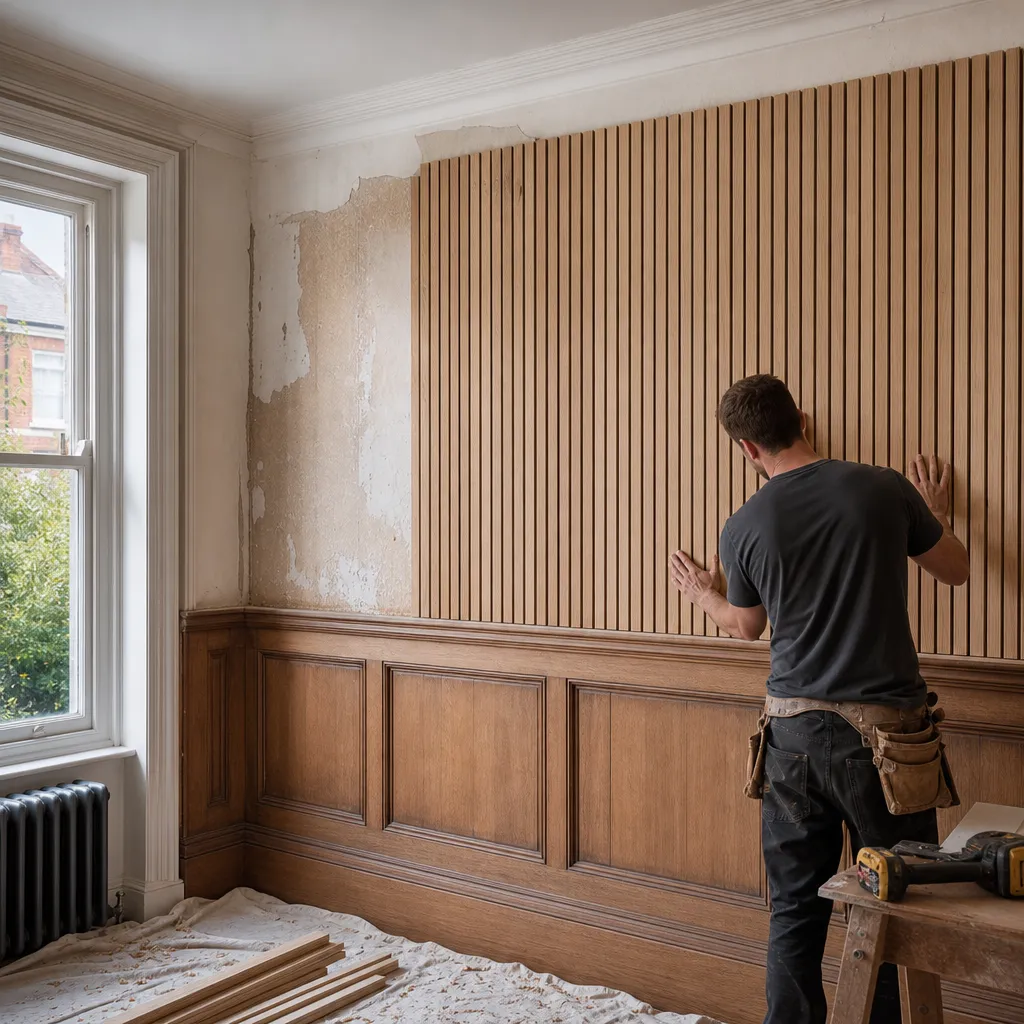
Updating Interior Wall Cladding or Replacing Wood Panelling
Interior walls shape how a home feels, and tired or outdated panelling — whether flaking tongue-and-groove, heavy 1970s dark boarding, or peeling MDF feature strips — is one of the first things owners and buyers want to change. Deciding how to approach the job depends on your property type, the material already in place, and — crucially in older homes — what may be concealed behind it. In the UK, property era makes a significant difference: a Victorian terrace and a 1990s new-build present very different risks when panels come off the walls.
Key points
- Interior cladding changes do not normally require planning permission, but listed buildings require listed building consent for any internal works that affect their character.
- Building Regulations Approved Document B (Fire Safety) requires wall and ceiling linings in UK dwellings to achieve at least Class C surface spread of flame under BS EN 13501-1; always check product data sheets before purchasing.
- Stairways and escape routes require the stricter standard of Class B or better — relevant for any hallway or landing cladding.
- Pre-1985 properties may have panelling or backing materials containing asbestos; unidentified boarding must be tested before disturbance.
- Tongue-and-groove pine, MDF moulded panels, shiplap timber, engineered wood, and PVC boards are the most widely used interior cladding materials in UK homes.
What counts as interior wall cladding?
Interior wall cladding covers any material applied over a wall surface for decorative, acoustic, or thermal effect. In UK homes this includes:
- Tongue-and-groove timber boarding — traditional in Victorian and Edwardian hallways and bathrooms.
- MDF panel mouldings — widely fitted in 1990s and 2000s renovations.
- Shiplap and feather-edge timber — popular for rustic or Scandinavian-influenced living rooms.
- Engineered wood and bamboo panels — more dimensionally stable alternatives to solid timber.
- PVC wall panels — common in UK bathrooms and shower enclosures.
- Plywood feature walls — increasingly popular in contemporary self-builds and loft conversions.
Replacing wood panelling typically means removing existing boards and either returning the wall to its substrate (plaster, brick, or blockwork) or installing a different cladding product.
Planning permission and building regulations
Planning permission
For most UK homeowners, replacing or adding interior wall cladding is an internal alteration and does not require planning permission. Two situations to check:
- Listed buildings: Works affecting the character of a listed building — including internal cladding — may require listed building consent regardless of whether they are structural. Contact your local planning authority before starting.
- Leasehold properties: Your lease may require landlord consent before making material changes to the interior. Review your lease or seek legal advice if unsure.
Building Regulations in England and Wales
Approved Document B sets minimum fire-performance standards for wall and ceiling linings. Most habitable rooms require at least Class C under BS EN 13501-1. Stairways and escape routes require Class B or better — a stricter standard that applies to any hallway or landing cladding and is worth confirming with your supplier.
Adding thermally insulated cladding on battens may engage Approved Document L (Conservation of Fuel and Power) if it materially alters the wall's thermal properties. If in doubt, speak to a builder or your local building control officer before proceeding.
Comparison: common interior cladding materials
Material | Typical use | Approx. cost (supply only) | Fire class | Key consideration |
|---|---|---|---|---|
Tongue-and-groove pine | Hallways, bathrooms, period homes | £15–£35/m² | Typically Class C–D; check product | May need painting; classic period look |
MDF moulded panels | Living rooms, feature walls | £20–£45/m² | Often Class C with intumescent paint | Sensitive to moisture; not for bathrooms |
PVC wall panels | Bathrooms, kitchens | £10–£25/m² | Usually Class B–C | Easy to clean; can look plasticky |
Shiplap/feather-edge timber | Feature walls, studies | £18–£40/m² | Typically Class C–D; check product | Good for rustic or contemporary styles |
Engineered wood panels | Living rooms, bedrooms | £30–£70/m² | Varies by product | More stable than solid timber |
Plywood (birch/poplar) | Contemporary feature walls | £20–£50/m² | Typically Class C–D | Popular in loft conversions; verify fire rating |
Indicative UK supply costs, last reviewed 2026-05-06. Installation costs vary significantly by area and contractor — always obtain at least two quotes.
What to check before removing old panelling
Removing existing wall cladding — particularly in pre-1985 homes — can reveal unexpected issues. Work through this checklist before starting:
Homeowner checklist — before removing wall panelling:
Red flags: when to pause and investigate
- Damp patches or dark staining at the base of panelling or around window reveals — treat the moisture source before re-cladding, otherwise the problem will persist behind the new boards.
- Soft or crumbling plaster revealed when panels are removed — may require specialist lime replastering in older properties.
- Fibrous grey or white boards, particularly insulating board products or ceiling tiles in pre-1985 homes — potential asbestos; do not disturb without professional assessment.
- Unsheathed or clearly dated wiring visible when panels are removed — consult a qualified electrician before continuing.
- Original Victorian or Edwardian timber panelling in good condition — removal may significantly affect the character of a period property and may be difficult to reverse; consider restoration.
Choosing the right professional
For straightforward cladding replacement in a standard property, a competent carpenter or joiner is usually the right trade. For more complex situations:
- Lime plaster repair: seek a specialist lime plasterer experienced with older properties.
- Damp investigation and treatment: a CSRT-qualified surveyor for diagnosis; a specialist contractor for remediation.
- Suspected asbestos-containing materials: only an HSE-licensed contractor may remove notifiable asbestos — search the HSE asbestos licensed contractors register.
- Listed building consent or building control queries: contact your local authority's planning and building control department directly.
When to get professional help
Straightforward panelling replacement in a modern home is a reasonable project for a competent carpenter, but seek professional input if:
- Damp, mould, or structural cracking is discovered behind the panels.
- The property predates 1985 and the existing board material cannot be positively identified.
- The property is listed or in a conservation area.
- Cladding is planned on a stairway or escape-route wall, where Class B fire-rating requirements apply.
- You plan to add insulated cladding on battens that could trap moisture against the wall.
How Housey can help
Housey connects homeowners with qualified tradespeople across the UK — from carpenters and joiners to specialist damp surveyors and plasterers. If your panelling project uncovers something unexpected, or if you want to compare local professionals from the outset, Housey can help you request and compare quotes in your area.
Frequently asked questions
Do I need planning permission to replace wall panelling?
In most cases, no. Replacing or adding internal wall cladding is an internal alteration that does not require planning permission in England, Wales, Scotland, or Northern Ireland. However, if your property is a listed building, internal works may require listed building consent. Always check with your local planning authority if you are unsure.
Can I tile or panel directly over existing wood panelling?
You can fix lightweight panels over existing boarding if it is sound, flat, and firmly secured. However, tiling over wood panelling is generally not recommended as timber moves with moisture and temperature changes, which can cause tiles to crack. Removing the old panelling first usually gives a better, longer-lasting result.
Could my old wall panelling contain asbestos?
Asbestos was used in various building products until the full UK ban in 1999. Certain insulating boards and ceiling tiles installed before 1985 are known to contain asbestos. If you have panelling in a pre-1985 property and cannot identify the material, arrange an asbestos survey before removing or drilling through the boards.
What is the difference between wall panelling and wall cladding?
In common UK usage, wall cladding refers to any applied surface finish — timber, PVC, stone effect, and similar. Wall panelling typically refers to decorative timber or MDF boards with moulded profiles. Both terms are often used interchangeably for interior applications.
How long does it take to replace wall panelling in a typical room?
For a standard living-room feature wall of roughly 12–15 m², a competent carpenter would typically allow one to two days for removal and replacement, excluding plastering or remediation work. Whole-room cladding takes longer depending on penetrations such as sockets, radiator pipes, and window openings.
Sources and further reading
- Approved Document B (Fire Safety) — MHCLG, Building Regulations Approved Documents
- Approved Document L (Conservation of Fuel and Power) — MHCLG, Building Regulations Approved Documents
- Listed buildings: designation and guidance — Historic England
- Asbestos: the survey guide (HSG264) — Health and Safety Executive
- Planning permission: when you need it — GOV.UK
Useful next reads
 General property advice
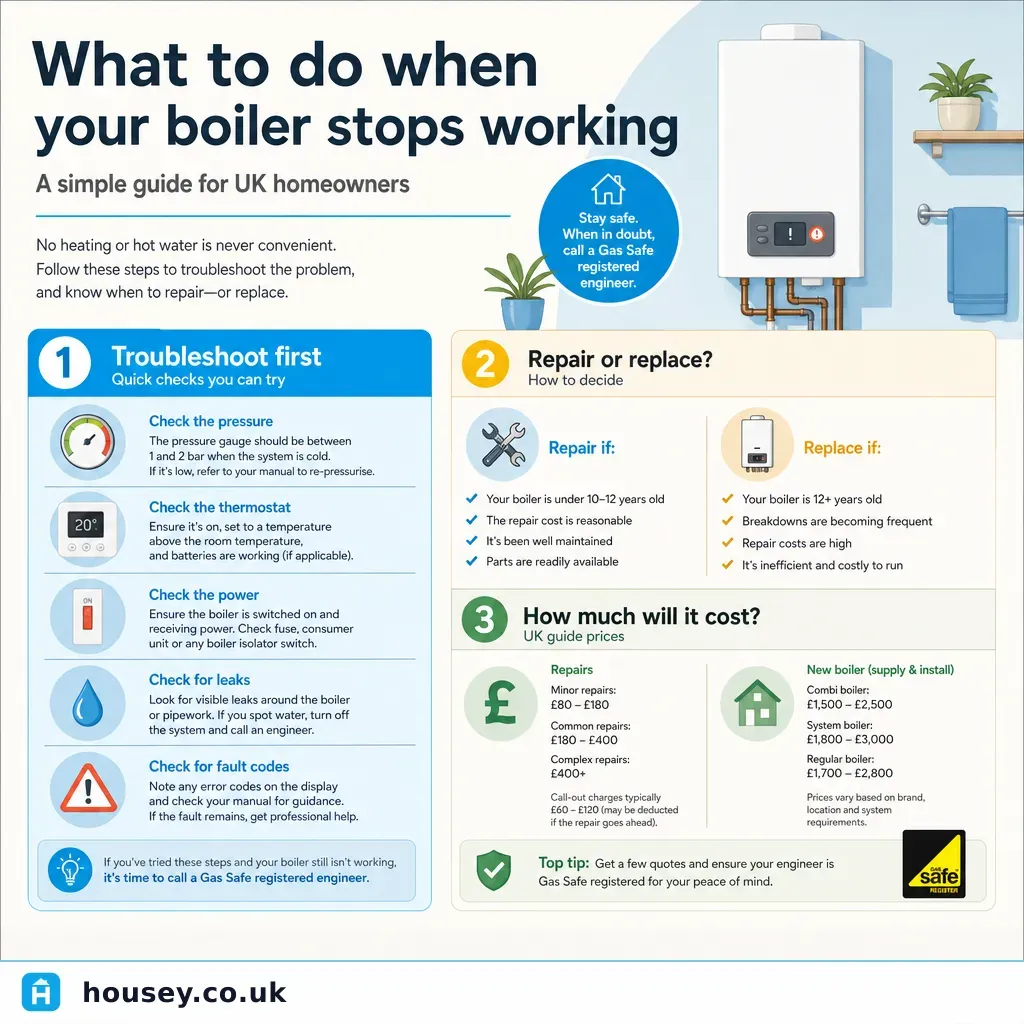
What to do when your boiler stops working
When your boiler stops working, check the pressure gauge (should read 1–1.
 General property advice
Property Market Trends: Activity Growth and Price Movements
UK property market activity is measured through completed sale registrations (HM Land Registry), lender mortgage data, and transaction volumes from HMRC.
 General property advice
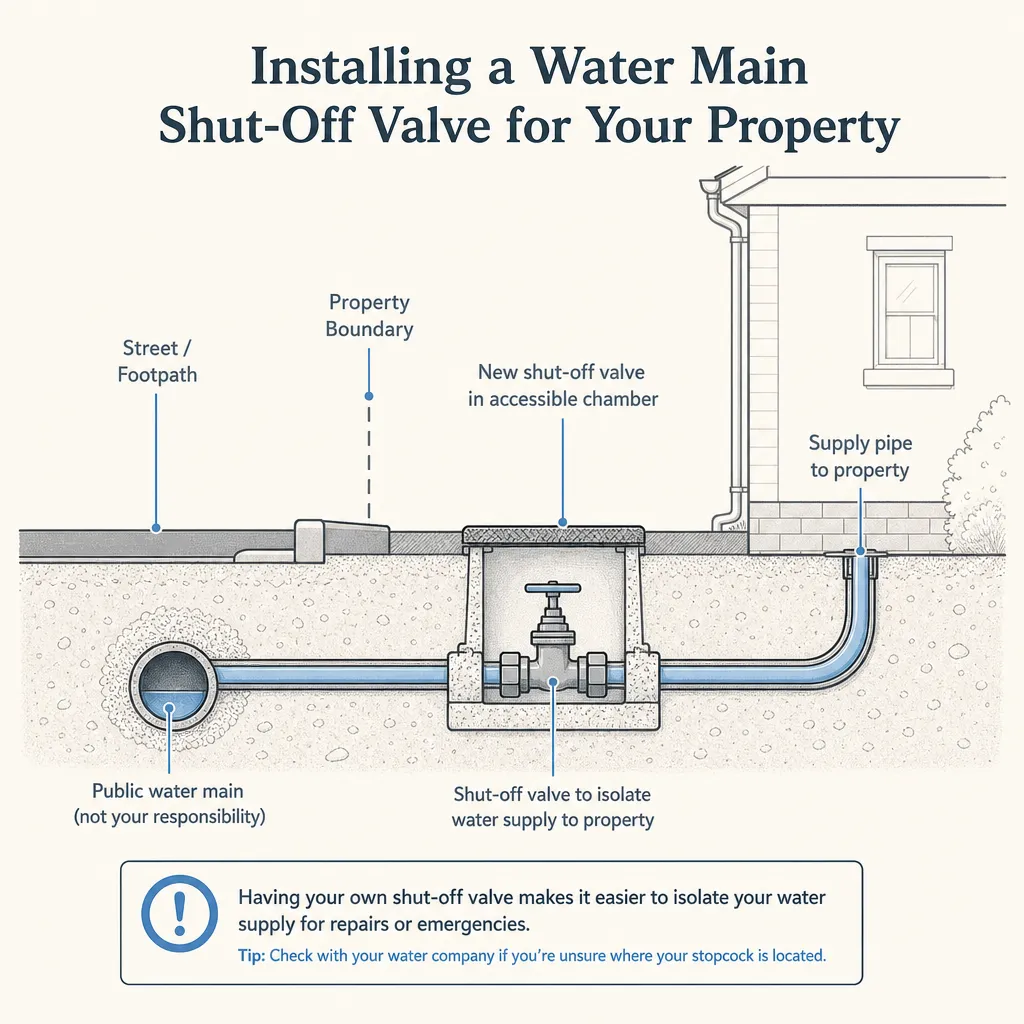
Installing a water main shut-off valve for your property
A water main shut-off valve — commonly called a stopcock — controls all water entering your home from the mains.
 General property advice
Monthly House Price Index: August Market Report and Analysis
The UK House Price Index is published monthly using completed Land Registry transaction data, meaning August figures typically reflect sales agreed months earlier.
 General property advice
Scottish Property Market: Activity and Regional Trends
Scotland's property market operates under distinct legal rules: sellers must provide a Home Report before marketing, transactions become legally binding at conclusion of missives rather than exchange of contracts, and Land and Buildings Transaction Tax replaces Stamp Duty.