Valuation Surveys for Property Purchase and Insurance
By Housey · Last reviewed 31st of May 2026
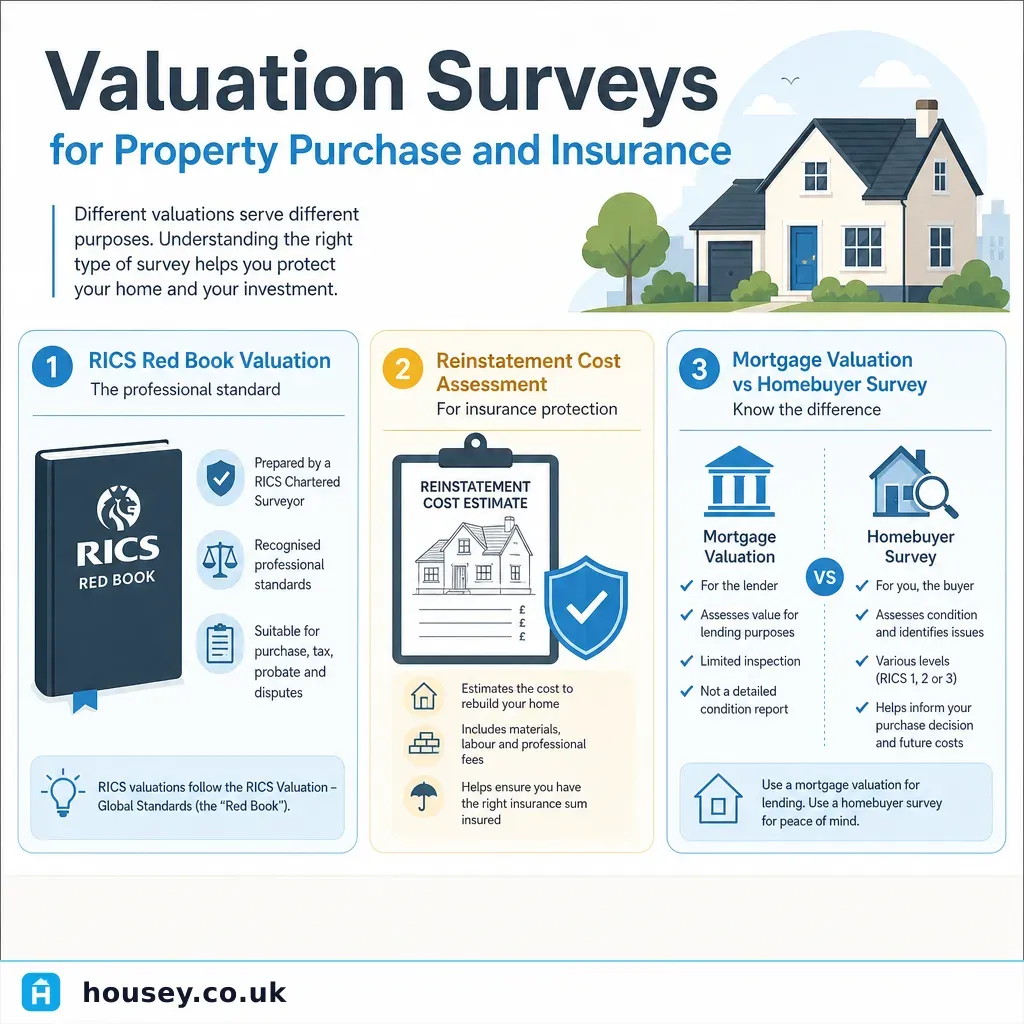
Valuation Surveys for Property Purchase and Insurance
Property valuations arise at several distinct points in a homeowner's journey — when buying (to confirm value before exchange or to satisfy a mortgage lender), when arranging or renewing buildings insurance (to set an accurate rebuild sum), and when navigating legal or tax processes such as probate, lease extension, or shared ownership staircasing. Each scenario calls for a different type of valuation, prepared to a different professional standard, by someone with the appropriate credentials. Confusing these products — or relying on a lender's mortgage valuation when something more robust is required — is a common and sometimes costly mistake in the UK market.
Key points
- A lender's mortgage valuation is prepared for the lender's benefit, not the buyer's — it confirms the property offers adequate security for the loan and is not a structural survey or independent opinion of value.
- A RICS Red Book valuation (prepared under RICS Valuation – Global Standards) is required for regulated purposes including probate, Help to Buy equity loan redemption, shared ownership staircasing, matrimonial proceedings, and certain HMRC tax matters.
- A reinstatement cost assessment (RCA) is an insurance valuation calculating the cost of rebuilding a property from scratch — this figure can differ dramatically from market sale value, particularly for period or listed buildings.
- RICS Registered Valuer status is a specific qualification within RICS membership — not all RICS members hold it; confirm registration before instructing for any formal valuation purpose.
- Automated valuation models (AVMs) and desktop valuations carry a wider margin of error than a physical inspection and are generally unsuitable for unusual properties, those in poor condition, or any regulated purpose.
What a mortgage valuation does — and does not — cover
When you apply for a mortgage, your lender instructs a valuer to confirm the property is worth at least the agreed purchase price and to flag any obvious material defects that could affect saleability. The report is produced for and owned by the lender. Buyers typically receive only a brief summary or confirmation that the mortgage has been offered.
A mortgage valuation does not assess damp, drainage, roof structure, or condition in depth. It does not identify hidden defects, asbestos, or evidence of subsidence. It does not advise whether the asking price is fair relative to comparable sales. It does not owe a duty of care to the buyer.
Buyers who exchange contracts based solely on a mortgage valuation summary and then discover significant defects after completion have very limited legal recourse against the lender or the lender's valuer.
RICS Red Book valuations: when are they required?
A Red Book valuation must be prepared by a RICS Registered Valuer using the methodology set out in RICS Valuation – Global Standards. It is a formal, defensible professional opinion of market value at a specific date, supported by comparable evidence and subject to RICS ethics and professional indemnity obligations.
Red Book valuations are typically required for:
- Probate and inheritance tax: valuing a property for HMRC as part of an estate — GOV.UK guidance sets out the process.
- Help to Buy equity loan redemption: Homes England requires a RICS Red Book valuation to calculate the market value against which the equity loan percentage is applied.
- Shared ownership staircasing: to establish current market value when a leaseholder buys additional shares.
- Matrimonial or civil partnership proceedings: court-admissible evidence of property value.
- SIPP and SSAS pension fund property: HMRC-compliant formal valuations for pension trustees.
- Capital Gains Tax calculations: where a formal opinion of value at a specific past date is needed.
For a standard purchase without a regulatory requirement, an independent homebuyer's valuation or a RICS Home Survey with a market value opinion may be proportionate — a RICS Registered Valuer can advise on the right approach for your situation.
Insurance valuations: the reinstatement cost assessment
A reinstatement cost assessment (RCA) calculates the cost of demolishing and fully rebuilding a property to its current specification under current construction-cost conditions, including professional fees, site clearance, VAT, and any heritage or planning requirements. It is an insurance figure, not a market valuation.
Why market value and rebuild cost differ
A Victorian terraced house in a popular city location might sell for £620,000 but cost £290,000 to rebuild. A remote listed cottage may have a market value of £330,000 but a rebuild cost exceeding £510,000 because of specialist lime-mortar construction, heritage materials, and planning conditions attached to the curtilage. Insuring at market value — or leaving an unreviewed index-linked sum insured to drift — is one of the most common causes of underinsurance in UK homes.
Property type | Recommended RCA approach | Key cost drivers |
|---|---|---|
Standard modern estate house | BCIS online rebuilding cost calculator may suffice for straightforward cases | Floor area, specification, region |
Victorian or Edwardian terrace | Full RCA by a RICS surveyor recommended | Period brickwork, chimneys, bay windows, solid floors |
Listed building | Full RCA essential; specialist input often needed | Lime mortar, specialist trades, planning restrictions on materials |
Flat in a converted building | Freeholder or management company should commission a building-level RCA | Shared structure, communal areas, roof |
Recently extended or altered property | RCA should reflect post-works rebuild cost | Extension materials, structural upgrades |
When to commission an RCA
- When first taking out buildings insurance on a new purchase, particularly for period or unusual properties.
- When the property has been extended or significantly altered since the last assessment.
- Every five to ten years as a routine review — more frequently during periods of high construction cost inflation.
- For listed buildings, where specialist materials and trades meaningfully increase rebuild cost relative to standard construction.
Which valuation do you need?
- Independent opinion of market value before buying: commission a RICS Home Survey Level 2 or Level 3 with market value opinion, or a standalone homebuyer's valuation from a RICS Registered Valuer.
- Satisfying a mortgage lender: the lender arranges this; you cannot choose the valuer, though you may be charged a fee.
- Probate, tax, or legal proceedings: commission a RICS Red Book valuation from a RICS Registered Valuer.
- Buildings insurance rebuild sum: commission a reinstatement cost assessment from a RICS surveyor or specialist RCA provider.
- Shared ownership staircasing or Help to Buy redemption: commission a RICS Red Book valuation from a Registered Valuer approved by your housing association or Homes England.
- Unsure which applies: contact a RICS Registered Valuer, describe the purpose, and let them advise on the correct product.
Important limitations
This article provides general guidance on the types of property valuation available in the UK. It does not constitute a valuation opinion, legal advice, tax advice, or a regulated report of any kind. Property values, rebuild costs, and regulatory requirements vary by location, property condition, market conditions, and the date of assessment. Rules governing regulated purposes — probate, Help to Buy, shared ownership, pension funds, and HMRC matters — may change and should be verified with the relevant authority or a qualified professional before being relied upon. Always appoint a RICS Registered Valuer for any purpose where a formal, defensible valuation is required.
What to ask a qualified professional
Before instructing a valuer or surveyor, confirm the following:
- Are you a RICS Registered Valuer, and will the report comply with RICS Valuation – Global Standards (Red Book) for my stated purpose?
- What comparable evidence are you using, and how recent is it?
- Have you previously valued similar properties — period, listed, or unusual construction — in this area?
- For an RCA: are you using current BCIS rebuild cost data, and does your methodology account for listed building constraints or period construction techniques?
- What access to the property will you need, and how long will the inspection take?
- Does the fee include VAT, and what does it cover — travel, the report, and follow-up queries?
- Will your report be accepted by my lender, HMRC, court, housing association, or Homes England for the purpose I have described?
- What level of professional indemnity insurance do you hold?
When to get professional help
You should appoint a qualified professional rather than rely on online tools or mortgage valuation summaries if:
- You are handling probate, a tax dispute, or matrimonial proceedings involving property.
- The property is unusual in construction, condition, or location and an AVM or desktop valuation is likely to be unreliable.
- Your buildings insurance sum insured has not been reviewed for more than five years, or the property has been significantly extended.
- You are a leaseholder approaching a lease extension — specialist leasehold valuation expertise is needed alongside the legal process.
- You have received a mortgage valuation you believe undervalues the property — discuss options with your mortgage broker, who can advise whether a reconsideration is feasible.
- You are purchasing a listed building and are uncertain of both its market value and its rebuild cost.
How Housey can help
Housey connects homeowners with RICS-qualified surveyors offering valuation surveys and RICS Home Surveys across the UK. Whether you need a standalone market valuation, a reinstatement cost assessment for buildings insurance, or a combined survey and valuation before exchange, compare qualified professionals in your area through Housey.
Frequently asked questions
Is a mortgage valuation the same as a homebuyer's survey?
No. A mortgage valuation is arranged by your lender and confirms the property provides adequate security for the loan — it does not assess condition in detail and is prepared for the lender, not the buyer. A RICS Home Survey (Level 2 or Level 3) is a condition report commissioned and owned by the buyer.
How long is a property valuation valid?
There is no universal rule, but lenders typically treat a valuation as current for three to six months. For regulated purposes such as probate, the date of valuation is specified in the instruction and may need to reflect a particular historical date rather than the current market.
Can I challenge a low mortgage valuation?
You can ask your mortgage broker to request a formal reconsideration from the lender's valuer, supported by evidence of comparable sold prices nearby. Applying through a different lender whose panel valuer may reach a different conclusion is sometimes an option. You cannot instruct the lender's valuer directly.
What is the difference between a desktop valuation and a full valuation?
A desktop valuation (or AVM — automated valuation model) uses Land Registry transaction data and comparable listings without a physical inspection. It is faster and cheaper but carries a wider margin of error and is generally unsuitable for unusual properties, distressed sales, or any regulated purpose requiring a defensible opinion of value.
Sources and further reading
- RICS Valuation – Global Standards (Red Book) — the professional standard for RICS valuations — RICS
- Help to Buy equity loan — valuation requirements for Help to Buy redemption — GOV.UK
- Valuing the estate of someone who died — HMRC guidance on property valuation for probate — GOV.UK / HMRC
- Buildings insurance guidance — ABI guidance on buildings insurance and rebuild cost — ABI
- BCIS — Building Cost Information Service — rebuild cost data used in reinstatement cost assessments — RICS / BCIS
- Find a RICS Registered Valuer — RICS firm and Registered Valuer search — RICS
Useful next reads
 Surveys & Inspections
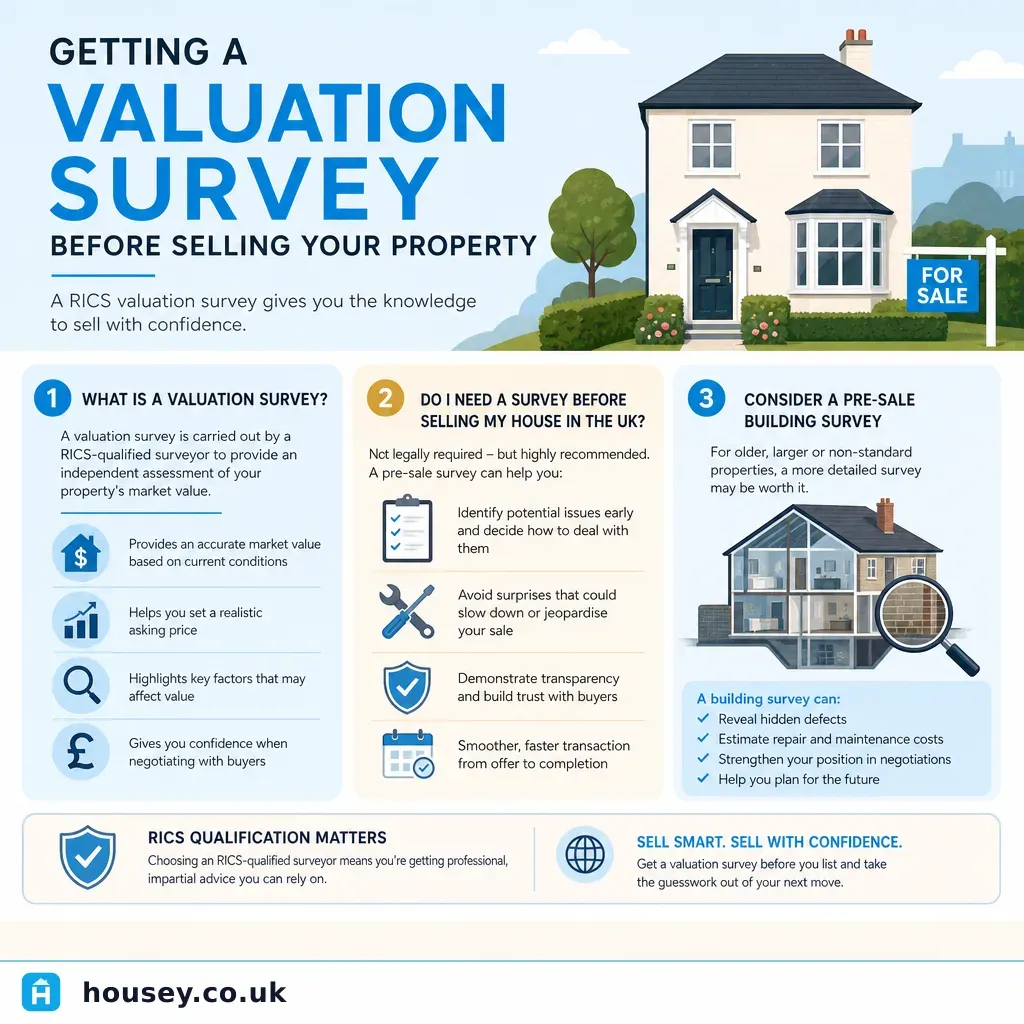
Getting a Valuation Survey Before Selling Your Property
Before selling, a free estate agent appraisal gives a market price guide, but only a RICS Red Book valuation carries formal professional standards and legal weight.
 Surveys & Inspections
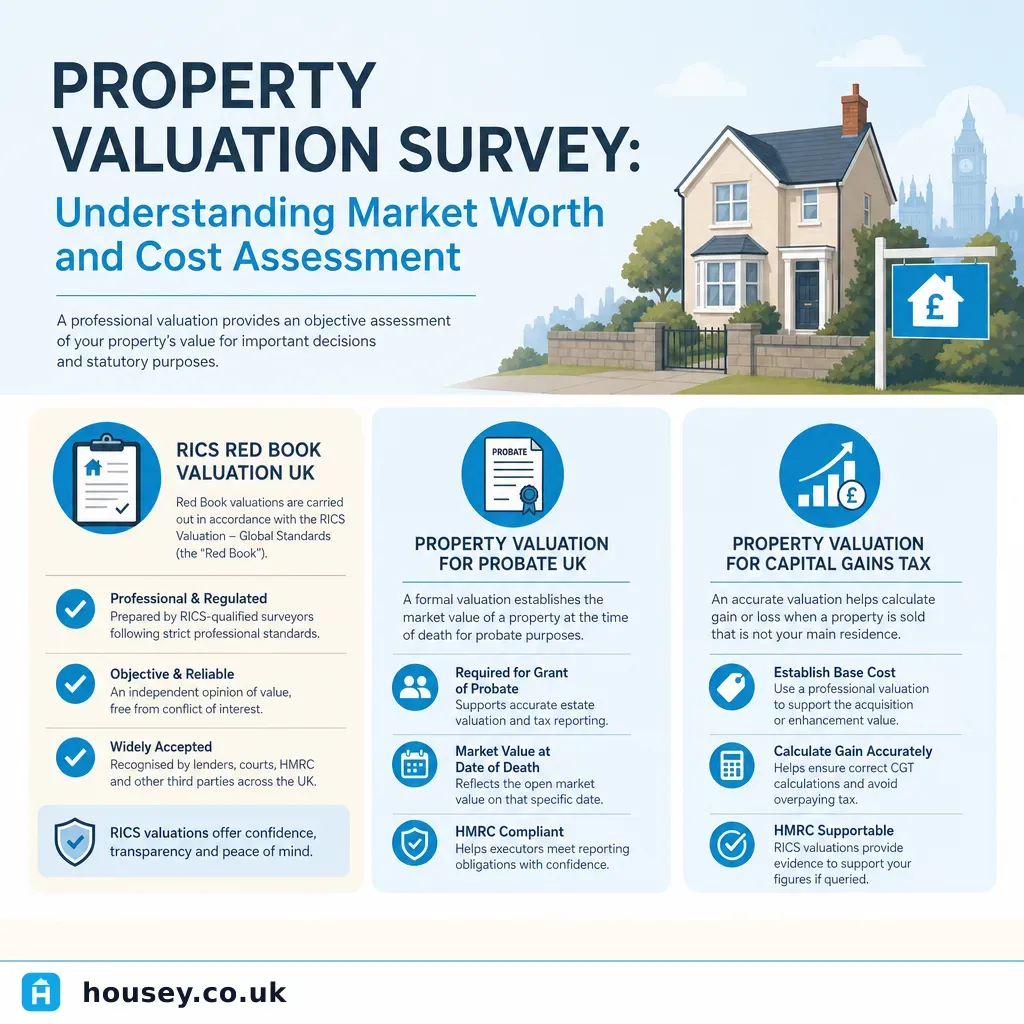
Property Valuation Survey: Understanding Market Worth and Cost Assessment
A property valuation survey establishes a property's market value at a specific date.
 Surveys & Inspections
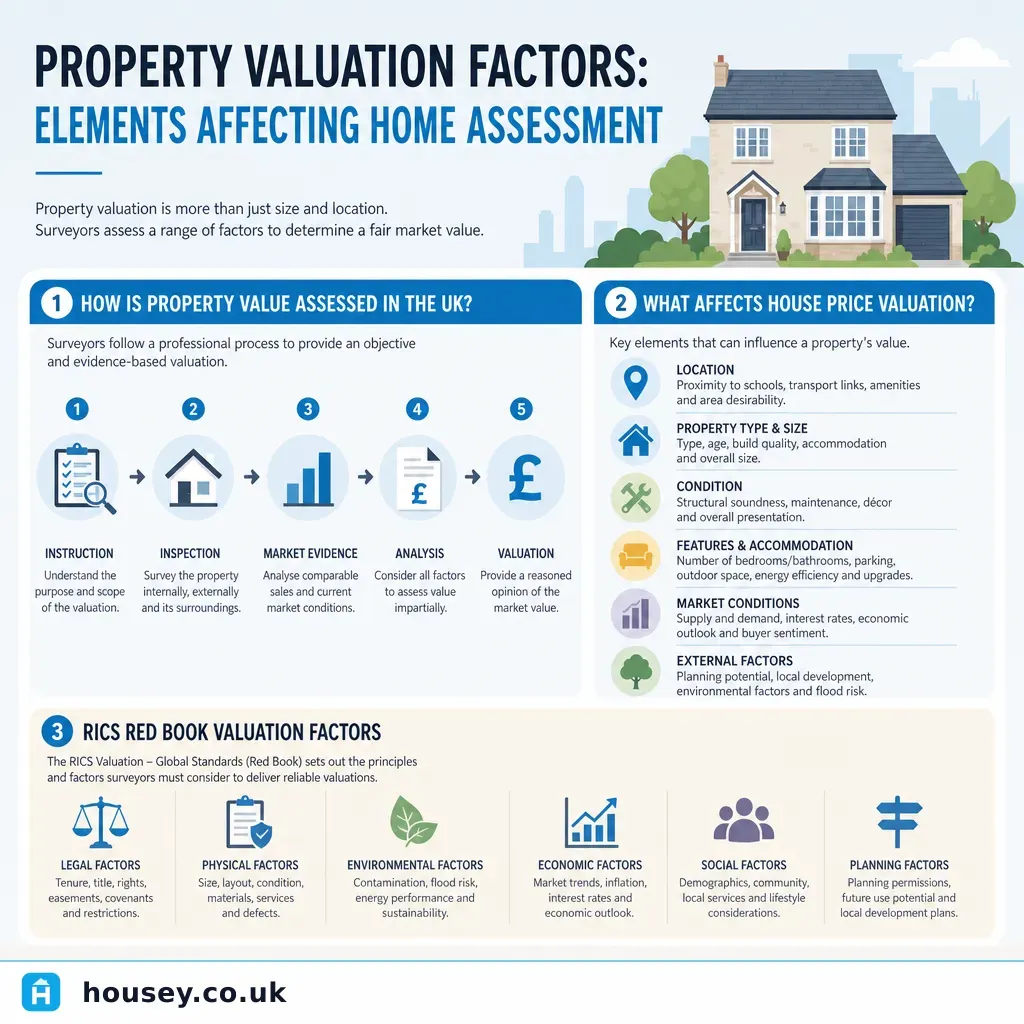
Property Valuation Factors: Elements Affecting Home Assessment
UK property valuations are primarily driven by location and comparable sales evidence, followed by floor area, condition, EPC rating, and legal factors such as lease length.
 Surveys & Inspections
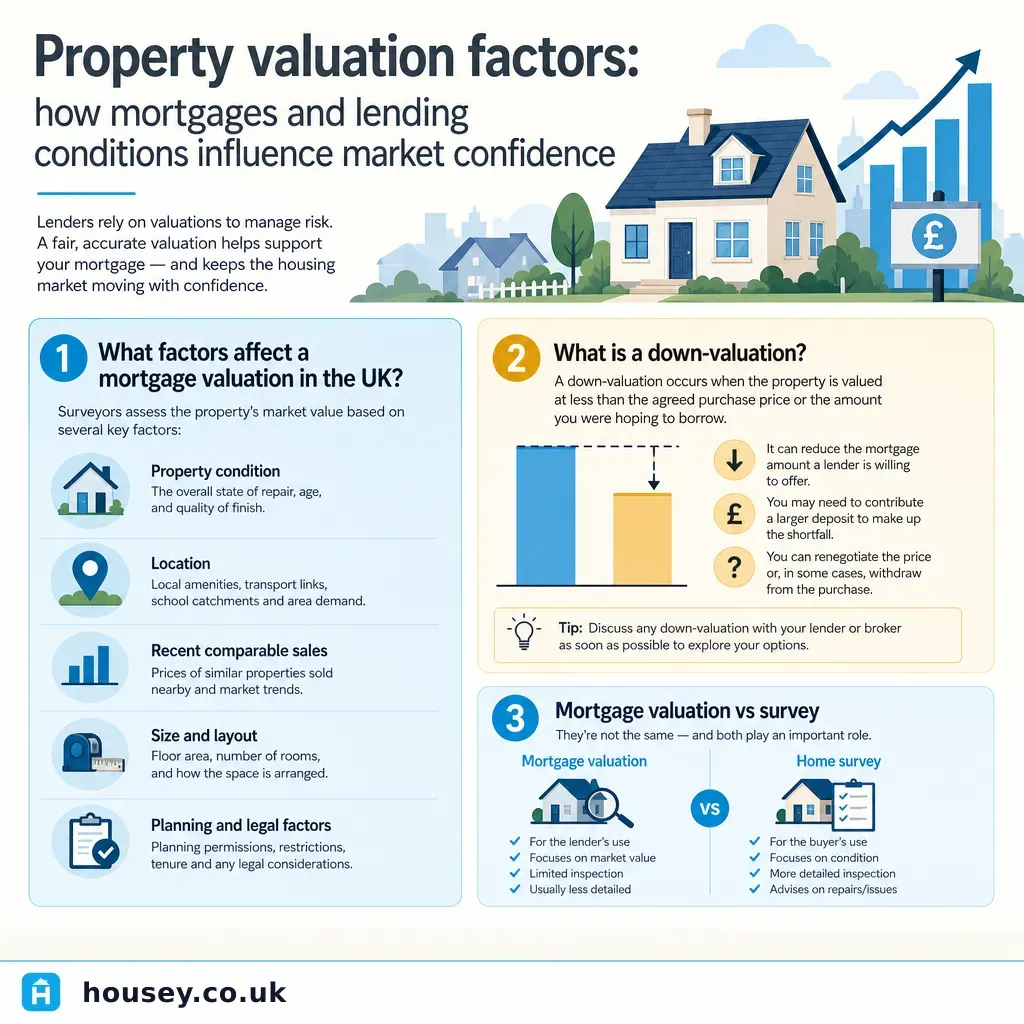
Property valuation factors: how mortgages and lending conditions influence market confidence
Mortgage lenders base their offer on the lower of the agreed purchase price or the surveyor's valuation.
 Surveys & Inspections
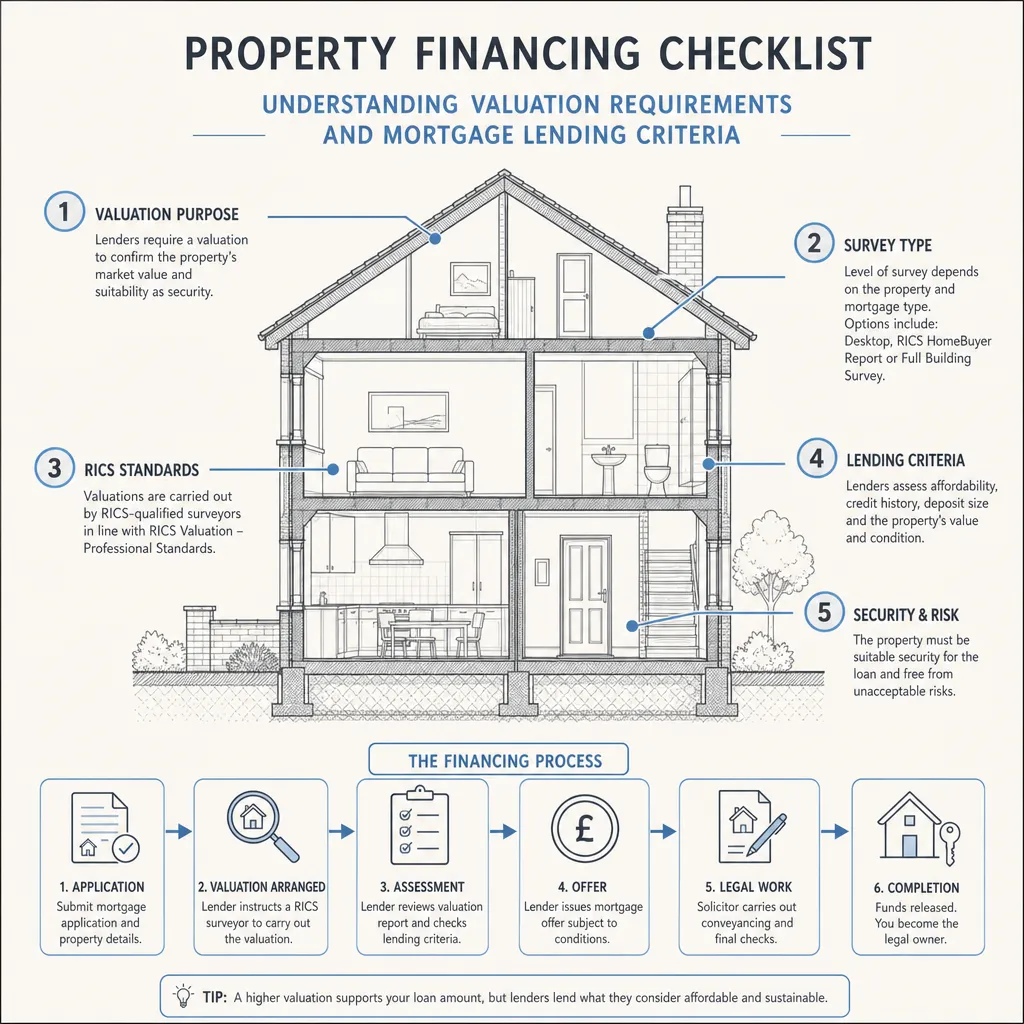
Property financing checklist: understanding valuation requirements and mortgage lending criteria
Mortgage lenders require their own valuation before releasing funds — this confirms the property is adequate security, not its condition.