Valuing Your Home: Tools and Methods for Property Estimation
By Housey · Last reviewed 8th of May 2026

Valuing Your Home: Tools and Methods for Property Estimation
Working out what your home is worth is rarely straightforward in the UK. Automated online tools, estate agent appraisals, and formal RICS valuations each serve different purposes, operate on different data, and carry different levels of authority. Understanding which method is appropriate — and when each falls short — helps you avoid costly assumptions whether you are planning to sell, remortgage, release equity, or deal with a legal or tax matter involving your property.
Key points
- Automated Valuation Models (AVMs), used by Zoopla and similar portals, are computer-generated estimates based on Land Registry data and local sales patterns; they carry no professional liability and are not accepted for mortgage, legal, or tax purposes.
- HM Land Registry Price Paid Data covers all registered sales in England and Wales and is the most reliable free public source of recent comparable prices, though data typically lags four to eight weeks behind completion.
- A RICS Red Book valuation is prepared to the RICS Valuation — Global Standards with professional indemnity insurance; it is required by mortgage lenders, courts, HMRC, and for probate or financial settlement purposes.
- Estate agent market appraisals are opinions of likely sale price, not professional valuations; they may be influenced by commercial incentives to secure an instruction.
- Leasehold tenure — particularly where fewer than 80 years remain on a lease — can significantly affect valuation and mortgage eligibility, regardless of the property's physical condition.
The main methods for estimating your home's value
Automated Valuation Models
Portals such as Zoopla and Rightmove offer instant automated estimates based on algorithms drawing on Land Registry sold prices, current listing data, and local market trends. They are convenient but have well-documented limitations:
- They cannot account for property condition, recent improvements, significant defects, or unusual features.
- Accuracy decreases in areas with low transaction volumes, including rural locations and non-standard property types.
- They carry no professional liability and are not suitable for mortgage, remortgage, legal, or tax purposes.
Use AVMs for broad market orientation — not for financial decision-making.
HM Land Registry sold prices
The HM Land Registry Price Paid Data is the definitive public record of all registered sales in England and Wales. You can search by address or postcode to find recent comparable prices. Key considerations:
- Data is typically published four to eight weeks after the actual completion date.
- It records the registered sale price, not the asking price, and does not reflect vendor incentives or part-exchange arrangements.
- New-build sales are included but may reflect developer incentives not available on the resale market.
- Scotland uses the Registers of Scotland; Northern Ireland uses the Land and Property Services register.
Estate agent market appraisals
Most estate agents will appraise your property at no charge. This provides a local expert's view of likely sale price and current market conditions. However:
- An appraisal is an opinion of likely sale price, not a professional valuation with regulatory standing.
- Some agents may provide higher estimates to secure an instruction — always request the comparable evidence behind any figure given.
- Comparing at least two or three agents and asking each to justify their figures with recent sold prices for similar properties in the same postcode gives a more reliable picture.
RICS formal valuations
A RICS Red Book valuation is a professional opinion of market value at a specific date, prepared to the RICS Valuation — Global Standards, with professional indemnity insurance. It is required for:
- Mortgage and remortgage applications (lenders instruct their own valuer, often via a panel).
- Probate and estate administration.
- Divorce and financial settlement proceedings.
- HMRC purposes, including Stamp Duty Land Tax disputes, Inheritance Tax, and Capital Gains Tax matters.
- Shared ownership staircasing and leasehold enfranchisement.
- Equity release applications.
A RICS valuation and a RICS survey are different products. A valuation addresses the question of current market worth; a survey assesses condition and identifies defects.
Comparison: which method for which purpose?
Purpose | AVM | Land Registry data | Estate agent appraisal | RICS formal valuation |
|---|---|---|---|---|
Broad market orientation | ✓ Useful | ✓ Useful | ✓ Useful | Rarely needed |
Setting an asking price | Indicative only | Useful context | ✓ Primary tool | Rarely needed |
Mortgage or remortgage | ✗ Not accepted | ✗ Not accepted | ✗ Not accepted | ✓ Required |
Probate or legal dispute | ✗ Not accepted | Background only | ✗ Not accepted | ✓ Required |
HMRC or tax matters | ✗ Not accepted | Background only | ✗ Not accepted | ✓ Required |
Equity release | ✗ Not accepted | ✗ Not accepted | ✗ Not accepted | ✓ Required |
Monitoring market movements | ✓ Useful | ✓ Useful | Periodic check | Rarely needed |
Which valuation method should you use?
- You want a rough idea of your home's current value for planning purposes → Check Land Registry sold prices for your street and nearby postcodes, then cross-reference with AVM estimates for context.
- You are preparing to sell → Request market appraisals from two or three local estate agents; ask each to show comparable sold evidence; cross-reference with Land Registry data before settling on an asking price.
- You are remortgaging or applying for a new mortgage → Your lender will instruct a valuer; for some products or higher loan-to-value applications, a RICS formal valuation may be required — check with your mortgage broker.
- You need an independent valuation for legal, probate, or tax purposes → Instruct a RICS-registered valuer directly; AVMs and estate agent appraisals are not accepted for these purposes.
- You believe your Council Tax band or Stamp Duty Land Tax assessment is wrong → RICS valuation evidence is typically required to mount a challenge; consult a RICS-registered valuer before appealing to the Valuation Office Agency or HMRC.
- You are concerned about lease length and its effect on value → Ask a RICS-registered valuer or a specialist leasehold solicitor; short leases — generally below 80 years — can materially reduce value and restrict mortgage eligibility.
What not to assume about property valuation
Do not assume an AVM is accurate for your specific property. Research consistently shows that automated tools can differ from actual sale prices by 10–20% for individual properties, particularly in areas with low transaction volumes or where a home has unusual construction, significant improvements, or notable defects.
Do not assume an estate agent appraisal is independent. Agents earn commission on sale. An inflated appraisal may win their instruction but can lead to price reductions after launch, extended marketing time, and reduced buyer confidence.
Do not assume a mortgage valuation protects you as a buyer. A lender's valuation confirms the property provides adequate security for the loan. It is not a structural survey and does not comprehensively assess condition, identify defects, or advise on whether the purchase price represents fair value to you personally.
Do not assume Land Registry data is current. Sold prices are published weeks after completion, and the market can shift significantly during periods of interest rate change or economic uncertainty. Recent data is more reliable than data from six or more months ago.
Do not assume improvements automatically increase your valuation. A valuer compares your property to recent sales of similar homes. Works that are not reflected in local comparable sales data, or that were carried out without proper consents and certification, may not translate into a higher valuation.
What factors most influence property value in the UK?
RICS-registered valuers consider a range of factors when forming an opinion of market value:
- Location: proximity to transport links, school catchment areas, employment centres, shops, and open space. Ofsted ratings for nearby schools can meaningfully influence buyer demand.
- Size and configuration: floor area in square metres, bedroom and bathroom count, garden size and aspect.
- Property type and construction era: terraced, semi-detached, detached, or flat; Victorian, interwar, post-war, or new-build.
- Condition and specification: structural condition, kitchen and bathroom quality, EPC rating, and the regulatory status of any improvements.
- Tenure: freehold versus leasehold. Short leases — generally below 80 years — can significantly reduce value and mortgage eligibility.
- Planning and legal factors: existing planning consents, Building Regulations compliance, restrictive covenants, easements, and outstanding enforcement matters.
Important limitations
This article provides general information to help UK homeowners understand the different methods available for estimating property value. It is not a professional valuation, financial advice, or legal advice.
Property values are specific to individual properties, their condition, tenure, location, and the state of the local market at a given time. For any purpose requiring a defensible, professional opinion of value — including mortgage applications, legal proceedings, probate, or HMRC matters — you should instruct a RICS-registered valuer. AVMs, Land Registry data, and estate agent appraisals are not substitutes for a formal valuation in these contexts.
What to ask a qualified professional
When instructing a RICS-registered valuer, ask:
- What standard will the valuation be prepared to — RICS Valuation Global Standards (Red Book)?
- What is the stated purpose of the valuation, and will that affect the methodology or value conclusion?
- What comparable sales are you using, and how recent and geographically close are they to my property?
- Are there any factors that might complicate the valuation — leasehold tenure, short lease, planning issues, or structural concerns?
- Will the report be in a format accepted by my lender, solicitor, or HMRC?
- What level of professional indemnity insurance do you hold?
- What is the expected turnaround time, and what does the fee include — does it cover a physical inspection?
When to get professional help
Instruct a RICS-registered valuer rather than relying on online tools or agent appraisals when:
- A mortgage or remortgage lender requires a formal valuation report.
- You are dealing with an estate, divorce, or legal dispute in which property value is contested.
- You are challenging a Council Tax band or a Stamp Duty Land Tax assessment.
- The property is unusual, leasehold with a short or complex lease, or has planning or structural complications that an automated tool cannot detect.
- You need a document that will withstand scrutiny from a solicitor, court, or HMRC.
How Housey can help
When you need a formal, professional opinion of your property's value, Housey can help you find and request quotes from RICS-registered valuers. Visit our valuation surveys service to get started.
Frequently asked questions
How accurate are online property valuation tools?
Automated Valuation Models used by portals such as Zoopla can differ from actual sale prices by 10–20% for individual properties, particularly in lower-transaction areas or for homes with unusual features. They are useful for broad market orientation but should not be relied upon for financial, legal, mortgage, or tax purposes, as they carry no professional liability.
How do I find out what similar houses have sold for?
HM Land Registry publishes sold prices for all registered properties in England and Wales via its Price Paid Data tool at gov.uk. You can search by address or postcode. Data typically lags four to eight weeks behind the actual completion date. Scotland uses the Registers of Scotland; Northern Ireland uses the Land and Property Services register.
Is an estate agent's valuation the same as a RICS valuation?
No. An estate agent's market appraisal is their opinion of likely sale price, useful for setting an asking price. A RICS Red Book valuation is a formal document prepared to published professional standards with indemnity insurance. Mortgage lenders, courts, and HMRC require the latter; estate agent appraisals are not accepted for these purposes.
How much does a RICS valuation cost?
Indicative UK costs vary by property value, location, and purpose. Residential valuations typically range from around £150 to £500 or more for standard properties; complex or high-value properties may cost more. Always request a fee quote specifying what is included and whether VAT applies. Indicative UK costs, last reviewed 2026-05-08.
Do I need a formal RICS valuation to sell my home?
No. A formal RICS valuation is not required to sell a property on the open market. An estate agent's appraisal is the standard starting point for setting an asking price. However, a formal valuation may be needed for specific legal or tax purposes connected with the sale, or if a buyer's lender requires one as a condition of their mortgage offer.
Sources and further reading
- HM Land Registry Price Paid Data — HM Land Registry
- RICS Valuation — Global Standards (Red Book) — RICS
- Search for land and property information — HM Land Registry
- Council Tax banding — Valuation Office Agency
- Registers of Scotland: house prices — Registers of Scotland
Useful next reads
 Buying & Moving
How to Get Your Property Professionally Valued
To get a professional property valuation in the UK, instruct a RICS Registered Valuer for any formal purpose — mortgage, probate, Help to Buy, or legal proceedings.
 Buying & Moving
Which Home Improvements Add Real Value to Your Property?
In the UK, loft conversions, single and double-storey extensions, and energy-efficiency upgrades are most reliably linked to added property value.
 Buying & Moving
Property Comparables: Using Market Data to Assess Home Value
Property comparables — known as 'comps' — are recently sold properties similar in size, type, tenure, and condition to the one being valued.
 Buying & Moving
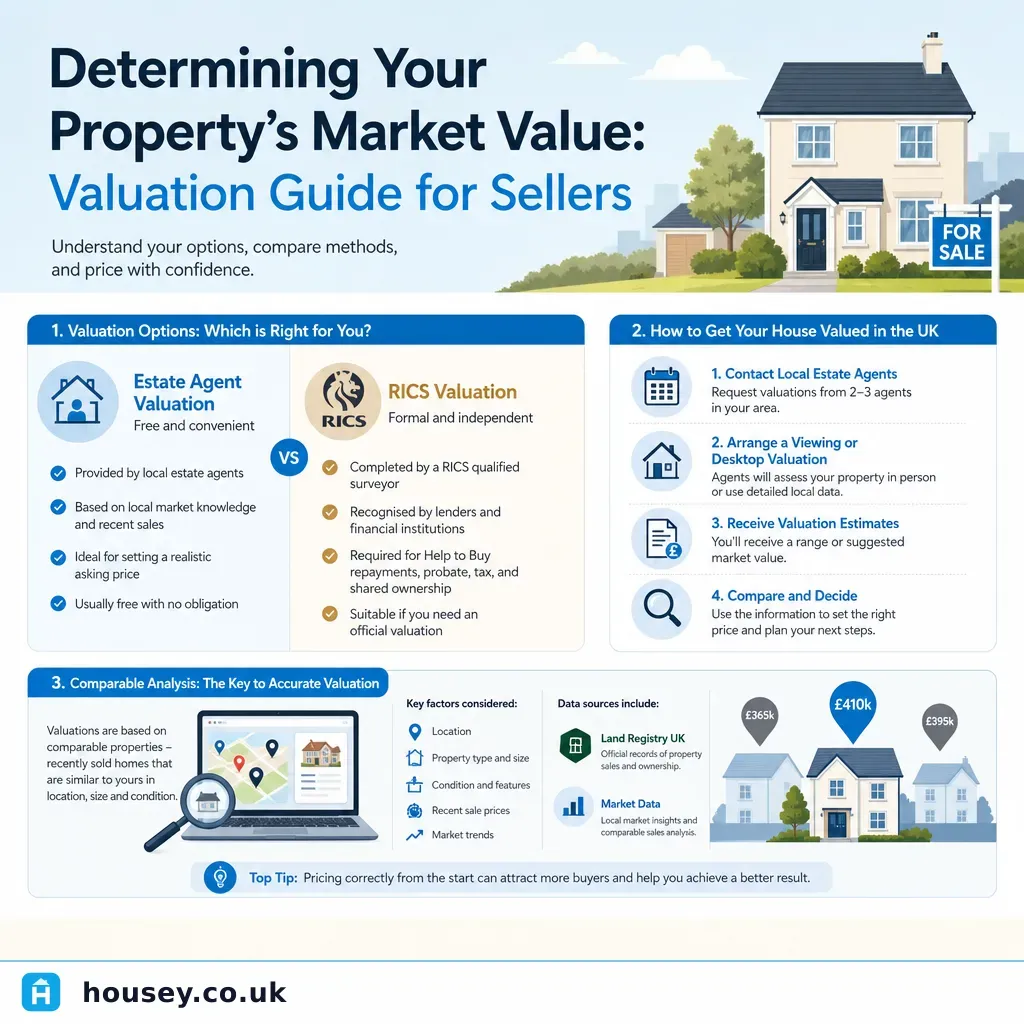
Determining Your Property's Market Value: Valuation Guide for Sellers
Market value in the UK is most reliably established by combining estate agent appraisals with your own analysis of recent sold prices on the HM Land Registry database.
 Buying & Moving
Proven Strategies for Selling Your Property Quickly and Effectively
To sell your UK home quickly, price it accurately from the outset, invest in professional photography and a measured floorplan, prepare your conveyancing documents before accepting an offer, and ensure the property presents well for viewings.