Vaulted Ceiling Installation: Design and Budget Planning
By Housey · Last reviewed 30th of May 2026
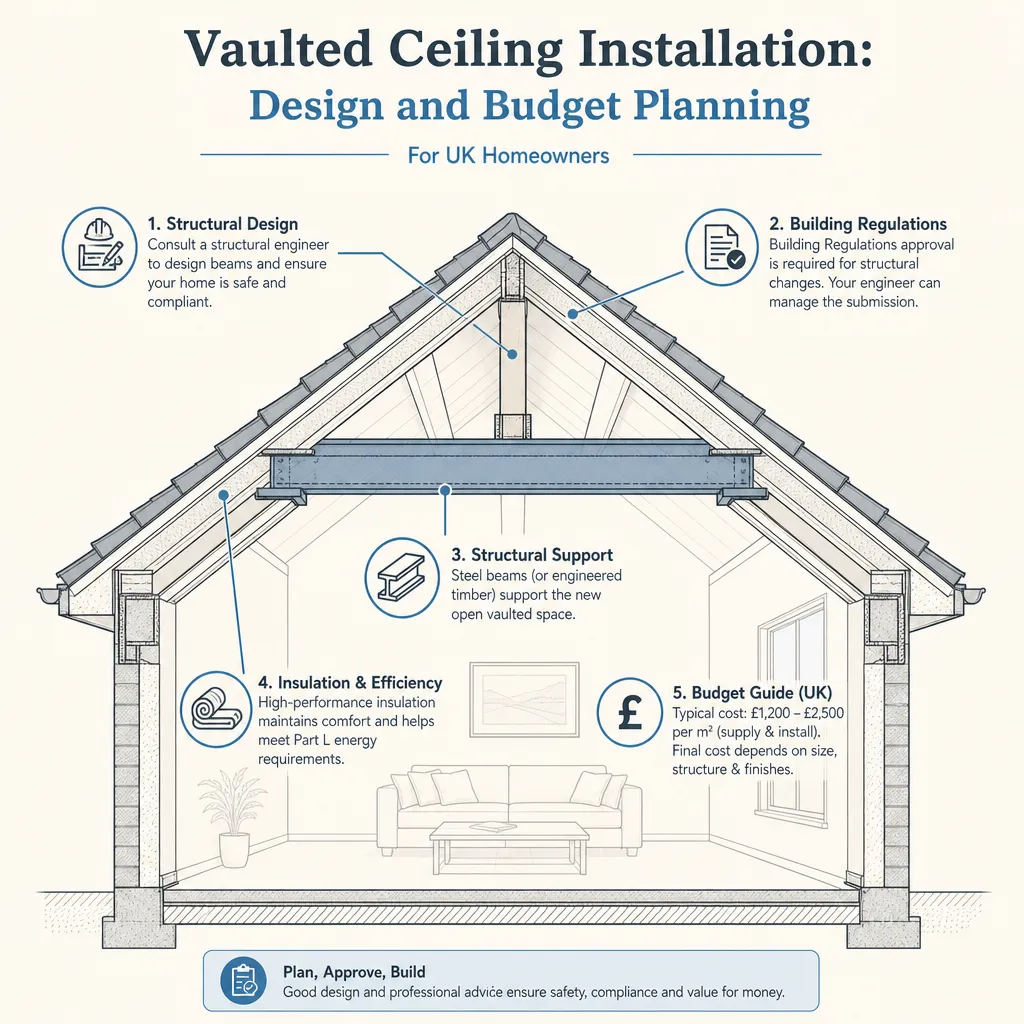
Vaulted Ceiling Installation: Design and Budget Planning
Creating a vaulted ceiling is one of the most structurally significant changes a homeowner can make to a UK property — it eliminates the horizontal ceiling plane, exposes the roof structure, and dramatically increases the perceived height of a room. The question most often arises during a loft rethink, a bungalow modernisation, or when single-storey living spaces feel oppressively low after a renovation. Because the work involves removing load-bearing elements from the roof, the consequences of an unengineered approach can be serious and very expensive to correct.
Key points
- Ceiling joists in a traditional couple or close-couple rafter roof act as lateral ties that prevent the walls spreading outward under roof load — removing them without an engineered structural substitute risks wall movement or partial roof collapse.
- All work that removes or alters ceiling joists is notifiable under the Building Regulations 2010 and requires compliance with Part A (Structure) and Part L (Conservation of Fuel and Power), with building control approval required before structural work begins.
- A structural engineer's calculations — including ridge beam or collar-tie specification — are a mandatory prerequisite; fees typically range from £500 to £1,500 for a standard residential room.
- Under Approved Document L, the resulting pitched roof must achieve a U-value of no worse than 0.18 W/m²K, which usually requires 150–250 mm of insulation depending on method, rafter depth, and roof pitch.
- Modern trussed-rafter roofs, dominant in estate housing built after approximately 1965, are structurally integrated systems — cutting any member invalidates the truss and significantly increases the scope and cost of vaulting work compared with traditional cut-rafter roofs.
What is a vaulted ceiling and how is it achieved?
A vaulted ceiling follows the slope of the roof above, removing the flat ceiling plane and revealing — or imitating — the rafter line. In UK residential construction, this is typically achieved by removing the existing ceiling joists and substituting their structural function using one of three main approaches:
- Structural ridge beam (steel RSJ or engineered timber): bears the rafter loads independently, transferring them to gable walls or internal posts. This is the most common approach for traditional cut-rafter roofs.
- Collar ties at raised level: retains lateral restraint at a higher position than the original joists, giving more headroom while maintaining a simpler structural solution over shorter spans.
- Room-in-roof trusses: some newer properties were designed with a vaulted profile integrated into the original truss specification — if this is the case, the ceiling void can be finished without structural redesign.
Which roof types are typically suitable?
Roof type | Vaulted ceiling feasibility | Typical structural approach | Main complication |
|---|---|---|---|
Traditional cut rafter (pre-1965) | Generally feasible | Steel or engineered timber ridge beam | Load path to gable walls or new posts |
Modern trussed rafter (post-1965) | Complex — structural redesign required | Full truss replacement or engineered frame | High cost; loss of roof void storage |
Room-in-roof truss | Feasible within designed zone | Use existing structure; finish only | Limited span flexibility |
Flat or shallow-pitch roof | Limited scope | Structural frame or new roof build-up | Weatherproofing and insulation challenge |
What building regulations apply?
Vaulting a ceiling is notifiable work. You must comply with:
Part A (Structure): The structural engineer's calculations must demonstrate the roof and wall structure remain adequate after the modification. Building control will check the calculations and inspect the structural beam installation.
Part L (Conservation of Fuel and Power): The exposed pitched roof must meet current thermal performance standards — typically a U-value of 0.18 W/m²K or better. This is usually achieved with a warm roof build-up using PIR rigid insulation boards between and below the rafters, or a full spray foam warm roof.
Part F (Ventilation): Vaulted ceiling construction can trap moisture within rafter cavities. A properly ventilated cold roof or a fully filled warm roof build-up must be specified to prevent interstitial condensation — the design must be confirmed by the engineer or a competent insulation specifier.
Apply for full plans approval or submit a building notice to your local authority building control (LABC) or a Registered Building Control Approver (under the Building Safety Act 2022). Do not begin structural work until building control approval is confirmed.
How much does a vaulted ceiling cost in the UK?
Costs vary significantly depending on roof structure, room span, access, insulation method, and finish. The following are indicative UK figures; always obtain at least three itemised quotes.
Indicative UK costs, last reviewed 2026-05-30. Costs vary by region, site access, and project complexity.
Cost element | Indicative range | Notes |
|---|---|---|
Structural engineer's fee | £500–£1,500 | Higher for complex or multi-span roofs |
Building control application | £300–£800 | LABC or Registered Building Control Approver |
Steel ridge beam supply and installation | £2,500–£8,000 | Includes temporary weatherproofing and cranage if required |
Carpentry and joinery labour | £1,500–£4,000 | Rafter trimming, noggins, boarding |
Insulation (PIR warm roof boards) | £800–£2,500 | Depends on area and U-value target |
Plasterwork and decoration | £1,000–£3,500 | Boarding, skimming, finishing coat |
Typical total (one room) | £8,000–£25,000+ | Trussed-rafter roofs typically at the higher end |
Worked UK property scenario
Property: 1953 detached bungalow with traditional cut-rafter roof, 4.2 m span main bedroom, original plaster-on-lath ceiling.
Goal: Vault the bedroom ceiling to increase headroom and create an architectural feature, retaining the chimney breast on the gable wall.
Process: A structural engineer visits, inspects the roof from the loft, records rafter sizes and spacing, and specifies a 203 × 102 UB steel ridge beam bearing on padstone corbels in both gable walls — with collar ties retained at 1.8 m on each rafter pair for additional stiffness. Building control full plans are submitted with the structural calculations. Once approved, the builder removes the plasterboard and lath, installs the steel ridge using a small crane through a temporary roof opening, refixes rafters around the chimney, installs 120 mm PIR between rafters and a continuous 50 mm PIR board below rafters to achieve a U-value of 0.17 W/m²K, adds a vapour control layer, boards, and skims. Building control carries out three stage inspections: structural steelwork, insulation, and final completion.
Outcome: Bedroom height increased from 2.35 m to 3.1 m at the ridge. Total project cost approximately £13,500 including VAT. Building control completion certificate issued six weeks after structural work began.
Pre-project checklist
Before instructing any trades, work through these steps:
Important limitations
This article provides general information about vaulted ceiling installation in UK residential properties. Every roof is structurally different — the feasibility and approach depend on the specific span, rafter sizes, wall construction, foundation condition, and roof geometry of your property. Nothing here constitutes a structural assessment. A chartered structural engineer must inspect the property and produce project-specific calculations before any ceiling joists are removed or modified. Removing ceiling joists without adequate structural provision can cause irreversible damage to the roof and walls.
What to ask a qualified professional
Before instructing a structural engineer or builder:
- Have you worked on this roof type before — traditional cut rafter or trussed — and can you provide references from comparable projects?
- Will your structural calculations be submitted directly to building control, and will you liaise with the building control body throughout?
- How will the ridge beam be installed, and what temporary weatherproofing will be in place while the roof is open?
- How will you achieve the required U-value under Part L — what insulation system do you recommend for this roof pitch and rafter depth?
- How will you handle the chimney stack and any services that currently pass through the ceiling void?
- Are you aware of the ventilation and condensation requirements under Approved Document F, and how will these be met?
When to get professional help
A structural engineer must always be appointed for vaulted ceiling work — this is not an optional extra. Seek urgent professional advice if:
- You notice cracks in the gable walls, at eaves level, or along the ridge line — these may indicate existing structural movement that removing lateral ties could worsen.
- The roof ridge line is visibly curved or sagging when viewed from outside.
- You discover the property has modern trussed rafters — the project scope and cost are substantially different from a cut-rafter roof.
- A builder quotes for the work without mentioning structural calculations, building regulations, or building control approval.
How Housey can help
Housey connects you with vetted structural engineering professionals and experienced extension builders who understand the demands of vaulted ceiling projects in UK homes. You can also find building control consultants to manage the approvals process from application through to completion certificate. Submit a brief project description to receive quotes from local specialists.
Frequently asked questions
Do I need planning permission for a vaulted ceiling?
Internal structural alterations such as vaulting a ceiling do not usually require planning permission in England. However, if the work involves any external roof alteration — raising the ridge height or adding rooflights — permitted development rights or a full planning application may be needed. If the property is listed or in a conservation area, listed building consent is likely required before any internal structural work begins.
Can I vault a ceiling in a semi-detached house?
Yes, but if the original ceiling joists span to a shared party wall, the structural solution must account for that shared structure. If any notifiable work affects the party wall, you must serve a party wall notice under the Party Wall etc. Act 1996 before work starts. If the adjoining owner dissents, both parties appoint a party wall surveyor to agree an award.
How long does a vaulted ceiling project take?
Structural work on a single-room vaulted ceiling typically takes three to six weeks from start to final decoration, depending on drying time for plaster and insulation system complexity. Allow an additional four to eight weeks before structural work begins for the structural engineer's calculations, drawings, and building regulations approval — these stages cannot be skipped or significantly shortened.
Can I vault a ceiling without a steel beam?
In some circumstances, engineered timber such as LVL or glulam can replace steel at the ridge, and collar ties may be adequate for shorter spans. A structural engineer will advise on the right solution for your specific roof geometry, rafter sizes, and load conditions. There is no universal answer — a site-specific assessment is always required before any joists are removed.
Sources and further reading
- Approved Document A: Structure — GOV.UK
- Approved Document L: Conservation of Fuel and Power — GOV.UK
- Approved Document F: Ventilation — GOV.UK
- Building Safety Act 2022 guidance — GOV.UK
- RICS Find a Surveyor — RICS
Useful next reads
 Improvement & Build
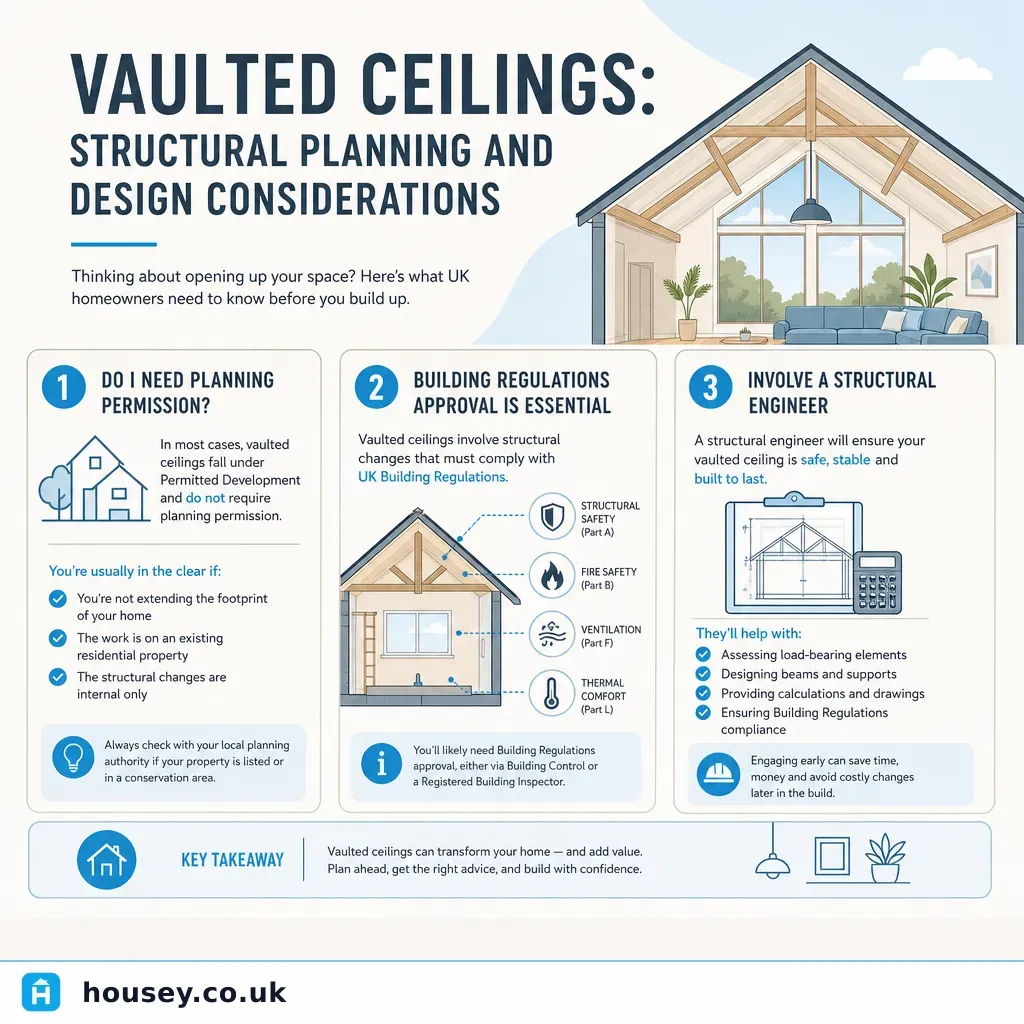
Vaulted Ceilings: Structural Planning and Design Considerations
Creating a vaulted ceiling in an existing UK home almost always requires structural engineering input, Building Regulations approval under Part A and Part L, and a new ridge beam or steel support structure.
 Improvement & Build
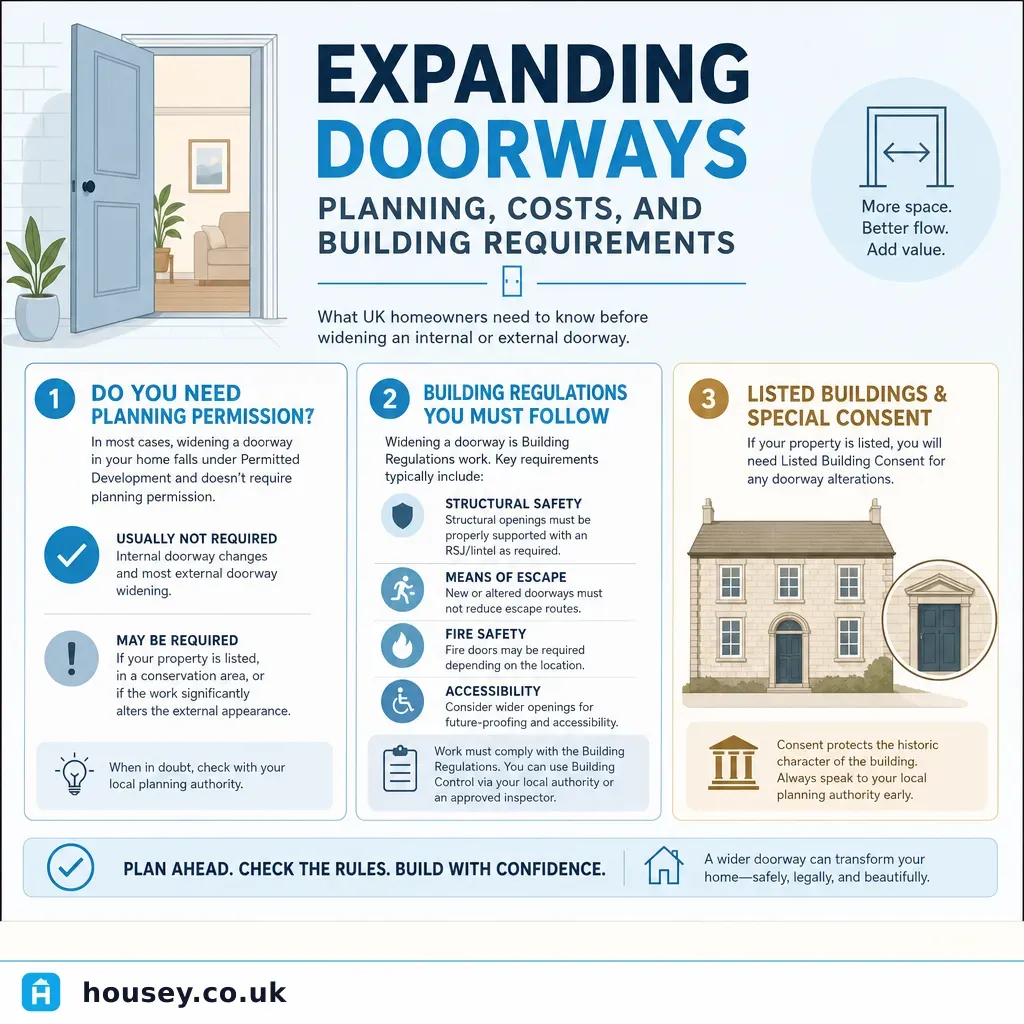
Expanding Doorways: Planning, Costs, and Building Requirements
Expanding a doorway in a load-bearing wall requires Building Regulations Part A approval and a structural engineer's lintel design.
 Improvement & Build
Estimate for Merging Two Properties into a Single Residence
Merging two properties into one typically costs £30,000–£120,000 or more, depending on property type, structural complexity, and professional fees.
 Improvement & Build
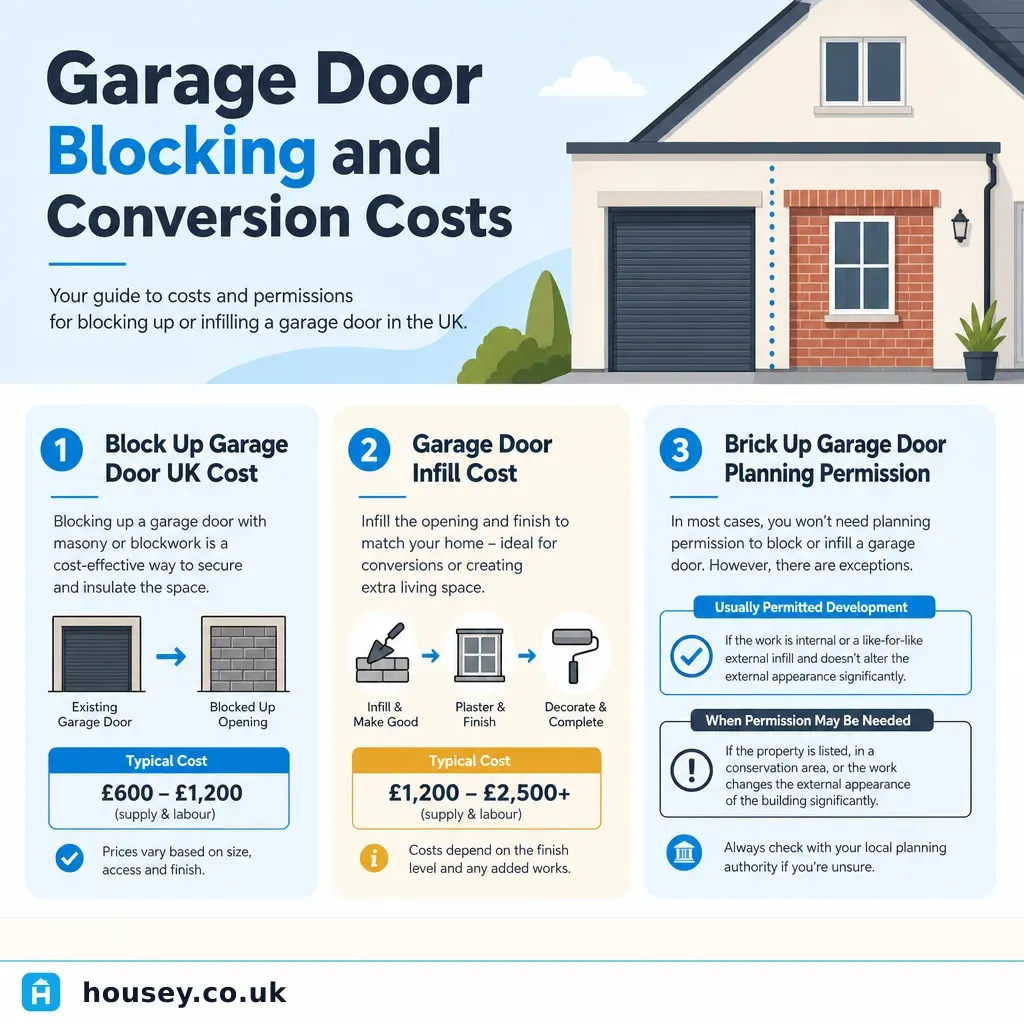
Garage Door Blocking and Conversion Costs
Blocking up a garage door in the UK typically costs £800–£3,000, depending on infill material, opening size, and whether a new window is included.
 Improvement & Build
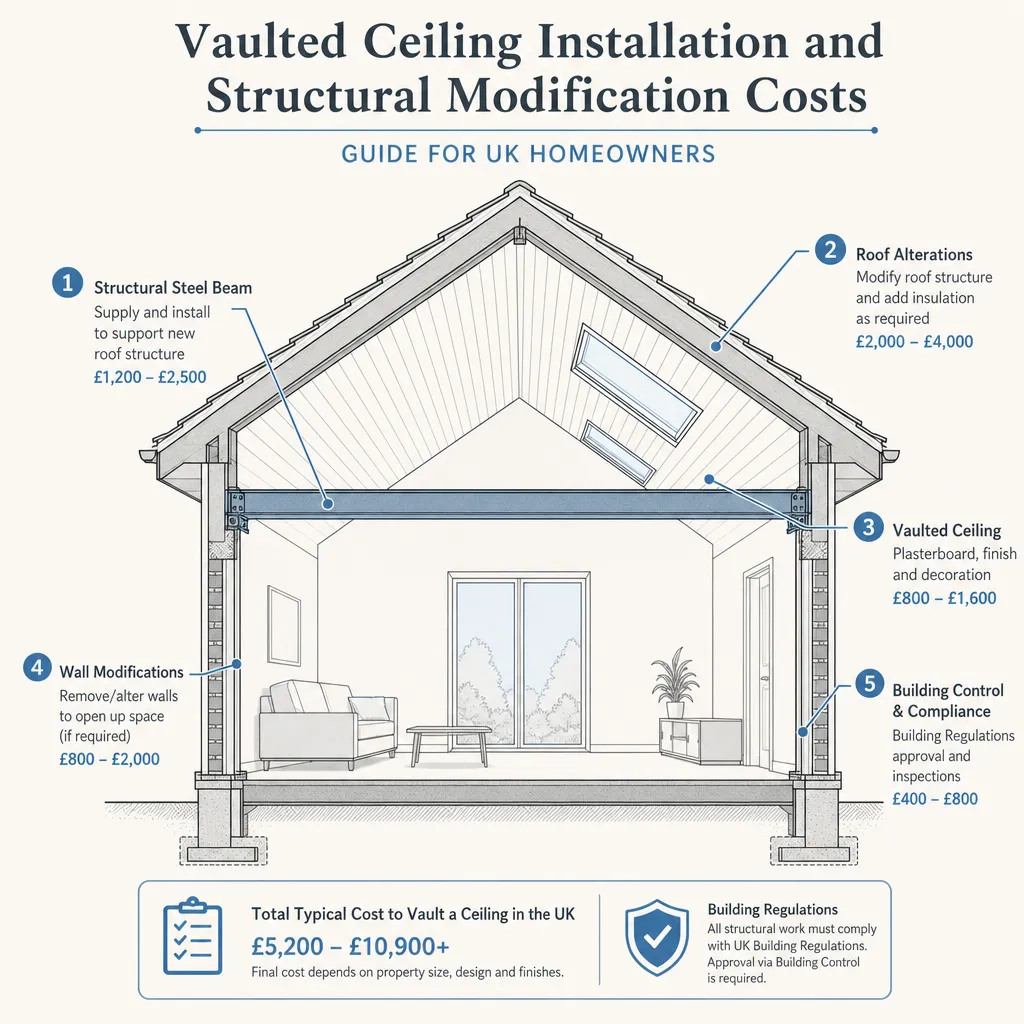
Vaulted Ceiling Installation and Structural Modification Costs
Creating a vaulted ceiling in the UK usually involves removing ceiling joists or modifying the roof structure, installing a structural ridge beam, and upgrading insulation — work that always requires a structural engineer's calculations and building regulations approval under Part A.