Vaulted Ceilings: Structural Planning and Design Considerations
By Housey · Last reviewed 1st of June 2026
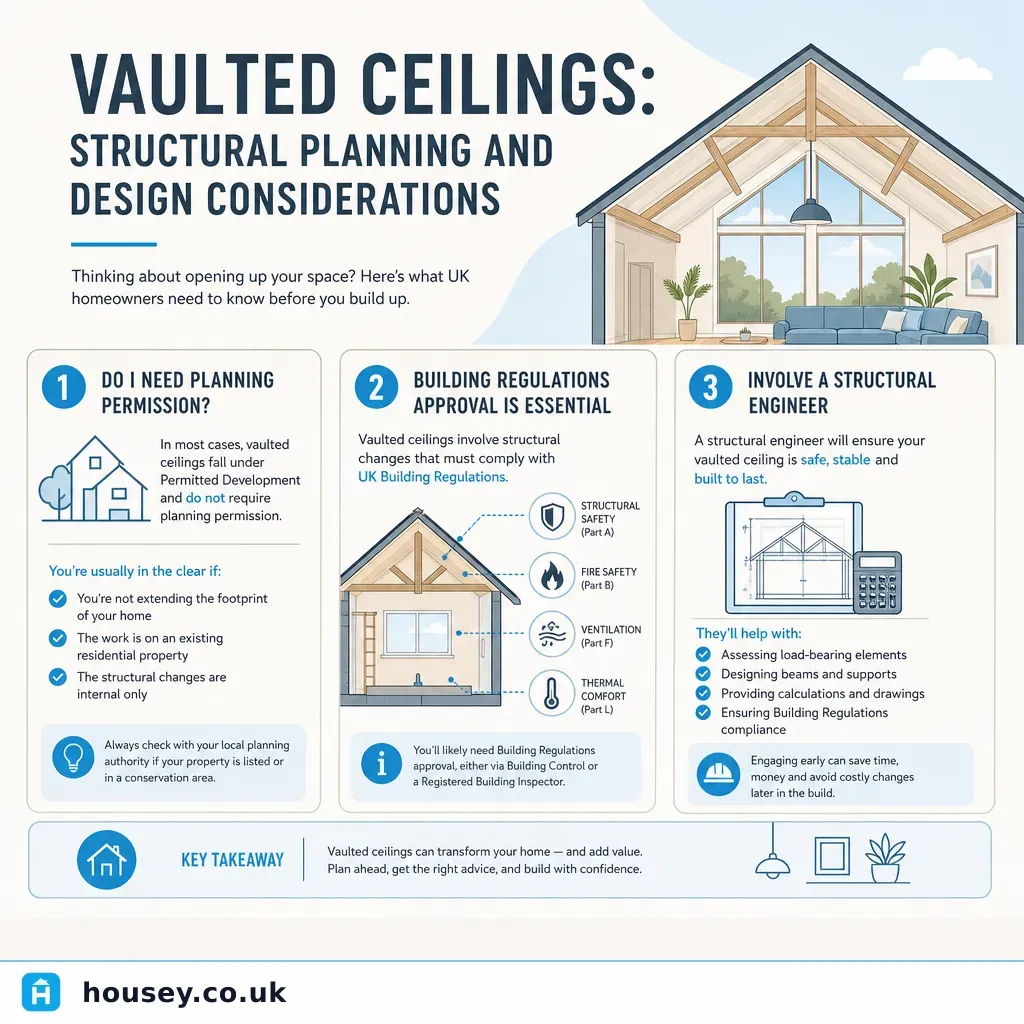
Vaulted Ceilings: Structural Planning and Design Considerations
Vaulted ceilings have become an increasingly sought-after feature in UK extensions, loft conversions, and room remodels — offering the impression of volume and light in spaces where headroom allows. The appeal is understandable, but the structural reality in most UK homes is that ceiling joists serve a purpose far beyond holding up plasterwork. In Victorian terraces, 1930s semis, post-war bungalows, and most other traditionally built properties, those joists prevent the roof from spreading outward. Removing them without a properly engineered replacement is one of the more common causes of serious and progressive structural damage in residential renovation. Understanding the process, which professionals are required, and what Building Regulations approval involves is essential before any decision is made.
Key points
- Ceiling joists in most traditionally built UK pitched roofs act as structural ties resisting the outward thrust of the roof; removing them without an engineered replacement structure can cause progressive and expensive structural damage.
- Building Regulations approval under Part A (Structure) is required for any work that removes or alters ceiling joists — this applies in existing rooms, extensions, and loft conversions alike, and cannot be self-certified under a competent person scheme.
- Part L (Conservation of Fuel and Power) also applies: the newly exposed roof plane must meet current insulation targets, typically a U-value of 0.18 W/m²K for a pitched insulated roof under the 2021 Building Regulations revisions for England.
- Planning permission is not usually required if no external changes are made, but listed building consent is mandatory for any works in a listed building, and permitted development rights may be restricted in conservation areas or Article 4 Direction areas.
- A structural engineer must design and specify the replacement structure — typically a ridge beam (often a steel section) and collar ties or equivalent — before any ceiling joists are touched; design calculations must be submitted to and approved by a building control body.
Why vaulted ceilings need structural engineering input
In a traditionally built pitched roof — which covers the majority of UK housing stock constructed before the mid-1970s — ceiling joists run horizontally at eaves level between the two opposing walls. Their primary structural function is to act as ties, resisting the horizontal outward thrust that the weight and geometry of the roof exerts on the walls. Remove those ties without an equivalent structural replacement and the walls slowly spread outward, the ridge drops, and roof coverings distort. This type of damage can be progressive, difficult to detect early, and costly to repair.
In trussed-rafter roofs, common in homes built after approximately 1965, each rafter, tie, and strut forms part of a pre-engineered structural system. Altering any element without full structural analysis of the entire truss risks compromising the whole roof assembly.
A structural engineer will assess the existing roof's geometry, span, loading, and wall construction, and design an appropriate substitute structure. This typically involves a new ridge beam — commonly a steel section, though engineered timber such as LVL or glulam is also used — and may include new collar ties at a higher level, wall plates, or additional supports depending on the span and loading.
Building Regulations requirements
Creating a vaulted ceiling in an existing UK home will require approval under at least two Parts of the Building Regulations for England (equivalent approval is required under separate but broadly similar regimes in Scotland, Wales, and Northern Ireland):
Part A — Structure: Any alteration to load-bearing or structural elements, including ceiling joists acting as roof ties, requires a structural engineer's design and building control approval. This work cannot be self-certified under any competent person scheme.
Part L — Conservation of Fuel and Power: The newly created roof plane must meet current thermal performance targets. Under the 2021 Building Regulations revisions for England, the target U-value for a pitched insulated roof is 0.18 W/m²K. Achieving this in a vaulted ceiling configuration requires careful selection of insulation type, depth, and positioning relative to the rafter.
Part F — Ventilation: Where habitable rooms are created or altered, ventilation requirements apply. Background trickle ventilation and, where applicable, intermittent extract must meet the requirements of Approved Document F.
A building control body — either your local authority's building control service or a Registered Building Control Approver (RBCA) — must approve the project. For structural work, a full plans application is strongly recommended over a building notice, as it provides written approval before works begin rather than relying on inspection after the fact.
Do you need planning permission?
For most UK homeowners, creating a vaulted ceiling in an existing room involves no external changes and therefore falls within permitted development rights — no planning permission is required. However, there are important exceptions:
- Listed buildings: Any works affecting the character of a listed building — including internal structural alterations — require listed building consent from the local planning authority, regardless of whether planning permission would otherwise be needed.
- Conservation areas: Internal works in a conservation area do not normally require planning permission, but if the works involve changes to the roof that are visible externally, or if permitted development rights have been removed by an Article 4 Direction, check with your local planning authority first.
- Flats and maisonettes: Permitted development rights do not apply to flats or maisonettes; planning permission may be required.
- Prior conditions: Some properties have had permitted development rights removed as a condition of a previous planning consent. Check the planning history of your property via your local planning authority's online register before assuming PD rights apply.
If uncertain, apply for a Certificate of Lawful Development before starting work — this gives formal written confirmation that the works are permitted development and provides protection if the position is later questioned.
Insulation options: warm roof vs cold roof
Meeting the required U-value in a vaulted ceiling is more technically demanding than in a standard loft with a flat ceiling, because the depth between rafter and roof covering limits insulation thickness. Two principal approaches are used:
Warm roof (insulation above the rafter) — Rigid insulation boards are fixed above the existing rafter, typically between counter-battens, raising the roof line by the insulation depth. This eliminates cold bridging through the rafter itself and is generally easier to detail correctly for condensation control. It is the preferred approach from a thermal performance and moisture-risk perspective, but involves either reroofing or working from above the existing covering.
Cold roof (insulation between or below the rafter) — Mineral wool or rigid board insulation is fitted between the rafters, with a minimum 50 mm ventilation gap maintained between the insulation and the underside of the roof covering to allow moisture to escape. This approach does not require external works but achieves lower thermal performance for a given total depth and requires careful ventilation detailing to avoid interstitial condensation.
Insulation approach | Thermal performance | Condensation risk | Effect on roof line | Typical application |
|---|---|---|---|---|
Warm roof (above rafter) | High — eliminates rafter cold bridging | Low if correctly detailed | Raises roof level | New extensions, reroofing projects |
Cold roof (between/below rafter) | Moderate — constrained by rafter depth | Higher — requires minimum 50 mm ventilation gap | Unchanged externally | Existing roofs where external height cannot increase |
Hybrid (above and between rafter) | High | Low | Modest increase | Where maximum performance is needed within limited overall height |
Discuss which approach is appropriate for your roof geometry, rafter depth, and covering type with your structural engineer or energy assessor before specifying materials.
Which approach is right for your project?
- Choose a warm roof if you are reroofing at the same time, building a new extension with a pitched roof, or where maximum thermal performance within a given overall depth is the priority.
- Choose a cold roof with the required ventilation gap if the existing roof covering is being retained and the rafter depth permits adequate ventilation alongside sufficient insulation depth to meet Part L.
- Appoint a structural engineer if you are altering or removing ceiling joists in any traditionally built or trussed-rafter roof — this is not a decision to make without a professional structural assessment.
- Apply for a Certificate of Lawful Development if you are uncertain whether your property's permitted development rights are intact before any work begins.
- Consult your local planning authority or a conservation architect if your property is listed, in a conservation area, or has had permitted development rights removed by planning condition.
- Engage a building control body with a full plans application before structural work starts — do not rely on a building notice for a structural alteration of this nature.
Important limitations
This article provides general background information on the planning, structural, and regulatory considerations that commonly apply to vaulted ceilings in UK homes. It is not a substitute for site-specific structural engineering advice, building control consultation, or planning guidance from your local authority. The structural behaviour of any individual roof depends on its age, construction method, span, loading, condition, and site-specific factors that cannot be assessed remotely. A chartered structural engineer must inspect and assess your property before any structural works are designed or carried out. Rules and requirements for listed buildings and conservation areas are applied case by case and may differ significantly from the general position described here.
What to ask a qualified professional
Before appointing a structural engineer or contractor for a vaulted ceiling project, ask:
- Have you worked on vaulted ceiling projects in properties of a similar age and construction type to mine?
- Will you provide a full structural calculation pack and design drawings suitable for building control submission?
- Which building control route do you recommend — full plans or building notice — and why?
- What temporary propping or support will be needed during the structural works, and who is responsible for providing and monitoring it?
- What insulation specification do you recommend to meet Part L for my roof geometry, and does the warm roof approach affect the roof line externally?
- Do I need to apply for planning permission or a Certificate of Lawful Development before structural works begin?
- Are there any site conditions — party walls, services in the roof space, non-standard construction — that might make this project more complex or more expensive than a standard case?
When to get professional help
Seek professional input before undertaking any work if:
- You are uncertain whether your ceiling joists are structural — in most traditionally built UK homes, they are, and the assumption should be that they are until a structural engineer confirms otherwise
- Cracks appear in walls, ceilings, or around door and window frames during or after any alteration work — stop work immediately and call a chartered surveyor or structural engineer
- Your property is listed or in a conservation area — consult your local planning authority and, for listed buildings, a conservation architect before any works are commissioned
- Your roof has complex geometry (hip and valley, mansard, dormers, or a combination) — structural analysis is especially important where geometry is non-standard
- You receive building control queries or objections that require technical guidance from the engineer of record to resolve
How Housey can help
Housey connects UK homeowners with vetted extension builders and specialist contractors experienced in structural alterations and bespoke ceiling works. If you are considering a vaulted ceiling as part of an extension or existing room remodel, Housey's service-matching tools can help you find local professionals who can coordinate structural engineering appointments, building control submissions, and the build itself.
Frequently asked questions
Will creating a vaulted ceiling always require a structural engineer?
In almost all cases, yes. Wherever ceiling joists are being removed or altered in a traditionally built pitched roof or trussed-rafter roof, a structural engineer must assess the existing structure and design the replacement. Building control bodies will require structural calculations as part of the approval process, and work should not begin on structural elements until approval is in place.
How long does building control approval take for a vaulted ceiling project?
For a full plans application — the recommended route for structural work — building control typically responds within five weeks of receiving a complete submission. A building notice route is faster to submit but means work must comply without prior written approval, which is not advisable for structural projects where full plans approval provides greater certainty and protection.
Can I vault the ceiling in a semi-detached or terraced house?
Yes, but the party wall position is an additional consideration. If the roof structure spans across the party wall, the Party Wall etc. Act 1996 may apply if works directly affect the party structure. Consult a party wall surveyor early in the project — ideally before structural engineering work begins — if your property shares a roof with a neighbour.
Do I need to notify my buildings insurer before starting structural work?
Yes. Structural alterations may affect your buildings insurance cover during and after works. Notify your insurer before starting, confirm that your contractor carries adequate employers' and public liability insurance, and retain all building control completion certificates. These are evidence of compliant work that may be requested for future insurance claims or during a property sale.
Sources and further reading
- Approved Document A: Structure — GOV.UK / Building Regulations
- Approved Document L: Conservation of Fuel and Power — GOV.UK / Building Regulations
- Approved Document F: Ventilation — GOV.UK / Building Regulations
- Permitted development rights for householders: technical guidance — GOV.UK
- When is permission required? — GOV.UK Planning Guidance
- Institution of Structural Engineers (IStructE) — IStructE
Useful next reads
 Improvement & Build
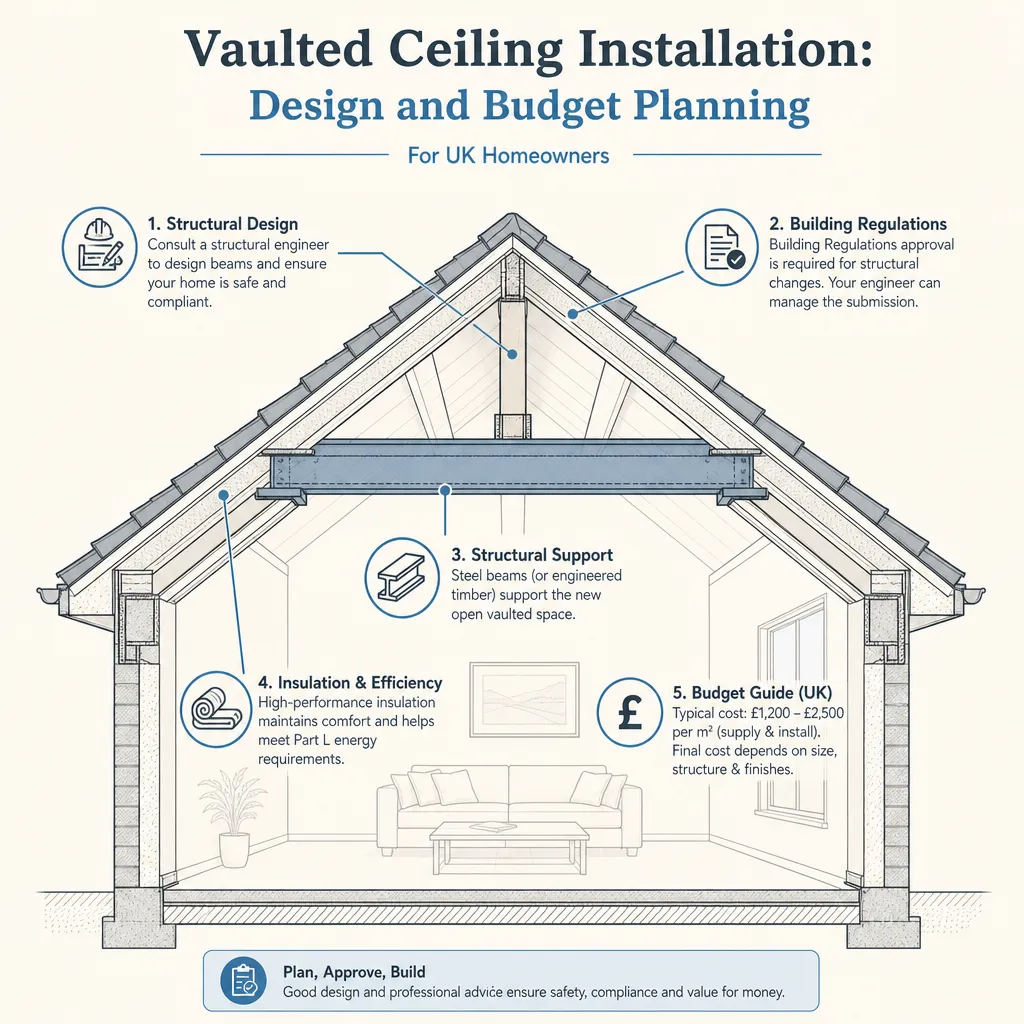
Vaulted Ceiling Installation: Design and Budget Planning
A vaulted ceiling removes ceiling joists and replaces their structural role with a ridge beam or collar ties — work that always requires a structural engineer's calculations and building regulations approval under Parts A and L.
 Improvement & Build
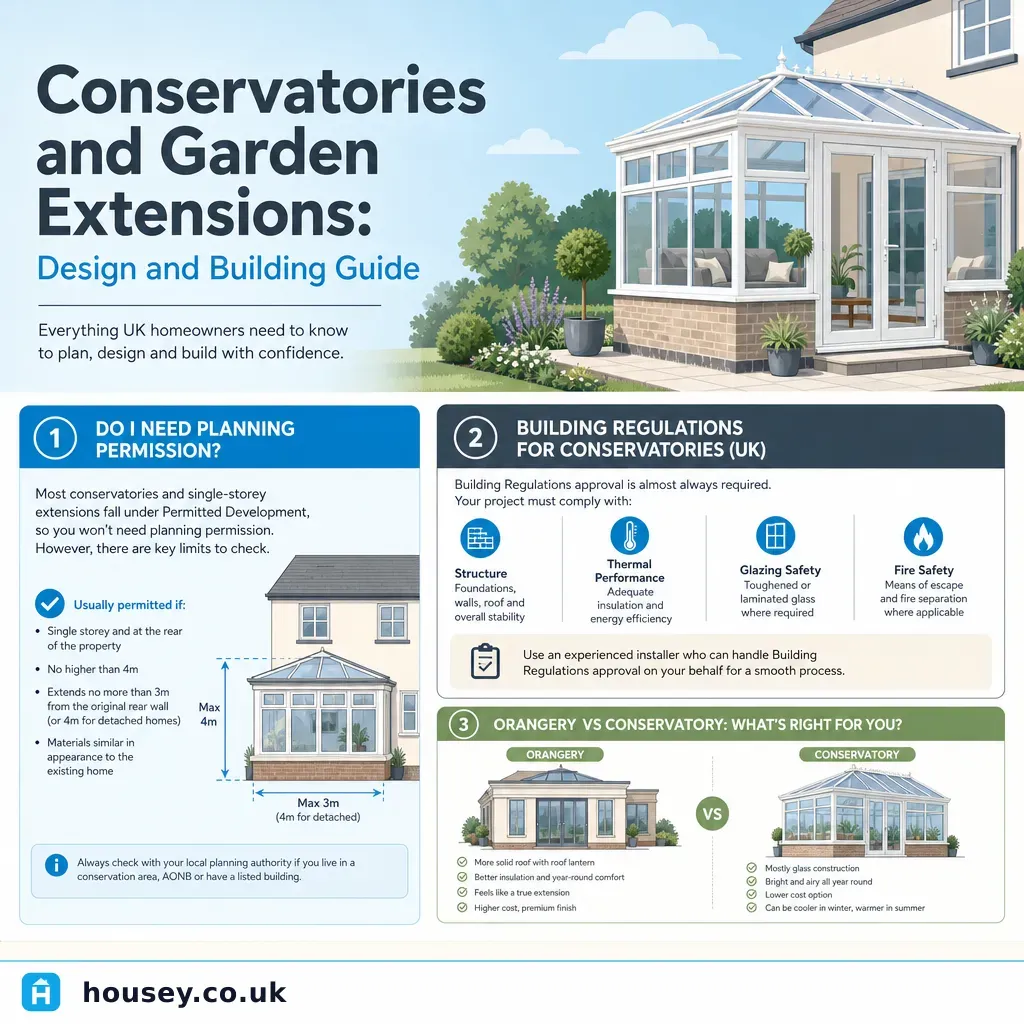
Conservatories and Garden Extensions: Design and Building Guide
Most conservatories qualify as permitted development in England if they are single-storey, within 50% of original curtilage, and meet dimensional limits.
 Improvement & Build
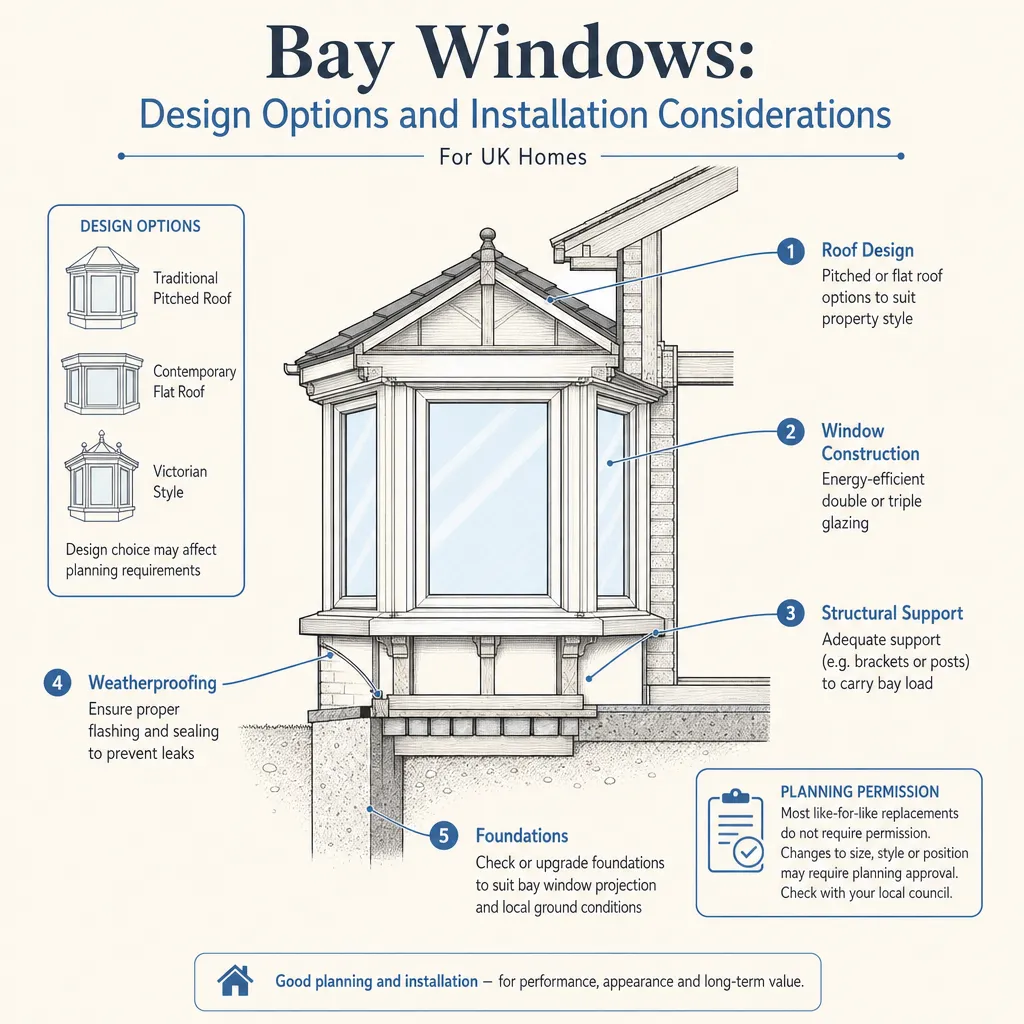
Bay Windows: Design Options and Installation Considerations
Bay windows project beyond the main wall of a house, increasing floor area and natural light.
 Improvement & Build
Distinctive Roof Terrace Features and Outdoor Living Design
A roof terrace can transform unused flat-roof space into a functional outdoor room, adding significant appeal to urban properties.
 Improvement & Build
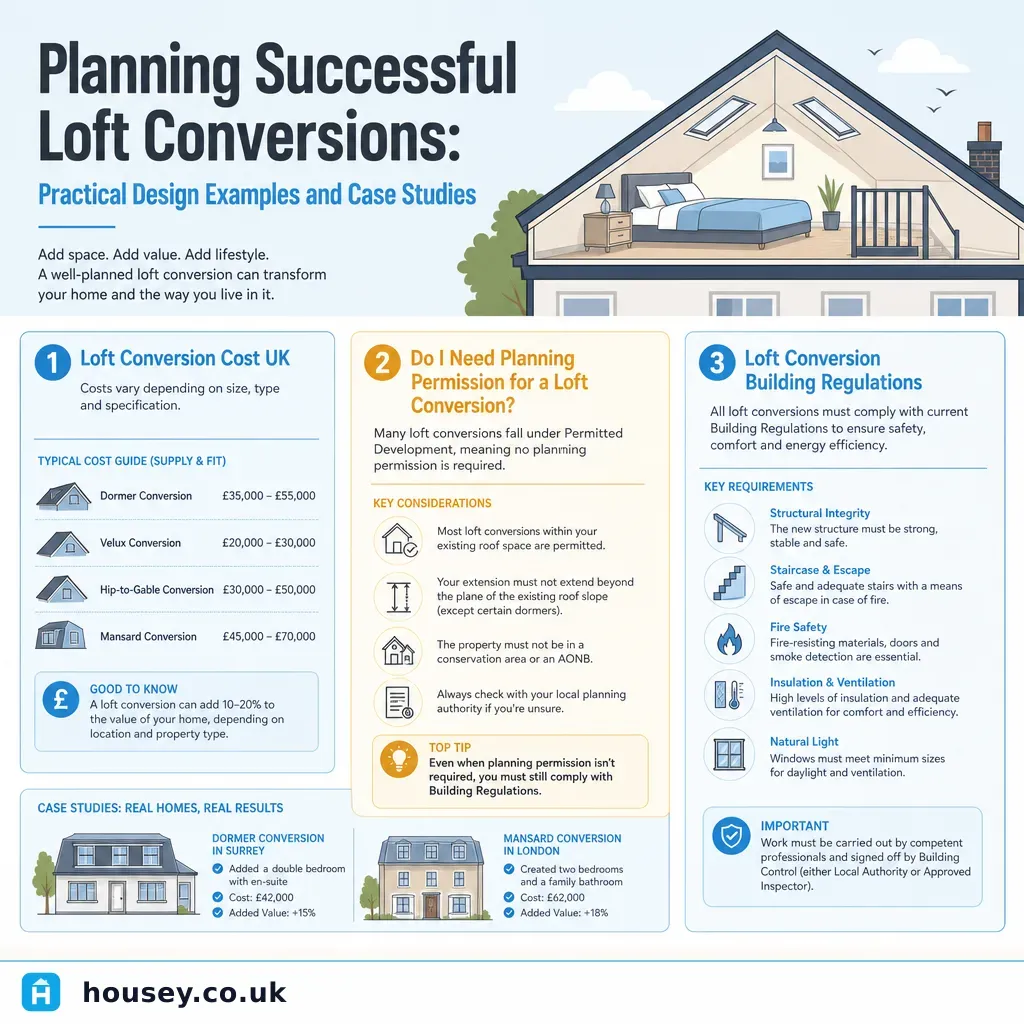
Planning Successful Loft Conversions: Practical Design Examples and Case Studies
Most UK loft conversions are permitted development and do not need planning permission, provided they remain within the volume allowances — 40 m³ for terraced houses and 50 m³ for detached or semi-detached properties.