Velux Skylight Installation Requirements: Manufacturer Certification and Installer Approval
By Housey · Last reviewed 4th of May 2026
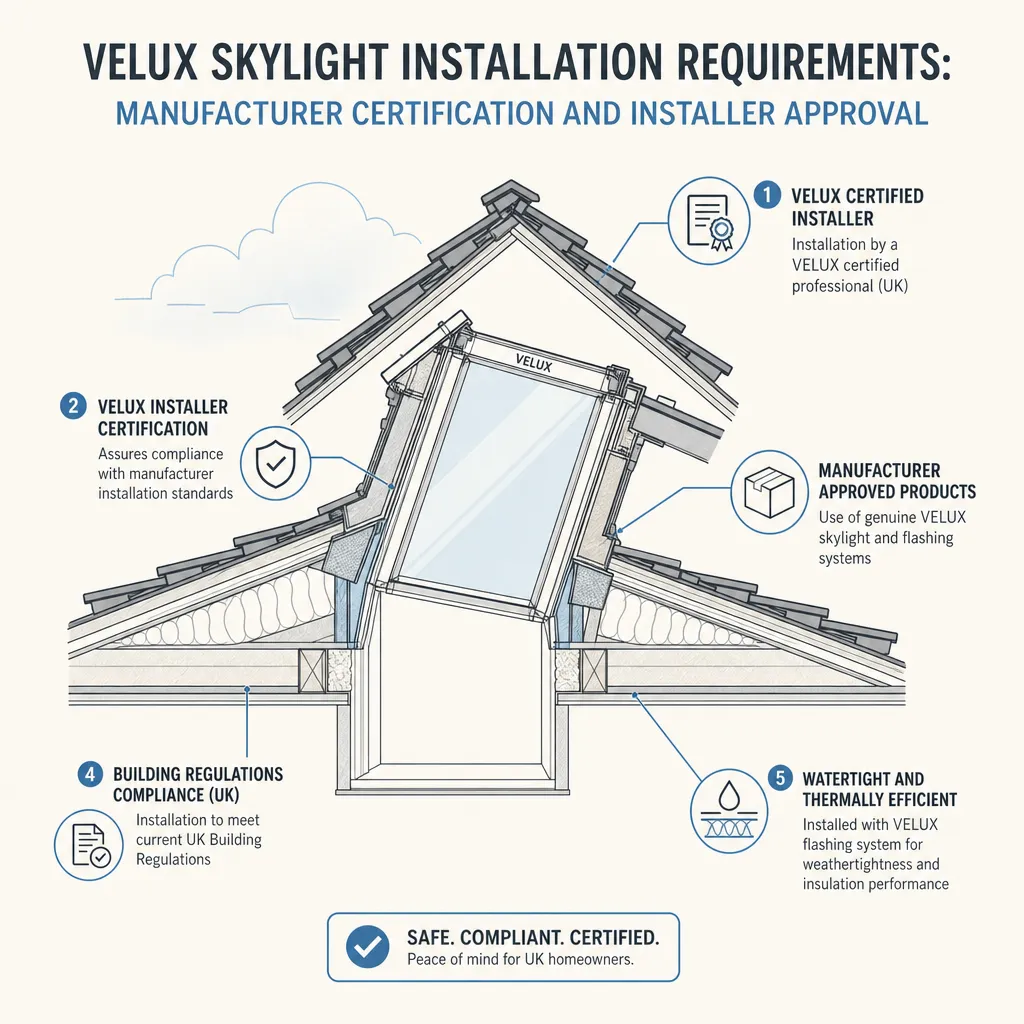
Velux Skylight Installation Requirements: Manufacturer Certification and Installer Approval
Velux skylights are among the most widely specified roof windows in UK residential properties, appearing in loft conversions, rear bedroom additions, and extension rooflines. Whether you are replacing ageing units or fitting new rooflights, the question of who should install them — and what certification matters — affects your warranty coverage, building regulations compliance, and long-term weatherproofing.
Key points
- Velux operates a registered installer network in the UK; using a registered installer typically provides a 10-year installation guarantee alongside the standard product warranty.
- Building Regulations Approved Document L sets minimum thermal performance thresholds for replacement and new roof windows, including a notional U-value of 1.4 W/m²K for rooflights.
- Rooflights fitted as replacement glazing may be notifiable; using a FENSA or CERTASS-registered installer allows self-certification without a separate building control application.
- Velux roof windows in a conservation area or listed building may require planning permission even for like-for-like replacement.
- The Work at Height Regulations 2005 apply to contractors carrying out pitched roof installation; homeowners should not undertake this work themselves.
What does Velux Registered Installer status mean?
Velux's Registered Installer programme is a voluntary manufacturer accreditation scheme. Installers who join are trained by Velux, assessed on installation technique, and can offer a 10-year installation guarantee alongside the standard Velux product warranty. The scheme is separate from FENSA or CERTASS, which are statutory competent person schemes covering building regulations self-certification for replacement glazing.
Registered installer status does not guarantee Building Regulations compliance automatically — that remains the installer's responsibility — but Velux training covers correct flashing kits, insulation collars, and installation sequences for each roof type. You can verify installer registration via the Velux UK website.
Do building regulations apply?
Yes, in most cases.
- Approved Document L (energy efficiency): Replacement rooflights must meet minimum thermal performance. The notional U-value for roof windows in energy calculations is 1.4 W/m²K or better. Check the specific product data sheet.
- Approved Document A (structural): Creating a new opening — including trimming a rafter — requires structural integrity to be maintained. A competent person should assess any rafter trimming.
- Approved Document B (fire safety): Escape roof windows must provide a minimum clear opening of 450mm × 450mm and 0.33m² clear area, with sill height restrictions for habitable rooms above ground floor.
For replacement units in the same opening, a FENSA or CERTASS-registered installer can self-certify, notifying the local authority on your behalf. If the installer is not scheme-registered, a building control application must be submitted before work begins.
Certified vs. non-certified installer: what changes?
Factor | Velux Registered Installer | Non-registered competent installer |
|---|---|---|
Installation guarantee | 10-year installation guarantee from Velux | Installer's own workmanship guarantee only |
Product warranty | Standard Velux warranty maintained | Maintained if installed correctly |
Building regs certification | Training covers compliance; installer certifies | Must use FENSA/CERTASS or notify building control |
Flashing kit specification | Trained on correct kit for each roof type | Incorrect kits are a common cause of leaks |
Insurance claims | Easier to substantiate workmanship quality | May require independent inspection |
Does Velux installation need planning permission?
In most cases, no. Fitting within the existing roof slope is usually permitted development under the Town and Country Planning (General Permitted Development) (England) Order 2015. Permission may be required if:
- The property is in a conservation area and Article 4 directions have removed permitted development rights.
- The property is a listed building — listed building consent is required for works affecting its character.
- The window projects more than 150mm beyond the existing roof plane.
- The works form part of a larger project already requiring permission.
Confirm with your local planning authority (LPA) if in any doubt.
Red flags when choosing a Velux installer
- Cannot confirm FENSA or CERTASS registration and gives no clear explanation of the certification route.
- No mention of the correct Velux flashing kit for your specific roof covering type.
- Quote does not specify product series, glazing specification, or energy performance rating.
- Unwilling to confirm a post-installation compliance certificate or building control sign-off.
- No evidence of public liability insurance or appropriate working at height equipment.
What to ask your installer before accepting a quote
- Are you a Velux Registered Installer, and can you provide the 10-year installation guarantee?
- Are you registered with FENSA or CERTASS, or will you submit a building control application on my behalf?
- Which Velux flashing kit is specified for my roof type, and is it included in the price?
- Will the installation achieve the required U-value under Approved Document L?
- Is any structural work — such as rafter trimming — included, and how will this be certified?
- What does your workmanship guarantee cover and for how long?
- Is VAT included?
When to get professional help
Seek additional professional input if:
- The installation involves a new structural opening — a structural engineer or competent carpenter should assess rafter trimming.
- The building is listed or in a conservation area — confirm requirements with your LPA before committing to the work.
- Existing roof damage, sagging, or damp is present — a roof survey before installation identifies problems that could affect the outcome.
- Post-installation condensation or water ingress develops — this can indicate incorrect flashing, a missing vapour barrier, or insulation errors.
How Housey can help
If you are planning a Velux skylight installation, Housey can help you request quotes from qualified window and door installers or arrange a pre-installation roof survey to check your roof's condition before work begins.
Frequently asked questions
Does a Velux installer need to be FENSA registered?
Not strictly. FENSA registration is one route to self-certification under the Building Regulations, but other competent person schemes such as CERTASS also cover glazing. Alternatively, a non-scheme-registered installer can submit a building control application directly. Using a FENSA or CERTASS member simplifies the process and generates a compliance certificate automatically on your behalf.
What happens to my Velux warranty if I use an unapproved installer?
The standard Velux product warranty covering manufacturing defects is not conditional on using a Velux Registered Installer, provided the product is installed correctly with appropriate flashing kits. However, the 10-year installation guarantee covering workmanship is only available through the registered installer programme. An incorrect installation that causes a product failure may complicate any warranty claim.
Do Velux skylights require building regulations approval?
Yes, in most cases. Replacement roof windows must comply with Approved Document L for energy efficiency, and new structural openings must satisfy Approved Document A. Self-certification by a FENSA or CERTASS-registered installer removes the need for a separate building control application; otherwise, building control notification is required before work begins.
Can a general builder fit a Velux window?
Legally, yes, provided they comply with all relevant building regulations and arrange appropriate certification. Practical competence matters: correct flashing installation is technical, and errors are a leading cause of roof leaks. If using a non-registered builder, verify their track record with roof window installation and confirm their route to certification before proceeding.
Sources and further reading
- Building Regulations Approved Document L — GOV.UK (energy efficiency standards for windows and rooflights)
- FENSA: Fenestration Self-Assessment Scheme — FENSA (glazing competent person scheme)
- Permitted Development Rights for Householders: Technical Guidance — GOV.UK
- Work at Height Regulations 2005 — HSE
- Velux Find an Installer — Velux UK
Useful next reads
 Improvement & Build
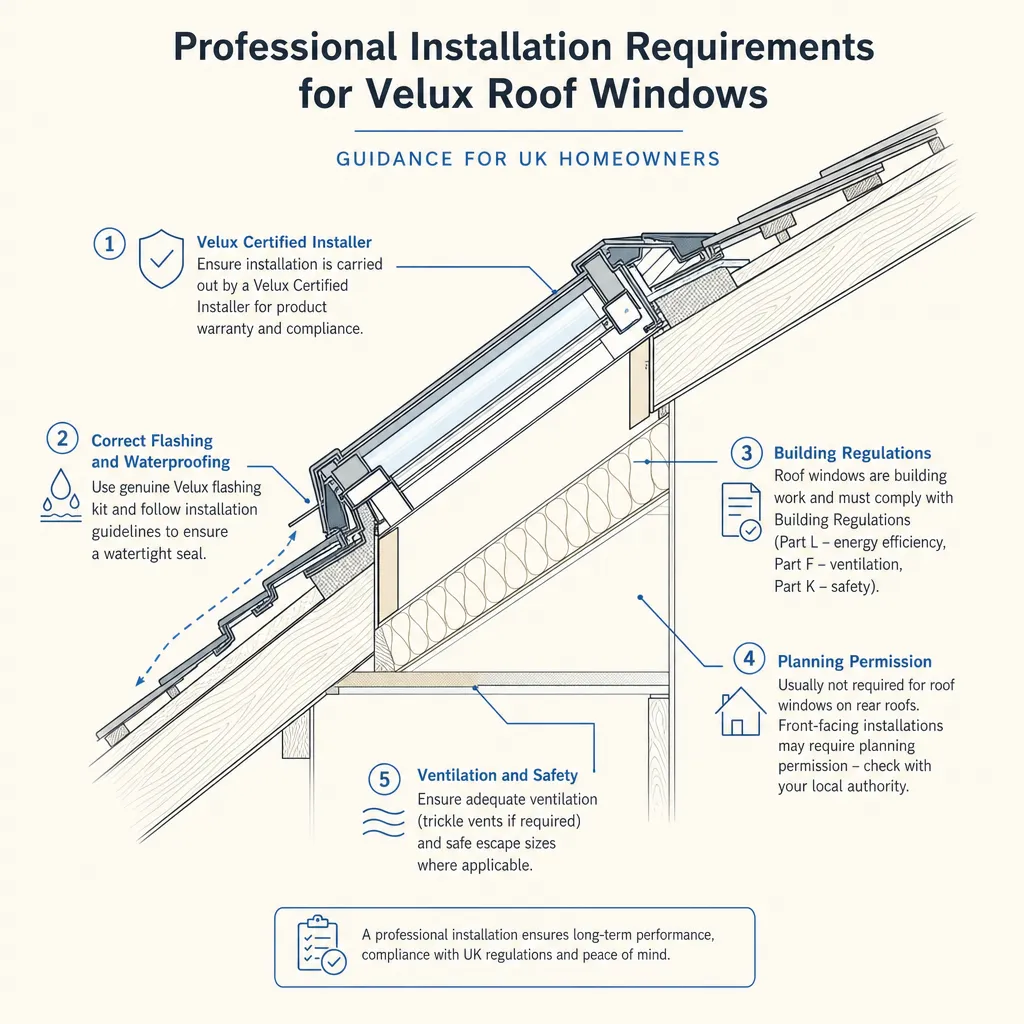
Professional Installation Requirements for Velux Roof Windows
Velux roof windows installed as replacements in the same opening usually fall under permitted development, but new openings or changes on listed buildings or in conservation areas require planning permission.
 Improvement & Build
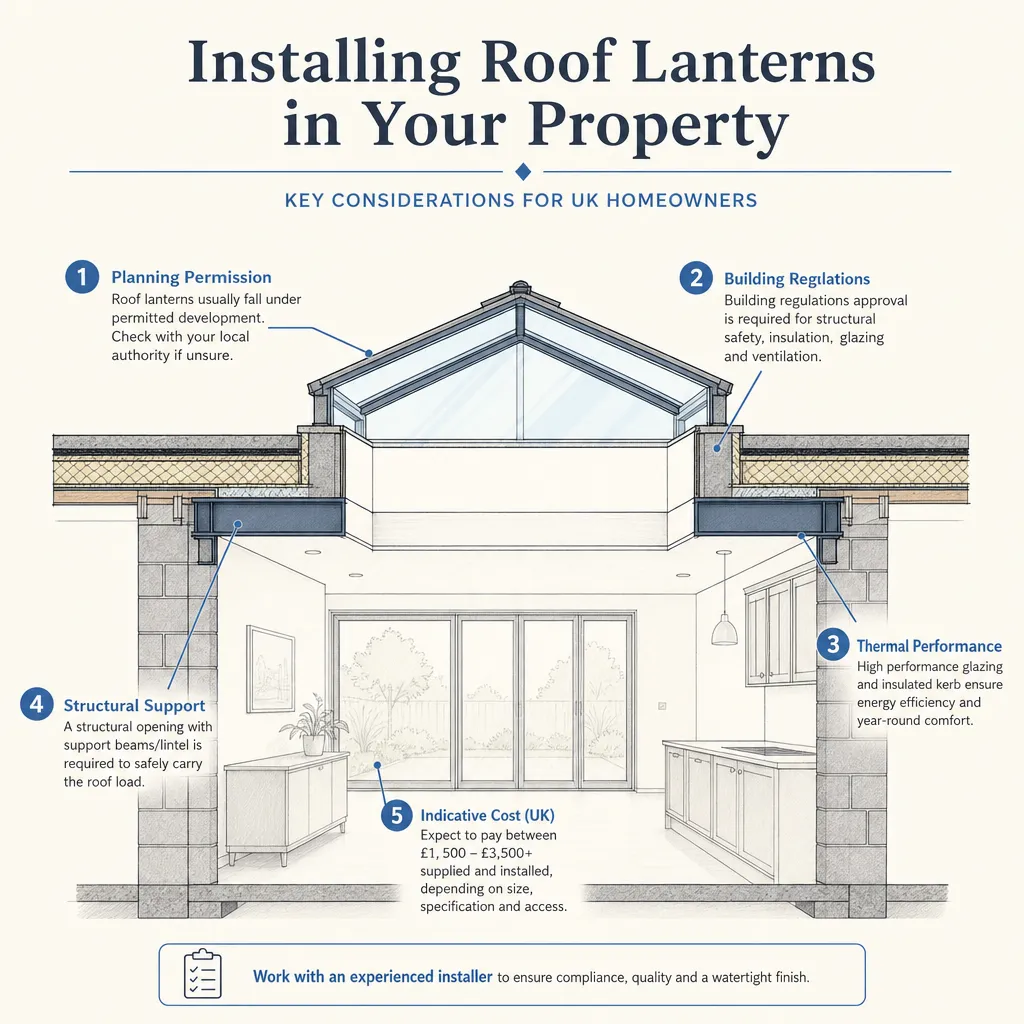
Installing Roof Lanterns in Your Property
A roof lantern can be installed under permitted development in most cases, though Building Regulations Part L applies and requires a minimum glazing U-value of 1.
 Improvement & Build
Common Velux Window Issues and How to Resolve Them
Most Velux roof window problems — leaks, misted panes, stiff handles, and draughts — have a specific cause.
 Improvement & Build
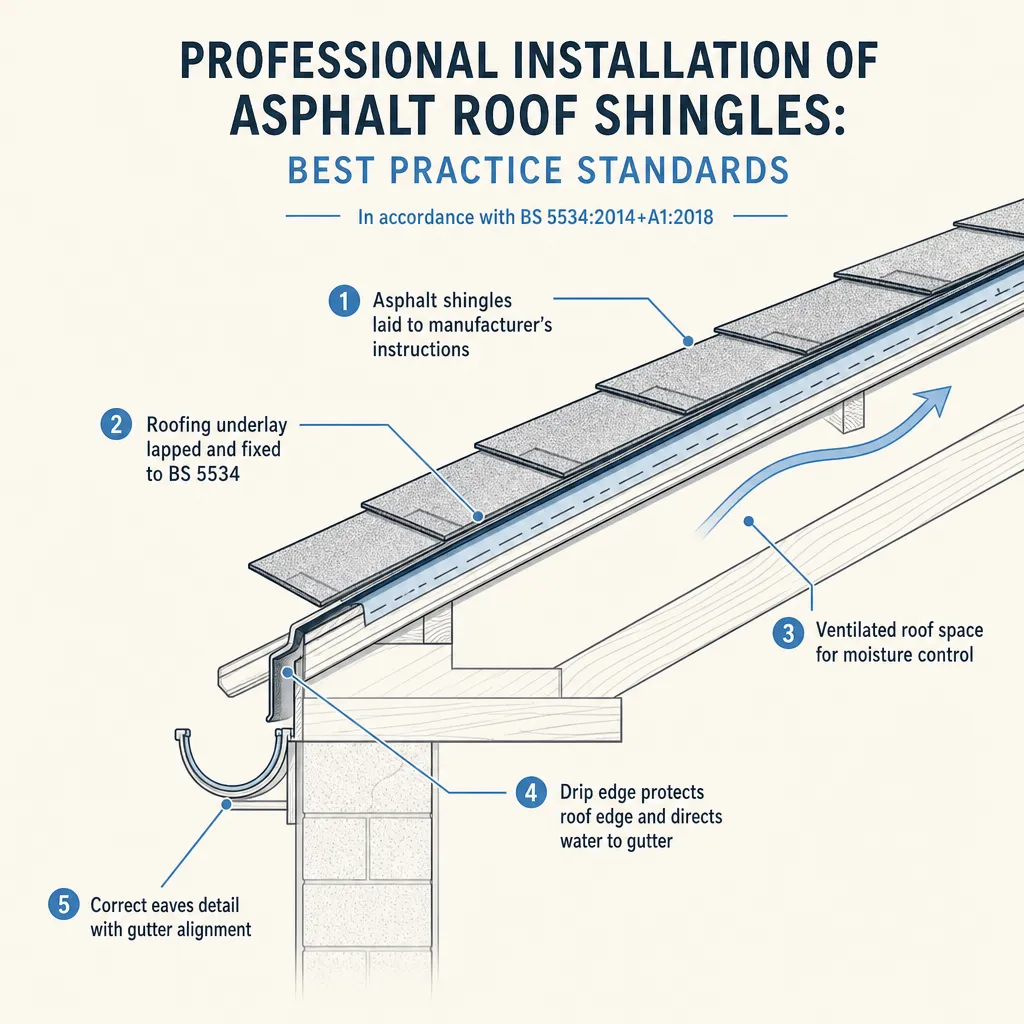
Professional Installation of Asphalt Roof Shingles: Best Practice Standards
Professional asphalt shingle installation in the UK must comply with BS 5534:2014+A2:2018, which sets requirements for breathable underlay, batten gauge, and nail fixing patterns.
 Improvement & Build
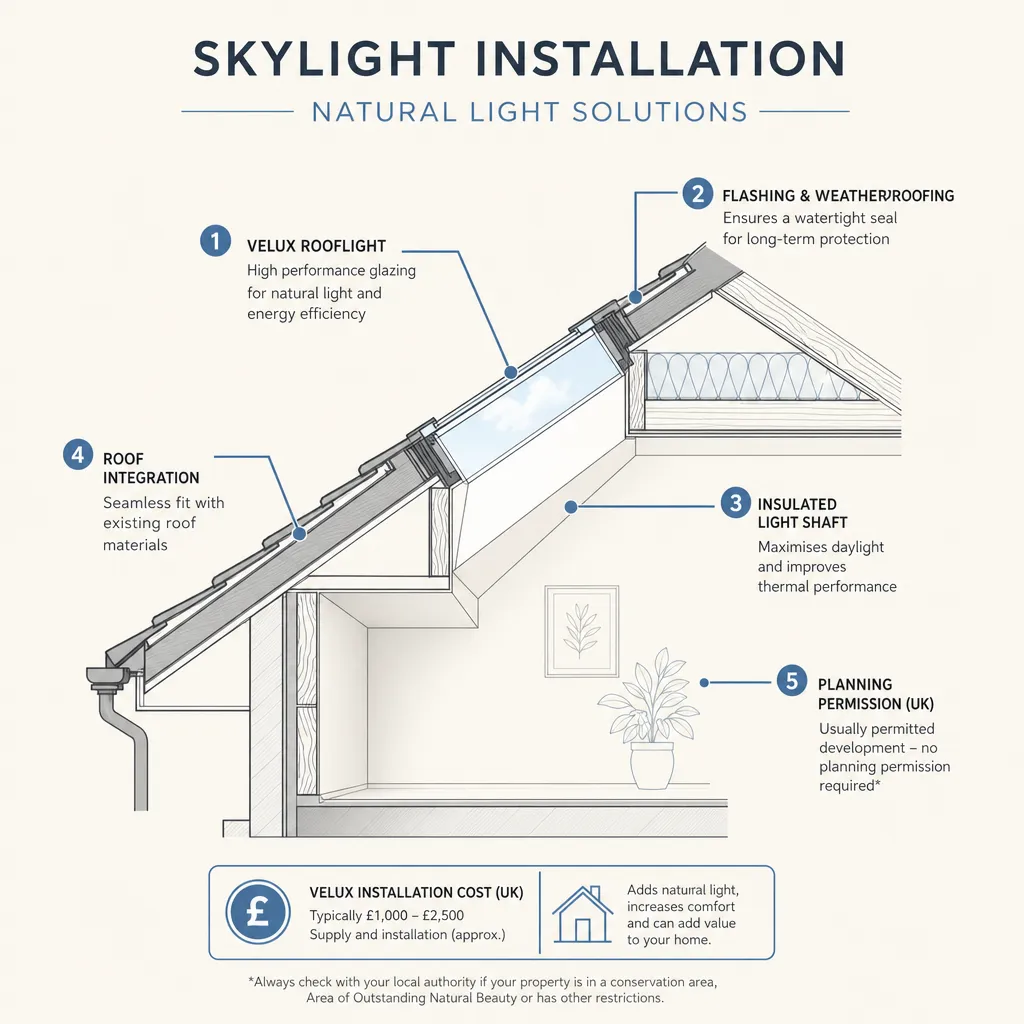
Skylight Installation: Natural Light Solutions
A standard pitched-roof skylight such as a Velux or equivalent roof window costs £800–£2,500 installed in the UK, including the unit and roofing work.