Water Well Pump Replacement: Costs and Installation
By Housey · Last reviewed 30th of May 2026
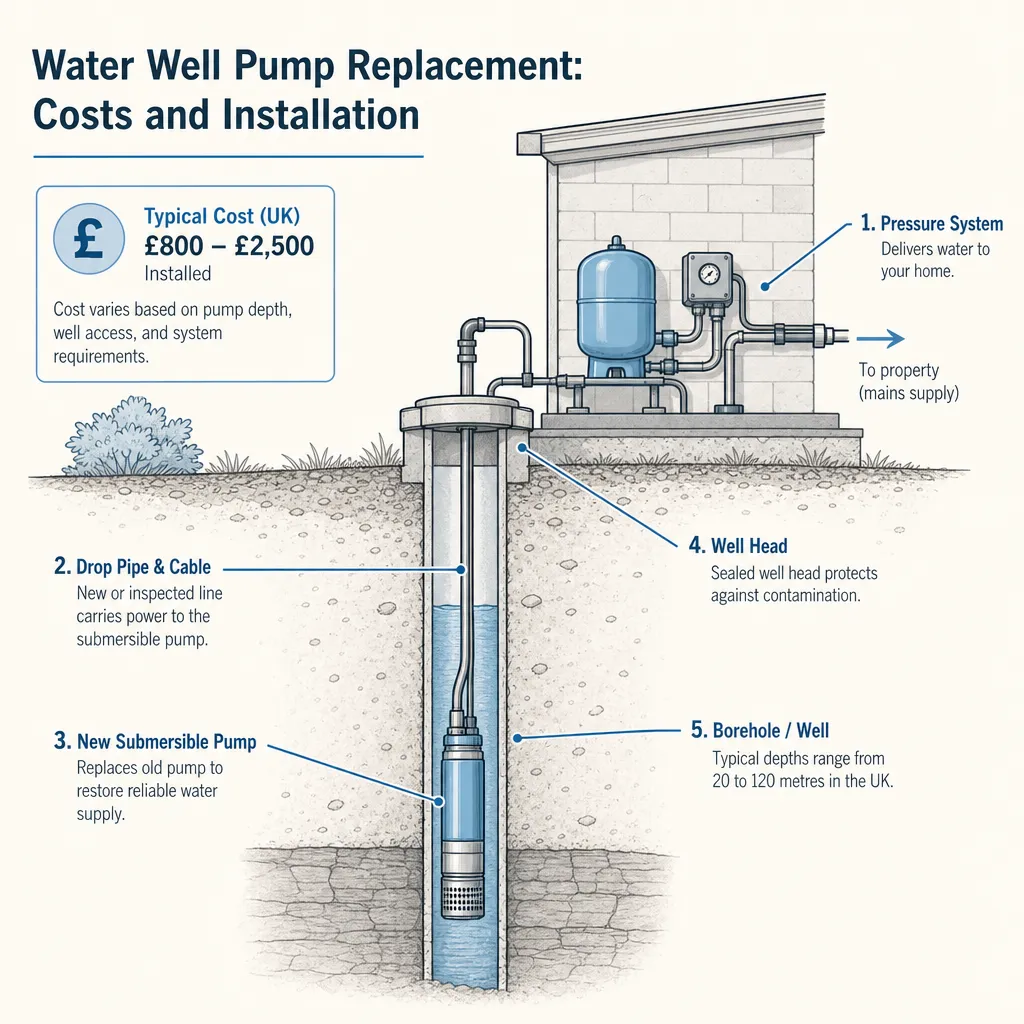
Water Well Pump Replacement: Costs and Installation
Private water supplies serve an estimated 1% of properties in England and Wales, the majority in rural or semi-rural locations where mains connection is impractical. If your home relies on a well or drilled borehole rather than the mains network, the pump is the most critical component in your supply system — and when it fails, identifying the right replacement and commissioning a competent contractor are the two most consequential decisions you face.
Key points
- Private water supplies in England are regulated under the Private Water Supplies (England) Regulations 2016; local authorities have a statutory duty to monitor and risk-assess supplies serving more than one property.
- Most domestic groundwater abstractions fall below the 20 cubic metres per day threshold that triggers an Environment Agency abstraction licence requirement.
- The British Drilling Association (BDA) represents qualified well and borehole contractors; BDA membership is a widely recognised benchmark of competence for this work.
- Submersible pumps installed inside the borehole casing are standard for depths greater than approximately 8 metres; surface jet pumps are only effective at shallower depths.
- Water quality testing after any pump replacement or major borehole work is strongly recommended and can be arranged through a UKAS-accredited laboratory.
Signs your well pump needs replacing
Pumps rarely fail without warning. Common indicators that a pump is failing or has already failed:
- No water at the taps — the most obvious sign; rule out a tripped circuit breaker or faulty pressure switch before assuming pump failure.
- Reduced flow or pressure — gradual performance loss often indicates pump wear, a partially blocked intake screen, or a failing pressure vessel.
- Pump runs constantly — may mean the pressure vessel has lost its air pre-charge, or the pump cannot meet demand.
- Air spitting at taps — can indicate a falling water table or the pump drawing air at the intake.
- Discoloured or cloudy water — temporary discolouration following mechanical disturbance usually clears, but always warrants a water quality test.
- Pump age over 10–12 years — submersible pumps have a finite working life; older units are at higher risk of sudden failure.
Submersible pump vs surface pump: which applies to your system?
Feature | Submersible pump | Surface / jet pump |
|---|---|---|
Typical operating depth | Effective at 8 m or more | Effective to approximately 6–8 m only |
Installed location | Lowered inside the borehole or well casing | Mounted above ground, typically in a pump house or outbuilding |
Common in UK | Standard for modern drilled boreholes | More common on older, shallow dug wells |
Maintenance access | Requires specialist lifting equipment to retrieve | Accessible for routine inspection and repair |
On failure | Must be extracted from below ground | Faster to diagnose and replace |
Typical unit cost (supply only) | £200–£900 | £150–£500 |
Indicative UK costs, last reviewed 2026-05-30. Prices vary by specification; always obtain multiple quotes.
How much does well pump replacement cost in the UK?
Cost depends on borehole depth, pump specification, access conditions, and whether ancillary components — pressure vessel, control panel, electrical cable, rising main — also need replacing.
Component | Indicative cost range |
|---|---|
Submersible pump unit (supply only) | £200–£900 |
Installation (extraction, replacement, reinstatement) | £500–£2,000+ |
Pressure vessel / accumulator tank replacement | £200–£600 |
Water quality test (basic bacteriological) | £80–£250 |
Typical total project cost | £800–£3,500+ |
Indicative UK costs, last reviewed 2026-05-30. Depths beyond 50 m, difficult access, or simultaneous rising main replacement will increase costs considerably. Obtain at least three quotes from specialist contractors.
The installation process
A standard pump replacement by a qualified contractor typically follows this sequence:
- Site assessment — the contractor inspects the borehole head, confirms the existing pump specification, and assesses cable and pipework condition before any lifting begins.
- Pump extraction — the submersible pump is carefully lifted from the borehole using specialist equipment, bringing the rising main and electrical cable with it.
- Condition inspection — while the pump is out, the contractor inspects the borehole casing for damage, corrosion, or evidence of contamination.
- New pump installation — the replacement unit is lowered, connected to the rising main and electrical supply, and the borehole head is reinstated.
- System commissioning — the contractor sets the pressure vessel pre-charge, tests flow rate and pressure at draw-off points, and checks the control panel and pressure switch settings.
- Water quality flush and sampling — the system is flushed before a water sample is taken; results from a UKAS-accredited laboratory are strongly recommended.
What to ask when getting quotes
Before accepting a quote for pump replacement, ask:
- What pump brand, model, flow rate, and head pressure are you proposing — and why is that specification appropriate for this borehole depth and yield?
- Is the quote based on a site visit and inspection, or a remote estimate?
- Are you a member of the British Drilling Association (BDA) or another recognised professional body?
- Does the quote include disposal of the old pump and any contaminated flush water?
- Is water quality testing included, or do I need to arrange this separately through a laboratory?
- What guarantee applies to the pump unit and the installation work?
- What additional costs could arise if the borehole casing, rising main, or pressure vessel also need attention?
- Is VAT included in the quoted price?
Regulatory and environmental considerations
- Private Water Supplies Regulations: under the Private Water Supplies (England) Regulations 2016, supplies serving more than one property must be registered with the local authority. Even single-property supplies can be risk-assessed if concerns arise about water quality.
- Source Protection Zones: the Environment Agency designates Source Protection Zones (SPZs) around groundwater sources. Works near an SPZ may require additional precautions to avoid contamination. Check the Environment Agency's SPZ guidance to confirm your property's position.
- Abstraction licensing: most domestic wells and boreholes abstract well below the 20 m³/day threshold that triggers an Environment Agency licence requirement. If you are increasing pump capacity, contact the Environment Agency before proceeding.
When to get professional help
Well pump replacement is not a DIY task — working at an open borehole carries significant risk, and incorrect pump specification reduces the replacement's working life substantially. Always instruct a qualified, preferably BDA-registered, contractor if:
- You have no water at the taps and cannot identify a simple electrical fault as the cause.
- Your pump is more than 10–12 years old and is showing reduced performance.
- You notice any deterioration in water quality — discolouration, unusual odour, or taste.
- The borehole has not been professionally inspected in the past 5–10 years.
How Housey can help
If you are planning borehole or private water supply work, or need an assessment of your site's subsurface conditions before major infrastructure decisions, Housey can connect you with specialists in geotechnical and soil investigations who can advise on groundwater-bearing strata and site suitability.
Frequently asked questions
Do I need planning permission to replace a well pump?
Replacing a pump within an existing well or borehole is maintenance of an existing installation and does not typically require planning permission. If you are sinking a new borehole, constructing a pump house, or the property is listed or in a conservation area, check with your local planning authority before starting work.
How long does a submersible well pump last?
A well-specified submersible pump in a clean borehole typically lasts 10–15 years with routine maintenance. Pump life is shortened by corrosive or silty water, incorrect sizing for the borehole yield, voltage fluctuations, and extended periods of low-frequency use, which can cause seals to deteriorate.
Should I test my water after a pump replacement?
Yes. A bacteriological water quality test is strongly recommended after any pump replacement or borehole disturbance. Physical disturbance during extraction can temporarily mobilise bacteria or sediment. Commission testing through a UKAS-accredited laboratory; your local authority environmental health team can advise on appropriate tests for your supply type.
Who regulates private water supplies in England?
Private water supplies in England are regulated under the Private Water Supplies (England) Regulations 2016. Your local authority environmental health department monitors and risk-assesses private supplies. The Environment Agency oversees groundwater quality and abstraction licensing for abstractions above the 20 cubic metres per day threshold.
Sources and further reading
- Private Water Supplies (England) Regulations 2016 — legislation.gov.uk
- Private water supplies: guidance for local authorities — GOV.UK
- Groundwater source protection zones — GOV.UK / Environment Agency
- Abstracting water: a guide for businesses — GOV.UK / Environment Agency
- British Drilling Association: find a contractor — British Drilling Association
Useful next reads
 Planning & Pre-Build
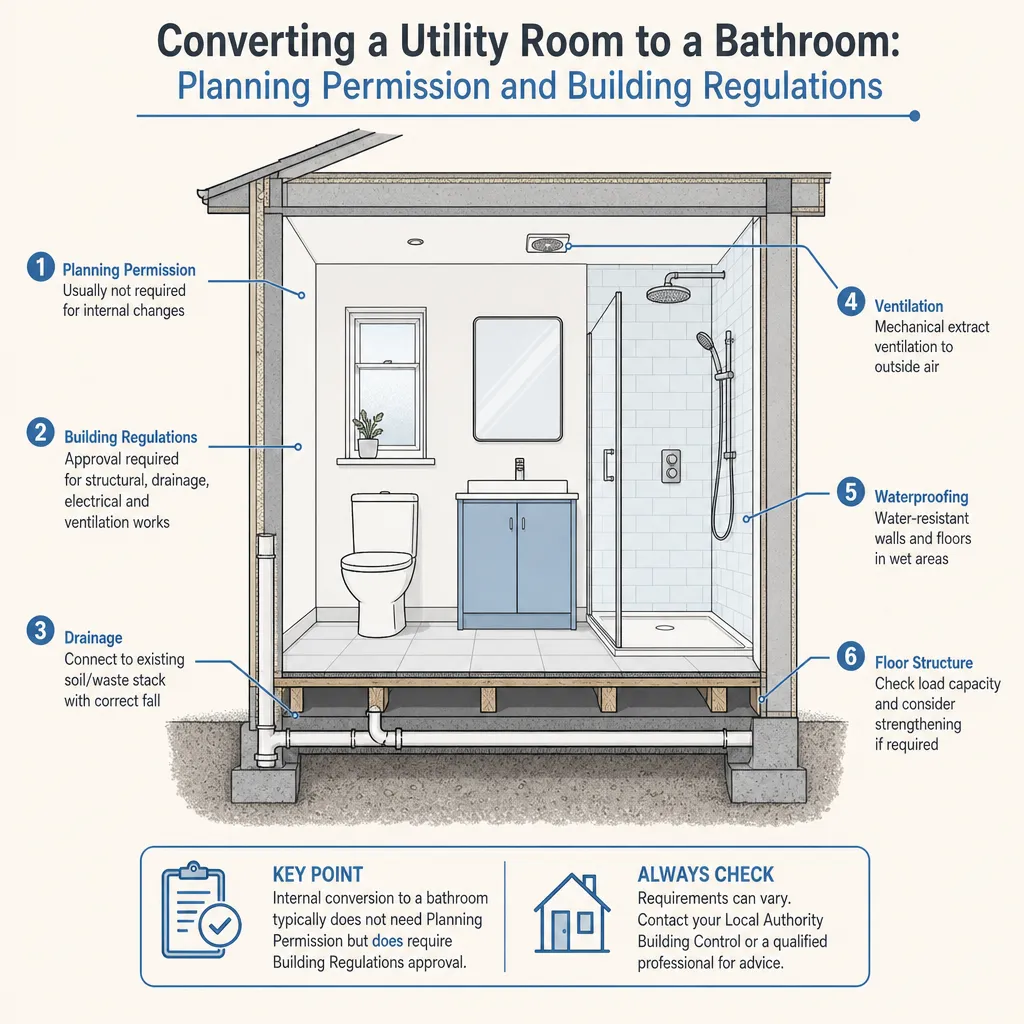
Converting a Utility Room to a Bathroom: Planning Permission and Building Regulations
Converting a utility room to a bathroom in England usually does not require planning permission, as it is an internal alteration.
 Planning & Pre-Build
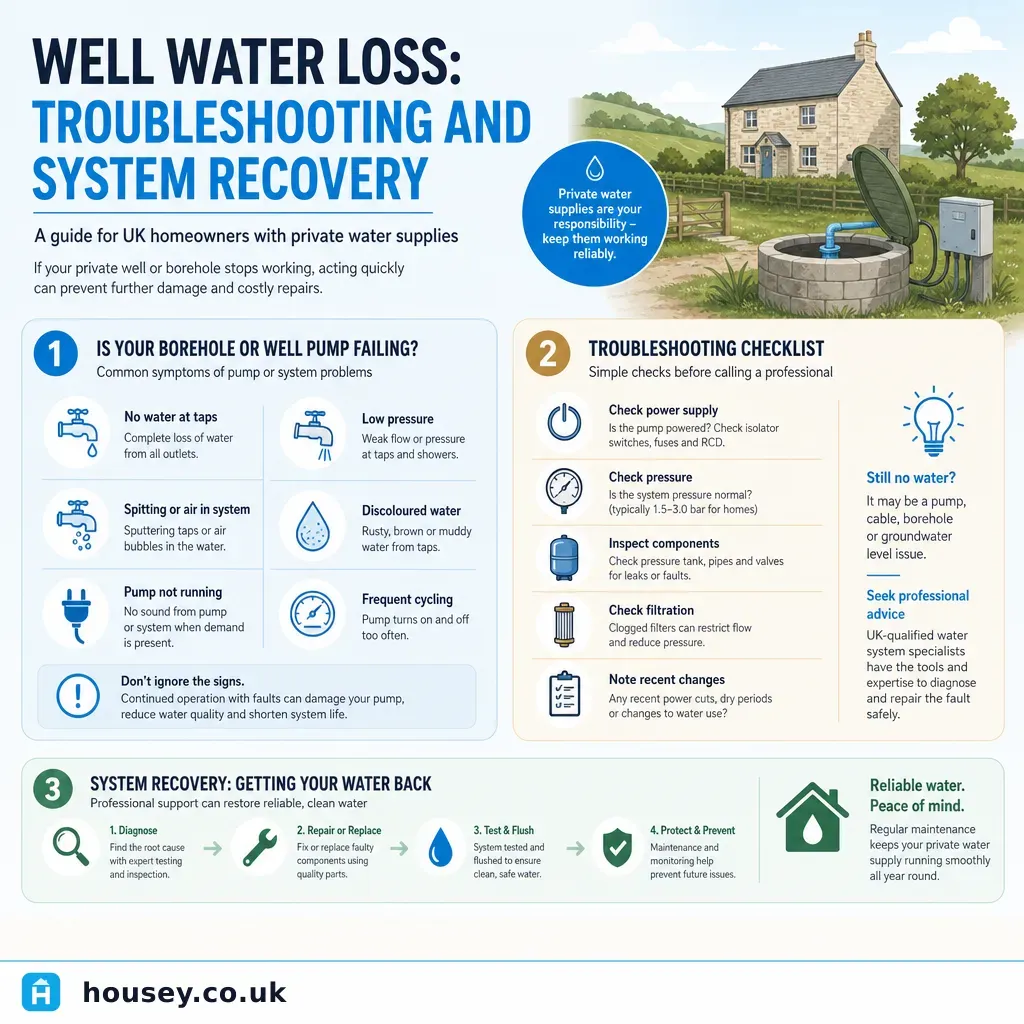
Well Water Loss: Troubleshooting and System Recovery
Well water loss in UK properties is most commonly caused by a tripped circuit breaker, pump failure, or a faulty pressure switch — not an empty aquifer.
 Planning & Pre-Build
Changes to Loft Conversion Rules: Permitted Development and Planning Updates
In England, most loft conversions on standard houses qualify as Permitted Development under Class B of the GPDO 2015, allowing up to 40 cubic metres (terraced) or 50 cubic metres (detached or semi-detached) without a planning application — if conditions are met.
 Planning & Pre-Build
Residential Properties Built with Concrete Construction Methods
UK homes are built using several concrete methods: in-situ cast concrete, precast panel systems, insulating concrete formwork (ICF), and older non-traditional types such as Wimpey No-Fines and Laing Easiform.
 Planning & Pre-Build
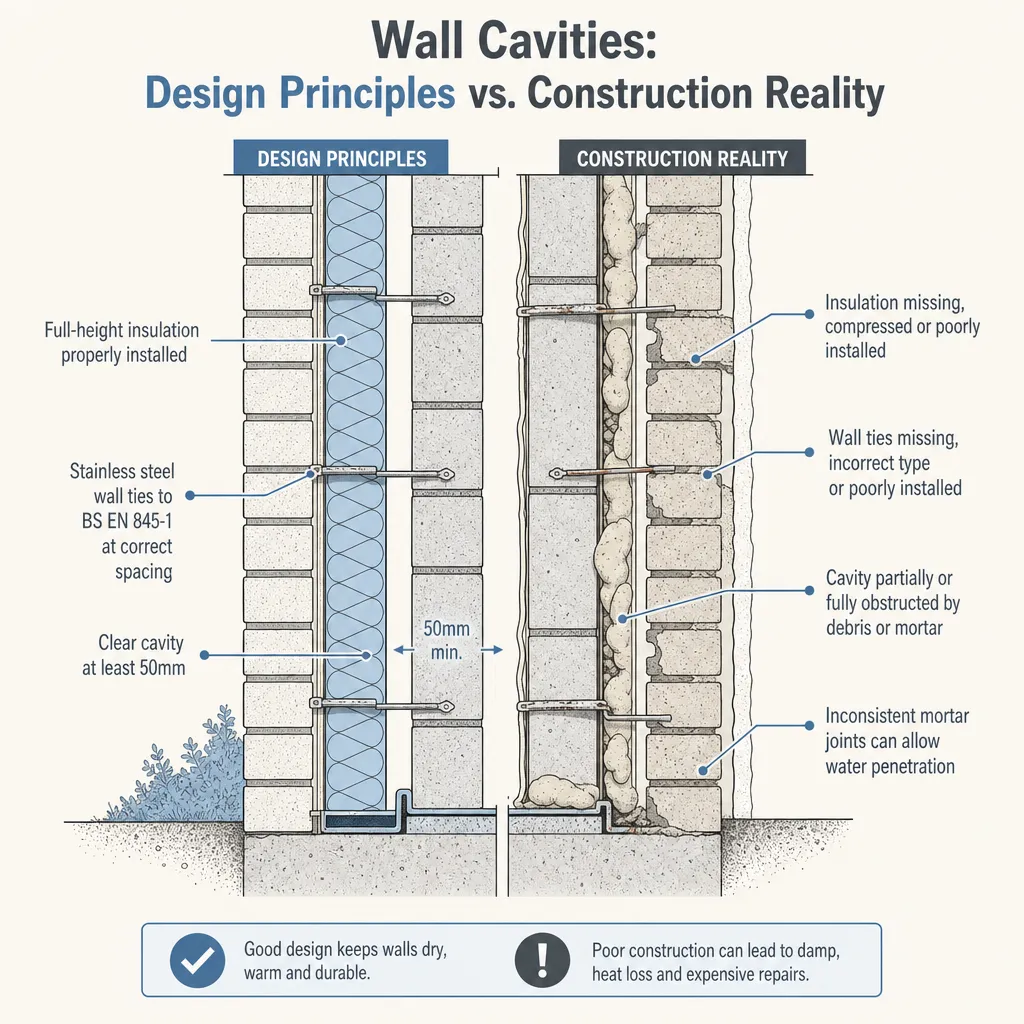
Wall Cavities: Design Principles vs. Construction Reality
A UK cavity wall is designed to resist weather, control heat loss, and structurally link two masonry leaves.