Well Water Loss: Troubleshooting and System Recovery
By Housey · Last reviewed 11th of May 2026
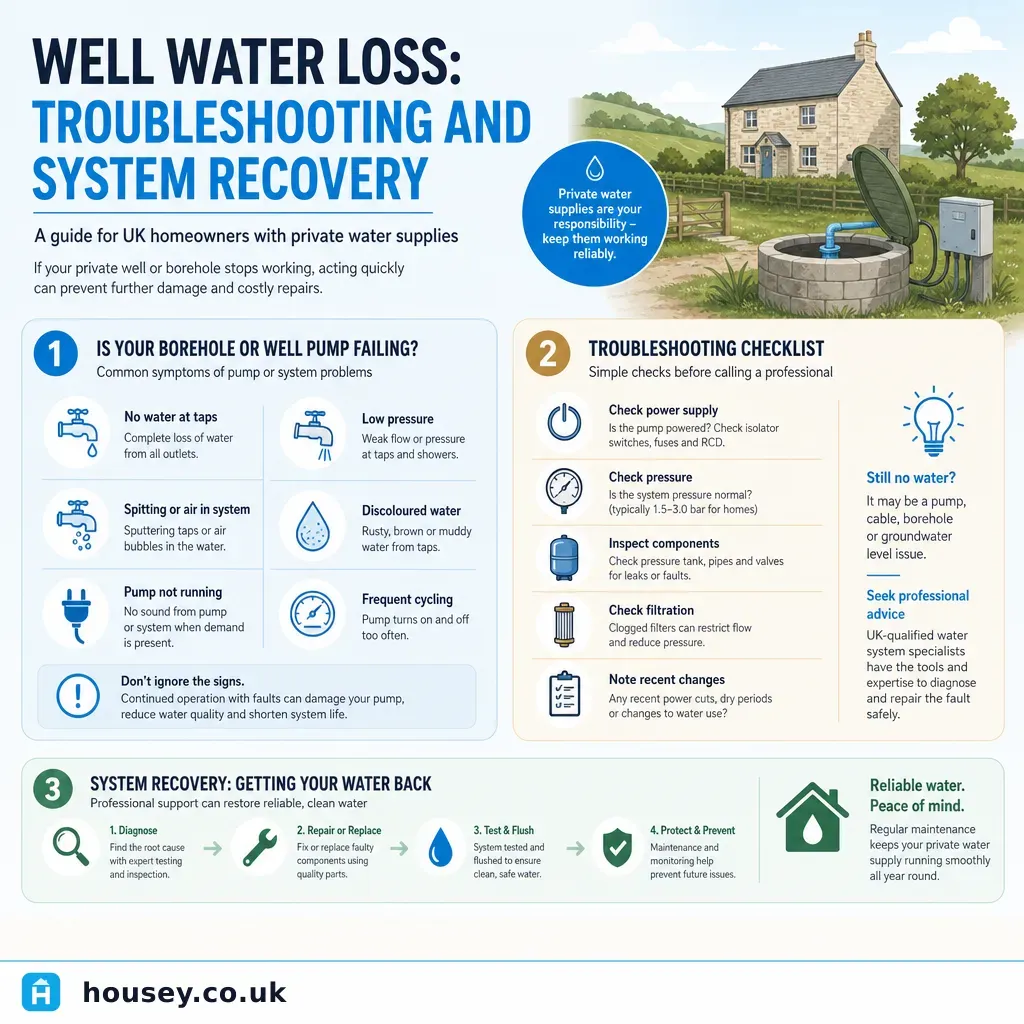
Well Water Loss: Troubleshooting and System Recovery
Losing the flow from a private well or borehole can be alarming, particularly in rural areas where mains water is miles away or prohibitively expensive to connect. A small but significant proportion of UK households — concentrated in rural England, Wales, and Scotland — rely entirely on a private water supply, which may be a drilled borehole, a spring, a dug well, or a surface water source. When that supply fails, pinpointing whether the problem lies with the pump, the electrical system, the borehole itself, or the aquifer determines both the speed and the cost of getting water flowing again.
Key points
- Private water supplies in England are regulated under the Private Water Supplies (England) Regulations 2016, with parallel legislation in Wales, Scotland, and Northern Ireland.
- Pump failure or an electrical fault accounts for the majority of sudden water loss incidents in borehole systems — not aquifer depletion.
- Extended dry periods can lower the water table and temporarily reduce borehole yield, particularly in chalk and limestone aquifers.
- Abstracting from a private borehole may require a licence from the Environment Agency (or Natural Resources Wales or SEPA) depending on volume and local designation — check before establishing a new supply or significantly increasing use.
- Any private supply serving more than one property must be risk-assessed and registered with the local authority under the Private Water Supplies Regulations.
Common causes of well water loss
Water loss from a private supply typically falls into four categories: electrical fault, pump failure, borehole or casing problems, or reduced aquifer yield. Correctly identifying the category before calling a contractor saves both time and money.
Electrical and control faults are the most frequent cause of sudden, complete loss of supply. A tripped circuit breaker, blown fuse, failed pressure switch, or damaged submersible cable can stop the pump without any mechanical damage to the pump itself.
Pump failure is the second most common cause. Submersible borehole pumps can operate reliably for many years in good conditions, but water quality, run cycles, and installation depth all affect working life. Signs of an ageing pump include a gradual pressure decline over weeks, intermittent supply, or discoloured water before total loss.
Borehole casing or screen problems — including casing corrosion, screen encrustation, or partial collapse — can restrict flow or introduce sediment. These are more common in older steel-cased boreholes than modern HDPE installations.
Reduced aquifer yield typically occurs during or after extended dry spells. Chalk and limestone aquifers are particularly sensitive to rainfall deficits. If neighbouring properties sharing the same aquifer zone are also reporting reduced flow, drawdown is a likely factor.
Initial checks before calling a contractor
Carry out these checks safely from inside the property and at ground level. Never attempt to remove a borehole pump or cap without specialist lifting equipment and appropriate training.
Homeowner troubleshooting checklist
- Check the fuse board: look for a tripped circuit breaker or blown fuse on the pump circuit. Reset once only — if it trips again immediately, do not reset; call a qualified electrician.
- Check the pressure switch and gauge: locate the pressure tank and pressure switch. Note the gauge reading. A failed switch or one set outside the correct range can prevent the pump from starting.
- Check the pressure tank: a waterlogged pressure tank (no air charge remaining) can mimic pump failure. Tap the tank — a healthy tank sounds hollow in the upper section.
- Ask neighbours: if your supply is shared, or neighbours draw from the same aquifer zone, check whether they are also affected.
- Review recent events: note any nearby construction, unusually dry weather over recent weeks, or unusual sounds from the pump before the loss occurred.
- Check pipework for visible damage: inspect unheated runs for signs of freezing, splitting, or disconnection, particularly after cold spells.
Which professional do you need?
Decision tree: matching the problem to the right expert
- Choose a WaterSafe-approved plumber or pump specialist if the problem appears electrical or pressure-related and the pump is accessible (surface pump or shallow well).
- Choose a specialist borehole contractor if the pump requires extraction from depth, the casing needs inspection via CCTV, or the borehole requires cleaning or re-development.
- Choose a hydrogeologist or geotechnical engineer if multiple supplies in the area are affected simultaneously, yield has declined gradually over months, or you need a professional assessment of aquifer capacity before deciding whether to redrill.
- Choose a WaterSafe-accredited plumber with private supply experience for pressure tank replacement, pipework repairs, or storage tank issues.
- Contact your local authority's private water supply team if you suspect contamination or if your supply serves more than one property — this may be a regulated supply with legal obligations.
- Contact the Environment Agency (or SEPA / Natural Resources Wales) if you believe nearby industrial, agricultural, or construction activity may be affecting your aquifer.
Borehole and aquifer recovery
If aquifer drawdown is the cause, the water table usually recovers naturally once rainfall resumes — often within days to weeks in chalk aquifers, longer in confined or lower-permeability aquifers. During a drawdown period, reduce abstraction by timing pumping to off-peak hours and increasing on-site storage capacity.
If the borehole itself is the problem — blocked screens, encrustation, or reduced yield — rehabilitation techniques include air-surging, jetting, and chemical treatment, all carried out by a specialist borehole contractor. A CCTV survey of the borehole casing is the standard first diagnostic step before deciding between rehabilitation and redrilling.
Where redrilling is necessary, a geotechnical assessment of local hydrogeology helps identify the appropriate target depth and aquifer zone.
Water quality after recovery
After any interruption to a private water supply, disinfect the system and test water samples before resuming use for drinking or food preparation. The Drinking Water Inspectorate (DWI) provides guidance on private supply testing requirements, and your local authority's environmental health team can advise on approved laboratories.
Turbidity or discolouration immediately after a pump restart is common and often clears within minutes to hours. Persistent discolouration, unusual odour, or changed taste warrant laboratory testing before the supply is used for human consumption.
When to get professional help
Seek specialist advice without delay if:
- The circuit breaker trips immediately on reset — indicates a fault in the pump, cable, or motor requiring an electrician or pump specialist.
- You see silt, sand, or rust in the water — suggests borehole casing or screen damage.
- Supply loss coincides with nearby drilling, construction, or agricultural activity — possible aquifer interference.
- Water quality changes (colour, odour, taste) accompany the loss — potential contamination requiring laboratory testing.
- Your supply serves more than one household — a regulated supply with local authority obligations.
- Supply has declined gradually over months — may indicate long-term yield reduction requiring hydrogeological assessment.
How Housey can help
If your troubleshooting points to a borehole or aquifer problem, a geotechnical and soil investigation can provide a professional assessment of ground conditions, aquifer characteristics, and borehole options — giving you the evidence base to make an informed decision about rehabilitation, redrilling, or supply alternatives.
Frequently asked questions
Why has my borehole suddenly stopped working after years of reliable supply?
Sudden total loss is most often a pump or electrical fault rather than an aquifer problem. Check the circuit breaker first. If the pump circuit is live but no water is delivered, the pump may have failed and will need to be extracted and inspected by a borehole contractor. Gradual decline over weeks or months is more likely to be yield- or casing-related.
Do I need a licence to abstract water from my well in England?
Abstraction licensing in England is regulated by the Environment Agency under the Water Resources Act 1991 and subsequent amendments. Domestic use from a single dwelling is often exempt, but the position depends on volume, location, and when the borehole was established. Check with the Environment Agency or Natural Resources Wales before establishing a new supply or significantly increasing use.
How long does a borehole pump typically last?
Working life varies considerably depending on water quality, run cycles, and depth. Quality submersible pumps in clean water can last 10–15 years or more; pumps in corrosive or sediment-laden water may last less. Running a pump dry even briefly causes rapid wear. Many borehole specialists recommend an inspection every 5–7 years as part of a routine maintenance programme.
Can I drink my well water after a system restart?
Not immediately. After any interruption — however brief — disinfect the system and arrange independent water testing before resuming use for drinking or food preparation. Your local authority's private water supply team or the Drinking Water Inspectorate can advise on the required tests and approved laboratories in your area.
What should a borehole CCTV survey show?
A borehole CCTV survey provides a video record of casing condition, screen condition, depth, any obstructions, deformations, and encrustation, and confirms the standing water level. It is the standard diagnostic step before deciding between pump replacement, borehole rehabilitation, or redrilling.
Sources and further reading
- Private Water Supplies (England) Regulations 2016 — legislation.gov.uk
- Private water supplies: guidance for homeowners — GOV.UK
- Water abstraction: apply for a licence — Environment Agency / GOV.UK
- Private water supply information for consumers — Drinking Water Inspectorate
- WaterSafe: find an approved plumber — WaterSafe
Useful next reads
 Planning & Pre-Build
Septic Tank Installation in the UK: Costs, Planning and Regulations
Installing a septic tank or sewage treatment plant in the UK requires registration or a permit under the Environment Agency's General Binding Rules, Building Regulations Part H compliance, and a percolation test to assess ground suitability.
 Planning & Pre-Build
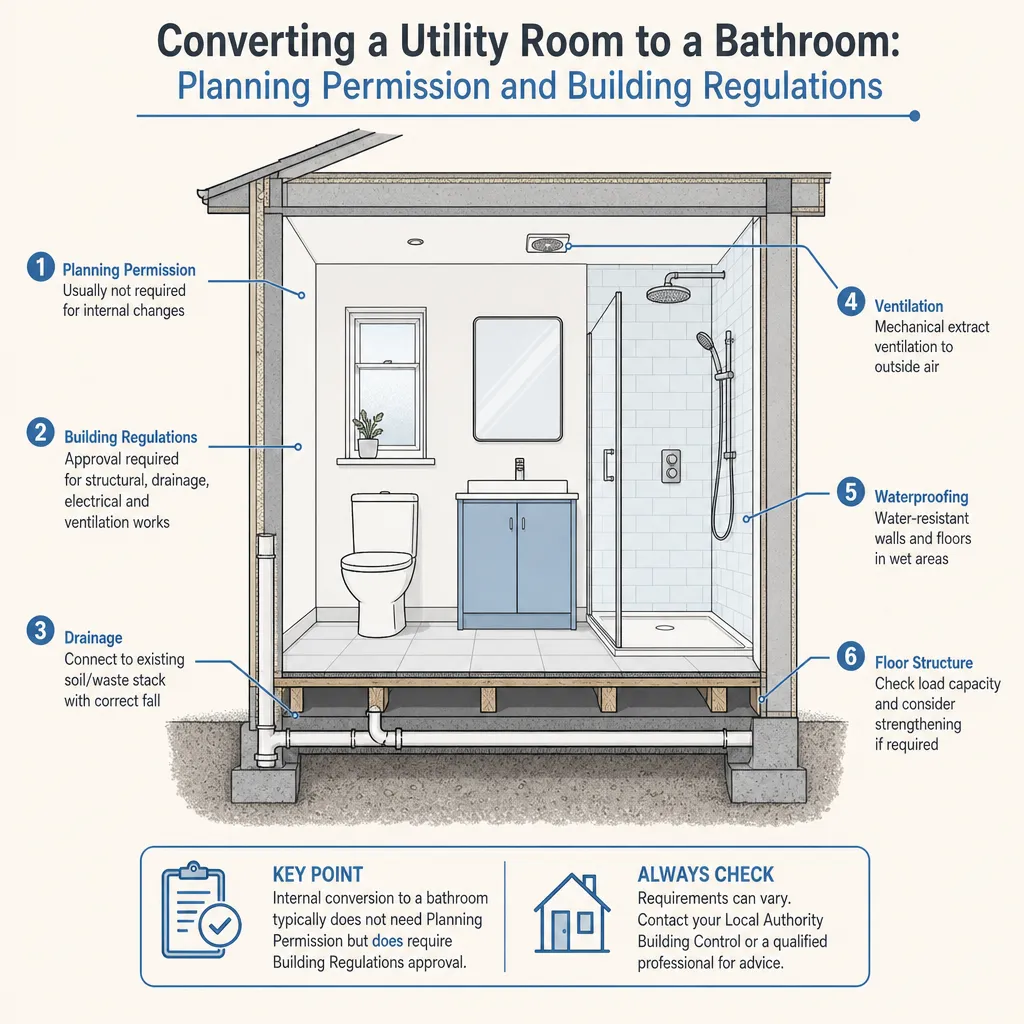
Converting a Utility Room to a Bathroom: Planning Permission and Building Regulations
Converting a utility room to a bathroom in England usually does not require planning permission, as it is an internal alteration.
 Planning & Pre-Build
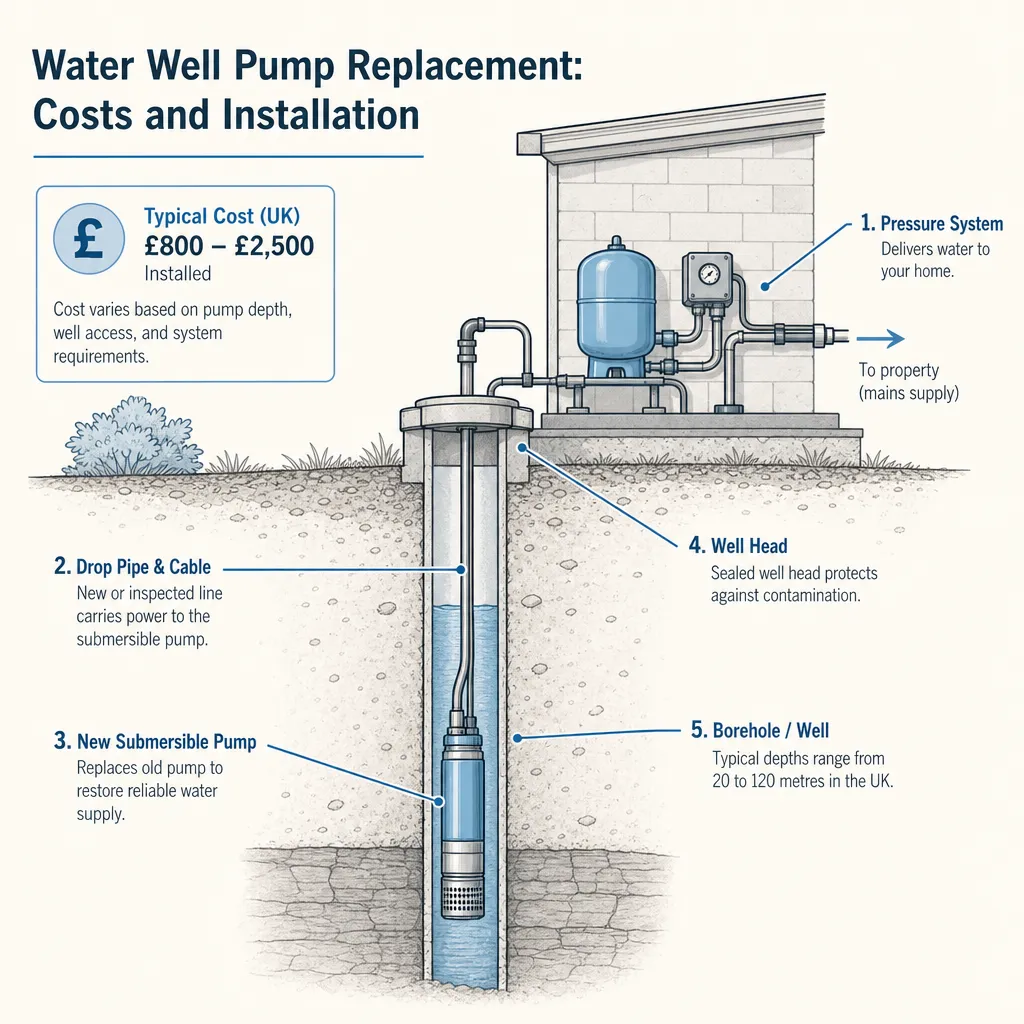
Water Well Pump Replacement: Costs and Installation
Private water supplies in rural UK rely on well or borehole pumps that typically last 10–15 years.
 Planning & Pre-Build
Understanding Barn Conversions: Property Types and Characteristics
A barn conversion is an agricultural building — typically a former threshing barn, cattle shed, or granary — converted into residential use.
 Planning & Pre-Build
Changes to Loft Conversion Rules: Permitted Development and Planning Updates
In England, most loft conversions on standard houses qualify as Permitted Development under Class B of the GPDO 2015, allowing up to 40 cubic metres (terraced) or 50 cubic metres (detached or semi-detached) without a planning application — if conditions are met.