Understanding Wavy Glass in Historic Windows and Modern Replacements
By Housey · Last reviewed 19th of May 2026
Understanding Wavy Glass in Historic Windows and Modern Replacements
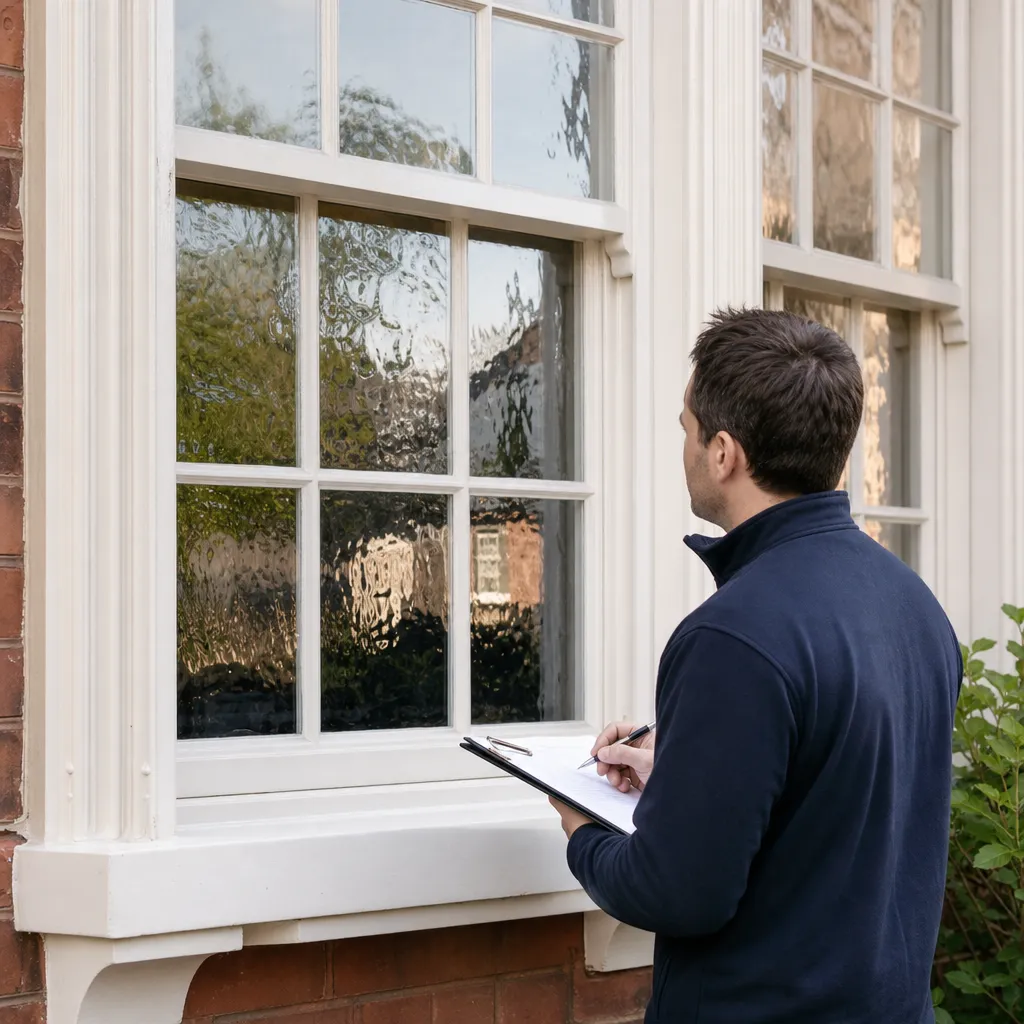
Walk down almost any Georgian or Victorian street in the UK and the original windows, where they survive, look unmistakably different from modern replacements — that subtly distorted, gently rippling quality is caused by the glass itself, not the frame, not age-related weathering, and not a fault in installation. Understanding what produces that appearance matters to any homeowner planning repair, restoration, or replacement work, particularly where the property carries heritage or planning constraints that significantly affect which options are available.
Key points
- The wavy, distorted quality of antique window glass results from the hand-blown cylinder or crown glass manufacturing process, which created panes of inherently varying thickness — this is a material characteristic, not a defect.
- In England, works to windows in listed buildings require listed building consent regardless of whether the property is in a conservation area; consent may be refused if original glass and frames are removed without justification.
- Conservation area properties may need planning permission to replace windows under an Article 4 Direction made by the local planning authority, even if the building is not individually listed — check with your local authority before ordering anything.
- Modern reproduction glass — sometimes marketed as 'restoration glass', 'heritage glass', or 'antique cylinder glass' — is produced by specialist UK suppliers and is accepted by some local authorities as a like-for-like replacement for broken original panes.
- FENSA or CERTASS registration is required for replacement glazing installations in England and Wales to self-certify Building Regulations compliance, but these schemes do not override listed building consent or planning permission requirements where those also apply.
What causes glass to look wavy?
Pre-industrial glass manufacturing methods
Before machine-drawn float glass became the industry standard in the late nineteenth and early twentieth centuries, window glass was made by hand using one of two principal methods.
Crown glass was made by blowing a gather of molten glass into a sphere, then spinning it rapidly on the blowing iron until centrifugal force flattened it into a disc. Panes were cut from the flat area; the central portion — called the 'crown' or 'bullion', with its characteristic concentric rings — was thicker and more distorted and was typically used in secondary locations or lesser buildings.
Cylinder (broad) glass was made by blowing molten glass into a long cylinder, cutting it along one side, and flattening it in a furnace into a sheet. The resulting pane has gentle waves and ripples running parallel to the direction of flattening, with thickness varying across the pane from approximately 1 mm to 4 mm.
Both processes produce glass that refracts and reflects light differently at different angles across its surface, creating the characteristic shimmer and distortion that distinguishes old windows from modern float glass. This is the physical record of how the glass was made, and it cannot be replicated precisely by any industrial process.
Why it matters for homeowners today
Antique glass surviving in its original frames is increasingly valued on historic, aesthetic, and material grounds. In listed buildings it is often irreplaceable: pre-industrial glass cannot be sourced new, only salvaged from demolitions or specialist dealers. A conservation officer may treat its removal as a material and irreversible change to a building's historic character — a consideration that can directly affect the outcome of a listed building consent application.
For homeowners in conservation areas who are not individually listed, the position is more varied: some local authorities have made Article 4 Directions that remove permitted development rights for window changes on certain streets or within defined areas, requiring a planning application before replacement. Others have not. Checking this before ordering windows or instructing a fitter avoids enforcement problems.
Comparison: original glass, reproduction glass, and secondary glazing
Option | Best for | Not ideal for | Indicative cost per window (2026-05-19) | Planning position |
|---|---|---|---|---|
Retaining original glass with frame repair and draught-proofing | Listed buildings; conservation-area properties where original glass survives | Severely cracked, buckled, or missing panes | £50–£200 per pane for specialist reglazing; frame repair costs vary | Preferred outcome for listed building consent; lowest planning risk |
Reproduction antique glass (cylinder or drawn-sheet type) | Replacement of broken original panes; matching new openings to existing originals | Full replacement where original glass survives intact | £30–£100 per pane plus joinery fitting | Medium — some local planning authorities accept; others require salvaged original glass; check before ordering |
Secondary glazing (internal slim-profile frame) | Listed buildings where primary window replacement is refused; draught reduction without external change | Where slim internal reveals are not achievable | £300–£800 per window supplied and installed | Low — typically does not require consent as a reversible internal alteration |
Full period-style replacement double glazing | Unlisted properties outside conservation area Article 4 Direction zones | Listed buildings; many conservation-area properties | £400–£1,200 per window supplied and installed | Higher — may require planning permission or listed building consent depending on location |
Indicative UK costs, last reviewed 2026-05-19. Obtain local quotes for your specific property, specification, and access conditions.
Decision tree: which approach is right for your property?
- Is your property listed (Grade I, Grade II* or Grade II in England; A or B in Scotland; Grade I or II in Wales)? → Listed building consent is almost certainly required for any window change. Contact your local conservation officer before proceeding. Retain original glass wherever possible.
- Is your property in a conservation area? → Check whether an Article 4 Direction is in force for your street or area. Your local planning authority's website or planning department can confirm. If so, replacement windows are likely to need planning permission.
- Is the original glass cracked or broken, but the frame is structurally sound? → Reglazing with reproduction antique glass is typically the most sympathetic option and may be accepted by a conservation officer where a like-for-like case is made.
- Are all panes intact but the frames are draughty? → Investigate draught-proofing strips and frame repair first — this preserves original fabric, is usually low cost, and is the approach conservation guidance recommends as a first step.
- Is the property unlisted and outside any conservation area or Article 4 zone? → You have more flexibility; a FENSA-registered installer can fit replacement double-glazed windows under self-certification without a separate building control application.
- Unsure of your property's status? → Search the Historic England National Heritage List for England (historicengland.org.uk/listing/the-list/) and check your local authority's conservation area mapping.
What to ask before instructing a window specialist or joiner
Before accepting a quote, ask:
- Do you have demonstrable experience working on listed buildings or conservation-area properties, and can you provide references?
- Can you supply or source reproduction antique glass, and what product type would you propose for this application?
- Will you advise on consent requirements, or do I need to approach the local planning authority separately before work begins?
- Is FENSA or CERTASS registration included in the quote, and will a completion certificate be provided on completion?
- What is the expected service life of the repair or installation with normal maintenance?
- Is VAT included in the quoted price?
- What will happen if the existing frames are found to be more deteriorated than expected once work begins — how will variations be agreed?
Homeowner checklist: before you repair or replace historic windows
When to get professional help
If your property is listed or in a conservation area, engaging a heritage and conservation consultant before any window work begins is strongly advisable. Conservation officers have wide discretion, and what one local authority accepts another may refuse. A conservation specialist can advise on consent strategy, prepare supporting heritage statements, and liaise with the planning authority on your behalf — reducing the risk of a refused application or an enforcement notice.
For the installation work itself, always use a window and door installer with demonstrable experience of period properties. FENSA or CERTASS registration confirms Building Regulations compliance for replacement units but does not indicate conservation expertise — ask specifically for examples of comparable work on listed or conservation-area buildings.
How Housey can help
Housey connects homeowners with specialists suited to period and historic properties. For guidance on consent strategy and heritage implications, a heritage and conservation consultant can advise on what is and is not acceptable in your local authority area. For installation and reglazing, window and door installers with period property experience can supply reproduction glass, carry out sympathetic frame repairs, or fit secondary glazing where primary window replacement is not an option.
Frequently asked questions
Is wavy glass a problem that needs fixing?
No. The waviness in old window glass is not a defect — it is a natural characteristic of pre-industrial hand-blown manufacture. It does not indicate structural weakness, failing seals, or brittleness beyond normal age-related factors. The only reasons to replace original wavy glass are physical damage such as cracking, or the decision to install double-glazed units, which carries planning implications in listed and conservation-area properties.
Can I replace original glass with modern double glazing in a listed building?
In most cases, full replacement of original single-glazed windows with modern double-glazed units in a listed building will not be granted listed building consent. Historic England guidance generally favours retention and repair of original fabric. Secondary glazing — fitted internally and reversibly — is often an acceptable compromise that improves thermal performance and draught control without altering the external appearance of the building.
Where can I find reproduction antique glass in the UK?
Several UK specialist suppliers produce cylinder-style and drawn-sheet glass that mimics the visual properties of pre-industrial glass. Look for products marketed as 'restoration glass', 'heritage glass', or 'antique float' glass. Your local conservation officer may have a preferred suppliers list, and specialist joiners experienced in listed buildings usually have established relationships with suitable glass suppliers.
Does replacing windows require Building Regulations approval?
Yes, in most cases. Replacement windows in England and Wales must comply with Building Regulations, including Part L (energy efficiency) and Part K (safety glazing where applicable). FENSA or CERTASS registration by the installer self-certifies compliance without a separate building control application. However, these schemes do not substitute for listed building consent or planning permission where those are also required.
Sources and further reading
- Historic England — Windows: repair and upgrading — Historic England
- Planning Portal — Windows in conservation areas and listed buildings — Planning Portal
- GOV.UK — Listed buildings — GOV.UK
- FENSA — What is FENSA? — FENSA
Useful next reads
 Improvement & Build
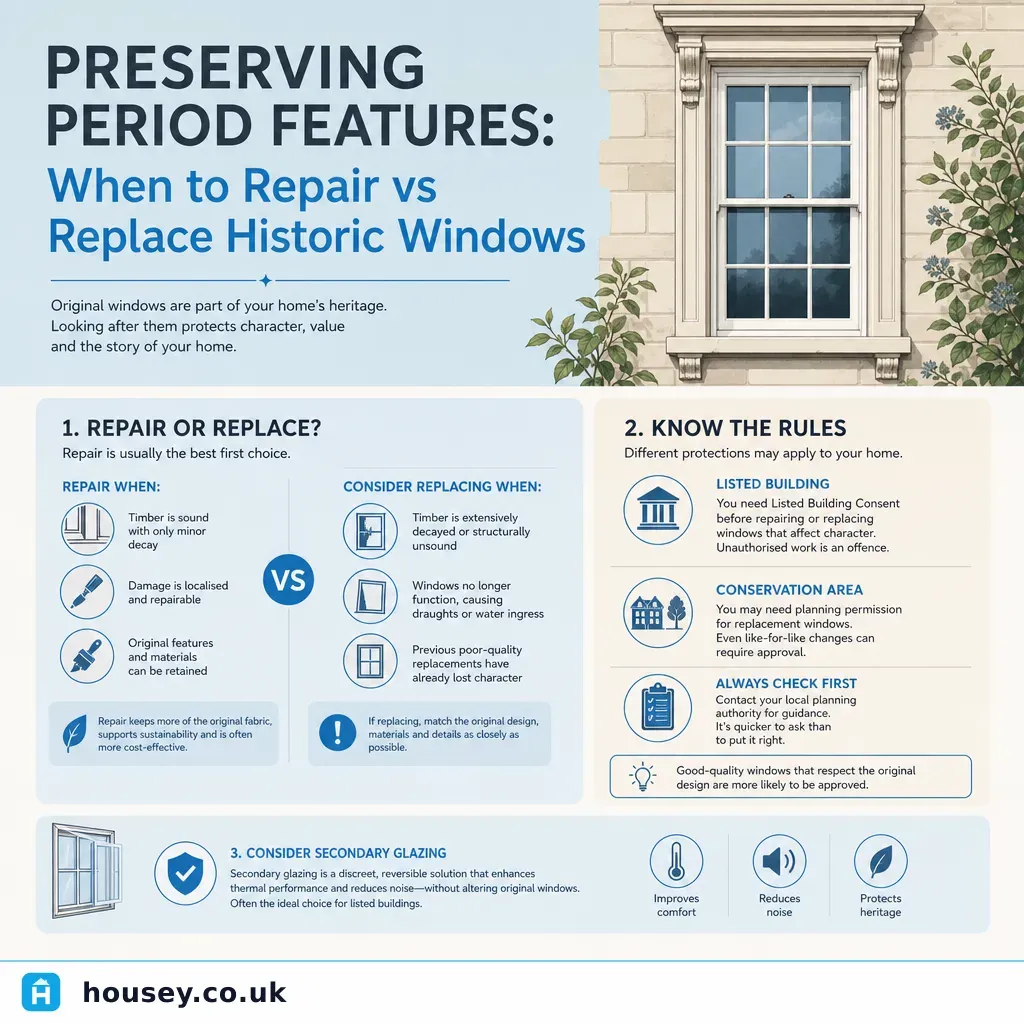
Preserving Period Features: When to Repair vs Replace Historic Windows
For most pre-1919 timber windows in listed buildings or conservation areas, repair and draught-proofing — often combined with secondary glazing — is both more appropriate and more likely to gain consent than full replacement.
 Improvement & Build
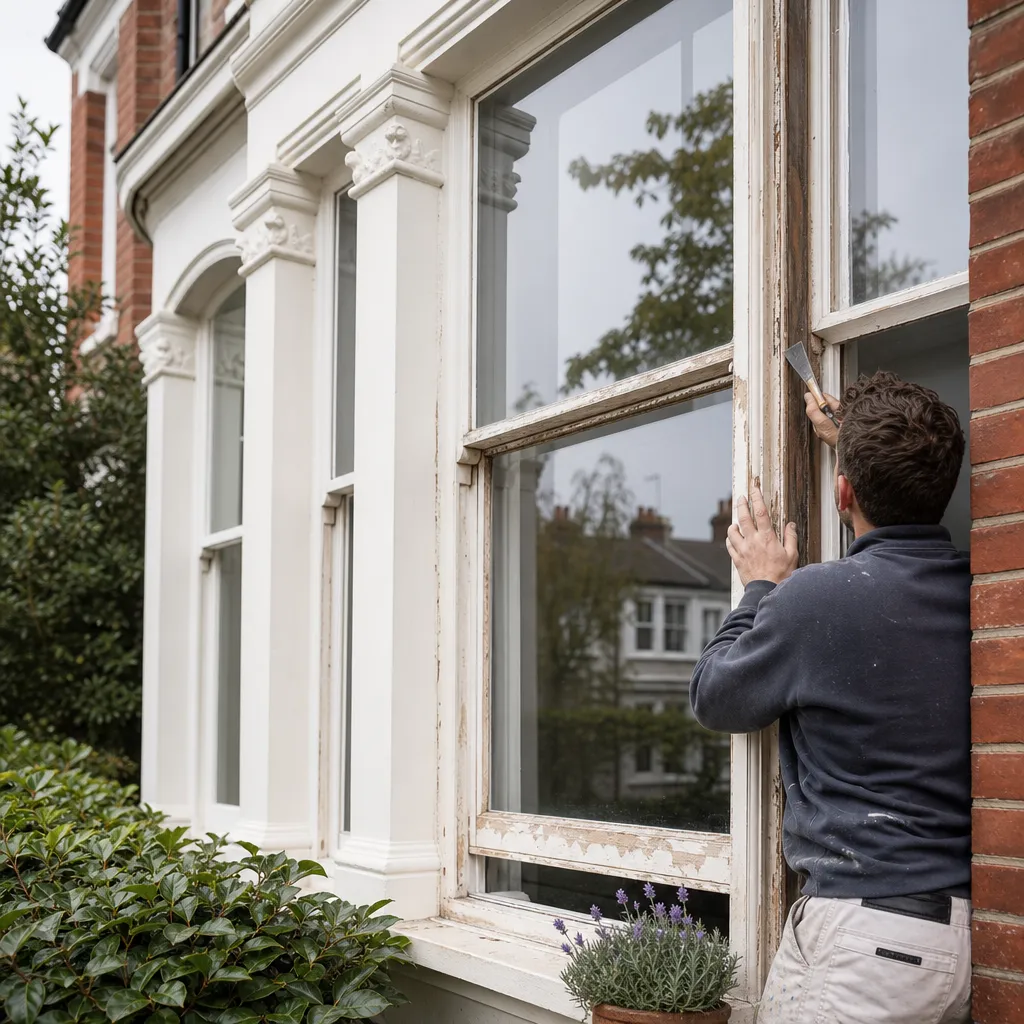
Restoring Historic Windows: Conservation Techniques and Materials
Historic window restoration involves repairing original timber or metal frames using like-for-like materials — often hardwood splices or epoxy consolidant — rather than replacing them outright.
 Improvement & Build
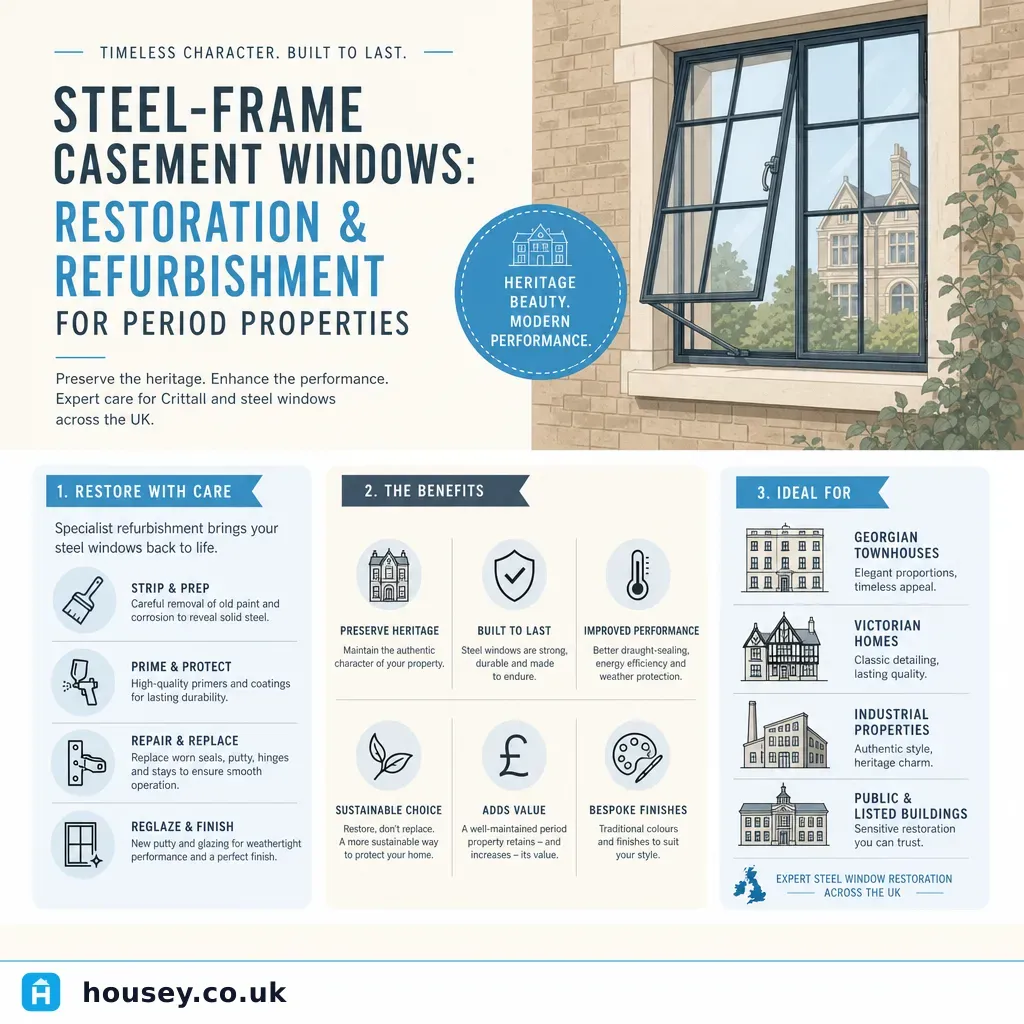
Steel-Frame Casement Windows: Restoration and Refurbishment for Period Properties
Original steel casement windows on listed buildings and conservation area properties should almost always be restored rather than replaced, as planning consent for alternative materials is usually refused.
 Improvement & Build
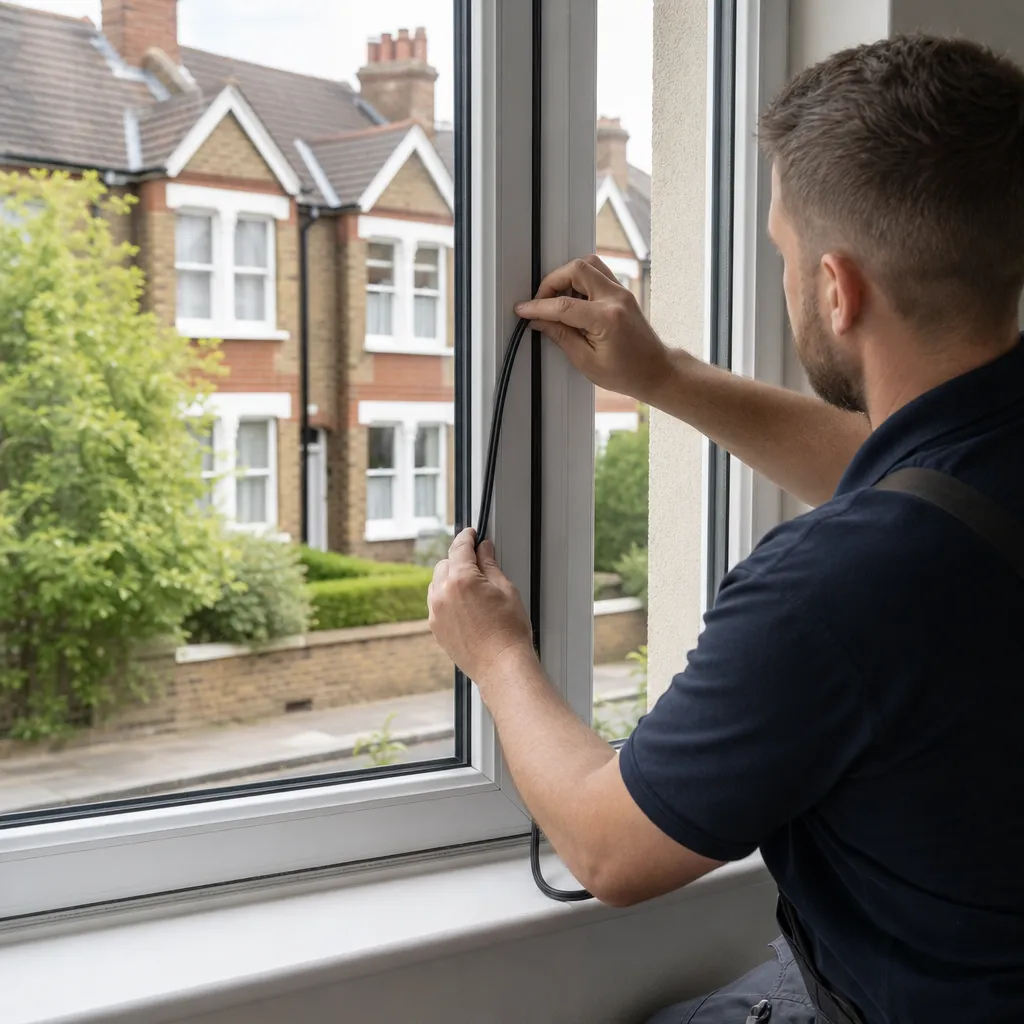
Replacing uPVC Window Seals: Restoring Energy Efficiency Without Full Replacement
Failed uPVC window seals typically cause draughts and can be replaced without full window replacement.
 Improvement & Build
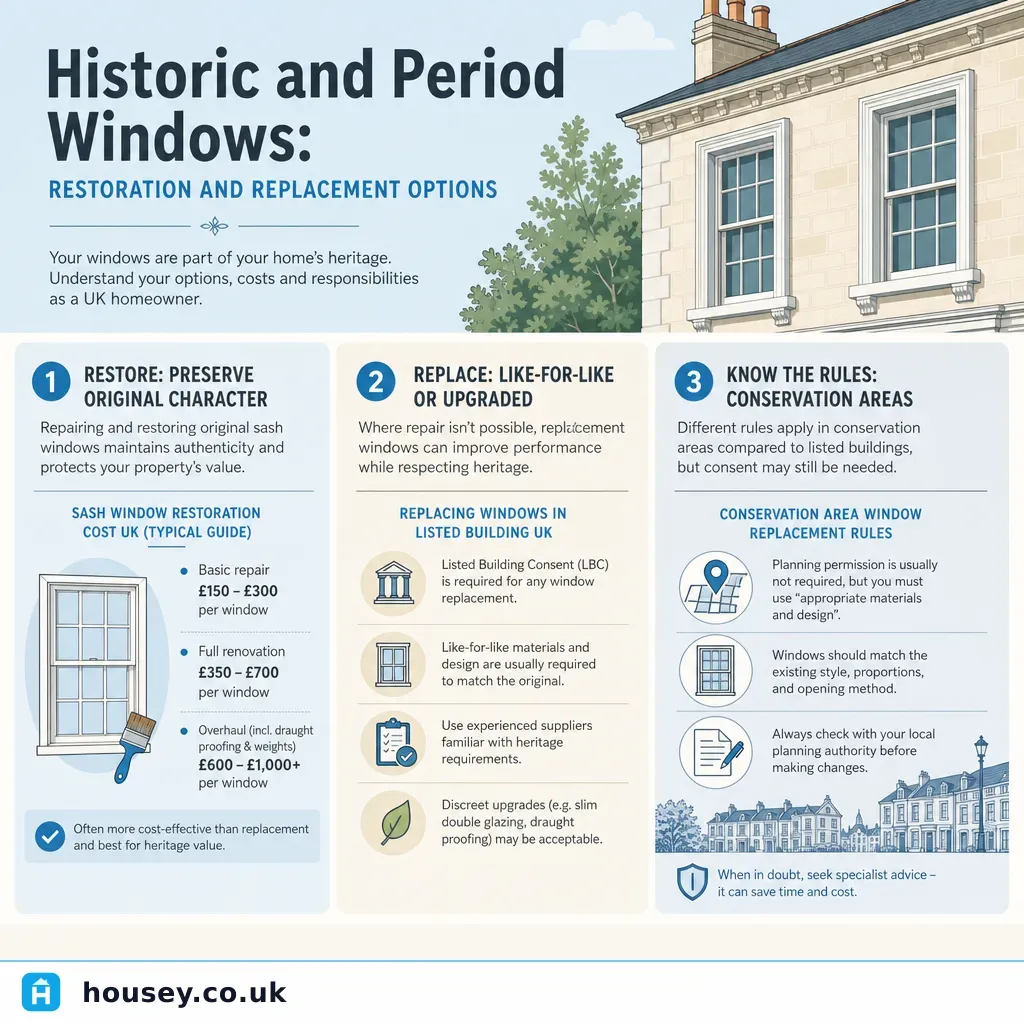
Historic and Period Windows: Restoration and Replacement Options
For period and historic windows, restoration is usually preferable — especially in listed buildings or conservation areas where replacement requires consent.