What Is a Split Jamb Door and When to Use One
By Housey · Last reviewed 31st of May 2026
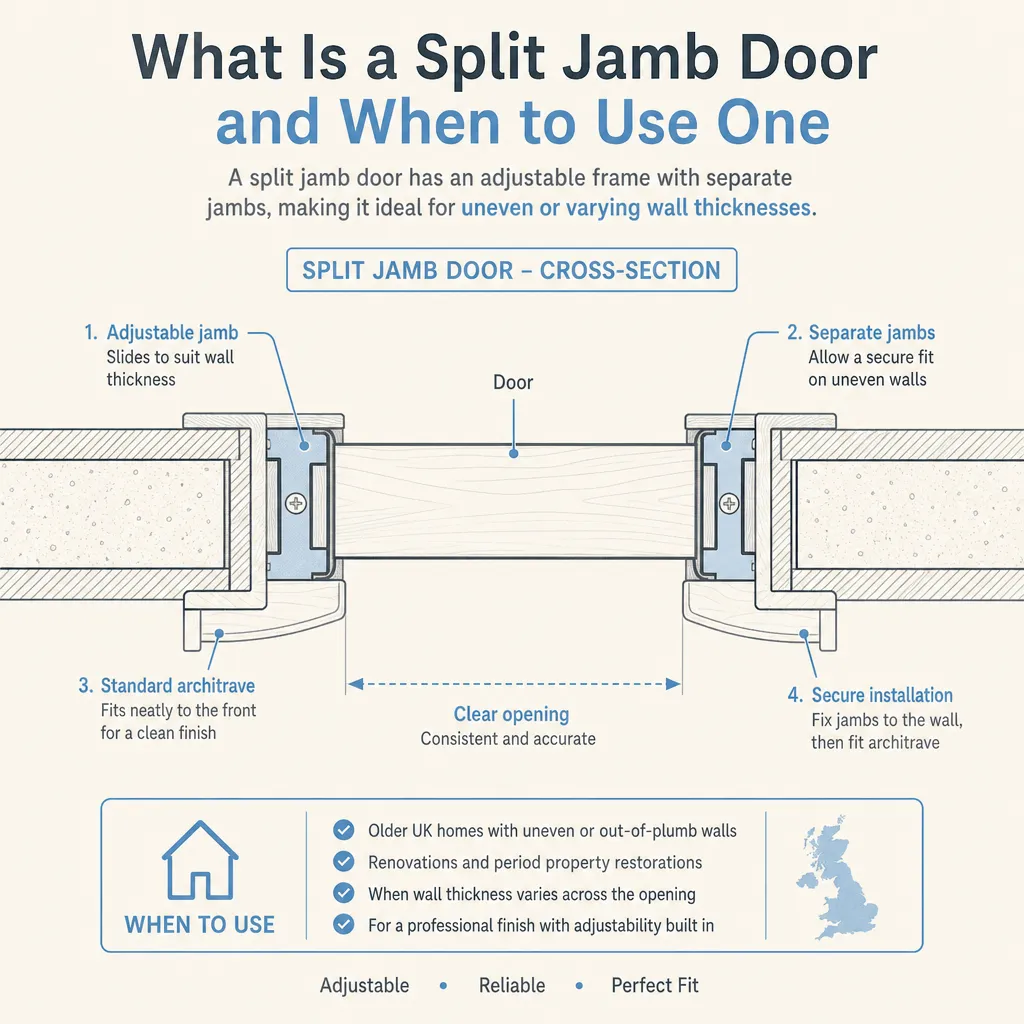
What Is a Split Jamb Door and When to Use One
Choosing the right door frame system matters most during renovations where wall thickness is non-standard — a common situation in Victorian terraces with deep plaster walls, timber-frame extensions, or homes where room layouts have been altered. Whether you are a builder sourcing internal door sets or a homeowner managing a refurbishment, understanding how a split jamb door differs from a conventional door lining will help you make a practical, cost-effective choice before measuring up or ordering materials.
Key points
- A split jamb door frame is manufactured in two interlocking halves, each with pre-attached casing (architrave), that slot together from opposite sides of the wall — eliminating the need for separately fitted architrave on site.
- Standard UK door linings are made for wall thicknesses of roughly 95–115 mm; split jamb systems are designed for walls outside this range.
- Building Regulations Approved Document M specifies a minimum 775 mm clear opening width for new doorways in dwellings (850 mm for accessible design) — wall thickness affects frame depth, not opening width.
- Fire door sets (FD30, FD60) must be installed as a certified complete system; any split jamb unit in a fire-rated position must carry appropriate third-party certification such as BM TRADA Q-Mark or Certifire.
- In the UK, split jamb units are more commonly labelled as "adjustable frame" or "split-frame" door linings — the term "split jamb" originates in North American construction.
How a split jamb frame works
A conventional UK door lining is a single-depth frame fixed into the rough opening, with architrave pinned to the wall surface on both sides to cover the joint between the lining and the plaster. The lining depth must match the wall thickness precisely, or packing and scribing are required on site.
A split jamb frame is built differently: each jamb (vertical frame member) is manufactured as two interlocking sections, each carrying its own integral stop and pre-fitted architrave moulding. One half is inserted from each face of the wall, then the two halves clip or slot together at a central tongue-and-groove joint. The casing is already attached, so the finished appearance is achieved in one operation with no separate scribing or beading.
Which door frame should you choose?
- Choose a split jamb frame if the wall thickness is non-standard (above or below 95–115 mm) and you want a factory-finished result without on-site cutting.
- Choose a split jamb frame if you are fitting multiple doors in one project and want to reduce on-site joinery time, particularly where the plaster finish is already complete.
- Choose a standard door lining if the wall thickness is standard and you have a plasterer on site who can make good around the frame.
- Choose a standard door lining if you want freedom to select your own architrave profile independently of the frame.
- Ask a joinery specialist if the door is in a fire-compartment wall — certification requirements must be confirmed before ordering.
- Check with your local planning authority if the property is listed or in a conservation area, where frame style may be restricted.
Split jamb vs standard door lining: comparison
Feature | Split jamb frame | Standard door lining |
|---|---|---|
Architrave included | Yes — pre-attached to each half | No — fitted separately on site |
Wall thickness flexibility | High — suited to non-standard depths | Low — lining must match wall depth |
On-site joinery time | Lower | Higher |
UK availability | Specialist suppliers and some merchants | Widely available at builders' merchants |
Fire-rated versions | Available (confirm certification) | Available (confirm certification) |
Typical finish | Factory-machined, consistent profile | Varies by timber quality and site finish |
Best suited to | Non-standard walls, volume projects | Standard walls, one-off replacements |
Installation overview
A split jamb door is supplied as a pre-hung unit — the door is already mounted on hinges within the frame. Installation typically follows these steps:
- Preparing the rough opening — the opening must be plumb, level, and square. A split jamb frame cannot compensate for a badly prepared opening.
- Inserting the first half — set from the face side, check for plumb, and temporarily brace before fixing through the hinge jamb.
- Interlocking the second half — press the opposite jamb half into the tongue-and-groove joint from the reverse face and secure.
- Checking door operation — the door should swing freely and latch consistently before fixings are fully tightened.
- Finishing — fill gaps between casing and wall with flexible decorator's caulk; prime and paint to match the room specification.
For fire doors, follow the certification holder's installation instructions precisely. Incorrect gap sizes, missing intumescent strips, or unsuitable hinges can invalidate the fire rating.
When to get professional help
A competent joiner or door installer can handle most split jamb installations. Seek professional advice when:
- The doorway is in a fire-compartment wall (FD30 or FD60 specification) — certification must be in place before the door is ordered.
- The opening is in or adjacent to a load-bearing wall — any structural alteration requires assessment before work begins.
- The door must comply with Approved Document M accessible design requirements, covering clear width, threshold height, and lever hardware.
- The property is listed or in a conservation area — confirm with your local planning authority before specifying any replacement frame.
How Housey can help
If you are replacing internal or external doors as part of a wider renovation, window and door installers listed on Housey can assess your opening sizes, advise on the most appropriate frame system, and supply and fit the complete door set — including fire-rated units where required.
Frequently asked questions
Are split jamb doors common in UK homes?
They are less common in UK residential projects than in North American construction, where the split jamb pre-hung system is the default for internal doors. In the UK, the equivalent is often labelled an "adjustable frame" or "split-frame" door lining and is available from joinery suppliers, though standard single-piece linings remain the norm at most builders' merchants.
What wall thickness suits a split jamb door?
Most standard UK door linings suit walls of 95–115 mm — covering an 89 mm stud plus two layers of plasterboard. Split jamb and adjustable-frame systems are particularly useful where finished wall thickness falls outside this range, such as Victorian solid-wall construction with 25 mm plaster or a timber-frame extension with additional insulated lining. Always confirm the exact thickness before ordering.
Can a split jamb frame be used for a fire door?
Yes, but only if the complete door set — frame, door leaf, and ironmongery — carries appropriate fire certification such as BM TRADA Q-Mark or Certifire. Components cannot be mixed and matched for a certified fire door assembly. Confirm the certification scope before ordering and follow the manufacturer's installation instructions precisely.
Do I need building regulations approval to replace a door frame?
Replacing a like-for-like internal door frame in a dwelling does not normally require a building regulations application. However, widening an opening, converting a standard door to a fire door, or altering a door in a protected corridor or escape route may require building control notification. Check with your local building control body if you are uncertain.
Sources and further reading
Useful next reads
 Improvement & Build
Understanding Door Types: Materials, Styles and Functional Options
Doors are available in timber, uPVC, aluminium, steel, and composite materials, each suited to different budgets, locations, and performance requirements.
 Improvement & Build
Understanding Standing Seam Metal Roofing Systems
A standing seam metal roof is built from long metal panels with raised, interlocked edges and all fixings concealed within the seams.
 Improvement & Build
Interior Door Selection: Styles, Materials and Function
Interior doors in UK homes come in solid core, hollow core, and glazed varieties, with styles from flush and panelled to bifold and pocket.
 Improvement & Build
What is window flashing and why it's essential for weatherproofing
Window flashing is a water-resistant material installed at the head, sill, and jambs of a window opening to direct rainwater away from the frame-to-wall junction.
 Improvement & Build
What Is Roof Underlayment and Why It Matters
Roof underlayment is a water-resistant layer fixed to the roof deck before tiles or slates are laid.