What Property Managers Do: Understanding the Role
By Housey · Last reviewed 31st of May 2026
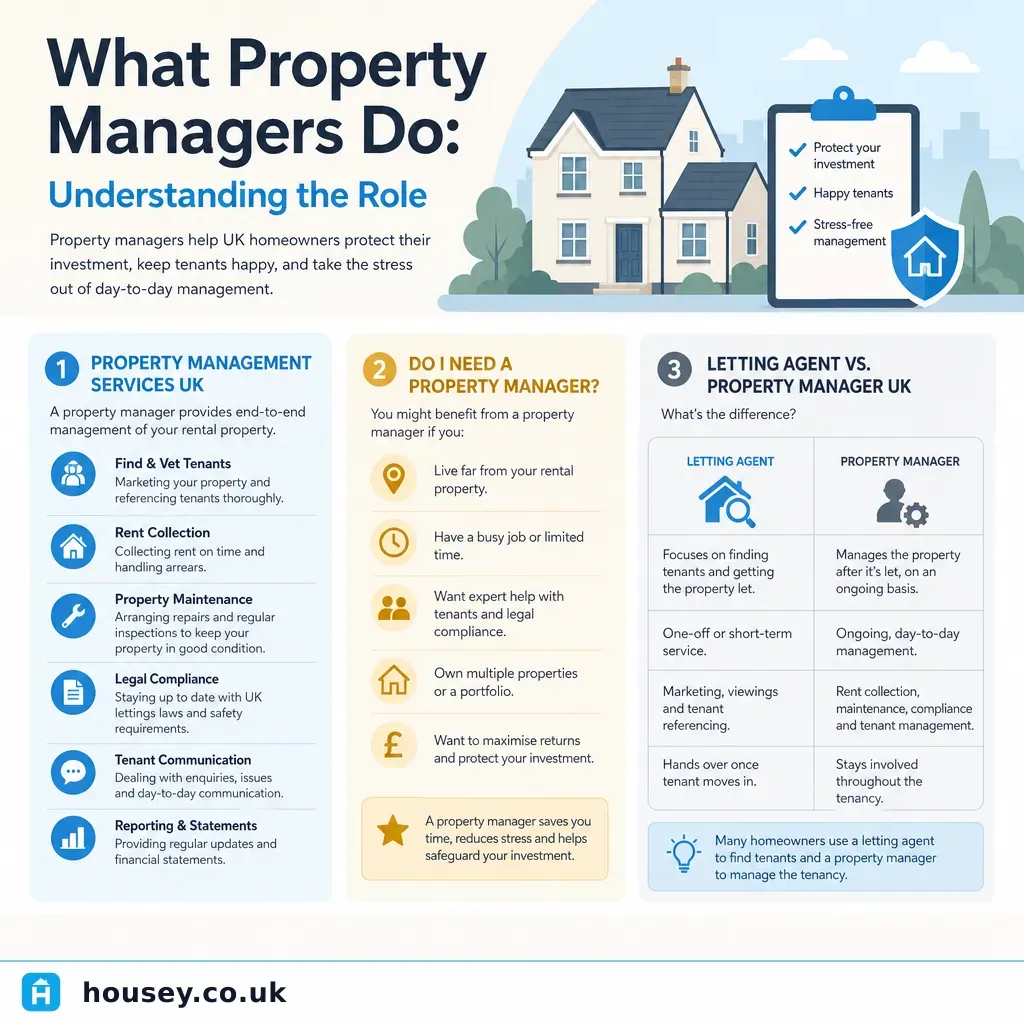
What Property Managers Do: Understanding the Role
Renting out a property involves considerably more than collecting rent at the end of each month. Most landlords encounter the property management question at a key moment — when a first tenancy begins, when a portfolio grows beyond one property, or when work and family commitments make hands-on management impractical. Getting the right support in place early can mean the difference between a smoothly run tenancy and a costly dispute.
Key points
- Client Money Protection (CMP) is a legal requirement for all letting agents and property managers in England who handle tenant or landlord money — always verify a firm is registered with an authorised scheme under the Client Money Protection Schemes for Property Agents (Approval and Designation of Schemes) Regulations 2018.
- Management fees in England typically range from 8–15% of monthly rent plus VAT, with fully managed services that include compliance handling and maintenance co-ordination sitting toward the higher end. (Indicative UK costs, last reviewed 2026-05-31.)
- The Tenant Fees Act 2019 restricts the charges a landlord or their agent can apply to tenants in England — property managers acting on your behalf must comply with these rules, and you as the landlord remain liable if they do not.
- Houses in Multiple Occupation (HMOs) are subject to mandatory or selective licensing in many local authority areas; a property manager handling HMOs should have direct experience of the relevant licensing requirements for that area.
- ARLA Propertymark is the main professional membership body for letting agents and property managers in the UK — members must hold client money in a separately protected account and carry professional indemnity insurance.
What a property manager actually does
A property manager's job is to act as the day-to-day point of contact between a landlord and their tenants. In a fully managed service, this typically covers:
Tenant management
- Advertising the property and referencing prospective tenants
- Preparing and issuing tenancy agreements (usually Assured Shorthold Tenancies under the Housing Act 1988)
- Collecting rent and chasing arrears
- Handling routine maintenance requests and co-ordinating tradespeople
- Carrying out periodic property inspections and issuing written reports
- Managing the checkout process, deposit deductions, and return of funds under a government-authorised Tenancy Deposit Scheme (TDS)
Compliance and statutory checks
- Arranging annual gas safety inspections by a Gas Safe registered engineer and issuing Gas Safety Records (CP12 certificates)
- Co-ordinating Electrical Installation Condition Reports (EICR) — required every five years for private rented properties in England under the Electrical Safety Standards in the Private Rented Sector (England) Regulations 2020
- Ensuring Energy Performance Certificates (EPCs) are current and meet the minimum E-band standard under the Minimum Energy Efficiency Standards (MEES) for new and renewed tenancies
- Supplying tenants with the government's How to Rent guide and a valid EPC at the start of each tenancy — a legal requirement before serving a valid Section 21 notice
Financial and administrative tasks
- Issuing monthly rent statements to the landlord
- Managing service charge or maintenance fund contributions where applicable
- Preparing annual income and expenditure summaries for tax purposes
The scope of service varies significantly between firms. Some property managers offer tenant-find-only or rent-collection-only packages at a lower fee; others bundle everything into a single monthly management fee. Always read the management agreement carefully before signing.
Letting agent vs property manager: what's the difference?
The terms are often used interchangeably in the UK, but there are practical distinctions worth understanding before engaging either service.
| Letting agent | Property manager |
|---|---|---|
Primary focus | Finding and placing tenants | Day-to-day running of the tenancy |
Service scope | Marketing, referencing, tenancy setup | Maintenance, compliance, rent collection, dispute handling |
Typical fee structure | One-off finder's fee (often one month's rent) | Ongoing monthly fee (8–15% of rent) |
Ongoing involvement | Often minimal after move-in | Continuous throughout the tenancy |
Best for | Landlords who prefer to self-manage | Landlords who want hands-off management |
Many firms offer both services under one management agreement. A letting agent that also provides full management is effectively acting as a property manager from the point of tenant move-in.
Do you need a property manager?
The right answer depends on your circumstances. Use this decision guide:
- Choose a fully managed service if you live more than 30–60 minutes from the property, have multiple rentals, or lack the time to handle maintenance calls and compliance paperwork directly.
- Consider a let-only or rent-collection service if you are an experienced landlord, live locally, and are confident managing maintenance requests and statutory compliance yourself.
- Ask about HMO-specialist management if your property is licensed as an HMO — compliance obligations such as room-by-room safety checks, fire door inspections, and mandatory licensing conditions are significantly more demanding than for a standard single let.
- Seek independent legal advice if you are in dispute with a tenant, facing possession proceedings, or dealing with a disrepair claim — a property manager handles day-to-day administration, not legal representation.
What property managers typically do not handle
Understanding the limits of a management agreement is as important as knowing what is included:
- Legal proceedings — property managers do not represent landlords in court or before the First-tier Tribunal (Property Chamber). Possession claims under Section 8 or Section 21 that proceed to court usually require a solicitor or specialist housing legal service.
- Major capital works — decisions about structural repairs, significant refurbishments, or extensions remain with the landlord. A manager may flag the need and obtain quotes, but instruction and financial sign-off stays with you.
- Valuations and RICS reports — property managers are not qualified surveyors. If you need a market appraisal, a RICS valuation, or a condition survey, commission a RICS-regulated firm separately.
- Tax advice — rental income must be declared to HMRC. A property manager can provide statements and summaries, but tax planning is a matter for a qualified accountant or tax adviser.
How to choose a property manager
What to ask before appointing
- Are you a member of ARLA Propertymark, RICS, or another recognised professional body?
- Which Client Money Protection scheme are you registered with, and can you provide your CMP certificate?
- What does your management fee include, and what charges are additional?
- How do you handle maintenance — in-house tradespeople or independent contractors, and how are costs authorised by you?
- What is your process for rent arrears, and at what point do you escalate to a solicitor?
- How often will you inspect the property, and will I receive written inspection reports?
- What notice period applies if I wish to end the management agreement?
When to get professional help
Most landlord-tenant situations can be managed through a competent property manager. However, specialist professional advice is essential when:
- A tenant has fallen into rent arrears of two or more months and you are considering possession proceedings
- You have received a disrepair claim or a notice from the local authority Environmental Health team
- The tenancy involves a protected or regulated tenant (typically a tenancy created before January 1989) or a complex leasehold structure
- The property is an HMO and you are uncertain whether a licence is required in that local authority area
- You are considering a rent increase and want to understand the correct statutory process under the current tenancy terms
In these situations, a specialist housing solicitor or a RICS-regulated chartered surveyor is the appropriate next step alongside, or instead of, a property manager alone.
How Housey can help
Housey connects landlords and property owners with vetted letting and property management professionals across the UK. Whether you need a tenant-find service or a fully managed package, you can describe your requirements and receive quotes from local providers to compare before making a commitment.
Frequently asked questions
Do property managers need to be licensed in the UK?
Property managers and letting agents in England are not currently required to hold a government licence, though the Renters' Rights Bill (as at 2026) proposes a mandatory landlord and agent registration scheme. Reputable firms voluntarily hold ARLA Propertymark membership and must by law be registered with a Client Money Protection scheme if they handle client funds in England.
How much does property management cost in the UK?
Fully managed services typically cost 10–15% of monthly rent plus VAT, though let-only or rent-collection packages can be cheaper. Fees vary by location, property type, and scope of services included. Always confirm whether VAT is included and ask what additional charges — such as tenancy renewal fees or maintenance co-ordination fees — apply on top of the headline percentage. (Indicative UK costs, last reviewed 2026-05-31.)
Can a property manager serve a Section 21 notice on my behalf?
Yes, in most cases a property manager can serve a Section 21 notice on a landlord's behalf, provided the correct prescribed form is used and all pre-conditions are met — including a valid EPC, Gas Safety Record, EICR, How to Rent guide served, and deposit protected in a government-authorised scheme. If the tenant does not leave and a court claim becomes necessary, a solicitor is usually required.
What is the difference between a property manager and a letting agent?
A letting agent focuses on marketing the property, finding and referencing tenants, and setting up the tenancy. A property manager takes over the day-to-day running after move-in — collecting rent, co-ordinating repairs, managing compliance, and handling end-of-tenancy matters. Many firms offer both services under a single management agreement, making the distinction largely one of service scope and fee structure.
Sources and further reading
- Tenant Fees Act 2019 — legislation.gov.uk
- Client Money Protection schemes for property agents — GOV.UK
- Electrical Safety Standards in the Private Rented Sector (England) Regulations 2020 — legislation.gov.uk
- ARLA Propertymark professional standards — Propertymark
- How to Rent guide — GOV.UK
- Minimum Energy Efficiency Standards: landlord guidance — GOV.UK
Useful next reads
 Improvement & Build
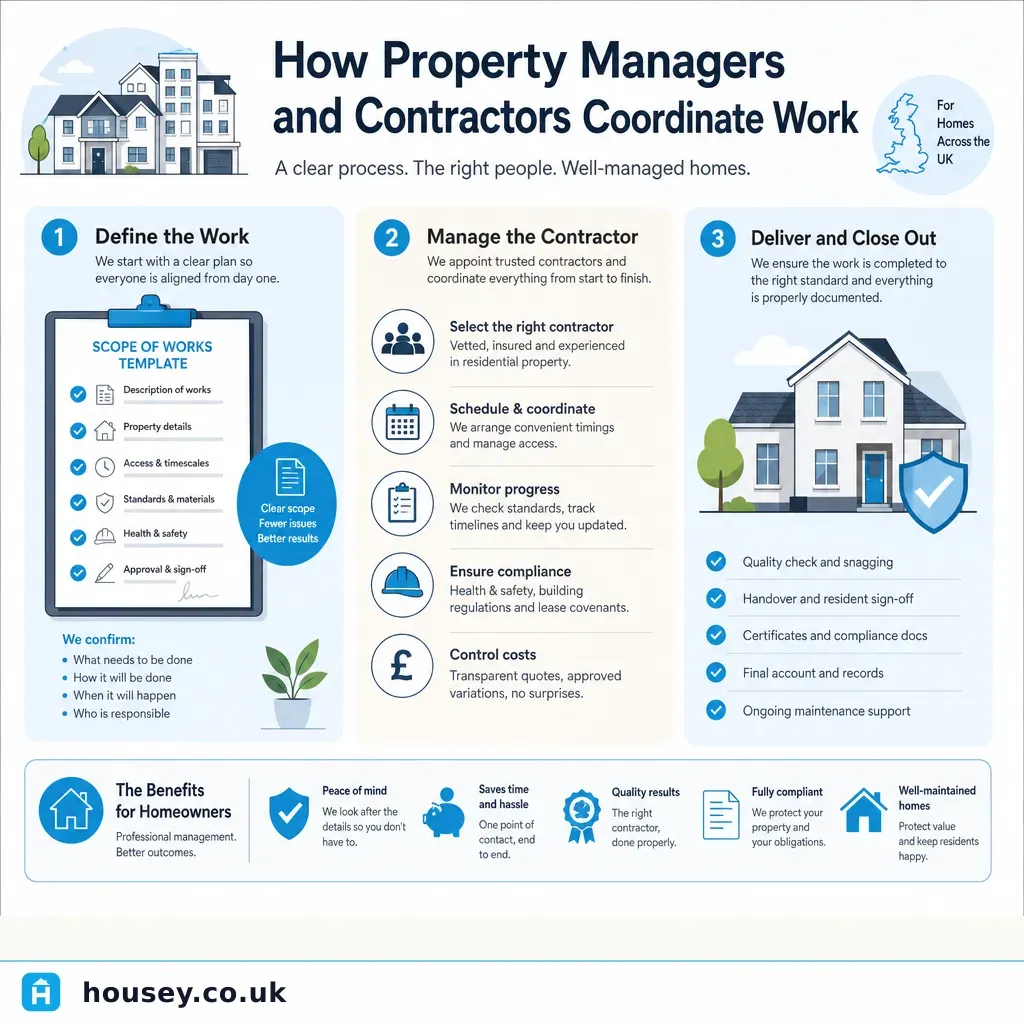
How Property Managers and Contractors Coordinate Work
Property managers coordinate contractors by scoping work clearly, selecting vetted and insured tradespeople, managing schedules and site access, checking progress against the brief, and handling sign-off and payment.
 Improvement & Build
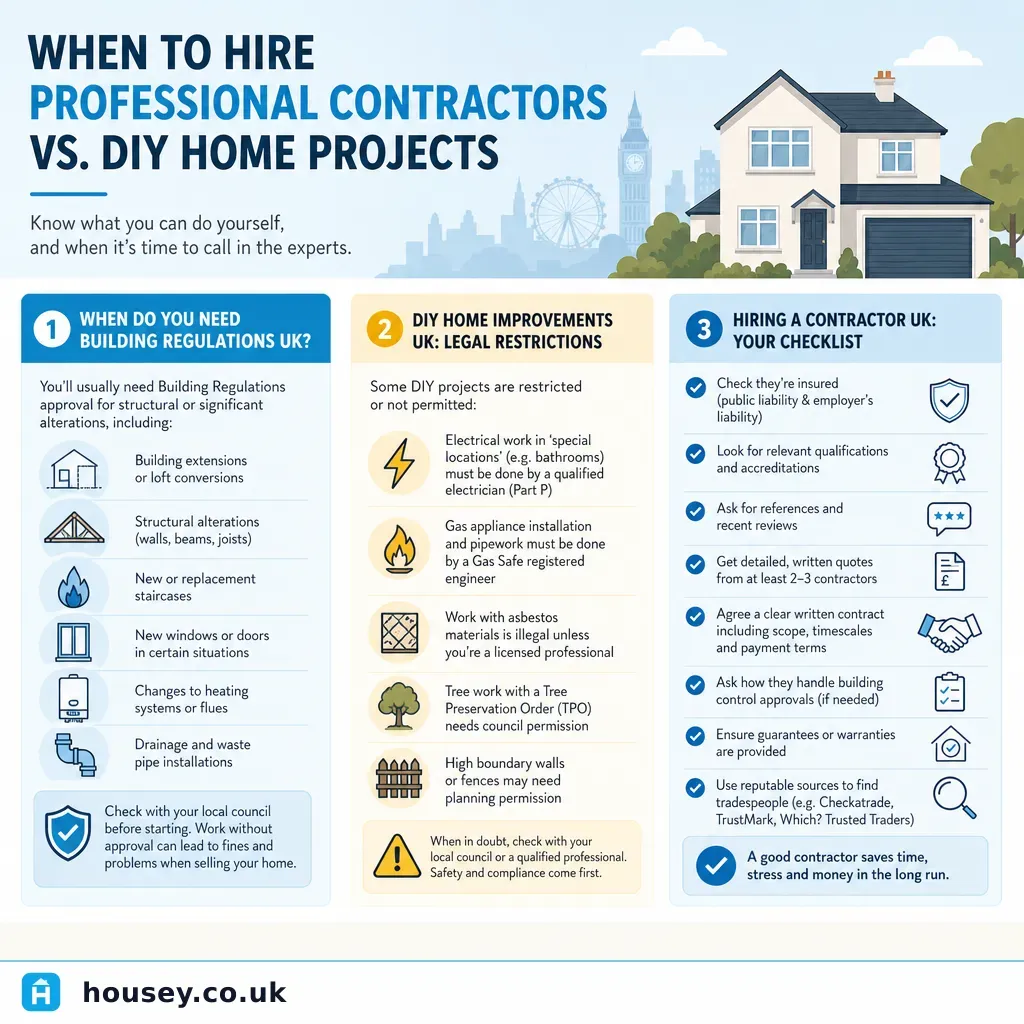
When to Hire Professional Contractors vs. DIY Home Projects
Some home improvement work — including gas fitting, consumer-unit electrical work, structural alterations, and asbestos removal — is legally restricted to qualified professionals in the UK.
 Improvement & Build
Garden Landscaping: Professional Transformation of Outdoor Spaces
Garden landscaping covers all physical works to reshape and improve an outdoor space, from earthworks and hard landscaping such as patios, paths, and walls, to planting, drainage, and lawn installation.
 Improvement & Build
Garden Design Services: What Designers Charge
UK garden designers typically charge £50–200+ per hour, or fixed fees from around £200 for an initial consultation to £3,000–5,000+ for a full design package on a medium garden.
 Improvement & Build
How to Find and Vet Professional Roofing Contractors
Professional roofing contractors should carry public liability insurance of at least £2m, provide a written workmanship guarantee, and hold accreditation from a recognised body such as the NFRC or the Competent Roofer scheme.